

A Meta-Analysis of the Impact of Problem Posing Strategies on Students’ Learning of Mathematics
Open accessThe DOI matches its Crossref record; 36 of the 38 references it cites were found in a registry or an index; 2 of the 21 sources its claims cite were checked for support.
Abstract
This is a review of experimental research in which students have been taught to pose mathematical problems as a means of developing their learning. Hence, the aim of the research is to combine the empirical evidence regarding the functionality of problem posing strategies and to explore the aspects which could influence the integration of problem posing in mathematical education. In this direction, a meta-analysis approach was utilized in this study. 20 experimental research published between years of 2000 and 2020 are contained in this research and 31 effect sizes were computed. According to random effects model, it was found that problem posing strategy has significant impact on learners’ problem-solving skills, mathematics achievement, level of problems posed, and attitudes towards mathematics (ES = 1.328; 1.142; 1.152; 0.643; p=0.05). These effects also were analyzed according to methodological and instructional variables. The findings obtained in the research was discussed in the light of the literature and suggestions were made for the future studies.
Overview
CoChat Summary
TL;DR
This meta-analysis of 20 experimental studies (31 effect sizes) found that problem posing-based mathematics teaching had positive effects on students’ mathematical learning outcomes. Effects were high for problem-solving skills, problem-posing ability, and mathematics achievement, and moderate for attitudes/beliefs.
Key findings
- Across 20 studies with 2,349 students (1,091 experimental, 1,258 control), random-effects mean effect sizes were 1.328 for skill-based outcomes, 1.152 for ability-based outcomes, 1.142 for knowledge-based outcomes, and 0.643 for attitude-belief outcomes (all p<0.05).
- Using Cohen’s classification, attitude effects were moderate, while ability-based, knowledge-based, and skill-based effects were high.
- Moderator analyses found study type moderated ability-based outcomes (Qb=50.028, p<0.05) and attitude outcomes (Qb=4.534, p<0.05); study method and sample group moderated skill-based outcomes (Qb=27.509, p<0.05 for both); duration moderated knowledge (Qb=12.450, p<0.05) and skill-based outcomes (Qb=29.998, p<0.05); learning area moderated skill-based outcomes (Qb=26.043, p<0.05).
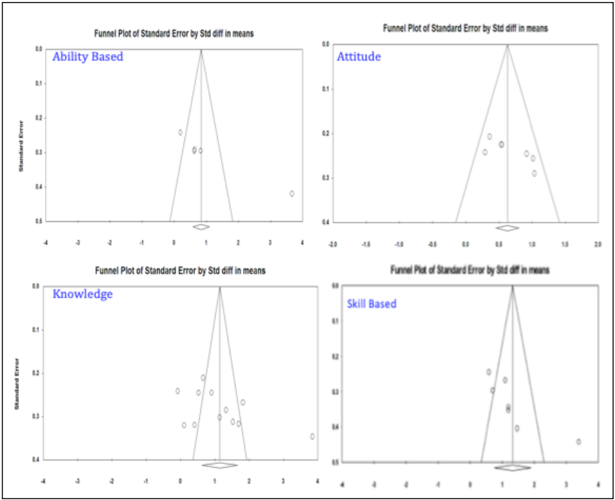
- Publication bias checks—funnel plot, Duval Tweedie Trim and Fill, and classic fail-safe N—indicated no publication bias; the fail-safe N required 68 ability-based, 87 attitude, 557 knowledge, and 185 skill-based contrary studies to invalidate the results.
Methods
- Meta-analysis of experimental research published between 2000 and 2020; databases searched were Web of Science, National Thesis Center, ProQuest Dissertations & Theses Global, ERIC, and Google Scholar; 339 studies were found and 20 met inclusion criteria, producing 31 effect sizes.
- Outcomes were coded as ability-based, attitude-belief, knowledge-based, and skill-based; effect sizes used Cohen’s d, and a random-effects model was applied because heterogeneity was high; analyses used CMA software.
- Moderator variables were methodological (study type, study method, sample group, measurement tool) and instructional (learning area, problem type, preparation for problem posing, duration); Qb values tested moderator differences; publication bias was assessed with funnel plot, Duval Tweedie Trim and Fill, and classic fail-safe N.
Limitations
- The paper states that it only brings together experimental studies related to problem posing; it recommends future experimental studies with larger sampling groups and relational meta-analyses examining correlations between problem posing and mathematical learning outcomes.
- Evident from the text: heterogeneity was high (e.g., knowledge Q=123.665, p<0.05), and the number of effect sizes per outcome was small (ability k=5, attitude k=7, knowledge k=12, skill k=7), with some moderator categories containing only 1–2 studies, so moderator findings should be interpreted cautiously.
Model-written summary. Check it against the paper before relying on it.
Integrity signals
Registry
Cites
Statistics
Figures
Verification
Claims the paper makes
1 Valid · 1 Not valid · 16 Not checked · 43 Own results and interpretations
At least one cited source doesn’t support this claim or points to a different paper, and none confirmed it — see the verdicts below.
In the paper
“In this regard, only two meta-analysis studies found in the literature directly address and measure the effectiveness of problem-posing.”
§ A Meta-Analysis of the Impact of Problem Posing Strategies on Students' Learning of Mathematics > 1. Introduction
What the sources say
- Not matchedcites Cantürk-Günhan, Geçici and Günkaya (2019)
An author–year citation the paper’s reference list doesn’t settle. We don’t search these by name.
- Disputedcites Rosli, Capraro and Capraro (2014) matched to “The Effects of Problem Posing on Student Mathematical Learning: A Meta-Analysis” (2014) sourceExperimental — accuracy not yet measured
Section 3 'The Need for a Meta-Analytic Review' states the opposite of the attributed count: 'To date, there is only one review of the literature available providing an overview of published articles on problem posing' (Silver, 1994 — a narrative review, not an effectiveness meta-analysis), and that 'It is the first meta-analytic review on this topic.' Our copy nowhere reports two meta-analyses directly measuring problem-posing effectiveness; the closest supporting material is the search yield in Section 4.2 (3,730 works → 167 screened → 14 eligible individual studies) and the limitation note in Section 6 that few quantitative studies existed. So the source contradicts, rather than supports, the 'only two meta-analysis studies' figure. (LLM, conf=0.75)
Checked by a reasoning model — may be wrong.
plain- Asserted: passes — The authors put it forward as true.
- Checkable: passes — It can be checked against evidence.
- Load-bearing: passes — The paper’s conclusions depend on it.
- Based: passes — The paper gives a reason why it holds.
- Not matched
Every source the paper cites for this claim was checked and supports it.
In the paper
“However, Rosli, Capraro and Capraro (2014) identified significant differences for educational stage and publication type for mathematical success as a result of methodological moderator variables.”
§ A Meta-Analysis of the Impact of Problem Posing Strategies on Students' Learning of Mathematics > 4. Discussion
What the sources say
- Supportedcites Rosli, Capraro and Capraro (2014) matched to “The Effects of Problem Posing on Student Mathematical Learning: A Meta-Analysis” (2014) source
Section 5.4.1 (Knowledge-Based) states that 'educational settings and publication sources had different effects statistically (p < .001)', and Table 4/Table 5 give Qbetween p < .001 for both moderators; Section 5.4.2 (Skill-Based) says effectiveness 'were dependent on educational setting, publication source, and presentation type', and 5.4.3 (Ability-Based) reports all hypothesized moderators significant at p < .001. The claim's 'educational stage' and 'publication type' map onto the paper's 'educational setting' and 'publication source' moderators (Section 4.6), and 'mathematical success' onto its learning outcomes, with knowledge-based called 'the broadest measure of student success' (Discussion, p. 6). Only caveat: the Discussion (p. 6) loosely says the three outcomes 'perform equally across the moderators', which sits awkwardly with the significant Qbetween results the claim rests on, but the reported moderator analyses support it. (LLM, conf=0.85)
plainstates a cause- Asserted: passes — The authors put it forward as true.
- Checkable: passes — It can be checked against evidence.
- Load-bearing: unclear — It is unclear whether the paper’s conclusions depend on it.
- Based: passes — The paper gives a reason why it holds.
- Supported
A result the paper reports from its own data — it cites no other source for it, so there is none to check. The quote shows it is in the paper.
In the paper
“As a result, it appears study type, method, sample group and scale tool did not have moderator roles for knowledge outcomes [Qb = 0.926, p > 0.05; Qb = 3.575, p > 0.05; Qb = 3.815, p > 0.05; Qb = 0.113, p > 0.05].”
§ A Meta-Analysis of the Impact of Problem Posing Strategies on Students' Learning of Mathematics > 3.2. Effect Sizes related to Moderator Variables
hedged- Asserted: passes — The authors put it forward as true.
- Checkable: passes — It can be checked against evidence.
- Load-bearing: passes — The paper’s conclusions depend on it.
- Based: passes — The paper gives a reason why it holds.
A result the paper reports from its own data — it cites no other source for it, so there is none to check. The quote shows it is in the paper.
In the paper
“Another result of this research is that methodological moderator analysis showed some methodological characteristics had significant differences for mathematics achievement.”
§ A Meta-Analysis of the Impact of Problem Posing Strategies on Students' Learning of Mathematics > 4. Discussion
plainstates an association- Asserted: passes — The authors put it forward as true.
- Checkable: passes — It can be checked against evidence.
- Load-bearing: passes — The paper’s conclusions depend on it.
- Based: passes — The paper gives a reason why it holds.
A result the paper reports from its own data — it cites no other source for it, so there is none to check. The quote shows it is in the paper.
In the paper
“Similarly, the duration spent on problem-generation activities changes the effect size for skill-based outcomes [Qb = 29.998,p <”
§ A Meta-Analysis of the Impact of Problem Posing Strategies on Students' Learning of Mathematics > 3.2. Effect Sizes related to Moderator Variables
plainstates a cause- Asserted: passes — The authors put it forward as true.
- Checkable: passes — It can be checked against evidence.
- Load-bearing: passes — The paper’s conclusions depend on it.
- Based: passes — The paper gives a reason why it holds.
37 more claims
Create a free account to see all 61 claims and to verify the 11 references still open.
- It may state two separate claims as one. 15
- Probably not a substantial claim. 6
Claims other papers make about this one
Each is checked against this paper’s own text: does it say what the citing paper says it does?
The source backs part of the claim, not all of it — or backs it for a different population, condition or comparison.
In the citing paper
“While these reviews occasionally ventured into a few studies examining the effect of engaging in problem posing activities on the development of problem posing, their primary focus remained on demonstrating the merit of problem posing as a tool on a broad-based impact for learning mathematics as opposed to examining problem posing as a goal.”
From Enhancing mathematical problem posing competence: a meta-analysis of intervention studies (2024) · cites this paper as Kul & Çelik, 2020
Experimental — accuracy not yet measured
Self-check
Percentages, sums and reported differences re-computed from the paper’s own numbers.
Rated minor: it would not touch a result — a value no result rests on, a p-value that stays on the same side of the significance level, or a conflict that is clerical, resolved elsewhere in the paper, or outside its own findings.
In the paper
“| | Numbers | | 6 1.364 0.515 0.857 | 1.403 | 7.623 0.10 | | | |”
§ A Meta-Analysis of the Impact of Problem Posing Strategies on Students' Learning of Mathematics > 4. Discussion
Reported 1.364 · recomputed 1.13
Rated minor: it would not touch a result — a value no result rests on, a p-value that stays on the same side of the significance level, or a conflict that is clerical, resolved elsewhere in the paper, or outside its own findings.
In the paper
“| | Not Stated | | 1 1.694 0.515 0.354 | 0.273 | | | | |”
§ A Meta-Analysis of the Impact of Problem Posing Strategies on Students' Learning of Mathematics > 4. Discussion
Reported 1.694 · recomputed 0.3135
Rated minor: it would not touch a result — a value no result rests on, a p-value that stays on the same side of the significance level, or a conflict that is clerical, resolved elsewhere in the paper, or outside its own findings.
In the paper
“| 16-20 hours | 4 0.863 0.141 0.795 | 1.838 | | | | |”
§ A Meta-Analysis of the Impact of Problem Posing Strategies on Students' Learning of Mathematics > 4. Discussion
Reported 0.863 · recomputed 1.3165
Citations
Cites
Statistical Power Analysis for the Behavioral Sciences
Muller, K. (1989) · Technometrics · doi:10.1080/00401706.1989.10488618 · Cited by 99,167
The Handbook of Research Synthesis and Meta-Analysis
(2019) · doi:10.7758/9781610448864 · Cited by 4,553 · cited 1×
“This value shows high levels of heterogeneity in the study (Cooper et al., 2009).”
BackgroundHow to Solve It. A New Aspect of Mathematical Method.
Bell, E. T., & Polya, G. (1945) · The American Mathematical Monthly · doi:10.2307/2306109 · Cited by 1,806
Research Synthesis and Meta-Analysis: A Step-by-Step Approach
Cooper, H. (2017) · doi:10.4135/9781071878644 · Cited by 1,716
Teaching Students to Generate Questions: A Review of the Intervention Studies
Rosenshine, B., Meister, C., & Chapman, S. (1996) · Review of Educational Research · doi:10.2307/1170607 · Cited by 888
Student-generated questions: A meaningful aspect of learning in science
Chin, C., & Brown, D. E. (2002) · International Journal of Science Education · doi:10.1080/09500690110095249 · Cited by 384
Problem-Posing Research in Mathematics Education: Some Answered and Unanswered Questions
Cai, J., Hwang, S., Jiang, C., & Silber, S. (2015) · Springer eBooks · doi:10.1007/978-1-4614-6258-3_1 · Cited by 315
The Development of Fifth-Grade Children's Problem-Posing Abilities
English, L. D. (1997) · Educational Studies in Mathematics · doi:10.1023/a:1002963618035 · Cited by 178
Experiments and Relational Studies in Problem Solving: A Meta-Analysis
Hembree, R. (1992) · Journal for Research in Mathematics Education · doi:10.2307/749120 · Cited by 171
Developing pre-service teachers understanding of fractions through problem posing
Toluk-Uçar, Z. (2009) · Teaching and Teacher Education · doi:10.1016/j.tate.2008.08.003 · Cited by 168
Research works printed but not linked: 7
- 2098 · DOI
- Çoğaltay, N., Karadağ, E., & Öztekin, Ö. (2014). The effect of school principals' transformational leadership behaviors on teachers' organizational commitment: a meta analysis study. educational administration: Theory and Practice, 20(4), 483-500. https://doi.org/10.14527/kuey.2014.019 · DOI
- El Sayed, R. A. E. (2002). Effectiveness of problem posing strategies on prospective mathematics teachers' problem solving performance. Journal of Science and Mathematics Education in Southeast Asia, 25(1), 56-69. https://inst.eecs.berkeley.edu/~cs375/fa18/resources /Oman- problemssolving.pdf
- Kaya, D. R. (2016). Problem solving based learning in math educatiȯn: Meta -analysis study [Unpublished master's thesis]. Recep Tayyip Erdoğan University, Rize.
- Lavy, I., & Shriki, A. (2007). Problem posing as a means for developing mathematical knowledge of prospective teachers. In Proceedings of the 31st Conference of the International Group for the Psychology of Mathematics Education, 3, 129-136. PME.
- Silver, E. A. (1994). On mathematical problem posing. For the Learning of Mathematics, 14(1), 19-28. https://doi.org/10.2307/749366 · DOI
- Stoyanova, E., & Ellerton, N. F. (1996). A framework for research into students' problem posing. In P. Clarkson (Ed.), Technology in mathematics education (pp. 518-525). Mathematics Education Research Group of Australasia.
Cited by
Meaningful Learning in Mathematics: A Research Synthesis of Teaching Approaches
Koskinen, R., & Pitkäniemi, H. (2022) · International Electronic Journal of Mathematics Education · doi:10.29333/iejme/11715 · Cited by 170
Bognar, B., Horvat, S. M., & Matić, L. J. (2025) · Education Sciences · doi:10.3390/educsci15010076 · Cited by 74
Wang, M., Walkington, C., & Rouse, A. (2022) · Investigations in Mathematics Learning · doi:10.1080/19477503.2022.2105104 · Cited by 55
Enhancing mathematical problem posing competence: a meta-analysis of intervention studies
Zhang, L., Stylianides, G. J., & Stylianides, A. J. (2024) · International Journal of STEM Education · doi:10.1186/s40594-024-00507-1 · Cited by 51
Zhang, C., Zhou, Y., Wijaya, T. T., Chen, J., & Ning, Y. (2024) · Thinking Skills and Creativity · doi:10.1016/j.tsc.2024.101587 · Cited by 37
Zhang, L., Stylianides, A. J., & Stylianides, G. J. (2025) · International Journal of Science and Mathematics Education · doi:10.1007/s10763-025-10542-1 · Cited by 17
Aisyah, S. A., & Usdiyana, D. (2022) · Journal of Physics Conference Series · doi:10.1088/1742-6596/2157/1/012036 · Cited by 15
Ran, H., Cai, J., Hwang, S., Han, J., Ma, Y., & Muirhead, F. (2025) · Journal for Research in Mathematics Education · doi:10.5951/jresematheduc-2024-0105 · Cited by 10
Yu, F., & Kuo, C. (2022) · Journal of Research on Technology in Education · doi:10.1080/15391523.2022.2119448 · Cited by 11
Pedagogical approach of grade 7 teachers in teaching the learning competency of integers
Acosta, C. P., & Soliba, B. L. (2024) · Educational Technology Quarterly · doi:10.55056/etq.652 · Cited by 8
Kolomiiets, A., Klochko, V., Stakhova, O., Клочко, О., Петрук, В., & Kovalchuk, M. (2023) · Revista Romaneasca pentru Educatie Multidimensionala · doi:10.18662/rrem/15.1/696 · Cited by 6
Mathematical Problem-Posing Research: Revisiting Some Answered and Unanswered Questions
Ölmez, İ. B., Han, J., Hwang, S., & Cai, J. (2025) · Avances de Investigación en Educación Matemática · doi:10.35763/aiem28.8124 · Cited by 4
Middle School Students Generating Mathematical Problems from a Real-life Situation
Coffland, D. A., & Xie, Y. (2022) · Journal of Humanistic Mathematics · doi:10.5642/jhummath.202201.06 · Cited by 3
Didactical Design with Problem Posing to Overcome Epistemological Obstacles in Problem Solving
Eka, F., Sugiatno, S., Munaldus, M., Hamdani, H., & Sayu, S. (2023) · Jurnal Didaktik Matematika · doi:10.24815/jdm.v10i2.33086 · Cited by 3
Yu, F. (2024) · Interactive Learning Environments · doi:10.1080/10494820.2024.2327040 · Cited by 3
Yu, F.-Y., & Chen, H.-C. (2024) · Journal of Research on Technology in Education · doi:10.1080/15391523.2024.2437747 · Cited by 4
Khan Academy Platform for Mathematics Teaching and Learning
Ruíz, F. A. Z., Lovatón, R. M., Rivera, W. F. R., Mayhua, J. A. C., & Dávila, V. L. A. (2024) · Evolutionary Studies in Imaginative Culture · doi:10.70082/esiculture.vi.900 · Cited by 2
Reviewing the Current State of Knowledge in Mathematical Problem-Posing Research
Ölmez, İ. B., Hwang, S., Han, J., & Cai, J. (2026) · Research in mathematics education · doi:10.1007/978-3-032-05493-7_8 · Cited by 3
Citing as an online learning support tool for student-generated assessment
Yu, F., & Wei, J.-K. (2024) · Technology Pedagogy and Education · doi:10.1080/1475939x.2024.2304858 · Cited by 2
Duyuşsal Bileşenler Açısından Problem Kurmaya Yönelik SSCI İndeksli Çalışmaların İncelenmesi esi
CANTİMER, G. G., & Şengül, S. (2023) · International Journal of Educational Studies in Mathematics · doi:10.17278/ijesim.1267361
Amiripour, P., & Moayeri, M. (2023) · Quarterly Journal of Managing Education In Organizations · doi:10.61186/meo.12.4.95
Xie, Y., & Coffland, D. A. (2022) · International Journal for Technology in Mathematics Education · doi:10.1564/tme_v29.2.01
Pama, K. E. (2025) · International Journal of Multidisciplinary Educational Research and Innovation · doi:10.64637/633141
Pama, K. E. (2025) · International Journal of Multidisciplinary Educational Research and Innovation · doi:10.64637/633139
Conhecimentos e Práticas de Formulação de Problemas Por Professores De 1.º Ciclo
Miranda, P., & Mamede, E. (2025) · PNA · doi:10.30827/pna.v20i1.31082
The Power of a Five-Finger Problem-Posing Strategy in the Mathematics Classroom
Stoyanova, E. (2026) · Research in mathematics education · doi:10.1007/978-3-032-05493-7_28
Tesfaw, B. K., Ayele, M. A., & Ahmed, A. M. (2026) · Discover Education · doi:10.1007/s44217-026-01368-2 · Cited by 2
Sabri, Asyari, S., & Natsir, R. A. (2026) · Pedagogy Jurnal Pendidikan Matematika · doi:10.30605/g81efk25
Ersoy, M., & Dağyar, M. (2026) · Eurasia Journal of Mathematics Science and Technology Education · doi:10.29333/ejmste/18740
Balacuit, I. C. P., & Oledan, A. M. B. (2026) · Journal of Education and Learning (EduLearn) · doi:10.11591/edulearn.v20i3.24410
Examining AI interaction profiles in generative AI supported fraction division problem posing
İncikabı, S. (2026) · Frontiers in Psychology · doi:10.3389/fpsyg.2026.1946583
Metadata
- Authors
- KUL, Ü., & ÇELİK, S.
- Affiliations
- Artvin Coruh University (TR)
- ORCID
- KUL, Ümit
- Venue
- Revista Romaneasca pentru Educatie Multidimensionala
- Publisher
- Asociatia LUMEN
- Published
- 2020-09-21
- Volume
- 12
- Issue
- 3
- Pages
- 341-368
- ISSN
- 2066-7329 (ISSN-L)
- 2067-9270
- OpenAlex
- W3092570935
- Cited by
- 31
- References
- 38
- Citations by year
- 2026: 7 · 2025: 7 · 2024: 7 · 2023: 4 · 2022: 6
- FWCI
- 0.58
- Type
- journal article
- Language
- en
- Open access
- diamond
- doi.org
- Licence
- cc-by-nc-nd
- Locations
- Revista Romaneasca pentru Educatie Multidimensionala (publishedVersion, cc-by-nc-nd)
- RePEc: Research Papers in Economics (submittedVersion)
- Topics
- Social Sciences › Education › Mathematics Education and Pedagogy
- Social Sciences › Education › Mathematics Education and Teaching Techniques
- Social Sciences › Education › Problem and Project Based Learning
- Keywords
- problem posing, mathematical problem posing, mathematics learning, mathematical problem solving ability, mathematics achievement, attitudes towards mathematics, mathematics education
About these checks
Registry, retraction, Cites and statistics results are computed, not judged, with one exception: a printed reference that no index lists is read once by a model before it counts as a citation error. Claims are extracted by a model and kept only when their quote appears verbatim in the text; each cited source is then checked, with a model’s help, for whether it says what the claim relies on. Those verdicts can be wrong — read the claim’s quote and the cited source before relying on one.
The claim verdicts this report counts are experimental: their accuracy is not yet measured.
A language model drew the claims from the paper on 2026-11-15, under version 3 of the claim definition (model deepseek-v4.1-flash, prompt extract-v3).
A second model labelled each claim on 2026-11-15 (model jev-1.13-20260917, definition revision gold-guideline-v0.2).
Cited sources are checked with a language model’s help (qwen3.8-omni-flash).
Statistics and arithmetic are recomputed, not judged.
Confidence bands are shown only for fields calibrated on our annotated test set. None is calibrated yet, so no band is shown.
What counts as a claim ›How we measure confidence ›How we check this ›
Are you an author, or do you see a problem with this page? Request a review
Data sources
Bibliographic data: Semantic Scholar, OpenAlex, Crossref.
Contains information from the Semantic Scholar Academic Graph Datasets, made available under the ODC Attribution License (ODC-BY 1.0).
Semantic Scholar’s data is described in: Kinney, R., et al. (2023). The Semantic Scholar Open Data Platform. arXiv:2301.10140.
