

Urinary Elimination of Ecdysterone and its Metabolites following a Single-Dose Administration in Humans
Open accessPreprint — published as 10.3390/metabo11060366 · Paper page
The DOI matches its Crossref record; 41 of the 41 references it cites were found in a registry or an index; 2 of the 24 sources its claims cite were checked for support.
Abstract
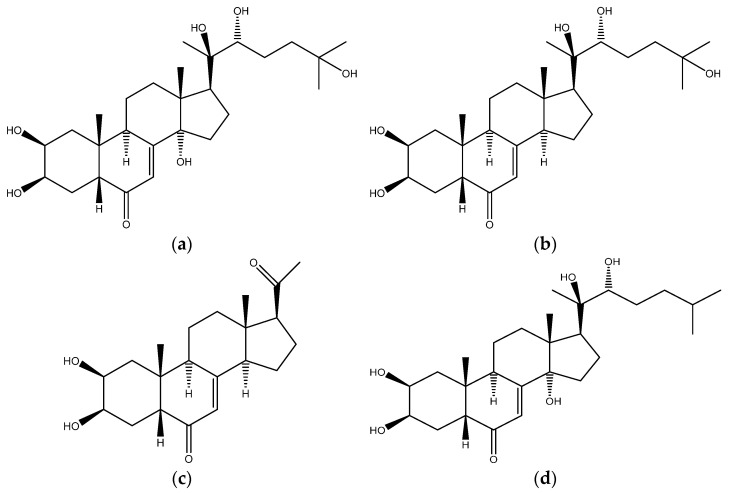
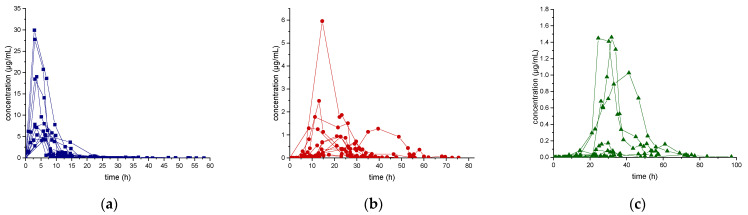
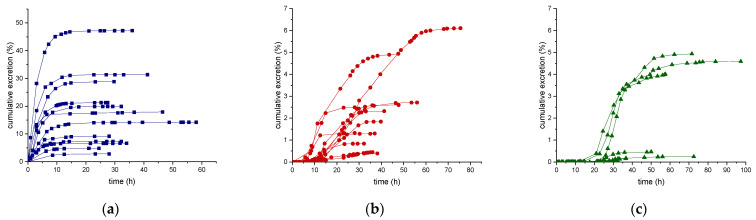
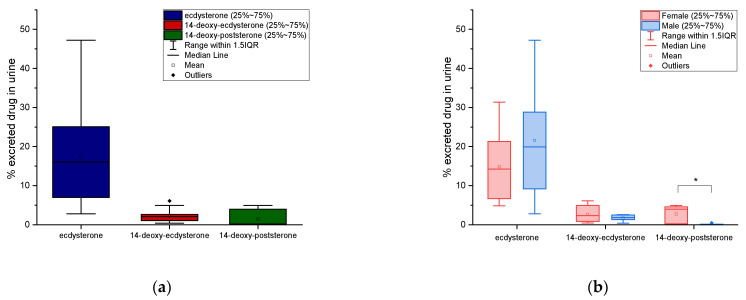
Ecdysterone is a phytosteroid widely discussed for its various pharmacological, growth-promoting and anabolic effects mediated by activation of estrogen receptor beta (ERbeta). Performance-enhancement in sports was demonstrated recently, and ecdysterone was consequently included in the Monitoring Program to detect potential patterns of misuse in sport. Only few studies on the pharmacokinetics of ecdysterone in humans have been reported so far. In this study, post-administration urines in twelve volunteers (single dose of 50 mg of ecdysterone) were analyzed using dilute-and-inject liquid chromatography-tandem mass spectrometry. Identification and quantitation of ecdysterone and of two metabolites, 14-deoxy ecdysterone and 14-deoxy poststerone was achieved. Ecdysterone was the most abundant analyte present in post-administration urines, detected for more than 2 days with a maximum concentration (Cmax) in the 2.8-8.5 h urines (Cmax = 4.4-30.0 µg/mL). The metabolites 14-deoxy ecdysterone and 14-deoxy poststerone were detected later reaching the maximum concentrations at 8.5-39.5 h (Cmax = 0.1-6.0 µg/mL) and 23.3-41.3 h (Cmax = 0.1-1.5 µg/mL), respectively. Cumulative urinary excretion yielded average values of 18%, 2.3% and 1.5% for ecdysterone, 14-deoxy ecdysterone and 14-deoxy poststerone, respectively. Ecdysterone and 14-deoxy ecdysterone were excreted following first order kinetics with half-lives calculated with three hours, while pharmacokinetics of 14-deoxy poststerone needs further evaluation.
Overview
CoChat Summary
TL;DR
In twelve healthy volunteers, a single 50 mg oral dose of pure ecdysterone produced urinary ecdysterone as the most abundant analyte, detectable for more than 2 days, plus two metabolites, 14-deoxy-ecdysterone and 14-deoxy-poststerone, with later detection windows. Cumulative urinary recovery averaged 18%, 2.3%, and 1.5% of the dose, respectively, and ecdysterone/14-deoxy-ecdysterone half-lives were about 3 h.
Key findings
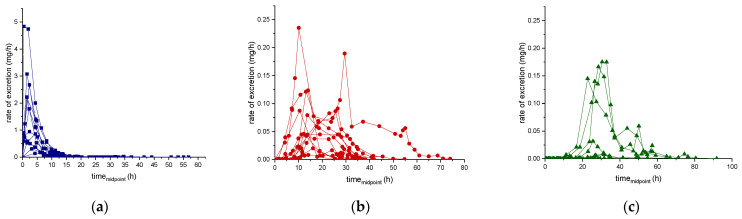
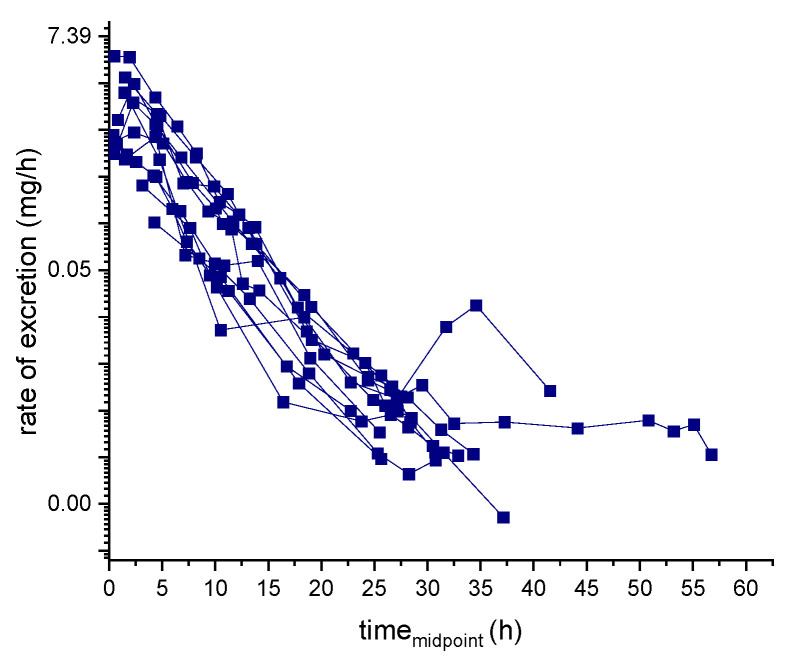
- Ecdysterone was detected in all subjects, with maximum concentration in the 2.8–8.5 h urine at 4.4–30.0 µg/mL; it appeared after 45 min and remained detectable for more than 2 days (58 h), with maximum excretion rate 0.1–4.8 mg/h in the 0.4–4.4 h urine.
- 14-Deoxy-ecdysterone was detected in all 12 subjects, with maximum concentration in the 8.5–39.5 h urine at 0.1–6.0 µg/mL and detection for about 3 days (75 h); 14-deoxy-poststerone was detected in 10 of 12 subjects, with maximum concentration in the 23.3–41.3 h urine at 0.1–1.5 µg/mL and detection from 8.50 to 97 h.
- Mean cumulative urinary excretion was 18% ± 13% for ecdysterone, 2.3% ± 1.74% for 14-deoxy-ecdysterone, and 1.5% ± 2.1% for 14-deoxy-poststerone; total recovery of parent drug plus metabolites was up to 50.3% (mean 21.1%, n = 12).
- Half-lives were about 3 h for ecdysterone (3.4 and 3.0 h by rate-of-excretion and sigma-minus methods) and 14-deoxy-ecdysterone (3.1 and 2.2 h); 14-deoxy-poststerone gave 9.7 ± 9.5 h versus 4.4 ± 1.0 h. No significant sex differences were found for ecdysterone and 14-deoxy-ecdysterone, while a significant difference (p ≤ 0.05) was reported for 14-deoxy-poststerone.
Methods
- Single-dose administration study in 12 healthy subjects (7 females and 5 males; mean age 26 ± 3.1 y, weight 74 ± 12.0 kg, height 174 ± 8.3 cm); 50 mg of pure ecdysterone dissolved in alcoholic solution was administered at 9:00 a.m., and urine was collected one day before and five days after administration.
- Urine samples were analyzed by dilute-and-inject LC–MS/MS with positive electrospray ionization and multiple reaction monitoring; the method was validated according to EMA and ICH M10 guidelines for ecdysterone and 14-deoxy-ecdysterone, including selectivity, linearity, LOD/LOQ, accuracy and precision, matrix effect, stability, and carryover.
- Excretion profiles, cumulative urinary amounts, and half-lives were calculated using the rate-of-excretion and sigma-minus methods; data acquisition and analysis used MassHunter Quant software, with Origin Pro 9.1 for visualization and statistical treatment.
Limitations
- Stated: the analytical method was fully validated only for ecdysterone and 14-deoxy-ecdysterone; no full validation was performed for 14-deoxy-poststerone, and no investigation of phase II metabolite excretion was carried out.
- Stated: 14-deoxy-poststerone was detected in only 10 of 12 subjects and an excretion profile curve could be obtained for only 5 volunteers; high inter-individual variability was observed, the half-life of 14-deoxy-poststerone needs further evaluation, and up to 50.3% of the dose was recovered in urine, with the remainder possibly unabsorbed or excreted by other pathways or as undetected metabolites.
- Evident from the text: the study has a small sample (n = 12), uses a single dose, and describes no placebo or control group; the abstract states that sex-specific differences were not observed, whereas the results and discussion report a significant sex difference (p ≤ 0.05) for 14-deoxy-poststerone.
Model-written summary. Check it against the paper before relying on it.
Integrity signals
Registry
Cites
Statistics
Figures
Verification
Claims the paper makes
2 Valid · 1 Not valid · 12 Not checked · 74 Own results and interpretations
The cited sources support only part of this claim — read each source’s verdict below.
In the paper
“This decision has been based mainly on the results of a controlled administration trial in humans, which demonstrated its performance-enhancing effects in power training [29].”
§ Urinary Elimination of Ecdysterone and Its Metabolites Following a Single-Dose Administration in Humans > 1. Introduction
What the sources say
- Partly supportedcites [29] Isenmann E. Ambrosio G. Joseph J.F. Mazzarino M. de la Torre X. Zimmer P. Kazlauskas R. Goebel C. Botre F. Diel P. Ecdysteroids as non-conventional anabolic agent: Performance enhancement by ecdysterone supplementation in humans Arch. Toxicol. 2019 93 1807 1816 10.1007/s00204-019-02490-x 31123801 sourceExperimental — accuracy not yet measured
The Abstract (page unavailable) describes a 10-week strength-training study in young men and reports greater gains in muscle mass and bench-press performance with ecdysterone. It recommends inclusion on the prohibited list, but our copy does not say WADA made a decision or that this trial was the main basis for one. (LLM, conf=0.84)
boostedstates a cause- Asserted: passes — The authors put it forward as true.
- Checkable: passes — It can be checked against evidence.
- Load-bearing: unclear — It is unclear whether the paper’s conclusions depend on it.
- Based: passes — The paper gives a reason why it holds.
- Partly supported
In the paper
“The LOQ was determined based on the lowest concentration in which the % error of accuracy was within ±–20% and coefficient of variation (CV) ≤ 20% [37], and corresponded to 1 ng/mL for both ecdysterone and 14-deoxyecdysterone.”
§ Urinary Elimination of Ecdysterone and Its Metabolites Following a Single-Dose Administration in Humans > 2. Results > 2.1. Validation of the Analytical Methodology
What the sources say
- Not matchedcites [37] International Council for Harmonisation of Technical Requirements for Pharmaceuticals for Human Use Draft Version. M10: Bioanalytical Method Validation ICH Geneva, Switzerland 2019
Its entry has no title and year that we can search by.
plain- Asserted: passes — The authors put it forward as true.
- Checkable: passes — It can be checked against evidence.
- Load-bearing: unclear — It is unclear whether the paper’s conclusions depend on it.
- Based: passes — The paper gives a reason why it holds.
- Not matched
A result the paper reports from its own data — it cites no other source for it, so there is none to check. The quote shows it is in the paper.
In the paper
“Its maximum concentration was detected in the 2.8–8.5 h urine, ranging from 4.4–30.0 µg/mL.”
§ Urinary Elimination of Ecdysterone and Its Metabolites Following a Single-Dose Administration in Humans > 2. Results > 2.2. Post-Administration Urine Analysis and Evaluation of the Urinary Excretion Profiles of Ecdysterone and Its Metabolites
plain- Asserted: passes — The authors put it forward as true.
- Checkable: passes — It can be checked against evidence.
- Load-bearing: unclear — It is unclear whether the paper’s conclusions depend on it.
- Based: passes — The paper gives a reason why it holds.
- Rests on an assumption not shown here.
A result the paper reports from its own data — it cites no other source for it, so there is none to check. The quote shows it is in the paper.
In the paper
“The maximum excretion rate was determined in the 10.1–29.5 h urine, ranging from 0.02–0.24 mg/h.”
§ Urinary Elimination of Ecdysterone and Its Metabolites Following a Single-Dose Administration in Humans > 2. Results > 2.2. Post-Administration Urine Analysis and Evaluation of the Urinary Excretion Profiles of Ecdysterone and Its Metabolites
plain- Asserted: passes — The authors put it forward as true.
- Checkable: passes — It can be checked against evidence.
- Load-bearing: unclear — It is unclear whether the paper’s conclusions depend on it.
- Based: passes — The paper gives a reason why it holds.
- Rests on an assumption not shown here.
A result the paper reports from its own data — it cites no other source for it, so there is none to check. The quote shows it is in the paper.
In the paper
“The maximum concentration was detected in the 23.3–41.3 h urine, ranging from 0.1–1.5 µg/mL.”
§ Urinary Elimination of Ecdysterone and Its Metabolites Following a Single-Dose Administration in Humans > 2. Results > 2.2. Post-Administration Urine Analysis and Evaluation of the Urinary Excretion Profiles of Ecdysterone and Its Metabolites
plainn = 12- Asserted: passes — The authors put it forward as true.
- Checkable: passes — It can be checked against evidence.
- Load-bearing: unclear — It is unclear whether the paper’s conclusions depend on it.
- Based: passes — The paper gives a reason why it holds.
- Rests on 3 assumptions not shown here.
53 more claims
Create a free account to see all 89 claims and to verify the 2 references still open.
- It may state two separate claims as one. 21
- The quote only partly states this claim. 3
- Probably not a substantial claim. 11
Claims other papers make about this one
Each is checked against this paper’s own text: does it say what the citing paper says it does?
The cited source doesn’t support the claim as written.
In the citing paper
“only 1–3% of 20E and its metabolites are absorbed.”
From How reliable is the labeling of a commercial phytosteroid product? A 12-week randomized double-blind training study (2025) · cites this paper as [40]
Checked by a reasoning model — may be wrong.
Experimental — accuracy not yet measuredThe source backs part of the claim, not all of it — or backs it for a different population, condition or comparison.
In the citing paper
“administration of 50 mg of pure 20E resulted in approximately 50% recovery in urine”
From How reliable is the labeling of a commercial phytosteroid product? A 12-week randomized double-blind training study (2025) · cites this paper as [40]
Experimental — accuracy not yet measuredThe source backs part of the claim, not all of it — or backs it for a different population, condition or comparison.
In the citing paper
“The first urinary concentrations of ECDY were reported in 2021 by Ambrosio et al. and Kraiem et al., showing a dose-dependent maximum concentration between 0.5 and 1.3 μg/mL for administrations below 5 mg ECDY and between 3 and 30 μg/mL for 50 mg ECDY applications.6,7”
From Investigations into the human metabolism of ecdysterone. (2023) · cites this paper as [7]
Experimental — accuracy not yet measuredThe source backs part of the claim, not all of it — or backs it for a different population, condition or comparison.
In the citing paper
“These extremely different excretion patterns have not been described before”
From Investigations into the human metabolism of ecdysterone. (2023) · cites this paper as [7]
Experimental — accuracy not yet measuredThe source backs part of the claim, not all of it — or backs it for a different population, condition or comparison.
In the citing paper
“Interestingly, Ambrosio et al. also noted a significantly higher excretion of 14DP in female volunteers compared with males, which was not detectable for 14DE or ECDY.7”
From Investigations into the human metabolism of ecdysterone. (2023) · cites this paper as [7]
Experimental — accuracy not yet measured
6 more claims about this paper
Create a free account to see every claim other papers make about this one.
Self-check
Percentages, sums and reported differences re-computed from the paper’s own numbers.
Each contradiction between two passages listed here was confirmed by an independent check.
Rated major: it would touch a result — a value a result rests on, reported and recomputed p-values on opposite sides of the significance level, two passages that conflict with no sign which is right, or a cited work retracted before this paper was published.
In the paper
§ Urinary Elimination of Ecdysterone and Its Metabolites Following a Single-Dose Administration in Humans > 5. Conclusions
“The results obtained within this study showed that about 50% of the administered dose was recovered in urine (sum of ecdysterone and the two metabolites).”
§ Urinary Elimination of Ecdysterone and Its Metabolites Following a Single-Dose Administration in Humans > 3. Discussion
“In total, up to 50.3% (mean = 21.1%, n = 12) of the administered dose was recovered in urine (as a parent drug and metabolites).”
Rated major: it would touch a result — a value a result rests on, reported and recomputed p-values on opposite sides of the significance level, two passages that conflict with no sign which is right, or a cited work retracted before this paper was published.
In the paper
§ Urinary Elimination of Ecdysterone and Its Metabolites Following a Single-Dose Administration in Humans > Abstract
“Sex-specific differences were not observed.”
§ Urinary Elimination of Ecdysterone and Its Metabolites Following a Single-Dose Administration in Humans > 2. Results > 2.3. Evaluation of Urinary Pharmacokinetic Parameters—Cumulative Amount and Half-Life
“No significant differences between male and female (p ≤ 0.05) were observed for ecdysterone and 14-deoxy-ecdysterone, while significant differences (p ≤ 0.05) were observed for the metabolite 14-deoxy-poststerone.”
Citations
Cites
Phytoecdysteroids: Biological aspects
Dinan, L. (2001) · Phytochemistry · doi:10.1016/s0031-9422(01)00078-4 · Cited by 392 · cited 1×
“Moreover, growth-promoting and anabolic effects in animals and in humans have been reported [3-19].”
BackgroundRecent developments in the use and abuse of growth promoters
Courtheyn, D., Le Bizec, B., Brambilla, G., De Brabander, H. F., Cobbaert, E., Van de Wiele, M., Vercammen, J., & De Wasch, K. (2002) · Analytica Chimica Acta · doi:10.1016/s0003-2670(02)00753-5 · Cited by 256 · cited 1×
“Moreover, growth-promoting and anabolic effects in animals and in humans have been reported [3-19].”
BackgroundPhytoecdysteroids and Anabolic Androgenic Steroids--Structure and Effects on Humans
Bathori, M., Toth, N., Hunyadi, A., Marki, A., & Zador, E. (2008) · Current Medicinal Chemistry · doi:10.2174/092986708783330674 · Cited by 201 · cited 1×
“Moreover, growth-promoting and anabolic effects in animals and in humans have been reported [3-19].”
BackgroundKeizer, R. J., Jansen, R. S., Rosing, H., Thijssen, B., Beijnen, J. H., Schellens, J. H. M., & Huitema, A. D. R. (2015) · Pharmacology Research & Perspectives · doi:10.1002/prp2.131 · Cited by 200 · cited 2×
“…following the administration of 50 14-deoxy-poststerone of ecdysterone and 14-deoxy-ecdysterone 14-deoxy-ecdysterone in post-administration urine samples and consequently their excretion Concentration data below below the LOQ (but not below the LOD) were included to evaluate parameters [39–42].”
BackgroundMethodEffects and applications of arthropod steroid hormones (ecdysteroids) in mammals
Dinan, L., & Lafont, R. (2006) · Journal of Endocrinology · doi:10.1677/joe.1.06900 · Cited by 200 · cited 1×
“Moreover, growth-promoting and anabolic effects in animals and in humans have been reported [3-19].”
BackgroundPractical uses for ecdysteroids in mammals including humans: and update
Lafont, R., & Dinan, L. (2003) · Journal of Insect Science · doi:10.1093/jis/3.1.7 · Cited by 196 · cited 1×
“Moreover, growth-promoting and anabolic effects in animals and in humans have been reported [3-19].”
BackgroundPractical uses for ecdysteroids in mammals including humans: And update
Lafont, R., & Dinan, L. (2003) · Journal of Insect Science · doi:10.1673/031.003.0701 · Cited by 196
Phytoecdysteroids increase protein synthesis in skeletal muscle cells.
Gorelick-Feldman, J., MacLean, D., Ilic, N., Poulev, A., Lila, M. A., Cheng, D., & Raskin, I. (2008) · Journal of Agricultural and Food Chemistry · doi:10.1021/jf073059z · Cited by 166 · cited 1×
“Moreover, growth-promoting and anabolic effects in animals and in humans have been reported [3-19].”
BackgroundIsenmann, E., Ambrosio, G., Joseph, J. F., Mazzarino, M., de la Torre, X., Zimmer, P., Kazlauskas, R., Goebel, C., Botrè, F., Diel, P., et al. (2019) · Archives of Toxicology · doi:10.1007/s00204-019-02490-x · Cited by 127 · cited 1×
“This decision has been based mainly on the results of a controlled administration trial in humans, which demonstrated its performance-enhancing effects in power training [29].”
Self-citationParr, M. K., Zhao, P., Haupt, O., Ngueu, S. T., Hengevoss, J., Fritzemeier, K. H., Piechotta, M., Schlörer, N., Muhn, P., Zheng, W., et al. (2014) · Molecular Nutrition & Food Research · doi:10.1002/mnfr.201300806 · Cited by 106 · cited 2×
“In vitro and in silico studies have shown that the anabolic effect of ecdysterone is mediated by activation of estrogen receptor beta (ER beta) [8,24–27].”
BackgroundSelf-citation
Research works printed but not linked: 2
- [9]Tchoukouegno Ngueu S. Bioactivity of Plants Secondary Metabolites: Estrogenic, Cytotoxic and Anabolic Effects on Estrogen Target Organs of an Extract of Erythrina Excelsa and Ecdysterone Ph.D. Thesis German Sport University Cologne, Germany 2013
- [38]International Conference on Harmonization of Technical Requirements fo Registration of Pharmaceuticals for Human Use Validation of Analytical Procedurs: Text and Methodology Q2(R1) ICH Geneva, Switzerland 2005
Cited by
Dioh, W., Tourette, C., Del Signore, S., Daudigny, L., Dupont, P., Balducci, C., Dilda, P. J., Lafont, R., & Veillet, S. (2023) · Journal of Cachexia, Sarcopenia and Muscle · doi:10.1002/jcsm.13195 · Cited by 40
“Moreover, these findings are consistent with other studies showing an excretion of 14dPost and 14d20E in human urine after 20E administration.(26,29) This clearly shows that 14d20E is the major metabolite that needs special focus and further characterization.”
ResultAnnual banned‐substance review: Analytical approaches in human sports drug testing 2020/2021
Thevis, M., Kuuranne, T., & Geyer, H. (2021) · Drug Testing and Analysis · doi:10.1002/dta.3199 · Cited by 31
Urinary Excretion of Ecdysterone and Its Metabolites Following Spinach Consumption
Yuliandra, T., Touvleliou, K., de la Torre, X., Botrè, F., Loke, S., Isenmann, E., Valder, S., Diel, P., & Parr, M. K. (2023) · Molecular Nutrition & Food Research · doi:10.1002/mnfr.202200518 · Cited by 12
Self-citationEcdysterone: Possible sources of origin in urine
Kwiatkowska, D., Grucza, K., Chajewska, K., Konarski, P., Wojtkowiak, K., Drapała, A., & Wicka, M. (2024) · Drug Testing and Analysis · doi:10.1002/dta.3420 · Cited by 10
Shuvalov, O., Kirdeeva, Y., Fefilova, E., Daks, A., Fedorova, O., Parfenyev, S., Nazarov, A., Vlasova, Y., Krasnov, G. S., & Barlev, N. A. (2024) · Antioxidants · doi:10.3390/antiox13111349 · Cited by 9
“Moreover, 20E is stable in water solution [62] and can be detected in post-administration urine samples for more than 2 days [63].”
Investigations into the human metabolism of ecdysterone.
Piper, T., & Thevis, M. (2023) · Drug Testing and Analysis · doi:10.1002/dta.3582 · Cited by 6
Isenmann, E., Yuliandra, T., Touvleliou, K., Broekmann, M., de la Torre, X., Botrè, F., Diel, P., & Parr, M. K. (2024) · Archiv der Pharmazie · doi:10.1002/ardp.202300689 · Cited by 5
Self-citationJędrejko, K., Lazarev, A., Jędrejko, M., & Muszyńska, B. (2024) · Food Reviews International · doi:10.1080/87559129.2023.2238055 · Cited by 4
“[74] The metabolism, pharmacokinetics, and pharmacodynamics parameters of ecdysterone continue to be evaluated in humans.”
Isenmann, E., Yuliandra, T., Touvleliou, K., Broekmann, M., Torre, X. D. L., Botrè, F., Diel, P., & Parr, M. K. (2023) · doi:10.1101/2023.10.10.560427 · Cited by 2
Self-citationDissemond, J., Havers, T., Held, S., Geisler, S., Kostov, T., Diel, P., Türschmann, S., Parr, M. K., & Isenmann, E. (2025) · Journal of the International Society of Sports Nutrition · doi:10.1080/15502783.2025.2540408 · Cited by 2
Self-citationHarris, D. R., Chapman-Lopez, T. J., Machek, S. B., Forsse, J. S., Sulak, T., & Funderburk, L. (2024) · Muscles · doi:10.3390/muscles3040031 · Cited by 2
“An empirically validated facemask was placed over the participant’s face and attached to the flowmeter to collect sample expired air as per manufacturer instructions and flow rate was established within the first 5 min of sampling [29,30].”
Ecdysterone: A Component of Dietary Supplements with Ergogenic Potential?
León, S. A., Robayna, B. P., Romero, C. D., & Brito, N. B. (2026) · Nutraceuticals · doi:10.3390/nutraceuticals6020031
“Its presence became quantifiable a mere 45 min post-administration of a 50 mg pure dose, indicating highly accelerated absorption and clearance dynamics [16].”
InfluentialBakun, P., Młynarczyk, D. T., Durowicz, K., Tomczak, S., Długaszewska, J., Ziental, D., Kleszcz, R., Majchrzak‐Celińska, A., Musielak, E., de Mezer, M., et al. (2026) · Pharmaceuticals · doi:10.3390/ph19081157
“HE and resveratrol and the formation of less acidic decomposition (oxidation, hydrolysis) products [21,22].”
Pharmacokinetic and Safety Profiles of Phytoecdysteroids in Mammals
Dinan, L. N., & Lafont, R. (2026) · Springer eBooks · doi:10.1007/978-981-95-8423-9_7
Lautner, C., Dietzsch, J., Bulla, V., Goshteliani, K., Wiewelhove, T., Geisler, S., Diel, P. R., Parr, M. K., & Isenmann, E. (2026) · Performance Enhancement & Health · doi:10.1016/j.peh.2026.100457
Self-citation
Metadata
- Authors
- Ambrosio, G., Yuliandra, T., Wuest, B., Mazzarino, M., Torre, X. D. L., Botrè, F., Diel, P., Isenmann, E., & Parr, M. K.
- Affiliations
- Freie Universität Berlin (DE)
- Agilent Technologies (Germany) (DE)
- Federazione Medico Sportiva Italiana (IT)
- German Sport University Cologne (DE)
- Corresponding author
- Parr, Maria Kristina
- ORCID
- Venue
- Metabolites
- Publisher
- MDPI AG
- Published
- 2021-05-06
- Volume
- 11
- Issue
- 6
- Pages
- 366-366
- ISSN
- 2218-1989 (ISSN-L)
- PMC
- PMC8227119
- OpenAlex
- W3157606085
- Cited by
- 14
- References
- 41
- Citations by year
- 2026: 4 · 2025: 1 · 2024: 3 · 2023: 4 · 2022: 1 · 2021: 1
- FWCI
- 2.55
- Type
- journal article
- Language
- en
- Open access
- gold
- doi.org
- Locations
- Metabolites (publishedVersion, cc-by)
- Preprints.org (submittedVersion, cc-by)
- PubMed Central (publishedVersion, cc-by)
- PubMed (publishedVersion)
- SERVAL (Université de Lausanne) (publishedVersion, cc-by)
- IRIS (submittedVersion, cc-by)
- DOAJ (DOAJ: Directory of Open Access Journals) (submittedVersion, cc-by-sa)
- Florence Research (University of Florence) (submittedVersion)
- Refubium (Universitätsbibliothek der Freien Universität Berlin) (submittedVersion, cc-by)
- Universitätsbibliothek der FU Berlin Hochschulschriftenstelle u. Dokumentenserver (cc-by)
- Funders
- World Anti-Doping Agency (WADA 18C18MP, 18C18MP)
- Freie Universität Berlin
- Topics
- Social Sciences › Sociology and Political Science › Doping in Sports
- Life Sciences › Agricultural and Biological Sciences › Animal Science and Zoology › Pharmacological Effects and Assays
- Life Sciences › Pharmacology, Toxicology and Pharmaceutics › Toxicology › Forensic Toxicology and Drug Analysis
- Keywords
- 20-hydroxyecdysone, urinary excretion, pharmacokinetics, phytosteroids, performance-enhancing drugs, doping detection, first-order elimination kinetics, half-life
About these checks
Registry, retraction, Cites and statistics results are computed, not judged, with one exception: a printed reference that no index lists is read once by a model before it counts as a citation error. Claims are extracted by a model and kept only when their quote appears verbatim in the text; each cited source is then checked, with a model’s help, for whether it says what the claim relies on. Those verdicts can be wrong — read the claim’s quote and the cited source before relying on one.
The claim verdicts this report counts are experimental: their accuracy is not yet measured.
A language model drew the claims from the paper on 2026-10-10, under version 3 of the claim definition (model deepseek-v4.1-flash, prompt extract-v3).
A second model labelled each claim on 2026-10-10 (model jev-1.13-20260917, definition revision gold-guideline-v0.2).
Cited sources are checked with a language model’s help (gpt-6-sol).
Statistics and arithmetic are recomputed, not judged.
Confidence bands are shown only for fields calibrated on our annotated test set. None is calibrated yet, so no band is shown.
What counts as a claim ›How we measure confidence ›How we check this ›
Are you an author, or do you see a problem with this page? Request a review
Data sources
Bibliographic data: Semantic Scholar, OpenAlex, Crossref.
Contains information from the Semantic Scholar Academic Graph Datasets, made available under the ODC Attribution License (ODC-BY 1.0).
Semantic Scholar’s data is described in: Kinney, R., et al. (2023). The Semantic Scholar Open Data Platform. arXiv:2301.10140.
