

Mild experimental increase in testis and epididymis temperature in men: effects on sperm morphology according to spermatogenesis stages
Open accessThe DOI matches its Crossref record; 52 of the 52 references it cites were found in a registry or an index; none of the 75 sources its claims cite is checked for support yet.
Abstract
BACKGROUND: A mild increase in testicular and epididymal temperatures in men, bulls and rams (pendulous scrotum) inhibits spermatogenesis and increases the percentage of sperm with an abnormal morphology. However, the stages of spermatogenesis that are most sensitive to a mild increase in testicular temperature in men are unknown. The aim of the present study was to explore the effects of a mild induced increase in testicular and epididymal temperature (i.e., testicular temperature maintained below the core body temperature) on sperm morphology in humans depending on the physiological time of spermatogenesis and epididymal transit. METHODS: Five healthy volunteers were enrolled in an experimental study in which testicular and epididymal temperatures were increased by maintaining the testes in a supra-scrotal position with a specially designed underwear worn 15±1 h a day for 120 consecutive days. Semen collection was scheduled on specific days depending on spermatogenic stages and epididymal transit. RESULTS: Sperm morphology and the multiple anomalies index (MAI) were analysed before, during and after heating. This mild induced increase in testicular and epididymal temperatures resulted in a significant rise in the percentage of morphologically abnormal spermatozoa on day 34 of heating, which remained elevated throughout the heating period and persisted until 45 days after cessation of heating. The MAI was significantly increased on day 20 throughout the heating period and persisted 45 days after cessation of heating. An increase in the percentage of anomalies in the sperm head, acrosome or tail occurred on days 34 and/or 45 of heating. Abnormal sperm morphology and MAI reverted to control values 73 days after cessation of heating. CONCLUSIONS: A mild sustained increase in testicular and epididymal temperature in man leads morphological abnormalities in spermatozoa mainly due to an impairment of spermiogenesis and meiosis.
Overview
CoChat Summary
TL;DR
In five healthy fertile men, a mild experimental testicular/epididymal temperature increase (1.5–2°C via supra-scrotal testis position for 15±1 h/day for 120 days) severely impaired sperm morphology, with effects appearing during heating and reversing after one spermatogenesis cycle. This is the first human study to map these morphological changes to spermatogenesis and epididymal transit stages.
Key findings
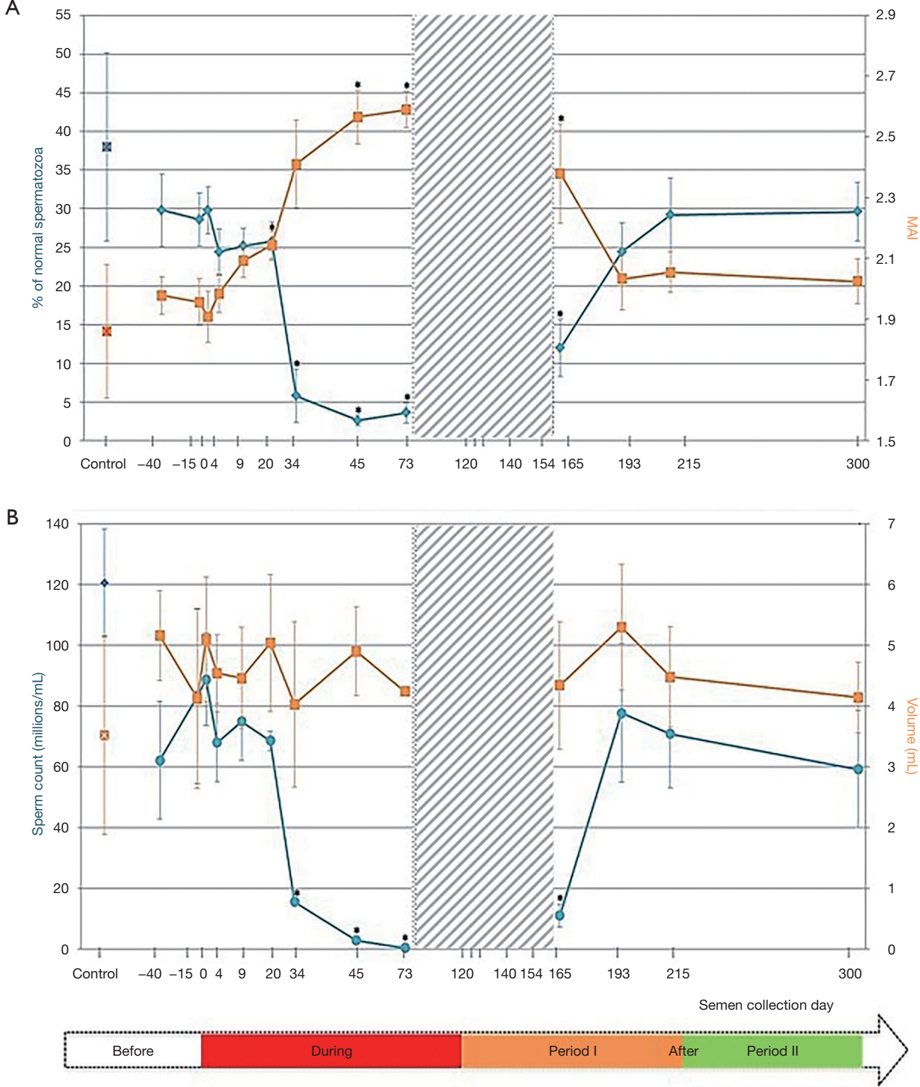
- Before heating, normal sperm percentage and MAI did not differ between experimental (n=5) and control (n=27) men. During heating, normal sperm percentage significantly decreased on D34, remained lower until D165 (45 days after cessation), and returned to control values at D193 (73 days after cessation); normal sperm was reduced 5-fold during heating. MAI significantly increased on D20 and returned to the normal mean at D193.
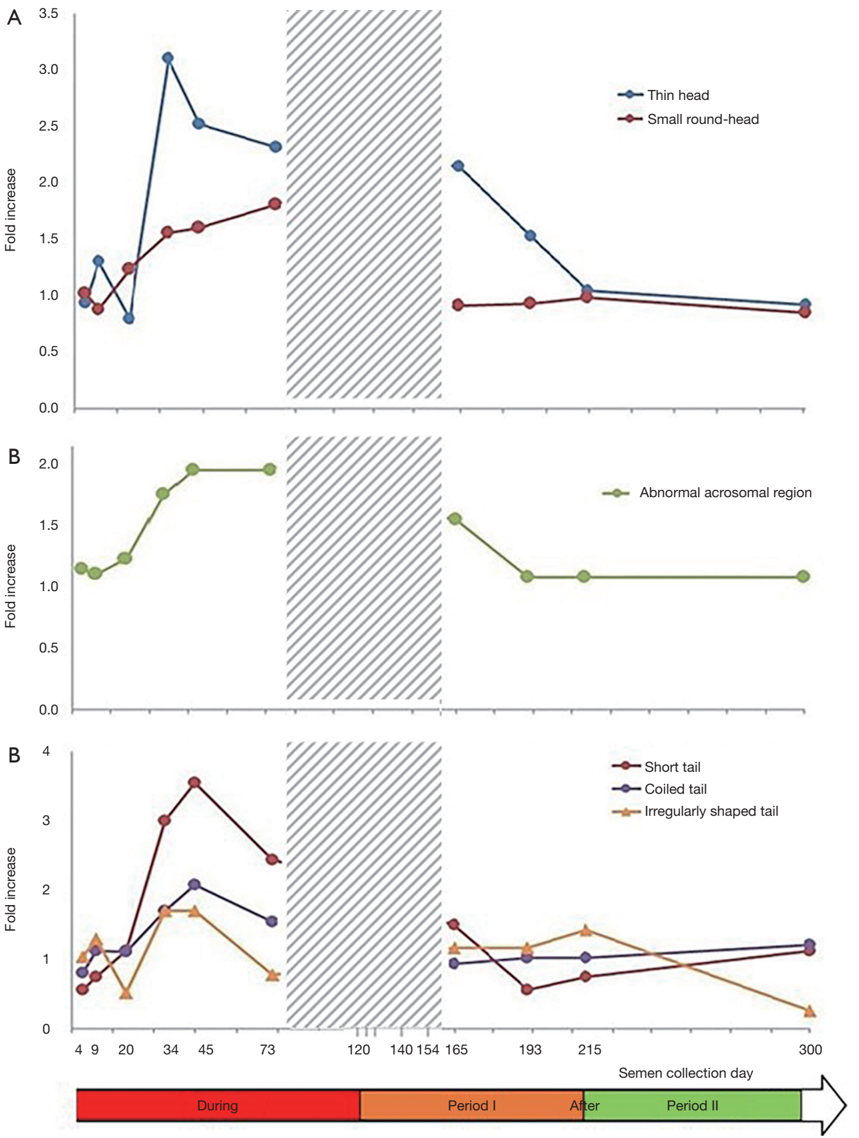
- Heat exposure increased specific head anomalies as early as D34: thin head 27% (10–31%), small round-head 29% (29–33%), and abnormal acrosomal region 79% (78–88%); thin-head or small round-head sperm were 3 times baseline values. Tail anomalies included short tail 2% (1–4%) and irregular tail 1% (1–5%) on D34, coiled tail 29% (21–30%) on D45, and multiple tails 4% (4–4%) on D73. At D165, thin heads 14% (10–18%) and abnormal acrosomal regions 72% (54–80%) remained higher than controls.
- Sperm concentration fell during heating; all men became severely oligozoospermic on D45, and 2 of 5 were azoospermic on D95 and D120. Semen volume did not change. Morphology analysis was invalid at some time points because men were azoospermic or had too few spermatozoa.
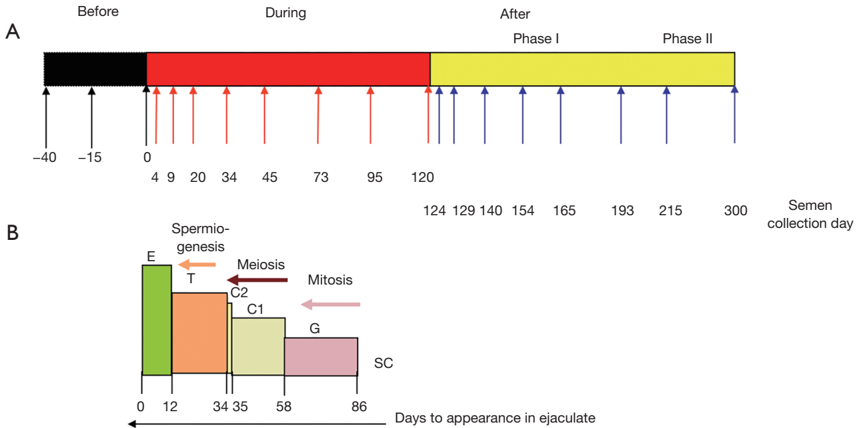
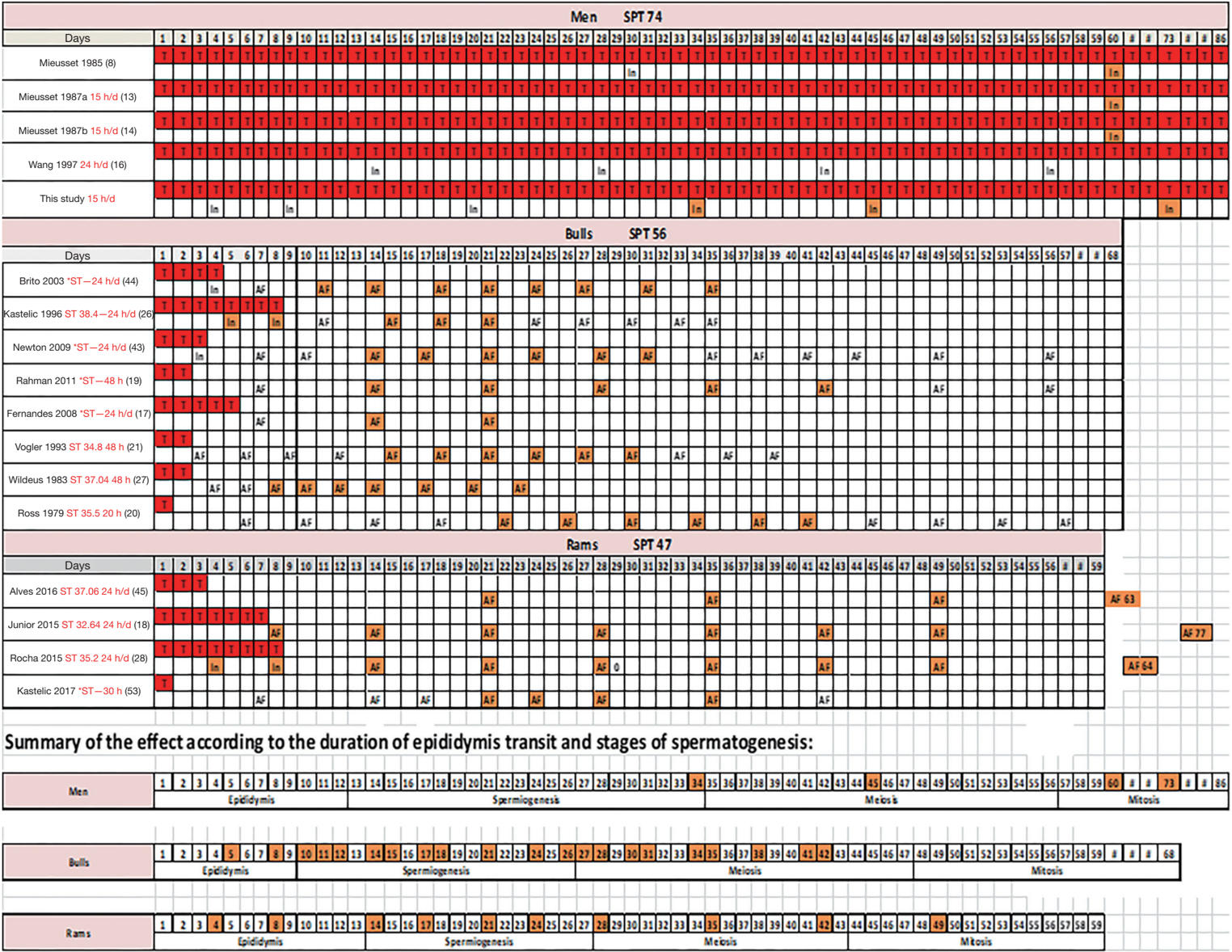
- No sperm morphology effect was seen at D4/D9, when sperm were likely in the epididymis. The MAI increase at D20 suggested late spermiogenesis was affected, and the 5-fold fall in normal sperm at D34 suggested effects on early spermiogenesis and late meiosis.
Methods
- Prospective experimental study in five healthy fertile men aged 25–35 who had fathered at least one child; 34 men volunteered, 6 were selected, and one dropped out on day 73 and was excluded. A control group of 27 healthy fertile men was also analyzed.
- Mild testicular/epididymal heating was induced by maintaining the testes in a supra-scrotal position using specially designed underwear worn 15±1 h/day for 120 consecutive days; this method produced a 1.5–2°C increase in testicular temperature. Semen was collected before heating (−40, −15, 0 days), during heating (4, 9, 20, 34, 45, 73, 95, 120 days), and after heating (124, 129, 140, 154, 165, 193, 215, 300 days).
- Semen analysis followed WHO recommendations; sperm morphology was assessed by modified David classification with Shorr staining, observing 100 spermatozoa per sample, and the multiple anomalies index (MAI) was calculated. Comparisons used Wilcoxon signed-rank tests with Bonferroni correction and Mann-Whitney tests against controls; analyses used SAS 9.3.
Limitations
- The paper states one major limitation: the small number of volunteers enrolled in the experimental protocol (n=5).
- Evident from the text: morphology analysis could not be performed at several time points because men were azoospermic or had too few spermatozoa, and the control group had only a single time-point morphology evaluation per man.
- Evident from the text: the 1.5–2°C testicular temperature increase is cited from prior studies rather than directly measured in this protocol.
Model-written summary. Check it against the paper before relying on it.
Integrity signals
Registry
Cites
Statistics
Figures
Verification
Claims the paper makes
0 Valid · 3 Not valid · 45 Not checked · 62 Own results and interpretations
A result the paper reports from its own data — it cites no other source for it, so there is none to check. The quote shows it is in the paper.
In the paper
“The percentage of morphologically normal sperm was reduced 5-fold during heating.”
§ Mild experimental increase in testis and epididymis temperature in men: effects on sperm morphology according to spermatogenesis stages > Percentage of normal spermatozoa and MAI
plainstates a causen = 5- Asserted: passes — The authors put it forward as true.
- Checkable: passes — It can be checked against evidence.
- Load-bearing: passes — The paper’s conclusions depend on it.
- Based: passes — The paper gives a reason why it holds.
A result the paper reports from its own data — it cites no other source for it, so there is none to check. The quote shows it is in the paper.
In the paper
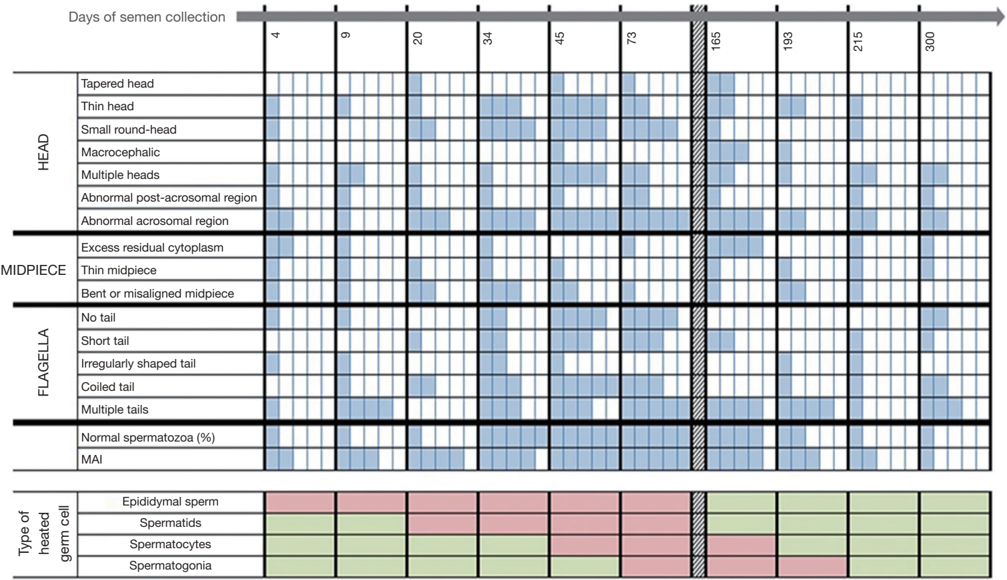
“More volunteers showed abnormal sperm tail morphology after 34 days and throughout the heat exposure period, except for irregularly shaped tail defects.”
§ Mild experimental increase in testis and epididymis temperature in men: effects on sperm morphology according to spermatogenesis stages > The incidence of men with abnormal sperm morphology values
plainstates a cause- Asserted: passes — The authors put it forward as true.
- Checkable: passes — It can be checked against evidence.
- Load-bearing: unclear — It is unclear whether the paper’s conclusions depend on it.
- Based: passes — The paper gives a reason why it holds.
A result the paper reports from its own data — it cites no other source for it, so there is none to check. The quote shows it is in the paper.
In the paper
“However, an excess of residual cytoplasm was noted in 4/5 men on Day 165.”
§ Mild experimental increase in testis and epididymis temperature in men: effects on sperm morphology according to spermatogenesis stages > The incidence of men with abnormal sperm morphology values
plainn = 5- Asserted: passes — The authors put it forward as true.
- Checkable: passes — It can be checked against evidence.
- Load-bearing: unclear — It is unclear whether the paper’s conclusions depend on it.
- Based: passes — The paper gives a reason why it holds.
A result the paper reports from its own data — it cites no other source for it, so there is none to check. The quote shows it is in the paper.
In the paper
“Tails anomalies such as short tail-an irregular shaped tail which could indicate anomalies of per-axonemal structures (36,37) were significantly increased from D34.”
§ Mild experimental increase in testis and epididymis temperature in men: effects on sperm morphology according to spermatogenesis stages > Effects on testicular germ cells
plainstates a cause- Asserted: passes — The authors put it forward as true.
- Checkable: passes — It can be checked against evidence.
- Load-bearing: passes — The paper’s conclusions depend on it.
- Based: passes — The paper gives a reason why it holds.
A result the paper reports from its own data — it cites no other source for it, so there is none to check. The quote shows it is in the paper.
In the paper
“The percentage of spermatozoa with either a thin head or small round-head was 3 times higher than the baseline mean values (D0, D15 and D40) (Figure 3).”
§ Mild experimental increase in testis and epididymis temperature in men: effects on sperm morphology according to spermatogenesis stages > During heating
plainstates a cause- Asserted: passes — The authors put it forward as true.
- Checkable: passes — It can be checked against evidence.
- Load-bearing: passes — The paper’s conclusions depend on it.
- Based: passes — The paper gives a reason why it holds.
55 more claims
Create a free account to see all 110 claims and every source verdict.
- It may state two separate claims as one. 35
- Probably not a substantial claim. 25
Claims other papers make about this one
Each is checked against this paper’s own text: does it say what the citing paper says it does?
In the citing paper
“In these models, changes in motility and sperm DNA integrity have been observed within weeks (15), whereas reductions in sperm output appear to follow thereafter over the subsequent spermatogenic cycle, which in humans spans approximately 74 days, with additional epididymal transit thereafter (1,15,18).”
From Garment fit, scrotal thermoregulation, and male fertility outcomes: a narrative review (2026) · cites this paper as [18]
In the citing paper
“Human studies indicate that febrile episodes, sauna exposure, experimental mild testicular heating and chronic wet‐heat exposure can all be followed by delayed, but potentially reversible, deterioration in semen parameters, with recovery trajectories extending over weeks to months [67, 68, 69, 70, 71].”
From Reversibility of Spermatogonial Stem Cell Injury After Single Acute Scrotal Hyperthermia in Mouse and Rat Models: A Systematic Review (2026) · cites this paper as [70]
Self-check
Percentages, sums and reported differences re-computed from the paper’s own numbers.
Each contradiction between two passages listed here was confirmed by an independent check.
Rated minor: it would not touch a result — a value no result rests on, a p-value that stays on the same side of the significance level, or a conflict that is clerical, resolved elsewhere in the paper, or outside its own findings.
In the paper
§ Mild experimental increase in testis and epididymis temperature in men: effects on sperm morphology according to spermatogenesis stages > Statistical analysis
“Data are presented as median and interquartile ranges Q1-Q3 for tables, due to the number of patients, and as mean and standard deviation for graphs.”
§ Mild experimental increase in testis and epididymis temperature in men: effects on sperm morphology according to spermatogenesis stages > Conclusions
“Means ± SEM were represented compared to the control group (control; n=27).”
Citations
Cites
Sperm Morphology, Motility, and Concentration in Fertile and Infertile Men
Guzick, D. S., Overstreet, J. W., Factor-Litvak, P., Brazil, C. K., Nakajima, S. T., Coutifaris, C., Carson, S. A., Cisneros, P., Steinkampf, M. P., Hill, J. A., et al. (2001) · New England Journal of Medicine · doi:10.1056/nejmoa003005 · Cited by 1,336
Testicular heating and its possible contributions to male infertility: a review
MIEUSSET, R., & BUJAN, L. (1995) · International Journal of Andrology · doi:10.1111/j.1365-2605.1995.tb00408.x · Cited by 341
Self-citationSlama, R. (2002) · Human Reproduction · doi:10.1093/humrep/17.2.503 · Cited by 308
Chemes, H. E. (2003) · Human Reproduction Update · doi:10.1093/humupd/dmg034 · Cited by 292
Male factors and the likelihood of pregnancy in infertile couples. I. Study of sperm characteristics
JOUANNET, P., DUCOT, B., FENEUX, D., & SPIRA, A. (1988) · International Journal of Andrology · doi:10.1111/j.1365-2605.1988.tb01011.x · Cited by 260
Predictive value of normal sperm morphology: a structured literature review
Coetzee, K. (1998) · Human Reproduction Update · doi:10.1093/humupd/4.1.73 · Cited by 255
EVENSON, D. P., JOST, L. K., CORZETT, M., & BALHORN, R. (2000) · Journal of Andrology · doi:10.1002/j.1939-4640.2000.tb02142.x · Cited by 214
Auger, J., Eustache, F., Andersen, A. G., Irvine, D. S., Jørgensen, N., Skakkebæk, N. E., Suominen, J., Toppari, J., Vierula, M., & Jouannet, P. (2001) · Human Reproduction · doi:10.1093/humrep/16.12.2710 · Cited by 211
Heat stress responses in spermatozoa: Mechanisms and consequences for cattle fertility
Rahman, M. B., Schellander, K., Luceño, N. L., & Soom, A. V. (2018) · Theriogenology · doi:10.1016/j.theriogenology.2018.02.012 · Cited by 180
Rahman, M. B., Vandaele, L., Rijsselaere, T., Maes, D. G. D., Hoogewijs, M., Frijters, A., Noordman, J., Granados, A., Dernelle, E., Shamsuddin, M., et al. (2011) · Theriogenology · doi:10.1016/j.theriogenology.2011.05.031 · Cited by 172
Wallach, E. E., Kandeel, F. R., & Swerdloff, R. S. (1988) · Fertility and Sterility · doi:10.1016/s0015-0282(16)59640-x · Cited by 170
EARLY CHANGES IN THE GERMINAL EPITHELIUM OF RAT TESTES FOLLOWING EXPOSURE TO HEAT
CHOWDHURY, A. K., & STEINBERGER, E. (1970) · Reproduction · doi:10.1530/jrf.0.0220205 · Cited by 164
Seminal and molecular evidence that sauna exposure affects human spermatogenesis
Garolla, A., Torino, M., Sartini, B., Cosci, I., Patassini, C., Carraro, U., & Foresta, C. (2013) · Human Reproduction · doi:10.1093/humrep/det020 · Cited by 163
Xia, W., Rao, M., Zhao, X.-L., Yang, J., Hu, S.-F., Lei, H., & Zhu, C.-H. (2015) · Asian Journal of Andrology · doi:10.4103/1008-682x.146967 · Cited by 161
Brito, L. F. C., Silva, A. E. D. F., Barbosa, R. T., Unanian, M. M., & Kastelic, J. P. (2003) · Animal Reproduction Science · doi:10.1016/s0378-4320(03)00082-4 · Cited by 159
Vogler, C. J., Bame, J. H., DeJarnette, J. M., McGilliard, M. L., & SAACKE, R. G. (1993) · Theriogenology · doi:10.1016/0093-691x(93)90291-c · Cited by 140
Insulating the scrotal neck affects semen quality and scrotal/testicular temperatures in the bull
Kastelic, J. P., Cook, R. B., Coulter, G. H., & SAACKE, R. G. (1996) · Theriogenology · doi:10.1016/0093-691x(96)00023-4 · Cited by 129
Auger, J., Eustache, F., & David, G. (2000) · Andrologie · doi:10.1007/bf03034491 · Cited by 107
Fernandes, C. E., Dode, M. A. N., Pereira, D. C., & Silva, A. E. D. F. (2008) · Theriogenology · doi:10.1016/j.theriogenology.2008.07.005 · Cited by 104
Effect of increased scrotal temperature on sperm production in normal men
Wang, C., McDonald, V., Leung, A., Superlano, L., Berman, N., Hull, L., & Swerdloff, R. S. (1997) · Fertility and Sterility · doi:10.1016/s0015-0282(97)81525-7 · Cited by 101
Alves, M. B. R., de Andrade, A. F. C., de Arruda, R. P., Batissaco, L., Florez-Rodriguez, S. A., de Oliveira, B. M. M., Torres, M. A., Lançoni, R., Ravagnani, G. M., Filho, R. R. D. P., et al. (2016) · Theriogenology · doi:10.1016/j.theriogenology.2016.02.034 · Cited by 91
Assessing human sperm morphology: top models, underdogs or biometrics?
Auger, J. (2010) · Asian Journal of Andrology · doi:10.1038/aja.2009.8 · Cited by 90
Effects of elevated temperature on the epididymis and testis: experimental studies
Bedford, J. M. (1991) · Advances in Experimental Medicine and Biology · doi:10.1007/978-1-4684-5913-5_3 · Cited by 87
Spermiogram and sperm reserves in hybrid Bos indicus × Bos taurus bulls after scrotal insulation
Wildeus, S. A., & Entwistle, K. (1983) · Reproduction · doi:10.1530/jrf.0.0690711 · Cited by 87
Rao, M., Xia, W., Yang, J., Hu, L. ‐., Hu, S. ‐., Lei, H., Wu, Y. ‐., & Zhu, C. ‐. (2016) · Andrology · doi:10.1111/andr.12228 · Cited by 82
Intrascrotal hyperthermia induced by scrotal insulation: effect on spermatogenesis.
Robinson, D., & Rock, J. A. (1967) · PubMed · Cited by 82
Ross, A. D., & Entwistle, K. (1979) · Theriogenology · doi:10.1016/0093-691x(79)90064-5 · Cited by 82
Semen quality in welders exposed to radiant heat.
Bonde, J. P. (1992) · Occupational and Environmental Medicine · doi:10.1136/oem.49.1.5 · Cited by 79
Inhibiting effect of artificial cryptorchidism on spermatogenesis
Mieusset, R., Grandjean, H., Mansat, A., & Pontonnier, F. (1985) · Fertility and Sterility · doi:10.1016/s0015-0282(16)48502-x · Cited by 78
Self-citationFertility and semen quality of workers exposed to high temperatures in the ceramics industry
Figa-Talamanca, I., Dell'Orco, V., Pupi, A., Dondero, F., Gandini, L., Lenzi, A., Lombardo, F., Scavalli, P., & Mancini, G. (1992) · Reproductive Toxicology · doi:10.1016/0890-6238(92)90036-s · Cited by 75
Effect of induced intrascrotal hyperthermia on testicular function in man
Rock, J., & Robinson, D. (1965) · American Journal of Obstetrics and Gynecology · doi:10.1016/0002-9378(65)90080-3 · Cited by 67
Mild induced testicular and epididymal hyperthermia alters sperm chromatin integrity in men
Ahmad, G., Moinard, N., Esquerré-Lamare, C., Mieusset, R., & Bujan, L. (2012) · Fertility and Sterility · doi:10.1016/j.fertnstert.2011.12.025 · Cited by 63
Self-citationEffect of increased testicular temperature on seminal plasma proteome of the ram
Rocha, D. R., Martins, J. A. M., van Tilburg, M. F., de Oliveira, R. V., Moreno, F. B. M. B., Monteiro‐Moreira, A. C. D. O., Moreira, R. D. A., de Araújo, A. A., & Moura, A. A. (2015) · Theriogenology · doi:10.1016/j.theriogenology.2015.07.008 · Cited by 63
Kastelic, J. P., Wilde, R. E., Rizzoto, G., & Thundathil, J. C. (2017) · Veterinární Medicína · doi:10.17221/124/2016-vetmed · Cited by 60
Effects of artificial cryptorchidism on sperm morphology
Mieusset, R., Bujan, L., MANSAT, A., Pontonnier, F., & Grandjean, H. (1987) · Fertility and Sterility · doi:10.1016/s0015-0282(16)49951-6 · Cited by 59
Self-citationMIEUSSET, R., BUJAN, L., MANSAT, A., PONTONNIER, F., & GRANDJEAN, H. (1987) · International Journal of Andrology · doi:10.1111/j.1365-2605.1987.tb00356.x · Cited by 56
Self-citationCorrelation between sperm parameters and sperm DNA fragmentation in fertile and infertile men
Sheikh, N., Amiri, I., Farimani, M., Najafi, R., & Hadeie, J. (2008) · International Journal of Reproductive BioMedicine (IJRM) · Cited by 52
Elevated testicular temperature modulates expression patterns of sperm proteins in Holstein bulls
Newton, L. D., Kastelic, J. P., Wong, B. S. Y., van der Hoorn, F., & Thundathil, J. C. (2008) · Molecular Reproduction and Development · doi:10.1002/mrd.20934 · Cited by 49
Effects of testicle insulation on seminal traits in rams: Preliminary study
Júnior, C. A. C., Lucci, C. M., Peripolli, V., Silva, A. F., de Menezes, A. M., Morais, S. R. L., Araújo, M. S., Ribeiro, L. M. C. S., Mattos, R. C., & McManus, C. (2015) · Small Ruminant Research · doi:10.1016/j.smallrumres.2015.06.014 · Cited by 46
Contraceptive efficacy of polyester-induced azoospermia in normal men
Shafik, A. (1992) · Contraception · doi:10.1016/0010-7824(92)90157-o · Cited by 45
Testicular suspension as a method of male contraception: technique and results.
Shafik, A. (1991) · PubMed · Cited by 45
Study on testicular temperature in men
Kitayama, T. (1965) · PubMed · Cited by 36
Temperature and the Production of Spermatozoa
Glover, T. D., & Young, D. H. (1963) · Fertility and Sterility · doi:10.1016/s0015-0282(16)34929-9 · Cited by 35
Zhang, M., Zhai, L., Fang, Z., Li, A., Xiao, W. L., & Qiu, Y. (2018) · Journal of Cellular Biochemistry · doi:10.1002/jcb.27365 · Cited by 29
MIEUSSET, R., CASARES, P. I. Q., SANCHEZ‐PARTIDA, L. G., SOWERBUTTS, S. F., ZUPP, J. L., & SETCHELL, B. P. (1991) · Annals of the New York Academy of Sciences · doi:10.1111/j.1749-6632.1991.tb27329.x · Cited by 27
Self-citationTemperature control of spermatogenesis and prospect of male contraception
Viejo-Borbolla, A. (2010) · Frontiers in Bioscience · doi:10.2741/s97 · Cited by 20
Temporary impairment of semen quality following recent acute fever.
Andrade‐Rocha, F. T. (2013) · PubMed · Cited by 19
Zhang, M., Zhai, L.-P., Fang, Z.-Y., Li, A.-N., Qiu, Y., & Liu, Y.-X. (2018) · Andrologia · doi:10.1111/and.12985 · Cited by 18
FERTILIZATION RATES OF SMALL-HEAD SPERM IN CONVENTIONAL IVF AND ICSI
Kihaile, P. E., Hirotsuru, K., Kumasako, Y., Misumi, J., & Utsunomiya, T. (2003) · Archives of Andrology · doi:10.1080/01485010390219692 · Cited by 15
Candas, V., Becmeur, F., Bothorel, B., & Hoeft, A. (1993) · International Journal of Andrology · doi:10.1111/j.1365-2605.1993.tb01166.x · Cited by 15
Effect of Increased Scrotal Temperature on Sperm Production in Normal Men
Wang, C., McDonald, V., Leung, A., Superlano, L., Berman, N., Hull, L., & Swerdloff, R. S. (1998) · Journal of Urology · doi:10.1016/s0022-5347(01)62981-1 · Cited by 5
He, M., & Tan, L. (2015) · Genetics and Molecular Research · doi:10.4238/2015.december.15.6 · Cited by 4
Research works printed but not linked: 2
- WHO. WHO laboratory manual for the examination of human semen and sperm-cervical mucus interaction. Cambridge: Cambridge University Press, 2010.
- Dott H, Glover T. Sperm production and delivery in mammals, including man. In: Glover TD, Barratt LR. editors. Male fertility and infertility. Cambridge: Cambridge University Press, 1999:34-55.
Cited by
Heat stress response of somatic cells in the testis
Aldahhan, R. A., & Stanton, P. G. (2021) · Molecular and Cellular Endocrinology · doi:10.1016/j.mce.2021.111216 · Cited by 91
An Assessment of Men Semen Alterations in SARS-CoV-2: Is Fever the Principal Concern?
Abdelhamid, M. H. M., Fellah, A. A., Marghani, A. E., & Almsellati, I. A. (2022) · Reproductive Sciences · doi:10.1007/s43032-022-00889-z · Cited by 28
Self-citationNguyen, T. T., Dang-Van, P., Dang-Ngoc, P., Kim, W. B., Le-Minh, T., & Nguyễn, V. Q. H. (2022) · International Journal of Reproductive BioMedicine (IJRM) · doi:10.18502/ijrm.v20i7.11559 · Cited by 25
Jorban, A., Lunenfeld, E., & Huleihel, M. (2024) · International Journal of Molecular Sciences · doi:10.3390/ijms25042160 · Cited by 25
Liu, W., Li, J., Sun, J., Liu, C., Yan, B., Zhou, C., Li, S., Song, X., Yan, W., Yang, Y., et al. (2024) · Plant Communications · doi:10.1016/j.xplc.2024.101192 · Cited by 24
Metadata
- Authors
- Abdelhamid, M. H. M., Walschaerts, M., Ahmad, G., Mieusset, R., Bujan, L., & Hamdi, S.
- Affiliations
- Université Toulouse III - Paul Sabatier (FR)
- The University of Sydney (AU)
- Corresponding author
- Bujan, Louis
- ORCID
- Venue
- Translational Andrology and Urology
- Publisher
- AME Publishing Company
- Published
- 2019-12
- Volume
- 8
- Issue
- 6
- Pages
- 651-665
- ISSN
- 2223-4683 (ISSN-L)
- 2223-4691
- PMC
- PMC6987600
- OpenAlex
- W2997054535
- Cited by
- 46
- References
- 52
- Citations by year
- 2026: 6 · 2025: 6 · 2024: 12 · 2023: 5 · 2022: 5 · 2021: 9 · 2020: 3
- FWCI
- 2.95
- Type
- journal article
- Language
- en
- Open access
- diamond
- doi.org
- Licence
- cc-by-nc-nd
- Locations
- Translational Andrology and Urology (publishedVersion, cc-by-nc-nd)
- Europe PMC (PubMed Central) (publishedVersion)
- PubMed Central (publishedVersion)
- PubMed (publishedVersion)
- HAL (submittedVersion, cc-by-nc-nd)
- HAL (submittedVersion)
- Funders
- Centre Hospitalier Universitaire de Toulouse
- Topics
- Health Sciences › Medicine › Reproductive Medicine › Sperm and Testicular Function
- Health Sciences › Medicine › Urology › Male Reproductive Health Studies
- Health Sciences › Medicine › Reproductive Medicine › Reproductive Health and Technologies
- Keywords
- testicular temperature, sperm morphology, epididymal transit, sperm head abnormalities, acrosome abnormalities, sperm tail abnormalities, male infertility, meiosis
About these checks
Registry, retraction, Cites and statistics results are computed, not judged, with one exception: a printed reference that no index lists is read once by a model before it counts as a citation error. Claims are extracted by a model and kept only when their quote appears verbatim in the text; each cited source is then checked, with a model’s help, for whether it says what the claim relies on. Those verdicts can be wrong — read the claim’s quote and the cited source before relying on one.
A language model drew the claims from the paper on 2026-11-27, under version 3 of the claim definition (model deepseek-v4.1-flash, prompt extract-v3).
A second model labelled each claim on 2026-11-27 (model jev-1.13-20260917, definition revision gold-guideline-v0.2).
Statistics and arithmetic are recomputed, not judged.
Confidence bands are shown only for fields calibrated on our annotated test set. None is calibrated yet, so no band is shown.
What counts as a claim ›How we measure confidence ›How we check this ›
Are you an author, or do you see a problem with this page? Request a review
Data sources
Bibliographic data: Semantic Scholar, OpenAlex, Crossref.
Contains information from the Semantic Scholar Academic Graph Datasets, made available under the ODC Attribution License (ODC-BY 1.0).
Semantic Scholar’s data is described in: Kinney, R., et al. (2023). The Semantic Scholar Open Data Platform. arXiv:2301.10140.
