Cited by 32

The DOI matches its Crossref record; 7 of the 7 references it cites were found in a registry or an index.

On the Euclidean action of de Sitter black holes and constrained instantons

Morvan, Edward K., van der Schaar, Jan Pieter, Visser, Manus R.·2023·SciPost Physics

Abstract

We compute the on-shell Euclidean action of Schwarzschild-de Sitter black holes, and take their contributions in the gravitational path integral into account using the formalism of constrained instantons. Although Euclidean de Sitter black hole geometries have conical singularities for generic masses, their on-shell action is finite and is shown to be independent of the Euclidean time periodicity and equal to minus the sum of the black hole and cosmological horizon entropy. We apply this result to compute the probability for a nonrotating, neutral arbitrary mass black hole to nucleate spontaneously in empty de Sitter space, which separates into a constant and a “non-perturbative” contribution, the latter corresponding to the proper saddle-point instanton in the Nariai limit. We also speculate on some further applications of our results, most notably as potential non-perturbative corrections to correlators in the de Sitter vacuum.

Overview

The claims and statistics of this paper haven’t been checked yet.

Run the check — free, no account needed. It reads the open-access text and checks the sources it cites.

A few free checks a day · papers already verified open instantly · results are public

Integrity signals

Registry

Crossref · 10.21468/scipostphys.14.2.022

Cites

7 of 7 references verified0 citation errors · 0 not checkable

Statistics

Figures
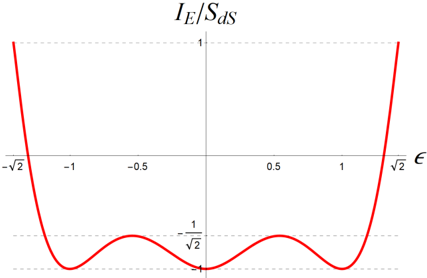
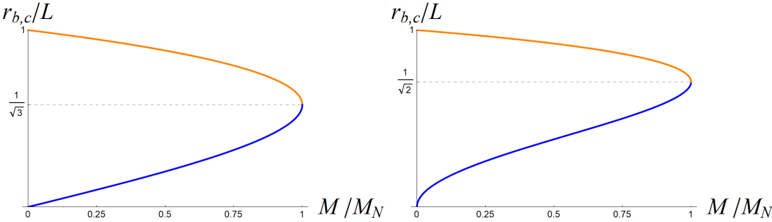
Figure 1 Horizon radii r b , c in units of the de Sitter radius L vs. mass M in units of the Nariai mass MN , where we have set d = 4 (left) and d = 5 (right). The black hole horizon radius (blue curve) becomes larger as M increases, whereas the cosmological horizon (orange curve) shrinks in size as M increases. For the Nariai solution the horizon radii coincide.
Figure 1 Horizon radii r b , c in units of the de Sitter radius L vs. mass M in units of the Nariai mass MN , where we have set d = 4 (left) and d = 5 (right). The black hole horizon radius (blue curve) becomes larger as M increases, whereas the cosmological horizon (orange curve) shrinks in size as M increases. For the Nariai solution the horizon radii coincide.CC-BY · From the PDF
Image 2
CC-BY · From the PDF
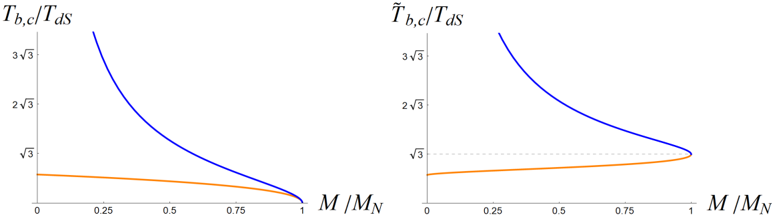
Figure 2 Temperatures Tb , c in units of TdS = 1 / 2 π L vs. unitless mass parameter M / MN , where we have set d = 4. The black hole temperature is shown in blue and the cosmological horizon temperature in orange. The left figure shows the temperatures Tb , c = κ b , c 2 π , where the surface gravities are defined with respect to the time translation Killing vector ξ = ∂ t . The right figure shows the Bousso-Hawking temperatures ˜ Tb , c = ˜ κ b , c 2 π , which are normalized with respect to a free-falling static observer, cf. (17). On the left the temperatures go to zero in the Nariai limit, whereas on the right the Nariai temperature is finite TN = π 3 2 π L .
Figure 2 Temperatures Tb , c in units of TdS = 1 / 2 π L vs. unitless mass parameter M / MN , where we have set d = 4. The black hole temperature is shown in blue and the cosmological horizon temperature in orange. The left figure shows the temperatures Tb , c = κ b , c 2 π , where the surface gravities are defined with respect to the time translation Killing vector ξ = ∂ t . The right figure shows the Bousso-Hawking temperatures ˜ Tb , c = ˜ κ b , c 2 π , which are normalized with respect to a free-falling static observer, cf. (17). On the left the temperatures go to zero in the Nariai limit, whereas on the right the Nariai temperature is finite TN = π 3 2 π L .CC-BY · From the PDF
Image 4
CC-BY · From the PDF
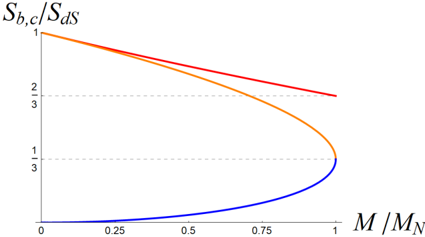
Figure 3 Horizon entropies S b , c in units of the de Sitter entropy SdS vs. unitless mass M / MN , for d = 4. The blue curve corresponds to the black hole entropy S b , and the orange curve shows the cosmological horizon entropy Sc . The sum of the entropies SSdS is approximately a straight line (red curve), and is always less than (or equal to) SdS . For the Nariai solution the horizon entropies are both equal to one third of the de Sitter entropy, and their sum is the Nariai entropy SN = 2 3 SdS . A similar plot appeared in [ 58 ] .
Figure 3 Horizon entropies S b , c in units of the de Sitter entropy SdS vs. unitless mass M / MN , for d = 4. The blue curve corresponds to the black hole entropy S b , and the orange curve shows the cosmological horizon entropy Sc . The sum of the entropies SSdS is approximately a straight line (red curve), and is always less than (or equal to) SdS . For the Nariai solution the horizon entropies are both equal to one third of the de Sitter entropy, and their sum is the Nariai entropy SN = 2 3 SdS . A similar plot appeared in [ 58 ] .CC-BY · From the PDF
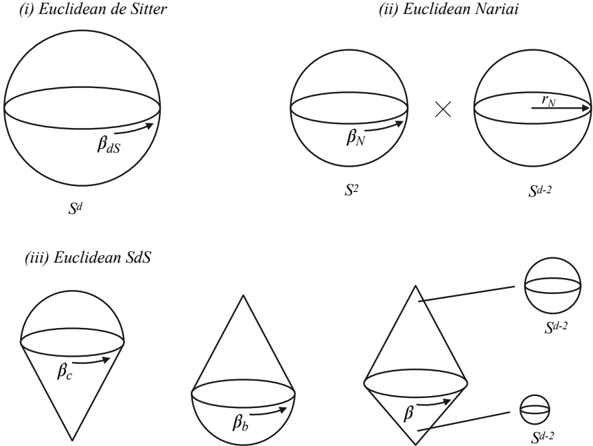
Figure 4 Euclidean SdS geometry. (i) Euclidean de Sitter space is a sphere S d and the Euclidean time circle has periodicity β dS = 2 π L . (ii) Euclidean Nariai space is S 2 × S d -2 , where the S 2 has a Euclidean time circle with periodicity β N = 2 π L / π d -1 and the S d -2 has radius r N . (iii) Euclidean SdS space is a warped product of S 2 , with one or two conical defects, times S d -2 . We have drawn three possible Euclidean SdS geometries ('ice cream cones'): on the left we removed the conical singularity at the cosmological horizon by fixing the Euclidean time periodicity to be β c = 2 π/κ c , in the middle we removed the conical singularity at the black hole horizon by fixing the periodicity to be β b = 2 π/κ b , and on the right both conical singularities are present since the periodicity β is arbitrary . For these three geometries the radius of the S d -2 varies along spatial sections, with the minimal (maximal) sphere corresponding to the black hole (cosmological) horizon.
Figure 4 Euclidean SdS geometry. (i) Euclidean de Sitter space is a sphere S d and the Euclidean time circle has periodicity β dS = 2 π L . (ii) Euclidean Nariai space is S 2 × S d -2 , where the S 2 has a Euclidean time circle with periodicity β N = 2 π L / π d -1 and the S d -2 has radius r N . (iii) Euclidean SdS space is a warped product of S 2 , with one or two conical defects, times S d -2 . We have drawn three possible Euclidean SdS geometries ('ice cream cones'): on the left we removed the conical singularity at the cosmological horizon by fixing the Euclidean time periodicity to be β c = 2 π/κ c , in the middle we removed the conical singularity at the black hole horizon by fixing the periodicity to be β b = 2 π/κ b , and on the right both conical singularities are present since the periodicity β is arbitrary . For these three geometries the radius of the S d -2 varies along spatial sections, with the minimal (maximal) sphere corresponding to the black hole (cosmological) horizon.CC-BY · From the PDF
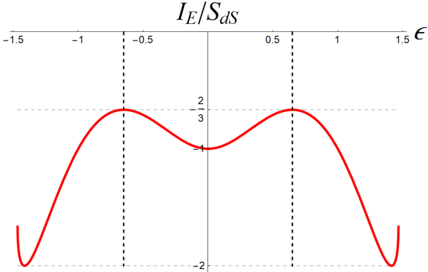
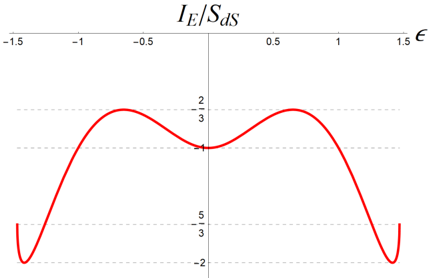
Figure 5 On-shell action I E , SdS of Euclidean SdS in units of SdS vs. the dimensionless parameter ε = ± 1 -r c / L , where we have set d = 4. At ε = 0 the action attains a local minimum, which corresponds to Euclidean de Sitter space S 4 , and at ε = ± 1 -1 / π 3 (dashed lines) the action attains a local maximum, corresponding to Euclidean Nariai space S 2 × S 2 . At | ε | = π 2 the action has a global minimum which resembles pure de Sitter space, see Appendix A. There is a negative mode between the de Sitter and Nariai stationary points.
Figure 5 On-shell action I E , SdS of Euclidean SdS in units of SdS vs. the dimensionless parameter ε = ± 1 -r c / L , where we have set d = 4. At ε = 0 the action attains a local minimum, which corresponds to Euclidean de Sitter space S 4 , and at ε = ± 1 -1 / π 3 (dashed lines) the action attains a local maximum, corresponding to Euclidean Nariai space S 2 × S 2 . At | ε | = π 2 the action has a global minimum which resembles pure de Sitter space, see Appendix A. There is a negative mode between the de Sitter and Nariai stationary points.CC-BY · From the PDF
Image 8
CC-BY · From the PDF
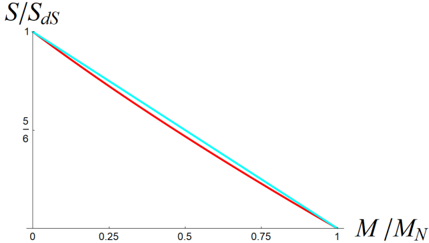
Figure 6 Total gravitational entropy SSdS = S b + Sc in units of the de Sitter entropy SdS vs. the dimensionless mass M / MN , where we have set d = 4. The red curve corresponds to the actual sum of the horizon entropies, whereas the cyan curve is a linear fit. The total entropy is approximately a straight line, which also holds in higher dimensions d > 4.
Figure 6 Total gravitational entropy SSdS = S b + Sc in units of the de Sitter entropy SdS vs. the dimensionless mass M / MN , where we have set d = 4. The red curve corresponds to the actual sum of the horizon entropies, whereas the cyan curve is a linear fit. The total entropy is approximately a straight line, which also holds in higher dimensions d > 4.CC-BY · From the PDF
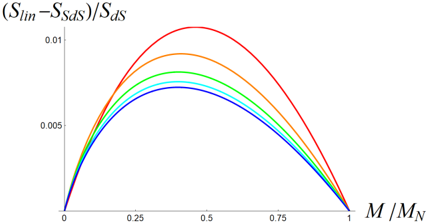
Figure 7 The difference between the linear fit Slin and the actual total entropy SSdS , in units of SdS vs. the mass M in units of MN . The different plots correspond to d = 4 (red), d = 5 (orange), d = 6 (green), d = 7 (cyan), d = 8 (blue).
Figure 7 The difference between the linear fit Slin and the actual total entropy SSdS , in units of SdS vs. the mass M in units of MN . The different plots correspond to d = 4 (red), d = 5 (orange), d = 6 (green), d = 7 (cyan), d = 8 (blue).CC-BY · From the PDF
Image 11
CC-BY · From the PDF
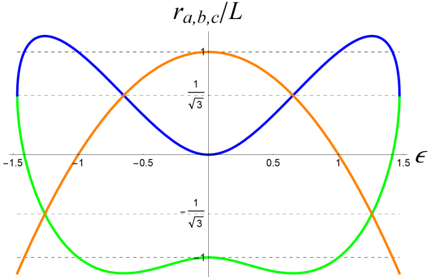
Figure 8 The roots of f ( r ) in units of L as a function of ε for d = 4. The black hole horizon radius r b is shown in blue, the cosmological horizon radius r c in orange and the third root r a = -( r b + r c ) in green.
Figure 8 The roots of f ( r ) in units of L as a function of ε for d = 4. The black hole horizon radius r b is shown in blue, the cosmological horizon radius r c in orange and the third root r a = -( r b + r c ) in green.CC-BY · From the PDF
Image 13
CC-BY · From the PDF
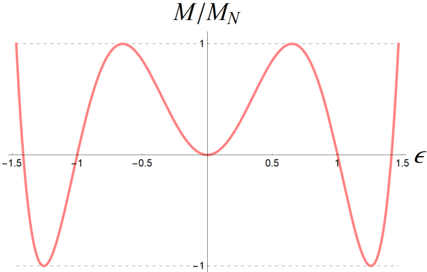
Figure 9 Mass M in units of MN as a function of ε for d = 4. For the values 1 < | ε | < π 2 the mass M becomes negative, and for | ε | > 1 + 2 / π 3 the mass exceeds MN .
Figure 9 Mass M in units of MN as a function of ε for d = 4. For the values 1 < | ε | < π 2 the mass M becomes negative, and for | ε | > 1 + 2 / π 3 the mass exceeds MN .CC-BY · From the PDF
Image 15
CC-BY · From the PDF
Figure 10 Euclidean action I E of SdS in units of SdS as a function of ε for d = 4. Empty de Sitter is a minimum and Nariai a maximum of the action, and there is an additional global minimum at | ε | = π 2 for which M = 0.
Figure 10 Euclidean action I E of SdS in units of SdS as a function of ε for d = 4. Empty de Sitter is a minimum and Nariai a maximum of the action, and there is an additional global minimum at | ε | = π 2 for which M = 0.CC-BY · From the PDF
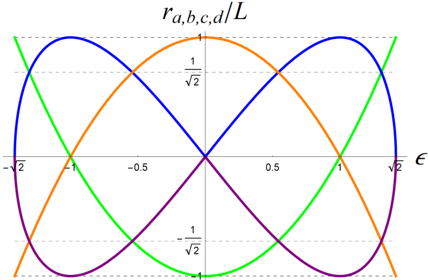
Figure 11 The roots of f ( r ) in units of L as a function of ε for d = 5. The black hole horizon radius r b is shown in blue, the cosmological horizon radius r c in orange, the root r a = -r c in green and the fourth root r d = -r b in purple.
Figure 11 The roots of f ( r ) in units of L as a function of ε for d = 5. The black hole horizon radius r b is shown in blue, the cosmological horizon radius r c in orange, the root r a = -r c in green and the fourth root r d = -r b in purple.CC-BY · From the PDF
Image 18
CC-BY · From the PDF
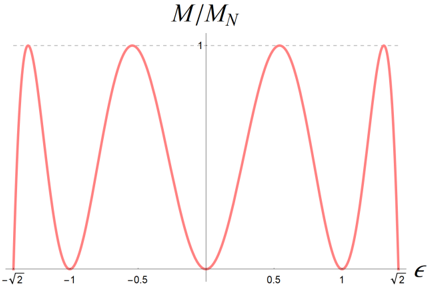
Figure 12 Mass in units of MN as a function of ε for d = 5.
Figure 12 Mass in units of MN as a function of ε for d = 5.CC-BY · From the PDF
Figure 13 Euclidean action in units of SdS as a function of ε for d = 5.
Figure 13 Euclidean action in units of SdS as a function of ε for d = 5.CC-BY · From the PDF
Image 21
CC-BY · From the PDF

Verification

Claims the paper makes

The claims and statistics of this paper haven’t been checked yet.

Run the check — free, no account needed. It reads the open-access text and checks the sources it cites.

A few free checks a day · papers already verified open instantly · results are public

Claims other papers make about this one

Each is checked against this paper’s own text: does it say what the citing paper says it does?

Self-check

Percentages, sums and reported differences re-computed from the paper’s own numbers.

The self-check needs the paper’s full text.

Citations

Cites

Research works printed but not linked: 68

  1. 10.48550/arXiv.hep-th/0106109 · DOI
  2. 10.48550/arXiv.hep-th/0110007 · DOI
  3. 10.1088/1475-7516/2004/11/006 · DOI
  4. 10.1007/JHEP12(2019)063 · DOI · Paper page
  5. 10.1016/0550-3213(83)90636-3 · DOI
  6. 10.1103/PhysRevD.54.6312 · DOI · Paper page
  7. 10.1103/PhysRevD.15.2752 · DOI · Paper page
  8. 10.1103/PhysRevD.15.2738 · DOI · Paper page
  9. 10.1088/1126-6708/2006/12/004 · DOI
  10. 10.48550/arXiv.1301.5924 · DOI
  11. 10.48550/arXiv.2003.03637 · DOI
  12. 10.1088/1361-6382/ab638f · DOI
  13. 10.1103/PhysRevD.104.L081501 · DOI · Paper page
  14. 10.1142/S0218271897000121 · DOI
  15. 10.1142/S0218271898000589 · DOI
  16. 10.1103/PhysRevD.59.103501 · DOI
  17. 10.1016/0370-2693(91)90665-D · DOI
  18. 10.1103/PhysRevD.49.958 · DOI
  19. 10.1103/PhysRevD.50.2662 · DOI
  20. 10.1103/PhysRevD.51.4302 · DOI
  21. 10.3390/universe7120464 · DOI
  22. 10.48550/arXiv.2109.01322 · DOI
  23. 10.1103/PhysRevD.105.126022 · DOI · Paper page
  24. 10.1103/PhysRevD.57.2436 · DOI
  25. 10.1103/PhysRevD.65.123508 · DOI
  26. 10.1088/1126-6708/2002/01/005 · DOI
  27. 10.48550/arXiv.hep-th/0203258 · DOI
  28. 10.1103/PhysRevD.67.104024 · DOI
  29. 10.1103/PhysRevD.69.064016 · DOI
  30. 10.1103/PhysRevD.88.044014 · DOI
  31. 10.1103/PhysRevD.67.084026 · DOI
  32. 10.1007/s10714-007-0489-0 · DOI
  33. 10.1103/PhysRevD.73.084009 · DOI
  34. 10.1088/0264-9381/26/10/105010 · DOI
  35. 10.1143/PTP.122.1239 · DOI
  36. 10.1103/PhysRevD.87.104017 · DOI
  37. 10.1088/0264-9381/33/24/245001 · DOI
  38. 10.1140/epjc/s10052-016-3955-6 · DOI
  39. 10.1103/PhysRevD.96.024038 · DOI
  40. 10.1103/PhysRevD.98.125013 · DOI
  41. 10.1088/1361-6382/ab8bba · DOI
  42. 10.1103/PhysRevD.105.126021 · DOI
  43. 10.1002/andp.19183611402 · DOI
  44. 10.1023/A:1026602724948 · DOI · Paper page
  45. 10.1103/PhysRevD.70.024002 · DOI
  46. 10.1007/JHEP08(2022)075 · DOI · Paper page
  47. 10.1007/JHEP01(2021)139 · DOI · Paper page
  48. 10.1007/JHEP06(2020)048 · DOI · Paper page
  49. 10.1088/1126-6708/2002/04/030 · DOI
  50. 10.21468/SciPostPhys.7.6.079 · DOI
  51. 10.48550/arXiv.1908.05469 · DOI
  52. 10.12942/lrr-2011-8 · DOI · Paper page
  53. 10.1103/PhysRevLett.72.957 · DOI
  54. 10.21468/SciPostPhys.2.3.016 · DOI
  55. 10.1103/PhysRevD.33.2092 · DOI
  56. 10.1103/PhysRevD.65.104030 · DOI
  57. 10.1103/PhysRevD.47.5370 · DOI
  58. 10.1103/PhysRevD.57.3503 · DOI
  59. 10.1088/1126-6708/2000/11/038 · DOI · Paper page
  60. 10.1088/1126-6708/2001/04/035 · DOI
  61. 10.1007/JHEP09(2021)001 · DOI
  62. 10.1016/S0550-3213(00)00287-X · DOI
  63. 10.1103/PhysRevD.25.330 · DOI
  64. 10.1103/PhysRevD.52.2254 · DOI · Paper page
  65. 10.1007/JHEP01(2020)039 · DOI
  66. 10.1103/PhysRevD.58.083511 · DOI
  67. 10.1103/PhysRevD.60.063503 · DOI · Paper page
  68. 10.1088/1126-6708/2003/04/021 · DOI · Paper page

Cited by

Sorted by citations

See all 32

Metadata

Authors
Morvan, E. K., van der Schaar, J. P., & Visser, M. R.
Affiliations
  • Delta Institute for Theoretical Physics
  • University of Geneva
Venue
SciPost Physics
Published
2023-02-23
Volume
14
Issue
2
ISSN
2542-4653
Cited by
32
References
7
Language
en
Funders
  • Ministerie van Onderwijs, Cultuur en Wetenschap
  • Schweizerischer Nationalfonds zur Förderung der Wissenschaftlichen Forschung (200020-182513, NCCR 51NF40-141869)

About these checks

Registry, retraction, Cites and statistics results are computed, not judged, with one exception: a printed reference that no index lists is read once by a model before it counts as a citation error. Claims are extracted by a model and kept only when their quote appears verbatim in the text; each cited source is then checked, with a model’s help, for whether it says what the claim relies on. Those verdicts can be wrong — read the claim’s quote and the cited source before relying on one.

Statistics and arithmetic are recomputed, not judged.

Confidence bands are shown only for fields calibrated on our annotated test set. None is calibrated yet, so no band is shown.

What counts as a claim ›How we measure confidence ›How we check this ›

Are you an author, or do you see a problem with this page? Request a review