

The DOI matches its Crossref record; 28 of the 30 references it cites were found in a registry or an index; none of the 21 sources its claims cite is checked for support yet.
Smartphone viewing distance and sleep: an experimental study utilizing motion capture technology
Open accessAbstract
There are studies reporting the negative impact of smartphone utilization on sleep. It is considered that reduction of melatonin secretion under the blue light exposure from smartphone displays is one of the causes. The viewing distance may cause sleep disturbance, because the viewing distance determines the screen illuminance and/or asthenopia. However, to date, there has been no study closely investigating the impact of viewing distance on sleep; therefore, we sought to determine the relationship between smartphone viewing distance and subjective sleep status. Twenty-three nursing students (mean age ± standard deviation of 19.7±3.1 years) participated in the study. Subjective sleep status was assessed using the Pittsburgh Sleep Quality Index, morningness–eveningness questionnaire, and the Epworth sleepiness scale. We used the distance between the head and the hand while holding a smartphone to measure the viewing distance while using smartphones in sitting and lying positions. The distance was calculated using the three-dimensional coordinates obtained by a noncontact motion-sensing device. The viewing distance of smartphones in the sitting position ranged from 13.3 to 32.9 cm among participants. In the lying position, it ranged from 9.9 to 21.3cm. The viewing distance was longer in the sitting position than in the lying position (mean ± standard deviation: 20.3±4.7 vs 16.4±2.7, respectively, P <0.01). We found that the short viewing distance in the lying position had a positive correlation to a poorer sleep state ( R 2 =0.27, P <0.05), lower sleep efficiency ( R 2 =0.35, P <0.05), and longer sleep latency ( R 2 =0.38, P <0.05). Moreover, smartphone viewing distances in lying position correlated negatively with subjective sleep status. Therefore, when recommending ideal smartphone use in lying position, one should take into account the viewing distances. Keywords: smartphone, sleep, blue light, distance
Overview
CoChat Summary
## TL;DR
This experimental study of 23 nursing students found that smartphone viewing distance was shorter when lying down than when sitting, and shorter lying-position distances were associated with worse subjective sleep. The authors conclude that smartphone use recommendations should consider viewing distance.
## Key findings
- In 23 nursing students (mean age 19.7±3.1 years; 4/23 male), the mean smartphone viewing distance was 20.3±4.7 cm in sitting and 16.4±2.7 cm in lying position; the sitting distance was significantly longer (t(21)=3.604, P<0.01).
- Viewing distance in the lying position ranged from 9.9 to 21.3 cm, and in the sitting position from 13.3 to 32.9 cm.
- Multiple regression found that shorter viewing distance in the lying position was associated with poorer sleep state (R2=0.27, P<0.05), lower sleep efficiency (R2=0.35, P<0.05), and longer sleep latency (R2=0.38, P<0.05).
- There were no significant associations between sitting-position viewing distance and any sleep variables.
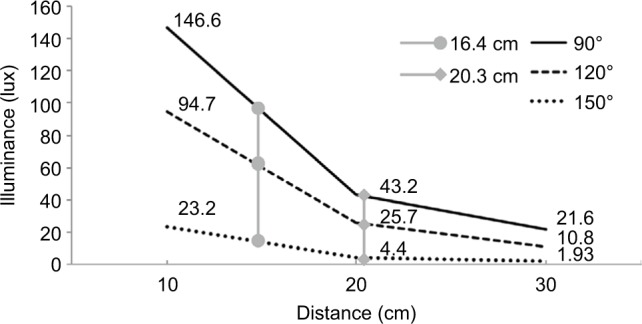
- The smartphone display spectrum peaked at 453 nm; estimated illuminance at the measured mean viewing distances was 25.3–42.6 lx when sitting and 50.5–80.4 lx when lying.
## Methods
- Experimental study with 23 healthy nursing students who owned smartphones and reported using them before sleep; they were randomly assigned to start in either sitting or lying position.
- Viewing distance was measured with Microsoft Kinect for Windows using the distance between the head and hand while holding an Apple iPhone 5; the viewing distance was recorded every 10 seconds during 14.5 minutes sitting and 22.3 minutes lying, with a 5-minute interval between conditions.
- Subjective sleep status was assessed using the PSQI, MEQ, and ESS; analyses used paired t-tests for position differences and multiple regression for associations with sleep measures.
## Limitations
- The paper states it did not measure duration of smartphone use, which could affect sleep quality.
- The paper states it did not measure melatonin, EEG, or other biological indices, so it could not examine direct physiological effects.
- The paper states the study used unfamiliar bedding, only two body positions (sitting and lying), fixed room illuminance (600 lx), did not rule out psychiatric/physical diseases, and was conducted in the daytime; these are stated limitations.
- Evident from the text: the sample was small and specific (23 nursing students), which limits generalizability.
Model-written summary. Check it against the paper before relying on it.
Integrity signals
Registry
Cites
Statistics
Figures


Verification
Claims the paper makes
0 Valid · 0 Not valid · 18 Not checked · 25 Own results and interpretations
A result the paper reports from its own data — it cites no other source for it, so there is none to check. The quote shows it is in the paper.
In the paper
“lower sleep efficiency (R2=0.35, P<0.05)”
- Also stated in: § The relationship between viewing distance and subjective sleep status · plain
“lower sleep efficiency (R2=0.35, P<0.05)”
§ Smartphone viewing distance and sleep: an experimental study utilizing motion capture technology > Abstract There are studies reporting the negative impact of smartphone utilization on sleep. It is considered that reduction of melatonin secretion under the blue light exposure from smart-phone displays is one of the causes. The viewing distance may cause sleep disturbance, because the viewing distance determines the screen illuminance and/or asthenopia. However, to date, there has been no study closely investigating the impact of viewing distance on sleep; therefore, we sought to determine the relationship between smartphone viewing distance and subjective sleep status. Twenty-three nursing students (mean age ± standard deviation of 19.7±3.1 years) participated in the study. Subjective sleep status was assessed using the Pittsburgh Sleep Quality Index, morningness–eveningness questionnaire, and the Epworth sleepiness scale. We used the distance between the head and the hand while holding a smartphone to measure the viewing distance while using smartphones in sitting and lying positions. The distance was calculated using the three-dimensional coordinates obtained by a noncontact motion-sensing device. The viewing distance of smartphones in the sitting position ranged from 13.3 to 32.9 cm among participants. In the lying position, it ranged from 9.9 to 21.3cm. The viewing distance was longer in the sitting position than in the lying position (mean ± standard deviation: 20.3±4.7 vs 16.4±2.7, respectively, P<0.01). We found that the short viewing distance in the lying position had a positive correlation to a poorer sleep state (R2=0.27, P<0.05), lower sleep efficiency (R2=0.35, P<0.05), and longer sleep latency (R2=0.38, P<0.05). Moreover, smartphone viewing distances in lying position correlated negatively with subjective sleep status. Therefore, when recommending ideal smartphone use in lying position, one should take into account the viewing distances.
plainstates an association- Asserted: passes — The authors put it forward as true.
- Checkable: passes — It can be checked against evidence.
- Load-bearing: passes — The paper’s conclusions depend on it.
- Based: passes — The paper gives a reason why it holds.
- Also stated in: § The relationship between viewing distance and subjective sleep status · plain
A result the paper reports from its own data — it cites no other source for it, so there is none to check. The quote shows it is in the paper.
In the paper
“and longer sleep latency (R2=0.38, P<0.05).”
- Also stated in: § The relationship between viewing distance and subjective sleep status · plain
“and longer sleep latency (R2=0.38, P<0.05).”
§ Smartphone viewing distance and sleep: an experimental study utilizing motion capture technology > Abstract There are studies reporting the negative impact of smartphone utilization on sleep. It is considered that reduction of melatonin secretion under the blue light exposure from smart-phone displays is one of the causes. The viewing distance may cause sleep disturbance, because the viewing distance determines the screen illuminance and/or asthenopia. However, to date, there has been no study closely investigating the impact of viewing distance on sleep; therefore, we sought to determine the relationship between smartphone viewing distance and subjective sleep status. Twenty-three nursing students (mean age ± standard deviation of 19.7±3.1 years) participated in the study. Subjective sleep status was assessed using the Pittsburgh Sleep Quality Index, morningness–eveningness questionnaire, and the Epworth sleepiness scale. We used the distance between the head and the hand while holding a smartphone to measure the viewing distance while using smartphones in sitting and lying positions. The distance was calculated using the three-dimensional coordinates obtained by a noncontact motion-sensing device. The viewing distance of smartphones in the sitting position ranged from 13.3 to 32.9 cm among participants. In the lying position, it ranged from 9.9 to 21.3cm. The viewing distance was longer in the sitting position than in the lying position (mean ± standard deviation: 20.3±4.7 vs 16.4±2.7, respectively, P<0.01). We found that the short viewing distance in the lying position had a positive correlation to a poorer sleep state (R2=0.27, P<0.05), lower sleep efficiency (R2=0.35, P<0.05), and longer sleep latency (R2=0.38, P<0.05). Moreover, smartphone viewing distances in lying position correlated negatively with subjective sleep status. Therefore, when recommending ideal smartphone use in lying position, one should take into account the viewing distances.
plainstates an association- Asserted: passes — The authors put it forward as true.
- Checkable: passes — It can be checked against evidence.
- Load-bearing: passes — The paper’s conclusions depend on it.
- Based: passes — The paper gives a reason why it holds.
- Also stated in: § The relationship between viewing distance and subjective sleep status · plain
A result the paper reports from its own data — it cites no other source for it, so there is none to check. The quote shows it is in the paper.
In the paper
“On the other hand, there were no significant associations between the sitting viewing distance and any of the sleep variables (Table 2).”
§ Smartphone viewing distance and sleep: an experimental study utilizing motion capture technology > Results > The relationship between viewing distance and subjective sleep status
plain- Asserted: passes — The authors put it forward as true.
- Checkable: passes — It can be checked against evidence.
- Load-bearing: passes — The paper’s conclusions depend on it.
- Based: passes — The paper gives a reason why it holds.
A result the paper reports from its own data — it cites no other source for it, so there is none to check. The quote shows it is in the paper.
In the paper
“The viewing distance was longer in the sitting position than in the lying position (mean ± standard deviation: 20.3±4.7 vs 16.4±2.7, respectively, P<0.01).”
- Also stated in: § The average viewing distances · plain
“The mean ± SD of viewing distance was longer in the sitting position than in the lying position (20.3±4.7 vs 16.4±2.7, respectively, t(21)=3.604, P<0.01).”
§ Smartphone viewing distance and sleep: an experimental study utilizing motion capture technology > Abstract There are studies reporting the negative impact of smartphone utilization on sleep. It is considered that reduction of melatonin secretion under the blue light exposure from smart-phone displays is one of the causes. The viewing distance may cause sleep disturbance, because the viewing distance determines the screen illuminance and/or asthenopia. However, to date, there has been no study closely investigating the impact of viewing distance on sleep; therefore, we sought to determine the relationship between smartphone viewing distance and subjective sleep status. Twenty-three nursing students (mean age ± standard deviation of 19.7±3.1 years) participated in the study. Subjective sleep status was assessed using the Pittsburgh Sleep Quality Index, morningness–eveningness questionnaire, and the Epworth sleepiness scale. We used the distance between the head and the hand while holding a smartphone to measure the viewing distance while using smartphones in sitting and lying positions. The distance was calculated using the three-dimensional coordinates obtained by a noncontact motion-sensing device. The viewing distance of smartphones in the sitting position ranged from 13.3 to 32.9 cm among participants. In the lying position, it ranged from 9.9 to 21.3cm. The viewing distance was longer in the sitting position than in the lying position (mean ± standard deviation: 20.3±4.7 vs 16.4±2.7, respectively, P<0.01). We found that the short viewing distance in the lying position had a positive correlation to a poorer sleep state (R2=0.27, P<0.05), lower sleep efficiency (R2=0.35, P<0.05), and longer sleep latency (R2=0.38, P<0.05). Moreover, smartphone viewing distances in lying position correlated negatively with subjective sleep status. Therefore, when recommending ideal smartphone use in lying position, one should take into account the viewing distances.
plain- Asserted: passes — The authors put it forward as true.
- Checkable: passes — It can be checked against evidence.
- Load-bearing: unclear — It is unclear whether the paper’s conclusions depend on it.
- Based: passes — The paper gives a reason why it holds.
- Also stated in: § The average viewing distances · plain
A result the paper reports from its own data — it cites no other source for it, so there is none to check. The quote shows it is in the paper.
In the paper
“We found that the short viewing distance in the lying position had a positive correlation to a poorer sleep state (R2=0.27, P<0.05)”
- Also stated in: § The relationship between viewing distance and subjective sleep status · plain
“we found that the short viewing distance in the lying position related positively to a poorer sleep state (R2=0.27, P<0.05)”
§ Smartphone viewing distance and sleep: an experimental study utilizing motion capture technology > Abstract There are studies reporting the negative impact of smartphone utilization on sleep. It is considered that reduction of melatonin secretion under the blue light exposure from smart-phone displays is one of the causes. The viewing distance may cause sleep disturbance, because the viewing distance determines the screen illuminance and/or asthenopia. However, to date, there has been no study closely investigating the impact of viewing distance on sleep; therefore, we sought to determine the relationship between smartphone viewing distance and subjective sleep status. Twenty-three nursing students (mean age ± standard deviation of 19.7±3.1 years) participated in the study. Subjective sleep status was assessed using the Pittsburgh Sleep Quality Index, morningness–eveningness questionnaire, and the Epworth sleepiness scale. We used the distance between the head and the hand while holding a smartphone to measure the viewing distance while using smartphones in sitting and lying positions. The distance was calculated using the three-dimensional coordinates obtained by a noncontact motion-sensing device. The viewing distance of smartphones in the sitting position ranged from 13.3 to 32.9 cm among participants. In the lying position, it ranged from 9.9 to 21.3cm. The viewing distance was longer in the sitting position than in the lying position (mean ± standard deviation: 20.3±4.7 vs 16.4±2.7, respectively, P<0.01). We found that the short viewing distance in the lying position had a positive correlation to a poorer sleep state (R2=0.27, P<0.05), lower sleep efficiency (R2=0.35, P<0.05), and longer sleep latency (R2=0.38, P<0.05). Moreover, smartphone viewing distances in lying position correlated negatively with subjective sleep status. Therefore, when recommending ideal smartphone use in lying position, one should take into account the viewing distances.
plainstates an association- Asserted: passes — The authors put it forward as true.
- Checkable: passes — It can be checked against evidence.
- Load-bearing: passes — The paper’s conclusions depend on it.
- Based: passes — The paper gives a reason why it holds.
- Also stated in: § The relationship between viewing distance and subjective sleep status · plain
13 more claims
Create a free account to see all 43 claims and every source verdict.
- Probably not a substantial claim. 19
- It may state two separate claims as one. 12
Claims other papers make about this one
Each is checked against this paper’s own text: does it say what the citing paper says it does?
The cited source says what the claim attributes to it.
In the citing paper
“the distance to the smartphone and the viewing angle can alter and modify the effects of the emitted short-wavelength light [50].”
From Preliminary Results: The Impact of Smartphone Use and Short-Wavelength Light during the Evening on Circadian Rhythm, Sleep and Alertness (2021) · cites this paper as [50]
Statistics recomputed
Every reported test result, recomputed from its test statistic and degrees of freedom. A result shows as not adding up only once an independent check has confirmed it.
- Consistentt(21) = 3.604reported p < .01 · recomputed p = .002
“t(21)=3.604, p < .01”
Self-check
Percentages, sums and reported differences re-computed from the paper’s own numbers.
Self-check results appear here once an independent check has confirmed them.
Citations
Cites
The Pittsburgh Sleep Quality Index: a new instrument for psychiatric practice and research
Buysse, D. J., Reynolds, C. F., Monk, T. H., Berman, S. R., & Kupfer, D. J. (1989) · Psychiatry Research · doi:10.1016/0165-1781(89)90047-4 · Cited by 35,234
A New Method for Measuring Daytime Sleepiness: The Epworth Sleepiness Scale
Johns, M. W. (1991) · Sleep · doi:10.1093/sleep/14.6.540 · Cited by 17,364
A self-assessment questionnaire to determine morningness- eveningness in human circadian rhythms
Home, J. K. (1976) · Medical Entomology and Zoology · Cited by 4,783
(1976) · PubMed · Cited by 3,979
Reliability and Factor Analysis of the Epworth Sleepiness Scale
Johns, M. W. (1992) · Sleep · doi:10.1093/sleep/15.4.376 · Cited by 2,122
Accuracy and Resolution of Kinect Depth Data for Indoor Mapping Applications
Khoshelham, K., & Elberink, S. O. (2012) · Sensors · doi:10.3390/s120201437 · Cited by 1,595 · cited 1×
“tool for distance, as it provides accurate information with an error of only a few millimeters.(16,17) We developed a custom program to measure viewing distances using Kinect.”
Chang, A.-M., Aeschbach, D., Duffy, J. F., & Czeisler, C. A. (2015) · Proceedings of the National Academy of Sciences · doi:10.1073/pnas.1418490112 · Cited by 1,430 · cited 1×
“Chang et al 3 reported that evening use of an e-Reader phase delays the circadian clock and suppresses melatonin secretion.”
Thapan, K., Arendt, J., & Skene, D. J. (2001) · The Journal of Physiology · doi:10.1111/j.1469-7793.2001.t01-1-00261.x · Cited by 1,320 · cited 1×
“Thapan et al 25 also confirmed this finding.”
Measuring and using light in the melanopsin age
Lucas, R. J., Peirson, S. N., Berson, D. M., Brown, T. M., Cooper, H. M., Czeisler, C. A., Figueiro, M. G., Gamlin, P. D., Lockley, S. W., O’Hagan, J. B., et al. (2014) · Trends in Neurosciences · doi:10.1016/j.tins.2013.10.004 · Cited by 1,278 · cited 2×
“18 In 1996, Boivin et al 22 reported that even low intensity light ( ~ 180 lx) can affect circadian rhythm based on the body temperature measurement, whereas it had been thought that bright light ( ~ 7000–13000 lx) was needed to synchronize circadian rhythm in humans.”
Doi, Y., Minowa, M., Uchiyama, M., Okawa, M., Kim, K., Shibui, K., & Kamei, Y. (2000) · Psychiatry Research · doi:10.1016/s0165-1781(00)00232-8 · Cited by 992
Cited by
Determinants of sleep quality in college students: A literature review
Wang, F., & Bíró, É. (2021) · EXPLORE · doi:10.1016/j.explore.2020.11.003 · Cited by 291
“Additionally, higher amounts of technological device use predicted poorer sleep quality.(83)”
BackgroundTFOS Lifestyle: Impact of the digital environment on the ocular surface
Wolffsohn, J. S., Lingham, G., Downie, L. E., Huntjens, B., Inomata, T., Jivraj, S., Kobia-Acquah, E., Muntz, A., Mohamed-Noriega, K., Plainis, S., et al. (2023) · The Ocular Surface · doi:10.1016/j.jtos.2023.04.004 · Cited by 166
“screen size [105,157,158], task type [104], display type [96], character size [96,193], screen luminance [158,194], screen”
BackgroundKitazawa, M., Yoshimura, M., Murata, M., Sato‐Fujimoto, Y., Hitokoto, H., Mimura, M., Tsubota, K., & Kishimoto, T. (2018) · Psychiatry and Clinical Neurosciences · doi:10.1111/pcn.12662 · Cited by 146
“Moreover, we found that smartphones, when used in bed, are placed closer to subjects’ faces compared to other times of use, so any effects caused by the blue light may be stronger in that position.(63) Furthermore, in research that examined Internet dependence over different years in the same region and with the same…”
BackgroundSelf-citationVisual implications of digital device usage in school children: a cross-sectional study
Ichhpujani, P., Singh, R. B., Foulsham, W., Thakur, S., & Lamba, A. S. (2019) · BMC Ophthalmology · doi:10.1186/s12886-019-1082-5 · Cited by 134
“Studies have previously shown that this type of usage may lead to reduced sleep quality, potentially increasing the likelihood of experiencing other ocular pathologies later in life [10, 28, 29].”
BackgroundJniene, A., Errguig, L., Hangouche, A. J. E., Rkain, H., Aboudrar, S., Ftouh, M. E., & Dakka, T. (2019) · BioMed Research International · doi:10.1155/2019/7012350 · Cited by 115
“These technologies have had a radical effect on the social transformation process with an impact on daily routines and habits and had become an integral part of human life [2, 3].”
Background
Metadata
- Authors
- Yoshimura, M., Kitazawa, M., Maeda, Y., Mimura, M., Tsubota, K., & Kishimoto, T.
- Affiliations
- Keio University (JP)
- RIKEN Center for Advanced Photonics (JP)
- Hofstra University (US)
- Corresponding author
- Kishimoto, Taishiro
- Venue
- Nature and Science of Sleep
- Publisher
- Informa UK Limited
- Published
- 2017-03
- Volume
- Volume 9
- Pages
- 59-65
- ISSN
- 1179-1608 (ISSN-L)
- PMC
- PMC5349506
- OpenAlex
- W2591636870
- Cited by
- 67
- References
- 30
- Citations by year
- 2026: 7 · 2025: 7 · 2024: 6 · 2023: 7 · 2022: 8 · 2021: 8 · 2020: 8 · 2019: 6 · 2018: 8 · 2017: 2
- FWCI
- 9.40
- Type
- journal article
- Language
- en
- Open access
- gold
- doi.org
- Licence
- Locations
- Nature and Science of Sleep (publishedVersion, cc-by-nc)
- PubMed Central (publishedVersion, cc-by-nc)
- PubMed (publishedVersion)
- DOAJ (DOAJ: Directory of Open Access Journals) (submittedVersion, cc-by-sa)
- Dove Medical Press (Taylor and Francis Group) (submittedVersion, cc-by-nc)
- Topics
- Social Sciences › Human Factors and Ergonomics › Ergonomics and Musculoskeletal Disorders
- Social Sciences › Psychology › Experimental and Cognitive Psychology › Sleep and related disorders
- Social Sciences › Psychology › Experimental and Cognitive Psychology › Sleep and Work-Related Fatigue
- Keywords
- sleep quality, blue light exposure, melatonin suppression, visual fatigue, sleep efficiency, sleep latency, nursing students, motion capture
About these checks
Registry, retraction, Cites and statistics results are computed, not judged, with one exception: a printed reference that no index lists is read once by a model before it counts as a citation error. Claims are extracted by a model and kept only when their quote appears verbatim in the text; each cited source is then checked, with a model’s help, for whether it says what the claim relies on. Those verdicts can be wrong — read the claim’s quote and the cited source before relying on one.
A language model drew the claims from the paper on 2026-10-11, under version 3 of the claim definition (model deepseek-v4.1-flash, prompt extract-v3).
A second model labelled each claim on 2026-10-11 (model jev-1.13-20260917, definition revision gold-guideline-v0.2).
Statistics and arithmetic are recomputed, not judged.
Confidence bands are shown only for fields calibrated on our annotated test set. None is calibrated yet, so no band is shown.
What counts as a claim ›How we measure confidence ›How we check this ›
Are you an author, or do you see a problem with this page? Request a review
How to cite
Cite CoChat for the checks on this page, and the paper for its own findings.
- This page
- CoChat. (2026). Citation check: Smartphone viewing distance and sleep: an experimental study utilizing motion capture technology. https://app.cochat.ai/papers/10.2147/nss.s123319
- The paper
- Yoshimura, M., Kitazawa, M., Maeda, Y., Mimura, M., Tsubota, K., & Kishimoto, T. (2017). Smartphone viewing distance and sleep: an experimental study utilizing motion capture technology. Nature and Science of Sleep. https://doi.org/10.2147/nss.s123319
Data sources
Bibliographic data: Semantic Scholar, OpenAlex, Crossref.
Contains information from the Semantic Scholar Academic Graph Datasets, made available under the ODC Attribution License (ODC-BY 1.0).
Semantic Scholar’s data is described in: Kinney, R., et al. (2023). The Semantic Scholar Open Data Platform. arXiv:2301.10140.
