

Adoption of Information Technology in Public Administration: a Focus on the Organizational Factors of a Brazilian Federal University
Open accessThe DOI matches its Crossref record; 54 of the 55 references it cites were found in a registry or an index.
Abstract
Objective: This study aims to analyze the influence of organizational factors in the adoption of the information system at UFCG.Methodology: This is quantitative research in which a survey at the Federal University of Campina Grande (UFCG) is carried out applying Structural Equation Modelling via R software.Results: The results confirmed the positive influence of training and top-management support on the perception of ease; of top-management support on the perception of usefulness; and the perception of usefulness on the perceived benefits of the Electronic Information System (EIS).Theoretical Contributions: This research advances in studies on information technology (IT) and its implication in Public Administration, and, as it has multidisciplinary academic support, presents contributions to practice and theory in a related way.A relevant theoretical contribution is that the results of measurements for perceived usefulness (PU) and benefits reinforce the need for a better understanding towards concepts and variables of both constructs.Such a situation open ups new opportunities for theory to understand such constructs in a mandatory context of IT.Practical contributions: For professionals, it provides subsidies for institutions adopting information systems to promote a more favorable environment for their acceptance.Once the relevance of training programs, coupled with the support of top management, has the potential to increase the perception of the quality of the system by users, and thus, greater assimilation of the benefits linked to this system, impacting its acceptance.
Overview
The claims and statistics of this paper haven’t been checked yet.
Free: it reads the open-access text and checks the first 5 claims that cite a source we can check. Create a free account to check every claim.
Integrity signals
Registry
Cites
Statistics
Figures
Verification
Claims the paper makes
The claims and statistics of this paper haven’t been checked yet.
Free: it reads the open-access text and checks the first 5 claims that cite a source we can check. Create a free account to check every claim.
Self-check
Percentages, sums and reported differences re-computed from the paper’s own numbers.
The self-check needs the paper’s full text.
Citations
Cites
Perceived usefulness, perceived ease of use, and user acceptance of information technology
Davis, F. D. (1989) · MIS Quarterly · doi:10.2307/249008 · Cited by 68,483 · cited 9×
“The promotion of adequate training positively influences the user's perception of the ease of use, corroborating the findings of the literature (Davis, 1989; Gamage, 2019; Sa-bherwal et al., 2006; Silva, 2018).”
BackgroundMethodResultInfluentialUser Acceptance of Information Technology: Toward A Unified View1
Venkatesh, V., Morris, M. G., Davis, G. B., & Davis, F. D. (2003) · MIS Quarterly · doi:10.2307/30036540 · Cited by 45,035 · cited 2×
“…related to the adoption of technologies in organizations such as Technology Acceptance Model (TAM) developed by Fred Davis in 1986; Unified Theory of Acceptance and Use of Technology -UTAUT) developed by de Venkatesh, Morris, Davis and Davis (2003); and the framework of Sabherwal et al. (2006).”
BackgroundMethodUser Acceptance of Computer Technology: A Comparison of Two Theoretical Models
Davis, F. D., Bagozzi, R. P., & Warshaw, P. R. (1989) · Management Science · doi:10.1287/mnsc.35.8.982 · Cited by 25,709 · cited 17×
“This current study has investigated, in particular, the influence of top-management support and training on perceived benefits by EIS’s users at UFCG mediated by TAM antecedents such as PU and PEOU.”
BackgroundMethodResultInfluential(1998) · Cited by 12,725
Technology Acceptance Model 3 and a Research Agenda on Interventions
Venkatesh, V., & Bala, H. (2008) · Decision Sciences · doi:10.1111/j.1540-5915.2008.00192.x · Cited by 8,159 · cited 2×
“For Venkatesh & Bala (2008), support and top management are interventions to be adopted in the pre-implementation of IT in order to minimize initial resistance and provide prior knowledge about the use of the system.”
BackgroundUser Acceptance of Information Technology: Toward a Unified View
Venkatesh, V., Morris, M. G., Davis, G. B., & Davis, F. D. (2003) · Cited by 3,068
Bhattacherjee, A., & Premkumar, G. (2004) · MIS Quarterly · doi:10.2307/25148634 · Cited by 1,764 · cited 1×
“For example, the scarcity of resources and personnel, budget constraints, change of government, and volatility of the strategy (Bhattacherjee & Premkumar, 2004; Liddle, 2013).”
BackgroundA Multilevel Model of Resistance to Information Technology Implementation1
Lapointe, L., & Rivard, S. (2005) · MIS Quarterly · doi:10.2307/25148692 · Cited by 1,323 · cited 1×
“For example, the difficulty that a user encounters when browsing the pages and menus of a system can cause frustration, anxiety, and resistance to use the system (Lapointe & Rivard, 2005; Laumer et al., 2016).”
BackgroundInvestigating User Resistance to Information Systems Implementation: A Status Quo Bias Perspective1
Kim, H.-W., & Kankanhalli, A. (2009) · MIS Quarterly · doi:10.2307/20650309 · Cited by 1,135 · cited 2×
“Also, user’s resistance is considered a relevant factor for the acceptance of technology (H.-W. Kim & Kankanhalli, 2009; Laumer et al., 2016).”
BackgroundMethodInformation System Success: Individual and Organizational Determinants
Sabherwal, R., Jeyaraj, A., & Chowa, C. (2006) · Management Science · doi:10.1287/mnsc.1060.0583 · Cited by 685 · cited 11×
“…related to the adoption of technologies in organizations such as Technology Acceptance Model (TAM) developed by Fred Davis in 1986; Unified Theory of Acceptance and Use of Technology -UTAUT) developed by de Venkatesh, Morris, Davis and Davis (2003); and the framework of Sabherwal et al. (2006).”
BackgroundMethodResultInfluentialPromoting transparency and accountability through ICTs, social media, and collaborative e‐government
Carlo Bertot, J., Jaeger, P. T., & Grimes, J. M. (2012) · Transforming Government: People, Process and Policy · doi:10.1108/17506161211214831 · Cited by 496 · cited 1×
“The management trend that guides innovation in Public Administration is the expansion of the use of information technology as a means of promoting the efficiency of public services (Bertot et al., 2012; Borins, 2001; Saab et al., 2019).”
BackgroundAn institutional analysis of an e-government system for anti-corruption: The case of OPEN
Kim, S., Kim, H. J., & Lee, H. (2009) · Government Information Quarterly · doi:10.1016/j.giq.2008.09.002 · Cited by 409 · cited 1×
“The steps to develop the measures were based on Davis (1989), Sabherwal et al. (2006), Bueno and Salmeron (2008), Silva (2018), Bhuiyan ( 2011), Heeks (2001), Kim et al. (2009) and Monga (2008).”
MethodEncouraging innovation in the public sector
Borins, S. (2001) · Journal of Intellectual Capital · doi:10.1108/14691930110400128 · Cited by 406 · cited 1×
“The management trend that guides innovation in Public Administration is the expansion of the use of information technology as a means of promoting the efficiency of public services (Bertot et al., 2012; Borins, 2001; Saab et al., 2019).”
BackgroundUnderstanding e-Governance for Development
Heeks, R. (2001) · SSRN Electronic Journal · doi:10.2139/ssrn.3540058 · Cited by 348 · cited 1×
“The steps to develop the measures were based on Davis (1989), Sabherwal et al. (2006), Bueno and Salmeron (2008), Silva (2018), Bhuiyan ( 2011), Heeks (2001), Kim et al. (2009) and Monga (2008).”
MethodCaldeira, M. M., & Ward, J. M. (2002) · Information Systems Journal · doi:10.1046/j.1365-2575.2002.00119.x · Cited by 317 · cited 2×
“Several previous studies indicate factors such as culture (Merchant, 2007), user satisfaction (Caldeira & Ward, 2002; Zviran & Erlich, 2003), quality of system (Sabherwal et al., 2006), training (Boothby et al., 2010), top-management support (Sharma & Rai, 2003) and so on.”
BackgroundDelivering Public Services: Time for a new theory?
Osborne, S. P. (2010) · Public Management Review · doi:10.1080/14719030903495232 · Cited by 301 · cited 1×
“One of the most significant examples of the use of IT to improve service to citizens is the transition from the administrative process from the physical to the electronic environment (Osborne, 2010).”
BackgroundIT innovation adoption in the government sector: identifying the critical success factors
Kamal, M. M. (2006) · Journal of Enterprise Information Management · doi:10.1108/17410390610645085 · Cited by 291 · cited 1×
“…and their interrelations, they can better serve and guide professionals, managers, and entities in direct contact with the organizational infrastructure within government organizations, initiating and implementing innovations successfully and effectively (Alreemy et al., 2016; Kamal, 2006).”
BackgroundA Meta-Analysis of the Role of Environment-Based Voluntariness in Information Technology Acceptance1
Wu, J., & Lederer, A. (2009) · MIS Quarterly · doi:10.2307/20650298 · Cited by 279 · cited 1×
“While acknowledge the robustness of IT adoption and use mainstream, studies continue analyzing (internal and external) critical factors of the organizations, helping to understand how users make decisions about systems adoption and use (Wu & Lederer, 2009).”
BackgroundElectronic Government (E-Government) and Development
Von Haldenwang, C. (2004) · The European Journal of Development Research · doi:10.1080/0957881042000220886 · Cited by 225 · cited 1×
“…of the main drivers of innovation in the public sector, offering new services such as issuing online certificates, consulting information of an individual or collective interest, monitoring of online processes, “digital” s ervice stations, among others (Koch & Hauknes, 2005; Von Haldenwang, 2004).”
BackgroundTechnology adoption, training and productivity performance
Boothby, D., Dufour, A., & Tang, J. (2010) · Research Policy · doi:10.1016/j.respol.2010.02.011 · Cited by 207 · cited 3×
“, 2006), training (Boothby et al., 2010), top-management support (Sharma & Rai, 2003) and so on.”
BackgroundPollard, C., & Cater-Steel, A. (2009) · Information Systems Management · doi:10.1080/10580530902797540 · Cited by 199 · cited 2×
“Similarly, top-management support is considered a critical success factor (Hochstein et al., 2005; Pollard & Cater-Steel, 2009; Tan et al., 2007), not only in the technological field but in any project organizational (Young & Poon, 2013).”
BackgroundResultTAM-based success modeling in ERP
Bueno, S., & Salmeron, J. L. (2008) · Interacting with Computers · doi:10.1016/j.intcom.2008.08.003 · Cited by 196 · cited 2×
“The steps to develop the measures were based on Davis (1989), Sabherwal et al. (2006), Bueno and Salmeron (2008), Silva (2018), Bhuiyan ( 2011), Heeks (2001), Kim et al. (2009) and Monga (2008).”
BackgroundMethodMeasuring IS User Satisfaction: Review and Implications
Zviran, M., & Erlich, Z. (2003) · Communications of the Association for Information Systems · doi:10.17705/1cais.01205 · Cited by 186 · cited 1×
“Several previous studies indicate factors such as culture (Merchant, 2007), user satisfaction (Caldeira & Ward, 2002; Zviran & Erlich, 2003), quality of system (Sabherwal et al., 2006), training (Boothby et al., 2010), top-management support (Sharma & Rai, 2003) and so on.”
BackgroundModernizing Bangladesh public administration through e-governance: Benefits and challenges
Bhuiyan, S. H. (2011) · Government Information Quarterly · doi:10.1016/j.giq.2010.04.006 · Cited by 180 · cited 1×
“The steps to develop the measures were based on Davis (1989), Sabherwal et al. (2006), Bueno and Salmeron (2008), Silva (2018), Bhuiyan ( 2011), Heeks (2001), Kim et al. (2009) and Monga (2008).”
MethodCritical success factors (CSFs) for information technology governance (ITG)
Alreemy, Z., Chang, V., Walters, R., & Wills, G. (2016) · International Journal of Information Management · doi:10.1016/j.ijinfomgt.2016.05.017 · Cited by 180 · cited 1×
“…and their interrelations, they can better serve and guide professionals, managers, and entities in direct contact with the organizational infrastructure within government organizations, initiating and implementing innovations successfully and effectively (Alreemy et al., 2016; Kamal, 2006).”
BackgroundYoung, R., & Poon, S. K.-S. (2013) · International Journal of Project Management · doi:10.1016/j.ijproman.2012.11.013 · Cited by 178 · cited 1×
“Similarly, top-management support is considered a critical success factor (Hochstein et al., 2005; Pollard & Cater-Steel, 2009; Tan et al., 2007), not only in the technological field but in any project organizational (Young & Poon, 2013).”
BackgroundGovernance and innovation in public sector services: The case of the digital library
Scupola, A., & Zanfei, A. (2016) · Government Information Quarterly · doi:10.1016/j.giq.2016.04.005 · Cited by 169 · cited 1×
“Its objective was to optimize the available resources, through innovative forms of management and organization, promoting more benefits to society (Moussa et al., 2018; Scupola & Zanfei, 2016).”
MethodHochstein, A., Zarnekow, R., & Brenner, W. (2005) · 2005 IEEE International Conference on e-Technology, e-Commerce and e-Service · doi:10.1109/eee.2005.86 · Cited by 166 · cited 3×
“Similarly, top-management support is considered a critical success factor (Hochstein et al., 2005; Pollard & Cater-Steel, 2009; Tan et al., 2007), not only in the technological field but in any project organizational (Young & Poon, 2013).”
BackgroundResultA Conceptual Framework of the Factors Influencing Innovation in Public Sector Organizations
Moussa, M., McMurray, A., & Muenjohn, N. (2017) · The Journal of Developing Areas · doi:10.1353/jda.2018.0048 · Cited by 143 · cited 1×
“Its objective was to optimize the available resources, through innovative forms of management and organization, promoting more benefits to society (Moussa et al., 2018; Scupola & Zanfei, 2016).”
MethodService Quality, Administrative Process, and Citizens’ Evaluation of Local Government in the US
Ryzin, G. G. V. (2013) · Public Management Review · doi:10.1080/14719037.2013.841456 · Cited by 123 · cited 1×
“The administrative process is an instrument that formalizes the ordered sequence of acts and activities of the State and individuals to produce a final will from the Administration (Van Ryzin, 2015).”
BackgroundSharma, S., & Rai, A. (2003) · Information & Management · doi:10.1016/s0378-7206(02)00049-6 · Cited by 121 · cited 1×
“Several previous studies indicate factors such as culture (Merchant, 2007), user satisfaction (Caldeira & Ward, 2002; Zviran & Erlich, 2003), quality of system (Sabherwal et al., 2006), training (Boothby et al., 2010), top-management support (Sharma & Rai, 2003) and so on.”
BackgroundChan, S. C. H., & Ngai, E. W. T. (2007) · Information Systems Journal · doi:10.1111/j.1365-2575.2007.00250.x · Cited by 101 · cited 1×
“Chan and Ngai (2007) consider that top-management support is a contingency factor that affects technology adoption.”
BackgroundLaumer, S., Maier, C., Eckhardt, A., & Weitzel, T. (2016) · European Journal of Information Systems · doi:10.1057/ejis.2016.1 · Cited by 96 · cited 2×
“Also, user’s resistance is considered a relevant factor for the acceptance of technology (H.-W. Kim & Kankanhalli, 2009; Laumer et al., 2016).”
BackgroundThe Critical Success Factors Study for e-Government Implementation
Napitupulu, D. B. (2014) · International Journal of Computer Applications · doi:10.5120/15716-4588 · Cited by 88 · cited 1×
“Thereby, the synthetic success factors serve to help the government organization in its information system planning process (Napitupulu & Sensuse, 2014).”
BackgroundICTs and value creation in public sector: Manufacturing logic vs service logic
Cordella, A., & Paletti, A. (2018) · Information Polity · doi:10.3233/ip-170061 · Cited by 87
E-government in India: Opportunities and challenges
Monga, A. (2008) · Cited by 86
A Multilevel Model of Resistance to Information Technology Implementation
Lapointe, L., & Rivard, S. (2005) · Journal of the Association for Information Systems · Cited by 70
Toward a deeper understanding of IT adoption: A multilevel analysis
Rizzuto, T. E., Schwarz, A., & Schwarz, C. (2014) · Information & Management · doi:10.1016/j.im.2014.02.005 · Cited by 60 · cited 1×
“At the same time, psychological aspects related to the resistance to the implementation of IT are considered fundamental barriers for a valid adoption (Rizzuto et al., 2014).”
BackgroundInvestigating User Resistance to Information Systems Implementation: A Status Quo Bias Perspective
Kim, H., & Kankanhalli, A. (2009) · National University of Singapore · Cited by 48
A framework for interoperability assessment in crisis management
Avanzi, D. D. S., Foggiatto, A., dos Santos, V. A., Deschamps, F., & Loures, E. D. F. R. (2017) · Journal of Industrial Information Integration · doi:10.1016/j.jii.2017.02.004 · Cited by 47 · cited 1×
“This demand led to the convergence of IT to enable the integration, communication, and interoperability of the various governmental bodies and information systems in a more fluid way (Avanzi et al., 2017).”
BackgroundMerchant, S. (2007) · Issues in Informing Science and Information Technology · doi:10.28945/961 · Cited by 33
Does public consultation encourage social participation?
Saab, F., Bermejo, P. H. D. S., Garcia, G. C., Pereira, J. S., & Silva, S. D. A. M. E. (2018) · Journal of Enterprise Information Management · doi:10.1108/jeim-11-2017-0169 · Cited by 30 · cited 1×
“In this way, its use allows new forms of social participation in the management of resources, giving greater legitimacy to public policies for the benefit of effectiveness, responsiveness, transparency, and governance (Edimara Mezzomo Luciano et al., 2018; Saab et al., 2018).”
BackgroundImplementing centralised IT service management: drawing lessons from the public sector
Tan, W., Cater‐Steel, A., Toleman, M., & Seaniger, R. (2007) · University of Southern Queensland ePrints (University of Southern Queensland) · Cited by 24
Information sharing practice in multi‐agency working
Peel, M., & Rowley, J. (2010) · Aslib Journal of Information Management · doi:10.1108/00012531011015172 · Cited by 24 · cited 1×
“In the public sector, top management plays a role in favouring the sharing of information between agencies, improving their quality, despite the difficulties imposed by the pressure of time and workload (Peel & Rowley, 2010).”
BackgroundMerchant, S. (2007) · Informing Science and IT Education Conference · doi:10.28945/3117 · Cited by 23 · cited 1×
“Several previous studies indicate factors such as culture (Merchant, 2007), user satisfaction (Caldeira & Ward, 2002; Zviran & Erlich, 2003), quality of system (Sabherwal et al., 2006), training (Boothby et al., 2010), top-management support (Sharma & Rai, 2003) and so on.”
BackgroundRamkumar, M., & Jenamani, M. (2015) · Service Science · doi:10.1287/serv.2015.0110 · Cited by 21 · cited 1×
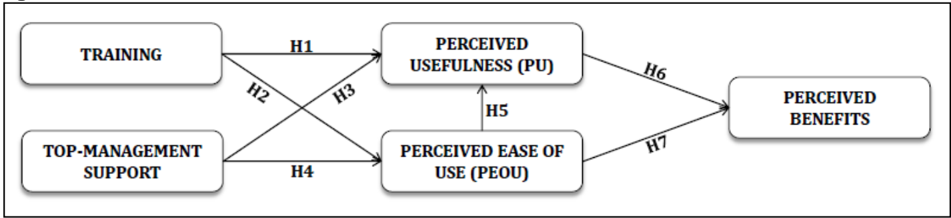
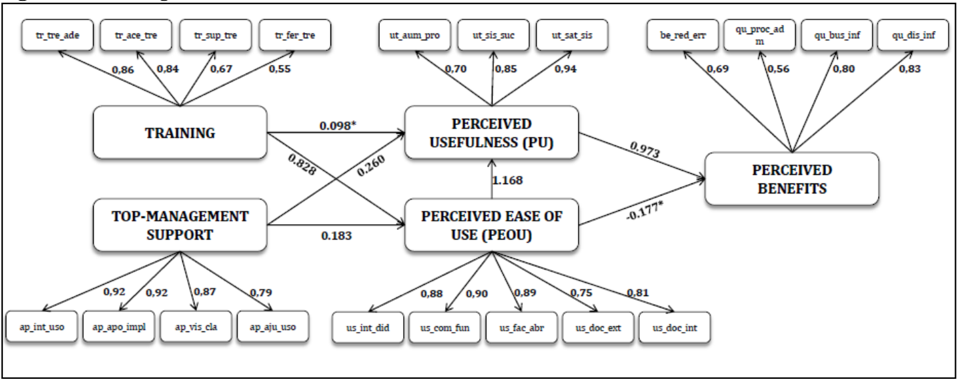
“Curiously, training ( β = 0.098; p ≥ 0.05) has no significant effect on the PU of EIS, ratifying the conclusion of Ramkumar and Jenamani (2015).”
BackgroundInfluentialDeterminants of Cloud Computing Adoption among SMEs in Sri Lanka: A Meta Theoretical Framework
Gamage, T. C. (2019) · International Journal of Asian Social Science · doi:10.18488/journal.1.2019.92.189.203 · Cited by 20 · cited 4×
“The promotion of adequate training positively influences the user's perception of the ease of use, corroborating the findings of the literature (Davis, 1989; Gamage, 2019; Sa-bherwal et al., 2006; Silva, 2018).”
BackgroundResultInfluentialA Meta-Analysis of the Role of Environment-Based Voluntariness in Information Technology Acceptance
Wu, J., & Lederer, A. L. (2009) · Journal of the Association for Information Systems · Cited by 17
Participatory Design for Public Services. Innovation in Public Administration
Sinni, G. (2017) · The Design Journal · doi:10.1080/14606925.2017.1352841 · Cited by 11 · cited 1×
“In this scenario, innovation was one of the primary mechanisms capable of ensuring the efficiency of Public Administration (Sinni, 2017).”
BackgroundEffective Performance Monitoring: A Necessary Condition for Public Sector Reform
Mayne, J. W., & Zapico-Goñi, E. (2017) · Routledge eBooks · doi:10.4324/9781315124681-2 · Cited by 11 · cited 2×
“The development and use of IT in the public sector defined how the Public Administration treated technology and how it innovated and modernized the provision of services to society (Mayne & Zapico-Goñi, 2017).”
BackgroundMethodEffects of user perceptions of SAP ERP system on user learning and skills
Shim, S. J., & Shim, M. K. (2019) · Journal of Computing in Higher Education · doi:10.1007/s12528-019-09218-x · Cited by 9 · cited 1×
“Thus, the more practice on a system, the more the user’s perception towards ease of use (Shim & Shim, 2019).”
BackgroundDiscussing and Conceiving an Information and Technology Governance Model in Public Organizations
Luciano, E. M., Wiedenhöft, G. C., Macadar, M. A., & Pereira, G. V. (2017) · Integrated series on information systems/Integrated series in information systems · doi:10.1007/978-3-319-58978-7_1 · Cited by 8 · cited 1×
“The models of IT governance in public organizations present essential aspects for their implementation (Luciano et al., 2017).”
BackgroundSaab, F., Lira, W. R. C., Alves, C. D. S., Bermejo, P. H. D. S., & Borges, G. H. A. (2018) · Advances in intelligent systems and computing · doi:10.1007/978-981-13-1165-9_43 · Cited by 8 · cited 3×
“Benefits and challenges of information technology for Public Administration The management trend that guides innovation in Public Administration is the expansion of the use of information technology as a means of promoting the efficiency of public services (Bertot et al., 2012; Borins, 2001; Saab et al., 2019).”
BackgroundLiddle, J. (2013) · Public Administration · doi:10.1111/padm.12009 · Cited by 7 · cited 2×
“The presence of factors inherited from the bureaucratic system, such as strict submission to the legal norm, hierarchical structures, and pre-established routines (Liddle, 2013), makes it challenging to insert innovative practices, especially related to the technological field.”
Background
Research works printed but not linked: 9
- [1]1. and challenges. Government Information Quarterly, 28(1), 54-65.
- [4]4. Bresser-Pereira, L. C. (2006). Da administração pública burocrática à gerencial. In Reforma do Estado e administração pública gerencial. (7 ed.). FGV.
- [10]10. Cunha, M. X. C., Souza Junior, M. F., Dornelas, J. S., & Maiad, C. F. M. (2011). Análise da Implantação dos Sistemas de Informação em uma Instituição Federal de Ensino de Alagoas à Luz da Teoria Institucio- nal. Revista de Administração, Contabilidade e Economia da Fundace, 2(2), 1-16.
- [18]18. Hussein, L. A., Baharudin, A. S., Jayaraman, K., & Kiumarsi, S. (2019). B2B e-commerce technology fac- tors with mediating effect perceived usefulness in Jordanian manufacturing SMES. Journal of Engi- neering Science and Technology, 14(1), 411-429.
- [27]27. Luciano, Edimara Mezzomo, Wiedenhöft, G. C., & Santos, F. P. dos. (2018). Promoting social participa- tion through digital governance: Identifying barriers in the brazilian public administration. Proceed- ings of the 19th Annual International Conference on Digital Government Research: Governance in the Data Age, 1-9.
- [35]35. Oliveira, L. C. P., Faleiros, S. M., & Diniz, E. H. (2015). Sistemas de informação em políticas sociais des- centralizadas: Uma análise sobre a coordenação federativa e práticas de gestão. , 49(1), 23-46. Re- vista de Administração Pública-RAP, 49(1), 23-46.
- [40]40. Reis, A. L. N., & Neto, J. S. (2019). Critical success factors in implementing information technology gov- ernance in federal public administration. Revista Do Servico Publico, 70(4), 609-630.
- [42]42. Rusu, L., & Viscusi, G. (2017). Information Technology Governance in Public Organizations: Theory and Practice (Vol. 38). Springer.
- [47]47. Secchi, L. (2009). Modelos organizacionais e reformas da administração pública. Revista de Admin- istração Pública, 43(2), 347-369.
Cited by
Data Quality in the Age of AI: A Review of Governance, Ethics, and the FAIR Principles
Guillen-Aguinaga, M., Aguinaga-Ontoso, E., Guillen-Aguinaga, L., Guillen-Grima, F., & Aguinaga-Ontoso, I. (2025) · Data · doi:10.3390/data10120201 · Cited by 37
“Government sector research shows that information technology alone does not ensure data quality [158,159].”
Melo, C. O., Luft, M. C. M. S., & Rocha, R. O. (2021) · Contextus - Revista Contemporânea de Economia e Gestão · doi:10.19094/contextus.2021.61445 · Cited by 15
“…2016), with limited analysis of the managerial aspect of this process in educational institutions (Klug & Bai, 2015; Eze, Awa, Okoye, Emecheta & Anazodo, 2015; Tashkandi & Al-Jabri, 2015; Silva et al., 2020), making this discussion relevant in the context of a Brazilian educational institution.”
BackgroundKoerich, A. B., Dutra, A. R. D. A., Guerra, J. B. S. O. D. A., & Casagrande, J. L. (2023) · Interações (Campo Grande) · doi:10.20435/inter.v24i3.3646 · Cited by 16
Koerich, A. B., Mussi, C. C., Guerra, J. B. S. O. D. A., & Casagrande, J. L. (2025) · The Electronic Journal of Information Systems in Developing Countries · doi:10.1002/isd2.70018 · Cited by 5
Koerich, A. B., Soares, S. V., Martins, C., & Casagrande, J. L. (2022) · CONTECSI - International Conference on Information Systems and Technology Management · doi:10.5748/18contecsi/com/gov/6844 · Cited by 1
Metadata
- Authors
- Silva, M. D. S. T., Correia, S. É. N., Machado, P. D. A., & Oliveira, V. M. D.
- Affiliations
- Universidade Federal de Campina Grande (BR)
- ORCID
- Venue
- Teoria e Prática em Administração
- Publisher
- Universidade Federal da Paraíba
- Published
- 2020-08-07
- Volume
- 10
- Issue
- 2
- Pages
- 138-153
- ISSN
- 2238-104X (ISSN-L)
- OpenAlex
- W3048927036
- Semantic Scholar
- 8ea5f50a4e636f71c4a101665fbc523e088d47a4
- Cited by
- 8
- References
- 55
- Citations by year
- 2025: 2 · 2024: 1 · 2023: 3 · 2022: 1 · 2021: 1
- FWCI
- 1.24
- Type
- journal article
- Language
- pt
- Open access
- diamond
- doi.org
- Licence
- cc-by
- Locations
- Teoria e Prática em Administração (publishedVersion, cc-by)
- DOAJ (DOAJ: Directory of Open Access Journals) (submittedVersion, cc-by-sa)
- Topics
- Social Sciences › Decision Sciences › Information Systems and Management › Technology Adoption and User Behaviour
- Social Sciences › Political Science and International Relations › E-Government and Public Services
- Social Sciences › Business, Management and Accounting › Management Information Systems › Information Systems Theories and Implementation
- Keywords
- information technology adoption, public administration, organizational factors, perceived usefulness, perceived ease of use, perceived benefits, top management support, employee training, electronic information systems, technology acceptance, Federal University of Campina Grande
About these checks
Registry, retraction, Cites and statistics results are computed, not judged, with one exception: a printed reference that no index lists is read once by a model before it counts as a citation error. Claims are extracted by a model and kept only when their quote appears verbatim in the text; each cited source is then checked, with a model’s help, for whether it says what the claim relies on. Those verdicts can be wrong — read the claim’s quote and the cited source before relying on one.
Statistics and arithmetic are recomputed, not judged.
Confidence bands are shown only for fields calibrated on our annotated test set. None is calibrated yet, so no band is shown.
What counts as a claim ›How we measure confidence ›How we check this ›
Are you an author, or do you see a problem with this page? Request a review
Data sources
Bibliographic data: Semantic Scholar, OpenAlex, Crossref.
Contains information from the Semantic Scholar Academic Graph Datasets, made available under the ODC Attribution License (ODC-BY 1.0).
Semantic Scholar’s data is described in: Kinney, R., et al. (2023). The Semantic Scholar Open Data Platform. arXiv:2301.10140.
