

The DOI matches its Crossref record; 292 of the 292 references it cites were found in a registry or an index.
HCN Channels Modulators: The Need for Selectivity
Open accessAbstract
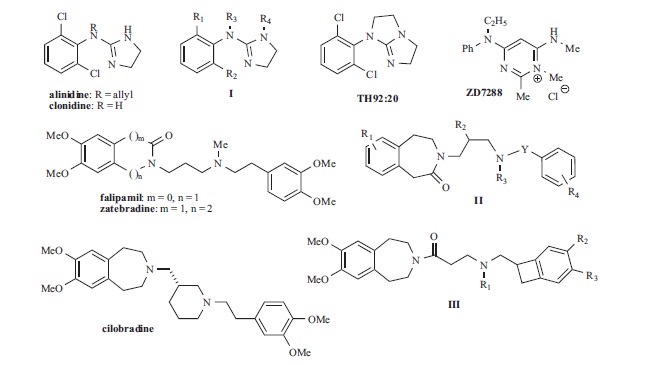
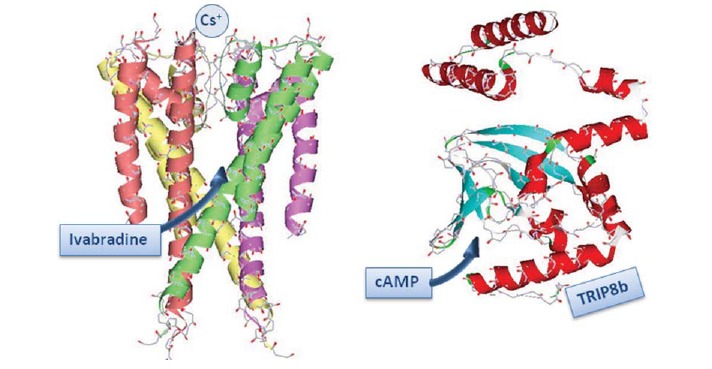
Hyperpolarization-activated, cyclic nucleotide-gated (HCN) channels, the molecular correlate of the hyperpolarization-activated current (If/Ih), are membrane proteins which play an important role in several physiological processes and various pathological conditions. In the Sino Atrial Node (SAN) HCN4 is the target of ivabradine, a bradycardic agent that is, at the moment, the only drug which specifically blocks If. Nevertheless, several other pharmacological agents have been shown to modulate HCN channels, a property that may contribute to their therapeutic activity and/or to their side effects. HCN channels are considered potential targets for developing drugs to treat several important pathologies, but a major issue in this field is the discovery of isoform-selective compounds, owing to the wide distribution of these proteins into the central and peripheral nervous systems, heart and other peripheral tissues. This survey is focused on the compounds that have been shown, or have been designed, to interact with HCN channels and on their binding sites, with the aim to summarize current knowledge and possibly to unveil useful information to design new potent and selective modulators.
Overview
The claims and statistics of this paper haven’t been checked yet.
Free: it reads the open-access text and checks the first 5 claims that cite a source we can check. Create a free account to check every claim.
Integrity signals
Registry
Cites
Statistics
Figures






Verification
Claims the paper makes
The claims and statistics of this paper haven’t been checked yet.
Free: it reads the open-access text and checks the first 5 claims that cite a source we can check. Create a free account to check every claim.
Claims other papers make about this one
Each is checked against this paper’s own text: does it say what the citing paper says it does?
The source backs part of the claim, not all of it — or backs it for a different population, condition or comparison.
In the citing paper
“Current pharmacology still lacks truly isoform-selective HCN modulators, which constrains both inference and dosing [296,297].”
From Synaptic Plasticity—Intrinsic Excitability and Antidepressant Discovery (2026) · cites this paper as [297]
Experimental — accuracy not yet measured
Self-check
Percentages, sums and reported differences re-computed from the paper’s own numbers.
The self-check needs the paper’s full text.
Citations
Cites
McDonagh, T. A., Metra, M., Adamo, M., Gardner, R. S., Baumbach, A., Böhm, M., Burri, H., Butler, J., Čelutkienė, J., Chioncel, O., et al. (2021) · European Heart Journal · doi:10.1093/eurheartj/ehab670 · Cited by 19,442
Ahmed, A., Jorna, T., & Bhandari, S. (2016) · Nephron · doi:10.1159/000447068 · Cited by 11,717
ESC Guidelines for the diagnosis and treatment of acute and chronic heart failure 2012
Authors/Task Force Members, McMurray, J. J. V., Adamopoulos, S., Anker, S. D., Auricchio, A., Böhm, M., Dickstein, K., Falk, V., Filippatos, G., Fonseca, C., et al. (2012) · European Heart Journal · doi:10.1093/eurheartj/ehs104 · Cited by 6,879
The Structure of the Potassium Channel: Molecular Basis of K + Conduction and Selectivity
Doyle, D. A., Cabral, J. M., Pfuetzner, R. A., Kuo, A., Gulbis, J. M., Cohen, S. L., Chait, B. T., & MacKinnon, R. (1998) · Science · doi:10.1126/science.280.5360.69 · Cited by 6,807
ESC Guidelines for the Diagnosis and Treatment of Acute and Chronic Heart Failure 2008
Dickstein, K., Authors/Task Force Members, Cohen-Solal, A., Filippatos, G., McMurray, J. J. V., Ponikowski, P., Poole-Wilson, P. A., Strömberg, A., van Veldhuisen, D. J., Atar, D., et al. (2008) · European Journal of Heart Failure · doi:10.1016/j.ejheart.2008.08.005 · Cited by 3,512
Ivabradine and outcomes in chronic heart failure (SHIFT): a randomised placebo-controlled study
Swedberg, K., Komajda, M., Böhm, M., Borer, J. S., Ford, I., Dubost-Brama, A., Lerebours, G., & Tavazzi, L. (2010) · The Lancet · doi:10.1016/s0140-6736(10)61198-1 · Cited by 2,563
Heart Rate, Life Expectancy and the Cardiovascular System: Therapeutic Considerations
Boudoulas, K. D., Borer, J. S., & Boudoulas, H. (2015) · Cardiology · doi:10.1159/000435947 · Cited by 1,938
Crystal structure and mechanism of a calcium-gated potassium channel
Jiang, Y., Lee, A., Chen, J., Cadene, M., Chait, B. T., & MacKinnon, R. (2002) · Nature · doi:10.1038/417515a · Cited by 1,332
Danshen: An Overview of Its Chemistry, Pharmacology, Pharmacokinetics, and Clinical Use
Zhou, L., Zuo, Z., & Chow, M. S. S. (2005) · The Journal of Clinical Pharmacology · doi:10.1177/0091270005282630 · Cited by 1,274 · cited 1×
“Indeed, a decrease of sinus rhythm, among many other effects, has been reported for this drug [197].”
BackgroundQueer Current and Pacemaker: The Hyperpolarization-Activated Cation Current in Neurons
Pape, H.-C. (1996) · Annual Review of Physiology · doi:10.1146/annurev.ph.58.030196.001503 · Cited by 1,151 · cited 1×
“Relative permeability to sodium and potassium is 1:3/1:5, which leads to a calculated reversal potential between -25 and -40 mV [53].”
Background
Research works printed but not linked: 1
- [231]Opthof T. The membrane current(If) in human atrial cells: implications for atrial arrhythmias. Cardiovasc. Res. 1998 38 3 537 540 9747423
Cited by
Davis, M. J., Earley, S., Li, Y.-S., & Chien, S. (2023) · Physiological Reviews · doi:10.1152/physrev.00053.2021 · Cited by 273
Sartiani, L., Mannaioni, G., Masi, A., Novella Romanelli, M., & Cerbai, E. (2017) · Pharmacological Reviews · doi:10.1124/pr.117.014035 · Cited by 143
“In the following discussion, only compounds used in the clinic are included; for a more comprehensive list, see Romanelli et al. (2016).”
BackgroundSelf-citationPathophysiological Mechanisms in Migraine and the Identification of New Therapeutic Targets
Haanes, K. A., & Edvinsson, L. I. (2019) · CNS Drugs · doi:10.1007/s40263-019-00630-6 · Cited by 114
Santoro, B., & Shah, M. M. (2020) · Annual Review of Pharmacology and Toxicology · doi:10.1146/annurev-pharmtox-010919-023356 · Cited by 108
Cardiac and neuronal HCN channelopathies
Rivolta, I., Binda, A., Masi, A., & DiFrancesco, J. C. (2020) · Pflügers Archiv - European Journal of Physiology · doi:10.1007/s00424-020-02384-3 · Cited by 96
Self-citation
Metadata
- Authors
- Novella Romanelli, M., Sartiani, L., Masi, A., Mannaioni, G., Manetti, D., Mugelli, A., & Cerbai, E.
- Affiliations
- University of Florence (IT)
- Venue
- Current Topics in Medicinal Chemistry
- Publisher
- Bentham Science Publishers Ltd.
- Published
- 2016-04-29
- Volume
- 16
- Issue
- 16
- Pages
- 1764-1791
- ISSN
- 1568-0266 (ISSN-L)
- PMC
- PMC5374843
- OpenAlex
- W2298251224
- Cited by
- 73
- References
- 290
- Citations by year
- 2026: 1 · 2025: 9 · 2024: 8 · 2023: 5 · 2022: 6 · 2021: 13 · 2020: 11 · 2019: 11 · 2018: 6 · 2017: 3
- FWCI
- 0.60
- Type
- journal article
- Language
- en
- Open access
- bronze
- doi.org
- Locations
- Current Topics in Medicinal Chemistry (publishedVersion)
- PubMed Central (publishedVersion, cc-by-nc)
- PubMed (publishedVersion)
- Florence Research (University of Florence) (submittedVersion)
- Topics
- Life Sciences › Biochemistry, Genetics and Molecular Biology › Molecular Biology › Ion channel regulation and function
- Health Sciences › Medicine › Cardiology and Cardiovascular Medicine › Cardiac electrophysiology and arrhythmias
- Life Sciences › Biochemistry, Genetics and Molecular Biology › Molecular Biology › Nicotinic Acetylcholine Receptors Study
- Keywords
- HCN channels, hyperpolarization-activated current, HCN4, ivabradine, drug design, sinoatrial node, cardiac pacemaker, bradycardic agents, adverse effects
- MeSH terms
- Animals, Humans, Drug Design, Molecular Structure, Membrane Transport Modulators, Hyperpolarization-Activated Cyclic Nucleotide-Gated Channels
About these checks
Registry, retraction, Cites and statistics results are computed, not judged, with one exception: a printed reference that no index lists is read once by a model before it counts as a citation error. Claims are extracted by a model and kept only when their quote appears verbatim in the text; each cited source is then checked, with a model’s help, for whether it says what the claim relies on. Those verdicts can be wrong — read the claim’s quote and the cited source before relying on one.
Statistics and arithmetic are recomputed, not judged.
Confidence bands are shown only for fields calibrated on our annotated test set. None is calibrated yet, so no band is shown.
What counts as a claim ›How we measure confidence ›How we check this ›
Are you an author, or do you see a problem with this page? Request a review
How to cite
Cite CoChat for the checks on this page, and the paper for its own findings.
- This page
- CoChat. (2026). Citation check: HCN Channels Modulators: The Need for Selectivity. https://app.cochat.ai/papers/10.2174/1568026616999160315130832
- The paper
- Novella Romanelli, M., Sartiani, L., Masi, A., Mannaioni, G., Manetti, D., Mugelli, A., & Cerbai, E. (2016). HCN Channels Modulators: The Need for Selectivity. Current Topics in Medicinal Chemistry. https://doi.org/10.2174/1568026616999160315130832
Data sources
Bibliographic data: Semantic Scholar, OpenAlex, Crossref.
Contains information from the Semantic Scholar Academic Graph Datasets, made available under the ODC Attribution License (ODC-BY 1.0).
Semantic Scholar’s data is described in: Kinney, R., et al. (2023). The Semantic Scholar Open Data Platform. arXiv:2301.10140.
