

Factors Influencing Patients’ Intentions to Use Diabetes Management Apps Based on an Extended Unified Theory of Acceptance and Use of Technology Model: Web-Based Survey
Open accessPublished version of a preprint
The DOI matches its Crossref record; 82 of the 82 references it cites were found in a registry or an index.
Abstract
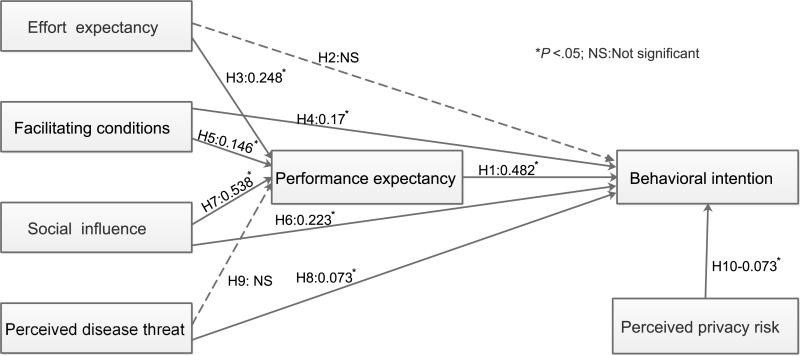
Background: Diabetes poses heavy social and economic burdens worldwide. Diabetes management apps show great potential for diabetes self-management. However, the adoption of diabetes management apps by diabetes patients is poor. The factors influencing patients’ intention to use these apps are unclear. Understanding the patients’ behavioral intention is necessary to support the development and promotion of diabetes app use. Objective: This study aimed to identify the determinants of patients’ intention to use diabetes management apps based on an integrated theoretical model. Methods: The hypotheses of our research model were developed based on an extended Unified Theory of Acceptance and Use of Technology (UTAUT). From April 20 to May 20, 2019, adult patients with diabetes across China, who were familiar with diabetes management apps, were surveyed using the Web-based survey tool Sojump. Structural equation modeling was used to analyze the data. Results: A total of 746 participants who met the inclusion criteria completed the survey. The fitness indices suggested that the collected data fit well with the research model. The model explained 62.6% of the variance in performance expectancy and 57.1% of the variance in behavioral intention. Performance expectancy and social influence had the strongest total effects on behavioral intention (β=0.482; P=.001). Performance expectancy (β=0.482; P=.001), social influence (β=0.223; P=.003), facilitating conditions (β=0.17; P=.006), perceived disease threat (β=0.073; P=.005), and perceived privacy risk (β=–0.073; P=.012) had direct effects on behavioral intention. Additionally, social influence, effort expectancy, and facilitating conditions had indirect effects on behavioral intention that were mediated by performance expectancy. Social influence had the highest indirect effects among the three constructs (β=0.259; P=.001). Conclusions: Performance expectancy and social influence are the most important determinants of the intention to use diabetes management apps. Health care technology companies should improve the usefulness of apps and carry out research to provide clinical evidence for the apps’ effectiveness, which will benefit the promotion of these apps. Facilitating conditions and perceived privacy risk also have an impact on behavioral intention. Therefore, it is necessary to improve facilitating conditions and provide solid privacy protection. Our study supports the use of UTAUT in explaining patients’ intention to use diabetes management apps. Context-related determinants should also be taken into consideration.
Overview
The claims and statistics of this paper haven’t been checked yet.
Free: it reads the open-access text and checks the first 5 claims that cite a source we can check. Create a free account to check every claim.
Integrity signals
Registry
Cites
Statistics
Figures
Verification
Claims the paper makes
The claims and statistics of this paper haven’t been checked yet.
Free: it reads the open-access text and checks the first 5 claims that cite a source we can check. Create a free account to check every claim.
Claims other papers make about this one
Each is checked against this paper’s own text: does it say what the citing paper says it does?
The source backs part of the claim, not all of it — or backs it for a different population, condition or comparison.
In the citing paper
“The Chinese versions of these scales were shown to be reliable and valid among Chinese adults [32].”
From Applying the Unified Theory of Acceptance and Use of Technology to Identify Factors Associated With Intention to Use Teledelivered Supportive Care Among Recently Diagnosed Breast Cancer Survivors During COVID-19 in Hong Kong: Cross-Sectional Survey (2024) · cites this paper as [32]
Experimental — accuracy not yet measured
Self-check
Percentages, sums and reported differences re-computed from the paper’s own numbers.
The self-check needs the paper’s full text.
Citations
Cites
The theory of planned behavior
Ajzen, I. (1991) · Organizational Behavior and Human Decision Processes · doi:10.1016/0749-5978(91)90020-t · Cited by 134,657 · cited 1×
“…of the Theory of Reasoned Action to deal with behaviors over which people have incomplete volitional control Theory of planned behavior (TPB) [42,43] Extrinsic Motivation, Intrinsic Motivation Widely used in psychology to explain human behavior Motivational model [44,45] Attitude Toward…”
User Acceptance of Information Technology: Toward A Unified View1
Venkatesh, V., Morris, M. G., Davis, G. B., & Davis, F. D. (2003) · MIS Quarterly · doi:10.2307/30036540 · Cited by 45,035 · cited 9×
“Performance expectancy, which is similar to perceived usefulness in the TAM, is defined as the degree to which use of a specific technology benefits users [37].”
InfluentialVenkatesh, V., Thong, J. Y. L., & Xu, X. (2012) · MIS Quarterly · doi:10.2307/41410412 · Cited by 15,756 · cited 7×
“Performance expectancy, which is similar to perceived usefulness in the TAM, is defined as the degree to which use of a specific technology benefits users [37].”
InfluentialEfficacy of the Theory of Planned Behaviour: A meta‐analytic review
Armitage, C. J., & Conner, M. (2001) · British Journal of Social Psychology · doi:10.1348/014466601164939 · Cited by 9,970 · cited 3×
“Attitude Toward Behavior, Subjective Norm, Perceived Behavioral Control Extension of the Theory of Reasoned Action to deal with behaviors over which people have incomplete volitional control Theory of planned behavior (TPB) [42,43]”
Moore, G. C., & Benbasat, I. (1991) · Information Systems Research · doi:10.1287/isre.2.3.192 · Cited by 9,150 · cited 1×
“Relative Advantage, Ease of Use, Image, Visibility, Compatibility, Results Demonstrability, Voluntariness of Use Grounded from sociology, this model has been applied to a wide range of innovations, such as information systems Diffusion of innovations theory [48]”
MethodUnderstanding information technology usage: a test of competing models
Taylor, S., & Todd, P. A. (1995) · Information Systems Research · doi:10.1287/isre.6.2.144 · Cited by 8,815 · cited 3×
“Attitude Toward Behavior, Subjective Norm, Perceived Behavioral Control, Perceived Usefulness A hybrid model of the TPB and TAM Combined TAM and TPB [46]”
The Health Belief Model: a decade later.
Janz, N. K., & Becker, M. H. (1984) · Health Education Quarterly · doi:10.1177/109019818401100101 · Cited by 8,437 · cited 2×
“The model has been widely employed to predict health behavioral intentions [36,63,64].”
Method10-year follow-up of intensive glucose control in type 2 diabetes
Holman, R. R., Paul, S. K., Bethel, M. A., Matthews, D. R., & Neil, H. A. W. (2008) · New England Journal of Medicine · doi:10.1056/nejmoa0806470 · Cited by 7,751 · cited 1×
“Optimal glycemic control can prevent diabetes-related complications [3].”
IDF Diabetes Atlas: Global estimates of diabetes prevalence for 2017 and projections for 2045
Cho, N. H., Shaw, J. E., Karuranga, S., Huang, Y., da Rocha Fernandes, J. D., Ohlrogge, A. W., & Malanda, B. (2018) · Diabetes Research and Clinical Practice · doi:10.1016/j.diabres.2018.02.023 · Cited by 7,283 · cited 2×
“Nearly 5 million deaths in the adult population were caused by diabetes in 2017 [1].”
BackgroundComputer Self-Efficacy: Development of a Measure and Initial Test
Compeau, D. R., & Higgins, C. A. (1995) · MIS Quarterly · doi:10.2307/249688 · Cited by 6,553 · cited 1×
“Outcome Expectations - personal, Self-efficacy, Affect, Anxiety Widely used in social behaviors, this model was also applied to information technologies Social cognitive theory [49]”
Method
Cited by
Young, A. T., Amara, D., Bhattacharya, A., & Wei, M. L. (2021) · The Lancet Digital Health · doi:10.1016/s2589-7500(21)00132-1 · Cited by 400
Portz, J. D., Bayliss, E. A., Bull, S., Boxer, R. S., Bekelman, D. B., Gleason, K., & Czaja, S. (2019) · Journal of Medical Internet Research · doi:10.2196/11604 · Cited by 313
C.C., S., & Prathap, S. K. (2020) · International Journal of Pervasive Computing and Communications · doi:10.1108/ijpcc-06-2020-0069 · Cited by 195
Aini, Q., Manongga, D., Rahardja, U., Sembiring, I., & Li, Y.-M. (2024) · International Journal of Human-Computer Interaction · doi:10.1080/10447318.2024.2357860 · Cited by 368
“Zhang et al. (2019) research has brought a robust and significant correlation between PE and user intentions, particularly in patients utilizing diabetes management applications.”
Octavius, G. S., & Antonio, F. (2021) · International Journal of Telemedicine and Applications · doi:10.1155/2021/6698627 · Cited by 138
“Future studies could include other constructs such as habit [48] and social influence [63], which positively and significantly affect behavioural intention in the respective study.”
BackgroundResultInfluential
Metadata
- Authors
- Zhang, Y., Liu, C., Luo, S., Xie, Y., Liu, F., Li, X., & Zhou, Z.
- Affiliations
- Central South University (CN)
- Corresponding author
- Zhou, Zhiguang
- Venue
- Journal of Medical Internet Research
- Publisher
- JMIR Publications Inc.
- Published
- 2019-08-13
- Volume
- 21
- Issue
- 8
- Pages
- e15023
- ISSN
- 1438-8871 (ISSN-L)
- PMC
- PMC6711042
- OpenAlex
- W2962977514
- Cited by
- 207
- References
- 82
- Citations by year
- 2026: 13 · 2025: 29 · 2024: 29 · 2023: 52 · 2022: 38 · 2021: 33 · 2020: 12 · 2019: 1
- FWCI
- 28.63
- Type
- journal article
- Language
- en
- Open access
- gold
- doi.org
- Licence
- cc-by
- Locations
- Journal of Medical Internet Research (publishedVersion, cc-by)
- Europe PMC (PubMed Central) (publishedVersion, cc-by)
- PubMed Central (publishedVersion, cc-by)
- PubMed (publishedVersion)
- DOAJ (DOAJ: Directory of Open Access Journals) (submittedVersion, cc-by-sa)
- Topics
- Health Sciences › Health Professions › General Health Professions › Mobile Health and mHealth Applications
- Social Sciences › Decision Sciences › Information Systems and Management › Technology Adoption and User Behaviour
- Health Sciences › Health Professions › Health Information Management › Health, Technology, Consumer Behavior
- Keywords
- diabetes self-management, technology acceptance, behavioral intention, extended UTAUT, performance expectancy, social influence, perceived privacy risk, facilitating conditions, effort expectancy, mobile health
- MeSH terms
- Adolescent, Adult, Diabetes Mellitus, Female, Humans, Male, Middle Aged, Surveys and Questionnaires, Internet, Biomedical Technology, Intention, Young Adult, Mobile Applications
About these checks
Registry, retraction, Cites and statistics results are computed, not judged, with one exception: a printed reference that no index lists is read once by a model before it counts as a citation error. Claims are extracted by a model and kept only when their quote appears verbatim in the text; each cited source is then checked, with a model’s help, for whether it says what the claim relies on. Those verdicts can be wrong — read the claim’s quote and the cited source before relying on one.
Statistics and arithmetic are recomputed, not judged.
Confidence bands are shown only for fields calibrated on our annotated test set. None is calibrated yet, so no band is shown.
What counts as a claim ›How we measure confidence ›How we check this ›
Are you an author, or do you see a problem with this page? Request a review
Data sources
Bibliographic data: Semantic Scholar, OpenAlex, Crossref.
Contains information from the Semantic Scholar Academic Graph Datasets, made available under the ODC Attribution License (ODC-BY 1.0).
Semantic Scholar’s data is described in: Kinney, R., et al. (2023). The Semantic Scholar Open Data Platform. arXiv:2301.10140.
