

The DOI matches its Crossref record; 7 of the 7 references it cites were found in a registry or an index.
Video Narratives Intervention Among Stroke Survivors: Feasibility and Acceptability Study of a Randomized Controlled Trial
Published version of a preprint
Abstract
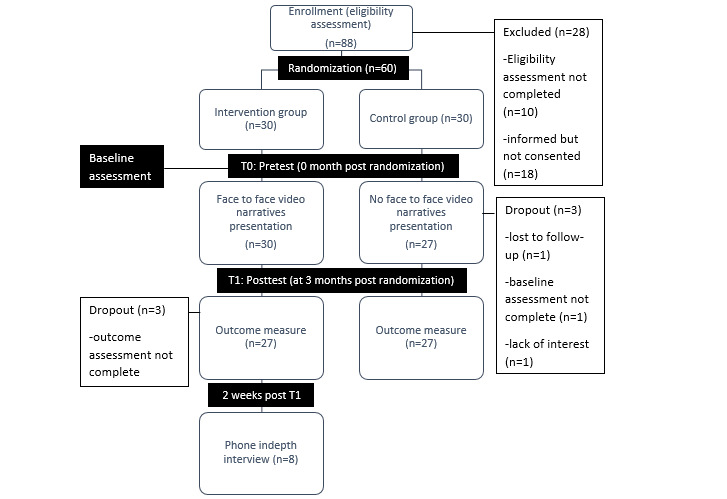
Background: A large number of stroke survivors worldwide suffer from moderate to severe disability. In Malaysia, long-term uncontrolled stroke risk factors lead to unforeseen rates of recurrent stroke and a growing incidence of stroke occurrence across ages, predominantly among the elderly population. This situation has motivated research efforts focused on tapping into patient education, especially related to patient self-efficacy of understanding and taking medication appropriately. Video narratives integrated with health belief model constructs have demonstrated potential impacts as an aide to patient education efforts. Objective: The aim of this study was to investigate the feasibility and acceptability of study procedures based on a randomized controlled trial protocol of a video narratives intervention among poststroke patients. We also aimed to obtain preliminary findings of video narratives related to medication understanding and use self-efficacy (MUSE) and blood pressure control. Methods: A parallel group randomized controlled trial including a control group (without video viewing) and an intervention group (with video viewing) was conducted by researchers at a neurology outpatient clinic on poststroke patients (N=54). Baseline data included patients’ sociodemographic characteristics, medical information, and all outcome measures. Measurements of MUSE and blood pressure following the trial were taken during a 3-month follow-up period. Feasibility of the trial was assessed based on recruitment and study completion rates along with patients’ feedback on the burden of the study procedures and outcome measures. Acceptability of the trial was analyzed qualitatively. Statistical analysis was applied to ascertain the preliminary results of video narratives. Results: The recruitment rate was 60 out of 117 patients (51.3%). Nevertheless, the dropout rate of 10% was within the acceptable range. Patients were aged between 21 and 74 years. Nearly 50 of the patients (>85%) had adequate health literacy and exposure to stroke education. Most of the patients (>80%) were diagnosed with ischemic stroke, whereby the majority had primary hypertension. The technicalities of randomization and patient approach were carried out with minimal challenge and adequate patient satisfaction. The video contents received good responses with respect to comprehension and simplicity. Moreover, an in-depth phone interview with 8 patients indicated that the video narratives were considered to be useful and inspiring. These findings paralleled the preliminary findings of significant improvement within groups in MUSE (P=.001) and systolic blood pressure control (P=.04). Conclusions: The queries and feedback from each phase in this study have been acknowledged and will be taken forward in the full trial. Trial Registration: Australian New Zealand Clinical Trials Registry ACTRN 12618000174280; https://www.anzctr.org.au/Trial/Registration/TrialReview.aspx?id=373554
Overview
The claims and statistics of this paper haven’t been checked yet.
Run the check — free, no account needed. It reads the open-access text and checks the sources it cites.
Integrity signals
Registry
Cites
Statistics
Figures
Verification
Claims the paper makes
The claims and statistics of this paper haven’t been checked yet.
Run the check — free, no account needed. It reads the open-access text and checks the sources it cites.
Claims other papers make about this one
Each is checked against this paper’s own text: does it say what the citing paper says it does?
In the citing paper
“Using symbols, language, and local values in culturally adapted approaches has been shown to increase participant engagement and boost the overall effectiveness of interventions (Appalasamy et al., 2020;Karibwende et al., 2023).”
From Effectiveness Of Narrative Therapy In Addressing Psychological Challenges: A Systematic Review Of Randomised Controlled Trials (2026) · cites this paper as Appalasamy et al., 2020
In the citing paper
“No adverse effects or declines in treatment adherence were observed during the intervention period.”
From Effectiveness Of Narrative Therapy In Addressing Psychological Challenges: A Systematic Review Of Randomised Controlled Trials (2026) · cites this paper as Appalasamy et al. (2020)
In the citing paper
“It promotes psychological empowerment, self-reflection, and the restructuring of meaning, helping participants shift from stories of suffering to those of hope and healing (Appalasamy et al., 2020;Fan et al., 2021).”
From Effectiveness Of Narrative Therapy In Addressing Psychological Challenges: A Systematic Review Of Randomised Controlled Trials (2026) · cites this paper as Appalasamy et al., 2020
In the citing paper
“The intervention significantly improved medication self-efficacy (mean difference = 4.3, p = .002)and enhanced patients' psychological control (p < .05).”
From Effectiveness Of Narrative Therapy In Addressing Psychological Challenges: A Systematic Review Of Randomised Controlled Trials (2026) · cites this paper as Appalasamy et al. (2020)
Self-check
Percentages, sums and reported differences re-computed from the paper’s own numbers.
The self-check needs the paper’s full text.
Citations
Cites
Using thematic analysis in psychology
Braun, V., & Clarke, V. (2006) · Qualitative Research in Psychology · doi:10.1191/1478088706qp063oa · Cited by 194,414
Considerations in determining sample size for pilot studies
Hertzog, M. A. (2008) · Research in Nursing & Health · doi:10.1002/nur.20247 · Cited by 2,337
Medication Adherence: WHO Cares?
Brown, M. T., & Bussell, J. K. (2011) · Mayo Clinic Proceedings · doi:10.4065/mcp.2010.0575 · Cited by 1,928
The role and interpretation of pilot studies in clinical research
Leon, A. C., Davis, L. L., & Kraemer, H. C. (2011) · Journal of Psychiatric Research · doi:10.1016/j.jpsychires.2010.10.008 · Cited by 1,917 · cited 1×
“Moreover, a feasibility study without inferential results does not necessarily require a power analysis [29].”
BackgroundMoltu, C., Stefansen, J., Svisdahl, M., & Veseth, M. (2012) · Disability and Rehabilitation · doi:10.3109/09638288.2012.656792 · Cited by 1,247
Initial Scale Development: Sample Size for Pilot Studies
Johanson, G. A., & Brooks, G. P. (2010) · Educational and Psychological Measurement · doi:10.1177/0013164409355692 · Cited by 1,012 · cited 1×
“Therefore, we estimated the sample size based on practical considerations and experience of the researchers [30,31].”
BackgroundNarratives and cancer communication
Green, M. C. (2006) · Journal of Communication · doi:10.1111/j.1460-2466.2006.00288.x · Cited by 682
Research works printed but not linked: 57
- Brown, C, 2006, Narrative Therapy: Making Meaning, Making Lives
- 10.2337/diaspect.17.4.219 · DOI
- Baldick, C, 2015, The Oxford Dictionary of Literary Terms, 10.1093/acref/9780198715443.001.0001 · DOI
- 10.1080/10810730903528017 · DOI
- 10.1097/00006205-200500001-00007 · DOI
- 10.1186/1472-6963-10-77 · DOI
- 10.1558/cam.v8i1.17 · DOI
- 10.1177/1524839916658023 · DOI
- 10.1177/2333393616646518 · DOI
- 10.1097/tld.0000000000000066 · DOI
- 10.1016/j.jstrokecerebrovasdis.2015.07.025 · DOI
- 10.1111/j.1747-4949.2010.00478.x · DOI
- 10.1016/S0140-6736(11)60325-5 · DOI · Paper page
- 10.2196/14399 · DOI
- 10.1111/j.1939-0025.1987.tb03541.x · DOI · Paper page
- 10.1007/s10433-011-0176-6 · DOI
- 10.1136/bmjopen-2017-016814 · DOI
- 10.1097/md.0000000000002417 · DOI
- 10.2147/PPA.S151053 · DOI
- Bandura, A, 1977, Social Learning Theory, 384
- 10.1177/1090198104263660 · DOI · Paper page
- 10.1177/109019818801500203 · DOI · Paper page
- 10.1016/j.pec.2011.04.029 · DOI
- 10.1016/j.pec.2014.06.015 · DOI
- 10.1371/journal.pone.0192155 · DOI
- 10.1097/md.0000000000010876 · DOI
- 10.2196/11539 · DOI
- 10.21236/ada098530 · DOI
- 10.1016/j.jneb.2015.08.012 · DOI
- 10.1007/s11606-008-0833-4 · DOI
- 10.1016/j.pec.2010.06.029 · DOI
- 10.1016/j.pec.2016.12.011 · DOI
- 10.1310/RED5-V47T-8MJN-JY9H · DOI
- 10.1016/j.jpsychores.2005.10.020 · DOI · Paper page
- 10.1016/s0022-3999(99)00057-4 · DOI · Paper page
- 10.1136/bmj.305.6846.160 · DOI
- 10.1016/j.joa.2015.10.003 · DOI
- Norfazilah, A, 2013, Malays Fam Physician, 8, 19
- 10.1016/j.vhri.2017.12.010 · DOI
- Sararaks, S, 2005, Med J Malaysia, 60, 163
- 10.1001/jama.2010.896 · DOI
- 10.1161/STROKEAHA.116.014458 · DOI
- Alexander, W, 2013, Pharm Therapeut, 38, 225
- 10.1007/s11906-013-0401-0 · DOI
- 10.1016/s0895-4356(98)00109-7 · DOI · Paper page
- 10.1111/j.1553-2712.2008.00326.x · DOI
- 10.1111/jmwh.12111 · DOI
- 10.1177/1524839916658023 · DOI
- 10.7326/0003-4819-154-2-201101180-00004 · DOI
- 10.1371/journal.pone.0171952 · DOI
- 10.1007/s00198-011-1533-1 · DOI
- 10.1016/j.pec.2007.08.010 · DOI
- 10.1080/08870446.2018.1508686 · DOI
- 10.3928/21650799-20120625-04 · DOI
- 10.1001/jama.2014.10057 · DOI · Paper page
- Hassan, ZA, 2006, Malays Fam Physician, 1, 70
- 10.1093/heapro/dat058 · DOI
Cited by
Sorted by citations
Permatasari, D. P., Windarwati, H. D., & Lestari, R. (2026) · Indigenous: Jurnal Ilmiah Psikologi · doi:10.23917/indigenous.v11i1.13778
Metadata
- Authors
- Appalasamy, J. R., Joseph, J. P., Seeta Ramaiah, S., Md Zain, A. Z., Quek, K. F., & Tha, K. K.
- ORCID
- Venue
- JMIR Aging
- Publisher
- JMIR Publications Inc.
- Published
- 2020-07-10
- Volume
- 3
- Issue
- 2
- Pages
- e17182
- ISSN
- 2561-7605
- PMC
- PMC7382013
- Cited by
- 16
- References
- 7
- Language
- en
About these checks
Registry, retraction, Cites and statistics results are computed, not judged, with one exception: a printed reference that no index lists is read once by a model before it counts as a citation error. Claims are extracted by a model and kept only when their quote appears verbatim in the text; each cited source is then checked, with a model’s help, for whether it says what the claim relies on. Those verdicts can be wrong — read the claim’s quote and the cited source before relying on one.
Statistics and arithmetic are recomputed, not judged.
Confidence bands are shown only for fields calibrated on our annotated test set. None is calibrated yet, so no band is shown.
What counts as a claim ›How we measure confidence ›How we check this ›
Are you an author, or do you see a problem with this page? Request a review
