

Artificial Intelligence for Caregivers of Persons With Alzheimer’s Disease and Related Dementias: Systematic Literature Review
Open accessPublished version of a preprint
The DOI matches its Crossref record; 54 of the 54 references it cites were found in a registry or an index.
Abstract
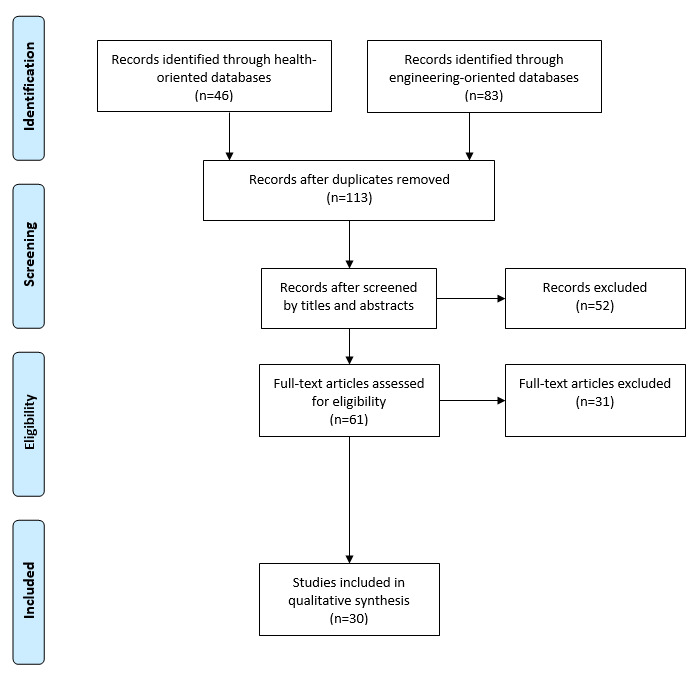
Background: Artificial intelligence (AI) has great potential for improving the care of persons with Alzheimer’s disease and related dementias (ADRD) and the quality of life of their family caregivers. To date, however, systematic review of the literature on the impact of AI on ADRD management has been lacking. Objective: This paper aims to (1) identify and examine literature on AI that provides information to facilitate ADRD management by caregivers of individuals diagnosed with ADRD and (2) identify gaps in the literature that suggest future directions for research. Methods: Following the Preferred Reporting Items for Systematic Reviews and Meta-Analyses guidelines for conducting systematic literature reviews, during August and September 2019, we performed 3 rounds of selection. First, we searched predetermined keywords in PubMed, Cumulative Index to Nursing and Allied Health Literature Plus with Full Text, PsycINFO, IEEE Xplore Digital Library, and the ACM Digital Library. This step generated 113 nonduplicate results. Next, we screened the titles and abstracts of the 113 papers according to inclusion and exclusion criteria, after which 52 papers were excluded and 61 remained. Finally, we screened the full text of the remaining papers to ensure that they met the inclusion or exclusion criteria; 31 papers were excluded, leaving a final sample of 30 papers for analysis. Results: Of the 30 papers, 20 reported studies that focused on using AI to assist in activities of daily living. A limited number of specific daily activities were targeted. The studies’ aims suggested three major purposes: (1) to test the feasibility, usability, or perceptions of prototype AI technology; (2) to generate preliminary data on the technology’s performance (primarily accuracy in detecting target events, such as falls); and (3) to understand user needs and preferences for the design and functionality of to-be-developed technology. The majority of the studies were qualitative, with interviews, focus groups, and observation being their most common methods. Cross-sectional surveys were also common, but with small convenience samples. Sample sizes ranged from 6 to 106, with the vast majority on the low end. The majority of the studies were descriptive, exploratory, and lacking theoretical guidance. Many studies reported positive outcomes in favor of their AI technology’s feasibility and satisfaction; some studies reported mixed results on these measures. Performance of the technology varied widely across tasks. Conclusions: These findings call for more systematic designs and evaluations of the feasibility and efficacy of AI-based interventions for caregivers of people with ADRD. These gaps in the research would be best addressed through interdisciplinary collaboration, incorporating complementary expertise from the health sciences and computer science/engineering–related fields.
Overview
The claims and statistics of this paper haven’t been checked yet.
Free: it reads the open-access text and checks the first 5 claims that cite a source we can check. Create a free account to check every claim.
Integrity signals
Registry
Cites
Statistics
Figures
Verification
Claims the paper makes
The claims and statistics of this paper haven’t been checked yet.
Free: it reads the open-access text and checks the first 5 claims that cite a source we can check. Create a free account to check every claim.
Claims other papers make about this one
Each is checked against this paper’s own text: does it say what the citing paper says it does?
The cited source says what the claim attributes to it.
In the citing paper
“Xie et al [12] conducted a review on AI specifically for caregivers of persons with dementia, but did not report on any virtual agents for which an actual experiment had been conducted.”
From Voice-Enabled Intelligent Virtual Agents for People With Amnesia: Systematic Review (2022) · cites this paper as [12]
Self-check
Percentages, sums and reported differences re-computed from the paper’s own numbers.
The self-check needs the paper’s full text.
Citations
Cites
Preferred Reporting Items for Systematic Reviews and Meta-Analyses: the PRISMA statement
Moher, D., Liberati, A., Tetzlaff, J., Altman, D. G., & for the PRISMA Group (2009) · BMJ · doi:10.1136/bmj.b2535 · Cited by 83,823
Preferred Reporting Items for Systematic Reviews and Meta-Analyses: The PRISMA Statement
Moher, D., Liberati, A., Tetzlaff, J., Altman, D. G., & The PRISMA Group (2009) · PLoS Medicine · doi:10.1371/journal.pmed.1000097 · Cited by 64,042 · cited 1×
“The selection process is summarized in Figure 1 according to the PRISMA guidelines [50].”
Wang, G., Ma, R., Qiao, G., Wada, K., Aizawa, Y., & Satoh, T. (2015) · Integrative Medicine International · doi:10.1159/000368408 · Cited by 18,657
2019 Alzheimer’s disease facts and figures.
Alzheimer's Association (2019) · Alzheimer's & Dementia · doi:10.1016/j.jalz.2019.01.010 · Cited by 2,461
The Levels of Evidence and Their Role in Evidence-Based Medicine
Burns, P. B., Rohrich, R. J., & Chung, K. C. (2011) · Plastic and Reconstructive Surgery · doi:10.1097/prs.0b013e318219c171 · Cited by 2,155 · cited 3×
“In addition, we assessed levels of evidence reported in the 30 papers [51].”
BackgroundInfluentialArtificial Intelligence in Health Care: A Report From the National Academy of Medicine
Matheny, M. E., Whicher, D., & Thadaney Israni, S. (2020) · JAMA · doi:10.1001/jama.2019.21579 · Cited by 628
Advance Directives as Acts of Communication: A Randomized Controlled Trial
Ditto, P. H., Danks, J. H., Smucker, W. D., Bookwala, J., Coppola, K. M., Dresser, R., Fagerlin, A., Gready, R. M., Houts, R. M., Lockhart, L. K., et al. (2001) · Archives of Internal Medicine · doi:10.1001/archinte.161.3.421 · Cited by 407
The Oxford Handbook of Retirement
(2012) · Oxford University Press eBooks · doi:10.1093/oxfordhb/9780199746521.001.0001 · Cited by 374
Bharucha, A. J., Anand, V., Forlizzi, J., Dew, M. A., Reynolds, C. F., Stevens, S., & Wactlar, H. (2009) · The American Journal of Geriatric Psychiatry · doi:10.1097/jgp.0b013e318187dde5 · Cited by 350 · cited 1×
“Some attempts have been made to apply AI for persons with ADRD and their caregivers in order to improve patients’ daily functioning, quality of life, and well-being, as well as reduce caregiver burden (eg, social robots to facilitate social interaction and engagement, assistive robots to facilitate daily activities su…”
BackgroundMihailidis, A., Boger, J. N., Craig, T., & Hoey, J. (2008) · BMC Geriatrics · doi:10.1186/1471-2318-8-28 · Cited by 345 · cited 2×
“In assisting with daily activities, assistive AI devices helped reduce patients’dependence on caregivers [42,43].”
BackgroundeHealth Literacy Interventions for Older Adults: A Systematic Review of the Literature
Watkins, I., & Xie, B. (2014) · Journal of Medical Internet Research · doi:10.2196/jmir.3318 · Cited by 227 · cited 3×
“Some were common types of papers reporting nonempirical data (eg, literature reviews, book reviews, and columns/commentaries), which one would typically expect from searches of health sciences databases (as in prior reviews [17-19]).”
BackgroundMethodSelf-citationImproving Decision‐Making for Feeding Options in Advanced Dementia: A Randomized, Controlled Trial
Hanson, L. C., Carey, T. S., Caprio, A. J., Lee, T. J., Ersek, M., Garrett, J., Jackman, A., Gilliam, R., Wessell, K., & Mitchell, S. L. (2011) · Journal of the American Geriatrics Society · doi:10.1111/j.1532-5415.2011.03629.x · Cited by 218 · cited 1×
“Caregiving for persons with ADRD is stressful [6-10], and it can severely affect the caregiver’s own health and well-being [7].”
BackgroundBoger, J., Hoey, J., Poupart, P., Boutilier, C., Fernie, G., & Mihailidis, A. (2006) · IEEE Transactions on Information Technology in Biomedicine · doi:10.1109/titb.2006.864480 · Cited by 180 · cited 1×
“A total of 30 papers remained in the final sample [20-49].”
BackgroundWang, R. H., Sudhama, A., Begum, M., Huq, R., & Mihailidis, A. (2017) · International Psychogeriatrics · doi:10.1017/s1041610216001435 · Cited by 180 · cited 3×
“Some studies reported mixed results for feasibility and satisfaction, with some participants reporting that they liked the AI technology but others reporting that they did not [23,26,47,49].”
BackgroundResultOllivet, C., Guigui, C., Hervé, C., & Rialle, V. (2008) · Methods of Information in Medicine · doi:10.3414/me9102 · Cited by 139
Letting go: Family willingness to forgo life support
Swigart, V. A., Lidz, C. W., Butteworth, V., & Arnold, R. M. (1996) · Heart & Lung · doi:10.1016/s0147-9563(96)80051-3 · Cited by 128
Mihailidis, A., Barbenel, J. C., & Fernie, G. (2004) · Neuropsychological Rehabilitation · doi:10.1080/09602010343000156 · Cited by 113 · cited 2×
“In assisting with daily activities, assistive AI devices helped reduce patients’dependence on caregivers [42,43].”
BackgroundAbdollahi, H., Mollahosseini, A., Lane, J. T., & Mahoor, M. H. (2017) · 2017 IEEE-RAS 17th International Conference on Humanoid Robotics (Humanoids) · doi:10.1109/humanoids.2017.8246925 · Cited by 112 · cited 1×
“A total of 30 papers remained in the final sample [20-49].”
BackgroundMoyle, W., Arnautovska, U., Ownsworth, T., & Jones, C. (2017) · International Psychogeriatrics · doi:10.1017/s1041610217001776 · Cited by 107 · cited 1×
“Some attempts have been made to apply AI for persons with ADRD and their caregivers in order to improve patients’ daily functioning, quality of life, and well-being, as well as reduce caregiver burden (eg, social robots to facilitate social interaction and engagement, assistive robots to facilitate daily activities su…”
BackgroundPlanning End-of-Life Care for Patients with Dementia: Roles of Families and Health Professionals
Gessert, C. E., Forbes, S., & Bern‐Klug, M. (2001) · OMEGA - Journal of Death and Dying · doi:10.2190/2mt2-5gyu-gxvv-95ne · Cited by 104 · cited 1×
“However, these caregivers report being unprepared for their roles and responsibilities, uninformed about care options, and unsupported by professionals in their decision making [2-5].”
BackgroundMihailidis, A., Fernie, G. R., & Barbenel, J. C. (2001) · Assistive Technology · doi:10.1080/10400435.2001.10132031 · Cited by 94 · cited 1×
“A total of 30 papers remained in the final sample [20-49].”
BackgroundPerformance of daily activities by older adults with dementia: The role of an assistive robot
Begum, M., Wang, R., Huq, R., & Mihailidis, A. (2013) · 2013 IEEE 13th International Conference on Rehabilitation Robotics (ICORR) · doi:10.1109/icorr.2013.6650405 · Cited by 84 · cited 3×
“Some studies reported mixed results for feasibility and satisfaction, with some participants reporting that they liked the AI technology but others reporting that they did not [23,26,47,49].”
BackgroundResultTechnological Solutions for Older People with Alzheimer’s Disease: Review
Marešová, P., Tomsone, S., Lameski, P., Madureira, J., Mendes, A., Zdravevski, E., Chorbev, I., Trajkovik, V., Ellen, M., & Rodil, K. (2018) · Current Alzheimer Research · doi:10.2174/1567205015666180427124547 · Cited by 83 · cited 1×
“Some attempts have been made to apply AI for persons with ADRD and their caregivers in order to improve patients’ daily functioning, quality of life, and well-being, as well as reduce caregiver burden (eg, social robots to facilitate social interaction and engagement, assistive robots to facilitate daily activities su…”
Surrogate decision making for patients with end‐stage dementia
Jox, R. J., Denke, E., Hamann, J., Mendel, R., Förstl, H., & Borasio, G. D. (2011) · International Journal of Geriatric Psychiatry · doi:10.1002/gps.2820 · Cited by 74 · cited 1×
“Caregiving for persons with ADRD is stressful [6-10], and it can severely affect the caregiver’s own health and well-being [7].”
BackgroundRequirements gathering with alzheimer's patients and caregivers
Hawkey, K., Inkpen, K. M., Rockwood, K., McAllister, M., & Slonim, J. (2005) · Proceedings of the 7th international ACM SIGACCESS conference on Computers and accessibility · doi:10.1145/1090785.1090812 · Cited by 65 · cited 1×
“A total of 30 papers remained in the final sample [20-49].”
BackgroundDevelopment and Testing of a Decision Aid on Goals of Care for Advanced Dementia
Einterz, S. F., Gilliam, R., Chang Lin, F., McBride, J. M., & Hanson, L. C. (2014) · Journal of the American Medical Directors Association · doi:10.1016/j.jamda.2013.11.020 · Cited by 65 · cited 1×
“Caregiving for persons with ADRD is stressful [6-10], and it can severely affect the caregiver’s own health and well-being [7].”
BackgroundCzarnuch, S., & Mihailidis, A. (2011) · Gerontechnology · doi:10.4017/gt.2011.10.3.005.00 · Cited by 56 · cited 2×
“A total of 30 papers remained in the final sample [20-49].”
BackgroundHwang, A. S., Truong, K. N., Cameron, J. I., Lindqvist, E., Nygård, L., & Mihailidis, A. (2015) · BioMed Research International · doi:10.1155/2015/720483 · Cited by 54 · cited 2×
“There is a great need for AI technology to provide tailored assistance to meet these user needs [37].”
BackgroundAssistive Technology Addressing Safety Issues in Dementia: A Scoping Review
Gagnon‐Roy, M., Bourget, A., Stocco, S., Lemieux-Courchesne, A.-C., Kühne, N., & Provencher, V. (2017) · American Journal of Occupational Therapy · doi:10.5014/ajot.2017.025817 · Cited by 53 · cited 1×
“Some attempts have been made to apply AI for persons with ADRD and their caregivers in order to improve patients’ daily functioning, quality of life, and well-being, as well as reduce caregiver burden (eg, social robots to facilitate social interaction and engagement, assistive robots to facilitate daily activities su…”
BackgroundStirling, C., Leggett, S., Lloyd, B., Scott, J., Blizzard, L., Quinn, S., & Robinson, A. (2012) · BMC Medical Informatics and Decision Making · doi:10.1186/1472-6947-12-21 · Cited by 49 · cited 1×
“Caregiving for persons with ADRD is stressful [6-10], and it can severely affect the caregiver’s own health and well-being [7].”
BackgroundHwang, A., Truong, K., & Mihailidis, A. (2012) · Proceedings of the 6th International Conference on Pervasive Computing Technologies for Healthcare · doi:10.4108/icst.pervasivehealth.2012.248671 · Cited by 43
Advance care treatment plan (ACT-Plan) for African American family caregivers: A pilot study
Bonner, G. J., Wang, E., Wilkie, D. J., Ferrans, C. E., Dancy, B. L., & Watkins, Y. J. (2012) · Dementia · doi:10.1177/1471301212449408 · Cited by 38 · cited 1×
“Caregiving for persons with ADRD is stressful [6-10], and it can severely affect the caregiver’s own health and well-being [7].”
BackgroundBurleson, W., Lozano, C., Ravishankar, V., Lee, J., & Mahoney, D. F. (2018) · JMIR Medical Informatics · doi:10.2196/medinform.5587 · Cited by 38 · cited 2×
“Performance of the technology, measured primarily by accuracy in detecting target events, varied widely across different tasks, ranging from as low as 23% in detecting incorrect dressing events [28] to as high as 98% in detection of falls [46].”
BackgroundMethodKönig, A., Francis, L. E., Joshi, J., Robillard, J. M., & Hoey, J. (2017) · Journal of Rehabilitation and Assistive Technologies Engineering · doi:10.1177/2055668316685038 · Cited by 36
Collaboration of an assistive robot and older adults with dementia
Begum, M., Huq, R., Wang, R., & Mihailidis, A. (2015) · Gerontechnology · doi:10.4017/gt.2015.13.4.005.00 · Cited by 32 · cited 1×
“A total of 30 papers remained in the final sample [20-49].”
BackgroundIntervention Tailoring in Augmented Cognition Systems for Elders With Dementia
Navarro, R. F., Rodríguez, M. D., & Favela, J. (2013) · IEEE Journal of Biomedical and Health Informatics · doi:10.1109/jbhi.2013.2267542 · Cited by 29 · cited 1×
“A total of 30 papers remained in the final sample [20-49].”
BackgroundXie, B., Berkley, A., Kwak, J., Fleischmann, K. R., Champion, J. D., & Koltai, K. (2018) · SAGE Open Medicine · doi:10.1177/2050312118777517 · Cited by 28 · cited 3×
“Some were common types of papers reporting nonempirical data (eg, literature reviews, book reviews, and columns/commentaries), which one would typically expect from searches of health sciences databases (as in prior reviews [17-19]).”
BackgroundMethodSelf-citationSmart Homes Design for People with Dementia
Amiribesheli, M., & Bouchachia, A. (2015) · International Conference on Intelligent Environments (IE) · doi:10.1109/ie.2015.33 · Cited by 27 · cited 1×
“A total of 30 papers remained in the final sample [20-49].”
BackgroundDesigning for Reminiscence with People with Dementia
Edmeads, J., & Metatla, O. (2019) · CHI Conference Extended Abstracts on Human Factors in Computing Systems (CHI EA) · doi:10.1145/3290607.3313059 · Cited by 23 · cited 2×
“Mixed results were reported for the AI technology’s features, with some features easier to use and more popular than others [33].”
BackgroundResultXie, B., Huang, M., & Watkins, I. (2012) · Oxford University Press eBooks · doi:10.1093/oxfordhb/9780199746521.013.0150 · Cited by 19 · cited 3×
“Some were common types of papers reporting nonempirical data (eg, literature reviews, book reviews, and columns/commentaries), which one would typically expect from searches of health sciences databases (as in prior reviews [17-19]).”
BackgroundMethodSelf-citationThe Moral Underpinning of the Proxy-Provider Relationship: Issues of Trust and Distrust
Collopy, B. J. (1999) · The Journal of Law Medicine & Ethics · doi:10.1111/j.1748-720x.1999.tb01434.x · Cited by 18 · cited 1×
“However, these caregivers report being unprepared for their roles and responsibilities, uninformed about care options, and unsupported by professionals in their decision making [2-5].”
BackgroundInteractive Memories: technology-aided reminiscence therapy for people with dementia
Klein, P., & Uhlig, M. (2016) · International Conference on PErvasive Technologies Related to Assistive Environments (PETRA) · doi:10.1145/2910674.2935838 · Cited by 18
Users requirements in the design of a virtual agent for patients with dementia and their caregivers
de Jong, M., Stara, V., von Döllen, V., Bolliger, D., Heerink, M., & Evers, V. (2018) · Proceedings of the 4th EAI International Conference on Smart Objects and Technologies for Social Good · doi:10.1145/3284869.3284899 · Cited by 18
Is Home Health Technology Adequate for Proactive Self-care?
Mueller, M., Wiley, D., Tentler, A., Bocko, M., Chen, L., Leibovici, A., Quinn, J., Shar, A. O., Pentland, A. P., & Horwitz, C. (2007) · Methods of Information in Medicine · doi:10.3414/me9101 · Cited by 16 · cited 1×
“A total of 30 papers remained in the final sample [20-49].”
BackgroundAcceptance of Cognitive Games through Smart TV Applications in Patients with Parkinson's Disease
López, J. P., Martín, D., Moreno, F., Hernández-Peñaloza, G., Álvarez, F., Marín, M., Carrasco, L., & Burgos, M. (2018) · International Conference on PErvasive Technologies Related to Assistive Environments (PETRA) · doi:10.1145/3197768.3201553 · Cited by 15 · cited 2×
“A total of 30 papers remained in the final sample [20-49].”
BackgroundChang, S., & Sung, H. (2013) · The JBI Database of Systematic Reviews and Implementation Reports · doi:10.11124/jbisrir-2013-914 · Cited by 11
Augmentative alternative communication for Alzheimer's patients and families' using SAVION
Berenbaum, R. L. J., Lange, Y., & Abramowitz, L. (2011) · International Conference on PErvasive Technologies Related to Assistive Environments (PETRA) · doi:10.1145/2141622.2141677 · Cited by 11 · cited 1×
“A total of 30 papers remained in the final sample [20-49].”
BackgroundVirtual Reality Performance Platform for Learning about Dementia
Berezina‐Blackburn, V., Oliszewski, A., Cleaver, D. D., & Udakandage, L. (2018) · ACM Conference on Computer Supported Cooperative Work (CSCW) · doi:10.1145/3272973.3274043 · Cited by 11 · cited 2×
“Some studies reported mixed results for feasibility and satisfaction, with some participants reporting that they liked the AI technology but others reporting that they did not [23,26,47,49].”
BackgroundResultMATY: Designing An Assistive Robot for People with Alzheimer's
Simão, H., & Guerreiro, T. (2019) · CHI Conference Extended Abstracts on Human Factors in Computing Systems (CHI EA) · doi:10.1145/3290607.3313016 · Cited by 10
A smart system for home monitoring of people with cognitive impairment
Osamu, T., Ryu, T., Hayashida, A., Moshnyaga, V. G., Sakamoto, D., Imai, Y., & Shibata, T. (2014) · IEEE Canada International Humanitarian Technology Conference · doi:10.1109/ihtc.2014.7147550 · Cited by 7 · cited 2×
“Performance of the technology, measured primarily by accuracy in detecting target events, varied widely across different tasks, ranging from as low as 23% in detecting incorrect dressing events [28] to as high as 98% in detection of falls [46].”
BackgroundMethodAdvanced Bio-Feedback and Collaborative Techniques to Support Caregivers of Alzheimer Patients
Apostolidis, I., Καρακώστας, Α., Dimitriou, T., Tsiatsos, Τ., & Tsolaki, M. (2014) · International Conference on Intelligent Networking and Collaborative Systems (INCoS) · doi:10.1109/incos.2014.88 · Cited by 5 · cited 2×
“One of those studies reported a high dropout rate (65%) [22], making it difficult to interpret the study’s reported positive outcomes.”
BackgroundResultChan, J., & Nejat, G. (2011) · IEEE RO-MAN · doi:10.1109/roman.2011.6005275 · Cited by 5 · cited 2×
“One study reported preliminary evidence supporting limited efficacy of a social robot in reducing patients’ stress [29].”
BackgroundChen, W.-H. (2009) · International ACM SIGACCESS Conference on Computers and Accessibility (ASSETS) · doi:10.1145/1639642.1639711 · Cited by 4
Jean-Baptiste, E. M. D., & Mihailidis, A. (2017) · International Conference on Soft Computing & Machine Intelligence (ISCMI) · doi:10.1109/iscmi.2017.8279623 · Cited by 3
Cited by
Hajjo, R., Sabbah, D. A., Abusara, O. H., & Bawab, A. Q. A. (2022) · Diagnostics · doi:10.3390/diagnostics12122975 · Cited by 63
Robots in Assisted Living Facilities: Scoping Review
Trainum, K., Tunis, R., Xie, B., & Hauser, E. (2023) · JMIR Aging · doi:10.2196/42652 · Cited by 46
Self-citationLukkien, D., Stolwijk, N. E., Askari, S. I., Hofstede, B. M., Nap, H. H., Boon, W., Peine, A., Moors, E. H. M., & Minkman, M. M. N. (2024) · JMIR Nursing · doi:10.2196/55962 · Cited by 69
Trainum, K., Liu, J., Hauser, E., & Xie, B. (2024) · JMIR Aging · doi:10.2196/58629 · Cited by 41
“This lack of empirical reporting is a common limitation in health informatics research and has been noted in previous literature reviews on care robots [13] and artificial intelligence for caregivers of persons with Alzheimer disease [65].”
BackgroundSelf-citationRenn, B. N., Schurr, M. S., Zaslavsky, O., & Pratap, A. (2021) · Frontiers in Psychiatry · doi:10.3389/fpsyt.2021.734909 · Cited by 42
Metadata
- Authors
- Xie, B., Tao, C., Li, J., Hilsabeck, R. C., & Aguirre, A.
- Affiliations
- The University of Texas at Austin (US)
- The University of Texas Health Science Center at Houston (US)
- North Dakota State University (US)
- Corresponding author
- Xie, Bo
- Venue
- JMIR Medical Informatics
- Publisher
- JMIR Publications Inc.
- Published
- 2020-08-20
- Volume
- 8
- Issue
- 8
- Pages
- e18189
- ISSN
- 2291-9694 (ISSN-L)
- PMC
- PMC7471889
- OpenAlex
- W3036801208
- Semantic Scholar
- d1ee218b439251eb4a48270ea289e1f6820bdf9a
- Cited by
- 80
- References
- 54
- Citations by year
- 2026: 18 · 2025: 13 · 2024: 25 · 2023: 9 · 2022: 13 · 2021: 2
- FWCI
- 0.99
- Type
- journal article
- Language
- en
- Open access
- gold
- doi.org
- Licence
- cc-by
- Locations
- JMIR Medical Informatics (publishedVersion, cc-by)
- PubMed Central (publishedVersion, cc-by)
- PubMed (publishedVersion)
- DOAJ (DOAJ: Directory of Open Access Journals) (submittedVersion, cc-by-sa)
- Topics
- Health Sciences › Medicine › Psychiatry and Mental health › Dementia and Cognitive Impairment Research
- Health Sciences › Medicine › Geriatrics and Gerontology › Technology Use by Older Adults
- Physical Sciences › Computer Science › Computer Vision and Pattern Recognition › Context-Aware Activity Recognition Systems
- Keywords
- artificial intelligence, Alzheimer's disease and related dementias, family caregivers, caregiver burden, activities of daily living, assistive technology, feasibility and usability, fall detection, user needs and preferences, technology acceptance, dementia care, research gaps, AI-based interventions, caregiver quality of life, user satisfaction, technology performance evaluation, user-centered design, user-centered evaluation
About these checks
Registry, retraction, Cites and statistics results are computed, not judged, with one exception: a printed reference that no index lists is read once by a model before it counts as a citation error. Claims are extracted by a model and kept only when their quote appears verbatim in the text; each cited source is then checked, with a model’s help, for whether it says what the claim relies on. Those verdicts can be wrong — read the claim’s quote and the cited source before relying on one.
Statistics and arithmetic are recomputed, not judged.
Confidence bands are shown only for fields calibrated on our annotated test set. None is calibrated yet, so no band is shown.
What counts as a claim ›How we measure confidence ›How we check this ›
Are you an author, or do you see a problem with this page? Request a review
Data sources
Bibliographic data: Semantic Scholar, OpenAlex, Crossref.
Contains information from the Semantic Scholar Academic Graph Datasets, made available under the ODC Attribution License (ODC-BY 1.0).
Semantic Scholar’s data is described in: Kinney, R., et al. (2023). The Semantic Scholar Open Data Platform. arXiv:2301.10140.
