

The DOI matches its Crossref record; 23 of the 23 references it cites were found in a registry or an index.
Investigating Mental Health of US College Students During the COVID-19 Pandemic: Cross-Sectional Survey Study
Open accessPublished version of a preprint
Abstract
Background: Evidence suggests that the COVID-19 pandemic has generally increased levels of stress and depression among the public. However, the impact on college students in the United States has not been well-documented. Objective: This paper surveys the mental health status and severity of depression and anxiety of college students in a large university system in the United States during the COVID-19 pandemic. Methods: An online survey was conducted among undergraduate and graduate students recruited from Texas A&M University via email. The survey consisted of two standardized scales—the Patient Health Questionnaire-9 and the General Anxiety Disorder-7—for depression and anxiety, and additional multiple-choice and open-ended questions regarding stressors and coping mechanisms specific to COVID-19. Results: Among the 2031 participants, 48.14% (n=960) showed a moderate-to-severe level of depression, 38.48% (n=775) showed a moderate-to-severe level of anxiety, and 18.04% (n=366) had suicidal thoughts. A majority of participants (n=1443, 71.26%) indicated that their stress/anxiety levels had increased during the pandemic. Less than half of the participants (n=882, 43.25%) indicated that they were able to cope adequately with the stress related to the current situation. Conclusions: The proportion of respondents showing depression, anxiety, and/or suicidal thoughts is alarming. Respondents reported academic-, health-, and lifestyle-related concerns caused by the pandemic. Given the unexpected length and severity of the outbreak, these concerns need to be further understood and addressed.
Overview
The claims and statistics of this paper haven’t been checked yet.
Run the check — free, no account needed. It reads the open-access text and checks the sources it cites.
Integrity signals
Registry
Cites
Statistics
Figures
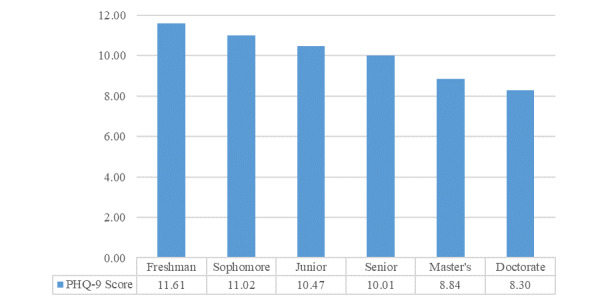
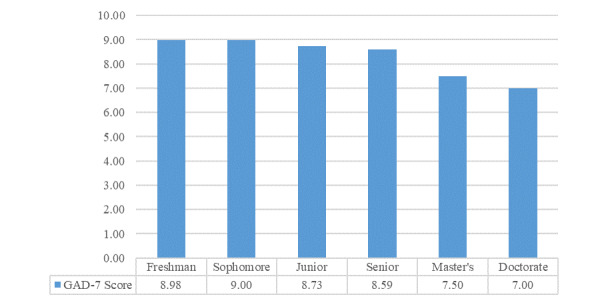
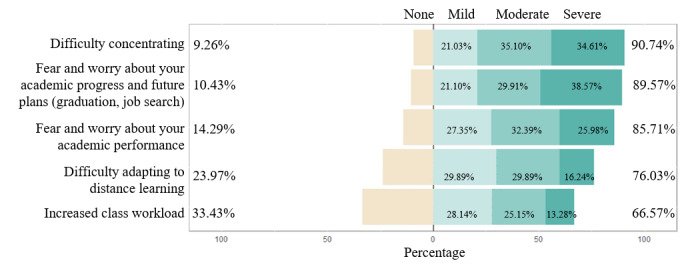
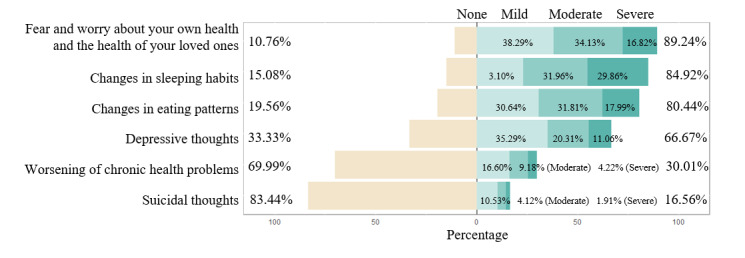
Verification
Claims the paper makes
The claims and statistics of this paper haven’t been checked yet.
Run the check — free, no account needed. It reads the open-access text and checks the sources it cites.
Claims other papers make about this one
Each is checked against this paper’s own text: does it say what the citing paper says it does?
The source backs part of the claim, not all of it — or backs it for a different population, condition or comparison.
In the citing paper
“Globally, students have expressed high distress levels, low engagement, and confidence in their academic performance and professional development in the wake of the COVID-19 pandemic [5, 6].”
From Supporting underrepresented students in health sciences: a fuzzy cognitive mapping approach to program evaluation (2024) · cites this paper as [6]
Experimental — accuracy not yet measuredThe cited source says what the claim attributes to it.
In the citing paper
“Of the 16 studies remaining, 15 were cross sectional studies and one was a cohort study [16, 19–33].”
From Mental Health Impact of COVID-19 among Children and College Students: A Systematic Review (2023) · cites this paper as [26]
The cited source says what the claim attributes to it.
In the citing paper
“Indeed research has indicated that the pandemic has a detrimental effect on university students’ mental health (Wang et al., 2020; Copeland et al., 2021; Gadosey et al., 2022; Birmingham et al., 2023).”
From The relationship between tolerance for uncertainty and academic adjustment: the mediating role of students’ psychological flexibility during COVID-19 (2023) · cites this paper as Wang et al., 2020
In the citing paper
“our findings of five studies on children and 16 studies on college students”
From Mental Health Impact of COVID-19 among Children and College Students: A Systematic Review (2023) · cites this paper as [26]
Self-check
Percentages, sums and reported differences re-computed from the paper’s own numbers.
The self-check needs the paper’s full text.
Citations
Cites
Wang, C., Pan, R., Wan, X., Tan, Y., Xu, L., Ho, C. S., & Ho, R. C. (2020) · International Journal of Environmental Research and Public Health · doi:10.3390/ijerph17051729 · Cited by 9,923
Guest, G., MacQueen, K., & Namey, E. (2012) · doi:10.4135/9781483384436 · Cited by 7,924
The PHQ-9: A New Depression Diagnostic and Severity Measure
Kroenke, K., & Spitzer, R. L. (2002) · Psychiatric Annals · doi:10.3928/0048-5713-20020901-06 · Cited by 5,898 · cited 1×
“The categories of severity range are minimal (0-4), mild (5-9), moderate (10-14), moderately severe (15-19), and severe (20-27) [11].”
BackgroundThe psychological impact of the COVID-19 epidemic on college students in China
Cao, W., Fang, Z., Hou, G., Han, M., Xu, X., Dong, J., & Zheng, J. (2020) · Psychiatry Research · doi:10.1016/j.psychres.2020.112934 · Cited by 5,843
Holmes, E. A., O'Connor, R. C., Perry, V. H., Tracey, I., Wessely, S., Arseneault, L., Ballard, C., Christensen, H., Cohen Silver, R., Everall, I., et al. (2020) · The Lancet Psychiatry · doi:10.1016/s2215-0366(20)30168-1 · Cited by 5,715
Löwe, B., Decker, O., Müller, S., Brähler, E., Schellberg, D., Herzog, W., & Herzberg, P. Y. (2008) · Medical Care · doi:10.1097/mlr.0b013e318160d093 · Cited by 4,527
Qiu, J., Shen, B., Zhao, M., Wang, Z., Xie, B., & Xu, Y. (2020) · General Psychiatry · doi:10.1136/gpsych-2020-100213 · Cited by 4,307
Effects of COVID-19 on College Students’ Mental Health in the United States: Interview Survey Study
Son, C., Hegde, S., Smith, A., Wang, X., & Sasangohar, F. (2020) · Journal of Medical Internet Research · doi:10.2196/21279 · Cited by 2,822
Self-citationGood practice in the conduct and reporting of survey research
Kelley, K. (2003) · International Journal for Quality in Health Care · doi:10.1093/intqhc/mzg031 · Cited by 2,162
Online mental health services in China during the COVID-19 outbreak
Liu, S., Yang, L., Zhang, C., Xiang, Y.-T., Liu, Z., Hu, S., & Zhang, B. (2020) · The Lancet Psychiatry · doi:10.1016/s2215-0366(20)30077-8 · Cited by 1,992
Suicide risk and prevention during the COVID-19 pandemic
Gunnell, D., Appleby, L., Arensman, E., Hawton, K., John, A., Kapur, N., Khan, M., O'Connor, R. C., Pirkis, J., Appleby, L., et al. (2020) · The Lancet Psychiatry · doi:10.1016/s2215-0366(20)30171-1 · Cited by 1,513
Iranian mental health during the COVID-19 epidemic
Zandifar, A., & Badrfam, R. (2020) · Asian Journal of Psychiatry · doi:10.1016/j.ajp.2020.101990 · Cited by 789
Persistence of mental health problems and needs in a college student population
Zivin, K., Eisenberg, D., Gollust, S. E., & Golberstein, E. (2009) · Journal of Affective Disorders · doi:10.1016/j.jad.2009.01.001 · Cited by 784
Huckins, J. F., daSilva, A. W., Wang, W., Hedlund, E., Rogers, C., Nepal, S. K., Wu, J., Obuchi, M., Murphy, E. I., Meyer, M. L., et al. (2020) · Journal of Medical Internet Research · doi:10.2196/20185 · Cited by 759
Addressing collegiate mental health amid COVID-19 pandemic
Zhai, Y., & Du, X. Y. (2020) · Psychiatry Research · doi:10.1016/j.psychres.2020.113003 · Cited by 702
Moccia, L., Janiri, D., Pepe, M., Dattoli, L., Molinaro, M., De Martin, V., Chieffo, D., Janiri, L., Fiorillo, A., Sani, G., et al. (2020) · Brain, Behavior, and Immunity · doi:10.1016/j.bbi.2020.04.048 · Cited by 605
College life is stressful today – Emerging stressors and depressive symptoms in college students
Acharya, L., Jin, L., & Collins, W. (2018) · Journal of American College Health · doi:10.1080/07448481.2018.1451869 · Cited by 410
US Public Concerns About the COVID-19 Pandemic From Results of a Survey Given via Social Media
Nelson, L. M., Simard, J. F., Oluyomi, A. O., Nava, V., Rosas, L. G., Bondy, M. L., & Linos, E. (2020) · JAMA Internal Medicine · doi:10.1001/jamainternmed.2020.1369 · Cited by 175
Zeng, Y., Wang, G., Xie, C., Hu, X., & Reinhardt, J. D. (2019) · Psychology, Health & Medicine · doi:10.1080/13548506.2019.1574358 · Cited by 161
Evaluation of an mHealth App (DeStressify) on University Students’ Mental Health: Pilot Trial
Lee, R. A., & Jung, M. E. (2018) · JMIR Mental Health · doi:10.2196/mental.8324 · Cited by 138
Psychological State of College Students During COVID-19 Epidemic
Liu, X., Liu, J., & Zhong, X. (2020) · SSRN Electronic Journal · doi:10.2139/ssrn.3552814 · Cited by 133
Improving and Restoring the Well-being and Resilience of Pharmacy Students during a Pandemic
Schlesselman, L. S., Cain, J. J., & DiVall, M. V. (2020) · American Journal of Pharmaceutical Education · doi:10.5688/ajpe8144 · Cited by 93
Nahas, A. R. F., Elkalmi, R., Al-Shami, A., & Elsayed, T. (2019) · Journal of Pharmacy And Bioallied Sciences · doi:10.4103/jpbs.jpbs_263_18 · Cited by 55 · cited 1×
“Our findings also show a higher proportion of respondents with depressive symptoms among students than findings in several recent studies in nonpandemic situations [17,18].”
Result
Research works printed but not linked: 1
- 2020, MAXQDA
Cited by
Sorted by citations
Fruehwirth, J. C., Biswas, S., & Perreira, K. M. (2021) · PLoS ONE · doi:10.1371/journal.pone.0247999 · Cited by 585
Charles, N. E., Strong, S. J., Burns, L. C., Bullerjahn, M. R., & Serafine, K. M. (2021) · Psychiatry Research · doi:10.1016/j.psychres.2021.113706 · Cited by 459
Li, Y., Wang, A., Wu, Y., Han, N., & Huang, H. (2021) · Frontiers in Psychology · doi:10.3389/fpsyg.2021.669119 · Cited by 441
Halat, D. H., Soltani, A., Dalli, R., Alsarraj, L., & Malki, A. M. (2023) · Journal of Clinical Medicine · doi:10.3390/jcm12134425 · Cited by 444
Suicide behaviors during the COVID-19 pandemic: A meta-analysis of 54 studies
Dubé, J. P., Smith, M. M., Sherry, S., Hewitt, P. L., & Stewart, S. H. (2021) · Psychiatry Research · doi:10.1016/j.psychres.2021.113998 · Cited by 312
Metadata
- Authors
- Wang, X., Hegde, S., Son, C., Keller, B., Smith, A., & Sasangohar, F.
- Affiliations
- Texas A&M University (US)
- Houston Methodist (US)
- Corresponding author
- Sasangohar, Farzan
- Venue
- Journal of Medical Internet Research
- Publisher
- JMIR Publications Inc.
- Published
- 2020-09-17
- Volume
- 22
- Issue
- 9
- Pages
- e22817
- ISSN
- 1438-8871 (ISSN-L)
- PMC
- PMC7505693
- OpenAlex
- W3084167506
- Cited by
- 1,463
- References
- 23
- Citations by year
- 2026: 69 · 2025: 132 · 2024: 247 · 2023: 361 · 2022: 395 · 2021: 251 · 2020: 5
- FWCI
- 101.09
- Type
- journal article
- Language
- en
- Open access
- gold
- doi.org
- Licence
- cc-by
- Locations
- Journal of Medical Internet Research (publishedVersion, cc-by)
- PubMed Central (publishedVersion, cc-by)
- PubMed (publishedVersion)
- DOAJ (DOAJ: Directory of Open Access Journals) (submittedVersion, cc-by-sa)
- Topics
- Social Sciences › Psychology › Clinical Psychology › COVID-19 and Mental Health
- Social Sciences › Psychology › Developmental and Educational Psychology › Student Stress and Coping
- Health Sciences › Medicine › Psychiatry and Mental health › Mental Health Treatment and Access
- Keywords
- COVID-19 pandemic, university students, mental health, depression, anxiety, suicidal ideation, stress, coping strategies, academic stress, health stress, lifestyle stress
- MeSH terms
- Betacoronavirus, COVID-19, SARS-CoV-2, Adolescent, Adult, Anxiety, Cross-Sectional Studies, Depression, Female, Health Surveys, Humans, Male, Mental Health, Pneumonia, Viral, Stress, Psychological, Students, Universities, Coronavirus Infections, Young Adult, Pandemics, Suicidal Ideation
About these checks
Registry, retraction, Cites and statistics results are computed, not judged, with one exception: a printed reference that no index lists is read once by a model before it counts as a citation error. Claims are extracted by a model and kept only when their quote appears verbatim in the text; each cited source is then checked, with a model’s help, for whether it says what the claim relies on. Those verdicts can be wrong — read the claim’s quote and the cited source before relying on one.
Statistics and arithmetic are recomputed, not judged.
Confidence bands are shown only for fields calibrated on our annotated test set. None is calibrated yet, so no band is shown.
What counts as a claim ›How we measure confidence ›How we check this ›
Are you an author, or do you see a problem with this page? Request a review
