

The DOI matches its Crossref record; 40 of the 40 references it cites were found in a registry or an index; none of the 28 sources its claims cite is checked for support yet.
Tweets, Apps, and Pods: Results of the 6-Month Mobile Pounds Off Digitally (Mobile POD) Randomized Weight-Loss Intervention Among Adults
Open accessAbstract
BACKGROUND: Previous interventions have shown promising results using theory-based podcasts to deliver a behavioral weight-loss intervention. OBJECTIVE: The objective of our study was to examine whether a combination of podcasting, mobile support communication, and mobile diet monitoring can assist people in weight loss. METHODS: In this 6-month, minimal contact intervention, overweight (n = 96, body mass index 32.6 kg/m(2)) adults were recruited through television advertisements and email listservs and randomly assigned to Podcast-only or Podcast+Mobile groups. Both groups received 2 podcasts per week for 3 months and 2 minipodcasts per week for months 3-6. In addition to the podcasts, the Podcast+Mobile group was also instructed to use a diet and physical activity monitoring application (app) on their mobile device and to interact with study counselors and other participants on Twitter. RESULTS: Weight loss did not differ by group at 6 months: mean -2.7% (SD 5.6%) Podcast+Mobile, n = 47; mean -2.7% (SD 5.1%) Podcast, n = 49; P = .98. Days/week of reported diet monitoring did not differ between Podcast+Mobile (mean 2.3, SD 1.9 days/week) and Podcast groups (mean 1.9, SD 1.7 days/week; P = .28) but method of monitoring did differ. Podcast+Mobile participants were 3.5 times more likely than the Podcast group to use an app to monitor diet (P = .01), whereas the majority of Podcast participants reported using the Web (14/41, 34%) or paper (12/41, 29%). There were more downloads per episode in the Podcast+Mobile group (1.4/person) than in the Podcast group (1.1/person; P < .001). The number of podcasts participants reported downloading over the 6-month period was significantly moderately correlated with weight loss in both the Podcast+Mobile (r = -.46, P = .001) and the Podcast (r = -.53, P < .001) groups. Podcast+Mobile participants felt more user control at 3 months (P = .02), but not at 6 months, and there was a trend (P = .06) toward greater elaboration among Podcast+Mobile participants. There were significant differences in reported source of social support between groups. More Podcast participants relied on friends (11/40, 28% vs 4/40, 10%; P = .045) whereas Podcast+Mobile participants relied on online sources (10/40, 25% vs 0/40; P = .001). CONCLUSIONS: Results confirm and extend previous findings showing a minimally intensive weight-loss intervention can be delivered via podcast, but prompting and mobile communication via Twitter and monitoring app without feedback did not enhance weight loss. TRIAL REGISTRATION: Clinicaltrials.gov NCT01139255; http://clinicaltrials.gov/ct2/show/NCT01139255 (Archived by WebCite at http://www.webcitation.org/625OjhiDy).
Overview
AI snapshot
Written from the paper’s full text.
TL;DR
In a 6-month randomized trial among 96 overweight/obese adults, a podcast-only weight-loss intervention produced modest weight loss, and adding a mobile diet-monitoring app plus Twitter prompts/support did not improve weight loss. Both groups lost a mean 2.7% of body weight at 6 months (P = .98 between groups).
Key findings
Weight loss did not differ by group at 6 months: mean –2.7% (SD 5.6%) Podcast+Mobile, n = 47; mean –2.7% (SD 5.1%) Podcast, n = 49; P = .98. Most participants did not achieve a 5% weight loss, the level described as clinically meaningful.
- Days/week of reported diet monitoring did not differ between Podcast+Mobile (mean 2.3, SD 1.9) and Podcast groups (mean 1.9, SD 1.7; P = .28), but method of monitoring did: Podcast+Mobile participants were 3.5 times more likely to use an app to monitor diet (P = .01), whereas most Podcast participants used the Web (14/41, 34%) or paper (12/41, 29%).
- Podcast downloads were higher in the Podcast+Mobile group (1.4/person vs 1.1/person; P < .001), and reported number of podcasts downloaded over 6 months was moderately correlated with weight loss in both Podcast+Mobile (r = –.46, P = .001) and Podcast (r = –.53, P < .001) groups.
- Social support source differed: more Podcast participants relied on friends (11/40, 28% vs 4/40, 10%; P = .045), while more Podcast+Mobile participants relied on online sources (10/40, 25% vs 0/40; P = .001). Podcast+Mobile participants felt more user control at 3 months (P = .02), but not at 6 months, and there was a trend toward greater elaboration at 6 months (P = .06).
Methods
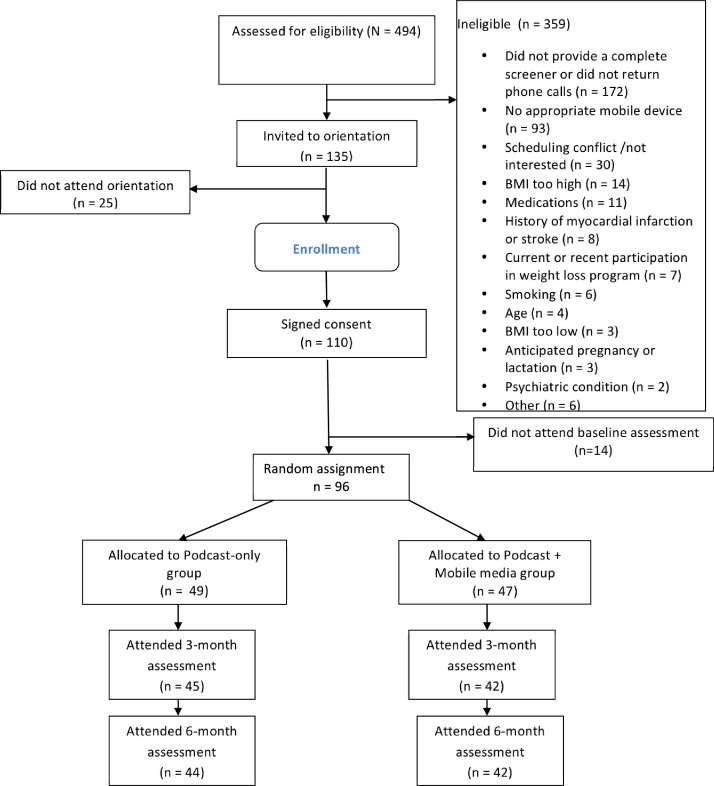
Six-month minimal-contact randomized trial; overweight/obese adults (BMI 25–45 kg/m2, 18–60 years) were recruited in Raleigh-Durham, North Carolina, via television advertisements and email listservs, required an Internet-capable mobile device, and were randomized to Podcast-only (n = 49) or Podcast+Mobile (n = 47). Both groups received 2 podcasts/week for 3 months and 2 minipodcasts/week for months 3–6; Podcast+Mobile was also instructed to use the FatSecret Calorie Counter app and Twitter, with the study coordinator sending 2 messages/day.
- Weight was measured at baseline, 3 months, and 6 months; measures included online questionnaires, 2 unannounced 24-hour dietary recalls, Paffenbarger Physical Activity Questionnaire, Weight Efficacy Life-Style Questionnaire, Eating Behavior Inventory, information-processing variables, weekly self-report, and objective podcast downloads. Analyses used intention-to-treat with baseline observation carried forward except for some 6-month-only variables assessed in completers; tests included t tests, repeated-measures ANOVA, logistic regression, chi-square, and Pearson correlation in SPSS 16.0.
Limitations
Stated: the study population was mostly white and female; the 6-month duration allowed examination of initial weight loss but not weight-loss maintenance; groups differed at baseline in prior health-related podcast/app experience; and noncompleters were younger and less likely to be white.
- Stated: the intervention did not include study counselor feedback or tailoring of messages/information, and the self-monitoring app and Twitter were poorly used; Twitter was not viewed as useful for weight-loss efforts (mean 3.4, SD 1.8, out of 7), and posting declined over time.
- Evident from the text: neither participants nor investigators were blinded to treatment assignment; dietary monitoring and Twitter use were largely self-reported; and months 3–6 overlapped with US holidays while the intervention dose was reduced, which the authors suggest may have affected outcomes.
Model-written summary. Check it against the paper before relying on it.
Integrity signals
Registry
Cites
Statistics
Figures
Verification
Claims the paper makes
60 Own result · 20 Not checked yet · 17 Own interpretation · 15 Own method · 12 No basis given · 2 Check pending
A result the paper reports from its own data — it cites no other source for it, so there is none to check. The quote shows it is in the paper.
In the paper
“whereas Podcast+Mobile participants relied on online sources (10/40, 25% vs 0/40; P = .001).”
§ Tweets, Apps, and Pods: Results of the 6-Month Mobile Pounds Off Digitally (Mobile POD) Randomized Weight-Loss Intervention Among Adults > Abstract > Results
plain- Asserted: passes — The authors put it forward as true.
- Checkable: passes — It can be checked against evidence.
- Load-bearing: unclear — It is unclear whether the paper’s conclusions depend on it.
- Based: passes — The paper gives a reason why it holds.
A result the paper reports from its own data — it cites no other source for it, so there is none to check. The quote shows it is in the paper.
In the paper
“The number of podcasts participants reported downloading over the 6-month period was significantly moderately correlated with weight loss in both the Podcast+Mobile (r = –.46, P = .001) and the Podcast (r = –.53, P < .001) groups.”
- Also stated in: § Results · plain
“The number of podcasts participants reported downloading over the 6-month period was significantly moderately correlated with weight loss in both the Podcast+Mobile (r = –.46, P = .001) and the Podcast (r = –.53, P < .001) groups.”
§ Tweets, Apps, and Pods: Results of the 6-Month Mobile Pounds Off Digitally (Mobile POD) Randomized Weight-Loss Intervention Among Adults > Abstract > Results
plaincorrelational- Asserted: passes — The authors put it forward as true.
- Checkable: passes — It can be checked against evidence.
- Load-bearing: unclear — It is unclear whether the paper’s conclusions depend on it.
- Based: passes — The paper gives a reason why it holds.
- Also stated in: § Results · plain
A result the paper reports from its own data — it cites no other source for it, so there is none to check. The quote shows it is in the paper.
In the paper
“Days/week of reported diet monitoring did not differ between Podcast+Mobile (mean 2.3, SD 1.9 days/week) and Podcast groups (mean 1.9, SD 1.7 days/week; P = .28) but method of monitoring did differ.”
- Also stated in: § Results · plain
“There was no difference between groups in the mean days per week that dietary intake or physical activity were self-reported by participants.”
§ Tweets, Apps, and Pods: Results of the 6-Month Mobile Pounds Off Digitally (Mobile POD) Randomized Weight-Loss Intervention Among Adults > Abstract > Results
plain- Asserted: passes — The authors put it forward as true.
- Checkable: passes — It can be checked against evidence.
- Load-bearing: unclear — It is unclear whether the paper’s conclusions depend on it.
- Based: passes — The paper gives a reason why it holds.
- Rests on an assumption: Self-reported days per week of diet monitoring accurately reflects actual monitoring frequency.
- Also stated in: § Results · plain
A result the paper reports from its own data — it cites no other source for it, so there is none to check. The quote shows it is in the paper.
In the paper
“More Podcast participants relied on friends (11/40, 28% vs 4/40, 10%; P = .045)”
§ Tweets, Apps, and Pods: Results of the 6-Month Mobile Pounds Off Digitally (Mobile POD) Randomized Weight-Loss Intervention Among Adults > Abstract > Results
plain- Asserted: passes — The authors put it forward as true.
- Checkable: passes — It can be checked against evidence.
- Load-bearing: unclear — It is unclear whether the paper’s conclusions depend on it.
- Based: passes — The paper gives a reason why it holds.
A result the paper reports from its own data — it cites no other source for it, so there is none to check. The quote shows it is in the paper.
In the paper
“There were significant differences in reported source of social support between groups.”
§ Tweets, Apps, and Pods: Results of the 6-Month Mobile Pounds Off Digitally (Mobile POD) Randomized Weight-Loss Intervention Among Adults > Abstract > Results
plain- Asserted: passes — The authors put it forward as true.
- Checkable: passes — It can be checked against evidence.
- Load-bearing: unclear — It is unclear whether the paper’s conclusions depend on it.
- Based: passes — The paper gives a reason why it holds.
A result the paper reports from its own data — it cites no other source for it, so there is none to check. The quote shows it is in the paper.
In the paper
“Weight loss did not differ by group at 6 months: mean –2.7% (SD 5.6%) Podcast+Mobile, n = 47; mean –2.7% (SD 5.1%) Podcast, n = 49; P = .98.”
- Also stated in: § Results · plain
“The percentage weight loss at 3 or 6 months did not differ between the groups.”
§ Tweets, Apps, and Pods: Results of the 6-Month Mobile Pounds Off Digitally (Mobile POD) Randomized Weight-Loss Intervention Among Adults > Abstract > Results
plainn = 47- Asserted: passes — The authors put it forward as true.
- Checkable: passes — It can be checked against evidence.
- Load-bearing: passes — The paper’s conclusions depend on it.
- Based: passes — The paper gives a reason why it holds.
- Also stated in: § Results · plain
A result the paper reports from its own data — it cites no other source for it, so there is none to check. The quote shows it is in the paper.
In the paper
“but method of monitoring did differ.”
- Also stated in: § Results · plain
“The method of self-monitoring, however, differed by group.”
§ Tweets, Apps, and Pods: Results of the 6-Month Mobile Pounds Off Digitally (Mobile POD) Randomized Weight-Loss Intervention Among Adults > Abstract > Results
plain- Asserted: passes — The authors put it forward as true.
- Checkable: passes — It can be checked against evidence.
- Load-bearing: unclear — It is unclear whether the paper’s conclusions depend on it.
- Based: passes — The paper gives a reason why it holds.
- Rests on an assumption: Self-reported method of diet monitoring accurately reflects the actual method used.
- Also stated in: § Results · plain
A result the paper reports from its own data — it cites no other source for it, so there is none to check. The quote shows it is in the paper.
In the paper
“Podcast+Mobile participants were 3.5 times more likely than the Podcast group to use an app to monitor diet (P = .01)”
- Also stated in: § Results · plain
“Podcast+Mobile participants were 3.5 times more likely than the Podcast group to use an app to monitor diet over the course of the study (95% confidence interval, 1.29–8.84; P = .01)”
§ Tweets, Apps, and Pods: Results of the 6-Month Mobile Pounds Off Digitally (Mobile POD) Randomized Weight-Loss Intervention Among Adults > Abstract > Results
plaincorrelational- Asserted: passes — The authors put it forward as true.
- Checkable: passes — It can be checked against evidence.
- Load-bearing: unclear — It is unclear whether the paper’s conclusions depend on it.
- Based: passes — The paper gives a reason why it holds.
- Rests on an assumption: Self-reported method of diet monitoring accurately reflects the actual method used.
- Also stated in: § Results · plain
A result the paper reports from its own data — it cites no other source for it, so there is none to check. The quote shows it is in the paper.
In the paper
“whereas the majority of Podcast participants reported using the Web (14/41, 34%) or paper (12/41, 29%).”
- Also stated in: § Results · plain
“whereas the majority of Podcast participants reported using Web (14/41, 34%) or paper (12/41, 29%) methods.”
§ Tweets, Apps, and Pods: Results of the 6-Month Mobile Pounds Off Digitally (Mobile POD) Randomized Weight-Loss Intervention Among Adults > Abstract > Results
plain- Asserted: passes — The authors put it forward as true.
- Checkable: passes — It can be checked against evidence.
- Load-bearing: unclear — It is unclear whether the paper’s conclusions depend on it.
- Based: passes — The paper gives a reason why it holds.
- Rests on an assumption: Self-reported method of diet monitoring accurately reflects the actual method used.
- Also stated in: § Results · plain
A result the paper reports from its own data — it cites no other source for it, so there is none to check. The quote shows it is in the paper.
In the paper
“There were more downloads per episode in the Podcast+Mobile group (1.4/person) than in the Podcast group (1.1/person; P < .001).”
- Also stated in: § Results · plain
“the objective data from the podcast hosting site showed a significant difference in the number of downloads by group with more downloads occurring in the Podcast+Mobile group than in the Podcast group during both 0–3 months (P < .001) and 3–6 months (P < .001).”
§ Tweets, Apps, and Pods: Results of the 6-Month Mobile Pounds Off Digitally (Mobile POD) Randomized Weight-Loss Intervention Among Adults > Abstract > Results
plain- Asserted: passes — The authors put it forward as true.
- Checkable: passes — It can be checked against evidence.
- Load-bearing: unclear — It is unclear whether the paper’s conclusions depend on it.
- Based: passes — The paper gives a reason why it holds.
- Also stated in: § Results · plain
- It may state two separate claims as one. 31
- Probably not a substantial claim. 24
A result the paper reports from its own data — it cites no other source for it, so there is none to check. The quote shows it is in the paper.
In the paper
“Podcast+Mobile participants felt more user control at 3 months (P = .02), but not at 6 months”
- Also stated in: § Results · plain
“Podcast+Mobile participants reported more user control at 3 months but not at 6 months (P = .08).”
§ Tweets, Apps, and Pods: Results of the 6-Month Mobile Pounds Off Digitally (Mobile POD) Randomized Weight-Loss Intervention Among Adults > Abstract > Results
plain- Asserted: passes — The authors put it forward as true.
- Checkable: passes — It can be checked against evidence.
- Load-bearing: unclear — It is unclear whether the paper’s conclusions depend on it.
- Based: passes — The paper gives a reason why it holds.
It may state two separate claims as one.
- Also stated in: § Results · plain
A result the paper reports from its own data — it cites no other source for it, so there is none to check. The quote shows it is in the paper.
In the paper
“Groups did not differ in changes in fat intake, self-efficacy (WEL score), or weight-related eating behaviors (EBI score) at 3 or 6 months.”
§ Tweets, Apps, and Pods: Results of the 6-Month Mobile Pounds Off Digitally (Mobile POD) Randomized Weight-Loss Intervention Among Adults > Results
plain- Asserted: passes — The authors put it forward as true.
- Checkable: passes — It can be checked against evidence.
- Load-bearing: unclear — It is unclear whether the paper’s conclusions depend on it.
- Based: passes — The paper gives a reason why it holds.
It may state two separate claims as one.
A result the paper reports from its own data — it cites no other source for it, so there is none to check. The quote shows it is in the paper.
In the paper
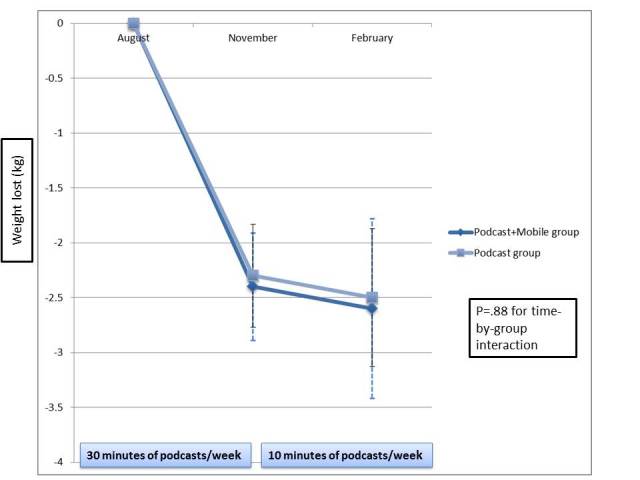
“and an additional –0.2 (SD 3.0) kg from months 3 to 6 (vs –0.3, SD 1.8 kg in the Podcast group; P = .88 for time-by-group interaction).”
§ Tweets, Apps, and Pods: Results of the 6-Month Mobile Pounds Off Digitally (Mobile POD) Randomized Weight-Loss Intervention Among Adults > Results
plain- Asserted: passes — The authors put it forward as true.
- Checkable: passes — It can be checked against evidence.
- Load-bearing: unclear — It is unclear whether the paper’s conclusions depend on it.
- Based: passes — The paper gives a reason why it holds.
It may state two separate claims as one.
A result the paper reports from its own data — it cites no other source for it, so there is none to check. The quote shows it is in the paper.
In the paper
“There was no difference in number of days of diet monitoring or weight loss by type of mobile device.”
§ Tweets, Apps, and Pods: Results of the 6-Month Mobile Pounds Off Digitally (Mobile POD) Randomized Weight-Loss Intervention Among Adults > Results
plain- Asserted: passes — The authors put it forward as true.
- Checkable: passes — It can be checked against evidence.
- Load-bearing: passes — The paper’s conclusions depend on it.
- Based: passes — The paper gives a reason why it holds.
It may state two separate claims as one.
A result the paper reports from its own data — it cites no other source for it, so there is none to check. The quote shows it is in the paper.
In the paper
“The intervention groups did not differ in changes in EBI score, WEL score, energy expenditure, or energy intake”
§ Tweets, Apps, and Pods: Results of the 6-Month Mobile Pounds Off Digitally (Mobile POD) Randomized Weight-Loss Intervention Among Adults > Discussion
plain- Asserted: passes — The authors put it forward as true.
- Checkable: passes — It can be checked against evidence.
- Load-bearing: passes — The paper’s conclusions depend on it.
- Based: passes — The paper gives a reason why it holds.
It may state two separate claims as one.
The paper states this without a source or data behind it here, so there is nothing to check it against. The quote shows it is in the paper.
In the paper
“Both groups felt equally supported in their weight-loss efforts, but source of support differed.”
§ Tweets, Apps, and Pods: Results of the 6-Month Mobile Pounds Off Digitally (Mobile POD) Randomized Weight-Loss Intervention Among Adults > Discussion
plain- Asserted: passes — The authors put it forward as true.
- Checkable: passes — It can be checked against evidence.
- Load-bearing: unclear — It is unclear whether the paper’s conclusions depend on it.
- Based: passes — The paper gives a reason why it holds.
It may state two separate claims as one.
A result the paper reports from its own data — it cites no other source for it, so there is none to check. The quote shows it is in the paper.
In the paper
“Participants who did not complete the study were significantly younger and less likely than completers to be white”
§ Tweets, Apps, and Pods: Results of the 6-Month Mobile Pounds Off Digitally (Mobile POD) Randomized Weight-Loss Intervention Among Adults > Discussion
plaincorrelational- Asserted: passes — The authors put it forward as true.
- Checkable: passes — It can be checked against evidence.
- Load-bearing: unclear — It is unclear whether the paper’s conclusions depend on it.
- Based: passes — The paper gives a reason why it holds.
It may state two separate claims as one.
The paper states this without a source or data behind it here, so there is nothing to check it against. The quote shows it is in the paper.
In the paper
“Podcast participants mainly turned to real-life friends as sources of support, whereas Podcast+Mobile participants relied on Internet-based sources, namely Twitter.”
§ Tweets, Apps, and Pods: Results of the 6-Month Mobile Pounds Off Digitally (Mobile POD) Randomized Weight-Loss Intervention Among Adults > Discussion
plaincorrelational- Asserted: passes — The authors put it forward as true.
- Checkable: passes — It can be checked against evidence.
- Load-bearing: unclear — It is unclear whether the paper’s conclusions depend on it.
- Based: passes — The paper gives a reason why it holds.
It may state two separate claims as one.
A result the paper reports from its own data — it cites no other source for it, so there is none to check. The quote shows it is in the paper.
In the paper
“Both groups reported similar levels of social support and days of dietary monitoring”
§ Tweets, Apps, and Pods: Results of the 6-Month Mobile Pounds Off Digitally (Mobile POD) Randomized Weight-Loss Intervention Among Adults > Discussion
plain- Asserted: passes — The authors put it forward as true.
- Checkable: passes — It can be checked against evidence.
- Load-bearing: passes — The paper’s conclusions depend on it.
- Based: passes — The paper gives a reason why it holds.
It may state two separate claims as one.
A result the paper reports from its own data — it cites no other source for it, so there is none to check. The quote shows it is in the paper.
In the paper
“Although days per week of diet monitoring did not differ between groups, method of monitoring did.”
§ Tweets, Apps, and Pods: Results of the 6-Month Mobile Pounds Off Digitally (Mobile POD) Randomized Weight-Loss Intervention Among Adults > Discussion
plain- Asserted: passes — The authors put it forward as true.
- Checkable: passes — It can be checked against evidence.
- Load-bearing: unclear — It is unclear whether the paper’s conclusions depend on it.
- Based: passes — The paper gives a reason why it holds.
It may state two separate claims as one.
The paper states this without a source or data behind it here, so there is nothing to check it against. The quote shows it is in the paper.
In the paper
“The study population was mostly white and female.”
§ Tweets, Apps, and Pods: Results of the 6-Month Mobile Pounds Off Digitally (Mobile POD) Randomized Weight-Loss Intervention Among Adults > Discussion
plain- Asserted: passes — The authors put it forward as true.
- Checkable: passes — It can be checked against evidence.
- Load-bearing: unclear — It is unclear whether the paper’s conclusions depend on it.
- Based: passes — The paper gives a reason why it holds.
It may state two separate claims as one.
A result the paper reports from its own data — it cites no other source for it, so there is none to check. The quote shows it is in the paper.
In the paper
“However, the number of Twitter posts averaged 2 per week, and declined over time, so participants were not communicating with other group members frequently.”
§ Tweets, Apps, and Pods: Results of the 6-Month Mobile Pounds Off Digitally (Mobile POD) Randomized Weight-Loss Intervention Among Adults > Discussion
plaindirect- Asserted: passes — The authors put it forward as true.
- Checkable: passes — It can be checked against evidence.
- Load-bearing: passes — The paper’s conclusions depend on it.
- Based: passes — The paper gives a reason why it holds.
It may state two separate claims as one.
The paper states this without a source or data behind it here, so there is nothing to check it against. The quote shows it is in the paper.
In the paper
“and equal numbers of participants from each group were members of Twitter at baseline.”
§ Tweets, Apps, and Pods: Results of the 6-Month Mobile Pounds Off Digitally (Mobile POD) Randomized Weight-Loss Intervention Among Adults > Discussion
plain- Asserted: passes — The authors put it forward as true.
- Checkable: passes — It can be checked against evidence.
- Load-bearing: fails — The paper’s conclusions may not depend on it.
- Based: passes — The paper gives a reason why it holds.
Probably not a substantial claim. The paper’s conclusions may not depend on it.
In the paper
“Behavioral interventions that target improvements in diet and physical activity are an effective way to help people lose weight and decrease chronic disease risk factors [6].”
§ Tweets, Apps, and Pods: Results of the 6-Month Mobile Pounds Off Digitally (Mobile POD) Randomized Weight-Loss Intervention Among Adults > Introduction
What the sources say
- Not checked yetcites [6] source
plaindirect- Asserted: passes — The authors put it forward as true.
- Checkable: passes — It can be checked against evidence.
- Load-bearing: passes — The paper’s conclusions depend on it.
- Based: passes — The paper gives a reason why it holds.
It may state two separate claims as one.
In the paper
“Although this can be an effective way to help people lose weight, it is time and resource intensive and not easy to disseminate.”
§ Tweets, Apps, and Pods: Results of the 6-Month Mobile Pounds Off Digitally (Mobile POD) Randomized Weight-Loss Intervention Among Adults > Introduction
What the sources say
- Not checked yetcites [7] Smith, CF, 2000, Diabetes Spectr
plain- Asserted: passes — The authors put it forward as true.
- Checkable: passes — It can be checked against evidence.
- Load-bearing: passes — The paper’s conclusions depend on it.
- Based: passes — The paper gives a reason why it holds.
It may state two separate claims as one.
In the paper
“Additionally, many people feel that participation in face-to-face weight-loss interventions is time consuming and often inconvenient [8].”
§ Tweets, Apps, and Pods: Results of the 6-Month Mobile Pounds Off Digitally (Mobile POD) Randomized Weight-Loss Intervention Among Adults > Introduction
What the sources say
- Not checked yetcites [8] Sherwood, NE, 1998, Am J Health Promot source
plain- Asserted: passes — The authors put it forward as true.
- Checkable: fails — It may be too vague to check against evidence.
- Load-bearing: passes — The paper’s conclusions depend on it.
- Based: passes — The paper gives a reason why it holds.
Probably not a substantial claim. It may be too vague to check against evidence.
The paper states this without a source or data behind it here, so there is nothing to check it against. The quote shows it is in the paper.
In the paper
“Moving away from a face-to-face setting to a mobile delivery method is a promising strategy in the delivery of a behavioral weight-loss intervention.”
§ Tweets, Apps, and Pods: Results of the 6-Month Mobile Pounds Off Digitally (Mobile POD) Randomized Weight-Loss Intervention Among Adults > Introduction
hedgedconditional- Asserted: passes — The authors put it forward as true.
- Checkable: passes — It can be checked against evidence.
- Load-bearing: passes — The paper’s conclusions depend on it.
- Based: fails — The paper may give no reason why it holds.
Probably not a substantial claim. The paper may give no reason why it holds.
What the paper did — it cites no source for this, so there is none to check. The quote shows it is in the paper.
In the paper
“More people in the Podcast+Mobile group than in the Podcast group reported previously downloading a health-related podcast (P = .04) or installing a healthy diet-related app to their mobile device (P = .04).”
§ Tweets, Apps, and Pods: Results of the 6-Month Mobile Pounds Off Digitally (Mobile POD) Randomized Weight-Loss Intervention Among Adults > Results
plaincorrelational- Asserted: passes — The authors put it forward as true.
- Checkable: passes — It can be checked against evidence.
- Load-bearing: fails — The paper’s conclusions may not depend on it.
- Based: passes — The paper gives a reason why it holds.
Probably not a substantial claim. The paper’s conclusions may not depend on it.
What the paper did — it cites no source for this, so there is none to check. The quote shows it is in the paper.
In the paper
“Participants were randomly assigned using a computerized random numbers generator (as conducted by study investigators) once they completed of all their baseline questionnaires.”
§ Tweets, Apps, and Pods: Results of the 6-Month Mobile Pounds Off Digitally (Mobile POD) Randomized Weight-Loss Intervention Among Adults > Methods > Study Population and Measures
plain- Asserted: passes — The authors put it forward as true.
- Checkable: passes — It can be checked against evidence.
- Load-bearing: passes — The paper’s conclusions depend on it.
- Based: passes — The paper gives a reason why it holds.
Probably not a substantial claim.
What the paper did — it cites no source for this, so there is none to check. The quote shows it is in the paper.
In the paper
“We conducted all data collection and analyses using intention-to-treat by using imputation (baseline observation carried forward), with the exception of some variables that we collected only at 6 months (such as information processing variables), which we assessed using completers only.”
§ Tweets, Apps, and Pods: Results of the 6-Month Mobile Pounds Off Digitally (Mobile POD) Randomized Weight-Loss Intervention Among Adults > Methods > Statistical Analyses
plain- Asserted: passes — The authors put it forward as true.
- Checkable: passes — It can be checked against evidence.
- Load-bearing: passes — The paper’s conclusions depend on it.
- Based: passes — The paper gives a reason why it holds.
Probably not a substantial claim. It may state two separate claims as one.
In the paper
“One study that used an entirely mobile-based approach was conducted by Patrick and colleagues [17] among overweight men and women.”
§ Tweets, Apps, and Pods: Results of the 6-Month Mobile Pounds Off Digitally (Mobile POD) Randomized Weight-Loss Intervention Among Adults > Introduction
What the sources say
- Not checked yetcites [17] source
plain- Asserted: passes — The authors put it forward as true.
- Checkable: passes — It can be checked against evidence.
- Load-bearing: unclear — It is unclear whether the paper’s conclusions depend on it.
- Based: passes — The paper gives a reason why it holds.
It may state two separate claims as one.
What the paper did — it cites no source for this, so there is none to check. The quote shows it is in the paper.
In the paper
“Neither study participants nor investigators were blind to treatment assignment.”
§ Tweets, Apps, and Pods: Results of the 6-Month Mobile Pounds Off Digitally (Mobile POD) Randomized Weight-Loss Intervention Among Adults > Methods > Study Population and Measures
plain- Asserted: passes — The authors put it forward as true.
- Checkable: passes — It can be checked against evidence.
- Load-bearing: fails — The paper’s conclusions may not depend on it.
- Based: passes — The paper gives a reason why it holds.
Probably not a substantial claim. The paper’s conclusions may not depend on it. It may state two separate claims as one.
What the paper did — it cites no source for this, so there is none to check. The quote shows it is in the paper.
In the paper
“In a model examining demographic factors as predictors of noncompletion of the study at 6 months, there was a significant effect of age (P = .005) and a trend with ethnicity (P = .06), but not of gender, group assignment, or baseline BMI.”
§ Tweets, Apps, and Pods: Results of the 6-Month Mobile Pounds Off Digitally (Mobile POD) Randomized Weight-Loss Intervention Among Adults > Results
plaincorrelationaln = 10- Asserted: passes — The authors put it forward as true.
- Checkable: passes — It can be checked against evidence.
- Load-bearing: unclear — It is unclear whether the paper’s conclusions depend on it.
- Based: passes — The paper gives a reason why it holds.
It may state two separate claims as one.
What the paper did — it cites no source for this, so there is none to check. The quote shows it is in the paper.
In the paper
“More people in the Podcast+Mobile group than in the Podcast group reported previously downloading a health-related podcast (P = .04) or installing a healthy diet-related app to their mobile device (P = .04).”
§ Tweets, Apps, and Pods: Results of the 6-Month Mobile Pounds Off Digitally (Mobile POD) Randomized Weight-Loss Intervention Among Adults > Results
plaincorrelational- Asserted: passes — The authors put it forward as true.
- Checkable: passes — It can be checked against evidence.
- Load-bearing: fails — The paper’s conclusions may not depend on it.
- Based: passes — The paper gives a reason why it holds.
Probably not a substantial claim. The paper’s conclusions may not depend on it.
None of the sources cited for this claim have been checked yet.
In the paper
“Mobile devices have been used successfully to provide dietary guidance [12] and self-monitor weight and other health-related variables [13,14] and dietary intake [15].”
§ Tweets, Apps, and Pods: Results of the 6-Month Mobile Pounds Off Digitally (Mobile POD) Randomized Weight-Loss Intervention Among Adults > Introduction
What the sources say
plaindirect- Asserted: passes — The authors put it forward as true.
- Checkable: passes — It can be checked against evidence.
- Load-bearing: passes — The paper’s conclusions depend on it.
- Based: passes — The paper gives a reason why it holds.
It may state two separate claims as one.
What the paper did — it cites no source for this, so there is none to check. The quote shows it is in the paper.
In the paper
“These questionnaire items were transformed from paper instruments to online methods (but had not been previously validated for online use).”
§ Tweets, Apps, and Pods: Results of the 6-Month Mobile Pounds Off Digitally (Mobile POD) Randomized Weight-Loss Intervention Among Adults > Methods > Study Population and Measures
plain- Asserted: passes — The authors put it forward as true.
- Checkable: passes — It can be checked against evidence.
- Load-bearing: fails — The paper’s conclusions may not depend on it.
- Based: passes — The paper gives a reason why it holds.
Probably not a substantial claim. The paper’s conclusions may not depend on it. It may state two separate claims as one.
What the paper did — it cites no source for this, so there is none to check. The quote shows it is in the paper.
In the paper
“Both conditions were active treatments and participants were not told which group was the intervention of interest or enhanced group.”
§ Tweets, Apps, and Pods: Results of the 6-Month Mobile Pounds Off Digitally (Mobile POD) Randomized Weight-Loss Intervention Among Adults > Methods > Study Population and Measures
plain- Asserted: passes — The authors put it forward as true.
- Checkable: passes — It can be checked against evidence.
- Load-bearing: fails — The paper’s conclusions may not depend on it.
- Based: passes — The paper gives a reason why it holds.
Probably not a substantial claim. The paper’s conclusions may not depend on it. It may state two separate claims as one.
What the paper did — it cites no source for this, so there is none to check. The quote shows it is in the paper.
In the paper
“Participants who did not complete the study at 6 months (n = 10) were younger (mean 31.0, SD 11.2 vs 44.3, SD 10.3 years) and were 4.7 times (95% confidence interval, 0.96–23.24) less likely to be white (4/10, 40% black, 2/10, 20% Asian, and 4/10, 40% white).”
§ Tweets, Apps, and Pods: Results of the 6-Month Mobile Pounds Off Digitally (Mobile POD) Randomized Weight-Loss Intervention Among Adults > Results
plaincorrelationaln = 10- Asserted: passes — The authors put it forward as true.
- Checkable: passes — It can be checked against evidence.
- Load-bearing: unclear — It is unclear whether the paper’s conclusions depend on it.
- Based: passes — The paper gives a reason why it holds.
It may state two separate claims as one.
A conclusion the paper draws from its own results — it cites no other source for it, so there is none to check. The quote shows it is in the paper.
In the paper
“Greater elaboration and user control, however, may have led to greater podcast usage, as evidenced by more podcast downloads to the Podcast+Mobile group site.”
§ Tweets, Apps, and Pods: Results of the 6-Month Mobile Pounds Off Digitally (Mobile POD) Randomized Weight-Loss Intervention Among Adults > Discussion
hedgedconditional- Asserted: passes — The authors put it forward as true.
- Checkable: passes — It can be checked against evidence.
- Load-bearing: fails — The paper’s conclusions may not depend on it.
- Based: passes — The paper gives a reason why it holds.
Probably not a substantial claim. The paper’s conclusions may not depend on it. It may state two separate claims as one.
In the paper
“Our prior podcasting study showed greater elaboration and user control among the enhanced theory-based podcast at 3 months than among the control podcast [19].”
§ Tweets, Apps, and Pods: Results of the 6-Month Mobile Pounds Off Digitally (Mobile POD) Randomized Weight-Loss Intervention Among Adults > Discussion
What the sources say
- Not checked yetcites [19] source
plaindirect- Asserted: passes — The authors put it forward as true.
- Checkable: passes — It can be checked against evidence.
- Load-bearing: fails — The paper’s conclusions may not depend on it.
- Based: passes — The paper gives a reason why it holds.
Probably not a substantial claim. The paper’s conclusions may not depend on it.
What the paper did — it cites no source for this, so there is none to check. The quote shows it is in the paper.
In the paper
“The study also had strong retention rates”
§ Tweets, Apps, and Pods: Results of the 6-Month Mobile Pounds Off Digitally (Mobile POD) Randomized Weight-Loss Intervention Among Adults > Discussion
boosted- Asserted: passes — The authors put it forward as true.
- Checkable: passes — It can be checked against evidence.
- Load-bearing: fails — The paper’s conclusions may not depend on it.
- Based: passes — The paper gives a reason why it holds.
Probably not a substantial claim. The paper’s conclusions may not depend on it.
A conclusion the paper draws from its own results — it cites no other source for it, so there is none to check. The quote shows it is in the paper.
In the paper
“showing that those in the Podcast+Mobile group may have been more technically savvy or more familiar with the technology used in the study at baseline.”
§ Tweets, Apps, and Pods: Results of the 6-Month Mobile Pounds Off Digitally (Mobile POD) Randomized Weight-Loss Intervention Among Adults > Discussion
hedgedcorrelational- Asserted: passes — The authors put it forward as true.
- Checkable: passes — It can be checked against evidence.
- Load-bearing: fails — The paper’s conclusions may not depend on it.
- Based: passes — The paper gives a reason why it holds.
Probably not a substantial claim. The paper’s conclusions may not depend on it. It may state two separate claims as one.
A conclusion the paper draws from its own results — it cites no other source for it, so there is none to check. The quote shows it is in the paper.
In the paper
“and therefore some aspect of the study may not have been well suited to this demographic group.”
§ Tweets, Apps, and Pods: Results of the 6-Month Mobile Pounds Off Digitally (Mobile POD) Randomized Weight-Loss Intervention Among Adults > Discussion
hedgedconditional- Asserted: passes — The authors put it forward as true.
- Checkable: passes — It can be checked against evidence.
- Load-bearing: fails — The paper’s conclusions may not depend on it.
- Based: passes — The paper gives a reason why it holds.
Probably not a substantial claim. The paper’s conclusions may not depend on it.
In the paper
“Greater usage of weight-loss study components has been shown to lead to improved weight losses [37].”
§ Tweets, Apps, and Pods: Results of the 6-Month Mobile Pounds Off Digitally (Mobile POD) Randomized Weight-Loss Intervention Among Adults > Discussion
What the sources say
- Not checked yetcites [37] source
plaindirect- Asserted: passes — The authors put it forward as true.
- Checkable: passes — It can be checked against evidence.
- Load-bearing: fails — The paper’s conclusions may not depend on it.
- Based: passes — The paper gives a reason why it holds.
Probably not a substantial claim. The paper’s conclusions may not depend on it.
In the paper
“Several studies have shown that targeting dietary self-monitoring, providing social support, and emphasizing both dietary changes and physical activity are key components to successful face-to-face behavioral weight-loss programs [43].”
§ Tweets, Apps, and Pods: Results of the 6-Month Mobile Pounds Off Digitally (Mobile POD) Randomized Weight-Loss Intervention Among Adults > Discussion
What the sources say
- Not checked yetcites [43] source
boosteddirect- Asserted: passes — The authors put it forward as true.
- Checkable: passes — It can be checked against evidence.
- Load-bearing: passes — The paper’s conclusions depend on it.
- Based: passes — The paper gives a reason why it holds.
Probably not a substantial claim. It may state two separate claims as one.
In the paper
“Several of the components of Internet-based weight-loss interventions that have been shown to be effective were part of the Podcast+Mobile intervention, including self-monitoring, use of established behavioral strategies, and social support [44].”
§ Tweets, Apps, and Pods: Results of the 6-Month Mobile Pounds Off Digitally (Mobile POD) Randomized Weight-Loss Intervention Among Adults > Discussion
What the sources say
- Not checked yetcites [44] source
plain- Asserted: passes — The authors put it forward as true.
- Checkable: passes — It can be checked against evidence.
- Load-bearing: unclear — It is unclear whether the paper’s conclusions depend on it.
- Based: passes — The paper gives a reason why it holds.
It may state two separate claims as one.
In the paper
“Social support has been shown to be a possible key component in behavioral weight-loss programs [41].”
§ Tweets, Apps, and Pods: Results of the 6-Month Mobile Pounds Off Digitally (Mobile POD) Randomized Weight-Loss Intervention Among Adults > Discussion
What the sources say
- Not checked yetcites [41] source
hedgedconditional- Asserted: passes — The authors put it forward as true.
- Checkable: passes — It can be checked against evidence.
- Load-bearing: passes — The paper’s conclusions depend on it.
- Based: passes — The paper gives a reason why it holds.
Probably not a substantial claim.
In the paper
“Self-monitoring of dietary intake is an important component of behavioral weight-loss programs [38].”
§ Tweets, Apps, and Pods: Results of the 6-Month Mobile Pounds Off Digitally (Mobile POD) Randomized Weight-Loss Intervention Among Adults > Discussion
What the sources say
- Not checked yetcites [38] Burke, LE, 2005, J Ren Nutr source
plain- Asserted: passes — The authors put it forward as true.
- Checkable: passes — It can be checked against evidence.
- Load-bearing: passes — The paper’s conclusions depend on it.
- Based: passes — The paper gives a reason why it holds.
Probably not a substantial claim.
A conclusion the paper draws from its own results — it cites no other source for it, so there is none to check. The quote shows it is in the paper.
In the paper
“This intervention is an approach that could be easily disseminated, as there was very minimal contact with participants, everything was delivered remotely, and it was low cost.”
§ Tweets, Apps, and Pods: Results of the 6-Month Mobile Pounds Off Digitally (Mobile POD) Randomized Weight-Loss Intervention Among Adults > Discussion
hedged- Asserted: passes — The authors put it forward as true.
- Checkable: passes — It can be checked against evidence.
- Load-bearing: passes — The paper’s conclusions depend on it.
- Based: passes — The paper gives a reason why it holds.
Probably not a substantial claim. It may state two separate claims as one.
- Rests on an assumption: The intervention was low cost.
A conclusion the paper draws from its own results — it cites no other source for it, so there is none to check. The quote shows it is in the paper.
In the paper
“demonstrating that the additional components of Twitter and mobile diet monitoring did not increase cognitive burden and allowed for continued elaboration and user control.”
§ Tweets, Apps, and Pods: Results of the 6-Month Mobile Pounds Off Digitally (Mobile POD) Randomized Weight-Loss Intervention Among Adults > Discussion
boosted- Asserted: passes — The authors put it forward as true.
- Checkable: passes — It can be checked against evidence.
- Load-bearing: passes — The paper’s conclusions depend on it.
- Based: passes — The paper gives a reason why it holds.
It may state two separate claims as one.
A conclusion the paper draws from its own results — it cites no other source for it, so there is none to check. The quote shows it is in the paper.
In the paper
“This did not seem to affect the results”
§ Tweets, Apps, and Pods: Results of the 6-Month Mobile Pounds Off Digitally (Mobile POD) Randomized Weight-Loss Intervention Among Adults > Discussion
hedged- Asserted: passes — The authors put it forward as true.
- Checkable: passes — It can be checked against evidence.
- Load-bearing: fails — The paper’s conclusions may not depend on it.
- Based: fails — The paper may give no reason why it holds.
Probably not a substantial claim. The paper’s conclusions may not depend on it. The paper may give no reason why it holds.
What the paper did — it cites no source for this, so there is none to check. The quote shows it is in the paper.
In the paper
“This intervention used a randomized design and intention-to-treat analysis.”
§ Tweets, Apps, and Pods: Results of the 6-Month Mobile Pounds Off Digitally (Mobile POD) Randomized Weight-Loss Intervention Among Adults > Discussion
plain- Asserted: passes — The authors put it forward as true.
- Checkable: passes — It can be checked against evidence.
- Load-bearing: passes — The paper’s conclusions depend on it.
- Based: passes — The paper gives a reason why it holds.
Probably not a substantial claim. It may state two separate claims as one.
A conclusion the paper draws from its own results — it cites no other source for it, so there is none to check. The quote shows it is in the paper.
In the paper
“Both groups, however, found ways to self-monitor diet and obtain social support, meaning that structural aspects of the groups differed in type but not amount, which was reflected in the weight-loss outcomes.”
§ Tweets, Apps, and Pods: Results of the 6-Month Mobile Pounds Off Digitally (Mobile POD) Randomized Weight-Loss Intervention Among Adults > Discussion
plaindirect- Asserted: passes — The authors put it forward as true.
- Checkable: passes — It can be checked against evidence.
- Load-bearing: passes — The paper’s conclusions depend on it.
- Based: passes — The paper gives a reason why it holds.
It may state two separate claims as one.
What the paper did — it cites no source for this, so there is none to check. The quote shows it is in the paper.
In the paper
“used an objective measure for weight”
§ Tweets, Apps, and Pods: Results of the 6-Month Mobile Pounds Off Digitally (Mobile POD) Randomized Weight-Loss Intervention Among Adults > Discussion
plain- Asserted: passes — The authors put it forward as true.
- Checkable: passes — It can be checked against evidence.
- Load-bearing: fails — The paper’s conclusions may not depend on it.
- Based: passes — The paper gives a reason why it holds.
Probably not a substantial claim. The paper’s conclusions may not depend on it.
What the paper did — it cites no source for this, so there is none to check. The quote shows it is in the paper.
In the paper
“included 2 unannounced days of dietary intake collected using a multiple-pass method.”
§ Tweets, Apps, and Pods: Results of the 6-Month Mobile Pounds Off Digitally (Mobile POD) Randomized Weight-Loss Intervention Among Adults > Discussion
plain- Asserted: passes — The authors put it forward as true.
- Checkable: passes — It can be checked against evidence.
- Load-bearing: fails — The paper’s conclusions may not depend on it.
- Based: passes — The paper gives a reason why it holds.
Probably not a substantial claim. The paper’s conclusions may not depend on it.
What the paper did — it cites no source for this, so there is none to check. The quote shows it is in the paper.
In the paper
“The study was short-term (6 months) and so it was able to examine initial weight loss but not weight-loss maintenance.”
§ Tweets, Apps, and Pods: Results of the 6-Month Mobile Pounds Off Digitally (Mobile POD) Randomized Weight-Loss Intervention Among Adults > Discussion
plaindirect- Asserted: passes — The authors put it forward as true.
- Checkable: passes — It can be checked against evidence.
- Load-bearing: unclear — It is unclear whether the paper’s conclusions depend on it.
- Based: passes — The paper gives a reason why it holds.
It may state two separate claims as one.
The paper relies on this without support.
The observed weight loss in the Podcast and Podcast+Mobile groups is attributable to the podcast intervention rather than to other factors such as regression to the mean, seasonal effects, or measurement.
“Results confirm and extend previous findings showing a minimally intensive weight-loss intervention can be delivered via podcast”
The paper relies on this without support.
The provision of a calorie/fat gram book to the Podcast group did not offset the absence of the mobile app and Twitter components, so the comparison between groups isolates the effect of the mobile components.
“The Podcast group—but not the Podcast+Mobile group—received a book with calorie and fat gram amounts of food to assist them in monitoring their dietary intake.”
“but prompting and mobile communication via Twitter and monitoring app without feedback did not enhance weight loss.”
The paper relies on this without support.
Self-reported method of diet monitoring accurately reflects the actual method used.
“Podcast+Mobile participants were 3.5 times more likely than the Podcast group to use an app to monitor diet (P = .01)”
The paper relies on this without support.
Self-reported days per week of diet monitoring accurately reflects actual monitoring frequency.
“Days/week of reported diet monitoring did not differ between Podcast+Mobile (mean 2.3, SD 1.9 days/week) and Podcast groups (mean 1.9, SD 1.7 days/week; P = .28) but method of monitoring did differ.”
The paper relies on this without support.
Without the intervention, participants would have gained weight during the holiday period.
“the fact that only minimal weight loss occurred during months 3–6 in the present study (approximately –0.25 kg or –0.55 lb) demonstrates that this intervention may have worked to prevent holiday weight gain, versus promoting additional weight loss during this vulnerable period.”
The paper relies on this without support.
The intervention was low cost.
“This intervention is an approach that could be easily disseminated, as there was very minimal contact with participants, everything was delivered remotely, and it was low cost.”
Claims other papers make about this one
Each is checked against this paper’s own text: does it say what the citing paper says it does?
In the citing paper
“While some apps have demonstrated efficacy in definitive trials [2-5], others have performed poorly [6-9].”
From A Library of Analytic Indicators to Evaluate Effective Engagement with Consumer mHealth Apps for Chronic Conditions: Scoping Review (2019) · cites this paper as [8]
In the citing paper
“Although there have been RCTs using text-messaging interventions for weight management, PDAs for self-monitoring and smartphone apps as adjuncts to other weight management interventions, to our knowledge there have not been any RCTs of a smartphone app as a weight loss intervention in itself using both self-monitoring and text-messaging functions.”
From Adherence to a Smartphone Application for Weight Loss Compared to Website and Paper Diary: Pilot Randomized Controlled Trial (2013) · cites this paper as [20]
Self-check
Percentages, sums and reported differences re-computed from the paper’s own numbers.
Each contradiction between two passages listed here was confirmed by an independent check.
Rated minor: it would not touch a result — a value no result rests on, a p-value that stays on the same side of the significance level, or a conflict that is clerical, resolved elsewhere in the paper, or outside its own findings.
In the paper
§ Tweets, Apps, and Pods: Results of the 6-Month Mobile Pounds Off Digitally (Mobile POD) Randomized Weight-Loss Intervention Among Adults > Methods > Study Population and Measures
“Participants were also asked (on a 1- to 7-point Likert scale) to rate how supported they felt in their weight-loss efforts at 6 months.”
§ Tweets, Apps, and Pods: Results of the 6-Month Mobile Pounds Off Digitally (Mobile POD) Randomized Weight-Loss Intervention Among Adults > Results
“Although there was no difference in how supported (rated 0–7) participants reported feeling at 6 months”
Rated minor: it would not touch a result — a value no result rests on, a p-value that stays on the same side of the significance level, or a conflict that is clerical, resolved elsewhere in the paper, or outside its own findings.
In the paper
§ Tweets, Apps, and Pods: Results of the 6-Month Mobile Pounds Off Digitally (Mobile POD) Randomized Weight-Loss Intervention Among Adults > Methods > Intervention and Control Conditions
“During months 0–3, Podcast+Mobile participants were divided into 4 groups to create Twitter cohorts of 11–12 people.”
§ Tweets, Apps, and Pods: Results of the 6-Month Mobile Pounds Off Digitally (Mobile POD) Randomized Weight-Loss Intervention Among Adults > Discussion
“Podcast+Mobile participants were initially assigned to a small cohort of 10–11 people.”
Citations
Cites
Prevalence and Trends in Obesity Among US Adults, 1999-2008
Flegal, K. M. (2010) · JAMA · doi:10.1001/jama.2009.2014 · Cited by 7,580
Health Promotion by Social Cognitive Means
Bandura, A. (2004) · Health Education & Behavior · doi:10.1177/1090198104263660 · Cited by 7,238
Prevalence of obesity, diabetes, and obesity-related health risk factors, 2001
Mokdad, A. H., Ford, E. S., Bowman, B. A., Dietz, W. H., Vinicor, F., Bales, V. S., & Marks, J. S. (2003) · JAMA · doi:10.1001/jama.289.1.76 · Cited by 5,866
The Disease Burden Associated With Overweight and Obesity
Must, A. (1999) · JAMA · doi:10.1001/jama.282.16.1523 · Cited by 4,827
Cognitive Load Measurement as a Means to Advance Cognitive Load Theory
Paas, F., Tuovinen, J. E., Tabbers, H., & Van Gerven, P. W. M. (2003) · Educational Psychologist · doi:10.1207/s15326985ep3801_8 · Cited by 2,527
The IMAGE Study Group, Greaves, C. J., Sheppard, K. E., Abraham, C., Hardeman, W., Roden, M., Evans, P. H., & Schwarz, P. (2011) · BMC Public Health · doi:10.1186/1471-2458-11-119 · Cited by 1,163
Direct Measurement of Cognitive Load in Multimedia Learning
Brunken, R., Plass, J. L., & Leutner, D. (2003) · Educational Psychologist · doi:10.1207/s15326985ep3801_7 · Cited by 896
Controlling the Information Flow: Effects on Consumers' Decision Making and Preferences
Dan Ariely, C. (2000) · Journal of Consumer Research · doi:10.1086/314322 · Cited by 740
Self-efficacy in weight management.
Clark, M. M., Abrams, D. B., NIAURA, R. S., Eaton, C. A., & al, E. (1991) · Journal of Consulting and Clinical Psychology · doi:10.1037/0022-006x.59.5.739 · Cited by 693
A Text Message–Based Intervention for Weight Loss: Randomized Controlled Trial
Patrick, K., Raab, F., Adams, M. A., Dillon, L., Zabinski, M., Rock, C. L., Griswold, W. G., & Norman, G. J. (2009) · Journal of Medical Internet Research · doi:10.2196/jmir.1100 · Cited by 671
Research works printed but not linked: 2
- Pasanisi, F, 2001, Nutr Metab Cardiovasc Dis, 11, 401
- Smith, CF, 2000, Diabetes Spectr, 13, 142
Cited by
Sorted by citations
Moorhead, S. A., Hazlett, D. E., Harrison, L., Carroll, J. K., Irwin, A., & Hoving, C. (2013) · Journal of Medical Internet Research · doi:10.2196/jmir.1933 · Cited by 2,517
Free, C., Phillips, G., Galli, L., Watson, L., Felix, L., Edwards, P., Patel, V., & Haines, A. (2013) · PLoS Medicine · doi:10.1371/journal.pmed.1001362 · Cited by 1,766
“Three trials reported no statistically significant effects on weight of a diary-plus-mobile-phone daily feedback messages compared to a diary [54], a text message based intervention [55], and a twitter, podcast, and mobile phone application based intervention [56].”
Maher, C. A., Lewis, L. K., Ferrar, K., Marshall, S., De Bourdeaudhuij, I., & Vandelanotte, C. (2014) · Journal of Medical Internet Research · doi:10.2196/jmir.2952 · Cited by 733
Carter, M. C., Burley, V. J., Nykjaer, C., & Cade, J. E. (2013) · Journal of Medical Internet Research · doi:10.2196/jmir.2283 · Cited by 666
Twitter as a Tool for Health Research: A Systematic Review
Sinnenberg, L. E., Buttenheim, A. M., Padrez, K., Mancheno, C., Ungar, L., & Merchant, R. M. (2016) · American Journal of Public Health · doi:10.2105/ajph.2016.303512 · Cited by 666
Metadata
- Authors
- Turner-McGrievy, G., & Tate, D.
- Affiliations
- University of North Carolina at Chapel Hill (US)
- ORCID
- Tate, Deborah
- Venue
- Journal of Medical Internet Research
- Publisher
- JMIR Publications Inc.
- Published
- 2011-12-20
- Volume
- 13
- Issue
- 4
- Pages
- e120
- ISSN
- 1438-8871 (ISSN-L)
- PMC
- PMC3278106
- OpenAlex
- W2081384957
- Semantic Scholar
- 2e8fdafa8ca23f5bfab181efc641e34dbdd1ad7f
- Cited by
- 263
- References
- 40
- Citations by year
- 2026: 2 · 2025: 4 · 2024: 11 · 2023: 6 · 2022: 16 · 2021: 14 · 2020: 16 · 2019: 27 · 2018: 26 · 2017: 28 · 2016: 30 · 2015: 34 · 2014: 28 · 2013: 16 · 2012: 5
- FWCI
- 29.07
- Type
- journal article
- Language
- en
- Open access
- gold
- doi.org
- Licence
- cc-by
- Locations
- Journal of Medical Internet Research (publishedVersion, cc-by)
- Europe PMC (PubMed Central) (publishedVersion, cc-by)
- PubMed Central (publishedVersion, cc-by)
- PubMed (publishedVersion)
- DOAJ (DOAJ: Directory of Open Access Journals) (submittedVersion, cc-by-sa)
- Funders
- Lineberger Comprehensive Cancer Center, University of North Carolina at Chapel Hill
- Topics
- Health Sciences › Health Professions › General Health Professions › Mobile Health and mHealth Applications
- Health Sciences › Medicine › Public Health, Environmental and Occupational Health › Obesity and Health Practices
- Social Sciences › Psychology › Applied Psychology › Digital Mental Health Interventions
- Keywords
- weight loss, podcasts, mobile health, Twitter, social support, user control, elaboration, overweight adults, digital health interventions, user engagement, user satisfaction
- MeSH terms
- Adult, Diet, Female, Humans, Male, Middle Aged, Motor Activity, Internet, Electronic Mail, Cell Phone, Webcasts as Topic, Blogging, Weight Reduction Programs
About these checks
Registry, retraction, Cites and statistics results are computed, not judged, with one exception: a printed reference that no index lists is read once by a model before it counts as a citation error. Claims are extracted by a model and kept only when their quote appears verbatim in the text; each cited source is then checked, with a model’s help, for whether it says what the claim relies on. Those verdicts can be wrong — read the claim’s quote and the cited source before relying on one.
A language model drew the claims from the paper on 2026-10-10, under version 3 of the claim definition (model deepseek-v4.1-flash, prompt extract-v3).
A second model labelled each claim on 2026-10-10 (model jev-1.13-20260917, definition revision gold-guideline-v0.2).
Statistics and arithmetic are recomputed, not judged.
Confidence bands are shown only for fields calibrated on our annotated test set. None is calibrated yet, so no band is shown.
What counts as a claim ›How we measure confidence ›How we check this ›
Are you an author, or do you see a problem with this page? Request a review
