

The DOI matches its Crossref record; 64 of the 64 references it cites were found in a registry or an index.
Self-Harm, Suicidal Behaviours, and Cyberbullying in Children and Young People: Systematic Review
Open accessPublished version of a preprint
Abstract
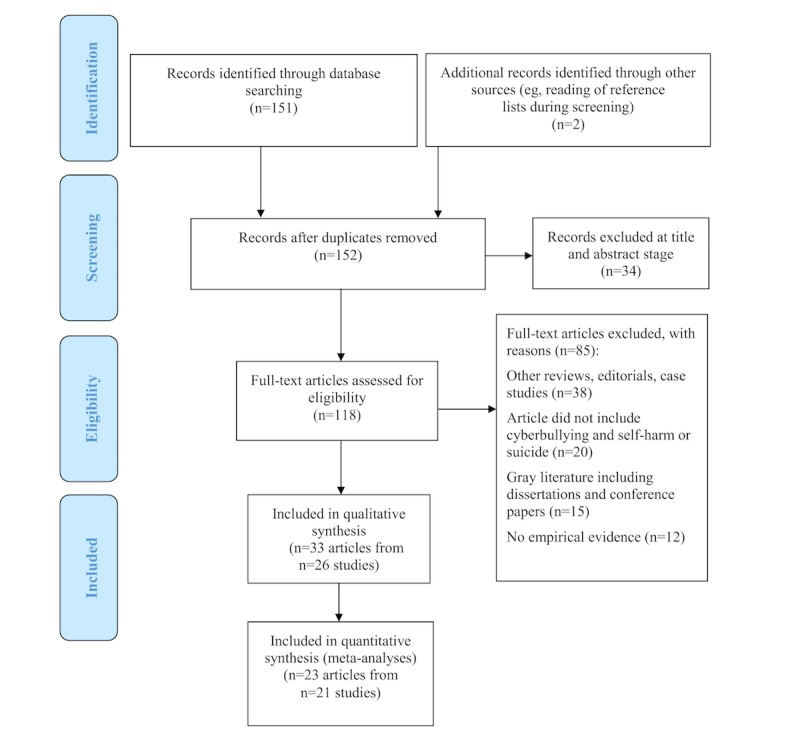
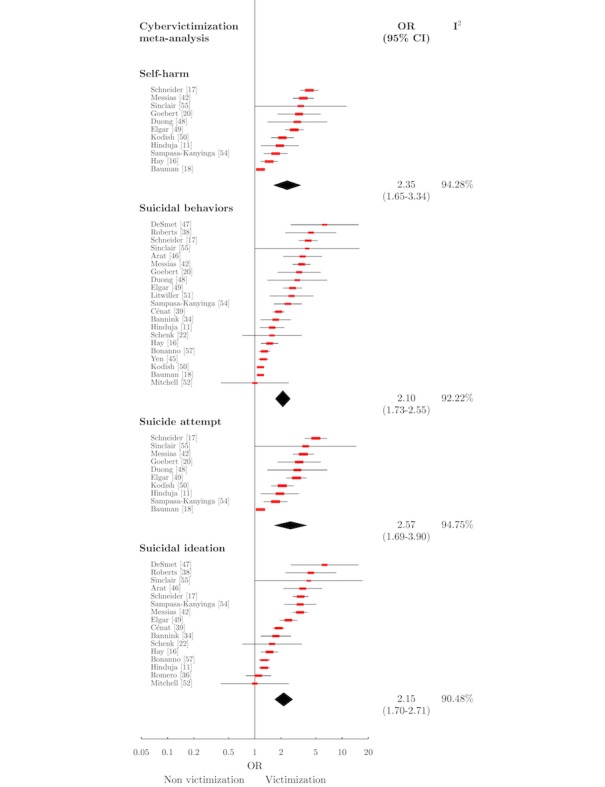
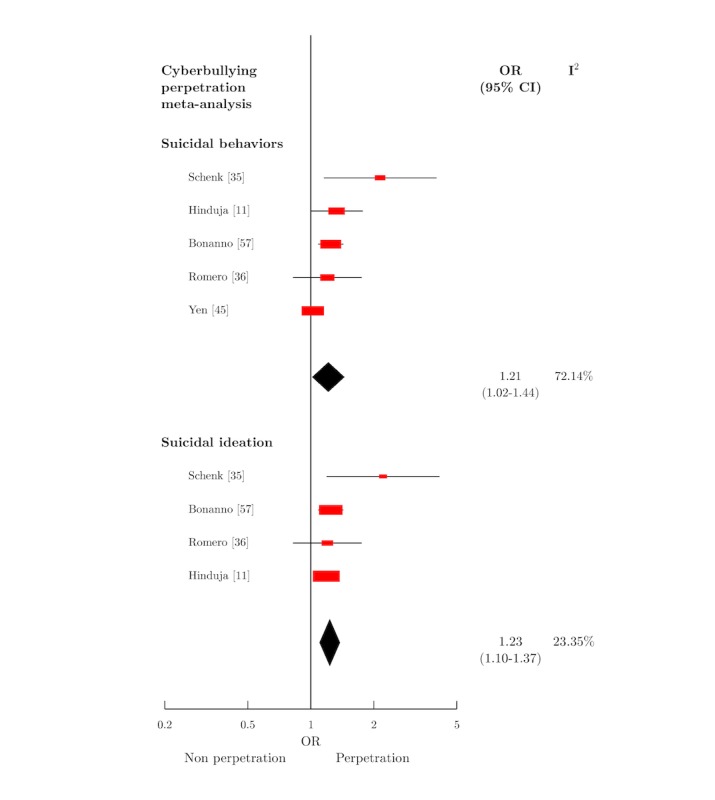
BACKGROUND: Given the concerns about bullying via electronic communication in children and young people and its possible contribution to self-harm, we have reviewed the evidence for associations between cyberbullying involvement and self-harm or suicidal behaviors (such as suicidal ideation, suicide plans, and suicide attempts) in children and young people. OBJECTIVE: The aim of this study was to systematically review the current evidence examining the association between cyberbullying involvement as victim or perpetrator and self-harm and suicidal behaviors in children and young people (younger than 25 years), and where possible, to meta-analyze data on the associations. METHODS: An electronic literature search was conducted for all studies published between January 1, 1996, and February 3, 2017, across sources, including MEDLINE, Cochrane, and PsycINFO. Articles were included if the study examined any association between cyberbullying involvement and self-harm or suicidal behaviors and reported empirical data in a sample aged under 25 years. Quality of included papers was assessed and data were extracted. Meta-analyses of data were conducted. RESULTS: A total of 33 eligible articles from 26 independent studies were included, covering a population of 156,384 children and young people. A total of 25 articles (20 independent studies, n=115,056) identified associations (negative influences) between cybervictimization and self-harm or suicidal behaviors or between perpetrating cyberbullying and suicidal behaviors. Three additional studies, in which the cyberbullying, self-harm, or suicidal behaviors measures had been combined with other measures (such as traditional bullying and mental health problems), also showed negative influences (n=44,526). A total of 5 studies showed no significant associations (n=5646). Meta-analyses, producing odds ratios (ORs) as a summary measure of effect size (eg, ratio of the odds of cyber victims who have experienced SH vs nonvictims who have experienced SH), showed that, compared with nonvictims, those who have experienced cybervictimization were OR 2.35 (95% CI 1.65-3.34) times as likely to self-harm, OR 2.10 (95% CI 1.73-2.55) times as likely to exhibit suicidal behaviors, OR 2.57 (95% CI 1.69-3.90) times more likely to attempt suicide, and OR 2.15 (95% CI 1.70-2.71) times more likely to have suicidal thoughts. Cyberbullying perpetrators were OR 1.21 (95% CI 1.02-1.44) times more likely to exhibit suicidal behaviors and OR 1.23 (95% CI 1.10-1.37) times more likely to experience suicidal ideation than nonperpetrators. CONCLUSIONS: Victims of cyberbullying are at a greater risk than nonvictims of both self-harm and suicidal behaviors. To a lesser extent, perpetrators of cyberbullying are at risk of suicidal behaviors and suicidal ideation when compared with nonperpetrators. Policy makers and schools should prioritize the inclusion of cyberbullying involvement in programs to prevent traditional bullying. Type of cyberbullying involvement, frequency, and gender should be assessed in future studies.
Overview
The claims and statistics of this paper haven’t been checked yet.
Run the check — free, no account needed. It reads the open-access text and checks the sources it cites.
Integrity signals
Registry
Cites
Statistics
Figures
Verification
Claims the paper makes
The claims and statistics of this paper haven’t been checked yet.
Run the check — free, no account needed. It reads the open-access text and checks the sources it cites.
Claims other papers make about this one
Each is checked against this paper’s own text: does it say what the citing paper says it does?
The source backs part of the claim, not all of it — or backs it for a different population, condition or comparison.
In the citing paper
“The rise of online anonymity has facilitated an increase in cyberbullying, which has been directly linked to self-harm behaviors among adolescents [77].”
From The Impact of Social Media & Technology on Child and Adolescent Mental Health (2025) · cites this paper as [77]
Experimental — accuracy not yet measuredIn the citing paper
“Many of the anticipated consequences of quarantine14 and associated social and physical distancing measures are themselves key risk factors for mental health issues.”
From Multidisciplinary research priorities for the COVID-19 pandemic: a call for action for mental health science (2020) · cites this paper as [22]
Self-check
Percentages, sums and reported differences re-computed from the paper’s own numbers.
The self-check needs the paper’s full text.
Citations
Cites
Preferred Reporting Items for Systematic Reviews and Meta-Analyses: the PRISMA statement
Moher, D., Liberati, A., Tetzlaff, J., Altman, D. G., & for the PRISMA Group (2009) · BMJ · doi:10.1136/bmj.b2535 · Cited by 83,823
Measuring inconsistency in meta-analyses
Higgins, J. P. T., Thompson, S. G., Deeks, J. J., & Altman, D. G. (2003) · BMJ · doi:10.1136/bmj.327.7414.557 · Cited by 63,139
Dermyshi, E., Wang, Y., Yan, C., Hong, W., Qiu, G., Gong, X., & Zhang, T. (2017) · Neonatology · doi:10.1159/000454668 · Cited by 24,586
Meta-analysis of Observational Studies in Epidemiology<SUBTITLE>A Proposal for Reporting</SUBTITLE>
Stroup, D. F. (2000) · JAMA · doi:10.1001/jama.283.15.2008 · Cited by 20,623
Preferred reporting items for systematic reviews and meta-analyses: The PRISMA statement
Moher, D., Liberati, A., Tetzlaff, J., & Altman, D. G. (2010) · International Journal of Surgery · doi:10.1016/j.ijsu.2010.02.007 · Cited by 12,156
Cochrane Handbook for Systematic Reviews of Interventions
Tarsilla, M. (2010) · Journal of MultiDisciplinary Evaluation · doi:10.56645/jmde.v6i14.284 · Cited by 5,232
Cyberbullying: Its nature and impact in secondary school pupils
Smith, P. K., Mahdavi, J., Carvalho, M., Fisher, S., Russell, S., & Tippett, N. (2008) · Journal of Child Psychology and Psychiatry · doi:10.1111/j.1469-7610.2007.01846.x · Cited by 3,639
Kowalski, R. M., Giumetti, G. W., Schroeder, A. N., & Lattanner, M. R. (2014) · Psychological Bulletin · doi:10.1037/a0035618 · Cited by 3,266
Nock, M. K., Borges, G., Bromet, E. J., Cha, C. B., Kessler, R. C., & Lee, S. (2008) · Epidemiologic Reviews · doi:10.1093/epirev/mxn002 · Cited by 2,897
Hawker, D. S. J., & Boulton, M. J. (2000) · Journal of Child Psychology and Psychiatry · doi:10.1111/1469-7610.00629 · Cited by 2,694
Research works printed but not linked: 2
- Price, M, 2010, Youth Stud Aust, 29, 51
- Kindrick, K, 2013, J Ark Med Soc, 110, 90
Cited by
Sorted by citations
Holmes, E. A., O'Connor, R. C., Perry, V. H., Tracey, I., Wessely, S., Arseneault, L., Ballard, C., Christensen, H., Cohen Silver, R., Everall, I., et al. (2020) · The Lancet Psychiatry · doi:10.1016/s2215-0366(20)30168-1 · Cited by 5,715
Self-citationTwenge, J. M., Cooper, A. B., Joiner, T. E., Duffy, M. E., & Binau, S. G. (2019) · Journal of Abnormal Psychology · doi:10.1037/abn0000410 · Cited by 1,469
Kickbusch, I., Piselli, D., Agrawal, A., Balicer, R. D., Banner, O., Adelhardt, M., Capobianco, E., Fabian, C., Gill, A. S., Lupton, D. A., et al. (2021) · The Lancet · doi:10.1016/s0140-6736(21)01824-9 · Cited by 480
Sahle, B. W., Reavley, N. J., Li, W., Morgan, A. J., Yap, M. B. H., Reupert, A., & Jorm, A. F. (2022) · European Child & Adolescent Psychiatry · doi:10.1007/s00787-021-01745-2 · Cited by 375
Cyberbullying and children and young people’s mental health: A systematic map of systematic reviews
Kwan, I., Dickson, K., Richardson, M., MacDowall, W., Burchett, H., Stansfield, C., Brunton, G., Sutcliffe, K., & Thomas, J. (2020) · Cyberpsychology, Behavior, and Social Networking · doi:10.1089/cyber.2019.0370 · Cited by 291
Metadata
- Authors
- John, A., Glendenning, A. C., Marchant, A., Montgomery, P., Stewart, A., Wood, S., Lloyd, K., & Hawton, K.
- Affiliations
- Swansea University (GB)
- University of Birmingham (GB)
- Oxford Health NHS Foundation Trust (GB)
- University of Oxford (GB)
- Corresponding author
- John, Ann
- ORCID
- Venue
- Journal of Medical Internet Research
- Publisher
- JMIR Publications Inc.
- Published
- 2018-04-19
- Volume
- 20
- Issue
- 4
- Pages
- e129
- ISSN
- 1438-8871 (ISSN-L)
- PMC
- PMC5934539
- OpenAlex
- W2802043748
- Cited by
- 580
- References
- 64
- Citations by year
- 2026: 66 · 2025: 68 · 2024: 97 · 2023: 85 · 2022: 73 · 2021: 85 · 2020: 70 · 2019: 31 · 2018: 5
- FWCI
- 7.41
- Type
- journal article
- Language
- en
- Open access
- gold
- doi.org
- Licence
- cc-by
- Locations
- Journal of Medical Internet Research (publishedVersion, cc-by)
- Europe PMC (PubMed Central) (publishedVersion, cc-by)
- PubMed Central (publishedVersion, cc-by)
- PubMed (publishedVersion)
- ORCA Online Research @Cardiff (Cardiff University) (submittedVersion)
- University of Birmingham Research Portal (University of Birmingham) (submittedVersion, cc-by)
- Funders
- Health and Care Research Wales (SCS-14-11)
- Public Health Wales
- National Institute for Health and Care Research
- Economic and Social Research Council (ES/N012267/2)
- Topics
- Social Sciences › Psychology › Social Psychology › Bullying, Victimization, and Aggression
- Social Sciences › Psychology › Clinical Psychology › Suicide and Self-Harm Studies
- Social Sciences › Sociology and Political Science › Impact of Technology on Adolescents
- Keywords
- cyberbullying, self-harm, suicidal behavior, suicidal ideation, suicide attempts, cyber victimization, cyberbullying perpetration, children and young people, adolescents, bullying, mental health
- MeSH terms
- Cyberbullying, Adolescent, Adult, Child, Female, Humans, Male, Self-Injurious Behavior, Young Adult, Suicidal Ideation
About these checks
Registry, retraction, Cites and statistics results are computed, not judged, with one exception: a printed reference that no index lists is read once by a model before it counts as a citation error. Claims are extracted by a model and kept only when their quote appears verbatim in the text; each cited source is then checked, with a model’s help, for whether it says what the claim relies on. Those verdicts can be wrong — read the claim’s quote and the cited source before relying on one.
Statistics and arithmetic are recomputed, not judged.
Confidence bands are shown only for fields calibrated on our annotated test set. None is calibrated yet, so no band is shown.
What counts as a claim ›How we measure confidence ›How we check this ›
Are you an author, or do you see a problem with this page? Request a review
