

A review of Quantum Cellular Automata
Open accessThe DOI matches its Crossref record; 168 of the 169 references it cites were found in a registry or an index, and 1 are not checked yet.
Abstract
Discretizing spacetime is often a natural step towards modelling physical systems. For quantum systems, if we also demand a strict bound on the speed of information propagation, we get quantum cellular automata (QCAs). These originally arose as an alternative paradigm for quantum computation, though more recently they have found application in understanding topological phases of matter and have} been proposed as models of periodically driven (Floquet) quantum systems, where QCA methods were used to classify their phases. QCAs have also been used as a natural discretization of quantum field theory, and some interesting examples of QCAs have been introduced that become interacting quantum field theories in the continuum limit. This review discusses all of these applications, as well as some other interesting results on the structure of quantum cellular automata, including the tensor-network unitary approach, the index theory and higher dimensional classifications of QCAs.
Overview
The claims and statistics of this paper haven’t been checked yet.
Free: it reads the open-access text and checks the first 5 claims that cite a source we can check. Create a free account to check every claim.
Integrity signals
Registry
Cites
Statistics
Figures
Verification
Claims the paper makes
The claims and statistics of this paper haven’t been checked yet.
Free: it reads the open-access text and checks the first 5 claims that cite a source we can check. Create a free account to check every claim.
Self-check
Percentages, sums and reported differences re-computed from the paper’s own numbers.
The self-check needs the paper’s full text.
Citations
Cites
Quantum Computation and Quantum Information: 10th Anniversary Edition
Nielsen, M. A., & Chuang, I. L. (2012) · doi:10.1017/cbo9780511976667 · Cited by 8,436
Simulating physics with computers
Feynman, R. P. (1982) · International Journal of Theoretical Physics · doi:10.1007/bf02650179 · Cited by 7,691
Anyons in an exactly solved model and beyond
Kitaev, A. (2006) · Annals of Physics · doi:10.1016/j.aop.2005.10.005 · Cited by 5,245 · cited 1×
“This was inspired by an analogous index for quantum walks [88, 89], which was called the flow in [89].”
MethodThe Lattice Boltzmann Equation for Fluid Dynamics and Beyond
Succi, S. (2001) · doi:10.1093/oso/9780198503989.001.0001 · Cited by 4,188
Statistical mechanics of cellular automata
Wolfram, S. (1983) · Reviews of Modern Physics · doi:10.1103/revmodphys.55.601 · Cited by 3,114 · cited 1×
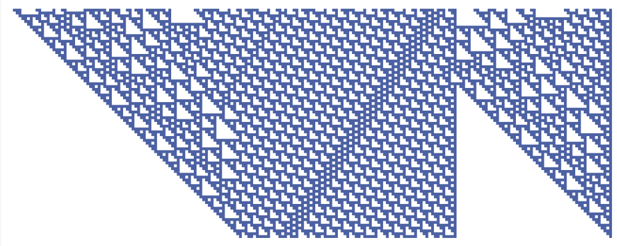
“best summarized by the table below. Initial state of a bit and its neighbours 111 110 101 100 011 010 001 000 New state of middle bit 0 1 1 0 1 1 1 0 The name comes from the result of the update rule [5]. Treating 01101110, which is the bottom row of the table above specifying the update rule, as binary and converting…”
BackgroundOperator Algebras and Quantum Statistical Mechanics
Bratteli, O., & Robinson, D. W. (1997) · Springer eBooks · doi:10.1007/978-3-662-03444-6 · Cited by 2,985
�ber das Paulische �quivalenzverbot
Jordan, P., & Wigner, E. (1928) · Zeitschrift f�r Physik · doi:10.1007/bf01331938 · Cited by 2,597 · cited 1×
“3 Fermionic index theory We might guess that, via the Jordan-Wigner transformation [92, 93], an index for fermionic QCAs should basically be the same as for qudit QCAs.”
Haag, R. (1996) · doi:10.1007/978-3-642-61458-3 · Cited by 2,443
On the product of semi-groups of operators
Trotter, H. F. (1959) · Proceedings of the American Mathematical Society · doi:10.1090/s0002-9939-1959-0108732-6 · Cited by 2,282 · cited 1×
“1 QCAs vs Hamiltonian dynamics We can simulate the dynamics of continuous-time systems on lattices with local Hamiltonians by using the Suzuki-Trotter decomposition [16, 101, 102].”
MethodLent, C. S., Tougaw, P. D., Porod, W., & Bernstein, G. H. (1993) · Nanotechnology · doi:10.1088/0957-4484/4/1/004 · Cited by 1,793 · cited 1×
“f the one-particle sector of a QCA [18, 30], which is something we will return to in section 6.3. Another potential source of confusion are quantum dot cellular automata, which were rst introduced in [40, 41]. These were originally referred to as quantum cellular automata, and, while the name quantum dot cellular auto…”
BackgroundInfluential
Research works printed but not linked: 18
- J. von Neumann. Theory of Self-Reproducing Automata. University of Illinois Press, Cham- paign, Illinois, 1966.
- In M. Bugliesi, B. Preneel, V. Sassone, and I. Wegener, editors, Automata, Languages and Programming, pages 132-143, Berlin, Heidelberg, 2006. Springer. DOI: ht- tps://doi.org/10.1007/11786986˙13. · doi:10.1007/11786986˙13
- J. Haah, L. Fidkowski, and M. B. Hastings. Nontrivial Quantum Cellular Automata in Higher Dimensions. arXiv:1812.01625, 2018. · arXiv
- B. Aoun and M. Tarifi. Introduction to Quantum Cellular Automata. arXiv:quant- ph/0401123, 2004.
- W. van Dam. Quantum cellular automata. Master's thesis, University of Nijmegen, 1996.
- C. A. Pérez Delgado. Quantum Cellular Automata: Theory and Applications. PhD thesis, University of Waterloo, 2007. · DOI · Paper page
- P. Arrighi. Quantum cellular automata. Habilitation thesis, Université de Grenoble, 2009.
- J. Gütschow. Quantum information processing with Clifford quantum cellular automata. PhD thesis, Leibniz Universität Hannover, 2012.
- C. A. Pérez-Delgado and D. Cheung. Models of Quantum Cellular Automata. arXiv:quant- ph/0508164, 2005.
- N. Margolus. Parallel quantum computation. In W. H. Zurek, editor, Complexity, Entropy, and the Physics of Information, page 273, Redwood City, CA, 1991. Addison Wesley.
- P. Arrighi and V. Nesme. Quantization of cellular automata. JAC 2008, pages 204-215, 2008.
- A. Shakeel. Quantum Cellular Automata: Schrödinger and Heisenberg Pictures. arXiv:1807.01192v1, 2018. · arXiv
- J. Haah. Clifford quantum cellular automata: Trivial group in 2d and Witt group in 3d. arXiv:1907.02075, 2019. · arXiv
- M. Freedman, J. Haah, and M. B. Hastings. The group structure of quantum cellular auto- mata. arXiv:1910.07998, 2019. · arXiv
- A. H. Werner H. Wilming. Finite group velocity implies locality of interactions. arXiv:2006.10062, 2020. · arXiv
- Z. Zimborás, T. Farrelly, S. Farkas, and L. Masanes. Does causal dynamics imply local interactions? arXiv:2006.10707, 2020. · arXiv
- M. Creutz. Quarks, Gluons and Lattices. Cambridge Monographs on Mathematical Physics. Cambridge University Press, 1983.
- M. McGuigan. Quantum Cellular Automata from Lattice Field Theories. arXiv:quant- ph/0307176, 2003.
Cited by
Items 101–196 of 196
Information scrambling in quantum walks: Discrete-time formulation of Krylov complexity
Sahu, H. (2024) · Physical Review A · doi:10.1103/physreva.110.052405 · Cited by 5
Quantum Circuits for Matrix-Product Unitaries
Styliaris, G., Trivedi, R., & Cirac, J. I. (2025) · Physical Review Letters · doi:10.1103/yshb-hmml · Cited by 7
“A well-understood subclass of MPUs is one-dimensional quantum cellular automata (QCA) [12], which coincide with MPUs formed by a single repeated tensor [13–15].”
Fully quantum lattice gas automata building blocks for computational basis state encodings
Calin, G., Schalkers, M. A., & Möller, M. (2025) · Journal of Computational Physics · doi:10.1016/j.jcp.2025.114595 · Cited by 9
Quantum Spatial Search with Electric Potential: Long-Time Dynamics and Robustness to Noise
Fredon, T., Zylberman, J., Arnault, P., & Debbasch, F. (2022) · Entropy · doi:10.3390/e24121778 · Cited by 6
Quantum cellular automata and invertible phases of matterPreprint
Jones, C., Sopenko, N., & Thorngren, R. (2026) · arXiv (Cornell University) · doi:10.48550/arxiv.2608.26456 · Cited by 7
A single-particle framework for unitary lattice gauge theory in discrete time
Arnault, P., & Cedzich, C. (2022) · New Journal of Physics · doi:10.1088/1367-2630/acac47 · Cited by 4
Sustainable Application of Automatically Generated Multi-Agent System Model in Urban Renewal
Liang, Z., Várady, G., & Zagorácz, M. B. (2023) · Sustainability · doi:10.3390/su15097308 · Cited by 4
Information flow in non-unitary quantum cellular automata
Wagner, E., Nigmatullin, R., Gilchrist, A., & Brennen, G. K. (2024) · SciPost Physics · doi:10.21468/scipostphys.16.1.014 · Cited by 5
“…in the simplest setting where space and time are discrete and causality is preserved, quantum many-body systems can be described by quantum cellular automata (QCA) [1–3], which are systems with discrete variables evolving under a local update rule (in analogy with classical cellular automata).”
BackgroundMassless interacting fermionic cellular automaton exhibiting bound states
Centofanti, E., Perinotti, P., & Bisio, A. (2024) · Physical Review A · doi:10.1103/physreva.109.052421 · Cited by 3
Information dynamics and natural computing in two-skyrmion system
Mori, H., Miki, S., Emoto, K., Ishikawa, R., Tamura, E., Nomura, H., Goto, M., & Suzuki, Y. (2026) · Physical Review Research · doi:10.1103/4cb8-lhtb · Cited by 4
Bypassing eigenstate thermalization with experimentally accessible quantum dynamics
Vikram, A. (2026) · SciPost Physics · doi:10.21468/scipostphys.21.1.029 · Cited by 5
Fermion doubling in Dirac quantum walks
Gupta, C., & Short, A. (2026) · Physical Review A · doi:10.1103/kkz3-fthm · Cited by 4
Design and analysis of a fault tolerance nano-scale code converter based on quantum-dots
Xie, C., Zhao, X., & Navimipour, N. J. (2024) · Nano Communication Networks · doi:10.1016/j.nancom.2024.100530 · Cited by 3
Classification of unitary operators by local generatability
Liu, X., Culver, A. B., Harper, F., & Roy, R. (2025) · Physical review. B./Physical review. B · doi:10.1103/physrevb.111.085149 · Cited by 4
The Dirac Vacuum in Discrete Spacetime
Gupta, C., & Short, A. (2025) · Quantum · doi:10.22331/q-2025-09-03-1845 · Cited by 6
“Discrete space-time models such as quantum walks (QW) and quantum cellular automata (QCA) have been shown to simulate some quantum field theories in the continuum limit [2].”
QUANTUM FIELD THEORY FROM FIRST PRINCIPLES
Perinotti, P. (2020) · Istituto Lombardo - Accademia di Scienze e Lettere - Rendiconti di Scienze · doi:10.4081/scie.2017.649 · Cited by 3
“Now the subject has been studied by various authors in further detail [16, 17, 18, 19, 20].”
BackgroundResultFrobenius light cone and the shift unitary
Yin, C., Lucas, A., & Stephen, D. T. (2024) · Physical Review A · doi:10.1103/physreva.109.052419 · Cited by 3
“First, we observe that U sh ⊗ U − 1 sh is easy to implement in the absence of symmetries using a depth-2 circuit of SWAP operations [29].”
BackgroundMethodUniversal coarse geometry of spin systems
Elokl, A., & Jones, C. (2025) · Letters in Mathematical Physics · doi:10.1007/s11005-025-01949-6 · Cited by 3
Tiling Photonic Topological Insulator for Laser Applications
Kim, P. N., Fedchenko, D. P., Rudakova, N. V., & Timofeev, I. V. (2023) · Applied Sciences · doi:10.3390/app13064004 · Cited by 4
Bulk Excitations of Invertible PhasesPreprint
Ji, W., Stephen, D. T., Levin, M., & Chen, X. (2025) · arXiv (Cornell University) · doi:10.48550/arxiv.2506.11288 · Cited by 3
“On a quantum many-body lattice system, a QCA is a locality-preserving unitary operator [23].”
Photonic cellular automaton simulation of relativistic quantum fields: Observation of Zitterbewegung
Suprano, A., Zia, D., Polino, E., Poderini, D., Carvacho, G., Sciarrino, F., Lugli, M., Bisio, A., & Perinotti, P. (2024) · Physical Review Research · doi:10.1103/physrevresearch.6.033136 · Cited by 2
Quantum complexity in rule-based constrained many-body models: Scars, fragmentation, and chaos
Sil, A., & Roy, S. S. (2026) · Physical review. B./Physical review. B · doi:10.1103/ps6c-c3s8 · Cited by 3
“In parallel, recent years have also witnessed growing interest in kinetically constrained quantum dynamics formulated in terms of rule-based evolution, where local updates depend on the population of neighboring sites rather than on a fixed symmetric projector structure.”
Continuous matrix-product operators for quantum fields
Tjoa, E., & Cirac, J. I. (2026) · Physical Review Research · doi:10.1103/d61y-cxx3 · Cited by 3
“Similarly, the fact that quantum cellular automata (QCA) [23–25] (unitaries with exact light cone) can only create little entanglement is captured by its equivalent representation as translationally-invariant matrix product unitaries (MPU) [26, 27].”
Recurrence Time for Finite Quantum Systems
Gupta, C., & Short, A. J. (2026) · Physical Review Letters · doi:10.1103/392k-bgpt · Cited by 2
“Inthispaper, we will bound the time for such a uniform recurrence of a quantum system, considering unitary evolution in both continuous time and discrete time (e.g. for a quantum walk or quantum cellular automata [5, 6]).”
Training the classification capability of large-scale quantum cellular automata
Boneberg, M., Kochsiek, S., Perfetto, G., & Lesanovsky, I. (2026) · Physical Review A · doi:10.1103/gds1-9vhy · Cited by 2
Structure and Classification of Matrix Product Quantum Channels
Anonymous, Cirac, J. I., Trivedi, R., & Styliaris, G. (2026) · Physical Review Letters · doi:10.1103/4216-bgrp · Cited by 2
“[23], a standard form for homogeneous MPUs was derived and in the one-dimensional case, they were shown to coincide with Quantum Cellular Automata (QCAs) [64], i.e., unitaries whose Heisenberg evolution maps strictly local observables to observables supported within a finite light cone.”
Defect Migration in the D4 Vacuum Lattice: Hop Parity, Site Symmetry, and Soliton Kinematics
Kulkarni, R. (2026) · Symmetry · doi:10.3390/sym18091571 · Cited by 3
Cellular Automata Music Composition: From Classical to Quantum
Miranda, E. R., & Miller-Bakewell, H. (2022) · Springer eBooks · doi:10.1007/978-3-031-13909-3_6 · Cited by 2
Dai, S. (2023) · International Journal of Quantum Information · doi:10.1142/s021974992350017x · Cited by 2
Fermionic cellular automata in one dimension
Trezzini, L. S., Lugli, M., Meda, P., Bisio, A., Perinotti, P., & Tosini, A. (2026) · Journal of Mathematical Physics · doi:10.1063/5.0267907 · Cited by 3
Diagnosis for Band Topology under Crystal Symmetries Based on Bulk Measurements
Jia, S., Li, S., Hu, J., Huang, R., Li, J., Xie, B., Zhan, P., & Wang, Z. (2025) · Physical Review Letters · doi:10.1103/physrevlett.134.023801 · Cited by 2
A Perturbative Approach to the Solution of the Thirring Quantum Cellular Automaton
Bisio, A., Perinotti, P., Pizzamiglio, A., & Rota, S. (2025) · Entropy · doi:10.3390/e27020198 · Cited by 3
“…QCAs offer an inherent architecture for the implementation of quantum simulation hardware and for distributed quantum computation [4,6], and they are universal for quantum computation as they were proved equivalent both to the quantum Turing machine and the circuit paradigm of quantum…”
Effective dynamics from minimizing dissipation
Rotundo, A. F., Perinotti, P., & Bisio, A. (2025) · Physical Review Research · doi:10.1103/t9kf-4342 · Cited by 2
Classification of Qubit Cellular Automata on Hypercubic Lattices
Pizzamiglio, A., Bisio, A., & Perinotti, P. (2025) · Physical Review Letters · doi:10.1103/physrevlett.134.240601 · Cited by 2
Open-systems tools for nonthermalizing closed quantum systems
Akhouri, U., Shandera, S. E., & Henry, J. (2025) · Physical review. E · doi:10.1103/zt7h-fj8w · Cited by 3
Efficient Quantum Simulation for Translationally Invariant Systems
Kattemölle, J., & Burkard, G. (2026) · Physical Review Letters · doi:10.1103/cswp-xy7k · Cited by 2
“We use it to find routing solutions with negligible overhead for circuits derived from quantum cellular automata [36–38], condensed matter simulations, and lattice gauge theory simulations.”
Unpredictability and entanglement in open quantum systems
Kazemi, J., & Weimer, H. (2023) · New Journal of Physics · doi:10.1088/1367-2630/acf151 · Cited by 2
Li, S., & Liu, J. (2022) · Cluster Computing · doi:10.1007/s10586-022-03698-w · Cited by 2
“In QCA technology, several attempts have been made to create various digital circuits [6].”
BackgroundContinuous extension of the discrete shift translations on one-dimensional quantum lattice systems
Moriya, H., & Narnhofer, H. (2024) · Proceedings of the American Mathematical Society · doi:10.1090/proc/16919 · Cited by 2
“The first one is related to the following question posed in § 6.1 of [10]: Is there a meaningful notion of a ground state for QCA(quantum cellular automata)?”
BackgroundInfluentialNzongani, U., & Arnault, P. (2024) · Quantum Information Processing · doi:10.1007/s11128-024-04400-2 · Cited by 3
“[1] and of this paper to quantum cellular automata (QCAs), which are multiparticle generalizations of DQWs [47, 48].”
Non-trivial Lyapunov spectrum from fractal quantum cellular automataPreprint
Berenstein, D. E., & Kent, B. (2021) · arXiv (Cornell University) · doi:10.48550/arxiv.2107.12191 · Cited by 2
“If we consider systems that are also translation invariant, we land on systems that are called quantum cellular automata (see [4] for a review).”
BackgroundMobility edges in pseudo-unitary quasiperiodic quantum walksPreprint
Cedzich, C., & Fillman, J. (2024) · arXiv (Cornell University) · doi:10.48550/arxiv.2411.16843 · Cited by 2
“…attention as a computational resource [4, 64, 74, 79, 85] as well as an excellent testbed for discrete-time quantum lattice dynamics [1– 3, 5, 9, 37, 53, 54, 84] and topological phases [7, 8, 22, 26– 28 , In this work, we obtain a new class of physically re-alizable pseudo-unitary quantum walks.”
A Quantum Cellular Automata Type Architecture with Quantum Teleportation for Quantum Computing
Ntalaperas, D., Giannakis, K., & Konofaos, N. (2019) · Entropy · doi:10.3390/e21121235 · Cited by 1
“For an in-depth survey on the progress in quantum cellular automata, the interested reader is referred to Reference [11] by Arrighi and [12] by Farrelly.”
BackgroundAn algorithmic approach to construct the library of universal logic gates beyond NAND and NOR
Goenka, A. G., Mitra, S., Santosh, K., Naskar, M. K., & Das, N. (2025) · Integration · doi:10.1016/j.vlsi.2025.102514 · Cited by 1
Experiments with Schrödinger Cellular Automata
van Berkel, K., de Graaf, J., & van Hee, K. (2025) · Quantum · doi:10.22331/q-2025-07-23-1811 · Cited by 1
“See also Costa [15] for background and Arrighi [6] and Farrelly [21] for review articles on the broad area of quantum cellular automata.”
Identification of Cellular Automata on Spaces of Bernoulli Probability Measures
Hafiz, F. M. F., Kunze, A., Formenti, E., & Torre, D. L. (2026) · Lecture notes in computer science · doi:10.1007/978-3-032-15641-9_11 · Cited by 1
QLCA and Entangled States as Single-Neuron Activity Generators
Roth, Y. G. (2021) · Frontiers in Computational Neuroscience · doi:10.3389/fncom.2021.600075 · Cited by 1
“A quantum CA process (QCA) integrates quantum concepts with CA; that is, it refers to quantum systems that evolve according to the CA rules (Arrighi, 2019; Farrelly, 2019).”
MethodDecompositions of average probability uninitialized sequential quantum machines
Huang, F. (2022) · Soft Computing · doi:10.1007/s00500-022-07063-2 · Cited by 1
“2017a), quantum pushdown automata (QPDAs) (Qiu2002), quantumTuringmachines (QTMs), quantumcellular automata(QCAs) (Farrelly 2020), and automata based on quantum logic (Qiu 2004, 2007; Ying 2000a, b; Wang et al.”
BackgroundIncreasing Extractable Work in Small Qubit Landscapes
Akhouri, U., Shandera, S. E., & Yesmurzayeva, G. (2023) · Entropy · doi:10.3390/e25060947 · Cited by 1
Symbolic Dynamics of Cellular Automata
Jin, W., & Chen, F. (2025) · Emergence, complexity and computation · doi:10.1007/978-3-031-78757-7_13 · Cited by 1
Time-periodic dynamics generates pseudo-random unitariesPreprint
Farshi, T., Toniolo, D., González-Guillén, C. E., Alhambra, A. M., & Masanes, L. (2020) · arXiv (Cornell University) · Cited by 1
Classification of Static and Driven Topological insulators
Liu, X. (2020) · eScholarship (California Digital Library) · Cited by 1
Quantum Cellular Automata from Kramers-Wannier Dualities and Modular RelationsPreprint
Zhang, C., & Hsin, P.-S. (2026) · arXiv (Cornell University) · doi:10.48550/arxiv.2607.21728 · Cited by 1
Complex systems dynamics in laser excited ensembles of Rydberg atoms
Wintermantel, T. M. (2021) · theses.fr (ABES) · doi:10.70675/fd7658c9z0316z445dzbebbz4ed409ec52a3 · Cited by 3
About the Reversibility of Elementary Cellular Automata with Rule Number 180
Llamazares-Elias, S., & del Rey, A. M. (2021) · Lecture notes in networks and systems · doi:10.1007/978-3-030-86887-1_12
Boundary problems in cellular automata for topological insulators
Fedchenko, D. P., Novikov, V. V., & Timofeev, I. V. (2021) · Journal of Physics Conference Series · doi:10.1088/1742-6596/2094/2/022079
(2022) · SciPost Physics · doi:10.21468/scipost.report.4436
(2022) · SciPost Physics · doi:10.21468/scipost.report.4491
(2022) · SciPost Physics · doi:10.21468/scipost.report.5557
(2022) · SciPost Physics · doi:10.21468/scipost.report.6364
Goenka, A. G., Mitra, S., Naskar, M. K., & Das, N. (2023) · arXiv (Cornell University) · doi:10.48550/arxiv.2308.11395
“The possible Logic Gates that can be created by it are 0F, 17, 33, 4D, 55, 69, 71, 8E, 96, AA, B2, CC, D4, E8 and F0.”
MethodTowards Conceptualization Of A Prototype For Quantum Database: A Complete Ecosystem
chakraborty, S. (2023) · INTERNATIONAL JOURNAL OF NEXT-GENERATION COMPUTING · doi:10.47164/ijngc.v14i4.1121
Report on scipost_202305_00047v1
(2023) · SciPost Physics · doi:10.21468/scipost.report.8178
Report on scipost_202305_00047v1
(2023) · SciPost Physics · doi:10.21468/scipost.report.8067
(2024) · SciPost Physics · doi:10.21468/scipost.report.8475
(2023) · SciPost Physics · doi:10.21468/scipost.report.8342
Simulation of the formation and the study of the nanofilm properties of Co-Fe-Nb nanofilms
Fedotov, A. Y., Severyukhina, O. Y., Salomatina, A., & Sidorenko, A. (2024) · Химическая физика и мезоскопия · doi:10.62669/17270227.2024.2.16
Report on scipost_202407_00034v1
(2024) · SciPost Physics · doi:10.21468/scipost.report.9518
Dongdong, L., & Tiantian, J. (2025) · Informacije MIDEM - Journal of Microelectronics Electronic Components and Materials · doi:10.33180/infmidem2025.202
“In QCA, there are four clock zones ( Zones 0-3 ), each of which is driven by a four-phase clock signal [22].”
A Gentle Introduction to Lattice Field Theory
Seiler, E. (2025) · Entropy · doi:10.3390/e27040341
(2024) · SciPost Physics · doi:10.21468/scipost.report.10403
Distributed Quantum Computing Across Heterogeneous Hardware with Hybrid Dependency Hypergraphs
Garces, M. G., Heunen, C., & Marina, M. K. (2025) · ACM SIGCOMM Conference Posters and Demos · doi:10.1145/3744969.3748417
“However, these methods are restricted to the quantum circuit model and exclude classical control or alternative quantum computing paradigms such as measurement-based quantum computing (MBQC) [10], quantum cellular automata (QCA) [6] or quantum walks (QW) [9].”
On One-Way and Two-Way Cellular Automata: Bi-Productiveness, Rice-Style Theorems, and Succinctness
Xie, J., Lin, C.-S., Hunt, H. B., & Stearns, R. E. (2026) · Theoretical Computer Science · doi:10.1016/j.tcs.2026.116307
Mammola, A., Schaeverbeke, Q., & Molfetta, G. D. (2026) · Physical Review Research · doi:10.1103/wc4h-thmg
Quantum cellular automata for word statistics facilitated by quantum correlations
Chen, G., & Yao, Y. (2025) · Journal of Physics A Mathematical and Theoretical · doi:10.1088/1751-8121/ae21a8
Repositioning Quantum Cellular Automata for Dependable Quantum-Classical Systems
Stapleton, N. H., & Leyton‐Ortega, V. (2025) · IEEE International Conference on Quantum Computing and Engineering (QCE) · doi:10.1109/qce65121.2025.10333
“P , BPP ), while the physics-oriented QCA literature focuses on universality constructions or Hamiltonian encodings without engaging complexity classes beyond “quantum advantage” or BQP [2], [3].”
Quantum Circuits for Elementary Cellular AutomataPreprint
Fedoriaka, D. (2025) · arXiv (Cornell University) · doi:10.48550/arxiv.2501.06648 · Cited by 1
Geib, T. (2022) · Institutional Repository of Leibniz Universität Hannover (Leibniz Universität Hannover) · doi:10.15488/11931 · Cited by 1
Topological Phases of Quantum Matter: From Equilibrium to Non-Equilibrium Dynamics
Na, I. (2024) · eScholarship (California Digital Library)
Creating a Quantum Analogue to an Arbitrary Classical Elementary Cellular Automaton
Decker, B. (2024) · mediaTUM (Technical University of Munich)
Decker, F. F. B. (2023) · mediaTUM – the media and publications repository of the Technical University Munich (Technical University Munich)
Sacha, M. (2026) · Preprints.org · doi:10.20944/preprints202512.2120.v3
Harata, P., Wongsaprom, K., & Srivilai, P. (2026) · Journal of Physics Condensed Matter · doi:10.1088/1361-648x/ae44e0
Beyond CMOS: Neuromorphic and Quantum Inspired VLSI for the Next Era of Intelligent Computing
Akram Ahamed, S., S, T. A., Vaishnavi, H., Neveythithaa, S., Yuvaraj, G., & S, A. F. A. (2026) · International Conference on Signal Processing and Electronics Design (ICSPED) · doi:10.1109/icsped65817.2026.11448357 · Cited by 1
Marches quantiques sous champ magnétique et cages d’Aharonov-Bohm
Perrin, H. (2021) · theses.fr (ABES) · doi:10.70675/a7c32d2bz9caaz4ec0z8380z92fc4da9d335
Sellapillay, K. (2022) · theses.fr (ABES) · doi:10.70675/68bcd681zb6b3z40e5zbcaezc518a0ba21ef
Gauge invariance in classical and quantum cellular automata
Eon, N. (2022) · theses.fr (ABES) · doi:10.70675/aabc8f7fz63c6z4325zb177z6df9a01cc061
Causal graph rewriting : Space-time determinism and reversibility
Costes, M. (2025) · theses.fr (ABES) · doi:10.70675/b479896bze1f6z43cazb4cfz741809b4aa30 · Cited by 1
Sacha, M. (2026) · Quantum Reports · doi:10.3390/quantum8020033 · Cited by 1
Sacha, M. (2026) · Preprints.org · doi:10.20944/preprints202604.1059.v1
Unitary realizations of synchronizing automata in quantum systems
Stempin, J., Wójcik, J., Banaszak, G., Grudka, A., Karczewski, M., Kurzyński, P., & Wójcik, A. (2026) · New Journal of Physics · doi:10.1088/1367-2630/aeb823
Crystalline Spectral Form Factors
Trunin, D. A., & Huse, D. A. (2026) · Physical Review Letters · doi:10.1103/94cc-zdbl · Cited by 1
“One class of remarkable examples of non-conventional yet universal level statistics are provided by quantum cellular automata [26–35] and random permutation circuits [36–38].”
Kunze, A., Formenti, E., & Torre, D. L. (2026) · ASU International Conference in Emerging Technologies for Sustainability and Intelligent Systems (ICETSIS) · doi:10.1109/icetsis68266.2026.11549125
Nonequilibrium Phases and Quantum Correlations in Synthetic Transport Models
Anonymous, Carollo, F., & Wald, S. (2026) · Physical Review Letters · doi:10.1103/2cvx-6hqz
Practical QCA-inspired quantum encryption with BB84 key distribution for NISQ devices
Soumya, S., & Chithralekha, T. (2026) · Scientific Reports · doi:10.1038/s41598-026-72348-7
“In this work, we address this gap by proposing a private-key quantum encryption protocol that integrates BB84-derived one-time session keys with quantum state-based message encryption using Quantum Cellular Automata (QCA) 12,13 inspired transformations.”
A Universal Ecumenical Proof System for Reversible and Quantum ComputationPreprint
Lundström-Imanov, G. O. Y. L.-F. (2026) · SSRN Electronic Journal · doi:10.2139/ssrn.7170772
Metadata
- Authors
- Farrelly, T.
- Affiliations
- Leibniz University Hannover (DE)
- Corresponding author
- Farrelly, Terry
- ORCID
- Farrelly, Terry
- Venue
- Quantum
- Published
- 2020-11-30
- Volume
- 4
- Pages
- 368
- ISSN
- 2521-327X (ISSN-L)
- OpenAlex
- W2943005320
- Cited by
- 138
- References
- 158
- Citations by year
- 2026: 21 · 2025: 32 · 2024: 20 · 2023: 21 · 2022: 25 · 2021: 15 · 2020: 2
- FWCI
- 6.41
- Type
- journal article
- Language
- en
- Open access
- gold
- doi.org
- Locations
- Quantum (publishedVersion, cc-by)
- arXiv (Cornell University) (submittedVersion)
- DOAJ (DOAJ: Directory of Open Access Journals) (submittedVersion, cc-by-sa)
- arXiv (Cornell University)
- Funders
- Australian Research Council (CE170100009, EQUS CE170100009)
- Topics
- Physical Sciences › Physics and Astronomy › Atomic and Molecular Physics, and Optics › Quantum many-body systems
- Physical Sciences › Computer Science › Computational Theory and Mathematics › Cellular Automata and Applications
- Physical Sciences › Computer Science › Artificial Intelligence › Quantum Computing Algorithms and Architecture
- Keywords
- quantum cellular automata, quantum computing, topological phases, periodically driven systems, periodically driven quantum systems, interacting quantum field theory, index theory
About these checks
Registry, retraction, Cites and statistics results are computed, not judged, with one exception: a printed reference that no index lists is read once by a model before it counts as a citation error. Claims are extracted by a model and kept only when their quote appears verbatim in the text; each cited source is then checked, with a model’s help, for whether it says what the claim relies on. Those verdicts can be wrong — read the claim’s quote and the cited source before relying on one.
Statistics and arithmetic are recomputed, not judged.
Confidence bands are shown only for fields calibrated on our annotated test set. None is calibrated yet, so no band is shown.
What counts as a claim ›How we measure confidence ›How we check this ›
Are you an author, or do you see a problem with this page? Request a review
Data sources
Bibliographic data: Semantic Scholar, OpenAlex, Crossref.
Contains information from the Semantic Scholar Academic Graph Datasets, made available under the ODC Attribution License (ODC-BY 1.0).
Semantic Scholar’s data is described in: Kinney, R., et al. (2023). The Semantic Scholar Open Data Platform. arXiv:2301.10140.
