

Degenerate Quantum LDPC Codes With Good Finite Length Performance
Open accessThe DOI matches its Crossref record; 57 of the 57 references it cites were found in a registry or an index.
Abstract
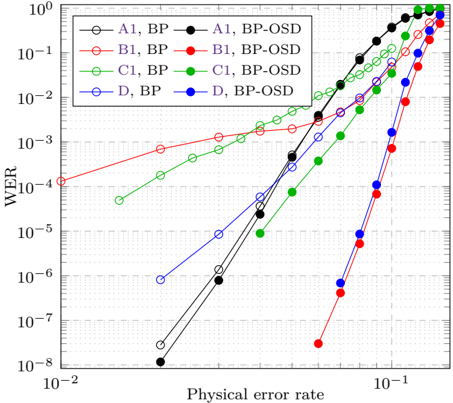
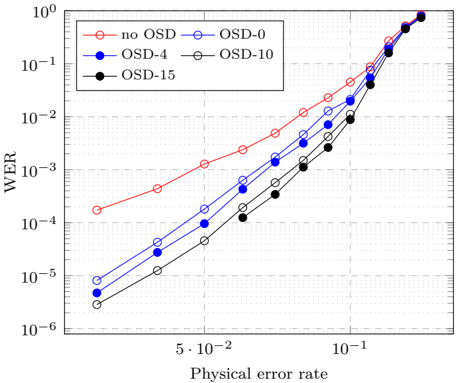
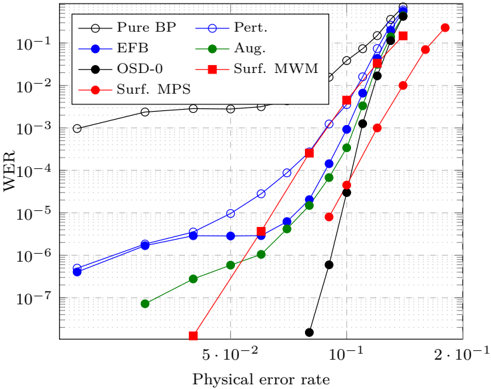
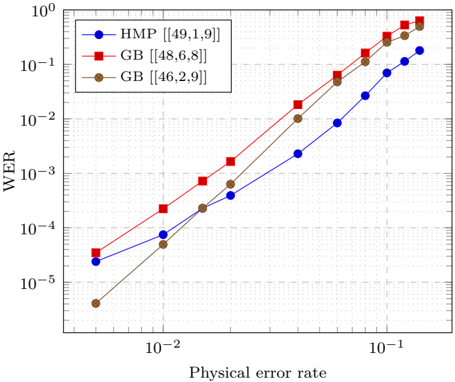
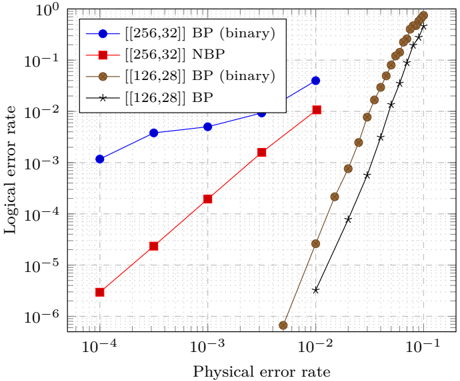
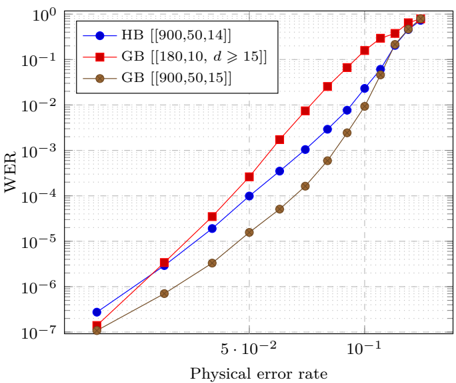
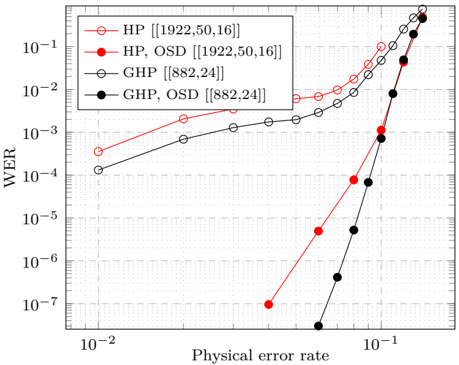
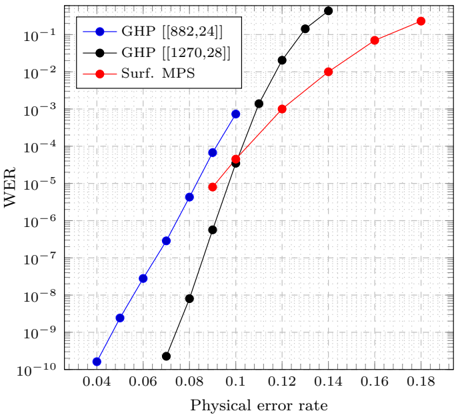
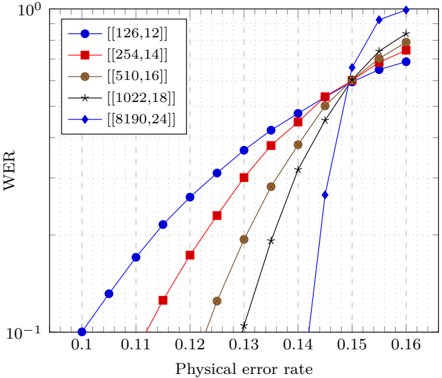
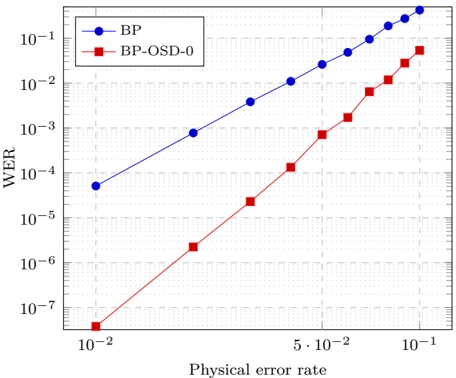
We study the performance of medium-length quantum LDPC (QLDPC) codes in the depolarizing channel. Only degenerate codes with the maximal stabilizer weight much smaller than their minimum distance are considered. It is shown that with the help of OSD-like post-processing the performance of the standard belief propagation (BP) decoder on many QLDPC codes can be improved by several orders of magnitude. Using this new BP-OSD decoder we study the performance of several known classes of degenerate QLDPC codes including hypergraph product codes, hyperbicycle codes, homological product codes, and Haah's cubic codes. We also construct several interesting examples of short generalized bicycle codes. Some of them have an additional property that their syndromes are protected by small BCH codes, which may be useful for the fault-tolerant syndrome measurement. We also propose a new large family of QLDPC codes that contains the class of hypergraph product codes, where one of the used parity-check matrices is square. It is shown that in some cases such codes have better performance than hypergraph product codes. Finally, we demonstrate that the performance of the proposed BP-OSD decoder for some of the constructed codes is better than for a relatively large surface code decoded by a near-optimal decoder.
Overview
The claims and statistics of this paper haven’t been checked yet.
Free: it reads the open-access text and checks the first 5 claims that cite a source we can check. Create a free account to check every claim.
Integrity signals
Registry
Cites
Statistics
Figures
Verification
Claims the paper makes
The claims and statistics of this paper haven’t been checked yet.
Free: it reads the open-access text and checks the first 5 claims that cite a source we can check. Create a free account to check every claim.
Claims other papers make about this one
Each is checked against this paper’s own text: does it say what the citing paper says it does?
The cited source says what the claim attributes to it.
In the citing paper
“The original work36 described BP-OSD in the context of a toy noise model with memory errors only.”
From High-threshold and low-overhead fault-tolerant quantum memory (2024) · cites this paper as [36]
Self-check
Percentages, sums and reported differences re-computed from the paper’s own numbers.
The self-check needs the paper’s full text.
Citations
Cites
Low-density parity-check codes
Gallager, R. (1962) · IEEE Transactions on Information Theory · doi:10.1109/tit.1962.1057683 · Cited by 10,602
Factor graphs and the sum-product algorithm
Kschischang, F. R., Frey, B. J., & Loeliger, H.-A. (2001) · IEEE Transactions on Information Theory · doi:10.1109/18.910572 · Cited by 6,486 · cited 1×
“There are a number of decoding algorithms for classical LDPC codes, but the most frequently used one is the belief propagation (BP) decoder [27], also known as the message passing decoder or the sum-product de-coder [29].”
Information theory, inference, and learning algorithms
(2004) · Choice Reviews Online · doi:10.5860/choice.41-5949 · Cited by 6,362
Low-Density Parity-Check Codes
Gallager, R. G. (1963) · The MIT Press eBooks · doi:10.7551/mitpress/4347.001.0001 · Cited by 4,401
A recursive approach to low complexity codes
Tanner, R. (1981) · IEEE Transactions on Information Theory · doi:10.1109/tit.1981.1056404 · Cited by 3,138
Error Correcting Codes in Quantum Theory
Steane, A. M. (1996) · Physical Review Letters · doi:10.1103/physrevlett.77.793 · Cited by 2,677
Good quantum error-correcting codes exist
Calderbank, A. R., & Shor, P. W. (1996) · Physical Review A · doi:10.1103/physreva.54.1098 · Cited by 2,516 · cited 1×
“A very important subclass of quantum stabilizer codes are the quantum Calderbank-Shor-Steane (CSS) codes introduced in [21].”
BackgroundEdmonds, J. (1965) · Canadian Journal of Mathematics · doi:10.4153/cjm-1965-045-4 · Cited by 2,428 · cited 1×
“The red curves are for the 4-limited [[1201,1,25]] surface code under the minimum weight matching (MWM) and the MPS-based decoders [36, 5].”
MethodDennis, E., Kitaev, A., Landahl, A., & Preskill, J. (2002) · Journal of Mathematical Physics · doi:10.1063/1.1499754 · Cited by 1,768
Edmonds, J. (2009) · Classic Papers in Combinatorics · doi:10.1007/978-0-8176-4842-8_26 · Cited by 1,517
Cited by
Items 301–400 of 587
Translation-invariant quantum low-density parity-check codes from compactified fracton modelsPreprint
Hopkin, C. M., Albert, V. V., & Williamson, D. J. (2026) · arXiv (Cornell University) · doi:10.48550/arxiv.2605.19298 · Cited by 7
Generalized Bicycle Codes as Cyclic Submodules and their Automorphism StructurePreprint
Davenport, A., Blue, J., & Chuang, I. L. (2026) · arXiv (Cornell University) · doi:10.48550/arxiv.2606.05044 · Cited by 7
Lifting Lifted Product CodesPreprint
Hirasaki, Y., & Lee, J. Y. (2026) · arXiv (Cornell University) · doi:10.48550/arxiv.2607.28621 · Cited by 7
Quantum LDPC Codes From Intersecting Subsets
Ostrev, D. (2024) · IEEE Transactions on Information Theory · doi:10.1109/tit.2024.3402091 · Cited by 6
Union-Intersection Union-Find for Decoding Depolarizing Errors in Topological Codes
Lin, T., & Lai, C. (2025) · IEEE Journal on Selected Areas in Information Theory · doi:10.1109/jsait.2025.3581810 · Cited by 6
Asymptotically Good Generalized Quantum Tanner Codes
Mostad, O. Å., Rosnes, E., & Lin, H.-Y. (2025) · IEEE Journal on Selected Areas in Information Theory · doi:10.1109/jsait.2025.3594310 · Cited by 6
Zhou, K., Lu, L., Xiang, D., Tao, C., Wu, A., Leng, J., Liu, F., Chen, M., & Yin, J. (2025) · IEEE/ACM International Symposium on Microarchitecture (MICRO) · doi:10.1145/3725843.3756084 · Cited by 6
Symmetry-based quantum codes beyond the Pauli group
Bradshaw, Z. P., LaBorde, M. L., & Montero, D. (2026) · Physical Review A · doi:10.1103/47pv-zzxb · Cited by 6
Power and Limitations of Linear Programming Decoder for Quantum LDPC Codes
Gu, S., & Soleimanifar, M. (2026) · IEEE Transactions on Information Theory · doi:10.1109/tit.2026.3715538 · Cited by 6
Improved Logical Error Rate via List Decoding of Quantum Polar Codes
Gong, A., & Renes, J. M. (2024) · IEEE International Symposium on Information Theory (ISIT) · doi:10.1109/isit57864.2024.10619465 · Cited by 6
A Blindness Property of the Min-Sum Decoding for the Toric Code
Crest, J. D., Mhalla, M., & Savin, V. (2025) · IEEE Journal on Selected Areas in Information Theory · doi:10.1109/jsait.2025.3571313 · Cited by 6
A low-complexity BP-OSD algorithm for quantum LDPC codes
Liang, J., Wang, Q., Li, L., Song, L., & Ma, X. (2025) · The European Physical Journal Special Topics · doi:10.1140/epjs/s11734-025-01712-x · Cited by 6
Small Quantum Codes from Algebraic Extensions of Generalized Bicycle CodesPreprint
Koukoulekidis, N., Šimkovic, F., Leib, M., & Pereira, F. R. F. (2024) · arXiv (Cornell University) · doi:10.48550/arxiv.2401.07583 · Cited by 6
Belief propagation for general graphical models with loopsPreprint
Hack, P., Hitter, J., Mendl, C. B., & Paler, A. (2024) · arXiv (Cornell University) · doi:10.48550/arxiv.2411.04957 · Cited by 6
Decoding Quantum LDPC Codes using Collaborative Check Node RemovalPreprint
Bhattacharyya, M., & Raina, A. (2025) · arXiv (Cornell University) · doi:10.48550/arxiv.2501.08036 · Cited by 6
Quantum Computing from GraphsPreprint
Khesin, A. B. (2025) · arXiv (Cornell University) · doi:10.48550/arxiv.2501.17959 · Cited by 6
Homology, Hopf Algebras and Quantum Code SurgeryPreprint
Cowtan, A. (2024) · arXiv (Cornell University) · doi:10.48550/arxiv.2508.01496 · Cited by 7
Bidirectional Decoding for Concatenated Quantum Hamming CodesPreprint
Zhang, C., Wu, Z., Wu, J., & Huang, S. (2026) · arXiv (Cornell University) · doi:10.48550/arxiv.2601.09131 · Cited by 7
Locality forces equal energy spacing of quantum many-body scar towersPreprint
O’Dea, N., Gioia, L., Moudgalya, S., & Motrunich, O. I. (2026) · arXiv (Cornell University) · doi:10.48550/arxiv.2601.14206 · Cited by 6
Kam, J. F., Southwell, A., Gicev, S., Usman, M., & Modi, K. K. (2026) · arXiv (Cornell University) · doi:10.48550/arxiv.2603.05474 · Cited by 6
Networked Realization of Quantum LDPC CodesPreprint
Shaw, S., & Rengaswamy, N. (2026) · arXiv (Cornell University) · doi:10.48550/arxiv.2604.25026 · Cited by 6
An infinite class of quantum codes derived from duadic constacyclic codes
Dastbasteh, R., Martínez, J. E., Nemec, A., iOlius, A. D., & Crespo, P. M. (2025) · Quantum Information Processing · doi:10.1007/s11128-025-04828-0 · Cited by 5
Decimation Strategies for Belief Propagation Decoding of Quantum LDPC Codes
Alinia, M., Mitchell, D. G. M., Yao, H., & Pfister, H. D. (2025) · International Symposium on Turbo Codes and Iterative Information Processing · doi:10.1109/istc65386.2025.11154483 · Cited by 5
Quantum Maxwell Erasure Decoder for qLDPC codes
Freire, B. C. A., Régent, F.-M. L., & Leverrier, A. (2026) · IEEE International Symposium on Information Theory (ISIT) · doi:10.1109/isit62367.2026.11654048 · Cited by 5
Stabilizer-Assisted Inactivation Decoding of Quantum Error-Correcting Codes with Erasures
Pech, G., Gökduman, M., Yao, H., & Pfister, H. D. (2026) · IEEE International Symposium on Information Theory (ISIT) · doi:10.1109/isit62367.2026.11653654 · Cited by 5
Note on Logical Gates by Gauge Field Formalism of Quantum Error Correction
Haruna, J. (2026) · Progress of Theoretical and Experimental Physics · doi:10.1093/ptep/ptag105 · Cited by 5
Towards practical quantum LDPC codes
Roffe, J. (2021) · doi:10.22331/qv-2021-11-30-63 · Cited by 5
Progressive-Proximity Bit-Flipping for Decoding Surface Codes
Pacenti, M., Flanagan, M. F., Chytas, D., & Vasic, B. V. (2024) · IEEE Transactions on Communications · doi:10.1109/tcomm.2024.3454029 · Cited by 5
Quantum Circuit Switching with One-Way Repeaters in Star Networks
Iñesta, Á. G., Choi, H., Englund, D. R., & Wehner, S. (2024) · IEEE International Conference on Quantum Computing and Engineering (QCE) · doi:10.1109/qce60285.2024.00215 · Cited by 5
Quantum Error Correction Exploiting Degeneracy to Approach the Hashing Bound
Kasai, K. (2026) · IEEE Transactions on Information Theory · doi:10.1109/tit.2026.3747884 · Cited by 5
Quantum X Y Z cyclic codes for biased noise
Liang, Z., Yang, F., Yi, Z., & Wang, X. (2025) · Physical Review A · doi:10.1103/6qbg-xslr · Cited by 5
Error correction for reliable quantum computing
Fuentes, P. (2022) · Depósito Académico Digital Universidad de Navarra (University of Navarra) · doi:10.15581/10171/63067 · Cited by 5
Usatyuk, V., Egorov, S., & Sapozhnikov, D. (2023) · arXiv.org · doi:10.48550/arxiv.2307.15778 · Cited by 3
A High-Performance List Decoding Algorithm for Surface Codes with Erroneous SyndromePreprint
Liang, J., Wang, Q., Li, L., & Ma, X. (2024) · arXiv (Cornell University) · doi:10.48550/arxiv.2409.06979 · Cited by 5
Romanesco codes: Bias-tailored qLDPC codes from fractal codesPreprint
Leroux, C., & Iverson, J. K. (2025) · arXiv (Cornell University) · doi:10.48550/arxiv.2506.00130 · Cited by 5
Toward Uncertainty-Aware and Generalizable Neural Decoding for Quantum LDPC CodesPreprint
Mi, X., & Mueller, F. (2025) · arXiv (Cornell University) · doi:10.48550/arxiv.2510.06257 · Cited by 5
Bias-tailored single-shot quantum LDPC codesPreprint
Wu, S., Brun, T. A., & Lidar, D. A. (2025) · arXiv (Cornell University) · doi:10.48550/arxiv.2507.02239 · Cited by 5
Fang, X., Ruan, J., Prabhu, S., Li, A., Humble, T., Tullsen, D. M., & Ding, Y. (2026) · arXiv (Cornell University) · doi:10.48550/arxiv.2601.10144 · Cited by 5
In-Situ Simultaneous Magic State Injection on Arbitrary CSS qLDPC CodesPreprint
Liu, K., Xu, S., Jochym-O’Connor, T., He, Z., Singh, S., & Ding, Y. (2026) · arXiv (Cornell University) · doi:10.48550/arxiv.2604.05126 · Cited by 5
Assessing System Capabilities and Bottlenecks of an Early Fault-Tolerant Bicycle ArchitecturePreprint
Liu, K., Foxman, B., Anselmetti, G.-L., & Ding, Y. (2026) · arXiv (Cornell University) · doi:10.48550/arxiv.2604.20013 · Cited by 5
High-Girth Regular Quantum LDPC Codes from Square-Base Hypergraph Products via CPM LiftsPreprint
Okada, K., & Kasai, K. (2026) · arXiv (Cornell University) · doi:10.48550/arxiv.2604.27817 · Cited by 5
Mitigating Classical Resource Costs in Quantum Error Correction via Generalized qLDPC PredecodingPreprint
Knapen, A., Luo, J., Tao, G., Wang, Y., Bruno, T., Zhang, Q., Sylvester, D., Saligane, M., & Ravi, G. S. (2026) · arXiv (Cornell University) · doi:10.48550/arxiv.2605.03180 · Cited by 5
Maximum Likelihood Decoding of Quantum Error Correction CodesPreprint
Cao, H., Yan, G., Du, Y., & Pan, F. (2026) · arXiv (Cornell University) · doi:10.48550/arxiv.2605.17230 · Cited by 5
A Two-Branch Finite-Field Construction for Regular CSS LDPC BasesPreprint
Okada, K., & Kasai, K. (2026) · arXiv (Cornell University) · doi:10.48550/arxiv.2605.23894 · Cited by 5
Real-Time Quantum Error Correction System Stack: Architecture, Algorithms, and Engineering PracticePreprint
Chen, Y., Luan, C., Zheng, P., Zeng, X., Hou, J., Fu, Z., Jin, Y., Wang, F., Yang, G., & Lv, D. (2026) · arXiv (Cornell University) · doi:10.48550/arxiv.2605.30765 · Cited by 6
A framework for low-overhead quantum fault tolerance via spacetime liftingPreprint
Xu, Y., Wang, Y., & Liu, Z.-W. (2026) · arXiv (Cornell University) · doi:10.48550/arxiv.2606.06365 · Cited by 5
Algebra of Bivariate-Bicycle Surface CodesPreprint
Wang, R., & Pryadko, L. P. (2026) · arXiv (Cornell University) · doi:10.48550/arxiv.2606.08771 · Cited by 5
Efficient foundation decoders for fault-tolerant quantum computingPreprint
Yan, G., Li, S., Xiao, S., Ma, P., Cao, H., Pan, F., & Du, Y. (2026) · arXiv (Cornell University) · doi:10.48550/arxiv.2606.27119 · Cited by 5
Designing Quantum Error Correcting Codes to fit decoders via Reinforcement LearningPreprint
Sella, O., Pinsler, R., & Heinis, T. (2026) · arXiv (Cornell University) · doi:10.48550/arxiv.2608.15754 · Cited by 6
Computing with qLDPC Codes by Climbing the Chain Map HierarchyPreprint
Sahay, R., Long, D. M., & Khemani, V. (2026) · arXiv (Cornell University) · doi:10.48550/arxiv.2609.02999 · Cited by 6
Informed Dynamic Scheduling for QLDPC Codes
Huang, T.-H., & Ueng, Y.-L. (2026) · Quantum · doi:10.22331/q-2026-01-16-1967 · Cited by 4
Graph-based approach to entanglement entropy of quantum error-correcting codes
Zhao, W., Fang, M., & Su, D. (2026) · Physical Review A · doi:10.1103/jc6b-txy9 · Cited by 4
Qubit-centric transformer for surface code decoding
Anonymous, Kwak, H.-Y., & Kim, Y. (2026) · Physical Review A · doi:10.1103/ll1h-sm1y · Cited by 4
Generalizing the matching decoder for the Chamon code
Schwartzman-Nowik, Z., & Brown, B. J. (2025) · Quantum · doi:10.22331/q-2025-06-18-1775 · Cited by 4
Protocols for intermodule two-qubit gates mediated by time-bin encoded photons
McIntyre, Z. M., & Coish, W. A. (2025) · Physical Review Research · doi:10.1103/xwyt-1ck7 · Cited by 4
Advancing Finite-Length Quantum Error Correction Using Generalized Bicycle Codes
Mostad, O. Å., Lin, H.-Y., Rosnes, E., Lee, D.-S., & Lai, C. (2025) · International Symposium on Turbo Codes and Iterative Information Processing · doi:10.1109/istc65386.2025.11154497 · Cited by 4
Trapping Set Analysis of Finite-Length Quantum LDPC Codes
Raveendran, N., & Vasic, B. V. (2021) · IEEE International Symposium on Information Theory (ISIT) · doi:10.1109/isit45174.2021.9518154 · Cited by 4
Quantum CSS Duadic and Triadic Codes: New Insights and Properties
Dastbasteh, R., Larrarte, O. S., Martínez, J. E., iOlius, A. D., del Moral, J. O., & Crespo, P. M. (2025) · Lecture notes in computer science · doi:10.1007/978-3-031-81824-0_5 · Cited by 4
Improved Construction of Generalized Quantum Tanner Codes
Mostad, O. Å., Rosnes, E., & Lin, H.-Y. (2025) · International Symposium on Turbo Codes and Iterative Information Processing · doi:10.1109/istc65386.2025.11154489 · Cited by 4
Turbo-XZ Algorithm: Low-Latency Decoders for Quantum LDPC Codes
Raveendran, N., Boutillon, E., & Vasic, B. V. (2023) · International Symposium on Turbo Codes and Iterative Information Processing · doi:10.1109/istc57237.2023.10273490 · Cited by 4
Trapping Sets of Iterative Decoders for Quantum and Classical Low-Density Parity-Check Codes
Raveendran, N. (2021) · UA Campus Repository (The University of Arizona) · Cited by 4
Breadth-first graph traversal union-find decoderPreprint
Löbl, M. C., Chen, S. X., Paesani, S., & Sørensen, A. S. (2024) · arXiv (Cornell University) · doi:10.48550/arxiv.2407.15988 · Cited by 4
Dastbasteh, R., Larrarte, O. S., Moncy, A. J., Schnabl, P., Crespo, P. M., Martinez, J. E., & Otxoa, R. M. (2025) · arXiv (Cornell University) · doi:10.48550/arxiv.2508.09082 · Cited by 4
GPU-Accelerated Automorphism Ensemble Decoding of Quantum LDPC Codes
Koutsioumpas, S., & Roffe, J. (2025) · doi:10.59350/2tsb3-hy509 · Cited by 4
Self-dual Stacked Quantum Low-Density Parity-Check CodesPreprint
Liu, Z.-C., Xu, C.-Y., & Xu, Y. (2026) · arXiv (Cornell University) · doi:10.48550/arxiv.2602.15372 · Cited by 4
ADaPT: Adaptive-window Decoding for Practical fault-TolerancePreprint
Oberoi, T., Viszlai, J., & Chong, F. T. (2026) · arXiv (Cornell University) · doi:10.48550/arxiv.2605.01149 · Cited by 4
Multiple-Bases Belief Propagation List Decoding for Quantum LDPC CodesPreprint
Rabeti, S., & Mahdavifar, H. (2026) · arXiv (Cornell University) · doi:10.48550/arxiv.2605.14170 · Cited by 4
Impulse Decoding of Quantum LDPC Codes: Equivalence of Degeneracy and Code-ShorteningPreprint
Bhatnagar, S., Pacenti, M., Raveendran, N., Declercq, D., & Vasic, B. V. (2026) · arXiv (Cornell University) · doi:10.48550/arxiv.2606.18240 · Cited by 4
Learning to Decode Quantum LDPC Codes via Cluster-Based Sequential Belief PropagationPreprint
Moradi, M., Kim, T., Chou, R. A., & Mitchell, D. G. M. (2026) · arXiv (Cornell University) · doi:10.48550/arxiv.2607.20130 · Cited by 4
Provably Efficient Self-Calibrating Quantum Fault TolerancePreprint
Gong, W., & Hu, H.-Y. (2026) · arXiv (Cornell University) · doi:10.48550/arxiv.2608.05686 · Cited by 4
Trapping Sets of Detector Error ModelsPreprint
Pacenti, M., Raveendran, N., & Vasic, B. V. (2026) · arXiv (Cornell University) · doi:10.48550/arxiv.2608.11516 · Cited by 4
Ultra-high-distance quantum memories from amplified qLDPC codesPreprint
Liang, Z., Gu, B., Chen, Y.-A., Eisert, J., & Wang, Z. (2026) · arXiv (Cornell University) · doi:10.48550/arxiv.2609.37231 · Cited by 4
Magic Quantum Code SurgeryPreprint
Chang, K., Lyons, A., Ren, Y., Putterman, H., Tantivasadakarn, N., Albert, V. V., Brown, B. J., & Williamson, D. J. (2026) · arXiv (Cornell University) · doi:10.48550/arxiv.2610.03920 · Cited by 4
Threshold for Fault-tolerant Quantum Advantage with the Quantum Approximate Optimization Algorithm
Omanakuttan, S., He, Z., Zhang, Z., Hao, T., Babakhani, A., Boulebnane, S., Chakrabarti, S., Herman, D., Sullivan, J., Perlin, M. A., et al. (2025) · arXiv · doi:10.48550/arxiv.2504.01897 · Cited by 3
“Benefits of these codes include more favorable encoding rates and higher relative code distances which may reduce over-heads for universal quantum computation [74, 75].”
Topological blocking decoder for surface codes
Jung, H.-W., & Ha, J. (2025) · Physical Review A · doi:10.1103/physreva.111.042424 · Cited by 3
High-dimensional quantum X Y Z product codes for biased noise
Liang, Z., Yi, Z., Yang, F., Chen, J., Wang, Z., & Wang, X. (2025) · Physical Review A · doi:10.1103/rrfk-1b51 · Cited by 3
Entanglement-assisted Quasi-cyclic Quantum Low-density Parity-check Codes over Qubits
Kumar, P., Sharma, A. K., Bharadwaj, K., & Garani, S. S. (2026) · Quantum · doi:10.22331/q-2026-07-31-2181 · Cited by 3
Reconstruction of detector error model for quantum error correction
Ye, C., & Zhang, P. (2026) · Chinese Physics B · doi:10.1088/1674-1056/ae663a · Cited by 3
Coset Ensemble Decoder for Quantum Error Correction with Algorithm-Hardware Co-Design
Liang, S., Xu, J., Bassanino, G., Wang, Q., Zhou, Y., Lu, Y., Mo, Z., Kelly, P. H. J., Yuan, B., Luk, W. W., et al. (2026) · Proceedings - International Symposium on Computer Architecture/Proceedings · doi:10.1109/isca66397.2026.00070 · Cited by 3
Liang, Z., Wang, Z., Yi, Z., Yang, F., & Wang, X. (2025) · Entropy · doi:10.3390/e27090940 · Cited by 3
Near-threshold qudit stabilizer codes with efficient encoding circuits for magic-state distillation
Sharma, A. K., & Garani, S. S. (2024) · Physical Review A · doi:10.1103/physreva.109.062426 · Cited by 3
Novel Long Distance Free Space Quantum Secure Direct Communication for Web 3.0 NetworksPreprint
Zhou, Y., Zhou, X.-L., Li, Z. Y., Wong, Y. K., & Liang, Y. (2024) · arXiv (Cornell University) · doi:10.48550/arxiv.2402.09108 · Cited by 3
In situ calibration of unitary operations during quantum error correctionPreprint
Kunjummen, J., & Taylor, J. M. (2025) · arXiv (Cornell University) · doi:10.48550/arxiv.2511.01080 · Cited by 3
Correction of chain losses in trapped ion quantum computers
Coble, N. J., Ye, M., & Delfosse, N. (2025) · arXiv (Cornell University) · doi:10.48550/arxiv.2511.16632 · Cited by 3
Accelerating BP-based decoders for QLDPC Codes with Local Syndrome-Based PreprocessingPreprint
Fan, W., Suzuki, Y., Ravi, G. S., Ueno, Y., Byun, I., Inoue, K., & Tanimoto, T. (2025) · arXiv (Cornell University) · doi:10.48550/arxiv.2509.01892 · Cited by 3
Correcting a noisy quantum computer using a quantum computerPreprint
Zhang, P. (2025) · arXiv (Cornell University) · doi:10.48550/arxiv.2506.08331 · Cited by 3
Time-Dynamic Circuits for Fault-Tolerant Shift Automorphisms in Quantum LDPC CodesPreprint
Kim, Y., Gicev, S., Sevior, M., & Usman, M. (2026) · arXiv (Cornell University) · doi:10.48550/arxiv.2601.09911 · Cited by 3
Generalized $\mathbb{Z}_p$ toric codes as qudit low-density parity-check codesPreprint
Liang, Z., & Chen, Y. (2026) · arXiv (Cornell University) · doi:10.48550/arxiv.2602.20158 · Cited by 3
Independent Trivariate Bicycle CodesPreprint
Galimova, A. A. (2026) · arXiv (Cornell University) · doi:10.48550/arxiv.2603.17703 · Cited by 3
Efficient Routing of Quantum LDPC Codes on Programmable 2D Toric ArchitecturesPreprint
Liu, K., Tsunoda, T., Xue, S. H., McKinney, E., Zhou, Z., Xu, S., Schoelkopf, R. J., & Ding, Y. (2026) · arXiv (Cornell University) · doi:10.48550/arxiv.2604.18714 · Cited by 4
Design and Analysis of Quantum Dual-Containing CSS LDPC Codes based on Quasi-Dyadic MatricesPreprint
Baldelli, A., Baldi, M., Battaglioni, M., Chiaraluce, F., & Santini, P. M. (2026) · arXiv (Cornell University) · doi:10.48550/arxiv.2605.03631 · Cited by 3
A Factor-Graph Formulation of CSS Syndrome Decoding: Joint BP and Four-State BPPreprint
Kasai, K. (2026) · arXiv (Cornell University) · doi:10.48550/arxiv.2605.05132 · Cited by 3
Clifford-deformed zero-rate LDPC codes with 50% biased noise thresholdsPreprint
Das, J., Dhara, S., Medina, P., Pesah, A. C., & Dua, A. (2026) · arXiv (Cornell University) · doi:10.48550/arxiv.2605.15348 · Cited by 3
Learning-Based List Sequential Belief Propagation Decoding of Quantum LDPC CodesPreprint
Moradi, M., Kim, T., & Chou, R. A. (2026) · arXiv (Cornell University) · doi:10.48550/arxiv.2606.20926 · Cited by 3
Routing Codes: High-Rate Quantum LDPC Codes with Short, Parallel Non-Local ConnectivityPreprint
Zhang, J., Chen, Z.-Y., Duan, P., Li, J.-N., Tian-hao, W. E. I., Hou, Q.-Y., Kong, W.-C., Wu, Y.-C., & Guo, G. (2026) · arXiv (Cornell University) · doi:10.48550/arxiv.2606.25330 · Cited by 4
Rate-2/3 Girth-8 (3,18)-Regular Quantum LDPC Codes from Two-Branch Finite-Field Bases and CPM LiftsPreprint
Okada, K., & Kasai, K. (2026) · arXiv (Cornell University) · doi:10.48550/arxiv.2606.27130 · Cited by 3
Strictly Local Tile-Code Architectures on Two-Dimensional Planar LatticesPreprint
Bae, Y., & Park, C.-Y. (2026) · arXiv (Cornell University) · doi:10.48550/arxiv.2607.05897 · Cited by 3
Quantum codes from classical annealingPreprint
Perlin, M. A., Steinberg, M., & Criger, B. (2026) · arXiv (Cornell University) · doi:10.48550/arxiv.2607.19574 · Cited by 3
Multistage Rewinding Decoder for QLDPC CodesPreprint
Taghipour, M., Chytas, D., & Vasic, B. V. (2026) · arXiv (Cornell University) · doi:10.48550/arxiv.2608.07783 · Cited by 3
Efficient fidelity simulation of high-rate magic distillation circuitsPreprint
Xiao, X., Hangleiter, D., Ataides, J. P. B., Mehta, R., Menon, V., Lukin, M. D., & Gullans, M. J. (2026) · arXiv (Cornell University) · doi:10.48550/arxiv.2610.03605 · Cited by 3
Metadata
- Authors
- Panteleev, P., & Kalachev, G.
- Affiliations
- Lomonosov Moscow State University (RU)
- Venue
- Quantum
- Published
- 2021-11-22
- Volume
- 5
- Pages
- 585
- ISSN
- 2521-327X (ISSN-L)
- OpenAlex
- W2926023653
- Cited by
- 257
- References
- 56
- Citations by year
- 2026: 48 · 2025: 89 · 2024: 49 · 2023: 25 · 2022: 22 · 2021: 21
- FWCI
- 10.30
- Type
- journal article
- Language
- en
- Open access
- gold
- doi.org
- Locations
- Quantum (publishedVersion, cc-by)
- arXiv (Cornell University) (acceptedVersion)
- arXiv (Cornell University) (submittedVersion)
- DOAJ (DOAJ: Directory of Open Access Journals) (submittedVersion, cc-by-sa)
- arXiv (Cornell University) (cc-by)
- Funders
- The Ministry of Science and Higher Education of the Russian Federation (075-15-2020-801)
- Topics
- Physical Sciences › Computer Science › Artificial Intelligence › Quantum Computing Algorithms and Architecture
- Physical Sciences › Computer Science › Computer Networks and Communications › Error Correcting Code Techniques
- Physical Sciences › Mathematics › Discrete Mathematics and Combinatorics › Coding theory and cryptography
- Keywords
- quantum LDPC codes, depolarizing channel, belief propagation decoding, hypergraph product codes, BCH codes, surface code, finite-length performance
About these checks
Registry, retraction, Cites and statistics results are computed, not judged, with one exception: a printed reference that no index lists is read once by a model before it counts as a citation error. Claims are extracted by a model and kept only when their quote appears verbatim in the text; each cited source is then checked, with a model’s help, for whether it says what the claim relies on. Those verdicts can be wrong — read the claim’s quote and the cited source before relying on one.
Statistics and arithmetic are recomputed, not judged.
Confidence bands are shown only for fields calibrated on our annotated test set. None is calibrated yet, so no band is shown.
What counts as a claim ›How we measure confidence ›How we check this ›
Are you an author, or do you see a problem with this page? Request a review
Data sources
Bibliographic data: Semantic Scholar, OpenAlex, Crossref.
Contains information from the Semantic Scholar Academic Graph Datasets, made available under the ODC Attribution License (ODC-BY 1.0).
Semantic Scholar’s data is described in: Kinney, R., et al. (2023). The Semantic Scholar Open Data Platform. arXiv:2301.10140.
