

Degenerate Quantum LDPC Codes With Good Finite Length Performance
Open accessThe DOI matches its Crossref record; 57 of the 57 references it cites were found in a registry or an index.
Abstract
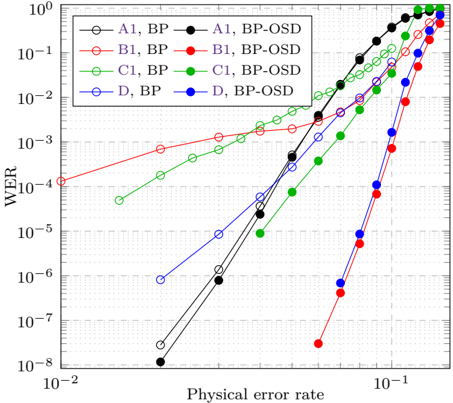
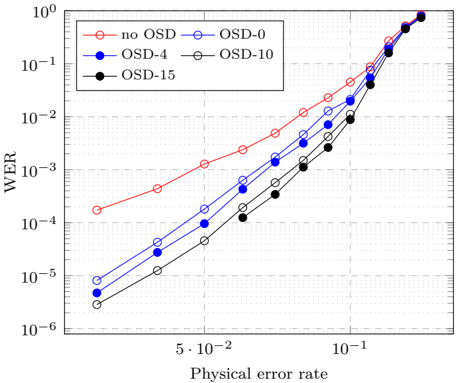
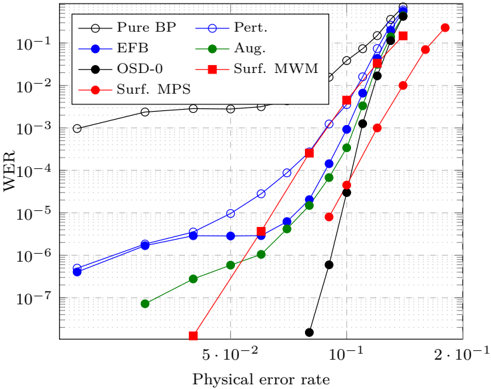
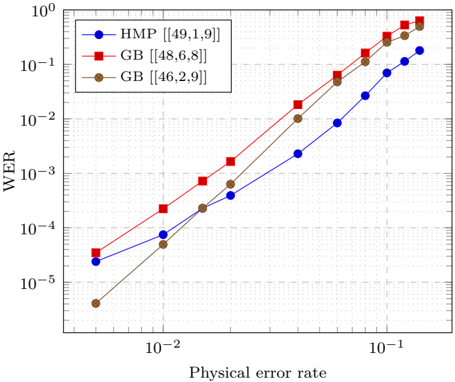
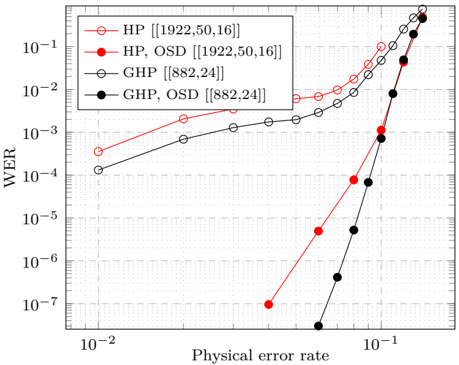
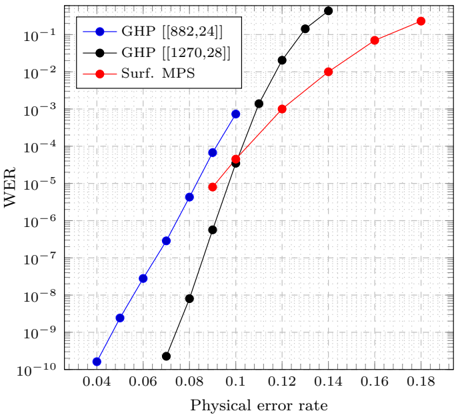
We study the performance of medium-length quantum LDPC (QLDPC) codes in the depolarizing channel. Only degenerate codes with the maximal stabilizer weight much smaller than their minimum distance are considered. It is shown that with the help of OSD-like post-processing the performance of the standard belief propagation (BP) decoder on many QLDPC codes can be improved by several orders of magnitude. Using this new BP-OSD decoder we study the performance of several known classes of degenerate QLDPC codes including hypergraph product codes, hyperbicycle codes, homological product codes, and Haah's cubic codes. We also construct several interesting examples of short generalized bicycle codes. Some of them have an additional property that their syndromes are protected by small BCH codes, which may be useful for the fault-tolerant syndrome measurement. We also propose a new large family of QLDPC codes that contains the class of hypergraph product codes, where one of the used parity-check matrices is square. It is shown that in some cases such codes have better performance than hypergraph product codes. Finally, we demonstrate that the performance of the proposed BP-OSD decoder for some of the constructed codes is better than for a relatively large surface code decoded by a near-optimal decoder.
Overview
The claims and statistics of this paper haven’t been checked yet.
Free: it reads the open-access text and checks the first 5 claims that cite a source we can check. Create a free account to check every claim.
Integrity signals
Registry
Cites
Statistics
Figures
Verification
Claims the paper makes
The claims and statistics of this paper haven’t been checked yet.
Free: it reads the open-access text and checks the first 5 claims that cite a source we can check. Create a free account to check every claim.
Claims other papers make about this one
Each is checked against this paper’s own text: does it say what the citing paper says it does?
The cited source says what the claim attributes to it.
In the citing paper
“The original work36 described BP-OSD in the context of a toy noise model with memory errors only.”
From High-threshold and low-overhead fault-tolerant quantum memory (2024) · cites this paper as [36]
Self-check
Percentages, sums and reported differences re-computed from the paper’s own numbers.
The self-check needs the paper’s full text.
Citations
Cites
Low-density parity-check codes
Gallager, R. (1962) · IEEE Transactions on Information Theory · doi:10.1109/tit.1962.1057683 · Cited by 10,602
Factor graphs and the sum-product algorithm
Kschischang, F. R., Frey, B. J., & Loeliger, H.-A. (2001) · IEEE Transactions on Information Theory · doi:10.1109/18.910572 · Cited by 6,486 · cited 1×
“There are a number of decoding algorithms for classical LDPC codes, but the most frequently used one is the belief propagation (BP) decoder [27], also known as the message passing decoder or the sum-product de-coder [29].”
Information theory, inference, and learning algorithms
(2004) · Choice Reviews Online · doi:10.5860/choice.41-5949 · Cited by 6,362
Low-Density Parity-Check Codes
Gallager, R. G. (1963) · The MIT Press eBooks · doi:10.7551/mitpress/4347.001.0001 · Cited by 4,401
A recursive approach to low complexity codes
Tanner, R. (1981) · IEEE Transactions on Information Theory · doi:10.1109/tit.1981.1056404 · Cited by 3,138
Error Correcting Codes in Quantum Theory
Steane, A. M. (1996) · Physical Review Letters · doi:10.1103/physrevlett.77.793 · Cited by 2,677
Good quantum error-correcting codes exist
Calderbank, A. R., & Shor, P. W. (1996) · Physical Review A · doi:10.1103/physreva.54.1098 · Cited by 2,516 · cited 1×
“A very important subclass of quantum stabilizer codes are the quantum Calderbank-Shor-Steane (CSS) codes introduced in [21].”
BackgroundEdmonds, J. (1965) · Canadian Journal of Mathematics · doi:10.4153/cjm-1965-045-4 · Cited by 2,428 · cited 1×
“The red curves are for the 4-limited [[1201,1,25]] surface code under the minimum weight matching (MWM) and the MPS-based decoders [36, 5].”
MethodDennis, E., Kitaev, A., Landahl, A., & Preskill, J. (2002) · Journal of Mathematical Physics · doi:10.1063/1.1499754 · Cited by 1,768
Edmonds, J. (2009) · Classic Papers in Combinatorics · doi:10.1007/978-0-8176-4842-8_26 · Cited by 1,517
Cited by
Items 501–587 of 587
Quaternary-Binary Message-Passing Decoder for Quantum LDPC Codes
Chytas, D., Raveendran, N., Pradhan, A. K., & Vasic, B. V. (2023) · Globecom · doi:10.1109/globecom54140.2023.10436874
Faster Tensor Network Decoding for Topological Quantum Codes
Sandia National Laboratories (SNL-NM), A., Maurer, C., & Administration, U. A. S. F. H. R. A. (2024) · OSTI OAI (U.S. Department of Energy Office of Scientific and Technical Information) · doi:10.2172/2430054
Novel Long Distance Free Space Quantum Secure Direct Communication for Web 3.0 NetworksPreprint
Zhou, Y., Zhou, X.-L., Li, Z. Y., Wong, Y. K., & Liang, Y. (2024) · Preprints.org · doi:10.20944/preprints202409.0656.v1
Block-Layered Sign-Flipping Belief Propagation Decoder Architecture for Surface Codes
Hu, T.-A., Huang, T.-H., Ku, H., & Ueng, Y.-L. (2024) · International Symposium on Information Theory and its Applications · doi:10.23919/isita60732.2024.10858284
Progressive-Proximity Bit-Flipping for the 2D Toric Code
Pacenti, M., Flanagan, M. F., Chytas, D., & Vasic, B. V. (2024) · Globecom · doi:10.1109/globecom52923.2024.10901286
Composite-dimensional topological codes with boundaries and defects
Mousa, M., Jamadagni, A., & Dumitrescu, E. (2026) · Physical Review A · doi:10.1103/qr5v-1rg6
Mean Estimation in High-Dimensional Binary Timeinhomogeneous Markov Gaussian Mixture Models
Kadry, A. E. L., Zhang, Y., & Weinberger, N. (2025) · IEEE International Symposium on Information Theory (ISIT) · doi:10.1109/isit63088.2025.11195426
Program Synthesis for Quantum Applications
Deng, H. (2025) · University Libraries (University of Maryland) · doi:10.13016/1iuj-bwm1
Quantum error mitigation and error correction for practical quantum computation
Strikis, A. (2023) · Oxford University Research Archive (ORA) (University of Oxford) · doi:10.5287/ora-y0rqzr45b
Online Gaussian elimination for quantum LDPC decodingPreprint
Griffiths, S. J., Benhemou, A., & Browne, D. E. (2025) · arXiv (Cornell University) · doi:10.48550/arxiv.2504.05080
Une odyssée de la communication classique au calcul quantique tolérant aux fautes
Tremblay, M. (2022) · Knowledge UdeS (Institutional Deposit of the University of Sherbrooke)
Analysis of Graph-based Decoders for Quantum Low Density Parity Check Codes
Morris, K. (2025) · Lincoln (University of Nebraska)
QUANTUM ERROR CORRECTION FOR LOGICAL FERMIONIC AND BOSONIC SYSTEMS
Xu, Y. (2025) · University Libraries (University of Maryland) · doi:10.13016/euwb-8qev
Neural Network Belief Propagation and Ordered Statistics Decoding for Quantum Error Correction Codes
Gong, C. S. (2025) · Digital Access to Scholarship at Harvard (DASH) (Harvard University)
Multi-Stage Bit-Flipping Decoder Design for Quantum Error-Correcting Codes
Moxom, P. J., & Flanagan, M. F. (2025) · Irish Signals and Systems Conference · doi:10.1109/issc67739.2025.11291312
On LLR Mismatch in Belief Propagation Decoding of Overcomplete QLDPC CodesPreprint
Cordova, H. X., Balatsoukas‐Stimming, A., Liga, G., Gültekin, Y. C., & Alvarado, A. (2026) · arXiv (Cornell University) · doi:10.48550/arxiv.2603.04991
Qiao, X., Xu, X., Ma, H., & Qiu, T. (2026) · Applied Sciences · doi:10.3390/app16052586
CSS codes from the Bruhat order of Coxeter groupsPreprint
Brádler, K. (2026) · arXiv (Cornell University) · doi:10.48550/arxiv.2603.16036
Analyzing Decoders for Quantum Error CorrectionPreprint
Molavi, A., Saad, F. A., & Albarghouthi, A. (2026) · arXiv (Cornell University) · doi:10.48550/arxiv.2603.20127 · Cited by 1
Twisted Fiber Bundle Codes over Group AlgebrasPreprint
Liu, C. (2026) · arXiv (Cornell University) · doi:10.48550/arxiv.2604.01478
Efficient Message-Passing Decoding of Quantum LDPC Codes
Crest, J. D. (2024) · theses.fr (ABES) · doi:10.70675/f7c07de4z0554z4a72z9410zc469825af2c5
Étude de la distance minimale des codes stabilisateurs locaux
Saussay, N. (2025) · theses.fr (ABES) · doi:10.70675/a375a8d5z60e9z4352zbe50zd9df54257d74
Noisy Soft Syndrome Decoding of Quantum LDPC Codes for the Quantum Erasure Channel
Gayathri, R., Bhatnagar, S., & Kumar, P. V. (2026) · National Conference on Communications · doi:10.1109/ncc68160.2026.11478883
A graph-aware bounded distance decoder for all stabilizer codesPreprint
Harikrishnan, K. J., & Pal, A. K. (2026) · arXiv (Cornell University) · doi:10.48550/arxiv.2604.25424
Lottery BP: Unlocking Quantum Error Decoding at ScalePreprint
Zhu, Y., Peng, C. Z., Chen, Y. H., Ueng, Y.-L., & Wu, D. (2026) · arXiv (Cornell University) · doi:10.48550/arxiv.2605.00038
Perceptually AMQE–QLDPC coding for quantum image transmission over amplitude—damping channels
Al-Hinai, M., Asif, H. M., & Kausar, F. (2026) · Scientific Reports · doi:10.1038/s41598-026-51130-9
A Two-Stage SCL–OSD Decoder for Short Polar Codes via Optimized Soft-Information Fusion
Choi, G., & Lee, N. (2026) · IEEE Transactions on Vehicular Technology · doi:10.1109/tvt.2026.3694320
LEAD: A Local Ensemble-Assisted Parallel Decoding Framework for Quantum Tanner CodesPreprint
Xiao, Z.-Y., Shi, S., Huang, C.-P., Wang, D.-S., & Wang, Y.-J. (2026) · arXiv (Cornell University) · doi:10.48550/arxiv.2605.17796
Quantum information processing in modular cavity QED architecturesPreprint
McIntyre, Z. (2025) · arXiv (Cornell University) · doi:10.48550/arxiv.2505.04747
Performance of Planar XYZ and XZZX Codes under Homogeneous and Spatially Nonuniform NoisePreprint
Wang, Z., & Wang, L. (2026) · arXiv (Cornell University) · doi:10.48550/arxiv.2605.23236
Towards Scalable Quaternary Message-Passing Decoding for Quantum Error CorrectionPreprint
Zhang, B., Pfister, H. D., Yao, H., & Niu, S. (2026) · arXiv (Cornell University) · doi:10.48550/arxiv.2605.24177
Three Sheets, One Architecture: Inter-Sheet Logical Gates for K=4 Quantum Error CorrectionPreprint
Kulkarni, R. (2026) · Research Square · doi:10.21203/rs.3.rs-9822693/v1
Design, decoding, and fault-tolerant implementation of quantum error-correcting codes
Forlivesi, D. (2026) · AMS Dottorato Institutional Doctoral Theses Repository (University of Bologna) · doi:10.48676/unibo/amsdottorato/12693
Auxiliary Nodes for BP Decoding of Quantum LDPC CodesPreprint
Tandler, D., Bezner, P., & ten Brink, S. (2026) · arXiv (Cornell University) · doi:10.48550/arxiv.2607.12187
Abiad, A., & Castriota, N. (2026) · arXiv (Cornell University) · doi:10.48550/arxiv.2607.13666
High-Performance Reinforcement-Learned BP Decoding of Quantum LDPC CodesPreprint
Moradi, M., Nourozi, V., Kim, T., Chou, R. A., & Mitchell, D. G. M. (2026) · arXiv (Cornell University) · doi:10.48550/arxiv.2607.24891
Fault-tolerant quantum computing with a microwave Cat BusPreprint
Chen, Y., Yu, X., Min, Y., Zhang, Z., Cao, S., & Li, X. (2026) · arXiv (Cornell University) · doi:10.48550/arxiv.2608.01111
Cheaper Qubits by Bounded Belief Matching: A Practical Per-Shot Decoder for Quantum Error CorrectionPreprint
Bousabaa, A. (2026) · SSRN Electronic Journal · doi:10.2139/ssrn.7236858
Bhattacharyya, M., & Raina, A. (2026) · arXiv (Cornell University) · doi:10.48550/arxiv.2608.09583
A Width-Range Boundary Atlas for Fixed-Point Quantum LDPC Min-Sum DecodingPreprint
Dang, H. N. (2026) · Research Square · doi:10.21203/rs.3.rs-10671682/v1
Subsystem Symmetries and Fracton Models in Quantum Error CorrectionPreprint
Canossa, G. (2026) · arXiv (Cornell University) · doi:10.5282/edoc.37524
The four-dimensional Chamon codePreprint
Liang, Z., & Wang, X. (2026) · arXiv (Cornell University) · doi:10.48550/arxiv.2608.20775
An Efficient Algorithm to Sample Dual-Containing Low-Density Parity-Check Codes
Santini, P. (2026) · IEEE International Symposium on Information Theory (ISIT) · doi:10.1109/isit62367.2026.11653937 · Cited by 1
ADMM Decoding of Quantum LDPC Codes
Lyu, J., & He, G. (2026) · IEEE International Symposium on Information Theory (ISIT) · doi:10.1109/isit62367.2026.11653953
Barreto, A. D. H., Vargas-Galarza, Z., Estudillo, J. L. P., & Escobar, K. Y. M. (2026) · IEEE International Conference on Quantum Control, Computing and Learning (qCCL) · doi:10.1109/qccl70331.2026.11668550
Quantum LDPC and High-Rate CSS Codes from Fair-Density Parity-Check CodesPreprint
Mahdavifar, H. (2026) · arXiv (Cornell University) · doi:10.48550/arxiv.2609.01181
A Sim-to-Real Study of Surface-Code Decoder BenchmarkingPreprint
Manor, S. J., Erhili, L., & Jebbouri, Y. (2026) · arXiv (Cornell University) · doi:10.48550/arxiv.2609.04557
Capability-Gated Conformance Testing of Quantum Error-Correction Decoder LibrariesPreprint
Shen, J., & Zhong, H. (2026) · arXiv (Cornell University) · doi:10.48550/arxiv.2609.07035
Quantum Compiler Design for Fault-Tolerant Quantum ComputingPreprint
Zhu, C., Chen, J., He, K., Yao, H., Yang, Z., Liu, J.-G., Wu, A., Ni, X., Luan, X., Fu, Z., et al. (2026) · arXiv (Cornell University) · doi:10.48550/arxiv.2609.17465 · Cited by 1
High-Rate Quasi-Dyadic Quantum LDPC CodesPreprint
Baldelli, A., Miao, S., Schmalen, L., Battaglioni, M., & Baldi, M. (2026) · arXiv (Cornell University) · doi:10.48550/arxiv.2609.24201
A thermal microwave bus for neutral atom quantum computingPreprint
Kendall, M. J. H., Watson, C. J., Shem, M. B., & Breeze, J. (2026) · arXiv (Cornell University) · doi:10.48550/arxiv.2609.24933
Analysis and optimization of quantum error correction techniques.
López, M. S. M. (2026) · Docta Complutense (Universidad Complutense de Madrid)
Quantum error-correcting code parameters, checkable by a certificate of provable sizePreprint
An, S., & Yang, F. (2026) · arXiv (Cornell University) · doi:10.5281/zenodo.22998465
Local autonomous inference machines for quantum LDPC codesPreprint
Midha, S., & Abanin, D. A. (2026) · arXiv (Cornell University) · doi:10.48550/arxiv.2609.38139
Adaptive decoding of quantum LDPC codes through decoder disagreementPreprint
Wang, M., & Coveney, P. V. (2026) · arXiv (Cornell University) · doi:10.48550/arxiv.2609.37629
Metachecks in Bivariate Bicycle Codes: Syndrome Distance, Measurement Faults, and Repair LimitsPreprint
Rowshan, M. (2026) · arXiv (Cornell University) · doi:10.48550/arxiv.2609.39121
Graph Neural Post-selection for Quantum Error CorrectionPreprint
Carty, C., Noszko, T., Roffe, J., & Bondesan, R. (2026) · arXiv (Cornell University) · doi:10.48550/arxiv.2610.00504
Improved BP Decoding With Multiple Error-Path Detection for Topological Quantum Codes
Kim, J., Jung, H., & Ha, J. (2026) · IEEE Transactions on Quantum Engineering · doi:10.1109/tqe.2026.3740093
Materialised symmetries of 2D translationally invariant codesPreprint
Li, A., Bartlett, S. D., Doherty, A. C., & McLauchlan, C. (2026) · arXiv (Cornell University) · doi:10.48550/arxiv.2610.06036
Coset Lifted Product Codes: Constructing Quantum LDPC Codes from Non-Normal Subgroup ActionsPreprint
Rajpurohit, R. P., Lalitha, V., & Garani, S. S. (2026) · arXiv (Cornell University) · doi:10.48550/arxiv.2610.12782
Pathfinder-BP: A Low-Latency Recursive Decoder for Topological CodesPreprint
Tinelli, S., Lázaro, F., & Herrero, F. G. (2026) · arXiv (Cornell University) · doi:10.48550/arxiv.2610.16375
Chromatic Block-Gibbs p-Bit Decoding of QLDPC CodesPreprint
Gökduman, M., Guyot, C., & Pfister, H. D. (2026) · arXiv (Cornell University) · doi:10.48550/arxiv.2610.17520
R, P. V. (2026) · Journal of Intelligent Decision Making and Information Science · doi:10.17762/jidmis.v3.3945
High-Girth QLDPC Codes from Circulant and Affine Permutation MatricesPreprint
Nourozi, V., Smarandache, R., & Mitchell, D. G. M. (2026) · arXiv (Cornell University) · doi:10.48550/arxiv.2610.19451
Stitched surface codes: planar concatenation through GHZ corridorsPreprint
Shalby, M. A., Bourassa, A., Karamlou, A., Martin, L., Morvan, A., Noll, N., Gidney, C., & Pryadko, L. P. (2026) · arXiv (Cornell University) · doi:10.48550/arxiv.2610.21357
Logical-Space Theory of Ordered-Statistics Decoding for Quantum LDPC CodesPreprint
Shang, Y. (2026) · arXiv (Cornell University) · doi:10.48550/arxiv.2610.24503
LiftDiff: Guided Discrete Diffusion for Quantum Code ConstructionPreprint
Peled, Y., & Nachmani, E. (2026) · arXiv (Cornell University) · doi:10.48550/arxiv.2610.25213
P(Yes): 15$\times$ Improvements via Test-Time Scaling of Decision ModelsPreprint
Stambler, L. (2026) · arXiv (Cornell University) · doi:10.48550/arxiv.2610.25474
Certified Non-Degenerate Maximum-Likelihood Benchmarking of Quantum LDPC DecodersPreprint
Banfi, M., Ferrari, M., Favano, A., Tarable, A., & Barletta, L. (2026) · arXiv (Cornell University) · doi:10.48550/arxiv.2610.28008
NEAT: A Neutral-Atom Transpiler for Joint Mapping and Scheduling of Syndrome Extraction Circuits
Gao, D.-C., Zhang, K., Li, S., Ying, S.-G., Liu, F.-M., & Chen, J.-X. (2026) · Design Automation Conference · doi:10.1145/3770743.3804083
Fast and accurate rare-event simulation by Markov chain Monte Carlo for general quantum codesPreprint
Haruna, J., & Murakami, K. (2026) · arXiv (Cornell University) · doi:10.48550/arxiv.2610.35498
Fast and accurate neural triage decoding of ultra-high-rate quantum LDPC codesPreprint
Hu, H.-Y., Wang, Z., Luo, B., Xiang, T., & Zhao, C. (2026) · arXiv (Cornell University) · doi:10.48550/arxiv.2610.40490 · Cited by 1
Distilling Knowledge from Search: Decoder Model Factory for Quantum LDPC CodesPreprint
Bilgin, A., Hou, W., Srinivas, P., & You, Y. (2026) · arXiv (Cornell University) · doi:10.48550/arxiv.2610.41398 · Cited by 1
Belief Propagation-Informed Tesseract Decoding of Quantum LDPC CodesPreprint
Javed, S., García-Herrero, F., Vasic, B. V., & Flanagan, M. F. (2026) · arXiv (Cornell University) · doi:10.48550/arxiv.2611.03128
Logical-Class Diagnostic Layer for Stabilizer Codes and Decoders via Supercharge StructuresPreprint
Lin, H. (2026) · arXiv (Cornell University) · doi:10.48550/arxiv.2611.01360
Linear-time erasure recovery for quantum expander codesPreprint
Krishna, A., & Pattison, C. A. (2026) · arXiv (Cornell University) · doi:10.48550/arxiv.2611.06818
Logically Augmented Quantum LDPC Codes: Construction and Hierarchical DecodingPreprint
Rabeti, S., Shirke, A., Dimitrova, I., & Mahdavifar, H. (2026) · arXiv (Cornell University) · doi:10.48550/arxiv.2611.07062
Dithered Belief Propagation for Real-Time Quantum Memory DecodingPreprint
Cai, Z., Jarkas, M. A., Zhao, B., & Gross, W. J. (2026) · arXiv (Cornell University) · doi:10.48550/arxiv.2611.07144
A Tutorial on Practical QKD Post-Processing Algorithms Using a GUI-Based Simulation FrameworkPreprint
Nath, U., Sharma, N., Meena, R., & Kundu, N. K. (2026) · arXiv (Cornell University) · doi:10.48550/arxiv.2611.09182
GARI++: A General-Purpose Decoder for Quantum Error CorrectionPreprint
Maan, A. S., García-Herrero, F., Báscones, D., Savin, V., & Paler, A. (2026) · arXiv (Cornell University) · doi:10.48550/arxiv.2611.12833
Dangi, A., & Chatterjee, A. (2026) · arXiv (Cornell University) · doi:10.48550/arxiv.2611.10796
Machine-learning decoders for fusion-based quantum computing in real timePreprint
Barter, D., Bridgeman, J. C., Dawson, C., Farrelly, T., Fleming, S. T., Gimeno-Segovia, M., Hartke, P., Hein, T., Howell, S., Jun, G. H., et al. (2026) · arXiv (Cornell University) · doi:10.48550/arxiv.2611.13630
Hierarchical Decoding for Quantum Error CorrectionPreprint
Tang, X., Alavisamani, N., Camps, J., Cha, M., Jennings, E., O’Connor, J., Bauza, H. M., Izaac, J., Anand, N., Bewtra, R., et al. (2026) · arXiv (Cornell University) · doi:10.48550/arxiv.2611.16271 · Cited by 1
Scaling Pêlagos: Multi-GPU Orchestration for Relay Belief-Propagation DecodingPreprint
Tang, X., Diamantopoulos, D., Müller, T., Kayi, A., Gonzalez, N. M., Osama, M., Seelam, S., Pozidis, H., Johnson, B., & Eckert, Y. (2026) · arXiv (Cornell University) · doi:10.48550/arxiv.2611.16285
Decomposing neural decoders: an exactly-anchored benchmark for quantum error correction
Charrwi, M. W. (2026) · Quantum Science and Technology · doi:10.1088/2058-9565/aebd16
Metadata
- Authors
- Panteleev, P., & Kalachev, G.
- Affiliations
- Lomonosov Moscow State University (RU)
- Venue
- Quantum
- Published
- 2021-11-22
- Volume
- 5
- Pages
- 585
- ISSN
- 2521-327X (ISSN-L)
- OpenAlex
- W2926023653
- Cited by
- 257
- References
- 56
- Citations by year
- 2026: 48 · 2025: 89 · 2024: 49 · 2023: 25 · 2022: 22 · 2021: 21
- FWCI
- 10.30
- Type
- journal article
- Language
- en
- Open access
- gold
- doi.org
- Locations
- Quantum (publishedVersion, cc-by)
- arXiv (Cornell University) (acceptedVersion)
- arXiv (Cornell University) (submittedVersion)
- DOAJ (DOAJ: Directory of Open Access Journals) (submittedVersion, cc-by-sa)
- arXiv (Cornell University) (cc-by)
- Funders
- The Ministry of Science and Higher Education of the Russian Federation (075-15-2020-801)
- Topics
- Physical Sciences › Computer Science › Artificial Intelligence › Quantum Computing Algorithms and Architecture
- Physical Sciences › Computer Science › Computer Networks and Communications › Error Correcting Code Techniques
- Physical Sciences › Mathematics › Discrete Mathematics and Combinatorics › Coding theory and cryptography
- Keywords
- quantum LDPC codes, depolarizing channel, belief propagation decoding, hypergraph product codes, BCH codes, surface code, finite-length performance
About these checks
Registry, retraction, Cites and statistics results are computed, not judged, with one exception: a printed reference that no index lists is read once by a model before it counts as a citation error. Claims are extracted by a model and kept only when their quote appears verbatim in the text; each cited source is then checked, with a model’s help, for whether it says what the claim relies on. Those verdicts can be wrong — read the claim’s quote and the cited source before relying on one.
Statistics and arithmetic are recomputed, not judged.
Confidence bands are shown only for fields calibrated on our annotated test set. None is calibrated yet, so no band is shown.
What counts as a claim ›How we measure confidence ›How we check this ›
Are you an author, or do you see a problem with this page? Request a review
Data sources
Bibliographic data: Semantic Scholar, OpenAlex, Crossref.
Contains information from the Semantic Scholar Academic Graph Datasets, made available under the ODC Attribution License (ODC-BY 1.0).
Semantic Scholar’s data is described in: Kinney, R., et al. (2023). The Semantic Scholar Open Data Platform. arXiv:2301.10140.
