

Degenerate Quantum LDPC Codes With Good Finite Length Performance
Open accessThe DOI matches its Crossref record; 57 of the 57 references it cites were found in a registry or an index.
Abstract
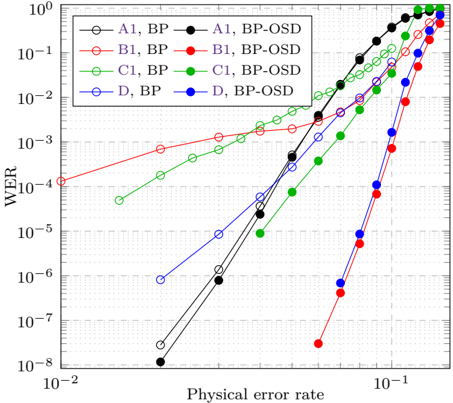
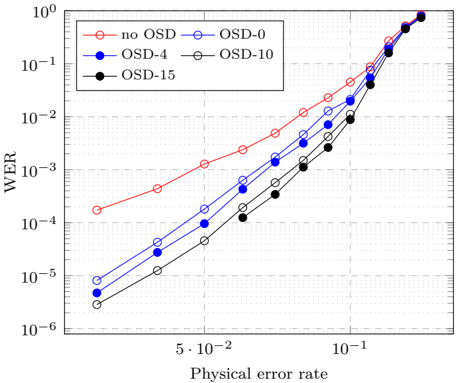
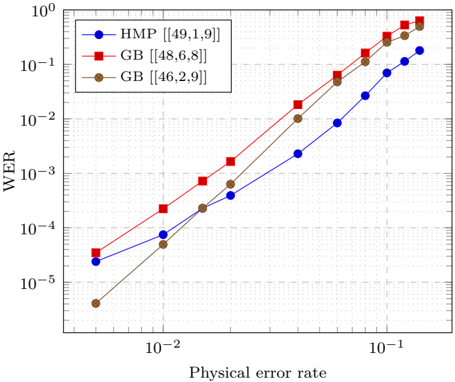
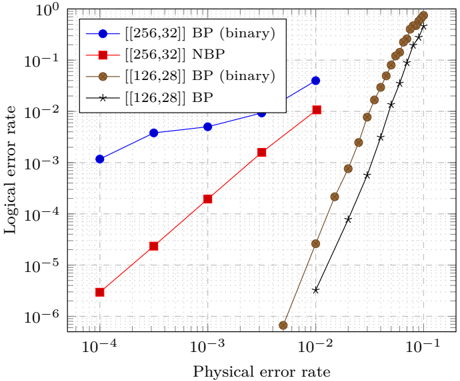
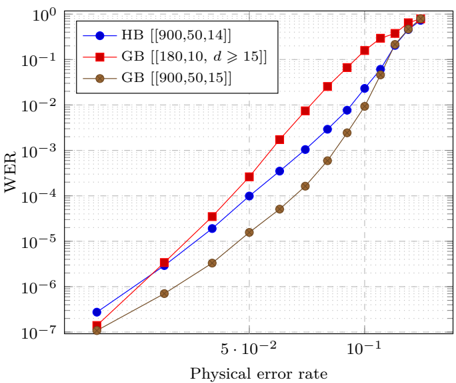
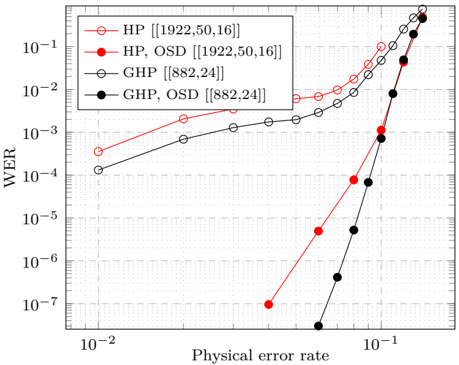
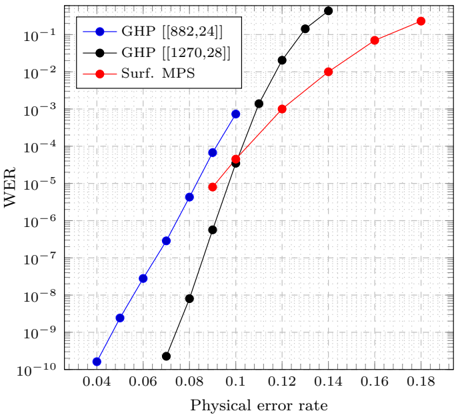
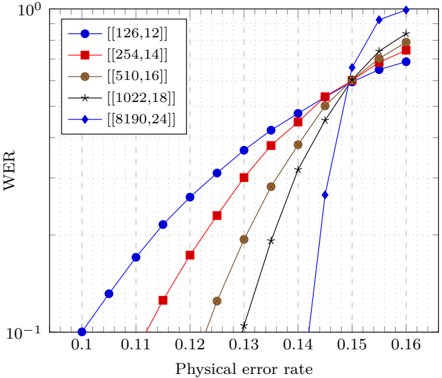
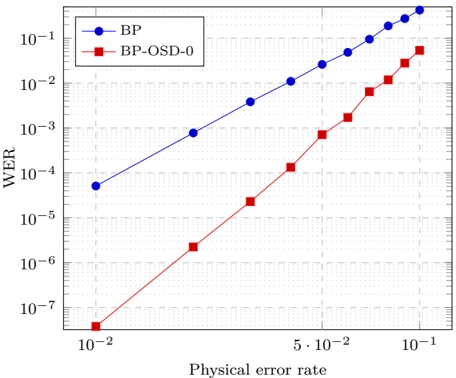
We study the performance of medium-length quantum LDPC (QLDPC) codes in the depolarizing channel. Only degenerate codes with the maximal stabilizer weight much smaller than their minimum distance are considered. It is shown that with the help of OSD-like post-processing the performance of the standard belief propagation (BP) decoder on many QLDPC codes can be improved by several orders of magnitude. Using this new BP-OSD decoder we study the performance of several known classes of degenerate QLDPC codes including hypergraph product codes, hyperbicycle codes, homological product codes, and Haah's cubic codes. We also construct several interesting examples of short generalized bicycle codes. Some of them have an additional property that their syndromes are protected by small BCH codes, which may be useful for the fault-tolerant syndrome measurement. We also propose a new large family of QLDPC codes that contains the class of hypergraph product codes, where one of the used parity-check matrices is square. It is shown that in some cases such codes have better performance than hypergraph product codes. Finally, we demonstrate that the performance of the proposed BP-OSD decoder for some of the constructed codes is better than for a relatively large surface code decoded by a near-optimal decoder.
Overview
The claims and statistics of this paper haven’t been checked yet.
Free: it reads the open-access text and checks the first 5 claims that cite a source we can check. Create a free account to check every claim.
Integrity signals
Registry
Cites
Statistics
Figures
Verification
Claims the paper makes
The claims and statistics of this paper haven’t been checked yet.
Free: it reads the open-access text and checks the first 5 claims that cite a source we can check. Create a free account to check every claim.
Claims other papers make about this one
Each is checked against this paper’s own text: does it say what the citing paper says it does?
The cited source says what the claim attributes to it.
In the citing paper
“The original work36 described BP-OSD in the context of a toy noise model with memory errors only.”
From High-threshold and low-overhead fault-tolerant quantum memory (2024) · cites this paper as [36]
Self-check
Percentages, sums and reported differences re-computed from the paper’s own numbers.
The self-check needs the paper’s full text.
Citations
Cites
Low-density parity-check codes
Gallager, R. (1962) · IEEE Transactions on Information Theory · doi:10.1109/tit.1962.1057683 · Cited by 10,602
Factor graphs and the sum-product algorithm
Kschischang, F. R., Frey, B. J., & Loeliger, H.-A. (2001) · IEEE Transactions on Information Theory · doi:10.1109/18.910572 · Cited by 6,486 · cited 1×
“There are a number of decoding algorithms for classical LDPC codes, but the most frequently used one is the belief propagation (BP) decoder [27], also known as the message passing decoder or the sum-product de-coder [29].”
Information theory, inference, and learning algorithms
(2004) · Choice Reviews Online · doi:10.5860/choice.41-5949 · Cited by 6,362
Low-Density Parity-Check Codes
Gallager, R. G. (1963) · The MIT Press eBooks · doi:10.7551/mitpress/4347.001.0001 · Cited by 4,401
A recursive approach to low complexity codes
Tanner, R. (1981) · IEEE Transactions on Information Theory · doi:10.1109/tit.1981.1056404 · Cited by 3,138
Error Correcting Codes in Quantum Theory
Steane, A. M. (1996) · Physical Review Letters · doi:10.1103/physrevlett.77.793 · Cited by 2,677
Good quantum error-correcting codes exist
Calderbank, A. R., & Shor, P. W. (1996) · Physical Review A · doi:10.1103/physreva.54.1098 · Cited by 2,516 · cited 1×
“A very important subclass of quantum stabilizer codes are the quantum Calderbank-Shor-Steane (CSS) codes introduced in [21].”
BackgroundEdmonds, J. (1965) · Canadian Journal of Mathematics · doi:10.4153/cjm-1965-045-4 · Cited by 2,428 · cited 1×
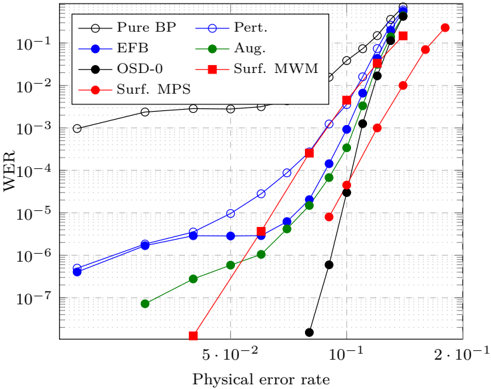
“The red curves are for the 4-limited [[1201,1,25]] surface code under the minimum weight matching (MWM) and the MPS-based decoders [36, 5].”
MethodDennis, E., Kitaev, A., Landahl, A., & Preskill, J. (2002) · Journal of Mathematical Physics · doi:10.1063/1.1499754 · Cited by 1,768
Edmonds, J. (2009) · Classic Papers in Combinatorics · doi:10.1007/978-0-8176-4842-8_26 · Cited by 1,517
Cited by
Items 401–500 of 587
Power and Limitations of Linear Programming Decoder for Quantum LDPC Codes
Gu, S., & Soleimanifar, M. (2025) · arXiv · doi:10.48550/arxiv.2508.04769 · Cited by 2
Tesseract: A Search-Based Decoder for Quantum Error Correction
Beni, L. A., Higgott, O., & Shutty, N. (2025) · arXiv · doi:10.48550/arxiv.2503.10988 · Cited by 2
Automorphism Ensemble Decoding of Quantum LDPC Codes
Koutsioumpas, S., Sayginel, H., Webster, M., & Browne, D. E. (2025) · arXiv · doi:10.48550/arxiv.2503.01738 · Cited by 2
Efficient Ordered Statistics Decoder with Unfolded Gaussian Elimination
Zhang, L., Ren, Y., Zhang, C., Burg, A. P., & Shen, Y. (2025) · International Symposium on Turbo Codes and Iterative Information Processing · doi:10.1109/istc65386.2025.11154634 · Cited by 2
An Improved Decimation Technique for Erasure Decoding of Quantum LDPC Codes
Gayathri, R., Bhatnagar, S., Vaishya, A., & Kumar, P. V. (2025) · IEEE Information Theory Workshop (ITW) · doi:10.1109/itw62417.2025.11240302 · Cited by 2
Belief Propagation Decoding on a Sparsified Graph Ensemble of the Surface Code
Zhang, B., Yao, H., & Pfister, H. D. (2025) · IEEE International Symposium on Information Theory (ISIT) · doi:10.1109/isit63088.2025.11195585 · Cited by 2
Evolutionary BP+OSD Decoding for Low-Latency Quantum Error Correction
Kwak, H.-Y., Park, S., Jung, H., Ha, J., & Kim, J.-W. (2026) · IEEE Journal on Selected Areas in Communications · doi:10.1109/jsac.2026.3746949 · Cited by 2
Single-Shot and Few-Shot Decoding via Stabilizer Redundancy in Bivariate Bicycle Codes
Rowshan, M. (2026) · IEEE International Symposium on Information Theory (ISIT) · doi:10.1109/isit62367.2026.11653650 · Cited by 2
BiBiEQ: Bivariate Bicycle Codes on Erasure Qubits
Bhave, A., Choudhury, N., Nemec, A., & Basu, K. (2026) · International Conference on Quantum Communications, Networking, and Computing (QCNC) · doi:10.1109/qcnc69040.2026.00101 · Cited by 2
Distilling Magic States in the Bicycle Architecture
Xu, S., Liu, K., Rall, P., He, Z., & Ding, Y. (2026) · Proceedings - International Symposium on Computer Architecture/Proceedings · doi:10.1109/isca66397.2026.00148 · Cited by 2
A Binary BP Decoding Using Posterior Adjustment for Quantum LDPC Codes
Huang, T.-H., & Ueng, Y.-L. (2024) · IEEE International Conference on Acoustics Speech and Signal Processing · doi:10.1109/icassp48485.2024.10446153 · Cited by 2
On the Minimum Distances of Finite-Length Lifted Product Quantum LDPC Codes
Raveendran, N., Declercq, D., & Vasic, B. V. (2026) · International Conference on Communications · doi:10.1109/icc59461.2026.11587715 · Cited by 2
Implementing Clifford Gates on Stabilizer Codes via MeasurementPreprint
Banfield, D., Leitch, H., & Kay, A. (2022) · arXiv (Cornell University) · doi:10.48550/arxiv.2210.14074 · Cited by 2
Quantum Design Automation: Foundations, Challenges, and the Road AheadPreprint
Wu, F., Guo, J., Xia, T., Kong, L., Zhang, F., Wang, Z., Dai, A., Wang, Z., Yang, Z., Deng, H., et al. (2025) · arXiv (Cornell University) · doi:10.48550/arxiv.2511.10479 · Cited by 2
Fermion-to-Fermion Low-Density Parity-Check CodesPreprint
Xu, C.-Y., Liu, Z.-C., & Xu, Y. (2025) · arXiv (Cornell University) · doi:10.48550/arxiv.2508.15323 · Cited by 2
Hyperbolic Floquet code with graph-edge syndromesPreprint
OZAWA, H., Kudo, I., Takeuchi, Y., & Yoshida, T. (2025) · arXiv (Cornell University) · doi:10.48550/arxiv.2509.24110 · Cited by 2
Bosonic quantum computing with near-term devices and beyondPreprint
Hillmann, T. (2025) · arXiv (Cornell University) · doi:10.48550/arxiv.2512.15063 · Cited by 2
Improved Decoding of Quantum Tanner Codes Using Generalized Check NodesPreprint
Mostad, O. Å., Rosnes, E., & Lin, H.-Y. (2026) · arXiv (Cornell University) · doi:10.48550/arxiv.2603.05486 · Cited by 2
Decoding of LDPC quantum codes
Grouès, L. (2022) · theses.fr (ABES) · doi:10.70675/4405a9b9z4ce7z49bez9fc0z6b5a10ebf2d1 · Cited by 2
Combinatorial Analysis of Dyadic and Quasi-Dyadic CodesPreprint
Gómez-Fonseca, A., Matthews, G. L., Morris, K. D., & Pllaha, T. (2026) · arXiv (Cornell University) · doi:10.48550/arxiv.2605.01942 · Cited by 2
Edge-Based Anisotropic Decoding for Generalized Bicycle CodesPreprint
Chytas, D., Fessatidis, P. N., Bash, B. A., & Vasic, B. V. (2026) · arXiv (Cornell University) · doi:10.48550/arxiv.2605.03218 · Cited by 2
Two Layers, No Swaps: Biplanar SPOQC Architecture Improves Runtime of Fermi-Hubbard SimulationPreprint
Bourdoncle, B., Derks, P.-J. H. S., Dessertaine, T., & Frank, J. (2026) · arXiv (Cornell University) · doi:10.48550/arxiv.2605.05315
Best-First Ordered Statistics Decoding of Quantum LDPC CodesPreprint
Banfi, M., Ferrari, M., Favano, A., Tarable, A., & Barletta, L. (2026) · arXiv (Cornell University) · doi:10.48550/arxiv.2605.25777 · Cited by 2
Untangling QLDPC Codes with Biased Noise AncillaPreprint
Bi, R., Chang, K., & Puri, S. (2026) · arXiv (Cornell University) · doi:10.48550/arxiv.2606.30592 · Cited by 3
Chongder, S. (2026) · arXiv (Cornell University) · doi:10.48550/arxiv.2607.05814 · Cited by 2
Biased-noise qubits: a guide to efficient fault-tolerance using the hierarchy of errorsPreprint
Ruiz, D., Guillaud, J., Vuillot, C., & Mirrahimi, M. (2026) · arXiv (Cornell University) · doi:10.48550/arxiv.2607.20143 · Cited by 2
Quantum Bicycle LDPC Codes with High $kd^2/n$ from Divisor-Driven SearchPreprint
Lu, L., Guo, G., Liu, Y., & Yang, R. (2026) · arXiv (Cornell University) · doi:10.48550/arxiv.2608.09115 · Cited by 2
Disassembling qLDPC codes for depth-optimal parity-check circuitsPreprint
Nguyen, M. T. P., Rimbach-Russ, M., & Bosco, S. (2026) · arXiv (Cornell University) · doi:10.48550/arxiv.2608.19917 · Cited by 2
Certified decoding of quantum LDPC codesPreprint
Krishnamoorthy, R., Gerhardt, F., Knaute, J., Klir, T., Maschek, S. R., Schulze, E., Maras, T., Dotterweich, A., Lee, L. K., Bauckhage, C., et al. (2026) · arXiv (Cornell University) · doi:10.48550/arxiv.2608.25545 · Cited by 2
Quantum Block Turbo CodesPreprint
Jebari, K., Neto, L. A., Pyndiah, R. M., & Tocnaye, J.-L. D. B. D. L. (2026) · arXiv (Cornell University) · doi:10.48550/arxiv.2608.30775 · Cited by 2
Lifted-Product QLDPC Codes in the Polynomial DomainPreprint
Nourozi, V., Moradi, M., Smarandache, R., & Mitchell, D. G. M. (2026) · arXiv (Cornell University) · doi:10.48550/arxiv.2609.01305 · Cited by 2
Reinforcement Learning for Syndrome ExtractionPreprint
Ye, J. Z., Pabla, A., & Palsberg, J. (2026) · arXiv (Cornell University) · doi:10.48550/arxiv.2609.12020 · Cited by 3
Composing Detector Error ModelsPreprint
Kliuchnikov, V., Lietz, J., & Pastawski, F. (2026) · arXiv (Cornell University) · doi:10.48550/arxiv.2609.13087 · Cited by 2
Logical Operator Decomposition for Distance Analysis of Bivariate Bicycle CodesPreprint
Rowshan, M., & Devitt, S. J. (2026) · arXiv (Cornell University) · doi:10.48550/arxiv.2609.39395 · Cited by 2
Learned Parallel Bit-Flipping Sequential Belief Propagation Decoding of Quantum LDPC CodesPreprint
Moradi, M., Kim, T., & Chou, R. A. (2026) · arXiv (Cornell University) · doi:10.48550/arxiv.2610.01068 · Cited by 2
Single-shot magic state factories for quantum LDPC codesPreprint
Menon, V., Mehta, R., Gu, A., Diaconu, A. C., Tan, D. B., Xiao, X., Gullans, M. J., Xu, Q., Zhou, H., Lukin, M. D., et al. (2026) · arXiv (Cornell University) · doi:10.48550/arxiv.2610.10731 · Cited by 3
GPU-Based Parallel BP Decoding for Quantum LDPC MemoryPreprint
Wang, M., Zhao, Y., Li, A., & Mueller, F. (2026) · arXiv (Cornell University) · doi:10.48550/arxiv.2610.13879 · Cited by 2
MaxSAT decoders for arbitrary CSS codes
Noormandipour, M., & Haug, T. (2024) · arXiv · doi:10.48550/arxiv.2410.01673 · Cited by 1
“[26, 27].”
BackgroundOn generating r-uniform subspaces with the isometric mapping method
Antipin, K. V. (2024) · Modern Physics Letters A · doi:10.1142/s0217732323501857 · Cited by 1
Neural Belief Propagation Decoders for Concatenated Calderbank-Shor-Steane Codes
Fan, J., & Zhang, J. (2024) · International Conference on Communications · doi:10.1109/icc51166.2024.10622478 · Cited by 1
An Equivariant Machine Learning Decoder for 3D Toric Codes
Weißl, O., & Egorov, E. (2025) · International Conference on Quantum Communications, Networking, and Computing (QCNC) · doi:10.1109/qcnc64685.2025.00112 · Cited by 1
Fan, J., Zhang, Q., Zhang, Z., & Li, J. (2025) · Communications in Theoretical Physics · doi:10.1088/1572-9494/ade49c · Cited by 1
Hierarchical Quantum Error Correction with Hypergraph Product Code and Rotated Surface Code
Haruna, J., & Fujii, K. (2025) · Progress of Theoretical and Experimental Physics · doi:10.1093/ptep/ptaf130 · Cited by 1
Symmetry-enriched topological order and quasifractonic behavior in Z N stabilizer codes
He, S., & Song, H. S. (2026) · Physical review. B./Physical review. B · doi:10.1103/f35h-pmfn · Cited by 1
Hyper-optimized Quantum Lego Contraction Schedules
Pató, B., Vanlerberghe, J., & Brown, K. R. (2026) · Quantum · doi:10.22331/q-2026-05-05-2092 · Cited by 1
On Finite-Blocklength Noisy Classical-Quantum Channel Coding With Amplitude Damping Errors
Havas, T., Lin, H.-Y., Rosnes, E., & Lai, C. (2025) · IEEE Information Theory Workshop (ITW) · doi:10.1109/itw62417.2025.11240474 · Cited by 1
Single-Shot Decoding of Biased-Tailored Quantum LDPC Codes
Campbell, D. (2025) · IEEE International Conference on Quantum Computing and Engineering (QCE) · doi:10.1109/qce65121.2025.10336 · Cited by 1
Low-Complexity Syndrome-Based Linear Programming Decoding of Quantum LDPC Codes
Javed, S., Colet, S., García-Herrero, F., Ruano, Ó., Maestro, J. A., Vasić, B., & Flanagan, M. F. (2025) · IEEE Transactions on Quantum Engineering · doi:10.1109/tqe.2025.3640361 · Cited by 1
BP-LCGCD: A Gaussian-Elimination-Free and High-Performance Decoder for Surface Codes
Wang, Q., Liang, J., Li, L., Song, L., & Ma, X. (2025) · IEEE Communications Letters · doi:10.1109/lcomm.2025.3646724 · Cited by 1
The adaptive decision-making strategy for surface code decoding
Xia, Z., Wang, S., Yan, Y., & Wang, X. (2026) · Quantum Science and Technology · doi:10.1088/2058-9565/ae3f4e · Cited by 1
Accelerating Computation in Quantum LDPC Code
Cho, J., Jeong, H., Kim, J., Choi, J., Hong, J., & Kim, J. (2026) · International Conference on Architectural Support for Programming Languages and Operating Systems (ASPLOS) · doi:10.1145/3779212.3790122 · Cited by 1
Efficient soft-output guessing for enhanced quantum Tanner code decoding
Rapp, L., Médard, M., Tang, E., & Duffy, K. R. (2026) · Physical Review A · doi:10.1103/hnds-fvry · Cited by 1
Perspective: Quantum Computing on Magnetic Racetrack
Zou, J., Klinovaja, J., & Loss, D. (2026) · Advanced Electronic Materials · doi:10.1002/aelm.70614 · Cited by 1
An iterative Ising decoder for quantum error correction codes
Liu, Y., Zeng, W., Li, P., Liu, Y., Huang, G., Liu, Y., Wang, D., Wu, J., & Lao, L. (2026) · Quantum Science and Technology · doi:10.48550/arxiv.2606.12301 · Cited by 1
Building Hybrid Quantum–Classical Computing Ecosystems: A Survey
Bharadwaj, D., Hou, Y., Knapen, A., Kwun, G., Zhitkov, N., & Ravi, G. S. (2026) · Communications in computer and information science · doi:10.1007/978-981-95-7829-0_13 · Cited by 1
Anonymous, & Yamasaki, H. (2026) · Physical Review A · doi:10.1103/6y9t-4zjp · Cited by 1
Usatyuk, V. S., & Иванович, Е. С. (2024) · Proceedings of Southwest State University · doi:10.21869/2223-1560-2023-27-4-79-97 · Cited by 1
A Multi-parameter Compensated Min-Sum Based LDPC Decoding Algorithm
He, S., Wang, C., Cai, S., & Wang, W. (2023) · IEEE International Conference on Computer and Communications (ICCC) · doi:10.1109/iccc59590.2023.10507301 · Cited by 1
Decoding Strategies for Generalized Quantum Data-Syndrome Coding Problems
Kuo, K.-Y., & Lai, C. (2024) · IEEE International Symposium on Information Theory (ISIT) · doi:10.1109/isit57864.2024.10619431 · Cited by 1
Wong, Y. K., Zhou, Y., Li, Z. Y., Liang, Y. S., & Zhou, X.-L. (2024) · International Conference on Software Engineering and Development (ICSED) · doi:10.1145/3686614.3686615 · Cited by 1
Bits to Qubits: A Comparative Study of Memory Management in Classical and Quantum Systems
Lamichhane, P., & Rawat, D. B. (2025) · IEEE Access · doi:10.1109/access.2025.3627127 · Cited by 1
Quantum memory based on concatenating surface codes and quantum Hamming codes
Fang, M., & Su, D. (2025) · Physical Review A · doi:10.1103/8ds6-l416 · Cited by 1
Usatyuk, V. S., Алексеевич, С. Д., & Иванович, Е. С. (2024) · arXiv (Cornell University) · doi:10.48550/arxiv.2401.14749 · Cited by 1
Tutorial on Quantum Error Correction for 2024 Quantum Information Knowledge (QuIK) WorkshopPreprint
Nadkarni, P. J., Rengaswamy, N., & Vasic, B. V. (2024) · arXiv (Cornell University) · doi:10.48550/arxiv.2407.12737 · Cited by 3
Equivariant Machine Learning Decoder for 3D Toric CodesPreprint
Weißl, O., & Egorov, E. (2024) · arXiv (Cornell University) · doi:10.48550/arxiv.2409.04300 · Cited by 1
GPU-Accelerated Automorphism Ensemble Decoding of Quantum LDPC Codes
Koutsioumpas, S., & Roffe, J. (2025) · doi:10.59350/jn3mh-ka680 · Cited by 1
Bias-Aware BP Decoding of Quantum Codes via Directional DegeneracyPreprint
Rowshan, M. (2026) · arXiv (Cornell University) · doi:10.48550/arxiv.2601.07240 · Cited by 1
An Efficient Algorithm to Sample Quantum Low-Density Parity-Check CodesPreprint
Santini, P. (2026) · arXiv (Cornell University) · doi:10.48550/arxiv.2601.08387 · Cited by 1
Simplified circuit-level decoding using Knill error correctionPreprint
Murphy, E., Sahu, S., & Vasmer, M. (2026) · HAL · doi:10.48550/arxiv.2603.05320 · Cited by 1
Study of Quantum LDPC Codes and their Decoding
Rozendaal, W. (2025) · theses.fr (ABES) · doi:10.70675/f66f43cez8153z479czbfb6z0657c45fd040 · Cited by 1
Affine Subcode Ensemble Decoding for Degeneracy-Aware Quantum Error CorrectionPreprint
Wursthorn, L., Mandelbaum, J., Miao, S., Liu, H., Jäkel, H., Koutsioumpas, S., & Schmalen, L. (2026) · arXiv (Cornell University) · doi:10.48550/arxiv.2605.06547 · Cited by 1
Spatial overhead reduction for 2D hypergraph product codesPreprint
Pabla, A., Wang, Y.-X., & Hong, Y. (2026) · arXiv (Cornell University) · doi:10.48550/arxiv.2605.11318 · Cited by 1
Aubele, A., Bayer, G., Eichhorn, T. R., Hahn, T., Jelezko, F., Mentzel, P., Neumann, P., Pfender, M., Plenio, M. B., Retzker, A., et al. (2026) · arXiv (Cornell University) · doi:10.48550/arxiv.2605.21204 · Cited by 1
Plaquette: A hardware-aware design platform for fault-tolerant quantum computersPreprint
Vendrell, R. C., López, C. D., Dhand, I., Kapoor, K., Laureti, D., Massaro, M., Nayak, P., Ogloblin, I., Plenio, M. B., Kumar, S. P., et al. (2026) · arXiv (Cornell University) · doi:10.48550/arxiv.2607.08767 · Cited by 2
Quantum XYZ Stabilizer CodesPreprint
Baldelli, A., Orsucci, D., Lázaro, F., & Battaglioni, M. (2026) · arXiv (Cornell University) · doi:10.48550/arxiv.2607.14988 · Cited by 1
Neural decoders for subsystem many-hypercube codesPreprint
Nakai, R., & Goto, H. (2026) · arXiv (Cornell University) · doi:10.48550/arxiv.2608.13975 · Cited by 1
A Classification of Translation-Invariant Quantum Codes in Any DimensionPreprint
Li, A., & Williamson, D. J. (2026) · arXiv (Cornell University) · doi:10.48550/arxiv.2608.20981 · Cited by 1
The Find Rows and Columns and Decode algorithm for quantum expander codesPreprint
Ostrev, D. (2026) · arXiv (Cornell University) · doi:10.48550/arxiv.2608.27211 · Cited by 1
Logical Neural Belief Propagation for Linear-Complexity Decoding of Surface CodesPreprint
Kwak, H.-Y., Park, S., Yun, D.-Y., Nachmani, E., & Kim, J.-W. (2026) · arXiv (Cornell University) · doi:10.48550/arxiv.2608.27682 · Cited by 1
Quantum low-density lattice codesPreprint
Hillmann, T., Eisert, J., & Arzani, F. (2026) · arXiv (Cornell University) · doi:10.48550/arxiv.2609.03021 · Cited by 1
Efficient Quantum Error Correction from Three Dimensional Qubit ControlPreprint
Wu, K. Y., Kwon, O., & Parsons, M. F. (2026) · arXiv (Cornell University) · doi:10.48550/arxiv.2609.04459 · Cited by 1
Moradi, M., Kim, T., & Chou, R. A. (2026) · arXiv (Cornell University) · doi:10.48550/arxiv.2609.20236 · Cited by 1
Near-optimal high-rate surgery from linear PCPPsPreprint
Cowtan, A., & Ide, B. (2026) · arXiv (Cornell University) · doi:10.48550/arxiv.2609.26973 · Cited by 1
Exact Maximum Likelihood Decoding beyond Treewidth via Rank-Decomposition Dynamic ProgrammingPreprint
Cheng, B., & Pan, F. (2026) · arXiv (Cornell University) · doi:10.48550/arxiv.2609.39556 · Cited by 1
A Code-Agnostic Graph Neural Network Decoder from the Detection Error ModelPreprint
Astolfi, F. A., & Pupillo, G. (2026) · arXiv (Cornell University) · doi:10.48550/arxiv.2610.01683 · Cited by 1
Large Language Model-Guided Discovery of Weight-Five Bivariate Bicycle CodesPreprint
Cruz-Benito, J. (2026) · arXiv (Cornell University) · doi:10.48550/arxiv.2610.06623 · Cited by 1
Designing Group-Valued Codes with Full Regular Low-Weight BasesPreprint
Lee, J. Y. (2026) · arXiv (Cornell University) · doi:10.48550/arxiv.2610.06820 · Cited by 2
Bicycle Race: small two-block codes on the Pareto frontierPreprint
Lee, G. (2026) · arXiv (Cornell University) · doi:10.48550/arxiv.2610.13880 · Cited by 1
Low-Latency Belief-Propagation Decoding of Quantum LDPC Codes with Reinforcement-Learned SchedulingPreprint
Moradi, M., Aissou, G., Kim, T., Chou, R. A., & Mitchell, D. G. M. (2026) · arXiv (Cornell University) · doi:10.48550/arxiv.2610.15857 · Cited by 1
NeST: ultra-high-rate qLDPC codes with sub-$50μ$s stabiliser cycles via spin shuttlingPreprint
Siegel, A. (2026) · arXiv (Cornell University) · doi:10.48550/arxiv.2610.28538 · Cited by 2
CoDecoder: Make Quantum Decoders Up to 100x Faster and Even More AccuratePreprint
Guang, Y., Xiong, Y., Gao, X., & Chen, Y. (2026) · arXiv (Cornell University) · doi:10.48550/arxiv.2610.28748 · Cited by 1
Dealing with low-weight errors that lead BP OSD to failPreprint
Fregona, G., Löbl, M. C., Brown, B. J., Kastoryano, M. J., & Paesani, S. (2026) · arXiv (Cornell University) · doi:10.48550/arxiv.2610.30305 · Cited by 3
Chytas, D., Raveendran, N., & Vasic, B. V. (2026) · arXiv (Cornell University) · doi:10.48550/arxiv.2610.31877 · Cited by 1
Real-time BP decoding of a high-rate QEC codePreprint
Kell, A., Herr, D., García, D. B., Paler, A., Orsucci, D., Lázaro, F., & Herrero, F. G. (2026) · arXiv (Cornell University) · doi:10.48550/arxiv.2610.41413 · Cited by 1
Quantum error correction and fault tolerance: A comprehensive tutorial
Spencer, D. J., Jain, S. P., Tanggara, A., Sun, Z., Haug, T., Khu, D., & Bharti, K. (2026) · arXiv
Accelerating the Tesseract Decoder for Quantum Error Correction
Grbic, D., Beni, L. A., & Shutty, N. (2026) · arXiv · doi:10.48550/arxiv.2602.02985
Decision-tree decoders for general quantum LDPC codes
Ott, K. R., Hetényi, B., & Beverland, M. E. (2025) · arXiv · doi:10.48550/arxiv.2502.16408
Quantum Error Source and Channel CodingPreprint
Lucarelli, D. G. (2020) · arXiv (Cornell University) · doi:10.48550/arxiv.2004.09479
Low-Complexity Decoding Algorithm Utilizing Degeneracy for Quantum LDPC Codes
Kim, J., Jung, H.-W., & Ha, J. (2023) · IEEE Military Communications Conference (MILCOM) · doi:10.1109/milcom58377.2023.10356284
Asymptotically good families of quantum and locally testable classical LDPC codes
Kalachev, G. V., & Panteleev, P. (2023) · Mathematical Problems of Cybernetics · doi:10.20948/mvk-2023-111
Self-citation
Metadata
- Authors
- Panteleev, P., & Kalachev, G.
- Affiliations
- Lomonosov Moscow State University (RU)
- Venue
- Quantum
- Published
- 2021-11-22
- Volume
- 5
- Pages
- 585
- ISSN
- 2521-327X (ISSN-L)
- OpenAlex
- W2926023653
- Cited by
- 257
- References
- 56
- Citations by year
- 2026: 48 · 2025: 89 · 2024: 49 · 2023: 25 · 2022: 22 · 2021: 21
- FWCI
- 10.30
- Type
- journal article
- Language
- en
- Open access
- gold
- doi.org
- Locations
- Quantum (publishedVersion, cc-by)
- arXiv (Cornell University) (acceptedVersion)
- arXiv (Cornell University) (submittedVersion)
- DOAJ (DOAJ: Directory of Open Access Journals) (submittedVersion, cc-by-sa)
- arXiv (Cornell University) (cc-by)
- Funders
- The Ministry of Science and Higher Education of the Russian Federation (075-15-2020-801)
- Topics
- Physical Sciences › Computer Science › Artificial Intelligence › Quantum Computing Algorithms and Architecture
- Physical Sciences › Computer Science › Computer Networks and Communications › Error Correcting Code Techniques
- Physical Sciences › Mathematics › Discrete Mathematics and Combinatorics › Coding theory and cryptography
- Keywords
- quantum LDPC codes, depolarizing channel, belief propagation decoding, hypergraph product codes, BCH codes, surface code, finite-length performance
About these checks
Registry, retraction, Cites and statistics results are computed, not judged, with one exception: a printed reference that no index lists is read once by a model before it counts as a citation error. Claims are extracted by a model and kept only when their quote appears verbatim in the text; each cited source is then checked, with a model’s help, for whether it says what the claim relies on. Those verdicts can be wrong — read the claim’s quote and the cited source before relying on one.
Statistics and arithmetic are recomputed, not judged.
Confidence bands are shown only for fields calibrated on our annotated test set. None is calibrated yet, so no band is shown.
What counts as a claim ›How we measure confidence ›How we check this ›
Are you an author, or do you see a problem with this page? Request a review
Data sources
Bibliographic data: Semantic Scholar, OpenAlex, Crossref.
Contains information from the Semantic Scholar Academic Graph Datasets, made available under the ODC Attribution License (ODC-BY 1.0).
Semantic Scholar’s data is described in: Kinney, R., et al. (2023). The Semantic Scholar Open Data Platform. arXiv:2301.10140.
