

Degenerate Quantum LDPC Codes With Good Finite Length Performance
Open accessThe DOI matches its Crossref record; 57 of the 57 references it cites were found in a registry or an index.
Abstract
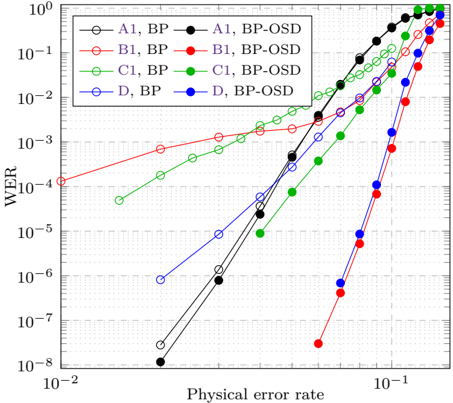
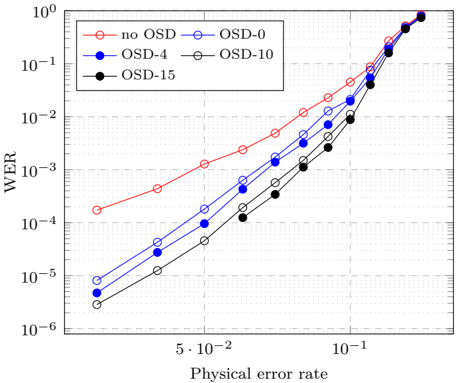
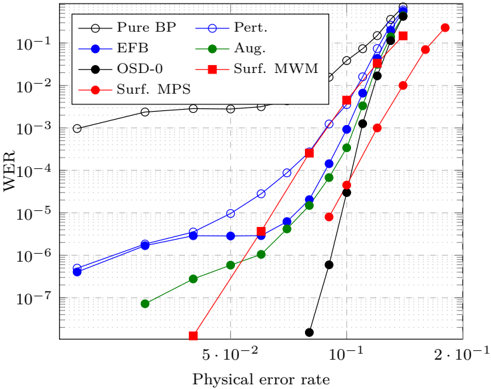
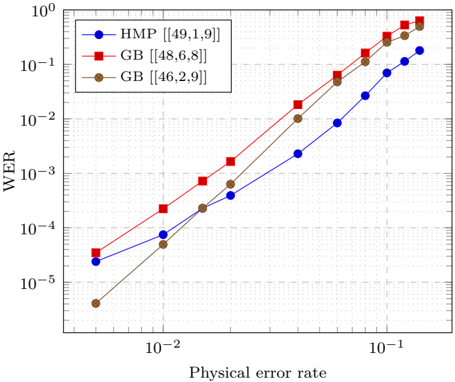
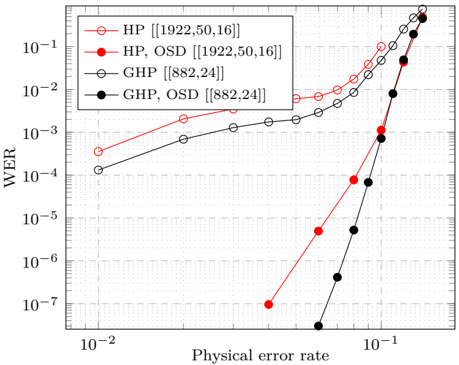
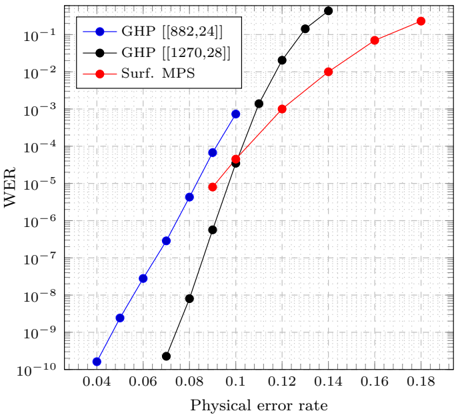
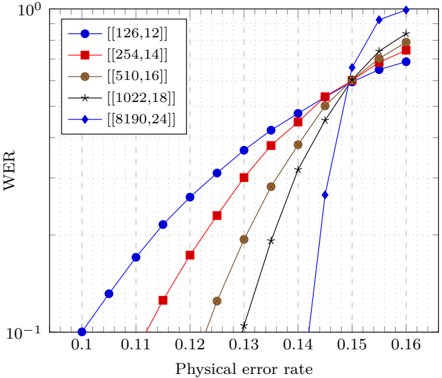
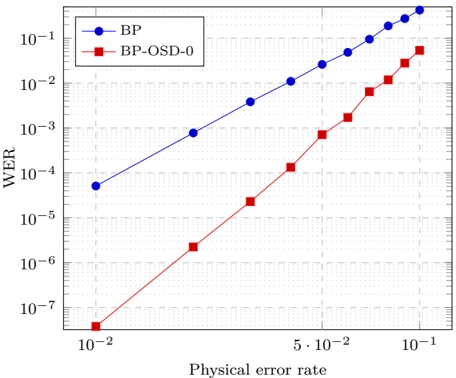
We study the performance of medium-length quantum LDPC (QLDPC) codes in the depolarizing channel. Only degenerate codes with the maximal stabilizer weight much smaller than their minimum distance are considered. It is shown that with the help of OSD-like post-processing the performance of the standard belief propagation (BP) decoder on many QLDPC codes can be improved by several orders of magnitude. Using this new BP-OSD decoder we study the performance of several known classes of degenerate QLDPC codes including hypergraph product codes, hyperbicycle codes, homological product codes, and Haah's cubic codes. We also construct several interesting examples of short generalized bicycle codes. Some of them have an additional property that their syndromes are protected by small BCH codes, which may be useful for the fault-tolerant syndrome measurement. We also propose a new large family of QLDPC codes that contains the class of hypergraph product codes, where one of the used parity-check matrices is square. It is shown that in some cases such codes have better performance than hypergraph product codes. Finally, we demonstrate that the performance of the proposed BP-OSD decoder for some of the constructed codes is better than for a relatively large surface code decoded by a near-optimal decoder.
Overview
The claims and statistics of this paper haven’t been checked yet.
Free: it reads the open-access text and checks the first 5 claims that cite a source we can check. Create a free account to check every claim.
Integrity signals
Registry
Cites
Statistics
Figures
Verification
Claims the paper makes
The claims and statistics of this paper haven’t been checked yet.
Free: it reads the open-access text and checks the first 5 claims that cite a source we can check. Create a free account to check every claim.
Claims other papers make about this one
Each is checked against this paper’s own text: does it say what the citing paper says it does?
The cited source says what the claim attributes to it.
In the citing paper
“The original work36 described BP-OSD in the context of a toy noise model with memory errors only.”
From High-threshold and low-overhead fault-tolerant quantum memory (2024) · cites this paper as [36]
Self-check
Percentages, sums and reported differences re-computed from the paper’s own numbers.
The self-check needs the paper’s full text.
Citations
Cites
Low-density parity-check codes
Gallager, R. (1962) · IEEE Transactions on Information Theory · doi:10.1109/tit.1962.1057683 · Cited by 10,602
Factor graphs and the sum-product algorithm
Kschischang, F. R., Frey, B. J., & Loeliger, H.-A. (2001) · IEEE Transactions on Information Theory · doi:10.1109/18.910572 · Cited by 6,486 · cited 1×
“There are a number of decoding algorithms for classical LDPC codes, but the most frequently used one is the belief propagation (BP) decoder [27], also known as the message passing decoder or the sum-product de-coder [29].”
Information theory, inference, and learning algorithms
(2004) · Choice Reviews Online · doi:10.5860/choice.41-5949 · Cited by 6,362
Low-Density Parity-Check Codes
Gallager, R. G. (1963) · The MIT Press eBooks · doi:10.7551/mitpress/4347.001.0001 · Cited by 4,401
A recursive approach to low complexity codes
Tanner, R. (1981) · IEEE Transactions on Information Theory · doi:10.1109/tit.1981.1056404 · Cited by 3,138
Error Correcting Codes in Quantum Theory
Steane, A. M. (1996) · Physical Review Letters · doi:10.1103/physrevlett.77.793 · Cited by 2,677
Good quantum error-correcting codes exist
Calderbank, A. R., & Shor, P. W. (1996) · Physical Review A · doi:10.1103/physreva.54.1098 · Cited by 2,516 · cited 1×
“A very important subclass of quantum stabilizer codes are the quantum Calderbank-Shor-Steane (CSS) codes introduced in [21].”
BackgroundEdmonds, J. (1965) · Canadian Journal of Mathematics · doi:10.4153/cjm-1965-045-4 · Cited by 2,428 · cited 1×
“The red curves are for the 4-limited [[1201,1,25]] surface code under the minimum weight matching (MWM) and the MPS-based decoders [36, 5].”
MethodDennis, E., Kitaev, A., Landahl, A., & Preskill, J. (2002) · Journal of Mathematical Physics · doi:10.1063/1.1499754 · Cited by 1,768
Edmonds, J. (2009) · Classic Papers in Combinatorics · doi:10.1007/978-0-8176-4842-8_26 · Cited by 1,517
Cited by
Items 201–300 of 587
Opportunities in full-stack design of low-overhead fault-tolerant quantum computation
Zhou, H., Cain, M., & Lukin, M. D. (2025) · Nature Computational Science · doi:10.1038/s43588-025-00895-6 · Cited by 15
Decoherence and quantum error correction for quantum computing and communications.
Martínez, J. E., & de Navarra, U. (2022) · Depósito Académico Digital Universidad de Navarra (University of Navarra) · doi:10.15581/10171/63013 · Cited by 14
A Topologically Fault-Tolerant Quantum Computer with Four Dimensional Geometric CodesPreprint
Aasen, D., Hastings, M. B., Kliuchnikov, V., Bello‐Rivas, J. M., Paetznick, A., Chao, R., Reichardt, B. W., Zanner, M., Silva, M. P. D., Wang, Z., et al. (2025) · arXiv (Cornell University) · doi:10.48550/arxiv.2506.15130 · Cited by 14
Forced Gap Post-Selection for Quantum LDPC Codes and their OperationsPreprint
Wills, A., Yoder, T. J., & Chuang, I. L. (2026) · arXiv (Cornell University) · doi:10.48550/arxiv.2605.20346 · Cited by 16
Quantum LDPC codes with design rate 1/5 and good performance below 1000 physical qubitsPreprint
Hong, Y. (2026) · arXiv (Cornell University) · doi:10.48550/arxiv.2607.27644 · Cited by 16
Decoding quantum color codes with MaxSAT
Berent, L., Burgholzer, L., Derks, P.-J. H. S., Eisert, J., & Wille, R. (2024) · Quantum · doi:10.22331/q-2024-10-23-1506 · Cited by 13
Simple logical quantum computation with concatenated symplectic double codes
Berthusen, N., & Durso-Sabina, E. (2026) · Quantum · doi:10.22331/q-2026-08-19-2195 · Cited by 13
Báscones, D., García-Herrero, F., & Valls, J. (2025) · EPJ Quantum Technology · doi:10.1140/epjqt/s40507-025-00446-y · Cited by 15
Toward Self-Correcting Quantum Codes for Neutral Atom Arrays
Guo, J., Hong, Y., Kaufman, A. M., & Lucas, A. (2026) · PRX Quantum · doi:10.1103/mfmt-fwkg · Cited by 13
Runtime reduction in lattice surgery utilizing timelike soft information
Akahoshi, Y., Toshio, R., Fujisaki, J., Oshima, H., Sato, S., & Fujii, K. (2026) · Physical Review Research · doi:10.1103/wz3p-sgdq · Cited by 15
Quantum Simulation of Electronic Structure via Quantum Fast Multipole Method
Berry, D. W., Wan, K., Baczewski, A., Eklund, E. C., Tikku, A., & Babbush, R. (2026) · PRX Quantum · doi:10.1103/b2vn-zf6c · Cited by 13
Linear programming decoder for hypergraph product quantum codes
Fawzi, O., Grouès, L., & Leverrier, A. (2021) · IEEE Information Theory Workshop (ITW) · doi:10.1109/itw46852.2021.9457611 · Cited by 13
Combining Hard and Soft Decoders for Hypergraph Product Codes
Grospellier, A., Grouès, L., Krishna, A., & Leverrier, A. (2019) · HAL · Cited by 13
On stability of k-local quantum phases of matterPreprint
Lavasani, A., Gullans, M. J., Albert, V. V., & Barkeshli, M. (2024) · arXiv (Cornell University) · doi:10.48550/arxiv.2405.19412 · Cited by 13
Large-Language-Model Discovery of Quantum LDPC Codes through Structured Concept EvolutionPreprint
Liu, Z., & Marquardt, F. (2026) · arXiv (Cornell University) · doi:10.48550/arxiv.2606.24808 · Cited by 13
Cluster Decomposition for Improved Erasure Decoding of Quantum LDPC Codes
Yao, H., Gökduman, M., & Pfister, H. D. (2025) · IEEE Journal on Selected Areas in Information Theory · doi:10.1109/jsait.2025.3578597 · Cited by 12
Abelian Multi-Cycle Codes for Single-Shot Error Correction
Lin, H.-K., Lim, P. K., Kovalev, A. A., & Pryadko, L. P. (2026) · PRX Quantum · doi:10.1103/mj28-925w · Cited by 12
Software Tools for Decoding Quantum Low-Density Parity-Check Codes
Berent, L., Burgholzer, L., & Wille, R. (2023) · Asia and South Pacific Design Automation Conference (ASP-DAC) · doi:10.1145/3566097.3567934 · Cited by 12
Splitting decoders for correcting hypergraph faultsPreprint
Delfosse, N., Paetznick, A., Haah, J., & Hastings, M. B. (2023) · arXiv (Cornell University) · doi:10.48550/arxiv.2309.15354 · Cited by 12
Decoding quantum low density parity check codes with diffusionPreprint
Liu, Z., Gong, A., & Clark, B. K. (2025) · arXiv (Cornell University) · doi:10.48550/arxiv.2509.22347 · Cited by 12
Macromux: scalable postselection for high-threshold fault-tolerant quantum computationPreprint
Birchall, P. M., Bridgeman, J. C., Dawson, C. M., Farrelly, T., Liu, Y.-H., Nickerson, N., Pant, M., Roberts, S., Seetharam, K., & Tuckett, D. K. (2026) · arXiv (Cornell University) · doi:10.48550/arxiv.2603.04875 · Cited by 12
Learning to Decode Quantum LDPC Codes Via Belief PropagationPreprint
Moradi, M., Nourozi, V., Habib, S., & Mitchell, D. G. M. (2026) · arXiv (Cornell University) · doi:10.48550/arxiv.2603.10192 · Cited by 12
Designer Codes from GALA: Compact, Self-Dual, and Rate-1/2 QEC on Reconfigurable Atom ArraysPreprint
Yang, W., Duckering, C., & Dua, A. (2026) · arXiv (Cornell University) · doi:10.48550/arxiv.2608.07431 · Cited by 10
Soft syndrome iterative decoding of quantum LDPC codes and hardware architectures
Raveendran, N., Valls, J., Pradhan, A. K., Rengaswamy, N., García-Herrero, F., & Vasic, B. V. (2023) · EPJ Quantum Technology · doi:10.1140/epjqt/s40507-023-00201-1 · Cited by 11
A Joint Code and Belief Propagation Decoder Design for Quantum LDPC Codes
Miao, S., Mandelbaum, J., Jäkel, H., & Schmalen, L. (2024) · IEEE International Symposium on Information Theory (ISIT) · doi:10.1109/isit57864.2024.10619120 · Cited by 11
Rate Adjustable Bivariate Bicycle Codes for Quantum Error Correction
Wang, M., & Mueller, F. (2024) · IEEE International Conference on Quantum Computing and Engineering (QCE) · doi:10.1109/qce60285.2024.10331 · Cited by 11
Generalized Quantum Data-Syndrome Codes and Belief Propagation Decoding for Phenomenological Noise
Kuo, K.-Y., & Lai, C. (2025) · IEEE Transactions on Information Theory · doi:10.1109/tit.2025.3529773 · Cited by 11
Collective Bit Flipping-Based Decoding of Quantum LDPC Codes
Chytas, D., Raveendran, N., & Vasic, B. V. (2025) · IEEE Transactions on Communications · doi:10.1109/tcomm.2025.3535897 · Cited by 11
Qudit low-density parity-check codes
Spencer, D. J., Tanggara, A., Haug, T., Khu, D., & Bharti, K. (2026) · Quantum · doi:10.22331/q-2026-03-13-2023 · Cited by 12
Fault Tolerant Quantum Simulation via Symplectic Transvections
Chen, Z., Weinberg, J. O., & Rengaswamy, N. (2025) · IEEE International Conference on Quantum Computing and Engineering (QCE) · doi:10.1109/qce65121.2025.00027 · Cited by 11
Planar fault-tolerant logical measurements with low qubit overhead
Yang, Y., Zhang, G., & Li, Y. (2026) · npj Quantum Information · doi:10.1038/s41534-026-01310-2 · Cited by 11
Shi, Y. B., Patil, A., & Guha, S. (2025) · Physical Review Letters · doi:10.1103/2bp8-cdxc · Cited by 11
Bacon-Shor Board GamesPreprint
Alam, M., Zen, J., & Scruby, T. R. (2025) · arXiv (Cornell University) · doi:10.48550/arxiv.2504.02749 · Cited by 11
Tableau-Based Framework for Efficient Logical Quantum CompilationPreprint
Wang, M., Liu, C., Garner, S. R., Stein, S., Ding, Y., Nair, P. J., & Li, A. (2025) · arXiv (Cornell University) · doi:10.48550/arxiv.2509.02721 · Cited by 12
Constant-Overhead Magic State Injection into qLDPC Codes with Error Independence GuaranteesPreprint
Guo, Z., Zhu, Y., Yuan, X., & Li, Y. (2025) · arXiv (Cornell University) · doi:10.48550/arxiv.2505.06981 · Cited by 11
Small quantum Tanner codes from left--right Cayley complexesPreprint
Leverrier, A., Rozendaal, W., & Zémor, G. (2025) · arXiv (Cornell University) · doi:10.48550/arxiv.2512.20532 · Cited by 11
Optimising Quantum Error Correction Using Morphing CircuitsPreprint
Shaw, M. H., & Terhal, B. M. (2026) · arXiv (Cornell University) · doi:10.48550/arxiv.2604.09797 · Cited by 12
Logical Spectroscopy: Lifted-Product Codes with Addressable BasesPreprint
Lee, J. Y. (2026) · arXiv (Cornell University) · doi:10.48550/arxiv.2607.05386 · Cited by 11
Quantum error correction at ultra-low overheadPreprint
Lu, Z., Li, W., & Deng, D.-L. (2026) · arXiv (Cornell University) · doi:10.48550/arxiv.2608.02773 · Cited by 11
Design Principles for Ultra-High-Rate Quantum CodesPreprint
Lee, J. Y., Okada, K., Maskara, N., Kasai, K., & Zhou, H. (2026) · arXiv (Cornell University) · doi:10.48550/arxiv.2609.30069 · Cited by 15
Spacetime codes of Clifford circuits
Delfosse, N., & Paetznick, A. (2023) · arXiv · doi:10.48550/arxiv.2304.05943 · Cited by 10
“To push the range of application further, we propose an algorithm to produce a set of low-weight stabilizer generators for the spacetime code 3, resulting in a LowDensity Parity-Check (LDPC) spacetime code for which efficient decoders exist [12, 21, 24, 8].”
Sequential BP-based Decoding of QLDPC Codes
Moradi, M., Habib, S., Nourozi, V., & Mitchell, D. G. M. (2026) · International Conference on Communications · doi:10.1109/icc59461.2026.11587995 · Cited by 10
On Belief Propagation Decoding of Quantum Codes with Quaternary Reliability Statistics
Kung, C.-F., Kuo, K.-Y., & Lai, C. (2023) · International Symposium on Turbo Codes and Iterative Information Processing · doi:10.1109/istc57237.2023.10273527 · Cited by 10
Low-Complexity Linear Programming Based Decoding of Quantum LDPC Codes
Javed, S., García-Herrero, F., Vasic, B. V., & Flanagan, M. F. (2024) · International Conference on Communications · doi:10.1109/icc51166.2024.10622622 · Cited by 10
Minimising surface-code failures using a color-code decoder
Benhemou, A., Sahay, K., Lao, L., & Brown, B. J. (2025) · Quantum · doi:10.22331/q-2025-02-17-1632 · Cited by 10
On the Logical Error Rate of Sparse Quantum Codes
Fuentes, P., Martínez, J. E., Crespo, P. M., & Garcia‐Frias, J. (2022) · IEEE Transactions on Quantum Engineering · doi:10.1109/tqe.2022.3196609 · Cited by 10
Distilling GHZ States using Stabilizer CodesPreprint
Rengaswamy, N., Raina, A., Raveendran, N., & Vasic, B. V. (2021) · arXiv (Cornell University) · doi:10.48550/arxiv.2109.06248 · Cited by 10
Fault-tolerant protocols through spacetime concatenationPreprint
Xu, Y., & Dua, A. (2025) · arXiv (Cornell University) · doi:10.48550/arxiv.2504.08918 · Cited by 10
A Scalable FPGA Architecture for Real-Time Decoding of Quantum LDPC Codes Using GARIPreprint
Báscones, D., Maan, A. S., Savin, V., & García-Herrero, F. (2026) · arXiv (Cornell University) · doi:10.48550/arxiv.2605.01035 · Cited by 10
Concatenating Algebraic Codes over High-Rate Quantum LDPC CodesPreprint
Wills, A., Beverland, M. E., Bishop, L. S., Gambetta, J., Rall, P., Siddhu, V., & Cross, A. W. (2026) · arXiv (Cornell University) · doi:10.48550/arxiv.2605.21898 · Cited by 10
Breaking the bicycle frame: Coset-based quantum LDPC codesPreprint
Aydin, A., Tamo, I., & Barg, A. (2026) · arXiv (Cornell University) · doi:10.48550/arxiv.2606.17268 · Cited by 10
OmniQEC: discovering practical quantum error-correcting codes by an AI scientistPreprint
Yan, G., Li, S., Ma, P., Zhang, Q., Ma, P., Wang, J., Hsieh, M.-H., & Du, Y. (2026) · arXiv (Cornell University) · doi:10.48550/arxiv.2607.25865 · Cited by 11
Asymptotically Good Quantum and Locally Testable Classical LDPC Codes
Panteleev, P., & Kalachev, G. (2021) · arXiv · doi:10.48550/arxiv.2111.03654 · Cited by 9
Self-citationSubsystem many-hypercube codes: High-rate concatenated codes with low-weight syndrome measurements
Nakai, R., & Goto, H. (2025) · Physical Review Applied · doi:10.1103/xbzn-vn37 · Cited by 9
Accelerating Fault-Tolerant Quantum Computation with Good Quantum Low-Density Parity-Check Codes
Zhang, G., Zhu, Y., & Li, Y. (2026) · PRX Quantum · doi:10.1103/3fj5-gn1h · Cited by 9
Restart Belief: A General Quantum LDPC Decoder
Valentini, L., Forlivesi, D., Talarico, A., & Chiani, M. (2026) · IEEE Communications Letters · doi:10.1109/lcomm.2026.3666352 · Cited by 9
Optimal Compilation of Syndrome Extraction Circuits for General Quantum LDPC Codes
Zhang, K., Gao, D., Yang, Z., Zhou, R., Liu, F., Ji, Z., & Chen, J. (2026) · Design, Automation, and Test in Europe · doi:10.23919/date69613.2026.11539585 · Cited by 10
Phenomenological noise models and optimal thresholds of the 3D toric code
Xu, J. Q., Zhong, Y., Martin-Delgado, M. A., Song, H., & Liu, K. (2026) · Quantum Science and Technology · doi:10.1088/2058-9565/ae799e · Cited by 9
Energy Barrier of Hypergraph Product Codes
Zhao, G., Doherty, A. C., & Kim, I. H. (2025) · Physical Review Letters · doi:10.1103/physrevlett.134.180601 · Cited by 9
Huang, T.-H., Hu, T.-A., & Ueng, Y.-L. (2023) · IEEE Transactions on Quantum Engineering · doi:10.1109/tqe.2023.3279379 · Cited by 9
Predictive Window Decoding for Fault-Tolerant Quantum ProgramsPreprint
Viszlai, J., Chadwick, J. D., Joshi, S., Ravi, G. S., Li, Y., & Chong, F. T. (2024) · arXiv (Cornell University) · doi:10.48550/arxiv.2412.05115 · Cited by 9
On the Minimum Distances of Finite-Length Lifted Product Quantum LDPC CodesPreprint
Raveendran, N., Declercq, D., & Vasic, B. V. (2025) · arXiv (Cornell University) · doi:10.48550/arxiv.2503.07567 · Cited by 9
Bayesian Optimization for Quantum Error-Correcting Code DiscoveryPreprint
Chengyu, Y., Meister, R., Carty, C., Lin, S.-K., & Bondesan, R. (2026) · arXiv (Cornell University) · doi:10.48550/arxiv.2601.18562 · Cited by 9
Mirror codes: High-threshold quantum LDPC codes beyond the CSS regimePreprint
Khesin, A. B., & Lu, J. Z. (2026) · arXiv (Cornell University) · doi:10.48550/arxiv.2603.05496 · Cited by 10
Lifted surgery: Fast processing with QLDPC codesPreprint
Berent, L., Cohen, L. Z., & Quintavalle, A. O. (2026) · arXiv (Cornell University) · doi:10.48550/arxiv.2609.11723 · Cited by 9
Unifying Qubit Routing Across Diverse Quantum ISAs via Canonical Representation
Yang, Z., Zhang, K., Tian, X., Ren, X., Liu, Y., Li, Y., Ding, D., Chen, J., & Xie, Y. (2026) · Proceedings - International Symposium on Computer Architecture/Proceedings · doi:10.1109/isca66397.2026.00162 · Cited by 8
Nonlocal resources for error correction in quantum low-density parity-check codes
Chandra, O., Muraleedharan, G., & Brennen, G. K. (2025) · Physical Review Research · doi:10.1103/x1rk-yg29 · Cited by 8
A Variant of the Bravyi–Terhal Bound for Arbitrary Boundary Conditions
Arnault, F., Gaborit, P., Rozendaal, W., Saussay, N., & Zémor, G. (2025) · IEEE Transactions on Information Theory · doi:10.1109/tit.2025.3629670 · Cited by 8
Local Probabilistic Decoding of a Quantum Code
Scruby, T. R., & Nemoto, K. (2023) · Quantum · doi:10.22331/q-2023-08-29-1093 · Cited by 8
Magic Mirror on the Wall, How to Benchmark Quantum Error Correction Codes, Overall?
Chatterjee, A., & Ghosh, S. (2024) · IEEE International Conference on Quantum Computing and Engineering (QCE) · doi:10.1109/qce60285.2024.00050 · Cited by 8
BlockBP decoder for the surface code
Kaufmann, A., & Arad, I. (2025) · Physical Review Research · doi:10.1103/z2qt-smfb · Cited by 8
Refined Belief-Propagation Decoding of Quantum Codes with Scalar Messages
Kuo, K.-Y., & Lai, C.-Y. (2020) · IEEE Globecom Workshops (GC Wkshps) · doi:10.1109/gcwkshps50303.2020.9367482 · Cited by 8
Addressing Stopping Failures for Small Set Flip Decoding of Hypergraph Product CodesPreprint
Stambler, L., Krishna, A., & Beverland, M. E. (2023) · arXiv (Cornell University) · doi:10.48550/arxiv.2311.00877 · Cited by 8
Kung, C.-F., Kuo, K.-Y., & Lai, C. (2024) · arXiv (Cornell University) · doi:10.48550/arxiv.2412.21118 · Cited by 8
List Decoding and New Bicycle Code Constructions for Quantum LDPC CodesPreprint
Rabeti, S., & Mahdavifar, H. (2025) · arXiv (Cornell University) · doi:10.48550/arxiv.2511.02951 · Cited by 8
Quantum advantages for syndrome-aware noisy logical observable estimationPreprint
Tsubouchi, K., Kwon, H., Jiang, L., & Yoshioka, N. (2026) · arXiv (Cornell University) · doi:10.48550/arxiv.2603.05145 · Cited by 8
Rethink the Role of Neural Decoders in Quantum Error CorrectionPreprint
Yan, G., Li, S., & Du, Y. (2026) · arXiv (Cornell University) · doi:10.48550/arxiv.2605.12046 · Cited by 8
Full Extractors for Logical Processing in Hypergraph Product CodesPreprint
Blue, J., He, Z., Zhou, H., & Chuang, I. L. (2026) · arXiv (Cornell University) · doi:10.48550/arxiv.2606.03507 · Cited by 8
Multi-agent discovery of practical quantum LDPC codesPreprint
Qian, D., & Li, T. (2026) · arXiv (Cornell University) · doi:10.48550/arxiv.2608.08996 · Cited by 8
Integer Linear Programming Decoder for Abelian and Non-Abelian Topological CodesPreprint
Jing, D., Zhang, A., Jiang, L., & Verresen, R. (2026) · arXiv (Cornell University) · doi:10.48550/arxiv.2608.18512 · Cited by 8
Parallel algebraic surgery for qLDPC codes with constant shuttling depthPreprint
Zhou, T.-G., Gu, B., Eisert, J., & Zhao, C. (2026) · arXiv (Cornell University) · doi:10.48550/arxiv.2609.39874 · Cited by 9
Reducing quantum error correction overhead using soft information
Majaniemi, J., & Matekole, E. S. (2026) · Quantum Science and Technology · doi:10.1088/2058-9565/ae4e55 · Cited by 9
Fundamental Thresholds for Computational and Erasure Errors via the Coherent Information
Colmenárez, L., Kim, S., & Müller, M. (2025) · PRX Quantum · doi:10.1103/d8rx-srpn · Cited by 8
HyperNQ: A Hypergraph Neural Network Decoder for Quantum LDPC Codes
Bhave, A., Choudhury, N., & Basu, K. (2026) · International Conference on Communications · doi:10.1109/icc59461.2026.11587226 · Cited by 7
Fault Tolerant Decoding of QLDPC-GKP Codes with Circuit Level Soft Information
Borah, S. K., Pradhan, A. K., Raveendran, N., Pacenti, M., & Vasic, B. V. (2025) · IEEE International Conference on Quantum Computing and Engineering (QCE) · doi:10.1109/qce65121.2025.00271 · Cited by 10
García-Herrero, F., Valls, J., Vergara-Picazo, L., & Torres, V. (2026) · Quantum · doi:10.22331/q-2026-04-16-2071 · Cited by 7
Takada, Y., & Yamasaki, H. (2026) · npj Quantum Information · doi:10.1038/s41534-026-01312-0 · Cited by 7
Streaming Belief Propagation on Mixed-Alphabet Tanner Graphs for Practical Quantum Memory
Kuo, K.-Y., & Lai, C. (2026) · Quantum · doi:10.22331/q-2026-09-10-2207 · Cited by 7
Mixed Integer Linear Programming Method for Energy-Based Model Trapping Sets Enumerating
Usatyuk, V. S., & Иванович, Е. С. (2024) · International Conference on Digital Signal Processing and its Applications (DSPA) · doi:10.1109/dspa60853.2024.10510058 · Cited by 7
Optimizing compilation of error correction codes for 2 × n quantum dot arrays and its NP hardness
Miccichè, A., Mian, F. A., Chatterjee, A., McGregor, A., & Krastanov, S. (2026) · Physical Review Research · doi:10.1103/l5y5-v3k7 · Cited by 7
Yi, Z., Liang, Z., Chen, J., Zhong, K., Wu, Y., Fang, Z., & Wang, X. (2025) · Quantum Information Processing · doi:10.1007/s11128-025-04709-6 · Cited by 7
Non-Pauli errors in the three-dimensional surface code
Scruby, T. R., Vasmer, M., & Browne, D. E. (2022) · Physical Review Research · doi:10.1103/physrevresearch.4.043052 · Cited by 7
Small Quantum Low Density Parity Check Codes for Near-Term ExperimentsPreprint
Andersen, C. K., & Greplová, E. (2025) · arXiv (Cornell University) · doi:10.48550/arxiv.2507.09690 · Cited by 7
Cored product codes for quantum self-correction in three dimensionsPreprint
Roberts, B., Koh, J. M., Tan, Y., & Yao, N. Y. (2025) · arXiv (Cornell University) · doi:10.48550/arxiv.2510.05479 · Cited by 7
Tsubouchi, K., Yamasaki, H., & Tamiya, S. (2025) · arXiv (Cornell University) · doi:10.48550/arxiv.2510.08695 · Cited by 7
A simple universal routing strategy for reducing the connectivity requirements of quantum LDPC codesPreprint
Zhao, G., Yan, F., & Ni, X. (2026) · Research Square · doi:10.21203/rs.3.rs-9819273/v1 · Cited by 7
Elevator Codes: Concatenation for resource-efficient quantum memory under biased noisePreprint
Shanahan, P., & Ruiz, D. (2026) · arXiv (Cornell University) · doi:10.48550/arxiv.2601.10786 · Cited by 7
Proof of a finite threshold for the union-find decoderPreprint
Yoshida, S., Lake, E., & 山崎, 隼. (2026) · arXiv (Cornell University) · doi:10.48550/arxiv.2602.20238 · Cited by 7
LightStim: A Framework for QEC Protocol Evaluation and Prototyping with Automated DEM ConstructionPreprint
Fang, X., Wang, M., Wu, Y. C., Prabhu, S., Tullsen, D. M., Miniskar, N. R., Mueller, F., Humble, T., & Ding, Y. (2026) · arXiv (Cornell University) · doi:10.48550/arxiv.2604.21472 · Cited by 6
Univariate Bicycle Quantum LDPC Codes: Explicit Logical Structure and Distance BoundsPreprint
Rabeti, S., & Mahdavifar, H. (2026) · arXiv (Cornell University) · doi:10.48550/arxiv.2605.14173 · Cited by 7
Metadata
- Authors
- Panteleev, P., & Kalachev, G.
- Affiliations
- Lomonosov Moscow State University (RU)
- Venue
- Quantum
- Published
- 2021-11-22
- Volume
- 5
- Pages
- 585
- ISSN
- 2521-327X (ISSN-L)
- OpenAlex
- W2926023653
- Cited by
- 257
- References
- 56
- Citations by year
- 2026: 48 · 2025: 89 · 2024: 49 · 2023: 25 · 2022: 22 · 2021: 21
- FWCI
- 10.30
- Type
- journal article
- Language
- en
- Open access
- gold
- doi.org
- Locations
- Quantum (publishedVersion, cc-by)
- arXiv (Cornell University) (acceptedVersion)
- arXiv (Cornell University) (submittedVersion)
- DOAJ (DOAJ: Directory of Open Access Journals) (submittedVersion, cc-by-sa)
- arXiv (Cornell University) (cc-by)
- Funders
- The Ministry of Science and Higher Education of the Russian Federation (075-15-2020-801)
- Topics
- Physical Sciences › Computer Science › Artificial Intelligence › Quantum Computing Algorithms and Architecture
- Physical Sciences › Computer Science › Computer Networks and Communications › Error Correcting Code Techniques
- Physical Sciences › Mathematics › Discrete Mathematics and Combinatorics › Coding theory and cryptography
- Keywords
- quantum LDPC codes, depolarizing channel, belief propagation decoding, hypergraph product codes, BCH codes, surface code, finite-length performance
About these checks
Registry, retraction, Cites and statistics results are computed, not judged, with one exception: a printed reference that no index lists is read once by a model before it counts as a citation error. Claims are extracted by a model and kept only when their quote appears verbatim in the text; each cited source is then checked, with a model’s help, for whether it says what the claim relies on. Those verdicts can be wrong — read the claim’s quote and the cited source before relying on one.
Statistics and arithmetic are recomputed, not judged.
Confidence bands are shown only for fields calibrated on our annotated test set. None is calibrated yet, so no band is shown.
What counts as a claim ›How we measure confidence ›How we check this ›
Are you an author, or do you see a problem with this page? Request a review
Data sources
Bibliographic data: Semantic Scholar, OpenAlex, Crossref.
Contains information from the Semantic Scholar Academic Graph Datasets, made available under the ODC Attribution License (ODC-BY 1.0).
Semantic Scholar’s data is described in: Kinney, R., et al. (2023). The Semantic Scholar Open Data Platform. arXiv:2301.10140.
