

Target for Glycemic Control
Open accessThe DOI matches its Crossref record, with a small difference in title or year; 41 of the 41 references it cites were found in a registry or an index.
Abstract
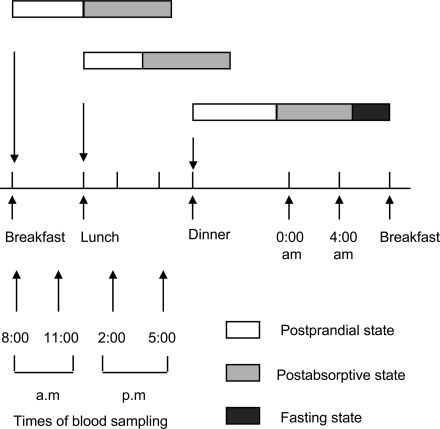
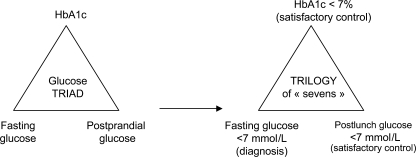
It is commonly admitted that the glycemic control of patients with type 2 diabetes proceeds from a complex “alchemy” in which the respective contributions of both fasting and postprandial glucose are still a subject of debate (1). A1C, which remains the gold standard for assessing glucose homeostasis, is an integration of both fasting and postprandial glucose variations over a 3-month period (2). From a mathematical point of view, the theory can be formulated as follows (3): ![Formula][1] where FPG ( t ) and PPG ( t ) are the time courses of fasting and postprandial glucose, respectively. As a consequence, the glycemic control of patients with type 2 diabetes can be schematically depicted by the “glucose triad,” whose components are as follows: A1C, fasting, and postprandial glucose levels. At present, and even though the debate remains wide open, it seems that the best assessment of glycemic control is provided by the determination of the three above-mentioned components. Most recommendations that have been published by medical organizations in different countries take into account the three parameters, even though the position statements differ around the world, but also within the same country (4). ### A tool for integrating the different periods of daytime Whereas many physicians continue to emphasize fasting glucose and A1C to guide management of diabetes, observational studies have indicated that glucose testing at postprandial and postabsorptive time points could play an important role (5,6). For instance, lessons from physiology tell us that humans spend half of their lives in postprandial states (7,8). The postprandial state, with respect to glucose, is defined as a 4-h period that immediately follows ingestion of a meal (7). During this period, dietary carbohydrates are progressively hydrolyzed through several sequential enzymatic actions. Even though the insulin response rapidly reduces the postprandial glucose excursion with a return to baseline levels within <2 h, the overall … [1]: /embed/graphic-1.gif
Overview
The claims and statistics of this paper haven’t been checked yet.
Free: it reads the open-access text and checks the first 5 claims that cite a source we can check. Create a free account to check every claim.
Integrity signals
Registry
Cites
Statistics
Figures
Verification
Claims the paper makes
The claims and statistics of this paper haven’t been checked yet.
Free: it reads the open-access text and checks the first 5 claims that cite a source we can check. Create a free account to check every claim.
Self-check
Percentages, sums and reported differences re-computed from the paper’s own numbers.
The self-check needs the paper’s full text.
Citations
Cites
(1993) · New England Journal of Medicine · doi:10.1056/nejm199309303291401 · Cited by 24,667
Report of the Expert Committee on the Diagnosis and Classification of Diabetes Mellitus
The Expert Committee on the Diagnosis and Classification of Diabetes Mellitus* (2002) · Diabetes Care · doi:10.2337/diacare.25.2007.s5 · Cited by 10,338
The metabolic phenotype in obesity: Fat mass, body fat distribution, and adipose tissue function
Goossens, G. H. (2017) · Obesity Facts · doi:10.1159/000471488 · Cited by 8,481
Effects of Intensive Glucose Lowering in Type 2 Diabetes
(2008) · New England Journal of Medicine · doi:10.1056/nejmoa0802743 · Cited by 7,888
Intensive blood glucose control and vascular outcomes in patients with type 2 diabetes
(2008) · New England Journal of Medicine · doi:10.1056/nejmoa0802987 · Cited by 7,397
Glucose control and vascular complications in veterans with type 2 diabetes
Duckworth, W., Abraira, C., Moritz, T., Reda, D., Emanuele, N., Reaven, P. D., Zieve, F. J., Marks, J., Davis, S. N., Hayward, R., et al. (2009) · New England Journal of Medicine · doi:10.1056/nejmoa0808431 · Cited by 4,762
Nathan, D. M., Buse, J. B., Davidson, M. B., Ferrannini, E., Holman, R. R., Sherwin, R., & Zinman, B. (2009) · Diabetes Care · doi:10.2337/dc08-9025 · Cited by 3,834
Report of the Expert Committee on the Diagnosis and Classification of Diabetes Mellitus
The Expert Committee on the Diagnosis and Classification of Diabetes Mellitus (2003) · Diabetes Care · doi:10.2337/diacare.26.2007.s5 · Cited by 2,689
Standards of Medical Care in Diabetes—2009
American Diabetes Association (2009) · Diabetes Care · doi:10.2337/dc09-s013 · Cited by 2,167
Kahn, S. E. (2003) · Diabetologia · doi:10.1007/s00125-002-1009-0 · Cited by 2,166
Research works printed but not linked: 1
- Levy, 1998, Beta-cell deterioration determines the onset and rate of progression of secondary dietary failure in type 2 diabetes mellitus: the 10-year follow-up of the Belfast diet study, Diabet Med, 15, 290, 10.1002/(SICI)1096-9136(199804)15:4<290::AID-DIA570>3.0.CO;2-M · DOI
Cited by
Joshi, S. R., Standl, E., Tong, N., Shah, P., Kalra, S., & Rathod, R. (2015) · Expert Opinion on Pharmacotherapy · doi:10.1517/14656566.2015.1070827 · Cited by 303
Ketema, E. B., & Kibret, K. T. (2015) · Archives of Public Health · doi:10.1186/s13690-015-0088-6 · Cited by 236
Wu, B., Bell, K., Stanford, A., Kern, D. M., Tunceli, O., Vupputuri, S., Kalsekar, I., & Willey, V. (2016) · BMJ Open Diabetes Research & Care · doi:10.1136/bmjdrc-2015-000154 · Cited by 216
Haghighatpanah, M., Nejad, A. S. M., Haghighatpanah, M., Thunga, G., & Mallayasamy, S. (2018) · Osong Public Health and Research Perspectives · doi:10.24171/j.phrp.2018.9.4.05 · Cited by 186
Glycemic Control for Type 2 Diabetes Mellitus Patients: A Systematic Review
Bin Rakhis, S. A., AlDuwayhis, N. M., Aleid, N., AlBarrak, A. N., & Aloraini, A. A. (2022) · Cureus · doi:10.7759/cureus.26180 · Cited by 152
“Among these, glycosylated hemoglobin is the gold standard for the estimation of glycemic control [7].”
BackgroundRosenstock, J., Lorber, D. L., Gnudi, L., Howard, C. P., Bilheimer, D. W., Chang, P.-C., Petrucci, R., Boss, A., & Richardson, P. C. (2010) · The Lancet · doi:10.1016/s0140-6736(10)60632-0 · Cited by 122
Low glycemic index rice—a desired trait in starchy staples
Jukanti, A. K., Pautong, P. A., Liu, Q., & Sreenivasulu, N. (2020) · Trends in Food Science & Technology · doi:10.1016/j.tifs.2020.10.006 · Cited by 104
Rwegerera, G. M. (2014) · Pan African Medical Journal · doi:10.11604/pamj.2014.17.252.2972 · Cited by 106
Mathematical Modelling of Endocrine Systems
Zavala, E., Wedgwood, K. C. A., Voliotis, M., Tabak, J., Spiga, F., Lightman, S. L., & Tsaneva-Atanasova, K. (2019) · Trends in Endocrinology & Metabolism · doi:10.1016/j.tem.2019.01.008 · Cited by 81
“The ultimate aim of treatment in diabetes is to achieve glycaemic control; that is, to keep blood glucose concentrations within a certain band [30].”
Hypoglycemia in everyday life after gastric bypass and duodenal switch
Abrahamsson, N., Edén Engström, B., Sundbom, M., & Karlsson, F. A. (2015) · European Journal of Endocrinology · doi:10.1530/eje-14-0821 · Cited by 63
Bourgot, C. L., Apper, E., Blat, S., & Respondek, F. (2018) · Nutrition & Metabolism · doi:10.1186/s12986-018-0245-3 · Cited by 69
Shearer, J., & Graham, T. E. (2014) · Nutrition Reviews · doi:10.1111/nure.12124 · Cited by 58
Guess, N. D. (2018) · Nutrients · doi:10.3390/nu10091245 · Cited by 75
Siervo, M., Corander, M., Stranges, S., & Bluck, L. (2011) · Nutrition Metabolism and Cardiovascular Diseases · doi:10.1016/j.numecd.2010.10.003 · Cited by 55
Al-ofi, E. A., Mosli, H. H., Ghamri, K. A., & Ghazali, S. M. (2018) · Journal of International Medical Research · doi:10.1177/0300060518809872 · Cited by 50
Henry, R. R., Dandona, P., Pettus, J., Mudaliar, S., Xu, J., & Hansen, L. (2017) · Diabetes, Obesity and Metabolism · doi:10.1111/dom.12882 · Cited by 42
Patient empowerment and optimal glycemic control
White, R. D. (2012) · Current Medical Research and Opinion · doi:10.1185/03007995.2012.677417 · Cited by 41
Fung, A. C. H., Tse, G., Cheng, H. L., Lau, E. S. H., Luk, A., Ozaki, R., So, T. T. Y., Wong, R. Y. M., Tsoh, J., Chow, E., et al. (2018) · Frontiers in Endocrinology · doi:10.3389/fendo.2018.00261 · Cited by 37
Glycemic control in the clinical management of diabetic patients
Mosca, A., Lapolla, A., & Gillery, P. (2012) · Clinical Chemistry and Laboratory Medicine (CCLM) · doi:10.1515/cclm-2012-0594 · Cited by 41
A nexus of lipid and O-Glcnac metabolism in physiology and disease
Lockridge, A. D., & Hanover, J. A. (2022) · Frontiers in Endocrinology · doi:10.3389/fendo.2022.943576 · Cited by 35
Owens, D. R., Monnier, L., & Hanefeld, M. (2017) · Diabetes Obesity and Metabolism · doi:10.1111/dom.12998 · Cited by 31
Self-citationColmegna, P. H., Sánchez‐Peña, R., Gondhalekar, R., Dassau, E., & Doyle, F. J. (2016) · Journal of Diabetes Science and Technology · doi:10.1177/1932296816638857 · Cited by 33
Awasthi, H., Nath, R., Usman, K., Mani, D., Khattri, S., Nischal, A., Singh, M., & Sawlani, K. K. (2015) · Complementary Therapies in Medicine · doi:10.1016/j.ctim.2015.06.005 · Cited by 36
Alsuliman, M., Al-Otaibi, S. A., Zhang, Q., & Durgampudi, P. K. (2020) · Diabetes/Metabolism Research and Reviews · doi:10.1002/dmrr.3395 · Cited by 30
Belay, E., Abera, A., Mehari, A., Gebremeskel, G., Endrias, A., & Endris, K. (2017) · International Journal of Chronic Diseases · doi:10.1155/2017/5713187 · Cited by 23
Meloni, A. R., DeYoung, M. B., Han, J., Best, J. H., & Grimm, M. F. (2013) · Cardiovascular Diabetology · doi:10.1186/1475-2840-12-48 · Cited by 21
Sanjeevi, N., & FREELAND-GRAVES, J. H. (2022) · Journal of Human Nutrition and Dietetics · doi:10.1111/jhn.13020 · Cited by 20
Harrabi, I., Harbi, F. A., & Ghamdi, S. A. (2014) · Journal of Diabetes Mellitus · doi:10.4236/jdm.2014.42021 · Cited by 21
Glucose: Archetypal Biomarker in Diabetes Diagnosis, Clinical Management and Research
Krentz, A. J., & Hompesch, M. (2016) · Biomarkers in Medicine · doi:10.2217/bmm-2016-0170 · Cited by 25
El‐Marasy, S. A., El-Shenawy, S. M. A., Moharram, F. A.-E., & El-Sherbeeny, N. A. (2020) · Open Access Macedonian Journal of Medical Sciences · doi:10.3889/oamjms.2020.3325 · Cited by 22
Siddiqui, M. K., Smith, G., Jean, P. S., Dawed, A. Y., Bell, S., Soto‐Pedre, E., Kennedy, G., Carr, F., Wallentin, L. C., White, H. D., et al. (2021) · Diabetologia · doi:10.1007/s00125-021-05574-5 · Cited by 18
Joshi, S., Jayanth, V., Loganathan, S., Sambandamurthy, V. K., & Athalye, S. N. (2023) · Drugs · doi:10.1007/s40265-023-01925-1 · Cited by 16
Acteoside as a multifunctional natural glycoside: therapeutic potential across various diseases
Mohammed, R. A., Kamel, A. S. E. D., Hindam, M. O., El‐Dessouki, A. M., Hamouda, H. A., Ramadan, N. M., Mohamed, S. S., El‐Shiekh, R. A., & Kamel, N. M. (2025) · Inflammopharmacology · doi:10.1007/s10787-025-01811-0 · Cited by 18
Wang, Y., & Fang, Y. (2021) · Diabetes Epidemiology and Management · doi:10.1016/j.deman.2021.100045 · Cited by 14
Late non-fasting plasma glucose predicts cardiovascular mortality independent of hemoglobin A1c
Wang, Y., & Fang, Y. (2022) · Scientific Reports · doi:10.1038/s41598-022-12034-6 · Cited by 13
Haghighatpanah, M. A., Thunga, G., Khare, S., & Mallayasamy, S. (2016) · International Journal of Pharmacy and Pharmaceutical Sciences · Cited by 18
Ali, Z., Chandrasekera, P. C., & Pippin, J. J. (2018) · Alternatives to Laboratory Animals · doi:10.1177/026119291804600101 · Cited by 14
Hendri, H., Suhartono, R., Kekalih, A., Adriani, J. R., & Faruk, M. (2023) · Surgery Open Science · doi:10.1016/j.sopen.2023.11.008 · Cited by 19
Li, J., Pan, Y., Zheng, Q., Chen, X., Jiang, X., Liu, R., Yu, Z., & Huang, L. (2024) · BMJ Open · doi:10.1136/bmjopen-2023-078325 · Cited by 14
Postprandial Glucose: A Variable in Continuum
Joshi, S., Kesavadev, J., M., P. K. K., Saboo, B., Mehta, A., Bhattacharyya, A., Sosale, A., Jabbar, P. K., Santosh, R., Deshmukh, V. C., et al. (2025) · Clinical Medicine Insights Endocrinology and Diabetes · doi:10.1177/11795514251370507 · Cited by 12
Oxidative Stress and Asprosin Levels in Type 2 Diabetic Patients with Good and Poor Glycemic Control
Şenyiğit, A., Durmuş, S., Gelışgen, R., & Uzun, H. (2024) · Biomolecules · doi:10.3390/biom14091123 · Cited by 9
Catalogna, M., Doenyas‐Barak, K., Sagi, R., Hamad, R. A., Nevo, U., Ben‐Jacob, E., & Efrati, S. (2016) · PLoS ONE · doi:10.1371/journal.pone.0168805 · Cited by 13
Papakonstantinou, E., Xaidara, M., Siopi, V., Giannoglou, M., Katsaros, G. I., Θεοδώρου, Γ., Maratou, E., Poulia, K., Dimitriadis, G., & Skandamis, P. N. (2022) · International Journal of Environmental Research and Public Health · doi:10.3390/ijerph19053001 · Cited by 11
Slebe, R., Wenker, E., Schoonmade, L. J., Bouman, E. J., Blondin, D. P., Campbell, D. J. T., Carpentier, A. C., Hoeks, J., Raina, P. S., Schrauwen, P., et al. (2024) · Diabetes Research and Clinical Practice · doi:10.1016/j.diabres.2024.111638 · Cited by 14
Understanding Patients with Type 2 Diabetes Mellitus Using Oral Antidiabetic Drugs
Irene, G. Y., Kuswinarti, K., & Kusumawati, M. (2020) · Journal Of Medicine & Health · doi:10.28932/jmh.v2i5.1110 · Cited by 14
Zhang, L., Ng, C. M., List, J. F., & Pfister, M. (2010) · The Journal of Clinical Pharmacology · doi:10.1177/0091270010376974 · Cited by 7
Widyaningsih, N., & Ahsani, D. N. (2021) · Advances in health sciences research/Advances in Health Sciences Research · doi:10.2991/ahsr.k.210115.031 · Cited by 5
Assaad-Khalil, S. H., Elkafrawy, N., Khaled, M., Mogeib, O., Badr, H. R., Rashwan, A., Youssef, M., Eltamawy, K., & Mohamed, S. (2022) · Evidence-based Complementary and Alternative Medicine · doi:10.1155/2022/9176026 · Cited by 7
Zacharodimos, N., Athanasaki, C., Vitsou-Anastasiou, S., Papadopoulou, O. S., Moniaki, N., Doulgeraki, A. I., Nychas, G. E., Tassou, C. C., & Papakonstantinou, E. (2023) · Metabolites · doi:10.3390/metabo13070791 · Cited by 5
Brenner, S., Oberaigner, W., & Stummer, H. (2020) · Journal of Public Health · doi:10.1007/s10389-019-01182-1 · Cited by 5
Ibrahim, N. F., Nofal, H. A. E., Ali, H. T., Elrafey, D. S., Almadani, N. A., Mahfouz, R., & Khodary, R. M. (2025) · Acta Diabetologica · doi:10.1007/s00592-025-02498-z · Cited by 5
Rathore, V., Gaikwad, K., & Mahat, R. K. (2025) · Cureus · doi:10.7759/cureus.80785 · Cited by 9
Kontou, T. G., Sargent, C., & Roach, G. D. (2022) · Sensors · doi:10.3390/s22186962 · Cited by 6
Xia, Y., Chen, H., Yan, R., Zhu, X.-W., Zhao, H., Ding, B., & Hu, Y. (2025) · Diabetes Metabolic Syndrome and Obesity · doi:10.2147/dmso.s543452 · Cited by 3
The association between abnormal glucose metabolism and rheumatoid arthritis
Zhang, X., Meng, F., Wang, Z., Ren, S., & Zhang, J. (2025) · Experimental and Molecular Pathology · doi:10.1016/j.yexmp.2025.105001 · Cited by 4
Clinical Profile of Patients with Diabetes Mellitus in Gusau, Northwestern, Nigeria
Sada, K. B., Sabir, A. A., Sakajiki, A. M., Umar, M. T., Abdullahi, U., & Sikiru, Y. A. (2021) · Annals of African Medicine · doi:10.4103/aam.aam_16_20 · Cited by 7
Li, W., Weng, K., Wang, C., Zheng, D., & Li, X.-N. (2025) · IntechOpen eBooks · doi:10.5772/intechopen.115568 · Cited by 1
Mangal, D. K., Shaikh, N., Tolani, H., Pandey, A. K., Gautam, D., Gupta, S. D., Kalra, S., Sharma, K. C., Prasad, J., Tewari, R., et al. (2025) · Scientific Reports · doi:10.1038/s41598-025-31681-z · Cited by 186
Metabolic flexibility during late pregnancy is associated with neonatal adiposity
Tinius, R. A., Blankenship, M. M., Furgal, K. E., Cade, W. T., Duchette, C., Pearson, K. J., & Maples, J. M. (2021) · Applied Physiology, Nutrition, and Metabolism · doi:10.1139/apnm-2020-1005 · Cited by 2
The new puzzle about the treatment of type 2 diabetes after the ACCORD and Da Qing studies
Pfeiffer, M., von Bauer, R., & Nawroth, P. P. (2011) · Langenbeck s Archives of Surgery · doi:10.1007/s00423-011-0781-z · Cited by 2
Nutritional Management of Diabetes Mellitus
(2016) · CRC Press eBooks · doi:10.1201/9781315381664-3 · Cited by 2
Papakonstantinou, E., Alsab, V., Lympaki, F., Chanioti, S., Giannoglou, M., & Katsaros, G. I. (2024) · European Journal of Clinical Nutrition · doi:10.1038/s41430-024-01482-0 · Cited by 2
Starck, C. S., Wolfe, R. R., & Moughan, P. J. (2024) · Journal of Nutrition · doi:10.1016/j.tjnut.2024.10.049 · Cited by 1
Yoon, J. S., Kim, J., Hong, E. H., & Hwang, S. (2026) · Diabetes Research and Clinical Practice · doi:10.1016/j.diabres.2026.113351 · Cited by 3
Effectiveness and Safety of Kenyan Anti- Diabetic Herbal Formulations: A Pilot Study
Chege, I. N., Okalebo, F., & Guantai, A. N. (2020) · International Journal of Health Sciences and Research · Cited by 1
Cancello, R., Lucchetti, E., Gobbi, M., & Brunani, A. (2020) · Springer eBooks · doi:10.1007/978-3-030-32274-8_4 · Cited by 3
Consequences of Chronic Sleep Restriction on Energy Balance in Healthy Adults
Spaeth, A. M. (2014) · ScholarlyCommons (University of Pennsylvania)
Ketema, E. B., & Kibret, K. T. (2015)
Sherif, E. M., Serag El Din, S., Hassanin, M., Makboul, K. M., & Ismail, A. (2015) · Journal of Scientific Research in Science /Journal of Scientific Research in Science · doi:10.21608/jsrs.2015.24894
Physical Activity and the Mosaic of Autoimmunity. Get Moving to Manage the Disease
Sharif, Κ., Lichtbroun, M., Watad, ., Borba, V. V., & Shoenfeld, Y. (2019) · Elsevier eBooks · doi:10.1016/b978-0-12-814307-0.00036-0 · Cited by 1
Effects of Exercise on Incretin Hormones
Toghi-Eshghi, S. R. (2018) · ERA: Education and Research Archive (University of Alberta) · doi:10.7939/r30g3hd88
Thérapeutique des désordres glycémiques
Monnier, L., & Colette, C. (2014) · Elsevier eBooks · doi:10.1016/b978-2-294-73954-5.00007-x
Sari, M. I., Daulay, M., Wahyuni, D. D., & Tala, Z. Z. (2018) · International Conference of Science, Technology, Engineering, Environmental and Ramification Researches (ICOSTEERR) · doi:10.5220/0010080206050609
Thérapeutique des désordres glycémiques
(2019) · Elsevier eBooks · doi:10.1016/b978-2-294-75889-8.00007-5
Zamaninour, N., Ansar, H., Pazouki, A., zadeh, M. H., & Kabir, A. (2022) · Indian Journal of Surgery · doi:10.1007/s12262-022-03419-y
The developmental history of insulin pharmaceuticals
Qian, H., & Kou, B. (2025) · Elsevier eBooks · doi:10.1016/b978-0-443-27402-2.00012-7
Biotechnological Assessment of SLC47A2 Genetic Variations and Glycemic Control in Diabetes Mellitus
Al‐Jboori, M. J., Hasan, R. N., & Al‐Terehi, M. N. (2025) · The Open Biotechnology Journal · doi:10.2174/0118740707414953251129062538
Hailu, F., Ali, J. H., Mengistu, Y. G., & Desalegn, Y. (2026) · Research Square · doi:10.21203/rs.3.rs-9171790/v1
From algorithm to alarm: a narrative review on insulin delivery innovation
Saleem, N. U. A., Arshad, F., Qadri, M., Mushtaq, M. S., Khan, M., Shakoor, P., Patel, T., Noor, A., Sardarova, N., Anand, N., et al. (2026) · Annals of Medicine and Surgery · doi:10.1097/ms9.0000000000005307
Dai, W., Hu, Z., Mao, W., Wu, J., & Hong, J. (2026) · International Journal of Endocrinology · doi:10.1155/ije/2656529
Chapitre 16 – Le diabète de type 2
Wémeau, J.-L. (2014) · doi:10.1016/b978-2-294-71584-6.00016-7 · Cited by 1
Metadata
- Authors
- Monnier, L., & Colette, C.
- Affiliations
- From the Laboratory of Human Nutrition, Institute of Clinical Research, Montpellier, France.
- Corresponding author
- Monnier, Louis
- ORCID
- Monnier, Louis
- Venue
- Diabetes Care
- Publisher
- American Diabetes Association
- Published
- 2009-11-01
- Volume
- 32
- Issue
- suppl_2
- Pages
- S199-S204
- ISSN
- 0149-5992 (ISSN-L)
- 1935-5548
- PMC
- PMC2811454
- OpenAlex
- W2164763907
- Cited by
- 82
- References
- 41
- Citations by year
- 2026: 4 · 2025: 10 · 2024: 5 · 2023: 3 · 2022: 8 · 2021: 5 · 2020: 7 · 2019: 3 · 2018: 9 · 2017: 3 · 2016: 6 · 2015: 6 · 2014: 6 · 2013: 1 · 2012: 2
- FWCI
- 0.26
- Type
- journal article
- Language
- en
- Open access
- hybrid
- doi.org
- Licence
- Locations
- Diabetes Care (publishedVersion, cc-by-nc-nd)
- PubMed Central (publishedVersion, cc-by-nc-nd)
- PubMed (publishedVersion)
- Topics
- Health Sciences › Medicine › Endocrinology, Diabetes and Metabolism › Diabetes Management and Research
- Health Sciences › Medicine › Endocrinology, Diabetes and Metabolism › Diabetes Treatment and Management
- Health Sciences › Medicine › Endocrinology, Diabetes and Metabolism › Diabetes, Cardiovascular Risks, and Lipoproteins
- Keywords
- glycemic control, type 2 diabetes, HbA1c, fasting blood glucose, postprandial blood glucose, glycemic targets, insulin response
- MeSH terms
- Blood Glucose, Circadian Rhythm, Diabetes Mellitus, Type 2, Fasting, Glycated Hemoglobin, Homeostasis, Humans, Hyperglycemia, Insulin, Postprandial Period, Consensus
About these checks
Registry, retraction, Cites and statistics results are computed, not judged, with one exception: a printed reference that no index lists is read once by a model before it counts as a citation error. Claims are extracted by a model and kept only when their quote appears verbatim in the text; each cited source is then checked, with a model’s help, for whether it says what the claim relies on. Those verdicts can be wrong — read the claim’s quote and the cited source before relying on one.
Statistics and arithmetic are recomputed, not judged.
Confidence bands are shown only for fields calibrated on our annotated test set. None is calibrated yet, so no band is shown.
What counts as a claim ›How we measure confidence ›How we check this ›
Are you an author, or do you see a problem with this page? Request a review
Data sources
Bibliographic data: Semantic Scholar, OpenAlex, Crossref.
Contains information from the Semantic Scholar Academic Graph Datasets, made available under the ODC Attribution License (ODC-BY 1.0).
Semantic Scholar’s data is described in: Kinney, R., et al. (2023). The Semantic Scholar Open Data Platform. arXiv:2301.10140.
