

Target for Glycemic Control
Open accessThe DOI matches its Crossref record, with a small difference in title or year; 41 of the 41 references it cites were found in a registry or an index.
Abstract
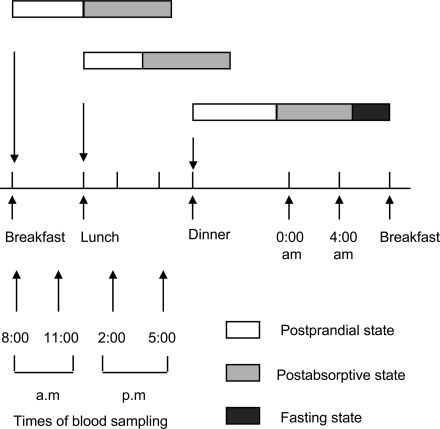
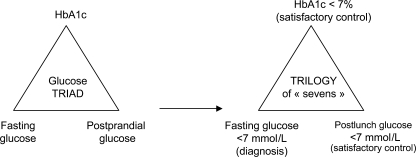
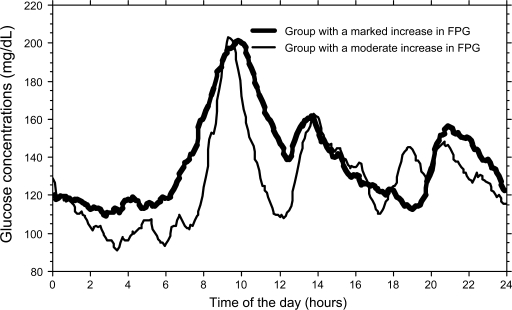
It is commonly admitted that the glycemic control of patients with type 2 diabetes proceeds from a complex “alchemy” in which the respective contributions of both fasting and postprandial glucose are still a subject of debate (1). A1C, which remains the gold standard for assessing glucose homeostasis, is an integration of both fasting and postprandial glucose variations over a 3-month period (2). From a mathematical point of view, the theory can be formulated as follows (3): ![Formula][1] where FPG ( t ) and PPG ( t ) are the time courses of fasting and postprandial glucose, respectively. As a consequence, the glycemic control of patients with type 2 diabetes can be schematically depicted by the “glucose triad,” whose components are as follows: A1C, fasting, and postprandial glucose levels. At present, and even though the debate remains wide open, it seems that the best assessment of glycemic control is provided by the determination of the three above-mentioned components. Most recommendations that have been published by medical organizations in different countries take into account the three parameters, even though the position statements differ around the world, but also within the same country (4). ### A tool for integrating the different periods of daytime Whereas many physicians continue to emphasize fasting glucose and A1C to guide management of diabetes, observational studies have indicated that glucose testing at postprandial and postabsorptive time points could play an important role (5,6). For instance, lessons from physiology tell us that humans spend half of their lives in postprandial states (7,8). The postprandial state, with respect to glucose, is defined as a 4-h period that immediately follows ingestion of a meal (7). During this period, dietary carbohydrates are progressively hydrolyzed through several sequential enzymatic actions. Even though the insulin response rapidly reduces the postprandial glucose excursion with a return to baseline levels within <2 h, the overall … [1]: /embed/graphic-1.gif
Overview
The claims and statistics of this paper haven’t been checked yet.
Free: it reads the open-access text and checks the first 5 claims that cite a source we can check. Create a free account to check every claim.
Integrity signals
Registry
Cites
Statistics
Figures
Verification
Claims the paper makes
The claims and statistics of this paper haven’t been checked yet.
Free: it reads the open-access text and checks the first 5 claims that cite a source we can check. Create a free account to check every claim.
Self-check
Percentages, sums and reported differences re-computed from the paper’s own numbers.
The self-check needs the paper’s full text.
Citations
Cites
(1993) · New England Journal of Medicine · doi:10.1056/nejm199309303291401 · Cited by 24,667
Report of the Expert Committee on the Diagnosis and Classification of Diabetes Mellitus
The Expert Committee on the Diagnosis and Classification of Diabetes Mellitus* (2002) · Diabetes Care · doi:10.2337/diacare.25.2007.s5 · Cited by 10,338
The metabolic phenotype in obesity: Fat mass, body fat distribution, and adipose tissue function
Goossens, G. H. (2017) · Obesity Facts · doi:10.1159/000471488 · Cited by 8,481
Effects of Intensive Glucose Lowering in Type 2 Diabetes
(2008) · New England Journal of Medicine · doi:10.1056/nejmoa0802743 · Cited by 7,888
Intensive blood glucose control and vascular outcomes in patients with type 2 diabetes
(2008) · New England Journal of Medicine · doi:10.1056/nejmoa0802987 · Cited by 7,397
Glucose control and vascular complications in veterans with type 2 diabetes
Duckworth, W., Abraira, C., Moritz, T., Reda, D., Emanuele, N., Reaven, P. D., Zieve, F. J., Marks, J., Davis, S. N., Hayward, R., et al. (2009) · New England Journal of Medicine · doi:10.1056/nejmoa0808431 · Cited by 4,762
Nathan, D. M., Buse, J. B., Davidson, M. B., Ferrannini, E., Holman, R. R., Sherwin, R., & Zinman, B. (2009) · Diabetes Care · doi:10.2337/dc08-9025 · Cited by 3,834
Report of the Expert Committee on the Diagnosis and Classification of Diabetes Mellitus
The Expert Committee on the Diagnosis and Classification of Diabetes Mellitus (2003) · Diabetes Care · doi:10.2337/diacare.26.2007.s5 · Cited by 2,689
Standards of Medical Care in Diabetes—2009
American Diabetes Association (2009) · Diabetes Care · doi:10.2337/dc09-s013 · Cited by 2,167
Kahn, S. E. (2003) · Diabetologia · doi:10.1007/s00125-002-1009-0 · Cited by 2,166
U.K. Prospective Diabetes Study Group (1995) · Diabetes · doi:10.2337/diab.44.11.1249 · Cited by 1,923
Translating the A1C assay into estimated average glucose values
Nathan, D. M., Kuenen, J., Borg, R., Zheng, H., Schoenfeld, D., Heine, R. J., & for the A1c-Derived Average Glucose (ADAG) Study Group (2008) · Diabetes Care · doi:10.2337/dc08-0545 · Cited by 1,812
Diagnosis and Classification of Diabetes Mellitus
American Diabetes Association (2004) · Diabetes Care · doi:10.2337/diacare.27.2007.s5 · Cited by 1,666
Riddle (2003) · doi:10.2337/diacare.26.11.3080 · Cited by 1,479
Monnier, L., Lapinski, H., & Colette, C. (2003) · Diabetes Care · doi:10.2337/diacare.26.3.881 · Cited by 1,461
Self-citationScreening for type 2 diabetes.
Engelgau, M. M., Narayan, K. M., & Herman, W. H. (2000) · Diabetes Care · doi:10.2337/diacare.23.10.1563 · Cited by 1,027
Defining the Relationship Between Plasma Glucose and HbA1c
Rohlfing, C. L., Wiedmeyer, H.-M., Little, R. R., England, J. D., Tennill, A., & Goldstein, D. E. (2002) · Diabetes Care · doi:10.2337/diacare.25.2.275 · Cited by 987
Skyler, J. S., Bergenstal, R., Bonow, R. O., Buse, J., Deedwania, P., Gale, E. A. M., Howard, B. V., Kirkman, M. S., Kosiborod, M., Reaven, P., et al. (2009) · Diabetes Care · doi:10.2337/dc08-9026 · Cited by 881
Sacks, D. B., Arnold, M., Bakris, G. L., Bruns, D. E., Horvath, A. R., Kirkman, M. S., Lernmark, A., Metzger, B. E., & Nathan, D. M. (2011) · Diabetes Care · doi:10.2337/dc11-9998 · Cited by 718
(1997) · Diabetes reviews · Cited by 671
Cavalot, F., Petrelli, A., Traversa, M., Bonomo, K., Fiora, E., Conti, M., Anfossi, G., Costa, G., & Trovati, M. (2006) · The Journal of Clinical Endocrinology & Metabolism · doi:10.1210/jc.2005-1005 · Cited by 569
Monnier, L., Colette, C., Dunseath, G. J., & Owens, D. R. (2007) · Diabetes Care · doi:10.2337/dc06-1612 · Cited by 490
Self-citationAssociation, A. D. (2001) · Diabetes Care · doi:10.2337/diacare.24.4.775 · Cited by 464
American Diabetes Association (2004) · Diabetes Care · doi:10.2337/diacare.27.2007.s11 · Cited by 442
Avignon, A., Radauceanu, A., & Monnier, L. (1997) · Diabetes Care · doi:10.2337/diacare.20.12.1822 · Cited by 363
Self-citationCarbohydrate Metabolism in Non-Insulin-Dependent Diabetes Mellitus
Dinneen, S., Gerich, J., & Rizza, R. (1992) · New England Journal of Medicine · doi:10.1056/nejm199209033271007 · Cited by 279
Ceriello, A., & Colagiuri, S. (2008) · Diabetic Medicine · doi:10.1111/j.1464-5491.2008.02565.x · Cited by 268
Plasma Glucose Levels Throughout the Day and HbA1c Interrelationships in Type 2 Diabetes
Bonora, E., Calcaterra, F., Lombardi, S., Bonfante, N., Formentini, G., Bonadonna, R. C., & Muggeo, M. (2001) · Diabetes Care · doi:10.2337/diacare.24.12.2023 · Cited by 235 · cited 1×
“(13) reported that preprandial plasma glucose concentrations were related to A1C more strongly than postprandial concentrations.”
BackgroundBolli, G. B., & Gerich, J. E. (1984) · New England Journal of Medicine · doi:10.1056/nejm198403223101203 · Cited by 235
Boden, G., Chen, X., & Urbain, J. L. (1996) · Diabetes · doi:10.2337/diab.45.8.1044 · Cited by 228 · cited 2×
“The prebreakfast glucose deterioration that occurs at the end of the overnight fast is known as the “dawn phenomenon” (33) and is mainly explained by the circadian variation of the hepatic glucose production that starts to rise in the evening and reaches a peak toward the end of the nocturnal period (32).”
BackgroundMethodBurgers, J. S., Bailey, J. V., Klazinga, N. S., Van der Bij, A. K., Grol, R., Feder, G., & for the AGREE Collaboration (2002) · Diabetes Care · doi:10.2337/diacare.25.11.1933 · Cited by 198
Sacks, D. B., Bruns, D. E., Goldstein, D. E., Maclaren, N. K., McDonald, J. M., & Parrott, M. A. (2002) · Diabetes Care · doi:10.2337/diacare.25.4.750 · Cited by 145
Is postprandial glucose a neglected cardiovascular risk factor in type 2 diabetes?
Monnier, L. (2000) · European Journal of Clinical Investigation · doi:10.1046/j.1365-2362.30.s2.2.x · Cited by 97
Self-citationMorning Hyperglycemic Excursions
Monnier, L., Colette, C., Rabasa-Lhoret, R., Lapinski, H., Caubel, C., Avignon, A., & Boniface, H. (2002) · Diabetes Care · doi:10.2337/diacare.25.4.737 · Cited by 96
Self-citationLebovitz, H. E., Austin, M. M., Blonde, L., Davidson, J. A., Prato, S. D., Gavin, J. R., Handelsman, Y., Jellinger, P. S., Levy, P., Riddle, M. C., et al. (2006) · Endocrine Practice · doi:10.4158/ep.12.s1.6 · Cited by 81
Monnier, L., Colette, C., Lapinski, H., & Boniface, H. (2004) · Diabetes & Metabolism · doi:10.1016/s1262-3636(07)70097-6 · Cited by 52
Self-citationSinclair, E. M., & Drucker, D. J. (2005) · Current Opinion in Endocrinology & Diabetes · doi:10.1097/01.med.0000155379.11926.e2 · Cited by 39
Global assessment for quality and safety of control in type 2 diabetic patients
Monnier, L., Colette, C., & Lapinski, H. (2004) · European Journal of Clinical Investigation · doi:10.1111/j.1365-2362.2004.01280.x · Cited by 25
Self-citationShould seven be the magic number of type 2 diabetes?
Monnier, L., & Colette, C. (2005) · Diabetologia · doi:10.1007/s00125-005-1885-1 · Cited by 9
Self-citationUKPDS 26: sulphonylurea failure in non-insulin-dependent diabetic patients over six years
UK Prospective Diabetes Study (UKPDS) Group, Matthews, D. R., Cull, C. A., Stratton, I. M., Holman, R. R., & Turner, R. C. (1998) · Diabetic Medicine · doi:10.1002/(sici)1096-9136(199804)15:4
Research works printed but not linked: 1
- Levy, 1998, Beta-cell deterioration determines the onset and rate of progression of secondary dietary failure in type 2 diabetes mellitus: the 10-year follow-up of the Belfast diet study, Diabet Med, 15, 290, 10.1002/(SICI)1096-9136(199804)15:4<290::AID-DIA570>3.0.CO;2-M · DOI
Cited by
Joshi, S. R., Standl, E., Tong, N., Shah, P., Kalra, S., & Rathod, R. (2015) · Expert Opinion on Pharmacotherapy · doi:10.1517/14656566.2015.1070827 · Cited by 303
Ketema, E. B., & Kibret, K. T. (2015) · Archives of Public Health · doi:10.1186/s13690-015-0088-6 · Cited by 236
Wu, B., Bell, K., Stanford, A., Kern, D. M., Tunceli, O., Vupputuri, S., Kalsekar, I., & Willey, V. (2016) · BMJ Open Diabetes Research & Care · doi:10.1136/bmjdrc-2015-000154 · Cited by 216
Haghighatpanah, M., Nejad, A. S. M., Haghighatpanah, M., Thunga, G., & Mallayasamy, S. (2018) · Osong Public Health and Research Perspectives · doi:10.24171/j.phrp.2018.9.4.05 · Cited by 186
Glycemic Control for Type 2 Diabetes Mellitus Patients: A Systematic Review
Bin Rakhis, S. A., AlDuwayhis, N. M., Aleid, N., AlBarrak, A. N., & Aloraini, A. A. (2022) · Cureus · doi:10.7759/cureus.26180 · Cited by 152
“Among these, glycosylated hemoglobin is the gold standard for the estimation of glycemic control [7].”
Background
Metadata
- Authors
- Monnier, L., & Colette, C.
- Affiliations
- From the Laboratory of Human Nutrition, Institute of Clinical Research, Montpellier, France.
- Corresponding author
- Monnier, Louis
- ORCID
- Monnier, Louis
- Venue
- Diabetes Care
- Publisher
- American Diabetes Association
- Published
- 2009-11-01
- Volume
- 32
- Issue
- suppl_2
- Pages
- S199-S204
- ISSN
- 0149-5992 (ISSN-L)
- 1935-5548
- PMC
- PMC2811454
- OpenAlex
- W2164763907
- Cited by
- 82
- References
- 41
- Citations by year
- 2026: 4 · 2025: 10 · 2024: 5 · 2023: 3 · 2022: 8 · 2021: 5 · 2020: 7 · 2019: 3 · 2018: 9 · 2017: 3 · 2016: 6 · 2015: 6 · 2014: 6 · 2013: 1 · 2012: 2
- FWCI
- 0.26
- Type
- journal article
- Language
- en
- Open access
- hybrid
- doi.org
- Licence
- Locations
- Diabetes Care (publishedVersion, cc-by-nc-nd)
- PubMed Central (publishedVersion, cc-by-nc-nd)
- PubMed (publishedVersion)
- Topics
- Health Sciences › Medicine › Endocrinology, Diabetes and Metabolism › Diabetes Management and Research
- Health Sciences › Medicine › Endocrinology, Diabetes and Metabolism › Diabetes Treatment and Management
- Health Sciences › Medicine › Endocrinology, Diabetes and Metabolism › Diabetes, Cardiovascular Risks, and Lipoproteins
- Keywords
- glycemic control, type 2 diabetes, HbA1c, fasting blood glucose, postprandial blood glucose, glycemic targets, insulin response
- MeSH terms
- Blood Glucose, Circadian Rhythm, Diabetes Mellitus, Type 2, Fasting, Glycated Hemoglobin, Homeostasis, Humans, Hyperglycemia, Insulin, Postprandial Period, Consensus
About these checks
Registry, retraction, Cites and statistics results are computed, not judged, with one exception: a printed reference that no index lists is read once by a model before it counts as a citation error. Claims are extracted by a model and kept only when their quote appears verbatim in the text; each cited source is then checked, with a model’s help, for whether it says what the claim relies on. Those verdicts can be wrong — read the claim’s quote and the cited source before relying on one.
Statistics and arithmetic are recomputed, not judged.
Confidence bands are shown only for fields calibrated on our annotated test set. None is calibrated yet, so no band is shown.
What counts as a claim ›How we measure confidence ›How we check this ›
Are you an author, or do you see a problem with this page? Request a review
Data sources
Bibliographic data: Semantic Scholar, OpenAlex, Crossref.
Contains information from the Semantic Scholar Academic Graph Datasets, made available under the ODC Attribution License (ODC-BY 1.0).
Semantic Scholar’s data is described in: Kinney, R., et al. (2023). The Semantic Scholar Open Data Platform. arXiv:2301.10140.
