

Intersections between Sexual Identity, Sexual Attraction, and Sexual Behavior among a Nationally Representative Sample of American Men and Women
Open accessThe DOI matches its Crossref record; 81 of the 81 references it cites were found in a registry or an index; 21 of the 80 sources its claims cite were checked for support.
Abstract
Social scientists struggle on how to best operationalize and measure sexual orientation. Depending on the survey, researchers can use self-reports of lesbian, gay, or bisexual (LGB) identity, same-sex partner cohabitation, same-sex sexual attraction, or same-sex sexual behavior. All measures come with their own limitations. To illuminate differences in these measures, this study examines the intersections between self-reported sexual identity, attraction, and behavior among a nationally representative sample of US men and women aged 15–45. I explore how and when the three measures align, examine the determinants of self-identifying as gay or bisexual based on sexual behavior and attraction, and assess gender differences in the patterns. I find that about 20% of women and 10% of men aged 15–45 would comprise the LGB community if it were defined to include those who report at least one of the following: gay or bisexual identity, any same-sex attraction, or same-sex sex in the last year. This is much higher than the 6.4% of women and 3.6% of men aged 15–45 who self-identify as LGB. I conclude with recommendations that can aid in measurement of the LGB population, and discuss implications for using certain measures over others when conducting research on the LGB community.
Overview
CoChat Summary
TL;DR
This study examines how sexual identity, attraction, and behavior intersect in a nationally representative sample of U.S. men and women aged 15–45, showing substantial disjunctures among the three measures. It finds that the estimated LGB population is much larger when based on any same-sex attraction, recent same-sex sex, or gay/bisexual identity than when based on identity alone.
Key findings
- About 20% of women and 10% of men aged 15–45 would be counted as LGB if the category included gay/bisexual identity, any same-sex attraction, or same-sex sex in the last year, compared with 6.4% of women and 3.6% of men who self-identify as gay or bisexual.
- Same-sex attraction and behavior are more common than LGB identity: about 15% of women and 5% of men report ever having same-sex sex, and about 17% of women and 7% of men report some current same-sex attraction.
- Disjunctures are gendered: 11.6% of straight women and about 3.7% of straight men report some same-sex attraction; only 56.9% of gay women and 67.1% of gay men report only same-sex attraction. Among bisexual respondents, 76.4% of women and 63.3% of men report ever having same-sex sex.
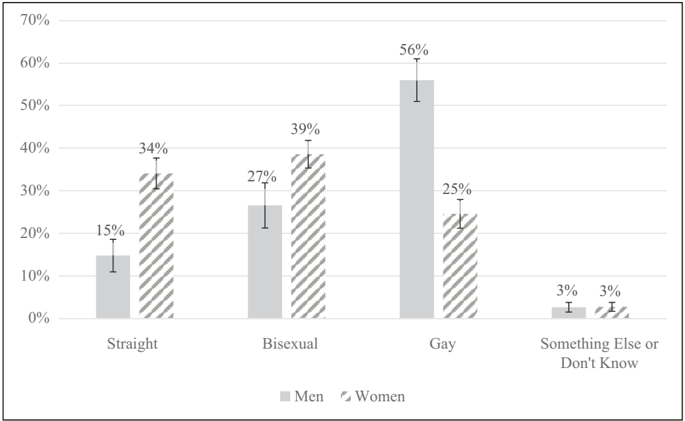
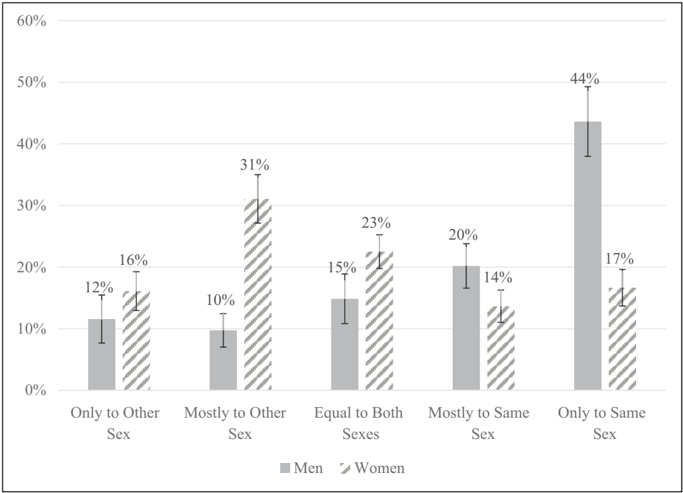
- Among those who had same-sex sex in the past year, women’s identities were distributed as 34% straight, 39% bisexual, and 25% gay, while men were 15% straight, 27% bisexual, and 56% gay; 44% of these men versus 17% of these women reported only same-sex attraction.
Methods
- Pooled four waves of the National Survey of Family Growth (2002, 2006–2010, 2011–2013, 2013–2015), a nationally representative U.S. household survey of men and women aged 15–45, for a total sample of 55,874; analyses used NSFG weights.
- Measured sexual identity (straight, gay, bisexual, something else/don’t know), sexual attraction on a five-point scale, and sexual behavior including lifetime and past-year same-sex partners.
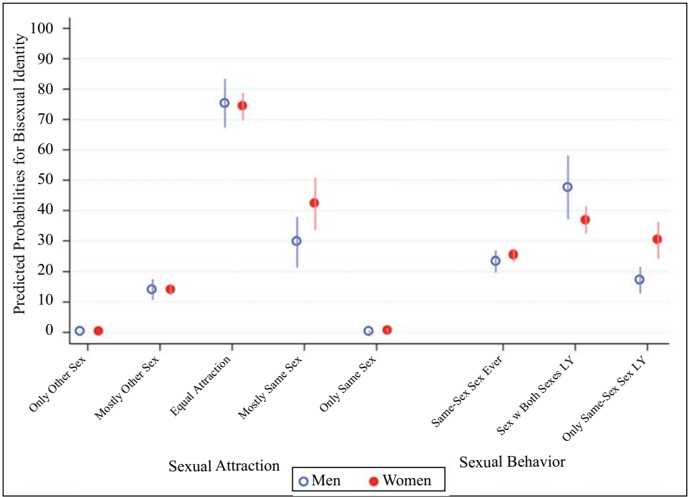
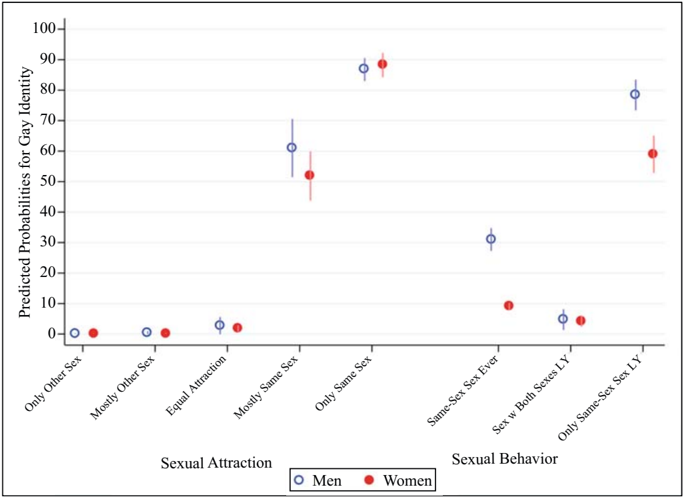
- Used descriptive statistics and two-tailed t-tests for gender differences, plus logistic regressions predicting bisexual or gay identity from attraction and behavior with controls for race, age, age-squared, mother’s education, immigrant status, metropolitan area, and survey wave; predicted probabilities were calculated using average marginal effects.
Limitations
- The paper states that the sample includes no individuals above age 45, motivating further research on older U.S. adults. It also discusses measure-specific limitations: identity-only measures may underestimate the LGB population, attraction-only measures may overestimate it, and behavior-only measures may over- or underestimate depending on whether recent or lifetime behavior is used.
- The paper notes possible measurement error and respondent misunderstanding, especially for puzzling cases such as gay identity with only other-sex attraction; these respondents were disproportionately immigrants, less educated, and less likely to be white, though 31% reported same-sex sex. It also notes that “something else/don’t know” responses are difficult to interpret and that question options varied across survey waves.
- Evident from the text: the analysis is cross-sectional and cannot establish causal direction between identity, attraction, and behavior; self-reports may still be subject to bias despite ACASI, and the gender-specific question pathways for same-sex partners differ for men and women, though the author argues this is unlikely to artifactually create a higher bar for men.
Model-written summary. Check it against the paper before relying on it.
Integrity signals
Registry
Cites
Statistics
Figures
Verification
Claims the paper makes
18 Valid · 0 Not valid · 26 Not checked · 116 Own results and interpretations
The sources with a verdict support this claim; the rest weren’t checked yet, have no full text we could read, or their verdicts aren’t rated yet.
In the paper
“and these disjunctures have been shown to change research results, depending on the measure of sexual orientation used (Bostwick et al. 2010; Compton et al. 2015; Korchmaros et al. 2013; Mize 2016).”
What the sources say
- Supportedcites Bostwick et al. 2010 matched to “Dimensions of sexual orientation and the prevalence of mood and anxiety disorders in the United States” (2010) source
The Discussion states that different dimensions of sexual orientation yield varying prevalence estimates of mental health disorders. It cautions against treating those dimensions as equivalent, supporting the claim that results depend on the measure used. No page number is supplied in our copy. (LLM, conf=0.92)
- Not checked yetcites Compton et al. 2015 matched to “Patterns of Bisexuality in America” (2015) source
Checked before — its earlier verdict is held back until a new check runs.
- Not checked — no full text of the sourcecites Korchmaros et al. 2013 matched to “Chasing Sexual Orientation: A Comparison of Commonly Used Single-Indicator Measures of Sexual Orientation” (2013) source
plainstates a cause- Asserted: passes — The authors put it forward as true.
- Checkable: passes — It can be checked against evidence.
- Load-bearing: passes — The paper’s conclusions depend on it.
- Based: passes — The paper gives a reason why it holds.
- Supported
The sources with a verdict support this claim; the rest weren’t checked yet, have no full text we could read, or their verdicts aren’t rated yet.
In the paper
“past studies show disjunctures between a person's self-described sexual identity and with whom the individual engages in sexual behavior, or to whom the individual is sexually attracted (Epstein et al. 2012; Igartua et al. 2009; Kinsey et al. 1953; Laumann et al. 1994)”
What the sources say
- Not checked — no full text of the sourcecites Epstein et al. 2012 matched to “Support for a Fluid-Continuum Model of Sexual Orientation: A Large-Scale Internet Study” (2012) source
- Supportedcites Igartua et al. 2009 matched to “Concordance and Discrepancy in Sexual Identity, Attraction, and Behavior Among Adolescents” (2009) source
The Introduction reports that prior studies found differences in sexual-orientation measures depending on whether they assessed identity, attraction, or behaviour. The Discussion also reports discrepancies among those dimensions in the paper’s adolescent sample, including students with a heterosexual identity who reported same-sex attraction or behaviour. (LLM, conf=0.94)
- Not matchedcites Kinsey et al. 1953
An author–year citation the paper’s reference list doesn’t settle. We don’t search these by name.
plainstates an association- Asserted: passes — The authors put it forward as true.
- Checkable: passes — It can be checked against evidence.
- Load-bearing: passes — The paper’s conclusions depend on it.
- Based: passes — The paper gives a reason why it holds.
The sources with a verdict support this claim; the rest weren’t checked yet, have no full text we could read, or their verdicts aren’t rated yet.
In the paper
“The estimates for those who identify as gay or bisexual are slightly larger here compared to the proportion of people who identify as gay or bisexual in the United Kingdom and Australia (see Geary et al. 2018; Richters et al. 2014)”
What the sources say
- Supportedcites Geary et al. 2018 matched to “Sexual identity, attraction and behaviour in Britain: The implications of using different dimensions of sexual orientation to estimate the size of sexual minority populations and inform public health interventions” (2018) source
Geary et al.’s Abstract (Findings) reports that 2.5% of men and 2.4% of women in Britain identified as lesbian, gay or bisexual. This supports the British proportion used for the comparison; the Australian proportion is attributed to the separate Richters et al. citation. (LLM, conf=0.90)
- Not checked — no full text of the sourcecites Richters et al. 2014 matched to “Sexual identity, sexual attraction and sexual experience: the Second Australian Study of Health and Relationships” (2014) source
plain- Asserted: passes — The authors put it forward as true.
- Checkable: passes — It can be checked against evidence.
- Load-bearing: unclear — It is unclear whether the paper’s conclusions depend on it.
- Based: passes — The paper gives a reason why it holds.
- Supported
The cited sources support only part of this claim — read each source’s verdict below.
In the paper
“The finding that more men and women report same-sex sexual experience or same-sex attraction than report gay or bisexual identity is consistent with past research”
What the sources say
- Partly supportedcites Compton et al. 2015 matched to “Patterns of Bisexuality in America” (2015) sourceExperimental — accuracy not yet measured
In 'Prevalence of Bisexuality' our copy states that 'behavior is usually more prevalent than identity,' crediting Kinsey et al. (1948), Poston & Baumle (2010) and Rust (2000b), and Note 1 adds that their correlations 'further support the notion that behavior and identity and/or desire are often not aligned' — so the behavior-vs-identity half of the claim, and its consistency with past research, is in the source. The attraction half is not: the source's own NSFG figures (Descriptive Statistics and Estimates) give equal-desire/attraction rates (0.47% women 2008; 0.02% men 2008) at or below self-identified bisexual rates (0.43% women; 0.38% men), and its Discussion ranks the behavior dimension highest, then the combined three-dimension measure, not attraction, so it does not establish that same-sex attraction outnumbers gay or bisexual identity. Our copy also confines these comparisons to the bisexual response rather than to homosexuality. (LLM, conf=0.78)
- Supportedcites Gates 2011
In “How many adults are lesbian, gay, or bisexual?” (page unavailable), the paper reports that a larger fraction of adults in the surveys reported same-sex attraction or behavior than identified as lesbian, gay, or bisexual. It presents this pattern across multiple surveys, supporting the claim that the finding is consistent with past research. (LLM, conf=0.90)
- Not checked — no full text of the sourcecites Korchmaros et al. 2013 matched to “Chasing Sexual Orientation: A Comparison of Commonly Used Single-Indicator Measures of Sexual Orientation” (2013) source
plain- Asserted: passes — The authors put it forward as true.
- Checkable: passes — It can be checked against evidence.
- Load-bearing: unclear — It is unclear whether the paper’s conclusions depend on it.
- Based: passes — The paper gives a reason why it holds.
- Partly supported
Every source the paper cites for this claim was checked and supports it.
In the paper
“After all, previous studies show differences in findings based on the measure of sexual orientation used.”
What the sources say
- Supportedcites Bostwick et al. 2010 matched to “Dimensions of sexual orientation and the prevalence of mood and anxiety disorders in the United States” (2010) source
The Discussion states that different dimensions of sexual orientation are associated with varying prevalence estimates of mental health disorders. It cautions against treating measures of identity, behavior, and attraction as interchangeable, supporting the citing sentence’s general point. (LLM, conf=0.92)
- Supportedcites Compton et al. 2015 matched to “Patterns of Bisexuality in America” (2015) source
The 'Conceptualization of Sexual Orientation' section states that 'Gates (2011) found that estimates of these population frequencies vary based on operational definitions of "sexuality" as well as the survey methods and the research questions being asked,' and flags Rust (2000a) and Baumle et al. (2009) on interpretive differences tied to question construction. The DISCUSSION AND CONCLUSION reinforces the general point that 'Our examination of bisexuality is one of many analyses that have focused on the measurement of sexuality. Specifically, the differences and disparities that arise are based on how the researcher defines "sexuality"' and that 'different rates are observed based on the different operational definitions.' The broad background claim that prior studies yield differing findings depending on the measure of sexual orientation used is therefore stated in our copy. (LLM, conf=0.85)
plainstates an association- Asserted: passes — The authors put it forward as true.
- Checkable: passes — It can be checked against evidence.
- Load-bearing: passes — The paper’s conclusions depend on it.
- Based: passes — The paper gives a reason why it holds.
- Supported
98 more claims
Create a free account to see all 160 claims and to verify the 12 references still open.
- Probably not a substantial claim. 31
- It may state two separate claims as one. 30
- The quote only partly states this claim. 1
Self-check
Percentages, sums and reported differences re-computed from the paper’s own numbers.
Each contradiction between two passages listed here was confirmed by an independent check.
Rated minor: it would not touch a result — a value no result rests on, a p-value that stays on the same side of the significance level, or a conflict that is clerical, resolved elsewhere in the paper, or outside its own findings.
In the paper
§ 3. Data and Measures
“in wave 2013-2105, 5,699 women and 4,506 men(10,205 in total) were sampled”
§ 3. Data and Measures
“I pool data from four NSFG survey waves: 2002, 2006-2010, 2011-2013, and 2013-2015.”
Citations
Cites
Hegemonic Masculinity: Rethinking the Concept
Connell, R. W., & Messerschmidt, J. W. (2005) · Gender & Society · doi:10.1177/0891243205278639 · Cited by 9,367 · cited 1×
“…many researchers have documented the strong ties between cultural notions of masculinity and of heterosexuality (e.g., Bridges 2014, Connell 1995; Connell and Messerschmidt 2005; Plummer 1999; Silva 2016; Ward 2008), which may also explain why women may be more sexually fluid in terms of…”
BackgroundThe social organization of sexuality: sexual practices in the United States
(1995) · Choice Reviews Online · doi:10.5860/choice.32-4802a · Cited by 2,890
Sexual Behavior in the Human Female
Zimmerman, C. C., Kinsey, A. C., Pomeroy, W. B., Martin, C. E., & Gebhard, P. H. (1954) · Harvard Law Review · doi:10.2307/1336986 · Cited by 2,625
Sexual Behavior in the Human Female
(1954) · Physical Therapy · doi:10.1093/ptj/34.1.50 · Cited by 1,716
The Social Organization of Sexuality. Sexual Practices in the United States
Giami, A., Laumann, E. O., Gagnon, J. H., Michael, R. T., Michaels, S., Michael, R. T., Laumann, E. O., & Kolata, G. (1997) · Population (French Edition) · doi:10.2307/1534637 · Cited by 1,555
Dude, You’re a Fag: Masculinity and Sexuality in High School
Pascoe, C. J. (2020) · University of California Press eBooks · doi:10.1525/9780520941045 · Cited by 1,374
Tourangeau, R., & Smith, T. W. (1996) · Public Opinion Quarterly · doi:10.1086/297751 · Cited by 1,295
Cochran, S. D., Sullivan, J. G., & Mays, V. M. (2003) · Journal of Consulting and Clinical Psychology · doi:10.1037/0022-006x.71.1.53 · Cited by 1,109
Bostwick, W. B., Boyd, C. J., Hughes, T. L., & McCabe, S. E. (2010) · American Journal of Public Health · doi:10.2105/ajph.2008.152942 · Cited by 829 · cited 4×
“…use reports of same-sex sexual attraction (e.g., Busseri et al. 2006); others use reports of same-sex partner cohabitation (e.g., Baumle and Poston 2011; Fischer 2016); and yet others use a combination of one or more of these measures (e.g., Bostwick et al. 2010; England et al. 2016; Mize 2016).”
BackgroundInfluentialRule of Law and Constitutional Democracy
(2015) · DergiPark (Istanbul University) · doi:10.2139/ssrn · Cited by 804
Research works printed but not linked: 2
- Pelligrini, A. 1992. S(h)ifting the terms of Hetero/sexism: Gender, power, homophobia.' In Homophobia: How We All Pay the Price , edited by W.J. Blumenfeld, 39-56. Boston: Beacon Press.
- Wellings, K., J. Field, A. Johnson, and J. Wadsworth. 1994. Sexual Behavior in Britain: The National Survey of Sexual Attitudes and Lifestyles . Penguin Books.
Cited by
Intersecting the Academic Gender Gap: The Education of Lesbian, Gay, and Bisexual America
Mittleman, J. (2022) · American Sociological Review · doi:10.1177/00031224221075776 · Cited by 112
“Sexuality is multifaceted: it is constituted by attractions, behaviors, and identifications that may not align (Mishel 2019; Silva 2019).”
BackgroundSexual Fluidity: Implications for Population Research
Mittleman, J. (2023) · Demography · doi:10.1215/00703370-10898916 · Cited by 45
Toward a Holistic Demographic Profile of Sexual and Gender Minority Well-being
Stacey, L., Reczek, C., & Spiker, R. (2022) · Demography · doi:10.1215/00703370-10081664 · Cited by 46
Constructing a queer population? Asking about sexual orientation in Scotland’s 2022 census
Guyan, K. (2021) · Journal of Gender Studies · doi:10.1080/09589236.2020.1866513 · Cited by 51
“The dimension of sexual orientation measured must match the research question under investigation (Compton, Farris, & Chang, 2015; Mishel, 2019).”
InfluentialDangerous data: Seeing social surveys through the sexuality prism
Westbrook, L., Budnick, J., & Saperstein, A. (2021) · Sexualities · doi:10.1177/1363460720986927 · Cited by 37
“More recently, scholars have argued that research should attend to multiple dimensions of sexuality, specifically desires, behaviors, and identities (Mishel, 2019; Savin-Williams and Ream, 2007; Silva, 2019; SMART, 2009; van Anders, 2015).”
BackgroundSexual Health Among Lesbian, Gay, Bisexual, and Heterosexual Older Adults: An Exploratory Analysis
Brennan-Ing, M., Kaufman, J., Larson, B., Gamarel, K., Seidel, L., & Karpiak, S. (2020) · Clinical Gerontologist · doi:10.1080/07317115.2020.1846103 · Cited by 26
“…dimensions: sexual identity (subjective sense of self), sexual attraction (sex of person to whom one is attracted), and sexual behavior (sex of sexual partner), and while these three dimensions overlap, there is not a one-to-one correspondence (Haseldon, Joloza, & Household, 2009; Mishel, 2019).”
BackgroundInfluentialMonto, M. A., & Neuweiler, S. (2023) · The Journal of Sex Research · doi:10.1080/00224499.2023.2225176 · Cited by 34
Silva, T. J., & Evans, C. R. (2020) · Sex Roles · doi:10.1007/s11199-020-01145-x · Cited by 33
“Second, as research with nationally representative surveys has shown, there are multiple dimensions to how individuals experience their sexuality, including romantic attraction, physical attraction, and sexual behavior (Mishel 2019; Priebe and Svedin 2013).”
BackgroundJulian, C. A., Manning, W. D., & Dush, C. M. K. (2024) · Journal of Marriage and the Family · doi:10.1111/jomf.12957 · Cited by 30
“The incorporation of wider dimensions will not only result in different estimates of sexually diverse individuals but likely lead to different substantive conclusions depending upon the dimensions examined (Mishel, 2019).”
Sexual Orientation Identity Mobility in the United Kingdom: A Research Note
Hu, Y., & Denier, N. (2023) · Demography · doi:10.1215/00703370-10769825 · Cited by 29
COVID-19 Stress and Sexual Identities
Manning, W. D., & Dush, C. M. K. (2022) · Socius Sociological Research for a Dynamic World · doi:10.1177/23780231221105376 · Cited by 22
Banze, A. R., Muleia, R., Nuvunga, S., et al. (2024) · BMC Public Health · doi:10.1186/s12889-024-18661-0 · Cited by 16
“This observation raises the hypothesis that individuals who identify with a sexual orientation involving partners from both gender groups might be more inclined to engage in occasional relationships [16].”
BackgroundWest, B. T., & McCabe, S. E. (2021) · Field Methods · doi:10.1177/1525822x21998516 · Cited by 15
“, “Christian male”), or individuals conflating sexual orientation with gender identity (Bates et al. 2019; Mishel 2019; Ridalfo et al. 2012; Truman et al. 2019).”
BackgroundSexual Identity‐Behavior Discordance in Canada
Silva, T., & Fetner, T. (2022) · Canadian Review of Sociology/Revue canadienne de sociologie · doi:10.1111/cars.12372 · Cited by 13
McMillan, C., Craig, B., la Roi, C., & Veenstra, R. (2023) · Social Science Research · doi:10.1016/j.ssresearch.2023.102916 · Cited by 13
Australia's LGBTIQ Research Data Landscape
Saxby, K. (2022) · Australian Economic Review · doi:10.1111/1467-8462.12462 · Cited by 9
Sexualities and Geographic Mobility Between Childhood and Adulthood in the United States
Levine, A. (2022) · Demography · doi:10.1215/00703370-10085223 · Cited by 12
Who Cares? Unpaid Caregiving by Sexual Identity, Gender, and Partnership Status Among U.S. Adults
Zhang, Z., Smith‐Johnson, M., & Gorman, B. K. (2024) · Demography · doi:10.1215/00703370-11145841 · Cited by 9
Garbarski, D. (2021) · LGBT Health · doi:10.1089/lgbt.2020.0270 · Cited by 11
Anderson, R. E., Kuhn, S., Vitale, A. M., Ciampaglia, A. M., & Silver, K. E. (2022) · Europe’s Journal of Psychology · doi:10.5964/ejop.6127 · Cited by 9
“The included studies largely defined SGM people by sexual identity; yet research has shown the SM community would comprise 20% of women and 10% of men, compared to 6.4% and 3.6%, respectively, if same-sex attraction/behavior within the past year is included (Mishel, 2019).”
InfluentialNagy, L., Bergeron, S., Koós, M., Gewirtz‐Meydan, A., Vaillancourt‐Morel, M., Kraus, S. W., Potenza, M. N., Demetrovics, Z., Dupuis-Fortier, F., Ballester‐Arnal, R., et al. (2025) · International Journal of Clinical and Health Psychology · doi:10.1016/j.ijchp.2024.100535 · Cited by 7
“We collected self-report data, including data on participants ’ sexual identity, which may not always align with their sexual behavior (Mishel, 2019).”
Silva, T. J. (2022) · Archives of Sexual Behavior · doi:10.1007/s10508-022-02293-9 · Cited by 8
“Prior research has clearly established the existence of identity–behavior discordance (Geary et al., 2018; Mishel, 2019; Richters et al., 2014), but it was unclear who exactly was included in estimates of heterosexuals with some history of same-sex contact.”
BackgroundInfluentialMishel, E., Bridges, T. S., & Caudillo, M. L. (2021) · Sociological Perspectives · doi:10.1177/07311214211001906 · Cited by 8
“…large, survey-based quantitative studies and qualitative studies using smaller samples show that more women report having samesex sex and same-sex attraction than men (e.g., Diamond 2008, 2014; England, Mishel, and Caudillo 2016; Gates 2011; Laumann et al. 1994; Mishel 2019; Mishel et al. 2020).”
Self-citationRecognizing Identity Fluidity in Demographic Research
Saperstein, A. (2024) · Population and Development Review · doi:10.1111/padr.12670 · Cited by 26
Ferrand, J. L., Buhi, E. R., Dodge, B., Svetina, D., & Herbenick, D. (2023) · AIDS and Behavior · doi:10.1007/s10461-023-04016-0 · Cited by 6
Using UK Biobank for sexual minority health research.
Saunders, C. L., & Massou, E. (2021) · Journal of Comparative Effectiveness Research · doi:10.2217/cer-2021-0052 · Cited by 5
“Sexual orientation is an umbrella term that encompasses sexual identity, attraction and behavior [22], which are overlapping but distinct constructs [23,24].”
BackgroundResultSexual Wellness in Cisgender Lesbian, Gay, and Bisexual People
Stark, B. A., Obedin‐Maliver, J., & Shindel, A. W. (2021) · Urologic Clinics of North America · doi:10.1016/j.ucl.2021.06.005 · Cited by 9
Gender Expression and Students’ Lived Experiences on College Campuses
Matre, J. C. V. (2023) · Journal of college student development · doi:10.1353/csd.2023.a901173 · Cited by 5
Cross, H., & Llewellyn, C. D. (2020) · Family Practice · doi:10.1093/fampra/cmaa033 · Cited by 4
Local Area Estimates and Geographical Patterns of Australia’s Sexual Minority Population
Wilson, T., & Temple, J. (2021) · Applied Spatial Analysis and Policy · doi:10.1007/s12061-021-09416-0 · Cited by 4
“Previous research has demonstrated substantial differences in population size are obtained depending on whether the definition is based on identity, behaviour or attraction (e.g. Mishel, 2019; Richters et al., 2014).”
BackgroundMok, S. V. T. L. (2024) · Journal of Homosexuality · doi:10.1080/00918369.2024.2356835 · Cited by 3
Shalley, F., & Wilson, T. (2025) · Population Studies · doi:10.1080/00324728.2024.2430560 · Cited by 3
“Much research evidence supports the conclusion that these dimensions do not always overlap (Durso and Gates 2013; Mishel 2019).”
Sexual Identities: The State of the Field and Future Directions
Silva, T. J. (2025) · Sex & Sexualities · doi:10.1177/3033371251331903 · Cited by 7
Mishel, E., Bridges, T., & Caudillo, M. L. (2018) · doi:10.31235/osf.io/4se75 · Cited by 2
Self-citationSexual Minorities, Religion, and Self‐Rated Health in the United States
Cranney, S. (2023) · Journal for the Scientific Study of Religion · doi:10.1111/jssr.12884 · Cited by 3
Comparing PrEP use among men who have sex with men with a recent incarceration history
Edwards, G. G., Moghanian, B., Reback, C. J., et al. (2025) · AIDS Care · doi:10.1080/09540121.2025.2465733 · Cited by 2
Hiramori, D., & Kamano, S. (2025) · International handbooks of population · doi:10.1007/978-3-031-87911-1_9 · Cited by 5
Gender and sexual orientation of undergraduate medical students in India: A cross-sectional study
Ali, T., Ryali, V. S. R., Upadhyay, S., Swaminathan, U., Patki, S., & Chaudhury, S. (2022) · Industrial Psychiatry Journal · doi:10.4103/ipj.ipj_115_22 · Cited by 2
“[18] Sexual drive was significantly higher in males.”
Beyond Binary: Exploring the Dynamics of Bi-Curiosity Propulsion and Persistence Among Young Women
Abhyankar, S., & Gopal, B. (2024) · Journal of Bisexuality · doi:10.1080/15299716.2024.2426729 · Cited by 1
“Among the Australian and British populations, same-sex sexual attraction and behavior are common without the adoption of a gay or bisexual identity (Mishel, 2019).”
Kasprowski, D., & Boertien, D. (2025) · European Societies · doi:10.1162/euso_a_00019 · Cited by 1
Half of the Picture: A Research Note on Measuring the Sexual Identity Composition of Couples
Julian, C. A., Tessler, H., Manning, W. D., VanBergen, A. M., & Dush, C. M. K. (2025) · Demography · doi:10.1215/00703370-12186740 · Cited by 3
Caprinali, A., & Vitali, A. (2025) · European Sociological Review · doi:10.1093/esr/jcaf045 · Cited by 1
On the Concordance of Romantic and Sexual Feelings and Identity Among University Students in Taiwan
Lee, I. (2024) · Archives of Sexual Behavior · doi:10.1007/s10508-024-02843-3 · Cited by 1
“Researchers have previously assessed different kinds of concordance, between feelings and identity, such as in Kinnish et al. (2005), Mishel (2019), Mock and Eibach (2012), Priebe and Svedin (2013), Savin-Williams and Diamond (2000), and Smith et al. (2003); between identity and behavior, such as…”
Anderson, R. E., Kuhn, S., Vitale, A. M., Ciampaglia, A. M., & Silver, K. E. (2021) · doi:10.31219/osf.io/a7dh4 · Cited by 1
Professionally Queer: Queer Men and the World of Work
Rothwell, W. R. (2020) · Deep Blue (University of Michigan) · doi:10.7302/45
(2019) · Journal of Official Statistics · doi:10.2478/jos-2019-0039
Mann, S., O’Leary, N. C., & Blackaby, D. (2022) · Public Choice · doi:10.1007/s11127-022-00988-0
“4% in the Netherlands (Statista, 2022), Mishel (2019) finds that self-reported rates in the USA (which has similar patterns to major European countries) are much higher, at 20% for women and 10% for men.”
BackgroundInfluentialSocial Location, Heteronormative Pressure, and Sexual Fluidity
Campbell, A. (2022) · Springer eBooks · doi:10.1007/978-3-031-13650-4_5 · Cited by 2
Theorizing Sexual Identity Change
Campbell, A. (2022) · Springer eBooks · doi:10.1007/978-3-031-13650-4_2
Parenting Desires and Sexual Identities
Vohlídalová, M., & Maříková, H. (2023) · Czech Sociological Review · doi:10.13060/csr.2023.006 · Cited by 1
“The lowest numbers of them are found when sexual orientation is defined in terms of identity: studies measuring how many people identify as bisexual, gay, or lesbian have typically put the share at around 2–3% of the population; other studies have found much larger numbers of people indicate same-sex attraction or to…”
BackgroundInfluentialMcCauley, H. L., Reid, T. A., Anderson, R. E., Ast, R. S., Zelazny, S. M., & Miller, E. P. (2023) · Violence Against Women · doi:10.1177/10778012231199110 · Cited by 1
“Our exploration of attraction and sexual behavior, rather than solely focusing on sexual orientation identity, is important as two to three times the number of women report same-gender sexual behavior as identify as lesbian or bisexual (Mishel, 2019).”
BackgroundBanze, A. R., Muleia, R., Nuvunga, S., et al. (2023) · Research Square · doi:10.21203/rs.3.rs-3313993/v1
First Sexual Experiences: The Intersection of Sexual Identity, Gender, and Generation
Holway, G. V., Brewster, K. L., & Tillman, K. H. (2025) · International handbooks of population · doi:10.1007/978-3-031-87911-1_17
The Demography of Sexuality: A Decade Later
Baumle, A. K., & Tuthill, Z. O. (2025) · International handbooks of population · doi:10.1007/978-3-031-87911-1_1
Queer Eye for the Social Psy: On the Interplay Between Social Psychology and Sexualities
Doan, L., Mize, T. D., & Or, R. T. (2025) · Handbooks of sociology and social research · doi:10.1007/978-3-031-93138-3_4 · Cited by 2
Rowe, M. W., Kwan, S., Rao, S., Beer, O. W. J., Curtis, T. J., Lung, S.-J. C., Busch, A., Vandervoort, D., Shuper, P. A., Scheadler, T. R., et al. (2026) · The Journal of Sex Research · doi:10.1080/00224499.2026.2658121
“Mishel (2019) analyzed a nationally representative sample of Americans, discovering that over 10% of self-identified heterosexual women and 2.6% of men reported at least one instance of same-sex activity.”
InfluentialTo Bi: An Exploration of Sexual and Romantic Identities, Attractions, and Behaviors
Vonlanthen, C., Savoie, É., & Roy‐Charland, A. (2025) · Journal of Bisexuality · doi:10.1080/15299716.2025.2566033
“As noted by several authors (Bauer & Jairam, 2008; Igartua et al., 2009; Mishel, 2019), such configurations among monosexual populations may be influenced by various factors, including measurement of behaviors that may have occurred for “experimentation purposes” (Mishel, 2019, p. 877) or before…”
InfluentialGender, Heteronormative Attitudes, and Sexual Identity Stability and Change
Campbell, A., & Silva, T. J. (2025) · Archives of Sexual Behavior · doi:10.1007/s10508-025-03301-4
“…Hu & Denier, 2023; Mit-tleman, 2023a; Ott, 2011; Savin-Williams et al., 2012) and could reflect that most people who identify as bisexual, other, or unsure report some attraction to people of the other sex, whereas most people who identify as gay or lesbian do not (Fu et al., 2019; Mishel, 2019).”
Janousch, C., Vock, F., Winter, B. L., Häßler, T., Eggenberger, L., Bechtiger, L., Loher, M., Binz, T. M., Baumgartner, M. R., Ribeaud, D., et al. (2026) · BMJ Public Health · doi:10.1136/bmjph-2025-003583
Metadata
- Authors
- Mishel, E.
- Affiliations
- New York University (US)
- Corresponding author
- Mishel, Emma
- ORCID
- Mishel, Emma
- Venue
- Journal of Official Statistics
- Publisher
- SAGE Publications
- Published
- 2019-12-01
- Volume
- 35
- Issue
- 4
- Pages
- 859-884
- ISSN
- 0282-423X (ISSN-L)
- 2001-7367
- OpenAlex
- W2995710956
- Semantic Scholar
- 6b69c073a7c0d735acbf59f2d62137d4fee9fffe
- Cited by
- 64
- References
- 70
- Citations by year
- 2026: 2 · 2025: 13 · 2024: 11 · 2023: 10 · 2022: 12 · 2021: 10 · 2020: 4 · 2019: 1
- FWCI
- 7.04
- Type
- journal article
- Language
- en
- Open access
- diamond
- doi.org
- Licence
- Locations
- Journal of Official Statistics (publishedVersion, cc-by-nc-nd)
- SocArXiv (OSF Preprints) (submittedVersion, cc-by)
- DOAJ (DOAJ: Directory of Open Access Journals) (submittedVersion)
- SocArXiv (OSF Preprints) (submittedVersion)
- OSF Preprints (OSF Preprints) (submittedVersion)
- Topics
- Social Sciences › Psychology › Social Psychology › LGBTQ Health, Identity, and Policy
- Social Sciences › Gender Studies › Gender and Feminist Studies
- Social Sciences › Gender Studies › Gender, Sexuality, and Education
- Keywords
- sexual orientation measurement, sexual identity, sexual attraction, same-sex sexual behavior, self-identification, gender differences, young adults, survey measurement validity
About these checks
Registry, retraction, Cites and statistics results are computed, not judged, with one exception: a printed reference that no index lists is read once by a model before it counts as a citation error. Claims are extracted by a model and kept only when their quote appears verbatim in the text; each cited source is then checked, with a model’s help, for whether it says what the claim relies on. Those verdicts can be wrong — read the claim’s quote and the cited source before relying on one.
The claim verdicts this report counts are experimental: their accuracy is not yet measured.
A language model drew the claims from the paper on 2026-10-05, under version 3 of the claim definition (model deepseek-v4.1-flash, prompt extract-v3).
A second model labelled each claim on 2026-10-05 (model jev-1.13-20260917, definition revision gold-guideline-v0.2).
Cited sources are checked with a language model’s help (gpt-6-sol and qwen3.8-omni-flash).
Statistics and arithmetic are recomputed, not judged.
Confidence bands are shown only for fields calibrated on our annotated test set. None is calibrated yet, so no band is shown.
What counts as a claim ›How we measure confidence ›How we check this ›
Are you an author, or do you see a problem with this page? Request a review
Data sources
Bibliographic data: Semantic Scholar, OpenAlex, Crossref.
Contains information from the Semantic Scholar Academic Graph Datasets, made available under the ODC Attribution License (ODC-BY 1.0).
Semantic Scholar’s data is described in: Kinney, R., et al. (2023). The Semantic Scholar Open Data Platform. arXiv:2301.10140.
