

The DOI matches its Crossref record; 28 of the 29 references it cites were found in a registry or an index.
Mental distress among U.S. adults during the COVID-19 pandemic
Open accessAbstract
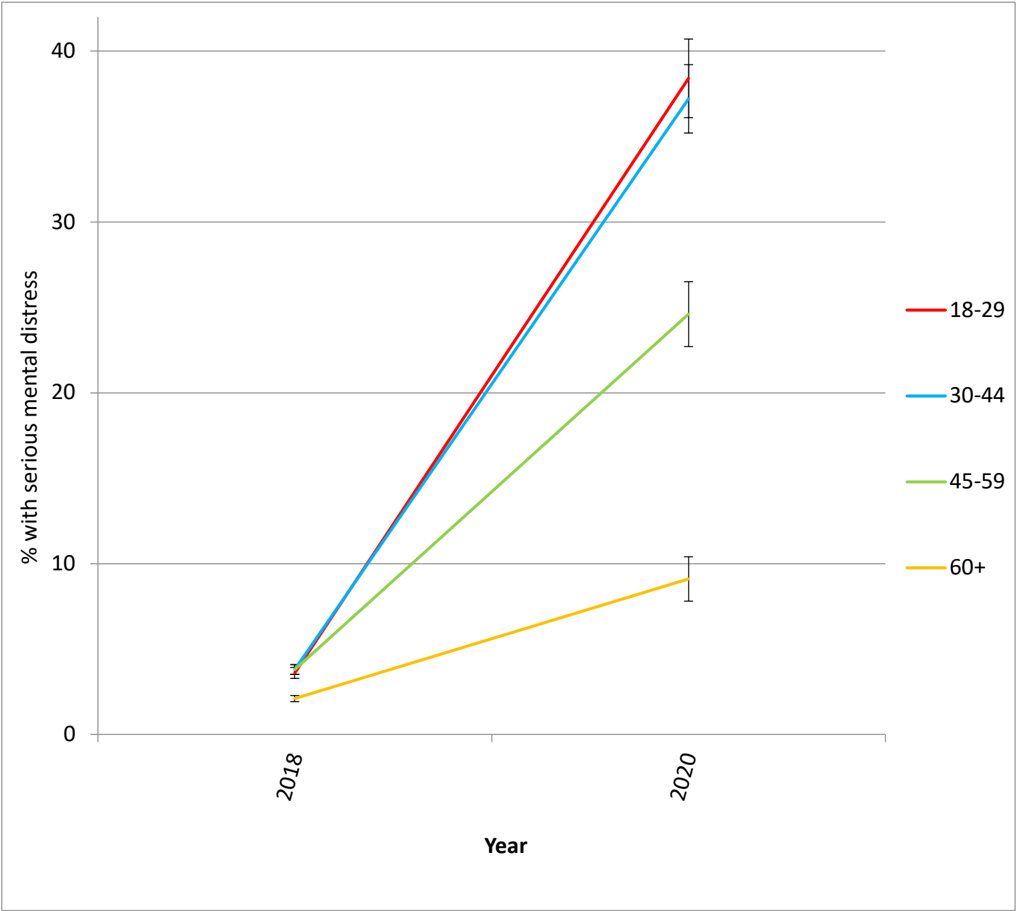
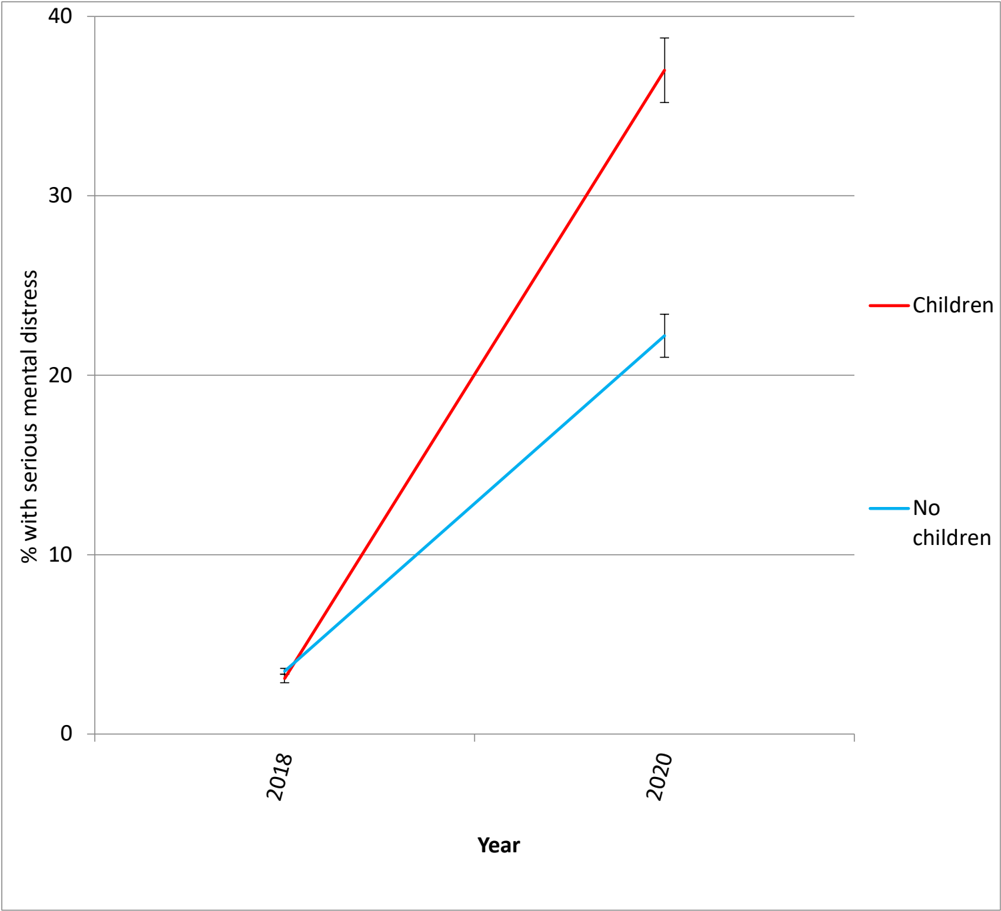
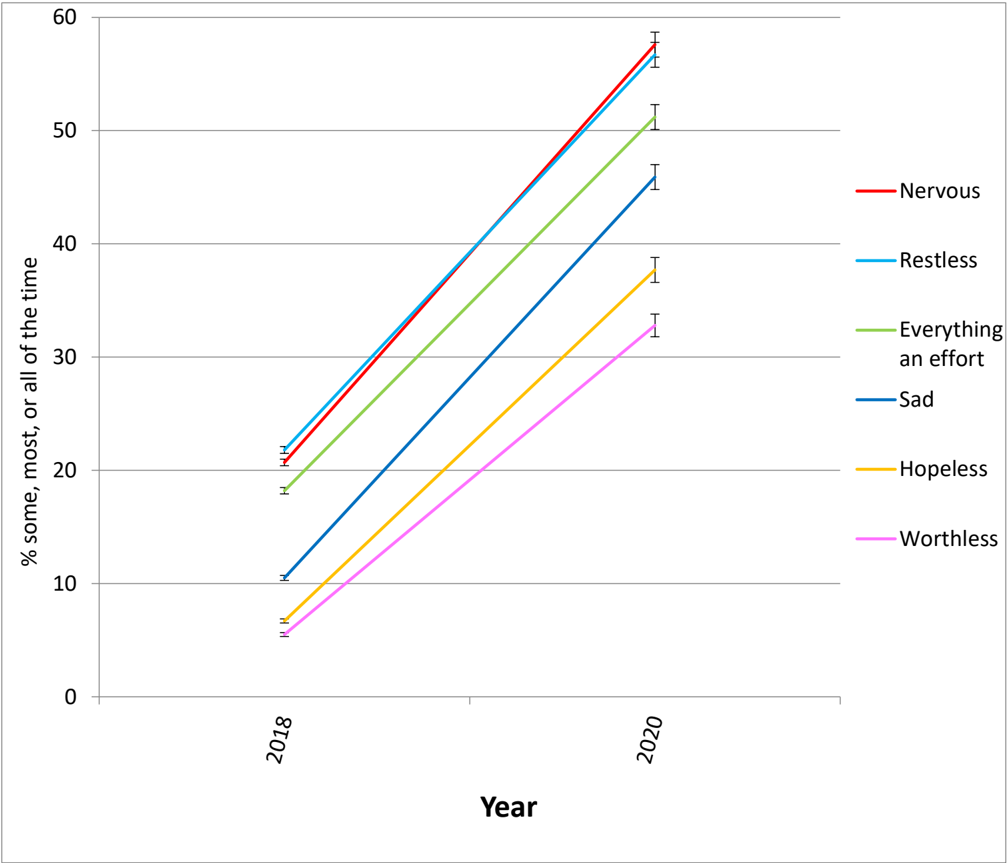
The COVID-19 pandemic substantially changed daily life in ways that may impact mental health. This study compared a nationally representative online sample of 2,032 U.S. adults in late April 2020 to 19,330 U.S. adult internet users who participated in the 2018 National Health Interview Survey (NHIS) using the Kessler-6 scale of mental distress in the last 30 days. Compared to the 2018 NHIS sample, U.S. adults in April 2020 were eight times more likely to fit criteria for serious mental illness (27.7% vs. 3.4%) and three times more likely to fit criteria for moderate or serious mental illness (70.4% vs. 22.0%). Differences between the 2018 and 2020 samples appeared across all demographic groups, with larger differences among younger adults and those with children in the household. These considerable levels of mental distress may portend substantial increases in diagnosed mental disorders and in the morbidity and mortality associated with them.
Overview
The claims and statistics of this paper haven’t been checked yet.
Run the check — free, no account needed. It reads the open-access text and checks the sources it cites.
Integrity signals
Registry
Cites
Statistics
Figures
Verification
Claims the paper makes
The claims and statistics of this paper haven’t been checked yet.
Run the check — free, no account needed. It reads the open-access text and checks the sources it cites.
Self-check
Percentages, sums and reported differences re-computed from the paper’s own numbers.
The self-check needs the paper’s full text.
Citations
Cites
KESSLER, R. C., ANDREWS, G., COLPE, L. J., HIRIPI, E., MROCZEK, D. K., NORMAND, S.-L. T., WALTERS, E. E., & ZASLAVSKY, A. M. (2002) · Psychological Medicine · doi:10.1017/s0033291702006074 · Cited by 10,327
Holmes, E. A., O'Connor, R. C., Perry, V. H., Tracey, I., Wessely, S., Arseneault, L., Ballard, C., Christensen, H., Cohen Silver, R., Everall, I., et al. (2020) · The Lancet Psychiatry · doi:10.1016/s2215-0366(20)30168-1 · Cited by 5,715
Screening for serious mental illness in the general population
Kessler, R. C., Barker, P. R., Colpe, L. J., Epstein, J. F., Gfroerer, J. C., Hiripi, E., Howes, M. J., Normand, S.-L. T., Manderscheid, R. W., Walters, E. E., et al. (2003) · Archives of General Psychiatry · doi:10.1001/archpsyc.60.2.184 · Cited by 5,692
The interpersonal theory of suicide.
Van Orden, K. A., Witte, T. K., Cukrowicz, K. C., Braithwaite, S. R., Selby, E. A., & Joiner, T. E. (2010) · Psychological Review · doi:10.1037/a0018697 · Cited by 5,292
Self-citationMental health and the COVID-19 pandemic
Pfefferbaum, B., & North, C. S. (2020) · New England Journal of Medicine · doi:10.1056/nejmp2008017 · Cited by 4,378
Twenge, J. M., Cooper, A. B., Joiner, T. E., Duffy, M. E., & Binau, S. G. (2019) · Journal of Abnormal Psychology · doi:10.1037/abn0000410 · Cited by 1,469
Self-citationKessler, R. C., Green, J. G., Gruber, M. J., Sampson, N. A., Bromet, E., Cuitan, M., Furukawa, T. A., Gureje, O., Hinkov, H., Hu, C., et al. (2010) · International Journal of Methods in Psychiatric Research · doi:10.1002/mpr.310 · Cited by 1,434
Conducting Clinical Research Using Crowdsourced Convenience Samples
Chandler, J., & Shapiro, D. (2016) · Annual Review of Clinical Psychology · doi:10.1146/annurev-clinpsy-021815-093623 · Cited by 1,072
Suicide mortality and coronavirus disease 2019—a perfect storm?
Reger, M. A., Stanley, I. H., & Joiner, T. E. (2020) · JAMA Psychiatry · doi:10.1001/jamapsychiatry.2020.1060 · Cited by 1,026
Self-citationCoppock, A., & McClellan, O. A. (2019) · Research & Politics · doi:10.1177/2053168018822174 · Cited by 987
Prochaska, J. J., Sung, H., Max, W., Shi, Y., & Ong, M. (2012) · International Journal of Methods in Psychiatric Research · doi:10.1002/mpr.1349 · Cited by 942
Suicidal thoughts and behaviors and social isolation: A narrative review of the literature
Calati, R., Ferrari, C., Brittner, M., Oasi, O., Olié, E., Carvalho, A. F., & Courtet, P. (2019) · Journal of Affective Disorders · doi:10.1016/j.jad.2018.11.022 · Cited by 584
Psychodiagnosis: Selected Papers
Meehl, P. E. (1973) · Medical Entomology and Zoology · Cited by 545
Loneliness over time: The crucial role of social anxiety.
Lim, M. H., Rodebaugh, T. L., Zyphur, M. J., & Gleeson, J. F. M. (2016) · Journal of Abnormal Psychology · doi:10.1037/abn0000162 · Cited by 443
Twenge, J. M., & Joiner, T. E. (2020) · Depression and Anxiety · doi:10.1002/da.23077 · Cited by 443
Self-citationMisinformation During a Pandemic
Bursztyn, L., Rao, A., Roth, C., & Yanagizawa-Drott, D. (2020) · National Bureau of Economic Research · doi:10.3386/w27417 · Cited by 312
The importance of assessing clinical phenomena in Mechanical Turk research.
Hall, K. A. A., Çek, D., Shaw, A. M., & Timpano, K. R. (2015) · Psychological Assessment · doi:10.1037/pas0000217 · Cited by 311
The Role of Social Isolation in Suicide
Trout, D. L. (1980) · Suicide and Life-Threatening Behavior · doi:10.1111/j.1943-278x.1980.tb00693.x · Cited by 270
(1973) · Cited by 154
Riehm, K. E., Holingue, C., Kalb, L. G., Bennett, D., Kapteyn, A., Jiang, Q., Veldhuis, C. B., Johnson, R. M., Fallin, M. D., Kreuter, F., et al. (2020) · American Journal of Preventive Medicine · doi:10.1016/j.amepre.2020.06.008 · Cited by 150
Misinformation During a PandemicPreprint
Bursztyn, L., Rao, A., Roth, C., & Yanagizawa-Drott, D. (2020) · SSRN Electronic Journal · doi:10.2139/ssrn.3580487 · Cited by 142
Spiller, H. A., Ackerman, J. P., Spiller, N. E., & Casavant, M. J. (2019) · The Journal of Pediatrics · doi:10.1016/j.jpeds.2019.02.045 · Cited by 119
Barger, S. D., Messerli‐Bürgy, N., & Barth, J. (2014) · BMC Public Health · doi:10.1186/1471-2458-14-273 · Cited by 118
Russell, D., Turner, R. J., & Joiner, T. E. (2009) · Suicide and Life-Threatening Behavior · doi:10.1521/suli.2009.39.4.440 · Cited by 81
Self-citationRobins, E. (1981) · Cited by 39
Stanley, I. H., Yancey, J. R., Patrick, C. J., & Joiner, T. E. (2018) · Psychological Assessment · doi:10.1037/pas0000588 · Cited by 16
Self-citationExpanding Telemental Health in Response to the COVID-19 Pandemic
Conrad, R. C., Rayala, H., Diamond, R., Jd, Busch, B., Krämer, N. C., & A, M. (2020) · Cited by 11
Reyes, O. (2020) · Minnesota Review · doi:10.1215/00265667-8128280 · Cited by 5
Research works printed but not linked: 2
- Wall Street Journal.
- Zarefsky, M. (2020, April 30). How to combat COVID-19's disparate mental health impact. American Medical Association. https://www.ama-assn.org/delivering-care/health-equity/how- combat-covid-19-s-disparate-mental-health-impact
Cited by
Sorted by citations
Daly, M., Sutin, A. R., & Robinson, E. (2020) · Psychological Medicine · doi:10.1017/s0033291720004432 · Cited by 780
Termorshuizen, J. D., Watson, H. J., Thornton, L. M., Borg, S., Flatt, R. E., MacDermod, C. M., Harper, L. E., van Furth, E. F., Peat, C. M., & Bulik, C. M. (2020) · doi:10.1101/2020.05.28.20116301 · Cited by 304
Westrupp, E. M., Bennett, C., Berkowitz, T. S., Youssef, G. J., Toumbourou, J. W., Tucker, R., Andrews, F. J., Evans, S., Teague, S. J., Karantzas, G. C., et al. (2021) · European Child & Adolescent Psychiatry · doi:10.1007/s00787-021-01861-z · Cited by 271
Addressing the mental health impact of COVID-19 through population health
Boden, M., Zimmerman, L., Azevedo, K. J., Ruzek, J. I., Gala, S., Abdel Magid, H. S., Cohen, N., Walser, R., Mahtani, N. D., Hoggatt, K. J., et al. (2021) · Clinical Psychology Review · doi:10.1016/j.cpr.2021.102006 · Cited by 216
Kowal, M., Conroy, E., Ramsbottom, N., Smithies, T. D., Toth, A. J., & Campbell, M. J. (2021) · JMIR Serious Games · doi:10.2196/26575 · Cited by 215
Metadata
- Authors
- Twenge, J., & Joiner, T.
- Affiliations
- San Diego State University (US)
- Florida State University (US)
- Corresponding author
- Twenge, Jean
- Venue
- Journal of Clinical Psychology
- Publisher
- Center for Open Science
- Published
- 2020-05-07
- Volume
- 76
- Issue
- 12
- Pages
- 2170-2182
- ISSN
- 0021-9762 (ISSN-L)
- PMC
- PMC7675251
- OpenAlex
- W3092116430
- Cited by
- 330
- References
- 29
- Citations by year
- 2026: 11 · 2025: 21 · 2024: 43 · 2023: 73 · 2022: 71 · 2021: 91 · 2020: 20
- FWCI
- 25.52
- Type
- journal article
- Language
- en
- Open access
- bronze
- doi.org
- Locations
- Journal of Clinical Psychology (publishedVersion)
- PubMed Central (publishedVersion)
- PubMed (publishedVersion)
- PsyArXiv (OSF Preprints) (submittedVersion, cc-by)
- PsyArXiv (OSF Preprints) (submittedVersion)
- Topics
- Social Sciences › Psychology › Clinical Psychology › COVID-19 and Mental Health
- Health Sciences › Medicine › Psychiatry and Mental health › Mental Health Treatment and Access
- Health Sciences › Medicine › Public Health, Environmental and Occupational Health › Maternal Mental Health During Pregnancy and Postpartum
- Keywords
- COVID-19 pandemic, psychological distress, Kessler-6, mental health, demographic differences, young adults, families with children
- MeSH terms
- Psychological Distress, COVID-19, Adult, Mental Disorders, Child, Female, Health Surveys, Humans, Male, Stress, Psychological, United States, Young Adult, Pandemics
About these checks
Registry, retraction, Cites and statistics results are computed, not judged, with one exception: a printed reference that no index lists is read once by a model before it counts as a citation error. Claims are extracted by a model and kept only when their quote appears verbatim in the text; each cited source is then checked, with a model’s help, for whether it says what the claim relies on. Those verdicts can be wrong — read the claim’s quote and the cited source before relying on one.
Statistics and arithmetic are recomputed, not judged.
Confidence bands are shown only for fields calibrated on our annotated test set. None is calibrated yet, so no band is shown.
What counts as a claim ›How we measure confidence ›How we check this ›
Are you an author, or do you see a problem with this page? Request a review
