

The DOI matches its Crossref record; 20 of the 20 references it cites were found in a registry or an index.
Candida auris in Healthcare Facilities, New York, USA, 2013–2017
Open accessAbstract
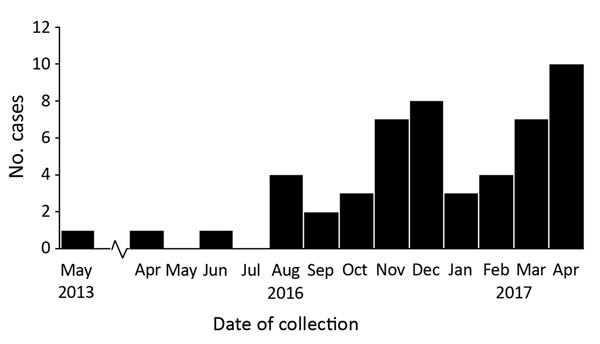
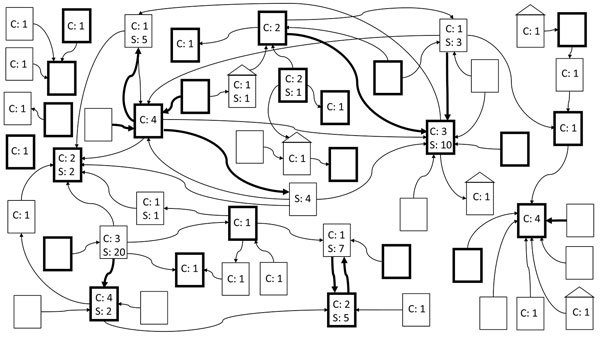
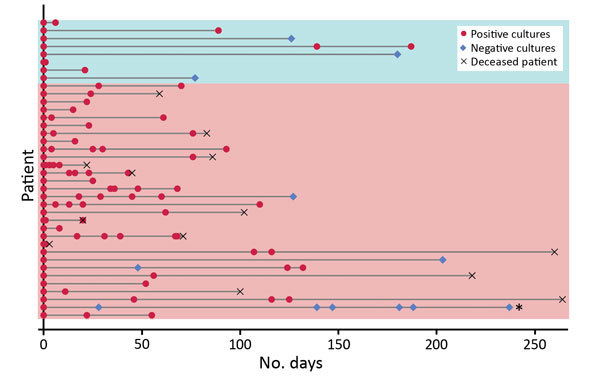
Candida auris is an emerging yeast that causes healthcare-associated infections. It can be misidentified by laboratories and often is resistant to antifungal medications. We describe an outbreak of C. auris infections in healthcare facilities in New York City, New York, USA. The investigation included laboratory surveillance, record reviews, site visits, contact tracing with cultures, and environmental sampling. We identified 51 clinical case-patients and 61 screening case-patients. Epidemiologic links indicated a large, interconnected web of affected healthcare facilities throughout New York City. Of the 51 clinical case-patients, 23 (45%) died within 90 days and isolates were resistant to fluconazole for 50 (98%). Of screening cultures performed for 572 persons (1,136 total cultures), results were C. auris positive for 61 (11%) persons. Environmental cultures were positive for samples from 15 of 20 facilities. Colonization was frequently identified during contact investigations; environmental contamination was also common.
Overview
The claims and statistics of this paper haven’t been checked yet.
Run the check — free, no account needed. It reads the open-access text and checks the sources it cites.
Integrity signals
Registry
Cites
Statistics
Figures
Verification
Claims the paper makes
The claims and statistics of this paper haven’t been checked yet.
Run the check — free, no account needed. It reads the open-access text and checks the sources it cites.
Claims other papers make about this one
Each is checked against this paper’s own text: does it say what the citing paper says it does?
The source backs part of the claim, not all of it — or backs it for a different population, condition or comparison.
In the citing paper
“C. auris has been demonstrated to colonize the skin of patients for months, and to persist as viable in the environment for weeks (Adams et al., 2018; Welsh et al., 2017), which both likely contribute to the nosocomial transmission of C. auris.”
From Murine model of colonization with fungal pathogen Candida auris to explore skin tropism, host risk factors and therapeutic strategies (2021) · cites this paper as Adams et al., 2018
Experimental — accuracy not yet measuredThe source backs part of the claim, not all of it — or backs it for a different population, condition or comparison.
In the citing paper
“C. auris skin colonization results in environmental shedding, which underlies hospital transmissions, and predisposes patients to subsequent infections.”
From Murine model of colonization with fungal pathogen Candida auris to explore skin tropism, host risk factors and therapeutic strategies (2021) · cites this paper as Adams et al., 2018
Experimental — accuracy not yet measuredThe source backs part of the claim, not all of it — or backs it for a different population, condition or comparison.
In the citing paper
“C. auris has been demonstrated to colonize the skin of patients for months, and to persist as viable in the environment for weeks (Adams et al., 2018; Welsh et al., 2017), which both likely contribute to the nosocomial transmission of C. auris.”
From Murine model of colonization with fungal pathogen Candida auris to explore skin tropism, host risk factors and therapeutic strategies (2021) · cites this paper as Adams et al., 2018
Experimental — accuracy not yet measuredThe cited source says what the claim attributes to it.
In the citing paper
“Candida auris is an emerging fungal species responsible for healthcare-associated outbreaks and infections associated with relatively poor patient outcomes (1–6).”
From Dual function of Candida auris mannosyltransferase, MNT5, in biofilm community protection from antifungal therapy and the host (2025) · cites this paper as [1]
The cited source says what the claim attributes to it.
In the citing paper
“These outbreaks are marked by the pathogen’s ability to persistently colonize patient skin and adhere to abiotic surfaces, creating reservoirs that enable prolonged transmission within healthcare settings9–15.”
From Adhesin Als4112 promotes Candida auris skin colonization through interactions with keratinocytes and extracellular matrix proteins (2025) · cites this paper as [11]
In the citing paper
“C. auris has burst onto the scene as a major cause of MDR, healthcare-associated candidiasis with mortality rates ranging from 30 to 45% [10, 11].”
From Investigational Agents for the Treatment of Resistant Yeasts and Molds (2021) · cites this paper as [10]
Self-check
Percentages, sums and reported differences re-computed from the paper’s own numbers.
The self-check needs the paper’s full text.
Citations
Cites
Lockhart, S. R., Etienne, K. A., Vallabhaneni, S., Farooqi, J., Chowdhary, A., Govender, N. P., Colombo, A. L., Calvo, B., Cuomo, C. A., Desjardins, C. A., et al. (2017) · Clinical Infectious Diseases · doi:10.1093/cid/ciw691 · Cited by 1,662
Self-citationSatoh, K., Makimura, K., Hasumi, Y., Nishiyama, Y., Uchida, K., & Yamaguchi, H. (2009) · Microbiology and Immunology · doi:10.1111/j.1348-0421.2008.00083.x · Cited by 1,381
First hospital outbreak of the globally emerging Candida auris in a European hospital
Schelenz, S., Hagen, F., Rhodes, J. L., Abdolrasouli, A., Chowdhary, A., Hall, A., Ryan, L., Shackleton, J., Trimlett, R., Meis, J. F., et al. (2016) · Antimicrobial Resistance & Infection Control · doi:10.1186/s13756-016-0132-5 · Cited by 768
First Three Reported Cases of Nosocomial Fungemia Caused by Candida auris
Lee, W. G., Shin, J. H., Uh, Y., Kang, M. G., Kim, S. H., Park, K. H., & Jang, H. (2011) · Journal of Clinical Microbiology · doi:10.1128/jcm.00319-11 · Cited by 524
Welsh, R. M., Bentz, M. L., Shams, A., Houston, H., Lyons, A., Rose, L. J., & Litvintseva, A. P. (2017) · Journal of Clinical Microbiology · doi:10.1128/jcm.00921-17 · Cited by 499
Incidence, characteristics and outcome of ICU-acquired candidemia in India
Chakrabarti, A., Sood, P., Rudramurthy, S. M., Chen, S., Kaur, H., Capoor, M., Chhina, D., Rao, R., Eshwara, V. K., Xess, I., et al. (2015) · Intensive Care Medicine · doi:10.1007/s00134-014-3603-2 · Cited by 454
Calvo, B., Melo, A. S. D. A., Mena, A. J. P., Hernandez, M., Francisco, E. C., Hagen, F., Meis, J. F. G. M., & Colombo, A. L. (2016) · Journal of Infection · doi:10.1016/j.jinf.2016.07.008 · Cited by 448
New Clonal Strain ofCandida auris, Delhi, India
Chowdhary, A., Sharma, C., Duggal, S., Agarwal, K., Prakash, A., Singh, P. K., Jain, S., Kathuria, S., Randhawa, H. S., Hagen, F., et al. (2013) · Emerging infectious diseases · doi:10.3201/eid1910.130393 · Cited by 418
Multidrug-resistant endemic clonal strain of Candida auris in India
Chowdhary, A., Anil Kumar, V., Sharma, C., Prakash, A., Agarwal, K., Babu, R., Dinesh, K. R., Karim, S., Singh, S. K., Hagen, F., et al. (2014) · European Journal of Clinical Microbiology & Infectious Diseases · doi:10.1007/s10096-013-2027-1 · Cited by 373
Vallabhaneni, S., Kallen, A., Tsay, S., Chow, N., Welsh, R., Kerins, J., Kemble, S. K., Pacilli, M., Black, S. R., Landon, E., et al. (2016) · MMWR. Morbidity and Mortality Weekly Report · doi:10.15585/mmwr.mm6544e1 · Cited by 302
Self-citation
Cited by
Sorted by citations
On the emergence of Candida auris: climate change, azoles, swamps, and birds
Casadevall, A., Kontoyiannis, D. P., & Robert, V. (2019) · mBio · doi:10.1128/mbio.01397-19 · Cited by 515
Chowdhary, A., Tarai, B., Singh, A. K., & Sharma, A. (2020) · Emerging infectious diseases · doi:10.3201/eid2611.203504 · Cited by 328
The rapid emergence of antifungal-resistant human-pathogenic fungi
Lockhart, S. R., Chowdhary, A., & Gold, J. A. W. (2023) · Nature Reviews Microbiology · doi:10.1038/s41579-023-00960-9 · Cited by 323
Chow, N. A., Gade, L., Tsay, S. V., Forsberg, K., Greenko, J. A., Southwick, K. L., Barrett, P. M., Kerins, J. L., Lockhart, S. R., Chiller, T. M., et al. (2018) · The Lancet Infectious Diseases · doi:10.1016/s1473-3099(18)30597-8 · Cited by 289
Self-citationAhmad, S., & Alfouzan, W. (2021) · Microorganisms · doi:10.3390/microorganisms9040807 · Cited by 269
Metadata
- Authors
- Adams, E., Quinn, M., Tsay, S., Poirot, E., Chaturvedi, S., Southwick, K., Greenko, J., Fernandez, R., Kallen, A., Vallabhaneni, S., Haley, V., Hutton, B., Blog, D., Lutterloh, E., Zucker, H., & Workgroup, C. A. I.
- Affiliations
- New York State Department of Health (US)
- Centers for Disease Control and Prevention (US)
- New York City Department of Health and Mental Hygiene (US)
- Corresponding author
- Lutterloh, Emily
- ORCID
- Venue
- Emerging Infectious Diseases
- Published
- 2018-10
- Volume
- 24
- Issue
- 10
- Pages
- 1816-1824
- ISSN
- 1080-6040 (ISSN-L)
- 1080-6059
- PMC
- PMC6154128
- OpenAlex
- W2890220120
- Cited by
- 284
- References
- 20
- Citations by year
- 2026: 26 · 2025: 42 · 2024: 34 · 2023: 28 · 2022: 24 · 2021: 27 · 2020: 55 · 2019: 42 · 2018: 6
- FWCI
- 24.54
- Type
- journal article
- Language
- en
- Open access
- diamond
- doi.org
- Licence
- cc-by
- Locations
- Emerging infectious diseases (publishedVersion, cc-by)
- Europe PMC (PubMed Central) (publishedVersion)
- PubMed Central (publishedVersion, cc-by)
- PubMed (publishedVersion)
- DOAJ (DOAJ: Directory of Open Access Journals) (submittedVersion)
- Funders
- Centers for Disease Control and Prevention (NU50CK000423, U50CK000423)
- Topics
- Health Sciences › Medicine › Infectious Diseases › Antifungal resistance and susceptibility
- Health Sciences › Medicine › Infectious Diseases › Infection Control in Healthcare
- Life Sciences › Immunology and Microbiology › Microbiology › Yeasts and Rust Fungi Studies
- Keywords
- Candida auris, nosocomial infections, outbreak investigation, antifungal resistance, fluconazole resistance, environmental contamination, contact tracing, New York City
- MeSH terms
- Adult, Aged, Aged, 80 and over, Antifungal Agents, Candida, Candidiasis, Cross Infection, Environmental Microbiology, Female, Health Facilities, Humans, Male, Microbial Sensitivity Tests, Middle Aged, New York, Sentinel Surveillance, History, 21st Century, Young Adult, Public Health Surveillance
About these checks
Registry, retraction, Cites and statistics results are computed, not judged, with one exception: a printed reference that no index lists is read once by a model before it counts as a citation error. Claims are extracted by a model and kept only when their quote appears verbatim in the text; each cited source is then checked, with a model’s help, for whether it says what the claim relies on. Those verdicts can be wrong — read the claim’s quote and the cited source before relying on one.
Statistics and arithmetic are recomputed, not judged.
Confidence bands are shown only for fields calibrated on our annotated test set. None is calibrated yet, so no band is shown.
What counts as a claim ›How we measure confidence ›How we check this ›
Are you an author, or do you see a problem with this page? Request a review
