

The DOI matches its Crossref record; 49 of the 49 references it cites were found in a registry or an index.
Erythrocyte survival is controlled by microRNA-142
Abstract
Hematopoietic-specific microRNA-142 is a critical regulator of various blood cell lineages, but its role in erythrocytes is unexplored. Herein, we characterize the impact of microRNA-142 on erythrocyte physiology and molecular cell biology, using a mouse loss-of-function allele. We report that microRNA-142 is required for maintaining the typical erythrocyte biconcave shape and structural resilience, for the normal metabolism of reactive oxygen species, and for overall lifespan. microRNA-142 further controls ACTIN filament homeostasis and membrane skeleton organization. The analyses presented reveal previously unappreciated functions of microRNA-142 and contribute to an emerging view of small RNAs as key players in erythropoiesis. Finally, the work herein demonstrates how a housekeeping network of cytoskeletal regulators can be reshaped by a single micro-RNA denominator in a cell type specific manner.
Overview
The claims and statistics of this paper haven’t been checked yet.
Run the check — free, no account needed. It reads the open-access text and checks the sources it cites.
Integrity signals
Registry
Cites
Statistics
Figures
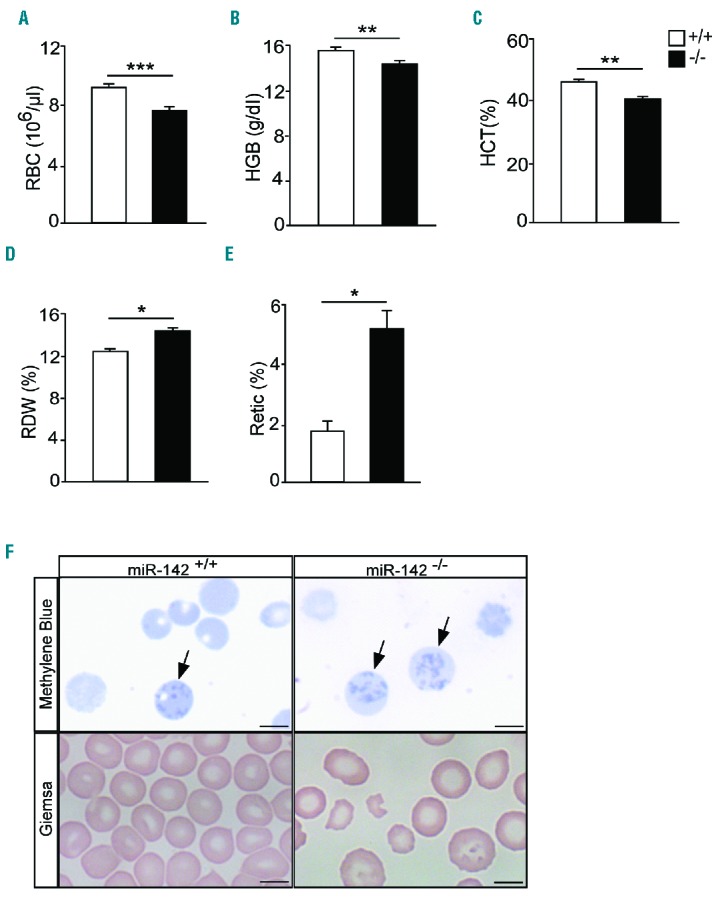
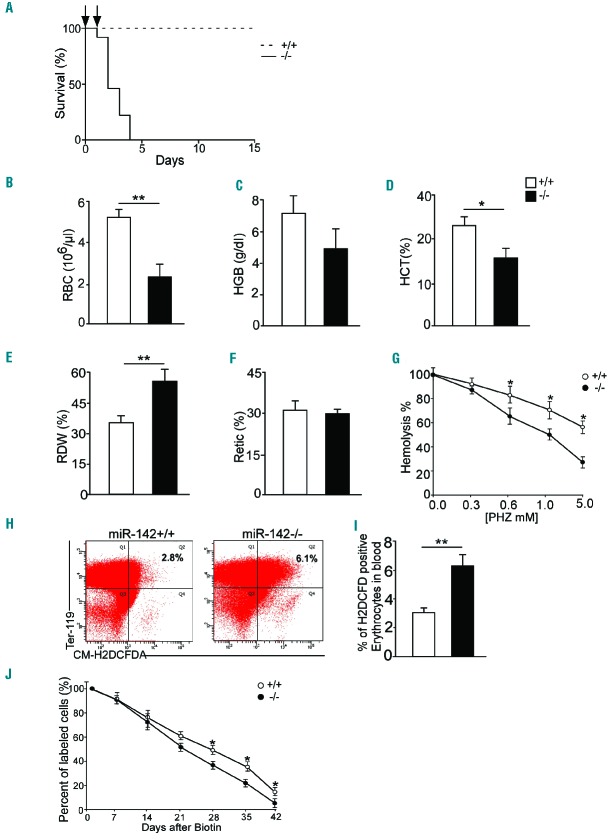
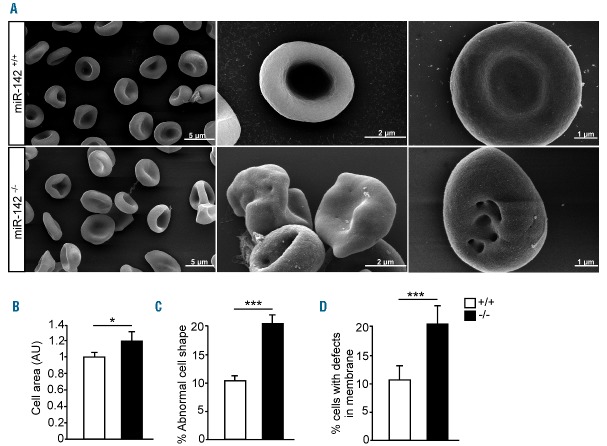
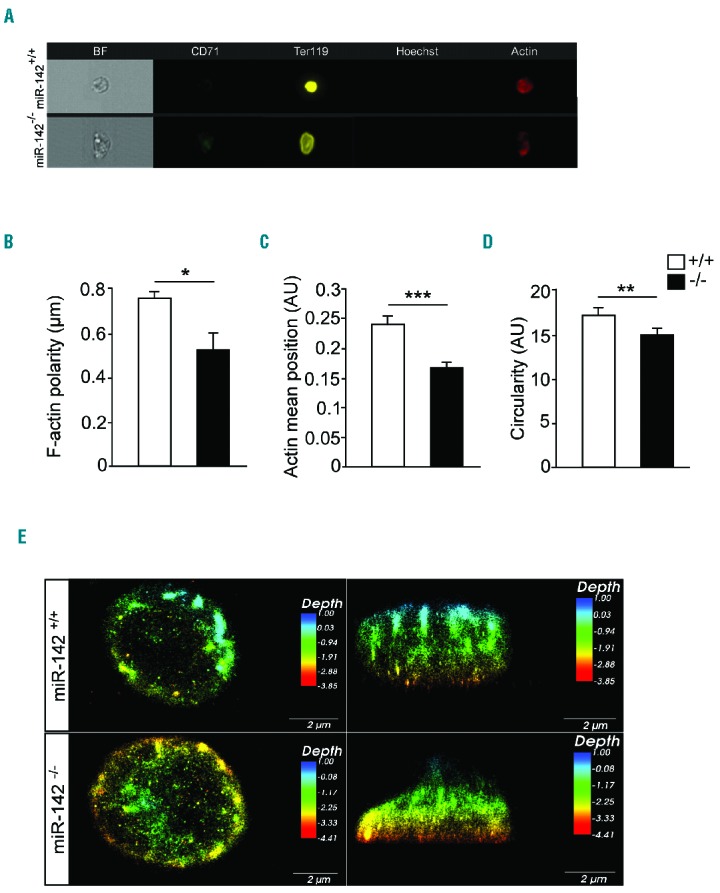
Verification
Claims the paper makes
The claims and statistics of this paper haven’t been checked yet.
Run the check — free, no account needed. It reads the open-access text and checks the sources it cites.
Claims other papers make about this one
Each is checked against this paper’s own text: does it say what the citing paper says it does?
In the citing paper
“miR-142 has been shown to regulate RBC survival in vivo”
From Red Blood Cells as Potential Repositories of MicroRNAs in the Circulatory System (2020) · cites this paper as Rivkin et al., 2017
Self-check
Percentages, sums and reported differences re-computed from the paper’s own numbers.
The self-check needs the paper’s full text.
Citations
Cites
MicroRNAs Modulate Hematopoietic Lineage Differentiation
Chen, C.-Z., Li, L., Lodish, H. F., & Bartel, D. P. (2004) · Science · doi:10.1126/science.1091903 · Cited by 3,257
Human chronic myelogenous leukemia cell-line with positive Philadelphia chromosome
Lozzio, C., & Lozzio, B. (1975) · Blood · doi:10.1182/blood.v45.3.321.321 · Cited by 2,995
A dicer-independent miRNA biogenesis pathway that requires Ago catalysis
Cheloufi, S., Dos Santos, C. O., Chong, M. M. W., & Hannon, G. J. (2010) · Nature · doi:10.1038/nature09092 · Cited by 1,149
Interaction of cytoskeletal proteins on the human erythrocyte membrane
Branton, D. (1981) · Cell · doi:10.1016/0092-8674(81)90497-9 · Cited by 601
Red blood cell oxidative stress impairs oxygen delivery and induces red blood cell aging
Mohanty, J. G., Nagababu, E., & Rifkind, J. M. (2014) · Frontiers in Physiology · doi:10.3389/fphys.2014.00084 · Cited by 595 · cited 1×
“Accordingly, oxidative damage inflicts cytoskeletal reorganization and shortens erythrocyte life span, which is ~40 days in Mus musculus, when adequate antioxidant response is manifested.(19) miRNAs, and the effector protein cofactor ARGONAUTE,(20) play important roles in erythropoiesis.”
BackgroundCanalization of development by microRNAs
Hornstein, E., & Shomron, N. (2006) · Nature Genetics · doi:10.1038/ng1803 · Cited by 578
Self-citationMohandas, N., & Evans, E. (1994) · Annual Review of Biophysics and Biomolecular Structure · doi:10.1146/annurev.bb.23.060194.004035 · Cited by 560
K562 human leukaemic cells synthesise embryonic haemoglobin in response to haemin
RUTHERFORD, T. R., CLEGG, J. B., & WEATHERALL, D. J. (1979) · Nature · doi:10.1038/280164a0 · Cited by 519
Free radical metabolism in human erythrocytes
Çimen, M. Y. B. (2008) · Clinica Chimica Acta · doi:10.1016/j.cca.2007.12.025 · Cited by 509
Visualization of the protein associations in the erythrocyte membrane skeleton.
Byers, T. J., & Branton, D. (1985) · Proceedings of the National Academy of Sciences · doi:10.1073/pnas.82.18.6153 · Cited by 395
Research works printed but not linked: 1
- [22]Kim M Tan YS Cheng WC Kingsbury TJ Heimfeld S Civin CI MIR144 and MIR451 regulate human erythropoiesis via RAB14. Br J Haematol. 2015; 168(4): 583– 597. 25312678 PMC4314389
Cited by
Bartel, D. P. (2018) · Cell · doi:10.1016/j.cell.2018.03.006 · Cited by 3,751
Therapeutic advances of miRNAs: A preclinical and clinical update
Chakraborty, C., Sharma, A. R., Sharma, G., & Lee, S.-S. (2021) · Journal of Advanced Research · doi:10.1016/j.jare.2020.08.012 · Cited by 402
Red Blood Cells as Potential Repositories of MicroRNAs in the Circulatory System
Sun, L., Yu, Y., Niu, B., & Wang, D. (2020) · Frontiers in Genetics · doi:10.3389/fgene.2020.00442 · Cited by 83
Metadata
- Authors
- Rivkin, N., Chapnik, E., Mildner, A., Barshtein, G., Porat, Z., Kartvelishvily, E., Dadosh, T., Birger, Y., Amir, G., Yedgar, S., Izraeli, S., Jung, S., & Hornstein, E.
- Venue
- Haematologica
- Published
- 2016-12-01
- Volume
- 102
- Issue
- 4
- Pages
- 676-685
- ISSN
- 0390-6078
- 1592-8721
- PMC
- PMC5395108
- Cited by
- 31
- References
- 49
- Language
- en
About these checks
Registry, retraction, Cites and statistics results are computed, not judged, with one exception: a printed reference that no index lists is read once by a model before it counts as a citation error. Claims are extracted by a model and kept only when their quote appears verbatim in the text; each cited source is then checked, with a model’s help, for whether it says what the claim relies on. Those verdicts can be wrong — read the claim’s quote and the cited source before relying on one.
Statistics and arithmetic are recomputed, not judged.
Confidence bands are shown only for fields calibrated on our annotated test set. None is calibrated yet, so no band is shown.
What counts as a claim ›How we measure confidence ›How we check this ›
Are you an author, or do you see a problem with this page? Request a review
Data sources
Bibliographic data: Semantic Scholar, OpenAlex, Crossref.
Contains information from the Semantic Scholar Academic Graph Datasets, made available under the ODC Attribution License (ODC-BY 1.0).
Semantic Scholar’s data is described in: Kinney, R., et al. (2023). The Semantic Scholar Open Data Platform. arXiv:2301.10140.
