

Time transfer and significance of vertical land motion in relativistic geodesy applications: a review paper
Open accessThe DOI matches its Crossref record; 58 of the 61 references it cites were found in a registry or an index; 18 of the 33 sources its claims cite were checked for support.
Abstract
Review of relativistic geodesy, optical atomic clock measurements, and their use for practical realization of vertical datums and height systems.
Overview
CoChat Summary
## TL;DR
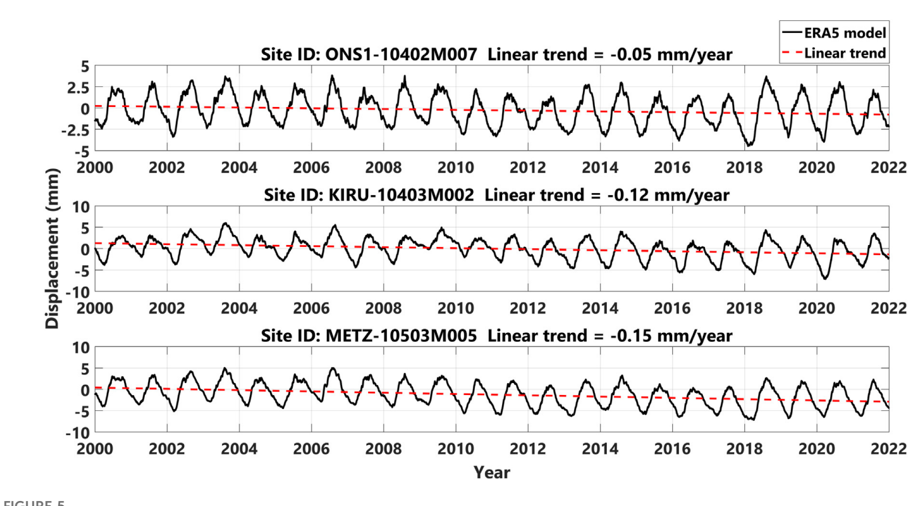
This review paper surveys relativistic (clock-based) geodesy, optical atomic clocks, and time/frequency transfer methods, with emphasis on how clock measurements can be used to infer geopotential and height differences. It also argues that tidal, non-tidal, and vertical land motion effects—especially hydrology loading—must be accounted for, because they can reach the 10^-18 level relevant to geodetic applications.
## Key findings
- A fractional frequency shift of 10^-18 corresponds to a height difference of about 1 cm at or near the Earth’s surface, and the paper states that with a clock accuracy of 10^-18, heights can be determined in the order of 1 cm.
- The paper reports that hydrology loading in its Fennoscandian example can affect gravitational redshift at levels close to the target uncertainty: for the ERA5 model, it found effects of about -4.4 to -7.8 × 10^-19 in winter and 2.9 to 4.7 × 10^-19 in summer; for GLDAS2 and MERRA2, the impact can reach 9 × 10^-19 at Metz.
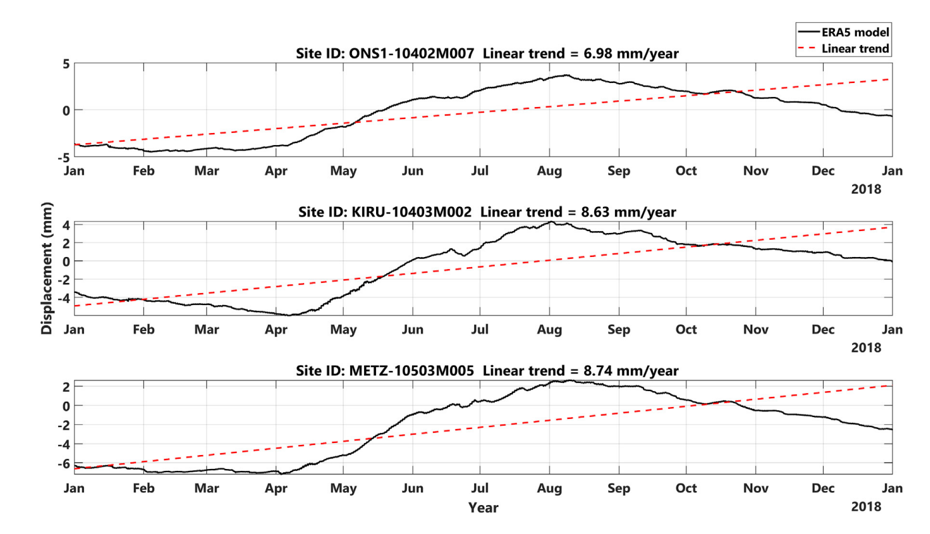
- For 2018, the ERA5 model showed vertical land motion of about 6.9 mm/year at Onsala, 8.6 mm/year at Kiruna, and 8.7 mm/year at Metz.
- The paper states that optical fiber links can achieve stability better than 10^-19 over about 1,400 km, and cites example network results such as 3 × 10^-17 for Paris–Braunschweig and 2 × 10^-19 for a 149 km link.
## Methods
- Narrative review of relativistic geodesy, optical atomic clocks, and time-transfer technologies, organized around theory, clock performance, network types, and perturbing geophysical effects.
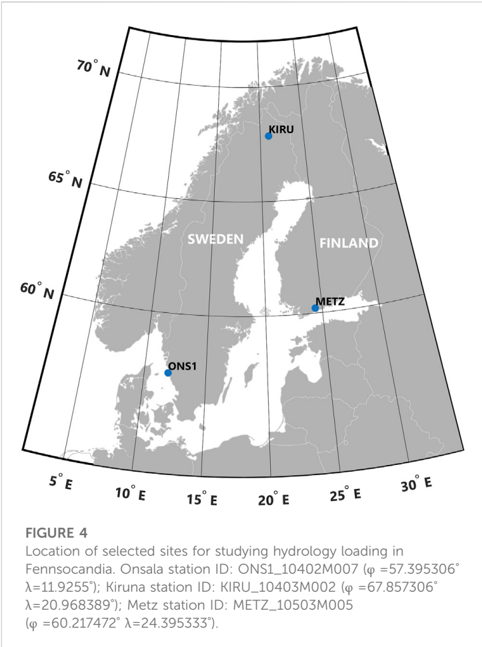
- Worked example using three stations in Fennoscandia—Onsala (Sweden), Kiruna (Sweden), and Metz (Finland)—to quantify hydrology loading effects on vertical land motion and clock measurements.
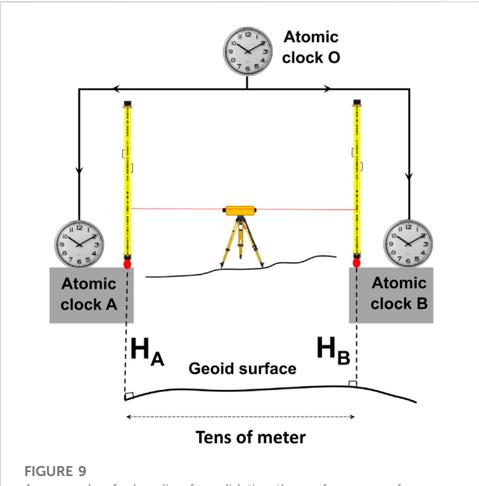
- Comparison of three hydrological models for the example: ERA5, GLDAS/Noah v2.0 (GLDAS2), and MERRA-2; the paper also discusses validating optical clocks with a precise leveling baseline of tens of meters and a height difference of a few meters.
## Limitations
- The paper explicitly notes that practical validation methods such as using precise leveling benchmarks across long distances are not accurate to the millimeter/submillimeter level because of error sources including GNSS measurements, spirit leveling, and geoid models.
- The authors state that hydrology loading effects depend on the chosen model and time period, and that these effects should be considered if relativistic geodesy is repeated at different times; this is an evident limitation of transferability across epochs and models.
- Not stated in the paper.
Model-written summary. Check it against the paper before relying on it.
Integrity signals
Registry
Cites
Statistics
Figures

Verification
Claims the paper makes
15 Valid · 2 Not valid · 12 Not checked · 17 Own results and interpretations
The cited sources support only part of this claim — read each source’s verdict below.
In the paper
“It is important to mention that the VLBI method is not the best in a short average period due to its low sampling rate (see Takiguchi et al. (2007); Rieck et al. (2010a); Hobiger et al. (2015).”
What the sources say
- Partly supportedcites Takiguchi et al. (2007)Experimental — accuracy not yet measured
Takiguchi et al. (2007) confine VLBI's demonstrated advantage to longer averaging times: the Abstract and Conclusions state that 'the Allan deviation showed that VLBI time transfer is more stable than GPS time transfer between 2000 seconds to 60000 seconds', with clock offsets estimated only every one hour in the CALC/SOLVE analysis, and section 3.2.1/3.2.2 likewise restrict the claim to 3600-60000 s. That supports the 'not the best in a short average period' half of the claim by implication, but no passage of our copy gives the stated REASON: nothing attributes the short-period weakness to a low sampling rate. The 'Residuals plus Clock Offsets' section only notes that the delay-residual data are obtained 'from every scan' and 'is not equal interval', so they interpolated it (every 60 seconds) to compute the Allan deviation, and that VLBI stability changed from stable to unstable between 1000 and 2000 seconds — a description of sparse, uneven sampling, not a causal explanation of poor short-term performance. (LLM, conf=0.70)
- Not matchedcites Rieck et al. (2010a)
More than one paper fits this citation.
- Supportedcites Hobiger et al. (2015) matched to “Combining GPS and VLBI for inter-continental frequency transfer” (2015) source
The Introduction states that VLBI’s low data sampling rate limits its use for shorter averaging periods and that it cannot match GPS’s short-term capabilities. Section 4.1 likewise says its sparse sampling prevents sufficiently dense clock estimates for shorter averaging periods. (LLM, conf=0.94)
plainstates a cause- Asserted: passes — The authors put it forward as true.
- Checkable: passes — It can be checked against evidence.
- Load-bearing: unclear — It is unclear whether the paper’s conclusions depend on it.
- Based: passes — The paper gives a reason why it holds.
- Partly supported
The cited sources support only part of this claim — read each source’s verdict below.
In the paper
“This method, due to the error sources mentioned in Denker et al. (2018) such as uncertainties because of utilizing GNSS measurements, sprite leveling, geoid models, etc., is not accurate to millimeter/ submillimeter level.”
What the sources say
- Partly supportedcites Denker et al. (2018) matched to “Geodetic methods to determine the relativistic redshift at the level of 10 $$^{-18}$$ - 18 in the context of international timescales: a review and practical results” (2018) sourceExperimental — accuracy not yet measured
Section 5 (page unavailable) reports centimetre-to-decimetre discrepancies between geodetic approaches over long distances and identifies systematic levelling error as a likely major contributor; it says GNSS plays only a minor role. Appendix 3 recommends millimetre-uncertainty levelling for local clock comparisons, so the blanket accuracy claim needs a distance qualifier. The passages do not describe this as a method for validating optical-fibre link performance. (LLM, conf=0.85)
plain- Asserted: passes — The authors put it forward as true.
- Checkable: passes — It can be checked against evidence.
- Load-bearing: unclear — It is unclear whether the paper’s conclusions depend on it.
- Based: passes — The paper gives a reason why it holds.
- Partly supported
The cited sources support only part of this claim — read each source’s verdict below.
In the paper
“Using an integration time of 1 day, an uncertainty of 10 -15 can result from evaluating the satellite signal ' s carrier phase.”
What the sources say
- Partly supportedcites Pizzocaro et al., 2020 matched to “Intercontinental comparison of optical atomic clocks through very long baseline interferometry” (2021) sourceExperimental — accuracy not yet measured
The section discussing VLBI and satellite links (page unavailable) reports that GPS-based IPPP had an uncertainty of 9 × 10^-16 after one day, supporting the claimed scale and integration time. Our copy does not say that this result came from evaluating the satellite signal’s carrier phase; it describes the method as precise point positioning with integer ambiguity resolution. (LLM, conf=0.82)
plainstates a cause- Asserted: passes — The authors put it forward as true.
- Checkable: passes — It can be checked against evidence.
- Load-bearing: unclear — It is unclear whether the paper’s conclusions depend on it.
- Based: passes — The paper gives a reason why it holds.
- Partly supported
Every source the paper cites for this claim was checked and supports it.
In the paper
“The redshift is related to the gravitational potential difference where a fractional frequency shift of 10 -18 corresponds to a height difference of 1 cm at or near the Earth ' s surface (Mehlstäubler et al., 2018).”
What the sources say
- Supportedcites Mehlstäubler et al., 2018 matched to “Atomic clocks for geodesy” (2018) source
The Introduction (p. 2) states that a fractional frequency shift of 10^-18 corresponds to a potential difference equivalent to 1 cm in height on Earth’s surface. Section 2.4 (p. 14) repeats the equivalence for earthbound stations. (LLM, conf=0.95)
plainstates an association- Asserted: passes — The authors put it forward as true.
- Checkable: passes — It can be checked against evidence.
- Load-bearing: passes — The paper’s conclusions depend on it.
- Based: passes — The paper gives a reason why it holds.
- Supported
Every source the paper cites for this claim was checked and supports it.
In the paper
“Pizzocaro et al. (2020) showed that it is possible to reach 10 -17 uncertainty level.”
What the sources say
- Supportedcites Pizzocaro et al. (2020) matched to “Intercontinental comparison of optical atomic clocks through very long baseline interferometry” (2021) source
The section ‘Uncertainty of the optical clocks, optical link and combs’ (page unavailable) reports systematic-shift uncertainties of 3.1 × 10⁻¹⁷ and 8 × 10⁻¹⁷ for the two clocks in this campaign. These results support the stated possibility of reaching a 10⁻¹⁷ uncertainty level for the clocks. (LLM, conf=0.90)
boosted- Asserted: passes — The authors put it forward as true.
- Checkable: passes — It can be checked against evidence.
- Load-bearing: unclear — It is unclear whether the paper’s conclusions depend on it.
- Based: passes — The paper gives a reason why it holds.
- Rests on an assumption not shown here.
- Supported
15 more claims
Create a free account to see all 46 claims and to verify the 4 references still open.
- Probably not a substantial claim. 20
- It may state two separate claims as one. 11
Citations
Cites
The Modern-Era Retrospective Analysis for Research and Applications, Version 2 (MERRA-2)
Gelaro, R., McCarty, W., Suárez, M. J., Todling, R., Molod, A., Takacs, L., Randles, C. A., Darmenov, A., Bosilovich, M. G., Reichle, R., et al. (2017) · Journal of Climate · doi:10.1175/jcli-d-16-0758.1 · Cited by 9,010 · cited 2×
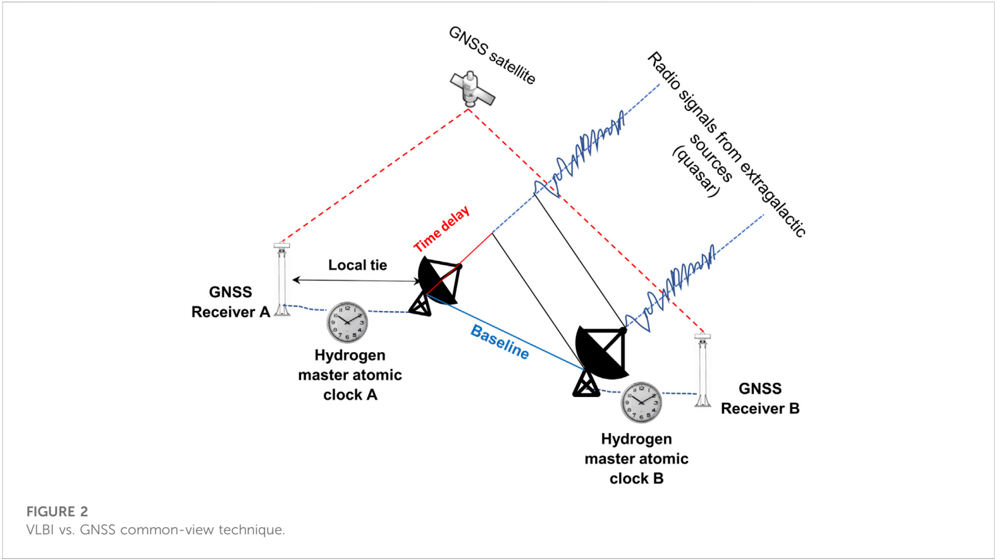
“, 2019; Haas, 2020). Time and frequency within the VLBI method have been presented in detail by Rieck et al. (2010b). Using the VLBI approach, the stability of time transfer can be assessed by other methods (see Figure 2) such as GPS common view (GPS CV) method (cf.”
BackgroundMethodLudlow, A. D., Boyd, M. M., Ye, J., Peik, E., & Schmidt, P. O. (2015) · Reviews of Modern Physics · doi:10.1103/revmodphys.87.637 · Cited by 2,385
Space geodesy constrains ice age terminal deglaciation: The global ICE‐6G_C (VM5a) model
Peltier, W. R., Argus, D. F., & Drummond, R. (2015) · Journal of Geophysical Research: Solid Earth · doi:10.1002/2014jb011176 · Cited by 1,470 · cited 3×
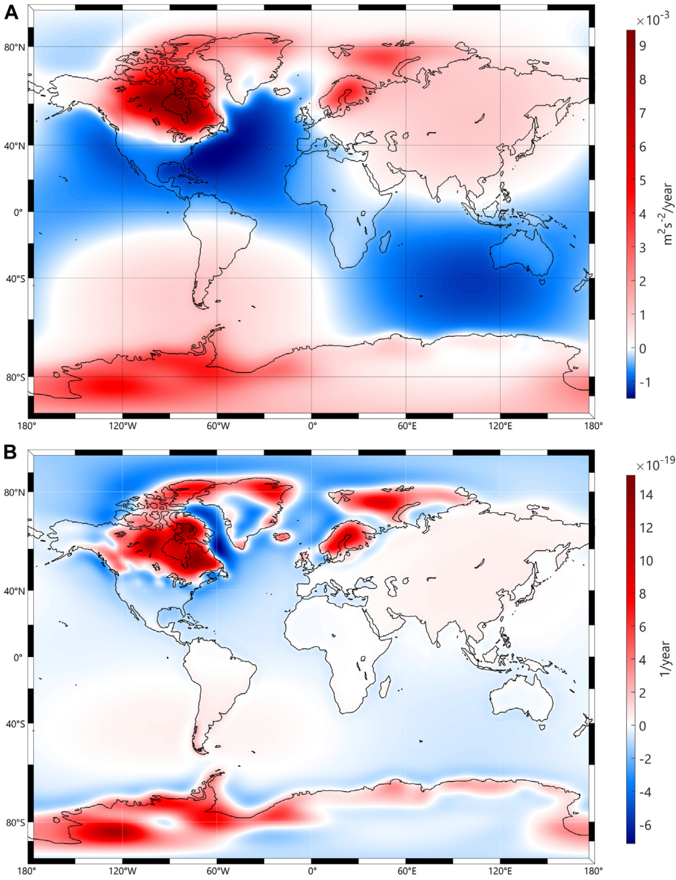
“Figure 3 shows the gravitational potential effect due to GIA using ICE-6G (VM5a) land uplift model (Peltier et al., 2015). The results illustrate that the GIA effect varies between 0.009 and −0.001 m(2)/s(2)/yr with a mean value of 0.0003 m(2)/s(2)/yr and a standard deviation of 0.001 m(2)/s(2)/yr. Moreover, dominant…”
MethodInfluentialSpringer Handbook of Global Navigation Satellite Systems
(2017) · Springer eBooks · doi:10.1007/978-3-319-42928-1 · Cited by 1,466
An optical lattice clock with accuracy and stability at the 10−18 level
Bloom, B. J., Nicholson, T. L., Williams, J. R., Campbell, S. L., Bishof, M., Zhang, X., Zhang, W., Bromley, S. L., & Ye, J. (2014) · Nature · doi:10.1038/nature12941 · Cited by 1,073 · cited 1×
“Bloom et al. (2014) demonstrated an atomic clock with a many-atom system that reaches an accuracy of 6×10⁻¹⁸ and could improve the accuracy of optical lattice clocks by a factor of 22.”
BackgroundFrequency Comparison of Two High-Accuracy Al + Optical Clocks
Chou, C., Hume, D., Koelemeij, J., Wineland, D., & Rosenband, T. (2010) · Physical Review Letters · doi:10.1103/physrevlett.104.070802 · Cited by 903
Takamoto, M., Hong, F.-L., Higashi, R., & Katori, H. (2005) · Nature · doi:10.1038/nature03541 · Cited by 853
An Atomic Clock with 10 –18 Instability
Hinkley, N., Sherman, J. A., Phillips, N. B., Schioppo, M., Lemke, N. D., Beloy, K., Pizzocaro, M., Oates, C. W., & Ludlow, A. D. (2013) · Science · doi:10.1126/science.1240420 · Cited by 817
Systematic evaluation of an atomic clock at 2 × 10⁻¹⁸ total uncertainty
Nicholson, T. L., Campbell, S. L., Hutson, R. B., Marti, G. E., Bloom, B. J., McNally, R. L., Zhang, W., Barrett, M. D., Safronova, M. S., Strouse, G. F., et al. (2015) · Nature Communications · doi:10.1038/ncomms7896 · Cited by 780
Atomic clock performance enabling geodesy below the centimetre level
McGrew, W. F., Zhang, X., Fasano, R. J., Schäffer, S. A., Beloy, K., Nicolodi, D., Brown, R. C., Hinkley, N., Milani, G., Schioppo, M., et al. (2018) · Nature · doi:10.1038/s41586-018-0738-2 · Cited by 727 · cited 2×
“There are three important parameters and quantities in the atomic clocks, namely, the uncertainty (or accuracy), instability (statistical uncertainty) and reproducibility, that are important for clock-based geodesy applications (McGrew et al., 2018).”
BackgroundMethod
Research works printed but not linked: 5
- Allan, D. W., and Barmes, J. A. (1981). A modi fi ed allan variance with increased oscillator characterization abitity. Proc. 35th Annual Frequency Control Symposium .
- Hersbach, 2016, ERA5 reanalysis is in production
- 2008, Evaluation of measurement data—guide to the expression of uncertainty in measurement
- Rodell, 2004, NASA/NOAA’s global land data assimilation system (GLDAS): Recent results and future plans, 61
- Vermeer, 1983, Chronometric levelling
Cited by
Cascaded quantum time transfer bypassing the no-cloning barrier
Hong, H., Xiang, X., Quan, R., Shi, B., Liu, Y., Xia, Z., Liu, T., Li, X., Cao, M., Zhang, S., et al. (2026) · Science China Physics Mechanics and Astronomy · doi:10.1007/s11433-025-2781-4 · Cited by 6
Modeling and Noise Impact Analysis of Electro-Optic Comb Time and Frequency Transfer System
Liang, W., Zhang, J., Zou, Y. H., et al. (2025) · doi:10.1109/acp66871.2025.11350515
Metadata
- Authors
- Bagherbandi, M., Shirazian, M., Amin, H., & Horemuz, M.
- Affiliations
- University of Gävle (SE)
- Shahid Rajaee Teacher Training University (IR)
- Corresponding author
- Bagherbandi, Mohammad
- Venue
- Frontiers in Earth Science
- Publisher
- Frontiers Media SA
- Published
- 2023-06-05
- Volume
- 11
- ISSN
- 2296-6463 (ISSN-L)
- OpenAlex
- W4379470060
- Semantic Scholar
- 1e8b648ed00556c2d6abe3366d6c012eba1f011f
- Cited by
- 2
- References
- 61
- Citations by year
- 2026: 1 · 2025: 1
- FWCI
- 0.27
- Type
- journal article
- Language
- en
- Open access
- gold
- dx.doi.org
- Licence
- Locations
- Frontiers in Earth Science (publishedVersion, cc-by)
- Diva portal (Dalarna University Library) (submittedVersion, other-oa)
- DOAJ (DOAJ: Directory of Open Access Journals) (submittedVersion, cc-by-sa)
- Topics
- Physical Sciences › Earth and Planetary Sciences › Geophysics › Geophysics and Gravity Measurements
- Physical Sciences › Physics and Astronomy › Atomic and Molecular Physics, and Optics › Advanced Frequency and Time Standards
- Physical Sciences › Engineering › Aerospace Engineering › GNSS positioning and interference
- Keywords
- relativistic geodesy, optical atomic clocks, clock distribution, gravity field, vertical datum unification, height systems, vertical land motion, time transfer
About these checks
Registry, retraction, Cites and statistics results are computed, not judged, with one exception: a printed reference that no index lists is read once by a model before it counts as a citation error. Claims are extracted by a model and kept only when their quote appears verbatim in the text; each cited source is then checked, with a model’s help, for whether it says what the claim relies on. Those verdicts can be wrong — read the claim’s quote and the cited source before relying on one.
The claim verdicts this report counts are experimental: their accuracy is not yet measured.
A language model drew the claims from the paper on 2026-10-10, under version 3 of the claim definition (model deepseek-v4.1-flash, prompt extract-v3).
A second model labelled each claim on 2026-10-10 (model jev-1.13-20260917, definition revision gold-guideline-v0.2).
Cited sources are checked with a language model’s help (qwen3.8-omni-flash and gpt-6-sol).
Statistics and arithmetic are recomputed, not judged.
Confidence bands are shown only for fields calibrated on our annotated test set. None is calibrated yet, so no band is shown.
What counts as a claim ›How we measure confidence ›How we check this ›
Are you an author, or do you see a problem with this page? Request a review
Data sources
Bibliographic data: Semantic Scholar, OpenAlex, Crossref.
Contains information from the Semantic Scholar Academic Graph Datasets, made available under the ODC Attribution License (ODC-BY 1.0).
Semantic Scholar’s data is described in: Kinney, R., et al. (2023). The Semantic Scholar Open Data Platform. arXiv:2301.10140.
