

Meal timing and its role in obesity and associated diseases
Open accessThe DOI matches its Crossref record; 196 of the 199 references it cites were found in a registry or an index; 67 of the 103 sources its claims cite were checked for support.
Abstract
Meal timing emerges as a crucial factor influencing metabolic health that can be explained by the tight interaction between the endogenous circadian clock and metabolic homeostasis. Mistimed food intake, such as delayed or nighttime consumption, leads to desynchronization of the internal circadian clock and is associated with an increased risk for obesity and associated metabolic disturbances such as type 2 diabetes and cardiovascular diseases. Conversely, meal timing aligned with cellular rhythms can optimize the performance of tissues and organs. In this review, we provide an overview of the metabolic effects of meal timing and discuss the underlying mechanisms. Additionally, we explore factors influencing meal timing, including internal determinants such as chronotype and genetics, as well as external influences like social factors, cultural aspects, and work schedules. This review could contribute to defining meal-timing-based recommendations for public health initiatives and developing guidelines for effective lifestyle modifications targeting the prevention and treatment of obesity and associated metabolic diseases. Furthermore, it sheds light on crucial factors that must be considered in the design of future food timing intervention trials.
Overview
CoChat Summary
TL;DR
This narrative review synthesizes evidence that meal timing interacts tightly with the endogenous circadian clock, such that mistimed eating (delayed or nighttime intake) desynchronizes internal clocks and raises risk for obesity, type 2 diabetes, and cardiovascular disease. It surveys underlying mechanisms, determinants of meal timing, and time-restricted eating as a potential intervention.
Key findings
- Mistimed food intake is associated with weight gain, increased body fat, impaired glucose tolerance, insulin resistance, higher blood pressure, elevated cholesterol, and increased risk of cardiovascular disease, diabetes, and metabolic syndrome; in mice, feeding during the rest (light) phase produced greater weight gain than feeding during the active (dark) phase.
- Eating the same meal in the evening versus morning lowered resting metabolic rate and increased glycemic/insulinemic responses; later dinner times worsened next-day postprandial glucose after breakfast, while consuming most calories in the morning improved glucose tolerance, particularly relevant for T2D patients.
- In an Indian cohort of 93 healthy individuals documenting intake by phone camera for 21 days, half had daily eating windows longer than 15 h, a decile around 20 h, and >30% of total calories were consumed in the evening/night with <30% in the morning.
- Heritability of meal timing was highest for breakfast (24% by De Castro; 56% by Lopez-Minguez et al.), with lunch 18–38%, dinner 22% (De Castro) but none detected by Lopez-Minguez et al., and 64% for caloric midpoint; a systematic review and meta-analysis of 15 TRE studies concluded metabolic effects depend on the duration of the eating window, with stronger anthropometric and cardiometabolic changes for shorter windows.
Methods
- Narrative review (no primary data collection) covering rodent and human studies on circadian clock–metabolism interaction, mistimed food intake, mechanisms, determinants of meal timing, and time-restricted eating.
- Evidence cited includes clock mutant/knockout mouse models, human observational cohorts (e.g., NHANES, Swedish and other cohorts), randomized crossover and clinical trials, twin studies of heritability, and systematic reviews/meta-analyses.
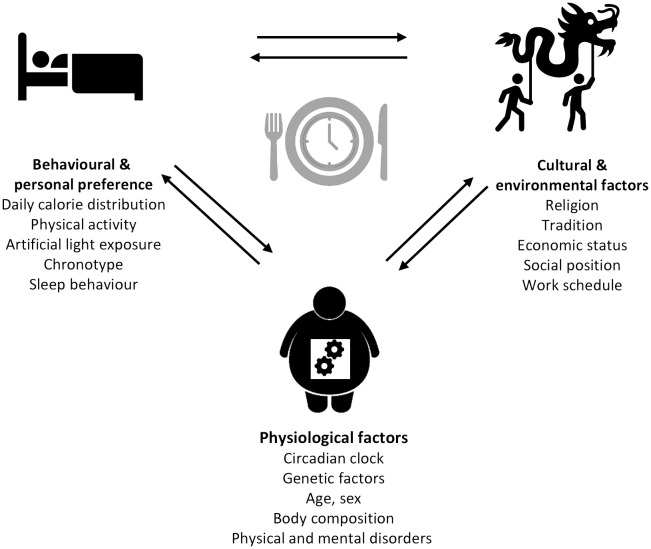
- Determinants of meal timing are organized into three categories: physiological (circadian clock, genetics, age, sex, body composition, disorders), behavioral/personal preferences (calorie distribution, physical activity, light exposure, chronotype, sleep), and cultural/environmental (religion, tradition, economic status, social position, work schedule).
Limitations
- Stated: the underlying mechanisms of meal-timing effects remain largely unknown; it is difficult to separate meal-timing-mediated from meal-timing-independent effects on metabolism in free-living individuals; results in TRE trials are highly variable due to heterogeneous study designs, eating windows, cohorts, and calorie intake; there is little evidence to recommend a specific TRE window (eTRE, mTRE, or lTRE); the genetic component needs further investigation.
- Evident from the text: as a narrative review it presents no new primary data and relies on cited studies of varying design and quality; several cited associations (e.g., breakfast-skipping, snacking, chronotype effects) are observational and cannot establish causality; the authors note that meal frequency and energy intake have not been carefully controlled in many studies.
Model-written summary. Check it against the paper before relying on it.
Integrity signals
Registry
Cites
Statistics
Figures
Verification
Claims the paper makes
46 Valid · 6 Not valid · 17 Not checked · 12 Own results and interpretations
At least one cited source doesn’t support this claim or points to a different paper, and none confirmed it — see the verdicts below.
In the paper
“light at night and the corresponding longer active compared to rest phase intervals have led to an increase in food intake and therefore excessive weight gain, as shown in rodent studies (56).”
§ Meal timing and its role in obesity and associated diseases > Factors influencing meal timing > Artificial light exposure and sleep–wake pattern
What the sources say
- Disputedcites [56] Fonken LK Workman JL Walton JC Weil ZM Morris JS Haim A. Light at night increases body mass by shifting the time of food intake. Proc Natl Acad Sci United States America. (2010) 107: 18664–9. doi: 10.1073/pnas.1008734107 PMC2972983 20937863 sourceExperimental — accuracy not yet measured
The paper reports weight gain in mice exposed to light at night, but its Energy intake results state that total 24-hour food consumption did not differ among groups. The Discussion attributes the gain to a shift in when mice ate, not to increased overall intake; it also reports similar total daily activity across groups, rather than establishing longer active intervals. (LLM, conf=0.90)
Checked by a reasoning model — may be wrong.
plainstates a cause- Asserted: passes — The authors put it forward as true.
- Checkable: passes — It can be checked against evidence.
- Load-bearing: unclear — It is unclear whether the paper’s conclusions depend on it.
- Based: passes — The paper gives a reason why it holds.
- Disputed
At least one cited source doesn’t support this claim or points to a different paper, and none confirmed it — see the verdicts below.
In the paper
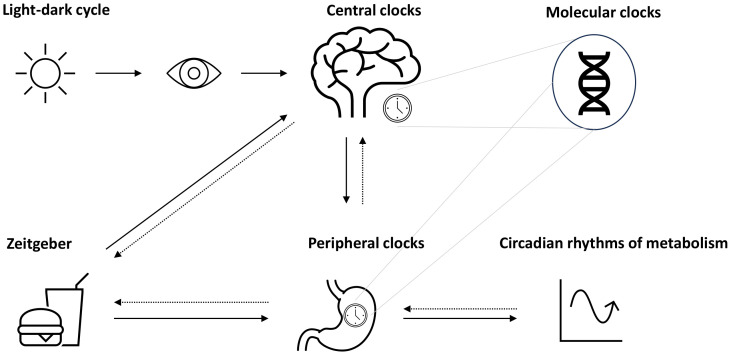
“However, food intake during the biological night can uncouple peripheral clocks from the SCN (31, 32), confirming that meal timing acts as a zeitgeber for circadian clocks.”
§ Meal timing and its role in obesity and associated diseases > Food intake and metabolic rhythms
What the sources say
- Not checked — no full text of the sourcecites [31] Stokkan KA Yamazaki S Tei H Sakaki Y Menaker M. Entrainment of the circadian clock in the liver by feeding. Science. (2001) 291: 490–3. doi: 10.1126/science.291.5503.490 11161204 source
- Disputedcites [32] Damiola F Le Minh N Preitner N Kornmann B Fleury-Olela F Schibler U. Restricted feeding uncouples circadian oscillators in peripheral tissues from the central pacemaker in the suprachiasmatic nucleus. Genes Dev. (2000) 14: 2950–61. doi: 10.1101/gad.183500 PMC317100 11114885 sourceExperimental — accuracy not yet measured
The paper’s “Daytime feeding uncouples peripheral circadian oscillators from the central SCN pacemaker” section says the opposite of the attributed timing: in nocturnal mice, daytime feeding uncoupled peripheral clocks from the SCN, whereas nighttime feeding had little effect on circadian gene-expression phase. The abstract likewise identifies feeding during the subjective day—not the biological night—as producing uncoupling. (LLM, conf=0.91)
Checked by a reasoning model — may be wrong.
plainstates a cause- Asserted: passes — The authors put it forward as true.
- Checkable: passes — It can be checked against evidence.
- Load-bearing: passes — The paper’s conclusions depend on it.
- Based: passes — The paper gives a reason why it holds.
The sources with a verdict support this claim; the rest weren’t checked yet, have no full text we could read, or their verdicts aren’t rated yet.
In the paper
“Food intake is one of the most important zeitgebers (3, 5), and therefore, meal timing, together with food composition and calorie intake, is a crucial factor affecting metabolic health (4, 6).”
§ Meal timing and its role in obesity and associated diseases > Introduction
What the sources say
- Not checked yetcites [4] Chamorro R Jouffe C Oster H Uhlenhaut NH Meyhöfer SM. When should I eat: A circadian view on food intake and metabolic regulation. Acta Physiol (Oxf). (2023) 237: e13936. doi: 10.1111/apha.13936 36645134 source
Checked before — its earlier verdict is held back until a new check runs.
- Supportedcites [6] Kessler K Pivovarova-Ramich O. Meal timing, aging, and metabolic health. Int J Mol Sci. (2019) 20: 1911. doi: 10.3390/ijms20081911 31003407 PMC6514931 source
The Introduction states that the timing of food intake is as critical as food quantity and quality, directly supporting the comparison in the claim. It also says a growing body of evidence links meal timing to metabolic state and body weight. (LLM, conf=0.94)
plainstates a cause- Asserted: passes — The authors put it forward as true.
- Checkable: passes — It can be checked against evidence.
- Load-bearing: passes — The paper’s conclusions depend on it.
- Based: passes — The paper gives a reason why it holds.
- Not checked yet
The cited sources support only part of this claim — read each source’s verdict below.
In the paper
“The desynchronization of the circadian clock associated with the modern 24/7 lifestyle increases the risk for several diseases, such as obesity, type 2 diabetes mellitus, and cardiovascular diseases (2, 4).”
§ Meal timing and its role in obesity and associated diseases > Introduction
What the sources say
- Partly supportedcites [2] Panda S. Circadian physiology of metabolism. Science. (2016) 354: 1008–15. doi: 10.1126/science.aah4967 PMC7261592 27885007 sourceExperimental — accuracy not yet measured
The Abstract (page not provided) says chronic circadian disruption increases the risk of metabolic diseases, and the Perspective and conclusion section reports that sleep deprivation and shift work correlate with higher incidence of metabolic diseases in humans. The paper discusses obesity and diabetes, but these passages do not establish increased risk specifically for type 2 diabetes or cardiovascular disease, or for the modern 24/7 lifestyle as a whole. (LLM, conf=0.84)
- Not checked yetcites [4] Chamorro R Jouffe C Oster H Uhlenhaut NH Meyhöfer SM. When should I eat: A circadian view on food intake and metabolic regulation. Acta Physiol (Oxf). (2023) 237: e13936. doi: 10.1111/apha.13936 36645134 source
Checked before — its earlier verdict is held back until a new check runs.
plainstates a cause- Asserted: passes — The authors put it forward as true.
- Checkable: passes — It can be checked against evidence.
- Load-bearing: passes — The paper’s conclusions depend on it.
- Based: passes — The paper gives a reason why it holds.
- Partly supported
The sources with a verdict support this claim; the rest weren’t checked yet, have no full text we could read, or their verdicts aren’t rated yet.
In the paper
“The circadian clock plays an essential role in metabolic processes.”
§ Meal timing and its role in obesity and associated diseases > Introduction
What the sources say
- Supportedcites [2] Panda S. Circadian physiology of metabolism. Science. (2016) 354: 1008–15. doi: 10.1126/science.aah4967 PMC7261592 27885007 source
The section ‘Metabolic pathways, metabolites, and their integration with the circadian clock’ says that interactions among circadian clocks, feeding cycles, and metabolism help maintain normal physiology. The ‘Central integration of peripheral metabolic status’ section describes extensive, reciprocal regulation between the clock and cellular metabolism. (LLM, conf=0.92)
- Not checked — no full text of the sourcecites [3] Asher G Sassone-Corsi P. Time for food: the intimate interplay between nutrition, metabolism, and the circadian clock. Cell. (2015) 161: 84– 92. doi: 10.1016/j.cell.2015.03.015 25815987 source
plainstates a cause- Asserted: passes — The authors put it forward as true.
- Checkable: passes — It can be checked against evidence.
- Load-bearing: passes — The paper’s conclusions depend on it.
- Based: passes — The paper gives a reason why it holds.
- Supported
40 more claims · 23 with their cited sources checked
Create a free account to see all 81 claims and to verify the 4 references still open.
- It may state two separate claims as one. 33
- Probably not a substantial claim. 7
Self-check
Percentages, sums and reported differences re-computed from the paper’s own numbers.
Each contradiction between two passages listed here was confirmed by an independent check.
Rated minor: it would not touch a result — a value no result rests on, a p-value that stays on the same side of the significance level, or a conflict that is clerical, resolved elsewhere in the paper, or outside its own findings.
In the paper
§ Meal timing and its role in obesity and associated diseases > Factors influencing meal timing > Geography, religion, and social status
“in the Islamic month of Ramadan, meal timing is restricted to the hours between sunrise and sunset for 1 month (181).”
§ Meal timing and its role in obesity and associated diseases > Factors influencing meal timing > Geography, religion, and social status
“the change in meal timing towards eating before and after sunset”
Rated minor: it would not touch a result — a value no result rests on, a p-value that stays on the same side of the significance level, or a conflict that is clerical, resolved elsewhere in the paper, or outside its own findings.
In the paper
§ Meal timing and its role in obesity and associated diseases > Mistimed food intake and metabolic disorders
“Over the last 40 years in the United States (US) (1971–2010), a shift in meal timing has been observed through the National Health and Nutrition Examination Surveys (NHANES) (87).”
§ Meal timing and its role in obesity and associated diseases > References
“87. Kant AK Graubard BI. Association of self-reported sleep duration with eating behaviors of American adults: NHANES 2005-2010.”
Citations
Cites
A preprandial rise in plasma ghrelin levels suggests a role in meal initiation in humans
Cummings, D. E., Purnell, J. Q., Frayo, R. S., Schmidova, K., Wisse, B. E., & Weigle, D. S. (2001) · Diabetes · doi:10.2337/diabetes.50.8.1714 · Cited by 2,940
Social Jetlag: Misalignment of Biological and Social Time
Wittmann, M., Dinich, J., Merrow, M., & Roenneberg, T. (2006) · Chronobiology International · doi:10.1080/07420520500545979 · Cited by 2,625 · cited 1×
“Social jetlag is a result of sleep depth due to a discrepancy between social and biological times, or rather work and free days (176).”
BackgroundObesity and Metabolic Syndrome in Circadian Clock Mutant Mice
Turek, F. W., Joshu, C., Kohsaka, A., Lin, E., Ivanova, G., McDearmon, E., Laposky, A., Losee-Olson, S., Easton, A., Jensen, D. R., et al. (2005) · Science · doi:10.1126/science.1108750 · Cited by 2,485
Dibner, C., Schibler, U., & Albrecht, U. (2010) · Annual Review of Physiology · doi:10.1146/annurev-physiol-021909-135821 · Cited by 2,421 · cited 1×
“The function of the circadian clock in mammals has been previously described in several excellent reviews (10 – 12).”
BackgroundDamiola, F., Le Minh, N., Preitner, N., Kornmann, B., Fleury-Olela, F., & Schibler, U. (2000) · Genes & Development · doi:10.1101/gad.183500 · Cited by 2,394
Adverse metabolic and cardiovascular consequences of circadian misalignment
Scheer, F. A. J. L., Hilton, M. F., Mantzoros, C. S., & Shea, S. A. (2009) · Proceedings of the National Academy of Sciences · doi:10.1073/pnas.0808180106 · Cited by 2,351 · cited 1×
“Surprisingly, there was even a resemblance to the postprandial response of a (pre)diabetic patient, despite the subject being healthy (75).”
BackgroundCentral and Peripheral Circadian Clocks in Mammals
Mohawk, J. A., Green, C. B., & Takahashi, J. S. (2012) · Annual Review of Neuroscience · doi:10.1146/annurev-neuro-060909-153128 · Cited by 2,265
Hatori, M., Vollmers, C., Zarrinpar, A., DiTacchio, L., Bushong, E. A., Gill, S., Leblanc, M., Chaix, A., Joens, M., Fitzpatrick, J. A. J., et al. (2012) · Cell Metabolism · doi:10.1016/j.cmet.2012.04.019 · Cited by 1,986 · cited 2×
“When restricting food intake to an 8-h period, CREB, mTOR, and AMPK pathway function and their circadian rhythms increase, leading to a higher expression pattern of certain liver genes and improved nutrient utilization (57).”
BackgroundEntrainment of the circadian clock in the liver by feeding
Stokkan, K.-A., Yamazaki, S., Tei, H., Sakaki, Y., & Menaker, M. (2001) · Science · doi:10.1126/science.291.5503.490 · Cited by 1,800 · cited 3×
“More precisely, in humans and animals, food intake has been proven to entrain the peripheral clocks of liver, heart, and pancreatic tissue (31 – 33).”
BackgroundSutton, E. F., Beyl, R., Early, K. S., Cefalu, W. T., Ravussin, E., & Peterson, C. M. (2018) · Cell Metabolism · doi:10.1016/j.cmet.2018.04.010 · Cited by 1,531
Research works printed but not linked: 1
- Hopkins M Beaulieu K Gibbons C Halford JCG Blundell J Stubbs J. The Control of Food Intake in Humans. In: Feingold KR Anawalt B Blackman MR Boyce A Chrousos G Corpas E de Herder WW Dhatariya K Dungan K Hofland J Kalra S Kaltsas G Kapoor N Koch C Kopp P Korbonits M Kovacs CS Kuohung W Laferrère B Levy M McGee EA McLachlan R New M Purnell J Sahay R Shah AS Singer F Sperling MA Stratakis CA Trence DL Wilson DP, editors. Endotext. MDText.com, Inc, South Dartmouth (MA (2000).
Cited by
Reytor-González, C., Simancas-Racines, D., Román-Galeano, N. M., Annunziata, G., Galasso, M., Zambrano-Villacres, R., Verde, L., Muscogiuri, G., Frias-Toral, E., & Barrea, L. (2025) · Nutrients · doi:10.3390/nu17132135 · Cited by 88
“Emerging research indicates that not only when we eat, but also which macronutrients are consumed at specific times of the day, significantly influences metabolic health [41].”
InfluentialBaşer, K. H. C., Haskologlu, I. C., & Erdağ, E. (2025) · Molecules · doi:10.3390/molecules30091888 · Cited by 69
“This misalignment leads to impaired metabolic regulation, elevated oxidative stress, and systemic inflammation, all of which are critical contributors to neurodegenerative disease progression [143,144].”
Update on Obesity and Cardiovascular Risk: From Pathophysiology to Clinical Management
Gallo, G., Desideri, G., & Savoia, C. (2024) · Nutrients · doi:10.3390/nu16162781 · Cited by 75
“…a food intake at unusual times may produce an internal desynchronization between central and peripheral clocks, resulting in impaired secretion of hormones such as insulin, glucagon, corticosterone, leptin, adiponectin, visfatin, chemerin, and lipocalin, which regulate satiation, and appetite [92].”
BackgroundCircadian nutrition and obesity: timing as a nutritional strategy
Alum, E. U. (2025) · Journal of Health Population and Nutrition · doi:10.1186/s41043-025-01102-y · Cited by 44
Ezzati, A., Tamargo, J. A., Golberg, L., Haub, M. D., & Anton, S. D. (2025) · Nutrients · doi:10.3390/nu17020322 · Cited by 20
“Some studies reported a reduction of 200–500 kcal daily with TRE without the need for calorie counting [18–20].”
Chrononutrition: Potential, Challenges, and Application in Managing Obesity
Fuad, S. A., Ginting, R. P., & Lee, M.-W. (2025) · International Journal of Molecular Sciences · doi:10.3390/ijms26115116 · Cited by 16
“This implies that the irregular feeding and fasting rhythms might play a pivotal role in the negative effects of a high-fat diet observed in animal models [10,13,14].”
Gorini, S., Camajani, E., Cava, E., Feraco, A., Armani, A., Amoah, I., Filardi, T., Wu, X., Strollo, R., Caprio, M., et al. (2025) · Journal of Translational Medicine · doi:10.1186/s12967-025-06311-x · Cited by 25
“This behavior, known to be associated with a higher risk of obesity and metabolic syndrome, has been widely documented in recent literature [28, 29].”
Peters, B., Schwarz, J., Schuppelius, B., Ottawa, A., Koppold, D. A., Weber, D., Steckhan, N., Mai, K., Grune, T., Pfeiffer, A. F. H., et al. (2025) · Science Translational Medicine · doi:10.1126/scitranslmed.adv6787 · Cited by 25
Self-citationSierpiński, R., Jankowski, M., & Raciborski, F. (2025) · Nutrients · doi:10.3390/nu17132083 · Cited by 13
“In addition, the number of meals, the regularity of their consumption, the conditions in which meals are consumed, and the time allocated for consumption are also behaviors that may influence the risk of excess energy intake [11,12].”
Korman, M., Fleischmann, C., Tkachev, V., Reis, C., Komada, Y., Gubin, D. G., Kumar, V., Kitamura, S., & Roenneberg, T. (2025) · SLEEP · doi:10.1093/sleep/zsaf247 · Cited by 10
“However, when eating occurs during the 24-h day, which is a topic at the focus of the current chrono-nutrition research, it is increasingly recognized as a significant factor for good health [14, 15, 46–48].”
Reytor-González, C., Cevallos-Fernández, E., Jácome, B., & Simancas-Racines, D. (2025) · Frontiers in Cardiovascular Medicine · doi:10.3389/fcvm.2025.1655889 · Cited by 9
“This dietary behavior shortens fasting intervals and maintains most individuals in a near-continuous postprandial state—typically involving four to ten eating occasions per day with minimal overnight respite (7).”
Weekday–Weekend Differences in Chrononutritional Variables Depend on Urban or Rural Living
Santos, J. S., Crispim, C. A., Skene, D. J., & Moreno, C. R. D. C. (2024) · Nutrients · doi:10.3390/nu17010108 · Cited by 7
“Moreover, eating either during the daytime or in the evening was reduced on weekends [35].”
Vahlhaus, J., Peters, B., Hornemann, S., Ost, A.-C., Kruse, M., Busjahn, A., Pfeiffer, A. F. H., & Pivovarova‐Ramich, O. (2025) · EBioMedicine · doi:10.1016/j.ebiom.2025.105737 · Cited by 15
“15,55 Further, several cross-sectional or prospective human cohorts have found no link between eating window duration and body weight or metabolic traits.”
Self-citationRen, X., Zhang, M., Sun, X., Zheng, L., Bi, Y., Li, Q., Sun, L., Di, F., Xu, Y., Zhu, D., et al. (2025) · Journal of Translational Medicine · doi:10.1186/s12967-025-06870-z · Cited by 8
“Second, the metabolic effects of circadian disruption occur independently from food quality [64–66].”
Chen, S., Zhang, X., Kortas, J. A., & Liu, H. (2025) · Frontiers in Nutrition · doi:10.3389/fnut.2025.1664412 · Cited by 11
Barrea, L., Verde, L., Camajani, E., Annunziata, G., Mollica, M. P., Minnetti, M., Trinchese, G., Losignore, P., Colao, A., Ferlin, A., et al. (2026) · Current Nutrition Reports · doi:10.1007/s13668-026-00731-x · Cited by 10
“For example, eating late at night, particularly carbohydrates-meal, (when endogenous insulin sensitivity is lower) forces mitochondria to process nutrients at a non-optimal time, increasing residual substrate burden, oxidative stress, and possibly promoting inflexibility [ 131, 132].”
Appropriate Lifelong Circadian Rhythms Are Established During Infancy: A Narrative Review
Miike, T. (2025) · Clocks & Sleep · doi:10.3390/clockssleep7030041 · Cited by 9
“…mothers should avoid staying up late as much as possible, rest during the day, maintain a regular sleep/wake rhythm, and eat regular meals [14–16 In particular, because the secretion of melatonin by the mother plays a crucial role in regulating these rhythms [63,74–79], maternal melatonin…”
Chong, G. Y., Kaur, S., Talib, R. A., Loy, S. L., Tan, H. Y., Abdullah, R. B., Mahmud, H. B., Siah, W. Y., Tan, L. K., Kee, C. C., et al. (2025) · Chronobiology International · doi:10.1080/07420528.2025.2543298 · Cited by 7
“However, inconsistencies in the literature may stem from small sample sizes, diverse populations, and methodological variations (Peters et al. 2024; Wirth et al. 2021).”
Caregiver feeding practices for infants and toddlers and their eating behaviors in Singapore
Quah, P. L., Chan, D. W. K., Loy, S. L., Ong, C., Tan, C.-H. N., Chia, M., Chua, T. B. K., Yap, F. K. P., Chua, M. C., & Tan, K. H. (2025) · Frontiers in Nutrition · doi:10.3389/fnut.2025.1540031 · Cited by 6
Ultra-processed foods, lifestyle management, and cardiovascular diseases
Guasti, L., Bonaccio, M., Abreu, A., Asteggiano, R., Bes‐Rastrollo, M., Christodorescu, R., de Gaetano, G., Ferrini, M., Marques-Vidal, P. M., Pathak, A., et al. (2026) · European Heart Journal · doi:10.1093/eurheartj/ehag226 · Cited by 7
Gong, Y., Zhang, J., Li, S., Li, L.-L., Dong, X.-J., Liu, L., Fan, Z., Li, Y., & Yang, Y. (2025) · Chronobiology International · doi:10.1080/07420528.2025.2464664 · Cited by 9
“Recent reviews indicate that late consumption of macronutrients affects risk of obesity and that meal timing may influence energy balance and body weight (Peters et al. 2024).”
Rodrigues, P. R. M., Monteiro, L. S., de Vasconcelos, T. M., Alves, I. A., Yokoo, E. M., Sichieri, R., & Pereira, R. A. (2024) · International Journal of Environmental Research and Public Health · doi:10.3390/ijerph21111403 · Cited by 4
“Peters et al. [8] noted, in a review study, that mistimed food intake, such as late or nighttime consumption, can lead to desynchronization of the internal circadian clock and increase the risk for obesity and associated metabolic disturbances, for example, type 2 diabetes.”
InfluentialCircadian phase inversion causes insulin resistance in a rat model of night work and jet lag
Wang, A., Foppen, E., Rumanova, V. S., Kool, T., Kalsbeek, A., & Stenvers, D. J. (2025) · Scientific Reports · doi:10.1038/s41598-025-91485-z · Cited by 6
“Prolonged desynchrony of appetite/eating behavior leads to eating at the wrong time-of-day (that is eating close to the sleep period), which may predispose to weight gain and further metabolic dysregulation 45,46 .”
Gorini, S., Camajani, E., Feraco, A., Armani, A., Quattrini, C., Tarsitano, M. G., Cava, E., Renzo, L. D., Caprio, M., LORENZO, A. D., et al. (2025) · Frontiers in Nutrition · doi:10.3389/fnut.2025.1578574 · Cited by 6
Hoevel, C. J., Llauradó, E., Valls, R. M., Besora‐Moreno, M., Queral, J., Solà, R., & Pedret, A. (2025) · Nutrients · doi:10.3390/nu17030435 · Cited by 6
“Factors such as the timing of gum chewing, types of meals, and individual differences likely play critical roles in these outcomes [41].”
Food Intake According to Clock Gene Polymorphisms: A Systematic Review
Campos, L. T., Fonseca, P. F., Rocha, D. M. U. P., Bressan, J., Kravchychyn, A. C. P., & Hermsdorff, H. H. M. (2025) · The FASEB Journal · doi:10.1096/fj.202500951r · Cited by 3
Temporal control of eating and body weight by GHSR-expressing suprachiasmatic nucleus neurons
Singh, O., Sheybani-Deloui, S., Kulkarni, S., Lyu, M., Li, B., Varshney, S., Shankar, K., Gupta, D., Mercado, L. L., Burstein, A. W., et al. (2025) · Cell Reports · doi:10.1016/j.celrep.2025.116213 · Cited by 3
Tae, H., & Chae, J. (2026) · Journal of Affective Disorders · doi:10.1016/j.jad.2026.121417 · Cited by 3
Moliterno, P., Donhauser, V., & Widhalm, K. (2025) · Nutrients · doi:10.3390/nu17101661 · Cited by 2
“On top of that, it is also unclear how meal timing variables interact with each other and with sleep according to light exposure, and how this could affect health [3,4].”
InfluentialFatima, G. (2025) · Chronobiology in Medicine · doi:10.33069/cim.2025.0017 · Cited by 2
Singh, R., Chen, J., Hawks, S. R., & Wagatsuma, Y. (2024) · Journal of Women s Health · doi:10.1089/jwh.2024.0073 · Cited by 1
“31,32 Furthermore, our investigation underscores the signi fi cance of regular eating patterns, particularly the avoidance of late-night meals, in reducing BMI and lipitension risk, highlighting the growing awareness of the pivotal roles of diet composition and meal timing in sustaining…”
Promoting a healthy diet for chronic disease prevention and environmental sustainability
Kushitor, S. B., Larbi-Sarpong, D. E., William, J., Bour, H., & Boateng, M. O. (2025) · Elsevier eBooks · doi:10.1016/b978-0-443-15976-3.00020-9 · Cited by 2
Miladi, S., Hammouda, O., Trabelsi, S., Miladi, S. C., Ameur, R., & Driss, T. (2025) · Physiology & Behavior · doi:10.1016/j.physbeh.2025.115200 · Cited by 2
CIRCADIAN RHYTHM DISRUPTION AND HORMONAL HEALTH: THE IMPACT OF MODERN LIFESTYLE
Bielawska, K., Auguścik, W. J., & Tlak, A. (2025) · International Journal of Innovative Technologies in Social Science · doi:10.31435/ijitss.4(48).2025.4155 · Cited by 1
Galatoula, P., Pipelias, P., Mantikas, V., Papadopoulou, A., Chrousos, G. P., Bacopoulou, F., Mykoniatis, M., & Darviri, C. (2026) · Nutrients · doi:10.3390/nu18152501 · Cited by 1
“Emerging evidence suggests that the circadian alignment of food intake may significantly influence glucose metabolism, hormonal regulation, inflammatory pathways, and energy homeostasis [42,43].”
Breakfast, a must for Individuals with Type 2 Diabetes Mellitus
de Lanerolle-Dias, M. (2024) · International Journal of Biochemistry & Physiology · doi:10.23880/ijbp-16000254
Koçak, T., Köksal, E., & Aktürk, M. (2025) · Research Square · doi:10.21203/rs.3.rs-8012414/v1 · Cited by 1
Datta, P. R., & Roy, K. (2026) · medRxiv · doi:10.64898/2026.02.06.26345732 · Cited by 1
Meal Timing: Its Relation to Metabolism and Heritability in German Adult Twins
Pivovarova‐Ramich, O., Vahlhaus, J., Peters, B., Hornemann, S., Ost, A.-C., Kruse, M., Busjahn, A., & Pfeiffer, A. F. H. (2024) · EMJ Diabetes · doi:10.33590/emjdiabet/yrcw6549
Self-citationSoliz‐Rueda, J. R., López‐Fernández‐Sobrino, R., Schellekens, H., Bravo, F. I., Suárez, M., Mulero, M., & Muguerza, B. (2025) · BioFactors · doi:10.1002/biof.70000 · Cited by 2
“13,24 29 In this context, flavanols have demonstrated extensive beneficial effects on metabolic disorders related to MetS.”
Macronutrients and Disease: Polycystic Ovary Syndrome
Tehrani, F. R., & Naz, M. S. G. (2025) · Springer eBooks · doi:10.1007/978-3-031-32047-7_28-1
Wulandari, F., Walker, A. N., Ardiansyah, M., Salsabila, Q., Kusuma, L. D., Putri, N., Putri, A. N. I., Rahmadani, L. A., Febrianti, N., Richyanto, A. A., et al. (2025) · Biological Rhythm Research · doi:10.1080/09291016.2025.2487445
“On the contrary, lengthening the daily feeding time may be a factor in the development of metabolic diseases (Gupta et al. 2017; Paoli et al. 2019; Adafer et al. 2020; Peters et al. 2024).”
An effect size-based screening approach to identify actigraphy markers of the submarine environmentPreprint
Marques, D., Fernandes, C., Barbosa‐Morais, N. L., & Reis, C. (2025) · bioRxiv (Cold Spring Harbor Laboratory) · doi:10.1101/2025.06.16.659930 · Cited by 1
Bobok, N. M. (2025) · GASTROENTEROLOGY · doi:10.22141/2308-2097.59.3.2025.693 · Cited by 1
Peters, B., Froehlich, N., Machann, J., Dambeck, U., Honsek, C., Gerbracht, C., Sachno, A., Kemper, M., Kabisch, S., Fritsche, A., et al. (2026) · medRxiv · doi:10.64898/2026.01.01.25342809
Self-citationLight matters: Investigating the influence of natural and artificial light on BMI and key mediators
Silva, G. L., de Menezes, R. C. E., Lima, M. D. O., de Melo, J. S., Soares, L. D. L., & Serenini, R. (2026) · Chronobiology International · doi:10.1080/07420528.2025.2606281 · Cited by 1
“While caution is warranted in the interpretation of these results, they imply that the impact of late-night eating may depend on factors such as the type, quantity, and energy density of the food consumed (Garaulet and Gómez-Abellán 2014; Ishihara et al. 2023; Peters et al. 2024).”
Chronotype and Chrononutrition Profiles in Adolescents Obesity
Hidayat, D. A., Khudin, M., & Prawitasari, T. (2026) · Jurnal Gastrohepatologi Anak Indonesia/Archives of Pediatric Gastroenterology, Hepatology, and Nutrition · doi:10.58427/apghn.5.1.2026.45-61
“32, 33 Integrating these strategies into public health policies could represent an effective preventive approach to address the rising prevalence of obesity among adolescents.”
Application of Causal Inference Techniques to Examine the Determinants and Outcomes of ObesityPreprint
Asare, I. O., Mensah, A. C., & Ayembilla, J. A. (2026) · Research Square · doi:10.21203/rs.3.rs-9142567/v1
Sarayreh, N. A., Al-Domi, H. A., & Jawamis, A. (2026) · Current Research in Nutrition and Food Science Journal · doi:10.12944/crnfsj.14.1.27 · Cited by 1
Chrononutrition and Physical Fitness in Schoolgirls Aged 10–14 Years: Associations with Obesity Risk
Alhabib, H. A., Alkahtani, S. A., & Alhussain, M. H. (2026) · Nutrients · doi:10.3390/nu18091441
“Eating at a later time has been linked to increased fat accumulation and disruptions in glucose regulation [6].”
Hasan, M. R., Mohana, C. A., Shil, K. K., Morshed, S., & Yeasna, K. F. (2026) · Bangladesh Journal of Endocrinology and Metabolism · doi:10.4103/bjem.bjem_4_26
Peters, B., Jokisch, J., Schwarz, J., Schuppelius, B., Pfeiffer, A. F. H., Michalsen, A., Kramer, A., & Pivovarova‐Ramich, O. (2026) · Frontiers in Nutrition · doi:10.3389/fnut.2026.1823259 · Cited by 1
“Early eating would better align eating timing with circadian rhythms, in particularly by reducing the overlap between the evening melatonin peak and postprandial insulin secretion, thereby improving glycemic control (42–44).”
Self-citationÇelen, M., & İnce, N. (2026) · Nutrire · doi:10.1186/s41110-026-00478-z
“Moreover, studies suggest that late lunch consumption or consuming a significant portion of daily energy intake in the evening may contribute to weight gain and obesity [7, 8].”
Zagzoog, A. M., Almujlad, F. Y., & Alanazi, A. M. (2026) · Frontiers in Nutrition · doi:10.3389/fnut.2026.1834114 · Cited by 1
“Moreover, irregular meal times have been associated with cognitive decline and reduced productivity (4).”
Meal timing disruption in maintenance dialysis patients: associations with sleep quality and fatigue
Chen, H., Xu, L., Ai, S., Li, M., Luo, N., Wei, M., Li, X., & Wang, W. (2026) · Frontiers in Nutrition · doi:10.3389/fnut.2026.1815750
Fatima, G., Dalmadi, I., Jánosi, A., Takács, K., & Halmy, E. (2026) · Food Safety and Health · doi:10.1002/fsh3.70108
Muntean, C., Piroș, T., Marin, R. C., Moleriu, L. C., Lupușoru, R., Dicu, A. M., Ştefănigă, S.-A., & Moleriu, R. D. (2026) · Nutrients · doi:10.3390/nu18121975
“Consequently, circadian misalignment between eating schedules and endogenous biological rhythms has been associated with impaired metabolic regulation, increased adiposity, and adverse cardiometabolic outcomes [17–19].”
Moleriu, R. D., Piroș, T., Moleriu, L. C., Muntean, C., Lupușoru, R., Dicu, A. M., Ştefănigă, S.-A., & Marin, R. C. (2026) · Nutrients · doi:10.3390/nu18142368 · Cited by 1
“Contemporary chrononutrition research indicates that irregular or mistimed food intake may disrupt circadian metabolic regulation and contribute to obesity-related metabolic risk [40].”
Chrononutrition, Social Support, and Sleep Quality Associated with Overweight Among Health Students
Maulana, A., Prameswari, F. S. P., Kumalasari, I., & Astuti, W. (2026) · Indonesian Journal of Multidisciplinary on Social and Technology · doi:10.69693/ijmst.v4i3.13021
Ernährungsintervention zur Therapie der Adipositas
Zumblick, A., & Kabisch, S. (2026) · Adipositas - Ursachen Folgeerkrankungen Therapie · doi:10.1055/a-2892-0913
“Die Essenszeit ist, neben Licht und Aktivität, einer der drei Zeitgeber der circadianen Uhr, und unpassende Mahlzeitenzeitpunkte, wie nächtliches Essen, können zu einer Desynchronisation führen, die mit einem erhöhten Adipositasrisiko assoziiert ist [23].”
Campos, R. M. D. S., Souza, H. D. S., Favaron, C. M., Saborosa, G. P., Ferez, L. C., Tufik, S. B., Antunes, H. K. M., D’Almeida, V., & Mônico‐Neto, M. (2026) · Frontiers in Sleep · doi:10.3389/frsle.2026.1943600
“…energy intake occurs later in the day or close to the habitual sleep period, has been associated with greater adiposity and less favorable metabolic outcomes, whereas earlier and more circadian-aligned eating patterns may be associated with metabolic benefits (Peters et al., 2024; Liu et al., 2024).”
Longo‐Silva, G., Serenini, R., Lima, M. D. O., Melo, J., Soares, L. D. L., & de Menezes, R. C. E. (2026) · Ciência & Saúde Coletiva · doi:10.1590/1413-8123202631.13912024 · Cited by 1
Folorunso, O. E., Amadi, J. C., Akinmoladun, O. F., & Ogunba, B. O. (2026) · medRxiv · doi:10.64898/2026.09.20.26363532
Photoperiod driven modulation of behavior, gut microbiota, and brain transcriptomics in zebrafish
Sivarajan, D., Pothayi, V., Devasia, S. C., & Ramachandran, B. (2026) · Pflügers Archiv - European Journal of Physiology · doi:10.1007/s00424-026-03214-8
AĞIRLIK YÖNETİMİNDE BESLENME ALIŞKANLIKLARININ ROLÜ
Çetinöz, N. B., Özler, E., & Şanlıer, N. (2026) · Journal of Advanced Studies in Health Science and Obesity · doi:10.51271/jashso.91
Chioma, B. E., Nguefack, U. H. Z., Akrukem, B. F., Chioma, P. U., Chidubem, H. A., Ihuoma, B. U., & Meh, B. K. (2026) · European Scientific Journal ESJ · doi:10.19044/esj.2026.v22n27p146
Meal timing associations on dietary quality and glucose response
Singh, R., & Salathé, M. (2026) · Communications Health · doi:10.1038/s44528-026-00033-2
“Recentreviews 15,36 suggestthatmealtimingin fl uencesbodyweightand obesity risk, though the strength and consistency of associations with BMI remainuncertain.”
Metadata
- Authors
- Peters, B., Vahlhaus, J., & Pivovarova-Ramich, O.
- Affiliations
- German Center for Diabetes Research (DE)
- German Institute of Human Nutrition (DE)
- ORCID
- Peters, Beeke
- Venue
- Frontiers in Endocrinology
- Publisher
- Frontiers Media SA
- Published
- 2024-03-22
- Volume
- 15
- Pages
- 1359772-1359772
- ISSN
- 1664-2392 (ISSN-L)
- PMC
- PMC10995378
- OpenAlex
- W4393091271
- Cited by
- 72
- References
- 199
- Citations by year
- 2026: 33 · 2025: 33 · 2024: 6
- FWCI
- 4.02
- Type
- journal article
- Language
- en
- Open access
- gold
- doi.org
- Licence
- Locations
- Frontiers in Endocrinology (publishedVersion, cc-by)
- PubMed Central (publishedVersion, cc-by)
- PubMed (publishedVersion)
- Informationszentrum Lebenswissenschaften (ZB MED) (submittedVersion, cc-by)
- DOAJ (DOAJ: Directory of Open Access Journals) (submittedVersion, cc-by-sa)
- Funders
- European Association for the Study of Diabetes
- Topics
- Life Sciences › Neuroscience › Endocrine and Autonomic Systems › Circadian rhythm and melatonin
- Health Sciences › Medicine › Physiology (medical) › Dietary Effects on Health
- Social Sciences › Psychology › Experimental and Cognitive Psychology › Sleep and Work-Related Fatigue
- Keywords
- meal timing, obesity, circadian clock, circadian misalignment, type 2 diabetes, cardiovascular disease, metabolic homeostasis, chronotype, sociocultural factors, work schedules, lifestyle modification
- MeSH terms
- Circadian Rhythm, Diabetes Mellitus, Type 2, Humans, Obesity, Circadian Clocks, Meals
About these checks
Registry, retraction, Cites and statistics results are computed, not judged, with one exception: a printed reference that no index lists is read once by a model before it counts as a citation error. Claims are extracted by a model and kept only when their quote appears verbatim in the text; each cited source is then checked, with a model’s help, for whether it says what the claim relies on. Those verdicts can be wrong — read the claim’s quote and the cited source before relying on one.
The claim verdicts this report counts are experimental: their accuracy is not yet measured.
A language model drew the claims from the paper on 2026-10-10, under version 3 of the claim definition (model deepseek-v4.1-flash, prompt extract-v3).
A second model labelled each claim on 2026-10-10 (model jev-1.13-20260917, definition revision gold-guideline-v0.2).
Cited sources are checked with a language model’s help (gpt-6-sol).
Statistics and arithmetic are recomputed, not judged.
Confidence bands are shown only for fields calibrated on our annotated test set. None is calibrated yet, so no band is shown.
What counts as a claim ›How we measure confidence ›How we check this ›
Are you an author, or do you see a problem with this page? Request a review
Data sources
Bibliographic data: Semantic Scholar, OpenAlex, Crossref.
Contains information from the Semantic Scholar Academic Graph Datasets, made available under the ODC Attribution License (ODC-BY 1.0).
Semantic Scholar’s data is described in: Kinney, R., et al. (2023). The Semantic Scholar Open Data Platform. arXiv:2301.10140.
