

The DOI matches its Crossref record; 105 of the 105 references it cites were found in a registry or an index.
Suicide and Microglia: Recent Findings and Future Perspectives Based on Human Studies
Open accessAbstract
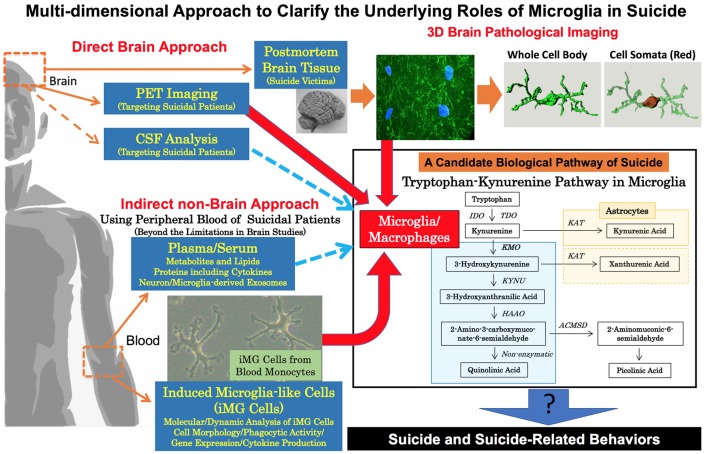
Suicide is one of the most disastrous outcomes for psychiatric disorders. Recent advances in biological psychiatry have suggested a positive relationship between some specific brain abnormalities and specific symptoms in psychiatric disorders whose organic bases were previously completely unknown. Microglia, immune cells in the brain, are regarded to play crucial roles in brain inflammation by releasing inflammatory mediators and are suggested to contribute to various psychiatric disorders such as depression and schizophrenia. Recently, activated microglia have been suggested to be one of the possible contributing cells to suicide and suicidal behaviors via various mechanisms especially including the tryptophan-kynurenine pathway. Animal model research focusing on psychiatric disorders has a long history, however, there are only limited animal models that can properly express psychiatric symptoms. In particular, to our knowledge, animal models of human suicidal behaviors have not been established. Suicide is believed to be limited to humans, therefore human subjects should be the targets of research despite various ethical and technical limitations. From this perspective, we introduce human biological studies focusing on suicide and microglia. We first present neuropathological studies using the human postmortem brain of suicide victims. Second, we show recent findings based on positron emission tomography (PET) imaging and peripheral blood biomarker analysis on living subjects with suicidal ideation and/or suicide-related behaviors especially focusing on the tryptophan-kynurenine pathway. Finally, we propose future perspectives and tasks to clarify the role of microglia in suicide using multi-dimensional analytical methods focusing on human subjects with suicidal ideation, suicide-related behaviors and suicide victims.
Overview
The claims and statistics of this paper haven’t been checked yet.
Run the check — free, no account needed. It reads the open-access text and checks the sources it cites.
Integrity signals
Registry
Cites
Statistics
Figures
Verification
Claims the paper makes
The claims and statistics of this paper haven’t been checked yet.
Run the check — free, no account needed. It reads the open-access text and checks the sources it cites.
Claims other papers make about this one
Each is checked against this paper’s own text: does it say what the citing paper says it does?
In the citing paper
“Activated microglia (208, 209), the primary immune response cells in the brain, and brain translocator protein (TSPO) found in mitochondria of activated glial cells (210) are linked to suicide risk, independently of the presence of psychiatric disorders.”
From A brain-centric model of suicidal behavior (2020) · cites this paper as [208]
In the citing paper
“This suggests that regulation of inflammatory pathways may change with level of suicidal ideation and therefore risk (208).”
From A brain-centric model of suicidal behavior (2020) · cites this paper as [208]
Self-check
Percentages, sums and reported differences re-computed from the paper’s own numbers.
The self-check needs the paper’s full text.
Citations
Cites
Kettenmann, H., Hanisch, U.-K., Noda, M., & Verkhratsky, A. (2011) · Physiological Reviews · doi:10.1152/physrev.00011.2010 · Cited by 3,547
Suicide Prevention Strategies: A Systematic Review
Mann, J. J., Apter, A., Bertolote, J., Beautrais, A., Currier, D., Haas, A., Hegerl, U., Lonnqvist, J., Malone, K., Marusic, A., et al. (2005) · JAMA · doi:10.1001/jama.294.16.2064 · Cited by 2,852
Risks of all-cause and suicide mortality in mental disorders: a meta-review
Chesney, E., Goodwin, G. M., & Fazel, S. (2014) · World Psychiatry · doi:10.1002/wps.20128 · Cited by 2,115
The neuropathology of schizophrenia
Harrison, P. J. (1999) · Brain · doi:10.1093/brain/122.4.593 · Cited by 1,677
Hawton, K., & van Heeringen, K. (2009) · The Lancet · doi:10.1016/s0140-6736(09)60372-x · Cited by 1,671
Microglia and inflammation-mediated neurodegeneration: Multiple triggers with a common mechanism
Block, M. L., & Hong, J.-S. (2005) · Progress in Neurobiology · doi:10.1016/j.pneurobio.2005.06.004 · Cited by 1,557
Dendritic spine pathology in neuropsychiatric disorders
Penzes, P., Cahill, M. E., Jones, K. A., VanLeeuwen, J.-E., & Woolfrey, K. M. (2011) · Nature Neuroscience · doi:10.1038/nn.2741 · Cited by 1,523
White matter in learning, cognition, and psychiatric disorders
Fields, R. D. (2008) · Trends in Neurosciences · doi:10.1016/j.tins.2008.04.001 · Cited by 1,337
Setiawan, E., Wilson, A. A., Mizrahi, R., Rusjan, P. M., Miler, L., Rajkowska, G., Suridjan, I., Kennedy, J. L., Rekkas, P. V., Houle, S., et al. (2015) · JAMA Psychiatry · doi:10.1001/jamapsychiatry.2014.2427 · Cited by 939
Rupprecht, R., Papadopoulos, V., Rammes, G., Baghai, T. C., Fan, J., Akula, N., Groyer, G., Adams, D., & Schumacher, M. (2010) · Nature Reviews Drug Discovery · doi:10.1038/nrd3295 · Cited by 930
Research works printed but not linked: 1
- 2014, Preventing Suicide. A Global Imperative.
Cited by
Sorted by citations
CD38: An Immunomodulatory Molecule in Inflammation and Autoimmunity
Piedra-Quintero, Z. L., Wilson, Z., Nava, P., & Guerau‐de‐Arellano, M. (2020) · Frontiers in Immunology · doi:10.3389/fimmu.2020.597959 · Cited by 351
Hikikomori : Multidimensional understanding, assessment, and future international perspectives
Kato, T. A., Kanba, S., & Teo, A. R. (2019) · Psychiatry and Clinical Neurosciences · doi:10.1111/pcn.12895 · Cited by 335
Self-citationSun, S., Xu, X., Liang, L., Wang, X., Bai, X., Zhu, L., He, Q., Liang, H., Xin, X., Wang, L., et al. (2021) · Frontiers in Immunology · doi:10.3389/fimmu.2021.777665 · Cited by 237
A brain-centric model of suicidal behavior
Mann, J. J., & Rizk, M. M. (2020) · American Journal of Psychiatry · doi:10.1176/appi.ajp.2020.20081224 · Cited by 214
Paracetamol – An old drug with new mechanisms of action
Przybyła, G. W., Szychowski, K. A., & Gmiński, J. (2021) · Clinical and Experimental Pharmacology and Physiology · doi:10.1111/1440-1681.13392 · Cited by 190
Metadata
- Authors
- Suzuki, H., Ohgidani, M., Kuwano, N., Chrétien, F., Lorin de la Grandmaison, G., Onaya, M., Tominaga, I., Setoyama, D., Kang, D., Mimura, M., Kanba, S., & Kato, T. A.
- Affiliations
- National Hospital Organization Shimofusa Psychiatric Medical Center (JP)
- Kyushu University (JP)
- Institut Pasteur (FR)
- Keio University (JP)
- Corresponding author
- Kato, Takahiro A.
- ORCID
- Venue
- Frontiers in Cellular Neuroscience
- Publisher
- Frontiers Media SA
- Published
- 2019-02-13
- Volume
- 13
- Pages
- 31-31
- ISSN
- 1662-5102 (ISSN-L)
- PMC
- PMC6381042
- OpenAlex
- W2912835554
- Cited by
- 198
- References
- 105
- Citations by year
- 2026: 2 · 2025: 11 · 2024: 16 · 2023: 6 · 2022: 12 · 2021: 93 · 2020: 46 · 2019: 12
- FWCI
- 13.36
- Type
- journal article
- Language
- en
- Open access
- gold
- doi.org
- Licence
- Locations
- Frontiers in Cellular Neuroscience (publishedVersion, cc-by)
- Europe PMC (PubMed Central) (publishedVersion, cc-by)
- PubMed Central (publishedVersion, cc-by)
- PubMed (publishedVersion)
- DOAJ (DOAJ: Directory of Open Access Journals) (submittedVersion, cc-by-sa)
- Funders
- Japan Agency for Medical Research and Development (17dk0307047h0003, JP18dk0307075, JP18dm0107095)
- SENSHIN Medical Research Foundation
- Japan Society for the Promotion of Science (15K15431, 26713039, 18H04042, 17H01550, 16H03741, JP16H06403, JP25117011, 16H06403, 18K07417, 17K19915, 16H02666)
- Topics
- Life Sciences › Neuroscience › Biological Psychiatry › Tryptophan and brain disorders
- Social Sciences › Psychology › Clinical Psychology › Suicide and Self-Harm Studies
- Life Sciences › Neuroscience › Neurology › Neuroinflammation and Neurodegeneration Mechanisms
- Keywords
- suicide, microglia, neuroinflammation, kynurenine pathway, suicidal ideation, suicide-related behaviors, positron emission tomography, blood biomarkers, mental illness, depression, schizophrenia
About these checks
Registry, retraction, Cites and statistics results are computed, not judged, with one exception: a printed reference that no index lists is read once by a model before it counts as a citation error. Claims are extracted by a model and kept only when their quote appears verbatim in the text; each cited source is then checked, with a model’s help, for whether it says what the claim relies on. Those verdicts can be wrong — read the claim’s quote and the cited source before relying on one.
Statistics and arithmetic are recomputed, not judged.
Confidence bands are shown only for fields calibrated on our annotated test set. None is calibrated yet, so no band is shown.
What counts as a claim ›How we measure confidence ›How we check this ›
Are you an author, or do you see a problem with this page? Request a review
