

The DOI matches its Crossref record; 143 of the 145 references it cites were found in a registry or an index, and 1 are not checked yet.
Minimal self-models and the free energy principle.
Open accessAbstract
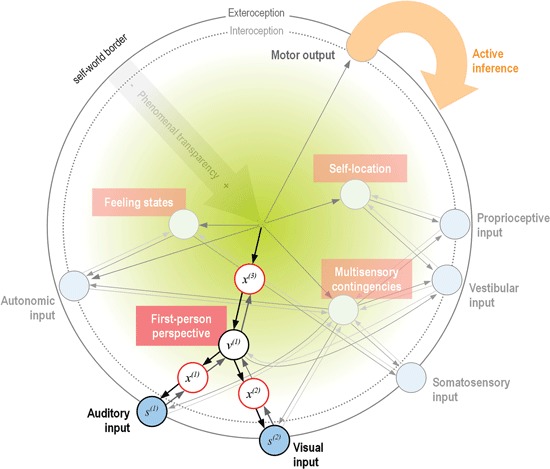
The term "minimal phenomenal selfhood" (MPS) describes the basic, pre-reflective experience of being a self (Blanke and Metzinger, 2009). Theoretical accounts of the minimal self have long recognized the importance and the ambivalence of the body as both part of the physical world, and the enabling condition for being in this world (Gallagher, 2005a; Grafton, 2009). A recent account of MPS (Metzinger, 2004a) centers on the consideration that minimal selfhood emerges as the result of basic self-modeling mechanisms, thereby being founded on pre-reflective bodily processes. The free energy principle (FEP; Friston, 2010) is a novel unified theory of cortical function built upon the imperative that self-organizing systems entail hierarchical generative models of the causes of their sensory input, which are optimized by minimizing free energy as an approximation of the log-likelihood of the model. The implementation of the FEP via predictive coding mechanisms and in particular the active inference principle emphasizes the role of embodiment for predictive self-modeling, which has been appreciated in recent publications. In this review, we provide an overview of these conceptions and illustrate thereby the potential power of the FEP in explaining the mechanisms underlying minimal selfhood and its key constituents, multisensory integration, interoception, agency, perspective, and the experience of mineness. We conclude that the conceptualization of MPS can be well mapped onto a hierarchical generative model furnished by the FEP and may constitute the basis for higher-level, cognitive forms of self-referral, as well as the understanding of other minds.
Overview
The claims and statistics of this paper haven’t been checked yet.
Run the check — free, no account needed. It reads the open-access text and checks the sources it cites.
Integrity signals
Registry
Cites
Statistics
Figures
Verification
Claims the paper makes
The claims and statistics of this paper haven’t been checked yet.
Run the check — free, no account needed. It reads the open-access text and checks the sources it cites.
Claims other papers make about this one
Each is checked against this paper’s own text: does it say what the citing paper says it does?
The source backs part of the claim, not all of it — or backs it for a different population, condition or comparison.
In the citing paper
“AIF agents aim to understand the underlying dynamics of the agent–environment coupling and model themselves as the ‘cause’ of changes to their own sensory states, developing their own sense of agency through active engagement and intervention onto the world”
From Active inference goes to school: the importance of active learning in the age of large language models (2024) · cites this paper as [55]
Experimental — accuracy not yet measuredThe source backs part of the claim, not all of it — or backs it for a different population, condition or comparison.
In the citing paper
“In order to regulate the body, interoception models the hidden causes of allostatic fluctuations by attributing them to a unified entity”
From Pain Asymbolia as Depersonalization for Pain Experience. An Interoceptive Active Inference Account (2020) · cites this paper as Limanowski and Blankenburg, 2013
Experimental — accuracy not yet measuredThe source backs part of the claim, not all of it — or backs it for a different population, condition or comparison.
In the citing paper
“prediction error is best minimized over the long term by attributing internally generated interoceptive sensations to a stable, unified entity, a self”
From Pain Asymbolia as Depersonalization for Pain Experience. An Interoceptive Active Inference Account (2020) · cites this paper as Limanowski and Blankenburg, 2013
Experimental — accuracy not yet measuredThe cited source says what the claim attributes to it.
In the citing paper
“In this putative classification, interoception plays a key role in structuring experiences of ‘being and having a body’ (i.e. embodied selfhood) and may also shape selfhood at other, hierarchically higher levels.”
From Active interoceptive inference and the emotional brain (2016) · cites this paper as [60]
The cited source says what the claim attributes to it.
In the citing paper
“In the last couple of years, several proposals of ‘minimal’ self-model implementations under a predictive coding scheme have been advanced (Seth, 2013; Limanowski and Blankenburg, 2013; Limanowski, 2014; Apps and Tsakiris, 2014; Ishida et al., 2015; Allen and Friston, 2016). These proposals have in common that they treat the ‘self’ as a hypothesis within the HGM, which tries to maximize its”
From 'Seeing the Dark': Grounding Phenomenal Transparency and Opacity in Precision Estimation for Active Inference (2018) · cites this paper as Limanowski and Blankenburg, 2013
Self-check
Percentages, sums and reported differences re-computed from the paper’s own numbers.
The self-check needs the paper’s full text.
Citations
Cites
Yaşlı Kadınlarda Üreme Sağlığı
Kokanalı, D., & Engin Üstün, Y. (n.d.) · DergiPark (Istanbul University) · Cited by 170,090
James, W. (1891) · Personality Culture Society · doi:10.1037/11059-000 · Cited by 25,876
Two new Later Stone Age sites from the Final Pleistocene in the Falémé Valley, eastern Senegal
Ndiaye, M., Lespez, L., Tribolo, C., Rassé, M., Hadjas, I., Davidoux, S., Huysecom, É., & Douze, K. (2024) · Monash University Research Portal (Monash University) · doi:10.3929/ethz-b-000667478 · Cited by 24,214
The free-energy principle: a unified brain theory?
Friston, K. (2010) · Nature Reviews Neuroscience · doi:10.1038/nrn2787 · Cited by 8,120 · cited 14×
“Conceptually, the FEP is based on the evaluation of the improbability of some sensory data under a hierarchical generative model, where the (model-conditional) improbability of the data is commonly referred to as surprise (Friston et al., 2006; Friston, 2010, 2011).”
BackgroundMethodInfluentialRizzolatti, G., & Craighero, L. (2004) · Annual Review of Neuroscience · doi:10.1146/annurev.neuro.27.070203.144230 · Cited by 7,433
Cognitive, social, and physiological determinants of emotional state.
Schachter, S., & Singer, J. (1962) · Psychological Review · doi:10.1037/h0046234 · Cited by 6,223
(2023) · doi:10.1126/science · Cited by 6,063
The feeling of what happens: body and emotion in the making of consciousness
(2000) · Choice Reviews Online · doi:10.5860/choice.37-6553 · Cited by 6,001
Whatever next? Predictive brains, situated agents, and the future of cognitive science
Clark, A. (2013) · Behavioral and Brain Sciences · doi:10.1017/s0140525x12000477 · Cited by 5,924
(1996) · Institutional Research Information System University of Turin (University of Turin) · doi:10.1111/j · Cited by 5,486
Research works printed but not linked: 3
- de Vignemont F. Tsakiris M. Haggard P. (2005). “Body mereology,” in Human Body Perception from the Inside Out, eds Knoblich G. Thornton I. M. Grosjean M. Shiffrar M. (New York: Oxford University Press), 147– 170
- Pennebaker J. W. Skelton J. A. (1981). Selective monitoring of bodily sensations. J. Pers. Soc. Psychol. 41, 213– 223 7277203
- Varela F. Thompson E. Rosch E. (1994). The Embodied Mind. Cambridge, MA: MIT Press
Cited by
Sorted by citations
Active interoceptive inference and the emotional brain
Seth, A. K., & Friston, K. J. (2016) · Philosophical Transactions of the Royal Society B: Biological Sciences · doi:10.1098/rstb.2016.0007 · Cited by 945
Behavioral, Neural, and Computational Principles of Bodily Self-Consciousness
Blanke, O., Slater, M., & Serino, A. (2015) · Neuron · doi:10.1016/j.neuron.2015.09.029 · Cited by 698
Interoception, contemplative practice, and health
Farb, N., Daubenmier, J., Price, C. J., Gard, T., Kerr, C., Dunn, B. D., Klein, A. C., Paulus, M. P., & Mehling, W. E. (2015) · Frontiers in Psychology · doi:10.3389/fpsyg.2015.00763 · Cited by 650
Kilteni, K., Maselli, A., Kording, K. P., & Slater, M. (2015) · Frontiers in Human Neuroscience · doi:10.3389/fnhum.2015.00141 · Cited by 549
The neurobiology of interoception in health and disease
Quadt, L., Critchley, H., & Garfinkel, S. N. (2018) · Annals of the New York Academy of Sciences · doi:10.1111/nyas.13915 · Cited by 488
Metadata
- Authors
- Limanowski, J., & Blankenburg, F.
- Affiliations
- Humboldt-Universität zu Berlin (DE)
- Corresponding author
- Limanowski, Jakub
- Venue
- Frontiers in Human Neuroscience
- Publisher
- Frontiers Media SA
- Published
- 2013
- Volume
- 7
- Pages
- 547-547
- ISSN
- 1662-5161 (ISSN-L)
- PMC
- PMC3770917
- OpenAlex
- W2148544865
- Cited by
- 263
- References
- 145
- Citations by year
- 2026: 15 · 2025: 17 · 2024: 29 · 2023: 44 · 2022: 17 · 2021: 30 · 2020: 22 · 2019: 15 · 2018: 23 · 2017: 16 · 2016: 7 · 2015: 13 · 2014: 11 · 2013: 4
- FWCI
- 0.99
- Type
- journal article
- Language
- en
- Open access
- gold
- doi.org
- Licence
- cc-by
- Locations
- Frontiers in Human Neuroscience (publishedVersion, cc-by)
- Europe PMC (PubMed Central) (publishedVersion, cc-by)
- PubMed Central (publishedVersion, cc-by)
- PubMed (publishedVersion)
- DOAJ (DOAJ: Directory of Open Access Journals) (submittedVersion, cc-by-sa)
- edoc Publication server (Humboldt University of Berlin) (submittedVersion, cc-by)
- Max Planck Institute for Plasma Physics (submittedVersion)
- Max Planck Digital Library (submittedVersion, other-oa)
- MPG.PuRe (Max Planck Society) (submittedVersion, other-oa)
- Refubium (Universitätsbibliothek der Freien Universität Berlin) (submittedVersion, cc-by)
- Universitätsbibliothek der FU Berlin Hochschulschriftenstelle u. Dokumentenserver (cc-by)
- Funders
- Wellcome Trust (088130)
- Topics
- Life Sciences › Neuroscience › Cognitive Neuroscience › Embodied and Extended Cognition
- Social Sciences › Arts and Humanities › Philosophy › Philosophy and Theoretical Science
- Social Sciences › Arts and Humanities › Philosophy › Free Will and Agency
- Keywords
- free energy principle, active inference, embodiment, multisensory integration, interoception, agency, perspective taking, mineness, self-referral, other minds, hierarchical generative models
About these checks
Registry, retraction, Cites and statistics results are computed, not judged, with one exception: a printed reference that no index lists is read once by a model before it counts as a citation error. Claims are extracted by a model and kept only when their quote appears verbatim in the text; each cited source is then checked, with a model’s help, for whether it says what the claim relies on. Those verdicts can be wrong — read the claim’s quote and the cited source before relying on one.
Statistics and arithmetic are recomputed, not judged.
Confidence bands are shown only for fields calibrated on our annotated test set. None is calibrated yet, so no band is shown.
What counts as a claim ›How we measure confidence ›How we check this ›
Are you an author, or do you see a problem with this page? Request a review
