

The DOI matches its Crossref record; 168 of the 171 references it cites were found in a registry or an index.
The role of the striatum in social behavior
Open accessAbstract
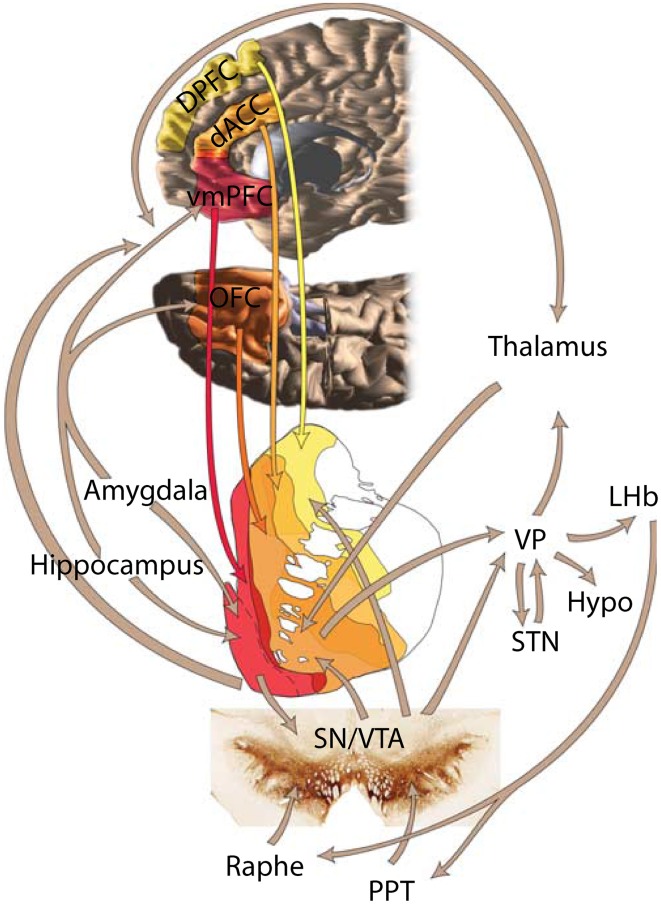
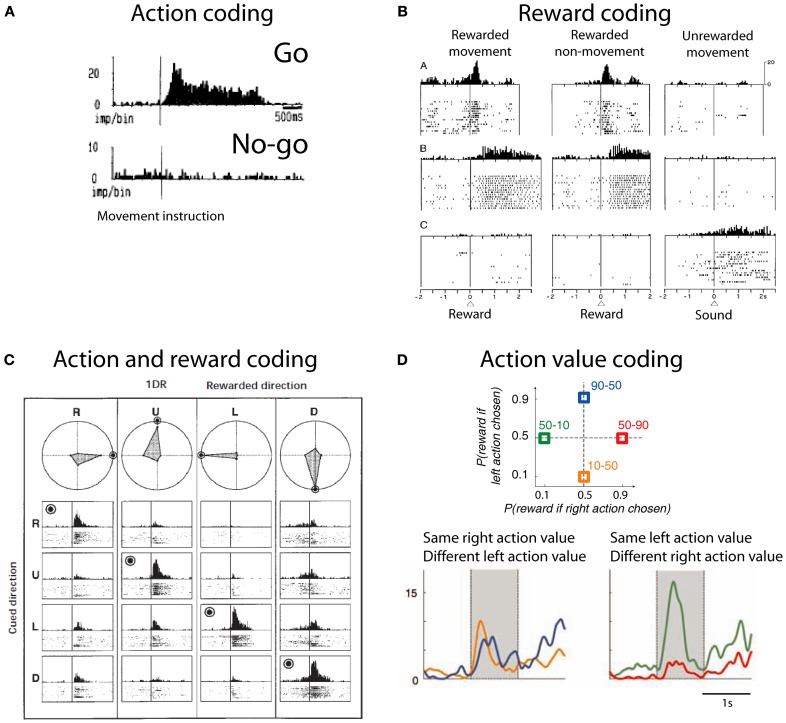
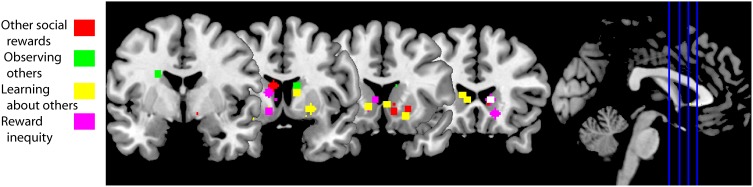
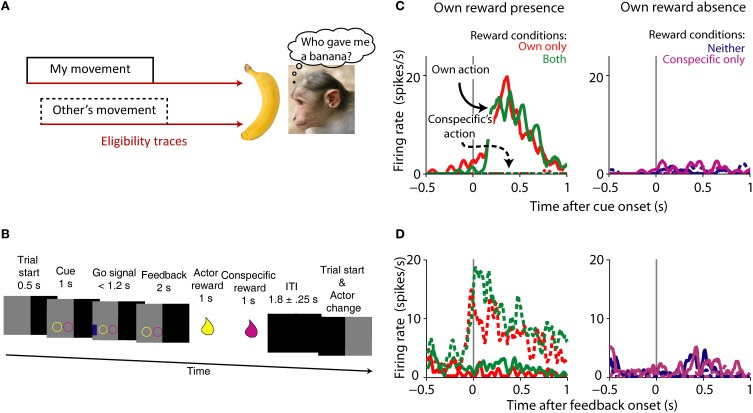
Where and how does the brain code reward during social behavior? Almost all elements of the brain's reward circuit are modulated during social behavior. The striatum in particular is activated by rewards in social situations. However, its role in social behavior is still poorly understood. Here, we attempt to review its participation in social behaviors of different species ranging from voles to humans. Human fMRI experiments show that the striatum is reliably active in relation to others' rewards, to reward inequity and also while learning about social agents. Social contact and rearing conditions have long-lasting effects on behavior, striatal anatomy and physiology in rodents and primates. The striatum also plays a critical role in pair-bond formation and maintenance in monogamous voles. We review recent findings from single neuron recordings showing that the striatum contains cells that link own reward to self or others' actions. These signals might be used to solve the agency-credit assignment problem: the question of whose action was responsible for the reward. Activity in the striatum has been hypothesized to integrate actions with rewards. The picture that emerges from this review is that the striatum is a general-purpose subcortical region capable of integrating social information into coding of social action and reward.
Overview
The claims and statistics of this paper haven’t been checked yet.
Run the check — free, no account needed. It reads the open-access text and checks the sources it cites.
Integrity signals
Registry
Cites
Statistics
Figures
Verification
Claims the paper makes
The claims and statistics of this paper haven’t been checked yet.
Run the check — free, no account needed. It reads the open-access text and checks the sources it cites.
Claims other papers make about this one
Each is checked against this paper’s own text: does it say what the citing paper says it does?
The source backs part of the claim, not all of it — or backs it for a different population, condition or comparison.
In the citing paper
“This activation is mediated by the release of dopamine, a neurotransmitter associated with pleasure and reward (Báez-Mendoza and Schultz, 2013).”
From The impact of digital technology, social media, and artificial intelligence on cognitive functions: a review (2023) · cites this paper as Báez-Mendoza and Schultz, 2013
Experimental — accuracy not yet measuredThe source backs part of the claim, not all of it — or backs it for a different population, condition or comparison.
In the citing paper
“Research has shown that excessive digital use, particularly related to activities such as social media and gaming, can trigger addictive behaviors by activating the brain's reward circuitry.”
From The impact of digital technology, social media, and artificial intelligence on cognitive functions: a review (2023) · cites this paper as Báez-Mendoza and Schultz, 2013
Experimental — accuracy not yet measured
Self-check
Percentages, sums and reported differences re-computed from the paper’s own numbers.
The self-check needs the paper’s full text.
Citations
Cites
Reinforcement Learning: An Introduction
Sutton, R. S., & Barto, A. G. (1998) · IEEE Transactions on Neural Networks · doi:10.1109/tnn.1998.712192 · Cited by 27,225
Reinforcement Learning: An Introduction
Sutton, R. S., & Barto, A. (2005) · IEEE Transactions on Neural Networks · doi:10.1109/tnn.2004.842673 · Cited by 25,268
Axelrod, R., & Hamilton, W. D. (1981) · Science · doi:10.1126/science.7466396 · Cited by 20,065
Theory of games and economic behavior
Garcia, S. R., & Miller, S. J. (2019) · American Mathematical Society eBooks · doi:10.1090/mbk/121/32 · Cited by 16,777
A Theory of Fairness, Competition, and Cooperation
Fehr, E., & Schmidt, K. M. (1999) · The Quarterly Journal of Economics · doi:10.1162/003355399556151 · Cited by 11,264
Five Rules for the Evolution of Cooperation
Nowak, M. A. (2006) · Science · doi:10.1126/science.1133755 · Cited by 5,894
ERC: A Theory of Equity, Reciprocity, and Competition
Bolton, G. E., & Ockenfels, A. (2000) · American Economic Review · doi:10.1257/aer.90.1.166 · Cited by 5,399
An experimental analysis of ultimatum bargaining
Güth, W., Schmittberger, R., & Schwarze, B. (1982) · Journal of Economic Behavior & Organization · doi:10.1016/0167-2681(82)90011-7 · Cited by 4,868
Incorporating Fairness into Game Theory and Economics
Rabin, M. (2011) · Princeton University Press eBooks · doi:10.2307/j.ctvcm4j8j.15 · Cited by 4,614
The reward circuit: linking primate anatomy and human imaging
Haber, S. N., & Knutson, B. (2010) · Neuropsychopharmacology · doi:10.1038/npp.2009.129 · Cited by 3,718
Research works printed but not linked: 3
- Báez-Mendoza R. Hoffman K. L. (2009). Object ontology in temporal lobe ensembles, in Cortical Mechanisms of Vision, 1st Edn., eds Jenkin M. Harris L. (Cambridge: Cambridge University Press), 237– 253
- Dawkins R. (2006). The Selfish Gene: – with a New Introduction by the Author. Oxford: University Press
- Hall F. S. Wilkinson L. S. Humby T. Robbins T. W. (1999). Maternal deprivation of neonatal rats produces enduring changes in dopamine function. Synapse 32, 37– 43 10188636
Cited by
Sorted by citations
Items 201–300 of 313
Post-weaning social isolation impairs purinergic signaling in rat brain
Andrejew, R., Paim, M., Moritz, C. E. J., Carreño, F. O., Rates, S. M. K., Elisabetsky, E., Souza, D. O., Almeida, R. F., & Battastini, A. M. O. (2021) · Neurochemistry International · doi:10.1016/j.neuint.2021.105111 · Cited by 6
Zhai, Y., Li, M., Gui, Z., Wang, Y., Hu, T., Liu, Y., & Xu, F. (2021) · Frontiers in Neural Circuits · doi:10.3389/fncir.2021.768125 · Cited by 6
The Interprocessual-Self Theory in Support of Human Neuroscience Studies
Luís, E. O., Akrivou, K., Bermejo‐Martins, E., Scalzo, G. R., & Semper, J. V. O. (2022) · Frontiers in Psychology · doi:10.3389/fpsyg.2021.686928 · Cited by 9
Brain Region- and Age-Dependent 5-Hydroxymethylcytosine Activity in the Non-Human Primate
Xu, Y., Zhong, L., Wei, H., Li, Y., Xie, J., Xie, L., Chen, X., Guo, X., Yin, P., Li, S., et al. (2022) · Frontiers in Aging Neuroscience · doi:10.3389/fnagi.2022.934224 · Cited by 7
Clinical Approach to a Child with Movement Disorders
O’Malley, J. A., & Gilbert, D. L. (2017) · Seminars in Pediatric Neurology · doi:10.1016/j.spen.2017.12.001 · Cited by 6
Etiologically Elusive Disorders Research Network Kumar A. (2017) · doi:10.31234/osf.io/8xh92 · Cited by 6
Evidence for the involvement of a fronto-striatal pathway in the processing of social reward
Lin, K., & Coutellier, L. D. (2025) · Progress in Neurobiology · doi:10.1016/j.pneurobio.2025.102834 · Cited by 6
Feng, Y., Ma, X., Zong, X., Jordan, J. D., Wu, C. Y., Tešić, V., Lee, R. H., & Zhang, Q. (2025) · Biomedicine & Pharmacotherapy · doi:10.1016/j.biopha.2025.117916 · Cited by 5
Primate sympatry shapes the evolution of their brain architecture
Robira, B., & Perez‐Lamarque, B. (2023) · Peer Community Journal · doi:10.24072/pcjournal.259 · Cited by 3
Trompeta, C., Gasca‐Salas, C., Pineda‐Pardo, J. A., Guida, P., Cohn, M., Mata‐Marín, D., Monje, M. H. G., López‐Aguirre, M., Obeso, I., & Sánchez‐Ferro, Á. (2023) · Behavioural Brain Research · doi:10.1016/j.bbr.2023.114654 · Cited by 6
Impact of early social isolation on social circuits and behavior: relevance to schizophrenia
Kawatake-Kuno, A., Leventhal, M. B., & Morishita, H. (2025) · Neuropsychopharmacology · doi:10.1038/s41386-025-02156-6 · Cited by 7
Dumitrescu, C. M., Costea, I. M., Cormoș, A. C., & Semenescu, A. (2021) · Sensors · doi:10.3390/s21217230 · Cited by 5
Novel behavioral tasks for the measurement of social motivation in mice: a comparison across strains
Wells, C., Huddleston, K. P., Brown, S., Razzaq, F., Chick, D., & Rogers, T. D. (2026) · Frontiers in Behavioral Neuroscience · doi:10.3389/fnbeh.2025.1678147 · Cited by 4
Neural Phenomenon in Musicality: The Interpretation of Dual-Processing Modes in Melodic Perception
Gande, N. (2022) · Frontiers in Human Neuroscience · doi:10.3389/fnhum.2022.823325 · Cited by 5
Suarez, G. L., Bezek, J. L., Westerman, H. B., Hanson, J. L., Klump, K. L., Burt, S. A., & Hyde, L. W. (2025) · Biological Psychiatry Global Open Science · doi:10.1016/j.bpsgos.2025.100550 · Cited by 4
Santin, M. D. N. (2025) · Neurophysiologie Clinique · doi:10.1016/j.neucli.2025.103090 · Cited by 5
Dual Oxytocin Signals in Striatal Astrocytes
Farsetti, E., Amato, S., Averna, M., Guidolin, D., Pedrazzi, M., Maura, G., Agnati, L. F., Cervetto, C., & Marcoli, M. (2025) · Biomolecules · doi:10.3390/biom15081122 · Cited by 4
Neurobiology and neuropharmacology of zebrafish social behavior
Apukhtin, K. V., Riga, V. D., Kotova, M. M., Galstyan, D. S., Yang, L., Cui, J., Lim, L. W., de Abreu, M. S., & Kalueff, A. V. (2026) · Journal of Psychopharmacology · doi:10.1177/02698811251413496 · Cited by 4
Wang, Y., Wu, R., Li, L., Ma, J., Yang, W., & Dai, Z. (2022) · Brain Imaging and Behavior · doi:10.1007/s11682-022-00723-9 · Cited by 5
Families in Eating Disorders: An Attachment Perspective
Monteleone, A. M. (2023) · Springer eBooks · doi:10.1007/978-3-030-97416-9_80-1 · Cited by 4
Interaction of amisulpride with GLUT1 at the blood-brain barrier. Relevance to Alzheimer’s disease
Boyanova, S., Lloyd-Morris, E., Corpe, C. P., Rahman, K. M., Farag, D. B., Page, L. K., Wang, H., Fleckney, A. L., Gatt, A. P., Troakes, C., et al. (2023) · PLoS ONE · doi:10.1371/journal.pone.0286278 · Cited by 5
Chen, Z., Li, Y., Rasheed, M., Wang, H., Lei, R., Zhao, T., Deng, Y., & Ma, H. (2023) · Frontiers in Cellular Neuroscience · doi:10.3389/fncel.2023.1252958 · Cited by 4
Wang, Y., & Yao, X. (2024) · Physiology & Behavior · doi:10.1016/j.physbeh.2024.114481 · Cited by 4
Apathy and effort‐based decision‐making in Alzheimer's disease and subjective cognitive impairment
Attaallah, B., Toniolo, S., Maio, M. R., & Husain, M. (2024) · Alzheimer s & Dementia Diagnosis Assessment & Disease Monitoring · doi:10.1002/dad2.70013 · Cited by 5
Mun, J., Power, K. C., Komatsu, N., Tomatz, S., Beery, A. K., & Landry, M. P. (2026) · Proceedings of the National Academy of Sciences · doi:10.1073/pnas.2509561123 · Cited by 4
Plant-Based Nutritional Supplementation Attenuates LPS-Induced Low-Grade Systemic Activation
Yu, J., Zhu, H., Taheri, S., Mondy, W. L., Perry, S. J., & Kindy, M. S. (2021) · International Journal of Molecular Sciences · doi:10.3390/ijms22020573 · Cited by 4
van Winden, F. A. A. M. (2023) · Journal of Economic Psychology · doi:10.1016/j.joep.2023.102625 · Cited by 5
Organization of the galaninergic neuronal system in the brain of the gecko Hemidactylus frenatus
Ganeyan, A., & Ganesh, C. B. (2022) · Neuropeptides · doi:10.1016/j.npep.2022.102310 · Cited by 4
Edelstyn, N., Rosa, E. D., & Martini, A. (2023) · European Neurology · doi:10.1159/000528900 · Cited by 4
Aberrant features of in vivo striatal dynamics in Parkinson's disease
Lee, K., & Masmanidis, S. C. (2019) · Journal of Neuroscience Research · doi:10.1002/jnr.24519 · Cited by 4
Nakagawa, R., Nani, F., Hipp, J. F., Honer, M., Knoflach, F., Gasser, R., Ozmen, L., Tamada, K., Fjeldskaar, F., Takacs, L., et al. (2026) · Molecular Psychiatry · doi:10.1038/s41380-025-03247-y · Cited by 3
Age‐related changes in gonadotropin‐releasing hormone (GnRH) splice variants in mouse brain
Gautam, P., Ajit, K., Das, M., Taliyan, R., Roy, R., & Banerjee, A. (2022) · Journal of Experimental Zoology Part A Ecological and Integrative Physiology · doi:10.1002/jez.2671 · Cited by 3
Ganeyan, A., & Ganesh, C. B. (2024) · Brain Structure and Function · doi:10.1007/s00429-024-02805-4 · Cited by 3
Simmons, D. A., Selvaraj, S., Chen, T., Cao, G., Camelo, T. S., McHugh, T. L. M., Gonzalez, S., Martin, R. M., Simanauskaite, J., Uchida, N., et al. (2025) · Molecular Therapy — Methods & Clinical Development · doi:10.1016/j.omtm.2025.101415 · Cited by 3
Interaction Between Oxytocin and Dopamine Signaling: Focus on the Striatum
Guidolin, D., Tortorella, C., Cervetto, C., Marcoli, M., Maura, G., & Agnati, L. F. (2025) · International Journal of Molecular Sciences · doi:10.3390/ijms26178711 · Cited by 3
Wilhelm, R. A., Spechler, P. A., Demuth, M. J., Gonzalez, M. B., Kemp, C. G., Walls, M. L., Aupperle, R. L., Paulus, M. P., Stewart, J. L., & White, E. J. (2023) · Drug and Alcohol Dependence · doi:10.1016/j.drugalcdep.2023.109852 · Cited by 4
Kobrzycka, A. T., Stankiewicz, A. M., Napora, P., Pierzchała, K., & Wieczorek, M. (2023) · Acta Neurobiologiae Experimentalis · doi:10.55782/ane-2023-009 · Cited by 3
Jeong, Y., & Noh, J. (2024) · Behavioural Brain Research · doi:10.1016/j.bbr.2024.114983 · Cited by 3
Washington, S. D., Shattuck, K. F., Steckel, J., Peremans, H., Jonckers, E., Hinz, R., Venneman, T., van den Berg, M., Ruijssevelt, L. V., Verellen, T., et al. (2024) · Proceedings of the National Academy of Sciences · doi:10.1073/pnas.2306029121 · Cited by 3
Chen, L., Lin, C., Chung, C., Chung, Y., Park, S. Y., Chang, W., Chang, C.-C., & Chang, H. (2025) · European Archives of Psychiatry and Clinical Neuroscience · doi:10.1007/s00406-025-02010-2 · Cited by 3
Psychoactive Properties of Microalgae
Rajakumar, P. D. (2018) · Elsevier eBooks · doi:10.1016/b978-0-12-811405-6.00016-5 · Cited by 4
Takesue, H., Miyauchi, C. M., Sakaiya, S., Fan, H., Matsuda, T., & Katô, J. (2017) · Scientific Reports · doi:10.1038/s41598-017-05469-9 · Cited by 3
TUSC3 regulates ERMA-mediated Mg2+ uptake for synaptic function and neurodevelopment
Park, G., Kim, N. H., Kim, S.-Y., Lee, H., Li, C. M., Seol, J. H., Choi, S., & Jung, Y. (2025) · Nature Communications · doi:10.1038/s41467-025-65668-1 · Cited by 2
Webster, J. F., & Cousin, M. A. (2026) · Neuroscience & Biobehavioral Reviews · doi:10.1016/j.neubiorev.2026.106547 · Cited by 2
From first impressions to bonds: The neural dynamics of social relationships
Jain, P., & Schiller, D. (2026) · Neuron · doi:10.1016/j.neuron.2026.05.031 · Cited by 3
Nuostolių baimės efekto teorinės interpretacijos neuroekonomikoje
Tauraitė, V. (2018) · Regional Formation and Development Studies · doi:10.15181/rfds.v25i2.1747 · Cited by 2
Parry, R., Buttelli, O., Sellam, N., Riff, J., Vidailhet, M., Welter, M., & Lalo, E. (2022) · Psychology and Health · doi:10.1080/08870446.2022.2047187 · Cited by 2
Parvathy, J., Sreedevi, A., Sankaranarayanan, P., & Vasu, S. T. (2023) · Current Pharmacology Reports · doi:10.1007/s40495-023-00331-1 · Cited by 2
Byun, Y., & Noh, J. (2023) · Physiology & Behavior · doi:10.1016/j.physbeh.2023.114379 · Cited by 2
Obesity differentially effects the somatosensory cortex and striatum of TgF344-AD rats
Ahmed, M., Lai, A. Y., Hill, M. E., Ribeiro, J. A., Amiraslani, A., & McLaurin, J. (2024) · Scientific Reports · doi:10.1038/s41598-024-57953-8 · Cited by 2
Kellij, S., Dobbelaar, S., Lodder, G. M. A., Veenstra, R., & Güroğlu, B. (2024) · Research on Child and Adolescent Psychopathology · doi:10.1007/s10802-024-01227-4 · Cited by 2
Toward a better understanding of social learning, social deciding, and other-regarding preferences
Chang, S. W. C., & Isoda, M. (2014) · Frontiers in Neuroscience · doi:10.3389/fnins.2014.00362 · Cited by 2
Social Decision-Making in Nonhuman Primates
Jazayari, M., Ballesta, S., & Duhamel, J. (2016) · Elsevier eBooks · doi:10.1016/b978-0-12-805308-9.00014-2 · Cited by 2
Neural Control of Social Decisions
Ugazio, G., & Ruff, C. C. (2016) · Elsevier eBooks · doi:10.1016/b978-0-12-805308-9.00019-1 · Cited by 2
Explore-exploit behaviors predict broad autism social phenotypes in general populationPreprint
Knep, E., Yan, X., Chen, C. S., Jacob, S., Darrow, D. P., Ebitz, R. B., Grissom, N. M., & Herman, A. B. (2024) · PsyArXiv (OSF Preprints) · doi:10.31234/osf.io/y8hrp · Cited by 3
Bueso, A., & Kim, K. J. (2025) · Journal of Social Work and Social Welfare Policy · doi:10.33790/jswwp1100133 · Cited by 1
Rigo, P., Giannotti, M., Filippi, B., Simonelli, A., Gemignani, M., Perzolli, S., Venuti, P., & de Falco, S. (2025) · BMC Psychology · doi:10.1186/s40359-025-03439-9 · Cited by 2
Neurobehavioral Impacts of the Autism Risk Gene, WAC: Studies Involving C. elegans and Mice
Boonpraman, N., Kim, D.-W., Tislerics, E., Barot, J., Pacheco-Cruz, D., Kuhn, N. C., Vogt, D. L., & Sammi, S. R. (2026) · Molecular Neurobiology · doi:10.1007/s12035-026-05964-z · Cited by 1
Shariatmadari, H., Bigdeli, M. R., Khaksar, S., & Vahidi, S. (2026) · Behavioural Pharmacology · doi:10.1097/fbp.0000000000000889 · Cited by 1
Jack, A., & Gupta, A. R. (2026) · Research in Autism · doi:10.1016/j.reia.2026.203025 · Cited by 1
Xuan, Z. (2018) · Global Journal of Anesthesiology · doi:10.17352/2455-3476.000040 · Cited by 1
Zhang, X. (2018) · Global Journal of Anesthesiology · doi:10.17352/gja.000010 · Cited by 1
Clinical and functional study of two de novo variations of CDKL5 gene
You, Y., Men, X., Wu, W., Liu, S., He, X., Sun, S., Wang, X., & Li, B. (2023) · Neurogenetics · doi:10.1007/s10048-023-00731-x · Cited by 1
Pollard-Wright, H. (2023) · IntechOpen eBooks · doi:10.5772/intechopen.1002799 · Cited by 1
Fetal endocrine axes mRNA expression levels are related to sex and intrauterine position
Yael, A., Fishman, R., Matas, D., Doniger, T., Vortman, Y., & Koren, L. (2024) · Biology of Sex Differences · doi:10.1186/s13293-024-00637-9 · Cited by 1
Basal Ganglia Anatomy, Biochemistry, and Physiology
Singer, H. S., Mink, J. W., Gilbert, D. L., & Jankovic, J. J. (2015) · Elsevier eBooks · doi:10.1016/b978-0-12-411573-6.00001-2 · Cited by 2
Gašević, G. R., & Žižak, A. (2016) · Annual of Social Work · doi:10.3935/ljsr.v23i1.74 · Cited by 1
Jung, W., Kim, S., Kim, H., Huh, S., Kim, D.-W., Yoon, D.-U., Yang, C. H., Kim, H. Y., & Jang, E. Y. (2019) · Psychiatry Investigation · doi:10.30773/pi.2019.05.13.2 · Cited by 1
Comparative anatomical analysis of dopamine systems in Mus musculus and Peromyscus californicus
Buck, J., Manion, M. T. C., Zhang, W., Glasper, E. R., & Wang, K. H. (2022) · Brain Structure and Function · doi:10.1007/s00429-022-02497-8 · Cited by 1
Automatic Detection of K-Complexes using Deep Neural Networks with EEG Signals
Dumitrescu, C. (2022) · Vide Leaf, Hyderabad eBooks · doi:10.37247/pasen.2.2022.20 · Cited by 1
The neural computation of human prosocial choices in complex motivational statesPreprint
Saulin, A., Horn, U., Lotze, M., Kaiser, J., & Hein, G. (2019) · bioRxiv (Cold Spring Harbor Laboratory) · doi:10.1101/851931 · Cited by 1
van Winden, F. A. A. M. (2021) · SSRN Electronic Journal · doi:10.2139/ssrn.3777026 · Cited by 1
La dysrégulation hédoniste comme forme d’anosognosie dans la maladie de Parkinson ?
Bruneau, M. (2016) · NPG. Neurologie, psychiatrie, gériatrie/NPG · doi:10.1016/j.npg.2016.03.007
Zaccarelli‐Magalhães, J. (2017) · Digital Library of Theses and Dissertations (Universidade de São Paulo) · doi:10.11606/d.10.2017.tde-20032017-141445
Nuostolių baimės efekto kompleksinė analizė
Tauraitė, V. (2019) · Regional Formation and Development Studies · doi:10.15181/rfds.v29i3.2002
Katô, J., Sakaiya, S., & Takesue, H. (2017) · The Annuals of Japanese Political Science Association · doi:10.7218/nenpouseijigaku.68.2_173
Lissoni, P., Messina, G., Porro, G., Gavazzeni, C., Trampetti, R., Tartarelli, O., Tartarelli, R., Caddeo, A., & Fede, G. D. (2020) · Mental Health and Addiction Research · doi:10.15761/mhar.1000190
Kim, H.-J., Yang, E.-J., Kim, H.-B., Jo, E. H., Woo, R., Kim, S., & Hye-Sun, K. (2021) · Research Square · doi:10.21203/rs.3.rs-152612/v1
Processi co-valutativi ed equità agentiva nella didattica trasformativa pandemica e post-pan
Bearzi, F., & Tarantino, A. (2021) · EDUCATION SCIENCES AND SOCIETY · doi:10.3280/ess2-2021oa12506
Basal Ganglia Anatomy, Biochemistry, and Physiology
Singer, H. S., Mink, J. W., Gilbert, D. L., & Jankovic, J. J. (2022) · Elsevier eBooks · doi:10.1016/b978-0-12-820552-5.00012-7
Neurobiologische Grundlagen der Adoleszenz
Frey, M. (2023) · Elsevier eBooks · doi:10.1016/b978-3-437-21382-3.00002-6
Interaction of amisulpride with GLUT1 at the blood-brain barrier. Relevance to Alzheimer’s diseasePreprint
Boyanova, S. T., Lloyd-Morris, E., Corpe, C. P., Rahman, K. M., Farag, D. B., Page, L. K., Wang, H., Fleckney, A. L., Gatt, A. P., Troakes, C., et al. (2023) · bioRxiv (Cold Spring Harbor Laboratory) · doi:10.1101/2023.05.15.540749
Bayesian image-on-image regression via deep kernel learning based Gaussian processes
Ma, G., Zhao, B., Abu‐Amara, H., & Kang, J. (2026) · The Annals of Applied Statistics · doi:10.1214/25-aoas2108
Yoo, T., Kim, S.-G., Yang, S. H., Kim, H., Kim, E., & Kim, S. Y. (2020) · Figshare · doi:10.6084/m9.figshare.11978484
Morella, I., Brambilla, R., & Hérault, Y. (2024) · Frontiers in Cellular Neuroscience · doi:10.3389/fncel.2024.1470882
Neurogenetics of Autism Spectrum Conditions in Individuals Assigned Female at Birth
Jack, A., McQuaid, G. A., & Gupta, A. R. (2024) · Springer eBooks · doi:10.1007/978-3-031-62072-0_5 · Cited by 1
Families in Eating Disorders: An Attachment Perspective
Monteleone, A. M. (2024) · Springer eBooks · doi:10.1007/978-3-031-46096-8_80
Dynorphin-secreting neuronal system in the brain of the gecko: An immunofluorescence study
Ganeyan, A., & Ganesh, C. B. (2025) · Brain Mechanisms · doi:10.1016/j.bramec.2025.202508
Burnout Mitigation with Neuromindfulness
Cieśla, M. M., Cieśla, P., Żok, A., Królak, A., & Mojs, E. H. (2023) · Biuletyn Głównej Biblioteki Lekarskiej · doi:10.2478/bgbl-2023-0035
Social aloofness is associated with non-social explore-exploit decisions
Knep, E., Yan, X., Chen, C. S., Jacob, S., Darrow, D., Ebitz, R. B., Grissom, N. M., & Herman, A. B. (2025) · Communications Psychology · doi:10.1038/s44271-025-00278-7 · Cited by 3
Pourdeh, E. F., Çil, M. A., & Jahrami, H. (2025) · Springer eBooks · doi:10.1007/978-3-031-93459-9_1
Armony, J. L., & Vuilleumier, P. O. (2025) · Cambridge University Press eBooks · doi:10.1017/9781009342919.020
Reward Learning in a Social World
Nicastri, C. M., Dejoie, J. M., Fareri, D. S., & Delgado, M. R. (2025) · Cambridge University Press eBooks · doi:10.1017/9781009342919.022
Evolutionarily conserved role of oxytocin in zebrafish social reward encoding
Kareklas, K., Herrera-Castillo, L., Levkowitz, G., & Oliveira, R. F. (2025) · Biology Letters · doi:10.1098/rsbl.2025.0628 · Cited by 1
Modifications of basal ganglia neuromodulatory systems
Raghanti, M. A., Smith, H. N., Armelli, K., Jones, D. N., Maycon, H., Edler, M. K., Hof, P. R., & Sherwood, C. C. (2025) · Elsevier eBooks · doi:10.1016/b978-0-443-27380-3.00032-4
Contributions of nonhuman primate research to unraveling the social brain and its impairments
Gacoin, M., Jiang, H., Obliger-Debouche, M., Cléry, J. C., & Sliwa, J. (2025) · Revue de primatologie · doi:10.4000/15cqb · Cited by 1
McKenna, M., Filteau, J. R., Butler, B., Sluis, K., Chungyoun, M., Schimek, N., & Nance, E. A. (2022) · Figshare · doi:10.6084/m9.figshare.20064215
Yoo, T., Kim, S.-G., Yang, S. H., Kim, H., Kim, E., & Kim, S. Y. (2020) · Figshare · doi:10.6084/m9.figshare.11978490
Yael, A., Fishman, R., Matas, D., Doniger, T., Vortman, Y., & Koren, L. (2024) · Figshare · doi:10.6084/m9.figshare.26757925
I’ve got a friend somewhere: control of social behavior across striatal subregions
Li, M. X., Baek, J., Guo, M. Y., Pomrenze, M. B., & Chen, A. P. F. (2026) · Frontiers in Behavioral Neuroscience · doi:10.3389/fnbeh.2026.1763517
Metadata
- Authors
- Báez-Mendoza, R., & Schultz, W.
- Affiliations
- University of Cambridge (GB)
- Corresponding author
- Báez-Mendoza, Raymundo
- Venue
- Frontiers in Neuroscience
- Publisher
- Frontiers Media SA
- Published
- 2013
- Volume
- 7
- Pages
- 233-233
- ISSN
- 1662-453X (ISSN-L)
- PMC
- PMC3857563
- OpenAlex
- W2116794070
- Cited by
- 312
- References
- 171
- Citations by year
- 2026: 18 · 2025: 22 · 2024: 23 · 2023: 27 · 2022: 38 · 2021: 36 · 2020: 26 · 2019: 32 · 2018: 21 · 2017: 22 · 2016: 17 · 2015: 19 · 2014: 11
- FWCI
- 1.59
- Type
- journal article
- Language
- en
- Open access
- gold
- doi.org
- Licence
- cc-by
- Locations
- Frontiers in Neuroscience (publishedVersion, cc-by)
- Europe PMC (PubMed Central) (publishedVersion, cc-by)
- PubMed Central (publishedVersion, cc-by)
- PubMed (publishedVersion)
- DOAJ (DOAJ: Directory of Open Access Journals) (submittedVersion, cc-by-sa)
- Funders
- Wellcome Trust (095495)
- Topics
- Life Sciences › Neuroscience › Cellular and Molecular Neuroscience › Neurotransmitter Receptor Influence on Behavior
- Life Sciences › Neuroscience › Endocrine and Autonomic Systems › Neuroendocrine regulation and behavior
- Life Sciences › Neuroscience › Cognitive Neuroscience › Neural and Behavioral Psychology Studies
- Keywords
- striatum, social behavior, reward coding, social reward, reward inequity, social learning, pair bonding, social contact, rearing conditions, single-unit recording, reward systems
About these checks
Registry, retraction, Cites and statistics results are computed, not judged, with one exception: a printed reference that no index lists is read once by a model before it counts as a citation error. Claims are extracted by a model and kept only when their quote appears verbatim in the text; each cited source is then checked, with a model’s help, for whether it says what the claim relies on. Those verdicts can be wrong — read the claim’s quote and the cited source before relying on one.
Statistics and arithmetic are recomputed, not judged.
Confidence bands are shown only for fields calibrated on our annotated test set. None is calibrated yet, so no band is shown.
What counts as a claim ›How we measure confidence ›How we check this ›
Are you an author, or do you see a problem with this page? Request a review
