

The DOI matches its Crossref record; 168 of the 171 references it cites were found in a registry or an index.
The role of the striatum in social behavior
Open accessAbstract
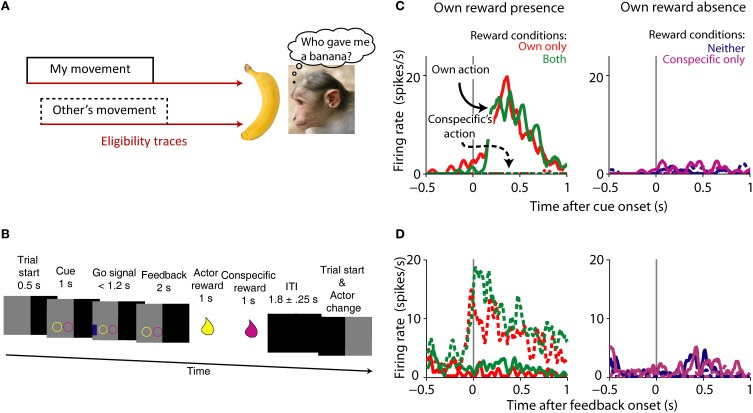
Where and how does the brain code reward during social behavior? Almost all elements of the brain's reward circuit are modulated during social behavior. The striatum in particular is activated by rewards in social situations. However, its role in social behavior is still poorly understood. Here, we attempt to review its participation in social behaviors of different species ranging from voles to humans. Human fMRI experiments show that the striatum is reliably active in relation to others' rewards, to reward inequity and also while learning about social agents. Social contact and rearing conditions have long-lasting effects on behavior, striatal anatomy and physiology in rodents and primates. The striatum also plays a critical role in pair-bond formation and maintenance in monogamous voles. We review recent findings from single neuron recordings showing that the striatum contains cells that link own reward to self or others' actions. These signals might be used to solve the agency-credit assignment problem: the question of whose action was responsible for the reward. Activity in the striatum has been hypothesized to integrate actions with rewards. The picture that emerges from this review is that the striatum is a general-purpose subcortical region capable of integrating social information into coding of social action and reward.
Overview
The claims and statistics of this paper haven’t been checked yet.
Run the check — free, no account needed. It reads the open-access text and checks the sources it cites.
Integrity signals
Registry
Cites
Statistics
Figures
Verification
Claims the paper makes
The claims and statistics of this paper haven’t been checked yet.
Run the check — free, no account needed. It reads the open-access text and checks the sources it cites.
Claims other papers make about this one
Each is checked against this paper’s own text: does it say what the citing paper says it does?
The source backs part of the claim, not all of it — or backs it for a different population, condition or comparison.
In the citing paper
“This activation is mediated by the release of dopamine, a neurotransmitter associated with pleasure and reward (Báez-Mendoza and Schultz, 2013).”
From The impact of digital technology, social media, and artificial intelligence on cognitive functions: a review (2023) · cites this paper as Báez-Mendoza and Schultz, 2013
Experimental — accuracy not yet measuredThe source backs part of the claim, not all of it — or backs it for a different population, condition or comparison.
In the citing paper
“Research has shown that excessive digital use, particularly related to activities such as social media and gaming, can trigger addictive behaviors by activating the brain's reward circuitry.”
From The impact of digital technology, social media, and artificial intelligence on cognitive functions: a review (2023) · cites this paper as Báez-Mendoza and Schultz, 2013
Experimental — accuracy not yet measured
Self-check
Percentages, sums and reported differences re-computed from the paper’s own numbers.
The self-check needs the paper’s full text.
Citations
Cites
Reinforcement Learning: An Introduction
Sutton, R. S., & Barto, A. G. (1998) · IEEE Transactions on Neural Networks · doi:10.1109/tnn.1998.712192 · Cited by 27,225
Reinforcement Learning: An Introduction
Sutton, R. S., & Barto, A. (2005) · IEEE Transactions on Neural Networks · doi:10.1109/tnn.2004.842673 · Cited by 25,268
Axelrod, R., & Hamilton, W. D. (1981) · Science · doi:10.1126/science.7466396 · Cited by 20,065
Theory of games and economic behavior
Garcia, S. R., & Miller, S. J. (2019) · American Mathematical Society eBooks · doi:10.1090/mbk/121/32 · Cited by 16,777
A Theory of Fairness, Competition, and Cooperation
Fehr, E., & Schmidt, K. M. (1999) · The Quarterly Journal of Economics · doi:10.1162/003355399556151 · Cited by 11,264
Five Rules for the Evolution of Cooperation
Nowak, M. A. (2006) · Science · doi:10.1126/science.1133755 · Cited by 5,894
ERC: A Theory of Equity, Reciprocity, and Competition
Bolton, G. E., & Ockenfels, A. (2000) · American Economic Review · doi:10.1257/aer.90.1.166 · Cited by 5,399
An experimental analysis of ultimatum bargaining
Güth, W., Schmittberger, R., & Schwarze, B. (1982) · Journal of Economic Behavior & Organization · doi:10.1016/0167-2681(82)90011-7 · Cited by 4,868
Incorporating Fairness into Game Theory and Economics
Rabin, M. (2011) · Princeton University Press eBooks · doi:10.2307/j.ctvcm4j8j.15 · Cited by 4,614
The reward circuit: linking primate anatomy and human imaging
Haber, S. N., & Knutson, B. (2010) · Neuropsychopharmacology · doi:10.1038/npp.2009.129 · Cited by 3,718
Research works printed but not linked: 3
- Báez-Mendoza R. Hoffman K. L. (2009). Object ontology in temporal lobe ensembles, in Cortical Mechanisms of Vision, 1st Edn., eds Jenkin M. Harris L. (Cambridge: Cambridge University Press), 237– 253
- Dawkins R. (2006). The Selfish Gene: – with a New Introduction by the Author. Oxford: University Press
- Hall F. S. Wilkinson L. S. Humby T. Robbins T. W. (1999). Maternal deprivation of neonatal rats produces enduring changes in dopamine function. Synapse 32, 37– 43 10188636
Cited by
Sorted by citations
Items 301–313 of 313
Apprentissage par observation chez le singe : études comportementale et électrophysiologique
Isbaine, F. (2015) · theses.fr (ABES) · doi:10.70675/8bdc5ff3z1df5z4e69z8712z4462d70bc748
Demolliens, M. (2015) · theses.fr (ABES) · doi:10.70675/a7ddf5fczc4e9z4501z8569z5ad05d12d542
Automatic speech and language processing for precision medicine in Huntington’s disease
Riad, R. (2022) · theses.fr (ABES) · doi:10.70675/1044c136z4a18z4b78zb00dz314b3b823381 · Cited by 1
A neurogenetic analysis of female autismPreprint
Sullivan, C. A. W., Gupta, A., Jack, A., & Pelphrey, K. A. (2020) · OSF Preprints (OSF Preprints)
Çeber, B. (2026) · Türkiye İletişim Araştırmaları Dergisi · doi:10.17829/turcom.1699459
Kjær, R. T., Jørgensen, M. B., & Jensen, K. H. R. (2026) · Psychiatry and Clinical Neurosciences · doi:10.1111/pcn.70112
From humans to model organisms: Translational insights into sociability and social dysfunction
Canonero, M., Chan, W. K., Hassan, N., Rasul, M., Shiadeh, S. M. J., Westberg, L., Ardalan, M., & Mallard, C. E. (2026) · Neuroscience & Biobehavioral Reviews · doi:10.1016/j.neubiorev.2026.106919
Harnessing antibodies for treating neurological disorders
Sharma, A. (2026) · Elsevier eBooks · doi:10.1016/b978-0-443-44631-3.00010-x
Henry, L., Dolk, H. M., Given, J. E., Loane, M. A., Simms, V., Slater, P. F., & Casey, F. (2026) · medRxiv · doi:10.64898/2026.09.02.26362009
Rodulfo-Cárdenas, R., Biosca-Brull, J., Barberà-Parada, S., Gabaldón-Díaz, R., Ruiz-Sobremazas, D., Blanco, J., Cabré, M., Domingo, J. L., López-Granero, C., Sánchez-Santed, F., et al. (2026) · Neurotoxicology · doi:10.1016/j.neuro.2026.103580
Zheng, Y., Han, L., Zou, M., Wang, J., Yu, M., Cui, N., Lu, X., Lei, W., & Chen, G. (2026) · Progress in Neuro-Psychopharmacology and Biological Psychiatry · doi:10.1016/j.pnpbp.2026.111977
Metadata
- Authors
- Báez-Mendoza, R., & Schultz, W.
- Affiliations
- University of Cambridge (GB)
- Corresponding author
- Báez-Mendoza, Raymundo
- Venue
- Frontiers in Neuroscience
- Publisher
- Frontiers Media SA
- Published
- 2013
- Volume
- 7
- Pages
- 233-233
- ISSN
- 1662-453X (ISSN-L)
- PMC
- PMC3857563
- OpenAlex
- W2116794070
- Cited by
- 312
- References
- 171
- Citations by year
- 2026: 18 · 2025: 22 · 2024: 23 · 2023: 27 · 2022: 38 · 2021: 36 · 2020: 26 · 2019: 32 · 2018: 21 · 2017: 22 · 2016: 17 · 2015: 19 · 2014: 11
- FWCI
- 1.59
- Type
- journal article
- Language
- en
- Open access
- gold
- doi.org
- Licence
- cc-by
- Locations
- Frontiers in Neuroscience (publishedVersion, cc-by)
- Europe PMC (PubMed Central) (publishedVersion, cc-by)
- PubMed Central (publishedVersion, cc-by)
- PubMed (publishedVersion)
- DOAJ (DOAJ: Directory of Open Access Journals) (submittedVersion, cc-by-sa)
- Funders
- Wellcome Trust (095495)
- Topics
- Life Sciences › Neuroscience › Cellular and Molecular Neuroscience › Neurotransmitter Receptor Influence on Behavior
- Life Sciences › Neuroscience › Endocrine and Autonomic Systems › Neuroendocrine regulation and behavior
- Life Sciences › Neuroscience › Cognitive Neuroscience › Neural and Behavioral Psychology Studies
- Keywords
- striatum, social behavior, reward coding, social reward, reward inequity, social learning, pair bonding, social contact, rearing conditions, single-unit recording, reward systems
About these checks
Registry, retraction, Cites and statistics results are computed, not judged, with one exception: a printed reference that no index lists is read once by a model before it counts as a citation error. Claims are extracted by a model and kept only when their quote appears verbatim in the text; each cited source is then checked, with a model’s help, for whether it says what the claim relies on. Those verdicts can be wrong — read the claim’s quote and the cited source before relying on one.
Statistics and arithmetic are recomputed, not judged.
Confidence bands are shown only for fields calibrated on our annotated test set. None is calibrated yet, so no band is shown.
What counts as a claim ›How we measure confidence ›How we check this ›
Are you an author, or do you see a problem with this page? Request a review
