

The DOI matches its Crossref record; 78 of the 78 references it cites were found in a registry or an index.
Socioeconomic status and structural brain development
Open accessAbstract
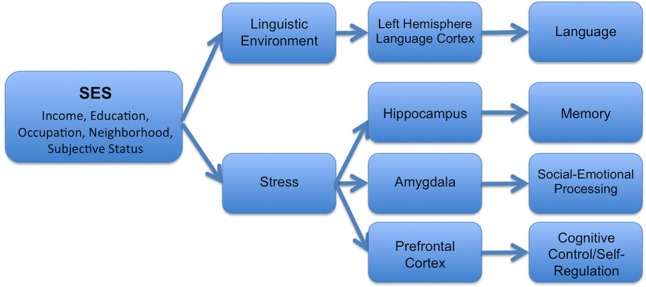
Recent advances in neuroimaging methods have made accessible new ways of disentangling the complex interplay between genetic and environmental factors that influence structural brain development. In recent years, research investigating associations between socioeconomic status (SES) and brain development have found significant links between SES and changes in brain structure, especially in areas related to memory, executive control, and emotion. This review focuses on studies examining links between structural brain development and SES disparities of the magnitude typically found in developing countries. We highlight how highly correlated measures of SES are differentially related to structural changes within the brain.
Overview
The claims and statistics of this paper haven’t been checked yet.
Run the check — free, no account needed. It reads the open-access text and checks the sources it cites.
Integrity signals
Registry
Cites
Statistics
Figures
Verification
Claims the paper makes
The claims and statistics of this paper haven’t been checked yet.
Run the check — free, no account needed. It reads the open-access text and checks the sources it cites.
Claims other papers make about this one
Each is checked against this paper’s own text: does it say what the citing paper says it does?
In the citing paper
“Recent studies indicate that socio-economic status (SES) can influence the structure of the developing brain166, 167.”
From Imaging structural and functional brain development in early childhood (2018) · cites this paper as [166]
Self-check
Percentages, sums and reported differences re-computed from the paper’s own numbers.
The self-check needs the paper’s full text.
Citations
Cites
Four Factor Index of Social Status
Paschou, R. (1975) · Cited by 6,989
Socioeconomic status and child development
Bradley, R. H., & Corwyn, R. F. (2002) · Annual Review of Psychology · doi:10.1146/annurev.psych.53.100901.135233 · Cited by 5,484
Adler, N. E., Epel, E. S., Castellazzo, G., & Ickovics, J. R. (2000) · Health Psychology · doi:10.1037/0278-6133.19.6.586 · Cited by 5,080
Meaningful Differences in the Everyday Experience of Young American Children
Panagos, R. J. (1998) · Remedial and Special Education · doi:10.1177/074193259801900609 · Cited by 4,183
Socioeconomic disadvantage and child development
McLoyd, V. C. (1998) · American Psychologist · doi:10.1037/0003-066x.53.2.185 · Cited by 3,763
Leventhal, T., & Brooks-Gunn, J. (2000) · Psychological Bulletin · doi:10.1037/0033-2909.126.2.309 · Cited by 3,550
The effects of poverty on children.
Brooks-Gunn, J., & Duncan, G. J. (1997) · The Future of Children · doi:10.2307/1602387 · Cited by 2,837
Socioeconomic status and health: The challenge of the gradient
Adler, N. E., Boyce, T., Chesney, M. A., Cohen, S., Folkman, S., Kahn, R. L., & Syme, S. L. (1994) · American Psychologist · doi:10.1037/0003-066x.49.1.15 · Cited by 2,383
Hoff, E. (2003) · Child Development · doi:10.1111/1467-8624.00612 · Cited by 2,346
Mapping cortical change across the human life span
Sowell, E. R., Peterson, B. S., Thompson, P. M., Welcome, S. E., Henkenius, A. L., & Toga, A. W. (2003) · Nature Neuroscience · doi:10.1038/nn1008 · Cited by 2,328
Cited by
Sorted by citations
Imaging structural and functional brain development in early childhood
Gilmore, J. H., Knickmeyer, R. C., & Gao, W. (2018) · Nature Reviews Neuroscience · doi:10.1038/nrn.2018.1 · Cited by 1,013
The neuroscience of socioeconomic status: Correlates, causes, and consequences
Farah, M. J. (2017) · Neuron · doi:10.1016/j.neuron.2017.08.034 · Cited by 653
State of the Art Review: Poverty and the Developing Brain
Johnson, S. B., Riis, J. L., & Noble, K. G. (2016) · Pediatrics · doi:10.1542/peds.2015-3075 · Cited by 624
Self-citationPoverty, Stress, and Brain Development: New Directions for Prevention and Intervention
Blair, C., & Raver, C. C. (2016) · Academic Pediatrics · doi:10.1016/j.acap.2016.01.010 · Cited by 543
Individual Differences in Language Acquisition and Processing
Kidd, E., Donnelly, S., & Christiansen, M. H. (2017) · Trends in Cognitive Sciences · doi:10.1016/j.tics.2017.11.006 · Cited by 560
Metadata
- Authors
- Brito, N. H., & Noble, K. G.
- Affiliations
- Columbia University (US)
- Corresponding author
- Brito, Natalie H.
- Noble, Kimberly G.
- Venue
- Frontiers in Neuroscience
- Publisher
- Frontiers Media SA
- Published
- 2014-09-04
- Volume
- 8
- Pages
- 276-276
- ISSN
- 1662-453X (ISSN-L)
- PMC
- PMC4155174
- OpenAlex
- W2031779126
- Cited by
- 525
- References
- 69
- Citations by year
- 2026: 24 · 2025: 42 · 2024: 72 · 2023: 44 · 2022: 74 · 2021: 55 · 2020: 44 · 2019: 62 · 2018: 43 · 2017: 30 · 2016: 21 · 2015: 13
- FWCI
- 29.60
- Type
- journal article
- Language
- en
- Open access
- gold
- doi.org
- Licence
- cc-by
- Locations
- Frontiers in Neuroscience (publishedVersion, cc-by)
- Europe PMC (PubMed Central) (publishedVersion, cc-by)
- PubMed Central (publishedVersion, cc-by)
- PubMed (publishedVersion)
- DOAJ (DOAJ: Directory of Open Access Journals) (submittedVersion, cc-by-sa)
- Funders
- Robert Wood Johnson Foundation
- Topics
- Social Sciences › Psychology › Experimental and Cognitive Psychology › Cognitive Abilities and Testing
- Social Sciences › Health › Health disparities and outcomes
- Social Sciences › Psychology › Clinical Psychology › Child Abuse and Trauma
- Keywords
- socioeconomic status, structural brain development, brain structure, socioeconomic disparities, developing countries, gene-environment interaction, memory, executive function, emotions
About these checks
Registry, retraction, Cites and statistics results are computed, not judged, with one exception: a printed reference that no index lists is read once by a model before it counts as a citation error. Claims are extracted by a model and kept only when their quote appears verbatim in the text; each cited source is then checked, with a model’s help, for whether it says what the claim relies on. Those verdicts can be wrong — read the claim’s quote and the cited source before relying on one.
Statistics and arithmetic are recomputed, not judged.
Confidence bands are shown only for fields calibrated on our annotated test set. None is calibrated yet, so no band is shown.
What counts as a claim ›How we measure confidence ›How we check this ›
Are you an author, or do you see a problem with this page? Request a review
