

The DOI matches its Crossref record; 234 of the 235 references it cites were found in a registry or an index.
Autism As a Disorder of High Intelligence
Open accessAbstract
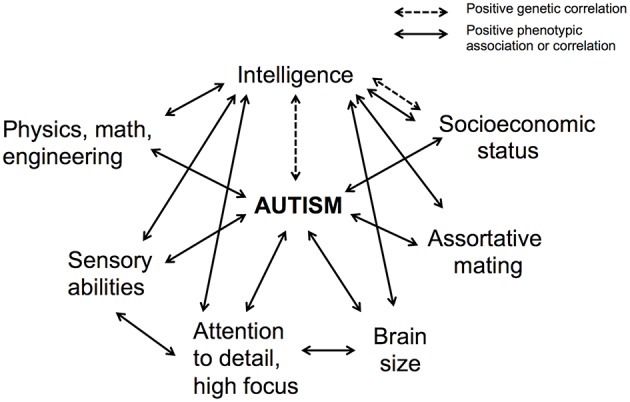
A suite of recent studies has reported positive genetic correlations between autism risk and measures of mental ability. These findings indicate that alleles for autism overlap broadly with alleles for high intelligence, which appears paradoxical given that autism is characterized, overall, by below-average IQ. This paradox can be resolved under the hypothesis that autism etiology commonly involves enhanced, but imbalanced, components of intelligence. This hypothesis is supported by convergent evidence showing that autism and high IQ share a diverse set of convergent correlates, including large brain size, fast brain growth, increased sensory and visual-spatial abilities, enhanced synaptic functions, increased attentional focus, high socioeconomic status, more deliberative decision-making, profession and occupational interests in engineering and physical sciences, and high levels of positive assortative mating. These findings help to provide an evolutionary basis to understanding autism risk as underlain in part by dysregulation of intelligence, a core human-specific adaptation. In turn, integration of studies on intelligence with studies of autism should provide novel insights into the neurological and genetic causes of high mental abilities, with important implications for cognitive enhancement, artificial intelligence, the relationship of autism with schizophrenia, and the treatment of both autism and intellectual disability.
Overview
The claims and statistics of this paper haven’t been checked yet.
Run the check — free, no account needed. It reads the open-access text and checks the sources it cites.
Integrity signals
Registry
Cites
Statistics
Figures
Verification
Claims the paper makes
The claims and statistics of this paper haven’t been checked yet.
Run the check — free, no account needed. It reads the open-access text and checks the sources it cites.
Claims other papers make about this one
Each is checked against this paper’s own text: does it say what the citing paper says it does?
The source backs part of the claim, not all of it — or backs it for a different population, condition or comparison.
In the citing paper
“Some gifted profiles might share socio-emotional problems with highfunctioning autism, mainly regarding social abilities, adaptation disorders, withdrawal in imaginary and/or intellectual abstraction, attention deficit, clumsiness, excessive attention to restricted interests, and hypersensitivity [7, 15, 16].”
From Behavioral and Socio-Emotional Disorders in Intellectual Giftedness: A Systematic Review (2024) · cites this paper as [16]
Experimental — accuracy not yet measuredThe source backs part of the claim, not all of it — or backs it for a different population, condition or comparison.
In the citing paper
“Notably, it was proposed that the higher cognitive capacities in humans were acquired at the cost of increased susceptibility to mental disease17–19.”
From Distinct selective forces and Neanderthal introgression shaped genetic diversity at genes involved in neurodevelopmental disorders (2017) · cites this paper as [19]
Experimental — accuracy not yet measured
Self-check
Percentages, sums and reported differences re-computed from the paper’s own numbers.
The self-check needs the paper’s full text.
Citations
Cites
Shrestha, S., & Offer, S. M. (2016) · Medical Epigenetics · doi:10.1159/000444713 · Cited by 8,951
(1943) · The Nervous child · Cited by 8,870
"General Intelligence," Objectively Determined and Measured
Spearman, C. (1904) · The American Journal of Psychology · doi:10.2307/1412107 · Cited by 6,207
An atlas of genetic correlations across human diseases and traits
ReproGen Consortium, Bulik-Sullivan, B., Psychiatric Genomics Consortium, Genetic Consortium for Anorexia Nervosa of the Wellcome Trust Case Control Consortium 3, Finucane, H. K., Anttila, V., Gusev, A., Day, F. R., Loh, P.-R., Duncan, L., et al. (2015) · Nature Genetics · doi:10.1038/ng.3406 · Cited by 4,255
The weak coherence account: detail-focused cognitive style in autism spectrum disorders
Happé, F., & Frith, U. (2006) · Journal of Autism and Developmental Disorders · doi:10.1007/s10803-005-0039-0 · Cited by 2,884
Model of autism: increased ratio of excitation/inhibition in key neural systems
Rubenstein, J. L. R., & Merzenich, M. M. (2003) · Genes, Brain and Behavior · doi:10.1034/j.1601-183x.2003.00037.x · Cited by 2,768
Mental Rotations, a Group Test of Three-Dimensional Spatial Visualization
Vandenberg, S. G., & Kuse, A. R. (1978) · Perceptual and Motor Skills · doi:10.2466/pms.1978.47.2.599 · Cited by 2,620
Autistic disturbances of affective contact.
Kanner, L. (1968) · PubMed · Cited by 2,282
Genetic relationship between five psychiatric disorders estimated from genome-wide SNPs
Cross-Disorder Group of the Psychiatric Genomics Consortium (2013) · Nature Genetics · doi:10.1038/ng.2711 · Cited by 2,263
Wai, J., Lubinski, D., & Benbow, C. P. (2009) · Journal of Educational Psychology · doi:10.1037/a0016127 · Cited by 2,004
Research works printed but not linked: 2
- Crespi, 2016, The evolutionary biology of human neurodevelopment: evo-neuro-devo comes of age, 205
- Hauser, 2002, Meritocracy, Cognitive Ability, and the Sources of Occupational Success
Cited by
Sorted by citations
Getting to the cores of autism
Iakoucheva, L. M., Muotri, A. R., & Sebat, J. (2019) · Cell · doi:10.1016/j.cell.2019.07.037 · Cited by 260
“This result has led to fascinating speculation as to the potential causative relationship of high intelligence to ASD (Crespi, 2016), but a rigorous dissection of the relationship of ASD PRS with intelligence in the general population is needed.”
BackgroundAntaki, D., Guevara, J., Maihofer, A. X., Klein, M., Gujral, M., Grove, J., Carey, C. E., Hong, O., Arranz, M. J., Hervas, A., et al. (2022) · Nature Genetics · doi:10.1038/s41588-022-01064-5 · Cited by 206
Peñuelas‐Calvo, I., Sareen, A., Sevilla‐Llewellyn‐Jones, J., & Fernández‐Berrocal, P. (2018) · Journal of Autism and Developmental Disorders · doi:10.1007/s10803-018-3814-4 · Cited by 130
Hou, Q.-L., Wang, Y., Li, Y., Chen, D., Yang, F., & Wang, S. (2018) · Frontiers in Behavioral Neuroscience · doi:10.3389/fnbeh.2018.00182 · Cited by 115
Saleh, M. W. A., & Mansour, M. (2024) · Accounting Research Journal · doi:10.1108/arj-04-2023-0106 · Cited by 127
Metadata
- Authors
- Crespi, B. J.
- Affiliations
- Simon Fraser University (CA)
- Corresponding author
- Crespi, Bernard J.
- ORCID
- Crespi, Bernard J.
- Venue
- Frontiers in Neuroscience
- Publisher
- Frontiers Media SA
- Published
- 2016-06-30
- Volume
- 10
- Pages
- 300-300
- ISSN
- 1662-453X (ISSN-L)
- PMC
- PMC4927579
- OpenAlex
- W2470385410
- Cited by
- 156
- References
- 235
- Citations by year
- 2026: 8 · 2025: 12 · 2024: 18 · 2023: 24 · 2022: 24 · 2021: 22 · 2020: 19 · 2019: 13 · 2018: 10 · 2017: 4 · 2016: 1
- FWCI
- 5.94
- Type
- journal article
- Language
- en
- Open access
- gold
- doi.org
- Licence
- cc-by
- Locations
- Frontiers in Neuroscience (publishedVersion, cc-by)
- Europe PMC (PubMed Central) (publishedVersion, cc-by)
- PubMed Central (publishedVersion, cc-by)
- PubMed (publishedVersion)
- Funders
- Natural Sciences and Engineering Research Council of Canada (311201)
- Topics
- Life Sciences › Neuroscience › Cognitive Neuroscience › Autism Spectrum Disorder Research
- Life Sciences › Biochemistry, Genetics and Molecular Biology › Genetics › Genetics and Neurodevelopmental Disorders
- Social Sciences › Psychology › Experimental and Cognitive Psychology › Cognitive Abilities and Testing
- Keywords
- autism spectrum disorder, high IQ, genetic correlation, IQ, brain size, brain growth, visuospatial ability, sensory abilities, synaptic function, attention, socioeconomic status, decision-making, career interest, assortative mating, autism etiology, schizophrenia, intellectual disability, cognitive enhancement
About these checks
Registry, retraction, Cites and statistics results are computed, not judged, with one exception: a printed reference that no index lists is read once by a model before it counts as a citation error. Claims are extracted by a model and kept only when their quote appears verbatim in the text; each cited source is then checked, with a model’s help, for whether it says what the claim relies on. Those verdicts can be wrong — read the claim’s quote and the cited source before relying on one.
Statistics and arithmetic are recomputed, not judged.
Confidence bands are shown only for fields calibrated on our annotated test set. None is calibrated yet, so no band is shown.
What counts as a claim ›How we measure confidence ›How we check this ›
Are you an author, or do you see a problem with this page? Request a review
