

Combining the unequal variance signal detection model with the health belief model to optimize shared decision making in tinnitus patients: part 2—patient profiling
Open accessThe DOI matches its Crossref record; 35 of the 36 references it cites were found in a registry or an index; 24 of the 30 sources its claims cite were checked for support.
Abstract
Introduction: Tinnitus affects approximately 14% of the population. Its symptomatology is versatile, ranging from mild annoyance to anxiety and depression. Current multidisciplinary treatments (psychological, audiological, and combinations) focus on impact reduction and acceptance. Shared decision making (SDM) promotes patients and health care professionals making treatment choices together based on the best available evidence. In the case of professional equipoise (no clear clinical evidence for superiority of a treatment), knowledge about individual factors influencing the outcome of patient decisions can be of utmost importance in informing the SDM process. Methods: A statistical model that was developed in previous work to analyze tinnitus patient decisions, was extended to analyze how patient characteristics on sex, age, and laterality of tinnitus affect the accuracy and utility of decisions concerning audiological care and cognitive behavioral therapy (CBT) based psychosocial counseling. For each group, we calculated Receiver-Operator-Characteristic curves and likelihood ratio curves as function of hearing loss and pre-treatment tinnitus impact to assess accuracy and utility of decisions for audiological care and CBT-based counseling, respectively. Results: The largest effect was found for sex differences. The results indicated that males used a strict decision criterion when deciding about psychosocial counseling, while females used a strict decision criterion for decisions about audiological care. The likelihood ratios of a successful treatment versus unsuccessful treatment are smaller than 1 for psychosocial counseling for females and for audiological care for males. The likelihood ratios of success are approximately 2 and almost 7 for audiological care for females and psychosocial counseling for males, respectively. For age differences, older participants adopted a more lenient decision criterion for audiological care across most of the hearing loss range, while younger participants adopt a stricter decision criterion up to hearing losses of approximately 75 dB(HL). For psychosocial counseling, older participants adopted an unbiased criterion and younger participants a strict decision criterion. For the younger group, psychological counseling seems more likely to be successful compared to the older group. When considering laterality, for audiological care the group with unilateral tinnitus adopted a strict decision criterion for the whole range of hearing loss, while the group with bilateral tinnitus adopted a strict decision criterion for hearing losses above approximately 70 dB(HL). For decisions about psychosocial counseling, the unilateral tinnitus group adopt a strict decision criterion for baseline THI-scores between approximately 25 and 90 points. The bilateral tinnitus group adopted an unbiased to strict decision criterion for psychosocial counseling for the entire baseline THI-score range. Discussion: These findings underscore the importance of personalized treatment approaches based on specific patient characteristics and the need for further research to test and improve these findings. Especially males may be more strongly advised to take up psychosocial counseling and females may be more strongly advised to take up audiological care. For age and laterality, the results are more diffuse. Copyright © 2025 Lehóczky, Smit, Kaldenbach, Lieftink, Versnel, Stokroos and Hoetink.
Overview
CoChat Summary
## TL;DR
This study extended a signal-detection/health-belief model to profile tinnitus patients’ treatment decisions for audiological care and CBT-based psychosocial counseling by sex, age, and tinnitus laterality. The main pattern was that individual differences were most pronounced by sex, with smaller and more diffuse differences by age and laterality.
## Key findings
- In the final cohort, there were 143 participants; mean age was 56 (13) years, mean hearing loss was 61 (27) dB(HL), and median baseline THI score was 42 (32).
- For the whole cohort, the decision for SEDEP and hearing loss had an intercept not significantly different from zero and a slope not significantly different from one; for PCU and THI-score, the intercept was smaller than zero and the slope was not significantly different from one, though close to being significantly larger than one.
- The largest effect was sex: for SEDEP, males had an intercept smaller than zero and slope smaller than one, while females had an intercept and slope larger than zero/one; for PCU, the slope differed from one for both sexes, with males larger than one and females smaller than one.
- For age, participants younger than 55 years showed a strict decision criterion for SEDEP up to about 75 dB(HL), while those 55 years and older were described as slightly lenient for SEDEP; for laterality, the bilateral group had a slope smaller than one for SEDEP and the unilateral group a slope larger than one.
## Methods
- Design and setting: Exploratory analysis of clinical data collected by convenience sampling over two years from an outpatient audiology clinic in Alkmaar, The Netherlands.
- Sample: 150 people with subjective tinnitus were initially included; after exclusions and missing decision data, 145 remained and 143 were analyzed for the psychosocial counseling decision.
- Analysis: The authors extended a prior signal detection theory model and stratified it by sex, age, and tinnitus laterality; they estimated logistic distribution parameters with Bayesian inference, used ROC curves and likelihood ratio curves, and applied leave-one-out bootstrapping plus random partitions for hypothesis testing.
## Limitations
- The authors state that using clinical practice data “inevitably leads to selection bias” and that the findings cannot be directly generalized to the overall population because the sample came from a specific audiological center and had increased hearing loss.
- They state that the analysis was done factor by factor, excluding multifactorial variances such as differences between older and younger females.
- Evident from the text: the study is exploratory, depends on a single clinic cohort, and had missing post-treatment THI data (post-treatment response rate 63%), which may affect precision.
Model-written summary. Check it against the paper before relying on it.
Integrity signals
Registry
Cites
Statistics
Figures
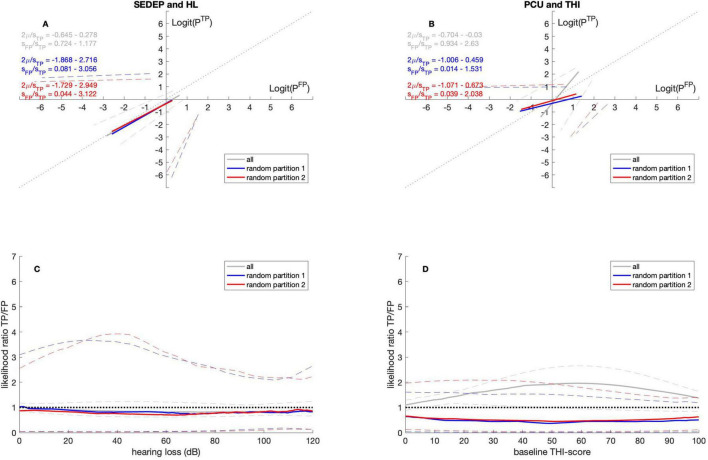
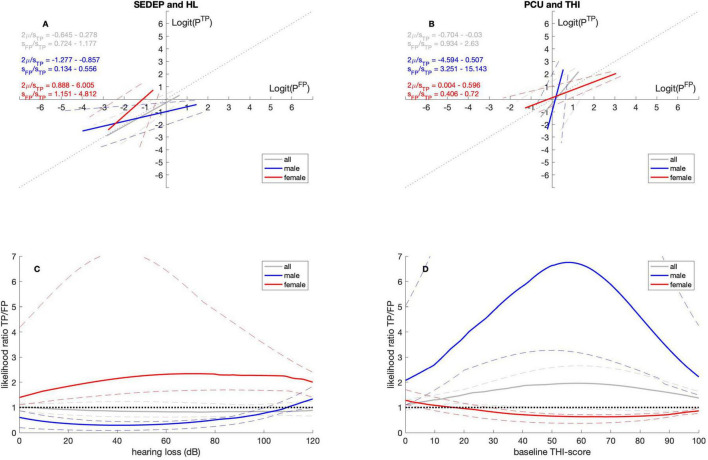
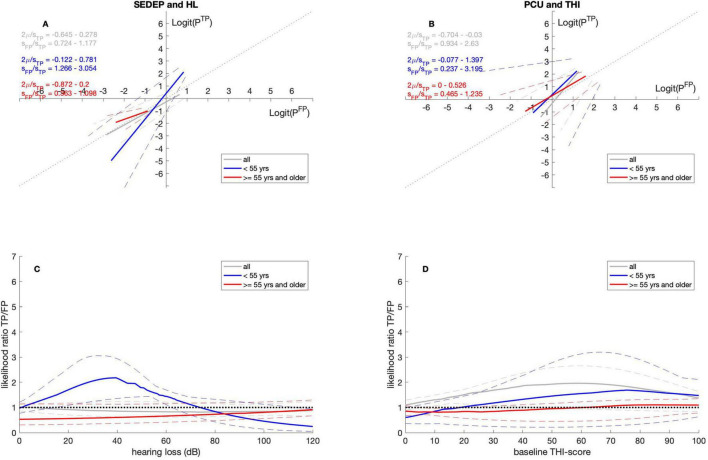
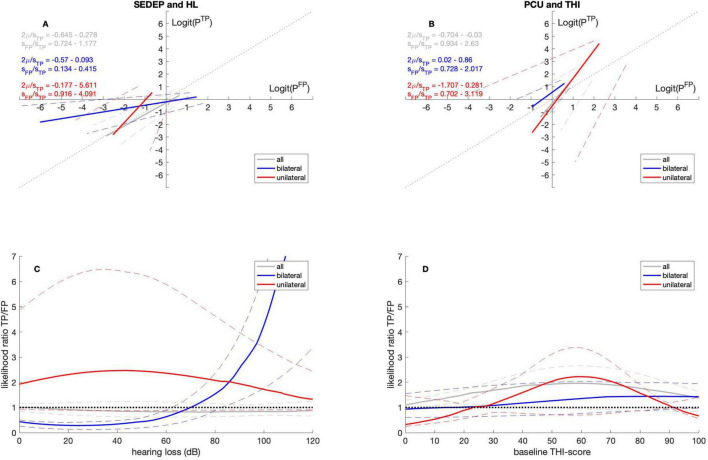
Verification
Claims the paper makes
16 Valid · 1 Not valid · 5 Not checked · 104 Own results and interpretations
Some cited sources support this claim and some don’t — read each source’s verdict below.
In the paper
“Despite the extensive literature, there is little consensus on treatment effectiveness for chronic tinnitus (Fuller et al., 2020; Marks et al., 2019).”
§ Combining the unequal variance signal detection model with the health belief model to optimize shared decision making in tinnitus patients: part 2—patient profiling > 1 Introduction
What the sources say
- Supportedcites Fuller et al., 2020 matched to “Cognitive behavioural therapy for tinnitus” (2020) source
The 'Diagnosis and clinical management of tinnitus' section says that the effects of management options are variable and their outcomes inconclusive. It also says there is no universally established standard procedure for tinnitus management, supporting the broad claim of limited consensus. The review separately finds more consistent evidence for CBT specifically. (LLM, conf=0.84)
- Disputedcites Marks et al., 2019 matched to “Living with tinnitus and the health care journey: An interpretative phenomenological analysis.” (2019) sourceExperimental — accuracy not yet measured
The Introduction (page unavailable) describes a robust evidence base for cognitive behavioural therapy, and the Discussion (page unavailable) identifies CBT and mindfulness-based cognitive therapy as the most effective approaches. Rather than describing little consensus about effectiveness, the paper presents these treatments as effective, while distinguishing relief of tinnitus-related distress from a biomedical cure. (LLM, conf=0.76)
Checked by a reasoning model — may be wrong.
plain- Asserted: passes — The authors put it forward as true.
- Checkable: passes — It can be checked against evidence.
- Load-bearing: passes — The paper’s conclusions depend on it.
- Based: passes — The paper gives a reason why it holds.
- Supported
The cited sources support only part of this claim — read each source’s verdict below.
In the paper
“There is a lack of reliable and consistent evidence on the efficacy of the individual and combination treatments, such as audiological care and psychological treatment.”
§ Combining the unequal variance signal detection model with the health belief model to optimize shared decision making in tinnitus patients: part 2—patient profiling > 1 Introduction
What the sources say
- Partly supportedcites Fuller et al., 2020 matched to “Cognitive behavioural therapy for tinnitus” (2020) sourceExperimental — accuracy not yet measured
The Completeness section (page unavailable) says there were too few studies comparing CBT with audiological care or tinnitus retraining therapy to reach a conclusion, and that evidence for comparisons with other active interventions was of low certainty. But it also reports moderate-certainty evidence that CBT is superior to wait-list control at the end of treatment. The review therefore supports uncertainty about some comparisons, not a general lack of reliable evidence for all individual and combination tinnitus treatments. (LLM, conf=0.86)
- Partly supportedcites Hoare et al., 2014 matched to “Amplification with hearing aids for patients with tinnitus and co-existing hearing loss.” (2014) sourceExperimental — accuracy not yet measured
The Authors’ conclusions (page not provided) say the evidence for hearing aids in tinnitus management is limited. The Description of the intervention (page not provided) reports mixed evidence for combining hearing aids with counselling. The review does not establish a lack of reliable evidence for individual psychological treatments or for tinnitus treatments generally. (LLM, conf=0.88)
- Partly supportedcites Sereda et al., 2018 matched to “Sound therapy (using amplification devices and/or sound generators) for tinnitus.” (2018) sourceExperimental — accuracy not yet measured
The Authors’ conclusions (Background; page unavailable) find low-quality evidence and insufficient evidence to compare hearing aids, sound generators, and combination devices. The review concerns sound therapy, however, and does not establish a lack of reliable evidence for psychological treatment or for audiological care and psychological treatment combined. (LLM, conf=0.87)
plain- Asserted: passes — The authors put it forward as true.
- Checkable: passes — It can be checked against evidence.
- Load-bearing: passes — The paper’s conclusions depend on it.
- Based: passes — The paper gives a reason why it holds.
- Partly supported
The cited sources support only part of this claim — read each source’s verdict below.
In the paper
“This is due to different study designs and lack of reproducible results (Fuller et al., 2020; Hoare et al., 2014; Sereda et al., 2018).”
§ Combining the unequal variance signal detection model with the health belief model to optimize shared decision making in tinnitus patients: part 2—patient profiling > 1 Introduction
What the sources say
- Partly supportedcites Fuller et al., 2020 matched to “Cognitive behavioural therapy for tinnitus” (2020) sourceExperimental — accuracy not yet measured
The Quality of the evidence section (page unavailable) says that inconsistency between results lowered certainty for some CBT comparisons, and Assessment of heterogeneity (page unavailable) considers differences in study design. The paper does not establish that different designs and a lack of reproducible results explain unreliable evidence for tinnitus treatments generally; its findings concern CBT specifically. (LLM, conf=0.86)
- Partly supportedcites Hoare et al., 2014 matched to “Amplification with hearing aids for patients with tinnitus and co-existing hearing loss.” (2014) sourceExperimental — accuracy not yet measured
The Authors’ conclusions say evidence for hearing aids as a tinnitus intervention is limited, and the Quality of the evidence section identifies design and outcome-measure limitations. But the review included only one RCT; it does not attribute the evidence gap to differences between study designs or to a lack of reproducible results. No page numbers are available in our copy. (LLM, conf=0.85)
- Partly supportedcites Sereda et al., 2018 matched to “Sound therapy (using amplification devices and/or sound generators) for tinnitus.” (2018) sourceExperimental — accuracy not yet measured
The Discussion (page unavailable) says evidence for the effectiveness of sound therapy is lacking, and identifies study limitations including risk of bias and imprecision. It does not attribute that gap to a lack of reproducible results; the Methods (page unavailable) instead describes three pooled studies as having similar, non-significant effect estimates. The review also concerns sound therapy specifically, rather than tinnitus treatments generally. (LLM, conf=0.84)
plainstates a cause- Asserted: passes — The authors put it forward as true.
- Checkable: passes — It can be checked against evidence.
- Load-bearing: passes — The paper’s conclusions depend on it.
- Based: passes — The paper gives a reason why it holds.
- Partly supported
The cited sources support only part of this claim — read each source’s verdict below.
In the paper
“Help-seeking is found to be most positively correlated with self-perceived hearing limitation (Rademaker et al., 2021; Vestergaard Knudsen et al., 2010) and tinnitus impact on quality of life (Rademaker et al., 2021).”
§ Combining the unequal variance signal detection model with the health belief model to optimize shared decision making in tinnitus patients: part 2—patient profiling > 1 Introduction
What the sources say
- Partly supportedcites Rademaker et al., 2021 matched to “Differences in characteristics between people with tinnitus that seek help and that do not.” (2021) sourceExperimental — accuracy not yet measured
In the Results (Comparison of help seekers versus non-help seekers; page unavailable), self-reported hearing problems were more frequent among help seekers (76.7%) than non-help seekers (55.6%). This supports a positive association, but the paper does not identify perceived hearing limitation as the strongest correlate of help-seeking; the same section reports substantial associations with perceived tinnitus severity. (LLM, conf=0.86)
- Partly supportedcites Vestergaard Knudsen et al., 2010 matched to “Factors influencing help seeking, hearing aid uptake, hearing aid use and satisfaction with hearing aids: A review of the literature.” (2010) sourceExperimental — accuracy not yet measured
The Results (Table 6; page unavailable) report a positive association between self-reported hearing problems and help-seeking in all three studies summarized. The Discussion calls self-perceived hearing difficulty a very important determinant, but the paper does not establish that it has the strongest positive correlation with help-seeking among all factors. (LLM, conf=0.85)
plainstates an association- Asserted: passes — The authors put it forward as true.
- Checkable: passes — It can be checked against evidence.
- Load-bearing: unclear — It is unclear whether the paper’s conclusions depend on it.
- Based: passes — The paper gives a reason why it holds.
- Partly supported
The cited sources support only part of this claim — read each source’s verdict below.
In the paper
“Help-seeking is found to be most positively correlated with self-perceived hearing limitation (Rademaker et al., 2021; Vestergaard Knudsen et al., 2010) and tinnitus impact on quality of life (Rademaker et al., 2021).”
§ Combining the unequal variance signal detection model with the health belief model to optimize shared decision making in tinnitus patients: part 2—patient profiling > 1 Introduction
What the sources say
- Partly supportedcites Rademaker et al., 2021 matched to “Differences in characteristics between people with tinnitus that seek help and that do not.” (2021) sourceExperimental — accuracy not yet measured
The Results (Comparison of help seekers versus non-help seekers; page not provided) report that people with higher Tinnitus Functional Index scores were more likely to seek help. The Methods (Outcome assessment; page not provided) say the index measures tinnitus’s impact on daily life, including quality of life. The paper does not establish that quality-of-life impact is the factor *most* positively associated with help-seeking. (LLM, conf=0.82)
plainstates an association- Asserted: passes — The authors put it forward as true.
- Checkable: passes — It can be checked against evidence.
- Load-bearing: unclear — It is unclear whether the paper’s conclusions depend on it.
- Based: passes — The paper gives a reason why it holds.
- Partly supported
82 more claims · 7 with their cited sources checked
Create a free account to see all 126 claims and every source verdict.
- Probably not a substantial claim. 21
- It may state two separate claims as one. 21
- The quote only partly states this claim. 3
Statistics that don’t add up
Each reported p-value recomputed from its test statistic and degrees of freedom, each partial η² from its F, and each ratio, mean difference or B printed with a p checked against its own confidence interval.
Rated minor: it would not touch a result — a value no result rests on, a p-value that stays on the same side of the significance level, or a conflict that is clerical, resolved elsewhere in the paper, or outside its own findings.
In the paper
“F(22, 142) = 1.71, p = 0.036”
§ Combining the unequal variance signal detection model with the health belief model to optimize shared decision making in tinnitus patients: part 2—patient profiling > 3 Results > 3.1 Descriptive statistics
Reported p = .036 · recomputed p = .033
Statistics recomputed
Every reported test result, recomputed from its test statistic and degrees of freedom. A result shows as not adding up only once an independent check has confirmed it.
- Doesn’t add upF(22, 142) = 1.71reported p = .036 · recomputed p = .033
“F(22, 142) = 1.71, p = .036”
- ConsistentF(22, 142) = 2.46reported p = .001 · recomputed p < .001
“F(22, 142) = 2.46, p = .001”
Self-check
Percentages, sums and reported differences re-computed from the paper’s own numbers.
Self-check results appear here once an independent check has confirmed them.
Citations
Cites
Shared decision making: A model for clinical practice
Elwyn, G., Frosch, D., Thomson, R., Joseph-Williams, N., Lloyd, A., Kinnersley, P., Cording, E., Tomson, D., Dodd, C., Rollnick, S., et al. (2012) · Journal of General Internal Medicine · doi:10.1007/s11606-012-2077-6 · Cited by 4,405 · cited 1×
“Elwyn et al. (2010) and Elwyn et al. (2012) promote the importance that practices are adopted to the patient’s decision-making process and priorities.”
Baguley, D., McFerran, D., & Hall, D. (2013) · The Lancet · doi:10.1016/s0140-6736(13)60142-7 · Cited by 1,245
Implementing shared decision making in the NHS
Elwyn, G., Laitner, S., Coulter, A., Walker, E., Watson, P., & Thomson, R. (2010) · BMJ · doi:10.1136/bmj.c5146 · Cited by 1,090 · cited 2×
“Elwyn et al. (2010) and Elwyn et al. (2012) promote the importance that practices are adopted to the patient’s decision-making process and priorities.”
Shared decision making: really putting patients at the centre of healthcare
Stiggelbout, A. M., Weijden, T. V. D., Wit, M. P. T. D., Frosch, D., Legare, F., Montori, V. M., Trevena, L., & Elwyn, G. (2012) · BMJ · doi:10.1136/bmj.e256 · Cited by 1,014 · cited 1×
“To assist a tinnitus patient effectively and sensitively in shared decision making (SDM), health care professionals have to understand the influence different personal factors may have on the individual’s preferences (Stiggelbout et al., 2012).”
Psychological Science Can Improve Diagnostic Decisions
Swets, J. A., Dawes, R. M., & Monahan, J. (2000) · Psychological Science in the Public Interest · doi:10.1111/1529-1006.001 · Cited by 868
(2000) · Europe PMC (PubMed Central) · Cited by 737
General Review of Tinnitus: Prevalence, Mechanisms, Effects, and Management
Henry, J. A., Dennis, K. C., & Schechter, M. A. (2005) · Journal of Speech, Language, and Hearing Research · doi:10.1044/1092-4388(2005/084 · Cited by 615
Global Prevalence and Incidence of Tinnitus: A Systematic Review and Meta-analysis
Jarach, C. M., Lugo, A., Scala, M., van den Brandt, P. A., Cederroth, C. R., Odone, A., Garavello, W., Schlee, W., Langguth, B., & Gallus, S. (2022) · JAMA Neurology · doi:10.1001/jamaneurol.2022.2189 · Cited by 548
Vestergaard Knudsen, L., Öberg, M., Nielsen, C., Naylor, G., & Kramer, S. E. (2010) · Trends in Amplification · doi:10.1177/1084713810385712 · Cited by 494
De Ridder, D., Vanneste, S., Weisz, N., Londero, A., Schlee, W., Elgoyhen, A. B., & Langguth, B. (2014) · Neuroscience & Biobehavioral Reviews · doi:10.1016/j.neubiorev.2013.03.021 · Cited by 398
Liddon, L., Kingerlee, R., & Barry, J. A. (2018) · British Journal of Clinical Psychology · doi:10.1111/bjc.12147 · Cited by 387 · cited 2×
“…as stigma, masculine ideals and less gender-sensitive therapy options have been reported to contribute to men’s hesitation in seeking psychological help (Cooper et al., 2019; Güney et al., 2024) despite experiencing higher rates of psychological struggles (Cooper et al., 2019; Liddon et al., 2018).”
An integrative tinnitus model based on sensory precision.
Sedley, W., Friston, K. J., Gander, P. E., Kumar, S., & Griffiths, T. D. (2016) · Trends in Neurosciences · doi:10.1016/j.tins.2016.10.004 · Cited by 237
Tinnitus Handicap Inventory for Evaluating Treatment Effects: Which Changes Are Clinically Relevant?
Zeman, F., Koller, M., Figueiredo, R., Aazevedo, A., Rates, M., Coelho, C., Kleinjung, T., de Ridder, D., Langguth, B., & Landgrebe, M. (2011) · Otolaryngology–Head and Neck Surgery · doi:10.1177/0194599811403882 · Cited by 234
Cognitive behavioural therapy for tinnitus
Fuller, T., Cima, R., Langguth, B., Mazurek, B., Vlaeyen, J. W., & Hoare, D. J. (2020) · Cochrane Database of Systematic Reviews · doi:10.1002/14651858.cd012614.pub2 · Cited by 212
Amplification with hearing aids for patients with tinnitus and co-existing hearing loss.
Hoare, D. J., Edmondson-Jones, M., Sereda, M., Akeroyd, M. A., & Hall, D. (2014) · Cochrane Database of Systematic Reviews · doi:10.1002/14651858.cd010151.pub2 · Cited by 170
Krauß, P., Tziridis, K., Metzner, C., Schilling, A., Hoppe, U., & Schulze, H. (2016) · Frontiers in Neuroscience · doi:10.3389/fnins.2016.00597 · Cited by 145
Sound therapy (using amplification devices and/or sound generators) for tinnitus.
Sereda, M., Xia, J., El Refaie, A., Hall, D. A., & Hoare, D. J. (2018) · Cochrane Database of Systematic Reviews · doi:10.1002/14651858.cd013094.pub2 · Cited by 135
Help-Seeking Behaviors Among Older Adults: A Scoping Review
Teo, K., Churchill, R., Riadi, I., Kervin, L. M., Wister, A., & Cosco, T. D. (2022) · Journal of Applied Gerontology · doi:10.1177/07334648211067710 · Cited by 127
The Neural Bases of Tinnitus: Lessons from Deafness and Cochlear Implants
Knipper, M., van Dijk, P., Schulze, H., Mazurek, B., Krauss, P., Scheper, V., Warnecke, A., Schlee, W., Schwabe, K., Singer, W., et al. (2020) · The Journal of Neuroscience · doi:10.1523/jneurosci.1314-19.2020 · Cited by 111
Vanneste, S., Joos, K., & Ridder, D. D. (2012) · PLoS ONE · doi:10.1371/journal.pone.0031182 · Cited by 89 · cited 1×
“For instance, women are more likely to exhibit emotional reactions, such as depressive states, to the diagnosis compared to men, suggesting a greater impact on their quality of life (Vanneste et al., 2012).”
Association Between Stress and Tinnitus—New Aspects
Mazurek, B., Boecking, B., & Brüeggemann, P. (2019) · Otology & Neurotology · doi:10.1097/mao.0000000000002180 · Cited by 86 · cited 1×
“Most research highlights genetic, cognitive, and behavioral variations in tinnitus (Mazurek et al., 2019).”
Gender differences in psychological help-seeking attitudes: a case in Türkiye
Güney, E., Aydemir, A. F., İyit, N., & Alkan, Ö. (2024) · Frontiers in Psychology · doi:10.3389/fpsyg.2024.1289435 · Cited by 80
Tinnitus characteristics in tinnitus complainers and noncomplainers.
Hallberg, L. R. M., & Erlandsson, S. I. (1993) · British Journal of Audiology · doi:10.3109/03005369309077885 · Cited by 74 · cited 2×
“Furthermore, unilateral tinnitus seemed negatively associated with treatment outcomes (Hallberg and Erlandsson, 1993).”
Predictive coding and stochastic resonance as fundamental principles of auditory phantom perception.
Schilling, A., Sedley, W., Gerum, R., Metzner, C., Tziridis, K., Maier, A., Schulze, H., Zeng, F.-G., Friston, K. J., & Krauss, P. (2023) · Brain · doi:10.1093/brain/awad255 · Cited by 70
Lim, M. T., Lim, Y. M. F., Tong, S. F., & Sivasampu, S. (2019) · PLoS ONE · doi:10.1371/journal.pone.0224260 · Cited by 69
Psychotherapy preferences of laypersons and mental health professionals: Whose therapy is it?
Cooper, M., Norcross, J. C., Raymond‐Barker, B., & Hogan, T. P. (2019) · Psychotherapy · doi:10.1037/pst0000226 · Cited by 60
Langguth, B., & De Ridder, D. (2023) · Journal of Clinical Medicine · doi:10.3390/jcm12227117 · Cited by 44
Living with tinnitus and the health care journey: An interpretative phenomenological analysis.
Marks, E., Smith, P., & McKenna, L. (2019) · British Journal of Health Psychology · doi:10.1111/bjhp.12351 · Cited by 43
Treatment of tinnitus: A scoping review.
Makar, S. K., Mukundan, G., & Gore, G. (2017) · The International Tinnitus Journal · doi:10.5935/0946-5448.20170027 · Cited by 40
Gender Differences in Help‐Seeking: A Meta‐analysis of Japanese Studies, Including Unreported Data 1
Nagai, S., Kimura, M., Honda, M., Iida, T., & Mizuno, H. (2023) · Japanese Psychological Research · doi:10.1111/jpr.12467 · Cited by 30
Searchfield, G. D. (2020) · Current topics in behavioral neurosciences · doi:10.1007/7854_2020_183 · Cited by 23 · cited 1×
“These, respectively, aim to replace the disturbing perception of tinnitus with another more pleasant sound or to reduce the sensitivity of the auditory system by restoring afferent input (Searchfield, 2021).”
Differences in characteristics between people with tinnitus that seek help and that do not.
Rademaker, M. M., Stegeman, I., Brabers, A. E. M., de Jong, J. D., Stokroos, R. J., & Smit, A. L. (2021) · Scientific Reports · doi:10.1038/s41598-021-01632-5 · Cited by 17
Self-citationTinnitus affects speech in noise comprehension in individuals with hearing loss.
Oosterloo, B. C., Homans, N. C., & Goedegebure, A. (2020) · Otology & Neurotology · doi:10.1097/mao.0000000000002733 · Cited by 14 · cited 4×
“Many studies have focused on biological sex, age and the symptomatology of tinnitus as individual factors (Henry et al., 2005; Sedley et al., 2016; Krauss et al., 2016; Oosterloo et al., 2020; Schilling et al., 2023).”
InfluentialAcute Onset of Tinnitus in Patients with Sudden Deafness
Čvorović, L., Arsovic, N. A., Radivojevic, N., Soldatović, I., & Hegemann, S. C. A. (2021) · Noise and Health · doi:10.4103/nah.nah_42_20 · Cited by 12 · cited 2×
“However, if hearing loss is present it might be more severe (Cvorovic et al., 2021).”
Hoetink, A. E., Kaldenbach, S., Lieftink, A., Versnel, H., & Stokroos, R. J. (2024) · Frontiers in Neuroscience · doi:10.3389/fnins.2024.1451741 · Cited by 3
Metadata
- Authors
- Lehóczky, Z. Z., Smit, A. L., Kaldenbach, S., Lieftink, A., Versnel, H., Stokroos, R. J., & Hoetink, A. E.
- Affiliations
- University Medical Center Utrecht (NL)
- Venue
- Frontiers in Neuroscience
- Publisher
- Frontiers Media SA
- Published
- 2025-05-19
- Volume
- 19
- Pages
- 1466354-1466354
- ISSN
- 1662-453X (ISSN-L)
- PMC
- PMC12127358
- OpenAlex
- W4410477700
- Cited by
- 0
- References
- 36
- FWCI
- 0.00
- Type
- journal article
- Language
- en
- Open access
- gold
- doi.org
- Licence
- Locations
- Frontiers in Neuroscience (publishedVersion, cc-by)
- PubMed Central (publishedVersion, cc-by)
- PubMed (publishedVersion)
- DOAJ (DOAJ: Directory of Open Access Journals) (submittedVersion, cc-by-sa)
- Utrecht University Repository (Utrecht University) (submittedVersion, other-oa)
- Topics
- Life Sciences › Neuroscience › Sensory Systems › Hearing, Cochlea, Tinnitus, Genetics
- Health Sciences › Health Professions › Speech and Hearing › Hearing Loss and Rehabilitation
- Health Sciences › Health Professions › General Health Professions › Patient-Provider Communication in Healthcare
- Keywords
- tinnitus, shared decision-making, Health Belief Model, patient characterization, cognitive behavioral therapy, hearing loss, sex differences, age differences, tinnitus laterality, treatment decision criteria, likelihood ratios, tinnitus distress, patient-professional relationship
About these checks
Registry, retraction, Cites and statistics results are computed, not judged, with one exception: a printed reference that no index lists is read once by a model before it counts as a citation error. Claims are extracted by a model and kept only when their quote appears verbatim in the text; each cited source is then checked, with a model’s help, for whether it says what the claim relies on. Those verdicts can be wrong — read the claim’s quote and the cited source before relying on one.
The claim verdicts this report counts are experimental: their accuracy is not yet measured.
A language model drew the claims from the paper on 2026-10-11, under version 3 of the claim definition (model deepseek-v4.1-flash, prompt extract-v3).
A second model labelled each claim on 2026-10-11 (model jev-1.13-20260917, definition revision gold-guideline-v0.2).
Cited sources are checked with a language model’s help (gpt-6-sol).
Statistics and arithmetic are recomputed, not judged.
Confidence bands are shown only for fields calibrated on our annotated test set. None is calibrated yet, so no band is shown.
What counts as a claim ›How we measure confidence ›How we check this ›
Are you an author, or do you see a problem with this page? Request a review
Data sources
Bibliographic data: Semantic Scholar, OpenAlex, Crossref.
Contains information from the Semantic Scholar Academic Graph Datasets, made available under the ODC Attribution License (ODC-BY 1.0).
Semantic Scholar’s data is described in: Kinney, R., et al. (2023). The Semantic Scholar Open Data Platform. arXiv:2301.10140.
