

The DOI matches its Crossref record; 52 of the 52 references it cites were found in a registry or an index; none of the 38 sources its claims cite is checked for support yet.
Effect of a nutrition education intervention on sports nutrition knowledge, dietary intake, and body composition in female athletes: a randomized controlled trial
Open accessAbstract
Background/objectives: Adolescent female athletes often present insufficient dietary intake and limited sports nutrition knowledge (SNK). This study aimed to evaluate the effects of a short-term nutrition education intervention on SNK, dietary intake, and body composition in adolescent female handball players. Methods: A community-based randomized controlled trial was conducted. Four handball clubs were randomly assigned to either an intervention group (IG) or a control group (CG). The IG received a nutrition education program consisting of three 30-min face-to-face group sessions delivered by a registered dietitian. The CG did not receive any nutrition education intervention during the study period. SNK, dietary intake, Mediterranean diet adherence (MD), and anthropometric and body composition measurements were assessed at baseline and follow-up in both groups. Results: A total of 97 participants were included (IG = 60, CG = 37), aged 12 to 19 years (mean 15.8 ± 1.2 years). SNK increased significantly in the IG immediately after the intervention and at three-month follow-up compared with baseline ( p < 0.05, effect size > 0.8). Baseline dietary records revealed, in both groups, insufficient energy intake (30 kcal/kg/day) and carbohydrate intake (2.7 g/kg/day), alongside a high total fat intake (1.5 g/kg/day). At baseline, 77.8% of the IG and 78.0% of the CG required improvements in adherence to the MD. No significant changes were observed in dietary intake, MD adherence, or body composition in either the IG or CG following the intervention. Conclusion: A brief nutrition education intervention effectively improved SNK in adolescent female athletes. However, these improvements did not translate into changes in dietary intake or body composition. These findings suggest that interventions incorporating behavioral strategies may be necessary to achieve significant dietary changes in this population. Clinical trial registration: ClinicalTrials.gov , identifier (NCT07460102).
Overview
CoChat Summary
TL;DR
A brief three-session nutrition education intervention significantly improved sports nutrition knowledge in adolescent female handball players but produced no significant changes in dietary intake or body composition. These findings suggest that knowledge gains alone may not be sufficient to drive short-term behavioral or physiological changes in this population.
Key findings
- Sports nutrition knowledge (SNK) increased significantly in the intervention group (IG) from baseline to post-intervention by 19.7 points (95% CI 15.1–24.2; p < 0.001; Hedges’ g = 1.05) and from baseline to 3-month follow-up by 16.8 points (95% CI 11.7–21.8; p < 0.001; Hedges’ g = 1.00); no significant changes occurred in the control group (CG). The group × time interaction was significant (post-intervention: β = 15.6, p < 0.001; follow-up: β = 13.2, p = 0.001).
- At baseline, both groups showed insufficient energy intake (~1,770 kcal/day; 30 kcal/kg/day), low carbohydrate intake (2.7 g/kg/day; ~35% of energy), and high total fat intake (1.5 g/kg/day; ~45% of energy). 77.8% of the IG and 78.0% of the CG required improvements in Mediterranean diet adherence.
- No significant group × time interactions were found for any dietary intake variable, Mediterranean diet adherence (KIDMED), or body composition parameter. Saturated fat intake decreased significantly in both groups (IG −2.7 g, p = 0.011; CG −3.4 g, p = 0.007), but without a differential intervention effect.
- Session attendance in the IG was 65% (session 1), 70% (session 2), and 60% (session 3).
Methods
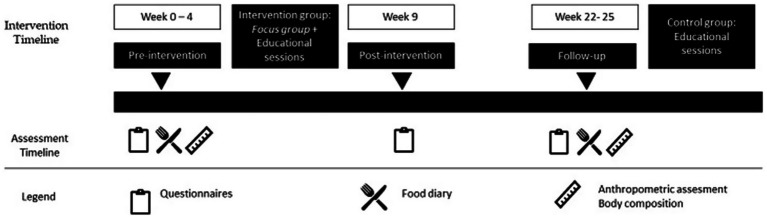
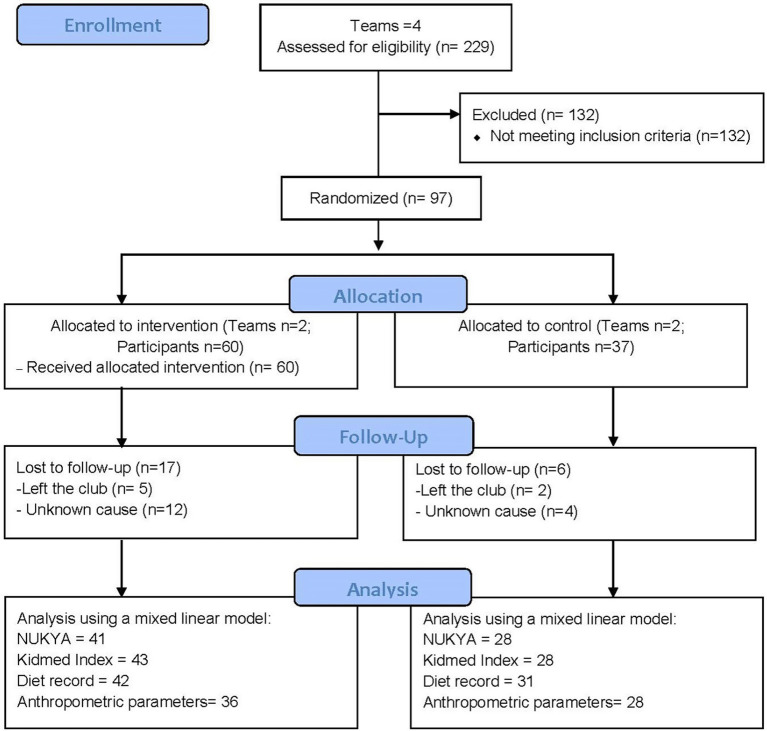
- A parallel-group cluster randomized controlled trial was conducted in Catalonia, Spain. Four handball clubs were randomized 1:1 to an intervention group (IG; 2 clubs) or control group (CG; 2 clubs). The IG received three 30-min face-to-face group sessions delivered weekly by a registered dietitian; the CG received no intervention during the study period.
- A total of 97 female handball players aged 12 to 19 years (mean 15.9 ± 1.2 years) were included (IG = 60, CG = 37). Outcomes were assessed at baseline, post-intervention, and 3-month follow-up: SNK (NUKYA questionnaire), Mediterranean diet adherence (KIDMED index), dietary intake (3-day photographic food record), and anthropometric/body composition measures (multifrequency bioelectrical impedance analysis).
- Changes over time were analyzed using linear mixed-effects models accounting for repeated observations nested within participants and participants clustered within clubs. Post hoc pairwise comparisons used Bonferroni correction; effect sizes were calculated with Hedges’ g. Sample size estimation required a minimum of 14 participants for SNK and 74 for calcium intake; attrition left 73 participants for dietary analyses.
Limitations
- The paper states: parents were not included in the educational sessions due to organizational constraints; dietary records were self-reported and may have introduced recall bias or underreporting; the final sample for dietary analyses (73) fell slightly short of the required 74, potentially reducing power; and participant losses (17 IG, 6 CG) due to club changes, discontinuation, or loss of interest could affect generalizability.
- The paper also notes: the small number of clubs (n = 4) meant club-level variance estimates were interpreted cautiously; the missing-data pattern was assumed missing at random but could not be formally verified; and the short intervention duration (three sessions) plus ongoing adolescent growth likely limited observable changes in body composition.
- Evident from the text: participants could not be blinded to the educational intervention, and the trial was conducted in a single sport (handball) and region, which may limit broader applicability.
Model-written summary. Check it against the paper before relying on it.
Integrity signals
Registry
Cites
Statistics
Figures
Verification
Claims the paper makes
0 Valid · 0 Not valid · 21 Not checked · 76 Own results and interpretations
A result the paper reports from its own data — it cites no other source for it, so there is none to check. The quote shows it is in the paper.
In the paper
“Baseline dietary records revealed, in both groups, insufficient energy intake (30 kcal/kg/day) and carbohydrate intake (2.7 g/kg/day), alongside a high total fat intake (1.5 g/kg/day).”
§ Effect of a nutrition education intervention on sports nutrition knowledge, dietary intake, and body composition in female athletes: a randomized controlled trial > Abstract > Results
plainn = 97- Asserted: passes — The authors put it forward as true.
- Checkable: passes — It can be checked against evidence.
- Load-bearing: unclear — It is unclear whether the paper’s conclusions depend on it.
- Based: passes — The paper gives a reason why it holds.
A result the paper reports from its own data — it cites no other source for it, so there is none to check. The quote shows it is in the paper.
In the paper
“The group × time interaction was not statistically significant (β = 0.48; p = 0.253), indicating that changes over time did not differ significantly between the IG and the CG.”
§ Effect of a nutrition education intervention on sports nutrition knowledge, dietary intake, and body composition in female athletes: a randomized controlled trial > Results > Mediterranean diet score adherence
plainn = 43- Asserted: passes — The authors put it forward as true.
- Checkable: passes — It can be checked against evidence.
- Load-bearing: passes — The paper’s conclusions depend on it.
- Based: passes — The paper gives a reason why it holds.
- Rests on an assumption not shown here.
A result the paper reports from its own data — it cites no other source for it, so there is none to check. The quote shows it is in the paper.
In the paper
“Furthermore, the IG exhibited significant improvements across all four questionnaire domains from baseline to post-intervention and from baseline to follow-up (p < 0.001).”
§ Effect of a nutrition education intervention on sports nutrition knowledge, dietary intake, and body composition in female athletes: a randomized controlled trial > Results > Sports nutritional knowledge
plainstates a cause- Asserted: passes — The authors put it forward as true.
- Checkable: passes — It can be checked against evidence.
- Load-bearing: passes — The paper’s conclusions depend on it.
- Based: passes — The paper gives a reason why it holds.
- Rests on an assumption not shown here.
A result the paper reports from its own data — it cites no other source for it, so there is none to check. The quote shows it is in the paper.
In the paper
“However, the group × time interaction reached statistical significance only for the hydration and periodization domains (p < 0.005), indicating that the intervention had a differential impact over time specifically for these areas.”
§ Effect of a nutrition education intervention on sports nutrition knowledge, dietary intake, and body composition in female athletes: a randomized controlled trial > Results > Sports nutritional knowledge
plain- Asserted: passes — The authors put it forward as true.
- Checkable: passes — It can be checked against evidence.
- Load-bearing: unclear — It is unclear whether the paper’s conclusions depend on it.
- Based: passes — The paper gives a reason why it holds.
- Rests on an assumption not shown here.
A result the paper reports from its own data — it cites no other source for it, so there is none to check. The quote shows it is in the paper.
In the paper
“At baseline, 77.8% of the IG and 78.0% of the CG required improvements in adherence to the MD.”
§ Effect of a nutrition education intervention on sports nutrition knowledge, dietary intake, and body composition in female athletes: a randomized controlled trial > Abstract > Results
plainn = 97- Asserted: passes — The authors put it forward as true.
- Checkable: passes — It can be checked against evidence.
- Load-bearing: unclear — It is unclear whether the paper’s conclusions depend on it.
- Based: passes — The paper gives a reason why it holds.
43 more claims
Create a free account to see all 97 claims and to verify the 38 references still open.
- Probably not a substantial claim. 24
- It may state two separate claims as one. 37
- The quote only partly states this claim. 1
Claims other papers make about this one
Each is checked against this paper’s own text: does it say what the citing paper says it does?
In the citing paper
“but dietary intake, Mediterranean diet adherence, and body composition did not change significantly”
In the citing paper
“Veloso-Pulgar and Farran-Codina found that brief dietitian-led education improved sports nutrition knowledge immediately and at follow-up in female handball players, both in the pilot study and in the subsequent randomized controlled trial (23, 37).”
In the citing paper
“Similarly, Veloso-Pulgar and Farran-Codina (23, 37) improved sports nutrition knowledge in female handball players”
In the citing paper
“However, knowledge improvement alone did not guarantee improvements in diet quality, dietary intake, or body composition (11, 14, 23, 32, 35, 37).”
In the citing paper
“whereas the handball studies by Veloso-Pulgar and Farran-Codina (23, 37) improved sports nutrition knowledge but did not significantly change energy intake, carbohydrate intake, Mediterranean diet adherence, or body composition.”
1 more claim about this paper
Create a free account to see every claim other papers make about this one.
Self-check
Percentages, sums and reported differences re-computed from the paper’s own numbers.
Each contradiction between two passages listed here was confirmed by an independent check.
Rated minor: it would not touch a result — a value no result rests on, a p-value that stays on the same side of the significance level, or a conflict that is clerical, resolved elsewhere in the paper, or outside its own findings.
In the paper
§ Effect of a nutrition education intervention on sports nutrition knowledge, dietary intake, and body composition in female athletes: a randomized controlled trial > Abstract > Results
“At baseline, 77.8% of the IG and 78.0% of the CG required improvements in adherence to the MD.”
§ Effect of a nutrition education intervention on sports nutrition knowledge, dietary intake, and body composition in female athletes: a randomized controlled trial > Discussion > Mediterranean diet score adherence
“At baseline, 78.0% of players in the IG and 77.8% in the CG required improvement in their adherence to the MD”
Rated minor: it would not touch a result — a value no result rests on, a p-value that stays on the same side of the significance level, or a conflict that is clerical, resolved elsewhere in the paper, or outside its own findings.
In the paper
§ Effect of a nutrition education intervention on sports nutrition knowledge, dietary intake, and body composition in female athletes: a randomized controlled trial > Abstract > Results
“A total of 97 participants were included (IG = 60, CG = 37), aged 12 to 19 years (mean 15.8 ± 1.2 years).”
§ Effect of a nutrition education intervention on sports nutrition knowledge, dietary intake, and body composition in female athletes: a randomized controlled trial > Results
“Overall, 97 participants were included in the study, with 60 assigned to the IG and 37 to the CG. Participants’ ages ranged from 12 to 19 years, with a mean of 15.9 ± 1.2 years (Table 2).”
Rated minor: it would not touch a result — a value no result rests on, a p-value that stays on the same side of the significance level, or a conflict that is clerical, resolved elsewhere in the paper, or outside its own findings.
In the paper
§ Effect of a nutrition education intervention on sports nutrition knowledge, dietary intake, and body composition in female athletes: a randomized controlled trial > Discussion > Mediterranean diet score adherence
“no significant changes were observed in KIDMED scores, indicating that adherence to the MD did not improve.”
§ Effect of a nutrition education intervention on sports nutrition knowledge, dietary intake, and body composition in female athletes: a randomized controlled trial > Results > Mediterranean diet score adherence
“this increase was statistically significant only in the IG (Δ = 0.8; IC 95% = 0.26 a 1.29; p = 0.003).”
Rated minor: it would not touch a result — a value no result rests on, a p-value that stays on the same side of the significance level, or a conflict that is clerical, resolved elsewhere in the paper, or outside its own findings.
In the paper
§ Effect of a nutrition education intervention on sports nutrition knowledge, dietary intake, and body composition in female athletes: a randomized controlled trial > Discussion > Dietary intake assessment
“Linear mixed-effects analyses showed no dietary changes over the study period.”
§ Effect of a nutrition education intervention on sports nutrition knowledge, dietary intake, and body composition in female athletes: a randomized controlled trial > Results > Dietary intake assessment
“However, a significant main effect of time was observed for saturated fat intake, which decreased significantly in both groups.”
Rated minor: it would not touch a result — a value no result rests on, a p-value that stays on the same side of the significance level, or a conflict that is clerical, resolved elsewhere in the paper, or outside its own findings.
In the paper
§ Effect of a nutrition education intervention on sports nutrition knowledge, dietary intake, and body composition in female athletes: a randomized controlled trial > Results > Mediterranean diet score adherence
“During the follow-up, 43 participants in the IG and 27 in the CG completed the questionnaire.”
§ Effect of a nutrition education intervention on sports nutrition knowledge, dietary intake, and body composition in female athletes: a randomized controlled trial > Results
“| KIDMED Index follow-up | 43 | 28 |”
1 more finding
Create a free account to see every finding of this check.
Citations
Cites
Sawyer, S. M., Azzopardi, P. S., Wickremarathne, D., & Patton, G. C. (2018) · The Lancet Child & Adolescent Health · doi:10.1016/s2352-4642(18)30022-1 · Cited by 3,666
Serra-Majem, L., Ribas, L., Ngo, J., Ortega, R. M., García, A., Pérez-Rodrigo, C., & Aranceta, J. (2004) · Public Health Nutrition · doi:10.1079/phn2004556 · Cited by 1,343
Nutrition and Athletic Performance
(2016) · Medicine & Science in Sports & Exercise · doi:10.1249/mss.0000000000000852 · Cited by 1,305
The Eating Attitudes Test (EAT-26): Reliability and Validity in Spanish Female Samples
Rivas, T., Bersabé, R. M., Jiménez, M., & Montiel, C. B. (2010) · The Spanish Journal of Psychology · doi:10.1017/s1138741600002687 · Cited by 178
The validity of a short version of the Body Shape Questionnaire
Dowson, J. H., & Henderson, L. (2001) · Psychiatry Research · doi:10.1016/s0165-1781(01)00254-2 · Cited by 145
Bartrina, J. A., Arija, V., Maíz, E., Muñoz, E. M. D. V., Anta, R. M. O., Pérez‐Rodrigo, C., Izquierdo, J. Q. I., Martín, A. R., Román‐Viñas, B., Castell, G. S., et al. (2016) · Nutrición Hospitalaria · doi:10.20960/nh.827 · Cited by 123
Condo, D., Lohman, R., Kelly, M., & Carr, A. (2019) · Nutrients · doi:10.3390/nu11050971 · Cited by 122
Valliant, M. W., Pittman Emplaincourt, H., Kieckhaefer Wenzel, R., & Garner, B. H. (2012) · Nutrients · doi:10.3390/nu4060506 · Cited by 93
A systematic review update of athletes’ nutrition knowledge and association with dietary intake
Janiczak, A., Devlin, B. L., Forsyth, A., & Trakman, G. L. (2022) · British Journal of Nutrition · doi:10.1017/s0007114521004311 · Cited by 83
Differences in reported winter and summer dietary intakes in young adults in Spain
Capita, R., & Alonso-Calleja, C. (2005) · International Journal of Food Sciences and Nutrition · doi:10.1080/09637480500407875 · Cited by 71
Vázquez-Espino, K., Rodas-Font, G., & Farran-Codina, A. (2022) · Nutrients · doi:10.3390/nu14071345 · Cited by 67
Łagowska, K., Kapczuk, K., & Jeszka, J. (2014) · Journal of the International Society of Sports Nutrition · doi:10.1186/s12970-014-0052-9 · Cited by 65
Trends in Adherence to the Mediterranean Diet in Spanish Children and Adolescents across Two Decades
Herrera‐Ramos, E., Tomaino, L., Sánchez‐Villegas, A., Ribas‐Barba, L., Gómez, S. F., Wärnberǵ, J., Osés, M., González‐Gross, M., Gusi, N., Aznar, S., et al. (2023) · Nutrients · doi:10.3390/nu15102348 · Cited by 61
Patton-Lopez, M. M., Manore, M. M., Branscum, A., Meng, Y., & Wong, S. S. (2018) · Nutrients · doi:10.3390/nu10111636 · Cited by 58
Magee, M. K., Jones, M. T., Fields, J. B., Kresta, J., Khurelbaatar, C., Dodge, C., Merfeld, B., Ambrosius, A., Carpenter, M., & Jagim, A. R. (2023) · Nutrients · doi:10.3390/nu15061502 · Cited by 50
Effects of dietary intervention in young female athletes with menstrual disorders
Łagowska, K., Kapczuk, K., Friebe, Z., & Bajerska, J. (2014) · Journal of the International Society of Sports Nutrition · doi:10.1186/1550-2783-11-21 · Cited by 47
Development and validation of a short sport nutrition knowledge questionnaire for athletes
Vázquez-Espino, K., Fernández-Tena, C., Lizarraga-Dallo, M. A., & Farran-Codina, A. (2020) · Nutrients · doi:10.3390/nu12113561 · Cited by 47
Tektunalı Akman, C., Gönen Aydın, C., & Ersoy, G. (2024) · Frontiers in Public Health · doi:10.3389/fpubh.2024.1289448 · Cited by 46
Foo, W. L., Faghy, M. A., Sparks, A., Newbury, J. W., & Gough, L. A. (2021) · Nutrients · doi:10.3390/nu13082713 · Cited by 41
Fahrenholtz, I. L., Melin, A. K., Garthe, I., Hollekim-Strand, S. M., Ivarsson, A., Koehler, K., Logue, D., Lundström, P., Madigan, S., Wasserfurth, P., et al. (2023) · Nutrients · doi:10.3390/nu15051082 · Cited by 40
Nutritional knowledge of youth academy athletes
Bird, S. P., & Rushton, B. D. (2020) · BMC Nutrition · doi:10.1186/s40795-020-00360-9 · Cited by 34
Martínez-Rodríguez, A., Martínez-Olcina, M., Hernández-García, M., Rubio-Arias, J. Á., Sánchez-Sánchez, J., Lara-Cobos, D., Vicente-Martínez, M., Carvalho, M. J., & Sánchez-Sáez, J. A. (2021) · International Journal of Environmental Research and Public Health · doi:10.3390/ijerph18062837 · Cited by 33
Nutritional intake and dietary knowledge of athletes: a scoping review
Hopper, C., Mooney, E., & Mc Cloat, A. (2025) · Nutrients · doi:10.3390/nu17020207 · Cited by 29
Nutritional risks among female athletes
Gastrich, M. D., Quick, V., Bachmann, G., & Moriarty, A. M. (2020) · Journal of Women's Health · doi:10.1089/jwh.2019.8180 · Cited by 25
Hand, R. K., Abram, J. K., Brown, K. A., Ziegler, P. J., Parrott, J. S., & Steiber, A. L. (2015) · Journal of Nutrition Education and Behavior · doi:10.1016/j.jneb.2015.03.003 · Cited by 23
Aguilo, A., Lozano, L., Tauler, P., Nafría, M., Colom, M., & Martínez, S. (2021) · Nutrients · doi:10.3390/nu13051399 · Cited by 23
Nutrition Knowledge and Perceived Dietary Requirements of Adolescent Student-Athletes: A Pilot Study
Jagim, A. R., Merfeld, B. R., Ambrosius, A., Carpenter, M., Fields, J. B., & Jones, M. T. (2024) · Nutrients · doi:10.3390/nu17010133 · Cited by 19
General and sport-specific nutrition knowledge and behaviors of adolescent athletes
Gibbs, R. L., & Becker, T. B. (2025) · Journal of the International Society of Sports Nutrition · doi:10.1080/15502783.2025.2477060 · Cited by 17
Determination of nutrition knowledge of adolescents engaged in sports
Kudret Saribay, A., & Kirbaş, Ş. (2019) · Universal Journal of Educational Research · doi:10.13189/ujer.2019.070106 · Cited by 16
The Impact of a Nutritional Intervention Program on Eating Behaviors in Italian Athletes
Terenzio, A., Cassera, A., Gervasoni, A., Pozzi, A., Orlando, A., Greco, A., Palestini, P., & Cazzaniga, E. (2021) · International Journal of Environmental Research and Public Health · doi:10.3390/ijerph18147313 · Cited by 16
Κοντελέ, Ι., Grammatikopoulou, M. G., & Vassilakou, T. (2021) · Children · doi:10.3390/children8121135 · Cited by 16
Sports nutrition and food knowledge among Malaysian university athletes
Nor Azizam, N. S., Yusof, S. N., Amon, J. J., Ahmad, A., Safii, N. S., & Jamil, N. A. (2022) · Nutrients · doi:10.3390/nu14030572 · Cited by 16
Nutritional behavior of Polish canoeist's athletes: The interest of nutritional education
Nowacka, E., Leszczyńska, T., Kopeć, A., & Hojka, D. (2016) · Science & Sports · doi:10.1016/j.scispo.2016.04.002 · Cited by 15
Nutritional Needs of the Female Athlete: Risk and Prevention of Low Energy Availability
Black, K. E., Baker, D. F., & Sims, S. T. (2020) · Strength & Conditioning Journal · doi:10.1519/ssc.0000000000000464 · Cited by 15
Roche, M. D., McIntyre, A., Oliver, C., Sainani, K. L., Boyd, T., Stoner, A. J., & Kraus, E. (2024) · BMJ Open Sport & Exercise Medicine · doi:10.1136/bmjsem-2024-001901 · Cited by 15
DeJong Lempke, A. F., Reece, L. M., & Whitney, K. E. (2025) · PLOS ONE · doi:10.1371/journal.pone.0314506 · Cited by 14
Grabia, M., Markiewicz-Żukowska, R., Bielecka, J., Puścion-Jakubik, A., & Socha, K. (2022) · Nutrients · doi:10.3390/nu14183681 · Cited by 13
Wenzel, R. K., Valliant, M. W., Chang, Y., Bomba, A. K., & Lambert, L. G. (2012) · Topics in Clinical Nutrition · doi:10.1097/tin.0b013e318246223b · Cited by 12
Adherence trends to the mediterranean diet in Spanish youth: a systematic review and meta-analysis
Alfaro-González, S., Garrido-Miguel, M., Fernández-Rodríguez, R., Sequí-Domínguez, I., Mesas, A. E., Bizzozero-Peroni, B., Jiménez-López, E., & Martínez-Vizcaíno, V. (2025) · Nutrition, Metabolism and Cardiovascular Diseases · doi:10.1016/j.numecd.2025.104220 · Cited by 12
Zaman, N. N. Z. K., Muhamad, A. S., & Jusoh, M. R. C. (2021) · Malaysian Journal of Nutrition · doi:10.31246/mjn-2020-0098 · Cited by 11
Sáenz, C., Sanders, D. J., Brooks, S. J., Bracken, L., Jordan, A., Stoner, J., Vatne, E. A., Wahler, M., & Brown, A. F. (2024) · Nutrients · doi:10.3390/nu16213733 · Cited by 11
Vicente, F., Anastácio, L., Monteiro, A., Brito, J., Ramalho, R., & Pereira, P. (2025) · Nutrients · doi:10.3390/nu17152404 · Cited by 10
Gao, Z., Wang, S., Peng, L., Sun, L., Qiu, P., Bai, B., Zhang, Q., Wu, J., Zha, Y., Zhu, F., et al. (2022) · International Journal of Environmental Research and Public Health · doi:10.3390/ijerph192113803 · Cited by 9
Ramírez‐Contreras, C., Farrán-Codina, A., Zerón-Rugerio, M. F., & Izquierdo-Pulido, M. (2023) · Nutrients · doi:10.3390/nu15081824 · Cited by 9
Deslippe, A. L., Bergeron, C., Wu, O. Y., Hernandez, K. J., Comtois-Rousseau, E., & Cohen, T. R. (2025) · Current Developments in Nutrition · doi:10.1016/j.cdnut.2024.104525 · Cited by 8
Sahnoune, R., & Bouchenak, M. (2020) · Mediterranean Journal of Nutrition and Metabolism · doi:10.3233/mnm-200414 · Cited by 6
Veloso-Pulgar, M., Fernández de Arriba, R., & Farran-Codina, A. (2025) · Nutrition Research Reviews · doi:10.1017/s0954422425100152 · Cited by 4
Self-citationVeloso-Pulgar, M., & Farran-Codina, A. (2025) · Nutrients · doi:10.3390/nu17152560 · Cited by 4
Self-citationGüzeldere, H. K. B., Aydın, O., Kumbasar, A. B., Sinan, N., Yıldız, Z. Z., & Lwaleed, B. A. (2025) · Food Science & Nutrition · doi:10.1002/fsn3.70327 · Cited by 3
Leonkiewicz, M., & Wawrzyniak, A. (2025) · Nutrients · doi:10.3390/nu17091468 · Cited by 2
Jayawardena, R., Weerasinghe, K., Nanayakkara, I., Madhujith, T., Hills, A. P., & Kalupahana, N. S. (2025) · Journal of the International Society of Sports Nutrition · doi:10.1080/15502783.2025.2519517 · Cited by 1
Research works printed but not linked: 2
- Ruiz-López, 2019, Guía Fotográfica de Porciones de Alimentos Consumidos en España
- Codina-Farran, 2022, Tablas Estándar de Composición de Los Alimentos–TECA: Taules Estàndard de Composició Dels Aliments-TECA
Cited by
Victoria-Montesinos, D., García-Muñoz, A. M., Mercader-Ros, M. T., Jaraba-Salinero, Y., & Figueroa-Morales, F. (2026) · Frontiers in Nutrition · doi:10.3389/fnut.2026.1939289 · Cited by 1
Metadata
- Authors
- Veloso-Pulgar, M., & Farran-Codina, A.
- Affiliations
- Universitat de Barcelona (ES)
- Departament de Nutrició, Ciències dels Aliments i Gastronomia, Facultat de Farmàcia i Ciències de l’Alimentació, Universitat de Barcelona
- Venue
- Frontiers in Nutrition
- Publisher
- Frontiers Media SA
- Published
- 2026-05-08
- Volume
- 13
- Pages
- 1821345-1821345
- ISSN
- 2296-861X (ISSN-L)
- PMC
- PMC13194427
- OpenAlex
- W7160546606
- Cited by
- 1
- References
- 52
- Citations by year
- 2026: 1
- FWCI
- 3.30
- Type
- journal article
- Language
- en
- Open access
- gold
- doi.org
- Licence
- Locations
- Frontiers in Nutrition (publishedVersion, cc-by)
- PubMed Central (publishedVersion, cc-by)
- PubMed (publishedVersion)
- DOAJ (DOAJ: Directory of Open Access Journals) (submittedVersion)
- Funders
- De La Salle University
- Agenția Națională pentru Cercetare și Dezvoltare
- Generalitat de Catalunya
- Universitat de Barcelona
- Agencia Nacional de Investigación y Desarrollo
- Agència de Gestió d'Ajuts Universitaris i de Recerca (2021 SGR 01190, 2022-72220321)
- Topics
- Health Sciences › Nursing › Nutrition and Dietetics › Nutrition, Health and Food Behavior
- Health Sciences › Nursing › Nutrition and Dietetics › Dietetics, Nutrition, and Education
- Health Sciences › Medicine › Public Health, Environmental and Occupational Health › Nutritional Studies and Diet
- Keywords
- nutrition education intervention, sports nutrition knowledge, adolescent female athletes, handball players, dietary intake, body composition, Mediterranean diet adherence, energy intake, carbohydrate intake, dietary fat intake, anthropometry, behavioral strategies
About these checks
Registry, retraction, Cites and statistics results are computed, not judged, with one exception: a printed reference that no index lists is read once by a model before it counts as a citation error. Claims are extracted by a model and kept only when their quote appears verbatim in the text; each cited source is then checked, with a model’s help, for whether it says what the claim relies on. Those verdicts can be wrong — read the claim’s quote and the cited source before relying on one.
A language model drew the claims from the paper on 2026-11-14, under version 3 of the claim definition (model deepseek-v4.1-flash, prompt extract-v3).
A second model labelled each claim on 2026-11-14 (model jev-1.13-20260917, definition revision gold-guideline-v0.2).
Statistics and arithmetic are recomputed, not judged.
Confidence bands are shown only for fields calibrated on our annotated test set. None is calibrated yet, so no band is shown.
What counts as a claim ›How we measure confidence ›How we check this ›
Are you an author, or do you see a problem with this page? Request a review
Data sources
Bibliographic data: Semantic Scholar, OpenAlex, Crossref.
Contains information from the Semantic Scholar Academic Graph Datasets, made available under the ODC Attribution License (ODC-BY 1.0).
Semantic Scholar’s data is described in: Kinney, R., et al. (2023). The Semantic Scholar Open Data Platform. arXiv:2301.10140.
