

Motor skills and cognitive benefits in children and adolescents: Relationship, mechanism and perspectives
Open accessThe DOI matches its Crossref record; 96 of the 100 references it cites were found in a registry or an index.
Abstract
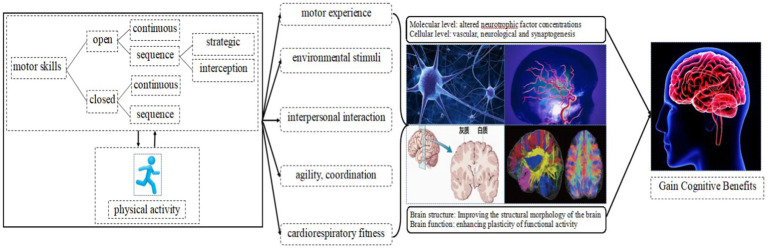
Objective: There is a strong interaction between motor skills and cognitive benefits for children and young people. The aim of this paper is to explore the relationship between motor skill types and their development and the cognitive benefits of children and adolescents. In turn, on this basis, it proposes pathways and mechanisms by which motor skills improve cognition, and provide a basis for subsequent teaching of skills that follow the laws of brain cognitive development. Methods: This paper summarizes the research on the relationship between different types of motor skills and their development and cognitive benefits of children and adolescents. Based on these relationships, pathways, and mechanisms for motor skills to improve cognition are tentatively proposed. Results: There is an overall pattern of “open > closed, strategy > interception, sequence > continuous” between motor skill types and the cognitive benefits of children and adolescents. Long-term motor skill learning practice is accompanied by increased cognitive benefits as skill proficiency increases. The dynamic interaction between motor skills and physical activity exposes children and adolescents to environmental stimuli and interpersonal interactions of varying complexity, promoting the development of agility, coordination and cardiorespiratory fitness, enhancing their motor experience, which in turn improves brain structure and functional activity. Conclusion: Motor skills training promote cognitive efficiency in children and adolescents. Motor skill interventions that are open-ended, strategic and sequential in nature are more effective. Environmental stimuli, interpersonal interaction, agility, coordination, and cardiorespiratory fitness can be considered as skill attribute moderators of motor skills to improve cognition.
Overview
The claims and statistics of this paper haven’t been checked yet.
Free: it reads the open-access text and checks the first 5 claims that cite a source we can check. Create a free account to check every claim.
Integrity signals
Registry
Cites
Statistics
Figures
Verification
Claims the paper makes
The claims and statistics of this paper haven’t been checked yet.
Free: it reads the open-access text and checks the first 5 claims that cite a source we can check. Create a free account to check every claim.
Claims other papers make about this one
Each is checked against this paper’s own text: does it say what the citing paper says it does?
The check wasn’t confident either way, so it gives no verdict — never disputed.
In the citing paper
“VR assessment instruments developed so far exhibit limited ecological validity, as their interfaces present scenarios and activities that bear little or no relation to actual daily life activities [35].”
From Enhancing Ecological Validity: Virtual Reality Assessment of Executive Functioning in Children and Adolescents with ADHD (2024) · cites this paper as [35]
Experimental — accuracy not yet measuredThe check wasn’t confident either way, so it gives no verdict — never disputed.
In the citing paper
“They also fail to incorporate natural types of movement (such as navigating through different scenarios and manipulating various materials) and real-life distractors [35], except for a new task developed to assess prospective memory [33,36].”
From Enhancing Ecological Validity: Virtual Reality Assessment of Executive Functioning in Children and Adolescents with ADHD (2024) · cites this paper as [35]
Experimental — accuracy not yet measured
Self-check
Percentages, sums and reported differences re-computed from the paper’s own numbers.
The self-check needs the paper’s full text.
Citations
Cites
Stodden, D. F., Goodway, J. D., Langendorfer, S. J., Roberton, M. A., Rudisill, M. E., Garcia, C., & Garcia, L. E. (2008) · Quest · doi:10.1080/00336297.2008.10483582 · Cited by 2,334 · cited 1×
“It interacts with physical activity to jointly maintain the physical health of children and adolescents (Stodden et al., 2008).”
BackgroundDevelopment of the adolescent brain: implications for executive function and social cognition
Blakemore, S., & Choudhury, S. (2006) · Journal of Child Psychology and Psychiatry · doi:10.1111/j.1469-7610.2006.01611.x · Cited by 2,328 · cited 1×
“The level of cognitive development at this stage is of great significance to individual academic performance, mental health, and social development in adulthood (Blakemore and Choudhury, 2006; Ahmed et al., 2020).”
BackgroundEnriched environments, experience-dependent plasticity and disorders of the nervous system
Nithianantharajah, J., & Hannan, A. J. (2006) · Nature Reviews Neuroscience · doi:10.1038/nrn1970 · Cited by 1,771 · cited 4×
“, 2000), increases the number of dendritic spines and the volume of synapses on certain neuronal populations (Nithianantharajah and Hannan, 2006), and promotes neuronal activation, signaling, and brain plasticity (Nithianantharajah and Hannan, 2006; Sale et al., 2009).”
BackgroundInfluentialPlasticity in gray and white: neuroimaging changes in brain structure during learning
Zatorre, R. J., Fields, R. D., & Johansen-Berg, H. (2012) · Nature Neuroscience · doi:10.1038/nn.3045 · Cited by 1,685 · cited 1×
“Acute or long-term motor skill learning can cause brain plasticity changes, promote brain angiogenesis, gliogenesis and synaptogenesis, and improve brain structural morphology and functional activities (Zatorre et al., 2012; Vints et al., 2022).”
BackgroundErtmer, P. A., & Newby, T. J. (1993) · Performance Improvement Quarterly · doi:10.1111/j.1937-8327.1993.tb00605.x · Cited by 1,410 · cited 1×
“With increasing research in cognitive psychology and cognitive neuroscience, there is a growing focus on the acquisition and restructuring of internal mental representations during motor skill learning (Ertmer and Newby, 1993).”
BackgroundDiamond, A., & Ling, D. S. (2016) · Developmental Cognitive Neuroscience · doi:10.1016/j.dcn.2015.11.005 · Cited by 1,177
Effects of acute bouts of exercise on cognition
Tomporowski, P. D. (2003) · Acta Psychologica · doi:10.1016/s0001-6918(02)00134-8 · Cited by 1,030 · cited 3×
“Effects of acute interventions in motor skills on cognition Exercise has immediate cognitive effect, and a single exercise intervention can produce certain cognitive benefits (Tomporowski, 2003).”
BackgroundInfluentialBrain plasticity and behaviour in the developing brain.
Kolb, B. E., & Gibb, R. L. (2011) · Europe PMC (PubMed Central) · Cited by 928
de Greeff, J. W., Bosker, R. J., Oosterlaan, J., Visscher, C., & Hartman, E. (2018) · Journal of Science and Medicine in Sport · doi:10.1016/j.jsams.2017.09.595 · Cited by 841
Voss, M. W., Kramer, A. F., Basak, C., Prakash, R. S., & Roberts, B. (2010) · Applied Cognitive Psychology · doi:10.1002/acp.1588 · Cited by 632
Research works printed but not linked: 31
- Bi Y. Li J. Qin Z. Sun X. P. Shi J. L. Lang J. (2020). Differences in response inhibition in female college students of different soccer levels: correlation with brain anatomy. J. Beijing Normal Univ. (Nat. Sci.) 58, 310– 317. doi: 10.12202/j.0476-0301.2021273 · doi:10.12202/j.0476-0301.2021273
- Cao C. M. Dong G. Liu Y. Gao C. (2017). Movement coordination and skill learning: a review of theory and perspective. J. Wuhan Inst. Phys. Educ. 51, 82– 87. doi: 10.15930/j.cnki.wtxb.2017.01.013 · doi:10.15930/j.cnki.wtxb.2017.01.013
- Chen A. G. Feng L. Zhu L. N. Yan J. (2015a). Effect of moderate intensity basketball dribbling training of different durations on children’ executive function. J. Capital Univ. Phys. Educ. Sports 27, 223– 227. doi: 10.14036/j.cnki.cn11-4513.2015.03.007 · doi:10.14036/j.cnki.cn11-4513.2015.03.007
- Chen A. G. Xiong X. Zhu L. N. (2021). Physical exercise and development of brain and mind in children and adolescents: evidence and theory. China Sport Sci. 41, 43– 51. doi: 10.16469/j.css.202111006 · doi:10.16469/j.css.202111006
- Chen A. G. Zhao L. Li H. Y. Yan J. Yin H. C. (2014). Effects of acute basketball dribbling training of different intensity on executive function of primary students. J. TUS 29, 352– 355. doi: 10.13297/j.cnki.issn1005-0000.2014.04.015 · doi:10.13297/j.cnki.issn1005-0000.2014.04.015
- Chen A. G. Zhao Z. Y. Yan J. (2015b). Effects of rope skipping with different forms of organization on the executive function of preadolescent children: a school-based experimental study. Chin J Sports Med 34, 886– 890. doi: 10.16038/j.1000-6710.2015.09.011 · doi:10.16038/j.1000-6710.2015.09.011
- Chen A. G. Zhu L. N. Jin L. Xiong X. Wang W. Yan J. (2016). Effects of aerobic exercise on executive control and its brain network in deaf children. J. Sports Sci. 37, 94– 101.
- Gong H. P. Liu M. Y. Kong Q. Q. Hu H. X. (2020). Scientific evidence of integration of sports and education: an analysis of association between sports exercise and education. China Sport Sci. Technol. 56, 19– 28.
- Hou W. D. (2008). A comparison of attention between outstanding young female soccer athletes and ordinary female middle-school students:constructing a distinction equation based on parameter differences. J. Clin. Rehabil. Tissue Eng. Res. 12, 1291– 1294.
- Hu J. Gu J. Y. Wang W. Y. Pang L. Ma R. (2022). Correlation between motor skills and focused with shifting attention in preschool children. Chin J Sch Health 43, 274– 279. doi: 10.16835/j.cnki.1000-9817.2022.02.026 · doi:10.16835/j.cnki.1000-9817.2022.02.026
- Ji X. H. (2014). Study on the Differences of Executive Function of Pupils Trained by Different Sports. Yangzhou, Yangzhou University.
- Ji L. Yin H. C. Yan J. (2010). Sports Psychology. (2nd Edn.) Beijing: Higher Education Press, 189– 190.
- Kong J. C. (2012). The effect of physical activity style on children’s attentional stability. Chin J Sch Health 33, 485– 486.
- Ma Z. H. Cao Q. J. Yan C. G. Mei T. Lu B. Liu J. R.. (2019). Functional connectivity characteristics of executive control network in patients with high-functioning autism aged 6-18 years. Chin. Ment. Health J. 33, 401– 405.
- Pan J. L. Yin H. C. Chen A. G. Cui L. Wang Y. Cui Y. B. (2016). An experimental study on the effect of exercise intervention on the executive functions of primary students with and without learning difficulties. China Sport Sci. 36, 84– 91. doi: 10.16469/j.css.201606009 · doi:10.16469/j.css.201606009
- Shao F. Z. (2019). Cognitive Psychology: Theory, Experiment and Application. (3rd Edn.) Shanghai: Shanghai Education Publishing House, 8– 10.
- Shi J. L. Wang J. Chen F. J. Li Y. T. Zhu J. Q. Huang H. J.. (2019). Advances in the frontal lobe-basal ganglia model of response inhibition. Chem. Life 39, 1113– 1119. doi: 10.13488/j.smhx.20190245 · doi:10.13488/j.smhx.20190245
- Song Y. Liu Y. Yang N. Wang C. Z. (2020). Research on orienteering exercise improving the execution function of children with attention deficit hyperactivity disorder. J. Phys. Educ. 27, 110– 115. doi: 10.16237/j.cnki.cn44-1404/g8.2020.03.017 · doi:10.16237/j.cnki.cn44-1404/g8.2020.03.017
- Wang W. Q. Shen Y. W. Huang M. (2001). Effect of the exercise on the cardio respiratory function of the old. J. Chengdu Phys. Educ. Inst. 19, 85– 88.
- Wang R. Y. Su Q. S. (2016). Exercise Physiology. Beijing: People’s Physical Culture Publishing House, 350– 360.
- Wu Y. Zhang J. Zeng Y. W. Shen C. (2015). Structural brain plasticity change in athletes associated with different sports. China Sport Sci. 35, 52– 57. doi: 10.16469/j.css.201504006 · doi:10.16469/j.css.201504006
- Xiao H. Yu L. Zhao L. (2021). Relationship of agility and quickness with EEG signals among school-age children. Chin J Sports Med 40, 942– 949. doi: 10.16038/j.1000-6710.2021.12.003 · doi:10.16038/j.1000-6710.2021.12.003
- Yan J. Wang Y. Chen A. G. Ma D. J. (2014). Empirical study of the impact of various school-term physical activity of moderate intensity on the executive function of children in their preadolescence. J. Sports Sci. 35, 94– 100. doi: 10.13598/j.issn1004-4590.2014.06.017 · doi:10.13598/j.issn1004-4590.2014.06.017
- Yin X. F. (2019). A study on the evaluation of motor ability and its socio-ecological influencing factors of Shanghai children (7-8 years old). Shanghai, Shanghai University of Sport.
- Yin H. C. Pan J. L. Liu M. Ma Q. Chen A. G. (2017). The effects of an exercise intervention on the executive functions of primary school students with learning difficulties and normally developing primary school students: a comparison of the time course efficiency. Chin. J. Spec. Educ. 2017, 55– 62.
- Yu Q. Liang Z. W. Zhang T. Li X. Y. Chen S. Z. (2019). The performance of different types of motor skills on proactive and reactive controls of executive functions. Chinese J. Rehabil. Med. 34, 280– 286. doi: 10.3969/j.issn.1001-1242.2019.03.006 · doi:10.3969/j.issn.1001-1242.2019.03.006
- Zhang Y. B. (2012). Theory and Practice of Motor Skills. Beijing: Higher Education Press, 4– 12.
- Zhang J. S. Ji X. Yan C. H. Xu J. Ren F. Shen L. X. (2009). Primary study on executive function in children with ping-pong training and swimming training. J. Shanghai Jiaotong Univ. (Med. Sci.) 29, 782– 784.
- Zhang Z. Y. Jin C. J. Xie C. (2022). Effects of eleven kinds of sports on working memory of our school-age children: a network meta-analysis. J. Liaoning Normal Univ. (Nat. Sci. Ed.) 45, 135– 144. doi: 10.11679/lsxblk2022010135 · doi:10.11679/lsxblk2022010135
- Zhong X. K. Zhang J. Wang Z. P. Jiang C. H. (2022). Effect of physical activity on neurocognitive function of overweight children: a systematic review. Chin J Rehabil Theory Pract 28, 421– 428.
- Zhou C. L. Jin X. H. (2021). Theory and practice of sports to promote learning efficiency from the perspective of brain science. J. Shanghai Univ. Sport 45, 20– 28. doi: 10.16099/j.sus.2021.01.003 · doi:10.16099/j.sus.2021.01.003
Cited by
Items 101–186 of 186
Liu, H., & Zhang, Z. (2025) · Research Square · doi:10.21203/rs.3.rs-6670044/v1
Wang, P., Zhao, Y., He, J., Chen, Z., He, L., & Li, D. (2025) · Research Square · doi:10.21203/rs.3.rs-6729483/v1
Associations Between Effort Capacity and Cognitive Processes in Basketball Players
Coteață, M.-A., & Trofin, P. F. (2025) · Studia Universitatis Babeş-Bolyai Educatio Artis Gymnasticae · doi:10.24193/subbeag.70(2).10
WANG, Z., Qin, G., & Lu, Y. (2025) · SSRN Electronic Journal · doi:10.2139/ssrn.5381905
Relationship Between Gadget Usage and Eye-Hand Coordination of Preschoolers
Beduya, A., Cariliman, C., Entia, J., Geraldez, C. R., Taac, L. T., & Revalde, H. O. (2025) · Psychology and Education A Multidisciplinary Journal · doi:10.70838/pemj.470302
Association Between Motor Competence and Response Time in Portuguese Youth
Flôres, F. S., Drews, R., Santos, V., Reyes, A., Casanova, N., & Cardozo, P. (2025) · Journal of Motor Behavior · doi:10.1080/00222895.2025.2563878
“This result underscores the importance of MC in facilitating quicker and more efficient responses to stimuli, advancing our understanding of cognitive-motor integration during youth (Magill & Anderson, 2017; Shi & Feng, 2022).”
An Assessment of Motor Skill Proficiency among Senior High School Students in Physical Education
Babalcon, J. R. R. (2025) · International Journal of Research Publications · doi:10.47119/ijrp1001811920258445
Physical Activity Applied to Learning and Psycho-social Variables in Young People
Ruiz-Ariza, A., Loureiro, V., García, J. E. M., & Sibold, J. (2025) · Frontiers research topics · doi:10.3389/978-2-8325-7140-8
Ulusoy, A. (2025) · Physical Activity in Children · doi:10.61882/pach.2025.514982.1048
Kordi, H. (2025) · Physical Activity in Children · doi:10.61882/pach.2025.528616.1054
Outdoor Education and the LAI project: A conceptual framework for an educational experience
Dati, S., Escolano Pérez, E., Striano, M., & Izquierdo, C. (2023) · Ricerche di pedagogia e didattica · doi:10.6092/issn.1970-2221/16535
Ruiz-de-la-Torre-Ruiz-Carrillo, M. P. (2023) · Re-Unir (International University of La Rioja)
(2025) · Frontiers research topics · doi:10.3389/978-2-8325-6613-8
Goda, A., Murata, S., Kai, Y., Shigeto, H., Kikuchi, Y., Miyachi, R., Yumioka, M., & Abiko, T. (2025) · Japanese Journal of Health Promotion and Physical Therapy · doi:10.9759/hppt.15.1
Park, S.-Y., Park, S.-Y., Park, S.-Y., & Oh, S. (2025) · Brain Sciences · doi:10.3390/brainsci15121285
Bilal Nuzul Ramdan, Jajat Darajat Kusumah N, & Agus Mahendra (2026) · Repository at Universitas Pendidikan Indonesia (Universitas Pendidikan Indonesia)
Ab Satar, M. S., & Abdul Aziz, A. (2024) · UiTM Institutional Repositories (Universiti Teknologi MARA)
ANALISIS HUBUNGAN KETERAMPILAN KOGNITIF DAN MOTORIK DALAM PEMBELAJARAN RENANG GAYA DADA
Tarigan, Y. (2025) · Riyadhoh Jurnal Pendidikan Olahraga · doi:10.31602/rjpo.v8i2.18732
Pemanfaatan Aplikasi D_Active Arcade untuk Mengembangkan Motorik Kasar Anak Usia Dini
Rahayu, P., & Nopriansyah, U. (2025) · Murhum Jurnal Pendidikan Anak Usia Dini · doi:10.37985/murhum.v6i1.1307
“Hal ini diperkuat oleh teori konektivitas saraf dari [5] yang menjelaskan bahwa aktivitas fisik intensif pada masa awal kehidupan memperkuat jalur saraf dan meningkatkan kapasitas otak dalam mengintegrasikan fungsi motorik dan kognitif.”
Arazeshi, N. (2025) · Physical Activity in Children · doi:10.61882/pach.2025.560075.1077
Sobko, I. N., Yefimenko, O., & Podmaryova, I. (2025) · Health-saving technologies rehabilitation and physical therapy · doi:10.58962/hstrpt.267
Wang, Y., Wang, J., Zhang, L., Wang, C., Wang, G., Li, C., Yuan, Y., Qiu, B., & Yang, Y. (2026) · Frontiers in Physiology · doi:10.3389/fphys.2025.1685099
“Similarly, longer intervention durations may facilitate the accumulation and reinforcement of neural adaptations over time, supporting the consolidation of skills and the long-term development of intellectual capacity (Shi and Feng, 2022).”
Gu, H., Yao, Q., Yang, C., Ding, Z., Li, X., & Chen, H. (2026) · Cerebral Cortex · doi:10.1093/cercor/bhaf348
Marković, Ž. M., Aleksandar Ignjatović, P., & Antonov, A. (2026) · Antropološki i teoantropološki pogled na fizičke aktivnosti · doi:10.5937/atavpa25190m
Mirfendereski, S., Fesharaki, S., & Zadehmir, M. (2026) · Iranian journal of child neurology. · doi:10.22037/ijcn.v20i1.48884
Lei, D., Liang, W., Yang, F., Liu, C., Zhou, L., & Wang, Z. (2026) · BMC Pediatrics · doi:10.1186/s12887-026-06590-3
“Recent evidence indicates that regular PA optimizes metabolic regulatory pathways and enhances the adaptability of the cardiovascular and musculoskeletal systems [12, 13].”
Aydemir, B., & YILMAZ, D. S. (2026) · Spor ve Performans Araştırmaları Dergisi · doi:10.17155/omuspd.1789796
Self-reported physical activity and attention performance in children aged 10–11 years
Kasović, M., Stračárová, N., & Očić, M. (2026) · PeerJ · doi:10.7717/peerj.20867
“Furthermore, motor skills that involve open, strategic, and unpredictable environments, such as team sports, appear to offer greater cognitive benefits than closed skills because they demand rapid adaptation and decision-making ( Zhang, 2012 ; Shi & Feng, 2022 ).”
Lanos, M. E. C., Manullang, J. G., Lestari, H., Dapiokta, J., & Rohman, M. F. (2026) · International journal of human movement and sports sciences · doi:10.13189/saj.2026.140205
Impact of game-based learning strategies on motor skill development of Grade 9 learners
Loresto, A. (2026) · Pantao (International Journal of the Humanities and Social Sciences) · doi:10.69651/pijhss0501854
Dance exercise as a school-based strategy for stress reduction among Grade 9 students
Posas, R. G. (2026) · Pantao (International Journal of the Humanities and Social Sciences) · doi:10.69651/pijhss0501853
Meda, S. S. (2026) · International Journal of Physiology Sports and Physical Education · doi:10.33545/26647710.2026.v8.i3b.243
Wang, X.-C., Zhou, B., Bao, Y.-H., & Xia, H. (2026) · Frontiers in Pediatrics · doi:10.3389/fped.2026.1777657
Impact of Educational Robotics on Enhancing Fine Motor Skill Development in AdolescentsPreprint
Tapia, J. C. S., Calle, L. P. A., Moscoso, F., & Tapia, J. C. (2026) · Research Square · doi:10.21203/rs.3.rs-9349325/v1
Alhameed, I. M. M. (2026) · JURNAL PENDIDIKAN OLAHRAGA · doi:10.37630/jpo.v16i2.4194
“…achievements of the physical education lesson, which contributed effectively to teaching and developing motor skills, through good preparation, proper organization, and the use of teaching methods appropriate to the students’ abilities and levels (Calero-Morales et al., 2023; P. Shi & Feng, 2022).”
Hubungan Tingkat Aktivitas Fisik Dengan Kemampuan Motorik Siswa Sekolah Dasar
Aziz, M. I. M., & Irawati, A. F. (2026) · Jurnal Olahraga Kebugaran dan Rehabilitasi (JOKER) · doi:10.35706/joker.v6i1.13555 · Cited by 2
Verma, V. (2026) · Elsevier eBooks · doi:10.1016/b978-0-443-33855-7.00012-7
Alfabetización física. Un enfoque integral desde la Educación Física
Galán-Arroyo, C., & Rojo-Ramos, J. (2026) · doi:10.59650/ovtf4440
Genç, H., Karaoğlu, B., Ceviz, E., Bahadır, Z., Yalçınkaya, A., Türkmen, M., & USUFLU, O. (2026) · Frontiers in Public Health · doi:10.3389/fpubh.2026.1830603 · Cited by 1
Абрамова, Т. Ф., Валентиновна, Б. Т., Михайловна, Н. Т., Викторовна, П. А., & Митрофановна, Я. Н. (2026) · CyberLeninK (CyberLeninka) · doi:10.24412/2588-0500-2026_10_02_29
Aprilo, I., Arfanda, P. E., & Mappaompo, M. A. (2026) · ETDC Indonesian Journal of Research and Educational Review · doi:10.51574/ijrer.v5i3.4971
“…the context of developing junior and senior high school student athletes, training motivation also plays a crucial role in maintaining the continuity of their sports participation, thereby preventing the risk of burnout or early dropout (Shi & Feng, 2022; Lochhead et al., 2024; Deng et al., 2024).”
Byczkovski, L. M., Paiva, C. F., Melo, J. D. A., da Costa, J. L. M. N., dos Santos, E. F., & Novello, D. (2026) · Periódicos Brasil Pesquisa Científica · doi:10.36557/2674-9432.2026v5n4p67-88
Jazali, M. K., Aliraid, H., & Da’i, M. (2026) · Holistic Journal of Sport Education · doi:10.52434/penjas.v5i2.43632
Миронова, С. И., Константинович, Б. А., Сергеевна, Т. О., Юрьевич, П. Р., & Николаевич, С. А. (n.d.) · CyberLeninK (CyberLeninka)
Петрович, Ш. М., & Федоровна, А. Т. (n.d.) · CyberLeninK (CyberLeninka)
Pengaruh Latihan Rondo Terhadap Peningkatan Keterampilan Passing Pemain Sepakbola Usia 13 Tahun
Almiqdaad, R., Sunaryadi, Y., & Mustaqim, R. (2026) · Gelanggang Olahraga Jurnal Pendidikan Jasmani dan Olahraga (JPJO) · doi:10.31539/h2g3z670
“Usia 13 tahun merupakan fase awal remaja, ditandai dengan perkembangan motorik dan kognitif yang pesat, menjadikannya waktu yang ideal untuk mengembangkan keterampilan teknis sepak bola (Shi & Feng, 2022).”
Latino, F., Tafuri, D., Saraiello, E., & Tafuri, M. G. (2026) · Nutrients · doi:10.3390/nu18132103 · Cited by 2
Chang, I.-C., & Yen, C.-E. (2026) · JMIR Formative Research · doi:10.2196/33138
“Comparisons with other studies [5,26] further support the notion that “cognitive-motor” integration is highly beneficial during critical growth periods.”
Identifikasi Permasalahan Perkembangan Motorik pada Anak Usia 5-6 Tahun di Wilayah Jakarta Selatan
Ratuhasanah, D., Zahri, Z. J., Nurfadilah, N., & Afriandita, S. (2026) · JEA (Jurnal Edukasi AUD) · doi:10.18592/jea.v12i1.15013
“Shi & Feng (2022) menerangkan bahwa keterampilan motorik berperan dalam fungsi eksekutif dan kesiapan akademik, sedangkan Suparyanto & Rosad (2020) serta Asthuti (2019) menjelaskan bahwa motorik menjadi dasar bagi perkembangan sosial, emosional, serta kognitif.”
Functional Organization of the Neonatal Basal Ganglia and ThalamusPreprint
Blake, S. L., Kenley, J. K., Smyser, T. A., Latham, A. R., Alexopoulos, D., Greene, D. J., Lean, R. E., Barch, D. M., Warner, B. B., Luby, J. L., et al. (2026) · bioRxiv (Cold Spring Harbor Laboratory) · doi:10.64898/2026.07.02.736181
“Typical development of motor skills early in life is important for subsequent cognitive development because infants need to physically explore their environment to learn and develop cognitive concepts (Piaget, 1952; Murray et al., 2007; Shi and Feng, 2022).”
Mayang, S., Yuliasti, A. P., & Fauzi, A. (2026) · Sports Science & Health Advances · doi:10.60081/ssha.4.1.2026.587-595
Braille Literacy and Visual Disabilities
Gurnani, B., & Kaur, K. (2026) · Springer eBooks · doi:10.1007/978-3-032-11375-7_522
Hamza, G. B., Sherkhan, L. A., Ghouili, H., Yahya, S. R., Muntean, R. I., Ceylan, H. İ., Ștefănică, V., Al-Selmi, A. D. H., Mohamood, M. S., Dhahbi, W., et al. (2026) · Journal of School Health · doi:10.1111/josh.70195
Ren, F., Zhao, X., & Qu, S. (2026) · Journal of Sports Science and Medicine · doi:10.52082/jssm.2026.627
“Repeated practice may help children consolidate movement patterns, receive feedback, and make corrections over time (Moore et al., 1981; Shi and Feng, 2022).”
Scano, A. (2026) · Frontiers in Systems Neuroscience · doi:10.3389/fnsys.2026.1838867 · Cited by 1
“Indeed, movement is not only the execution of motor commands but also the outcome of processes involving perception, prediction, evaluation, and decision-making, which is evident in child neuromotor learning (Shi and Feng, 2022).”
Koriakina, M. M., Urentcova, A., Burdukova, Y., Agranovich, O. Е., & Blagovechtchenski, E. (2026) · Frontiers in Psychology · doi:10.3389/fpsyg.2026.1704823
“These findings are consistent with studies demonstrating the hypothesis of neuroplasticity and compensatory mechanisms in early rehabilitation (Shi and Feng, 2022).”
Xu, L., An, X., Wang, L., Peng, Z., Zhong, X., Zhang, J., Tian, H., Shao, Y., & Wang, J. (2026) · Psychology of sport and exercise · doi:10.1016/j.psychsport.2026.103239
Naulo, E. (2026) · Jyväskylä University Digital Archive (University of Jyväskylä)
Niu, Z., Velu, P., Vijayalakshmi, A., & Xiao, F. (2026) · 3 Biotech · doi:10.1007/s13205-026-04926-5
“Prior studies have demonstrated a direct link between motor behaviour impairment and the extent of dopamine cell death in the SN (Shi et al. 2022 ).”
Koura, G. M., Kandakurti, P. K., Elshiwi, A. M. F., Melhat, A. M. E., Mohabozaid, S., Ibrahim, D. N. M., Salim, Z. A. A., ALMohiza, M. A., Hegab, E. A. A., Hassan, S. H. A., et al. (2026) · Scientific Reports · doi:10.1038/s41598-026-66387-3 · Cited by 2
“In contrast, consistent physical activity stimulates motor learning, sensorimotor integration, and muscular efficiency, thereby enhancing performance in tasks requiring balance, coordination, and reaction speed 33 .”
Gao, K., Zuo, Z., Jiang, C., Hu, J., & Zhang, Z. (2026) · Scientific Reports · doi:10.1038/s41598-026-67261-y
Yang, M. (2026) · Frontiers in Public Health · doi:10.3389/fpubh.2026.1870655 · Cited by 1
Deliberate practice reduces developmental neuromotor mismatches
Yan, J. H. (2026) · Child Neuropsychology · doi:10.1080/09297049.2026.2720190
Association Between Visual Search Performance and Eye–Hand Coordination in School-Aged Children
Sudo, D. (2026) · Life · doi:10.3390/life16091421
“Consistent with this interpretation, visual search and selective attention have been reported to mature from childhood to adolescence and improvements in cognitive processing capacity influence performance of visuomotor tasks [21–24].”
Synergistic Factors in Healthy Youth Development
Dimitrova, N. (2026) · Research Announcements "Heritage BG" · doi:10.58894/ar-hbg.2025.9.80-88
D’Isanto, T., Domenico, F. D., Simões, V., Esposito, G., & Aliberti, S. (2026) · Children · doi:10.3390/children13091255
“…observed between choice reaction performance and weekly physical activity is consistent with previous studies reporting links between regular physical activity, neuromotor performance, reaction-related abilities, inhibitory control, and cognitive functioning in children and adolescents [29,45].”
InfluentialBETWEEN THOUGHT AND GESTURE: MOTOR INSTRUCTION IN ADOLESCENCE
Fogliata, A., Tardini, S., & Cantoni, L. (2026) · Folia Turistica / Akademia Wychowania Fizycznego im. B. Czecha w Krakowie · doi:10.5604/01.3001.0055.9104
Erfan Afandi, A. K., Sucipto, A., Lestari, R. D., & Lestari, P. B. (2026) · COMPETITOR Jurnal Pendidikan Kepelatihan Olahraga · doi:10.67322/cpjok.v18i3.1295
“Recent research by (Shi and Feng 2022) This indicates that exercises involving rapid changes in direction have been shown to improve the efficiency of motor control while strengthening children’s motor adaptability to various changing movement situations.”
Guevara, J. V. V., & Urrego, A. J. (2026) · Revista de Investigación Educativa Niveles. · doi:10.61347/rien.v3i2.119
Savina, E., & Pieragostini, T. (2026) · Perceptual and Motor Skills · doi:10.1177/00315125261489167
Cusano, P., & Maddalena, S. (2025) · Giornale Italiano di Educazione alla Salute, Sport e Didattica Inclusiva · doi:10.32043/gsd.v9i2.1371
Atli, K., Balıkçı, M., Karadağ, Ö., Mirzeoğlu, A. D., & Akkaya, E. E. (2026) · Ankara Üniversitesi Beden Eğitimi ve Spor Yüksekokulu SPORMETRE Beden Eğitimi ve Spor Bilimleri Dergisi · doi:10.33689/spormetre.1834893
Fadlan, M. N., & Hutasuhut, D. H. (2025) · Attractive Innovative Education Journal · doi:10.51278/aj.v7i3.1710
Amir, F., Noviana, U., Rahman, T., & Iszakiyah, N. (2024) · JURNAL ILMIAH OBSGIN Jurnal Ilmiah Ilmu Kebidanan & Kandungan · doi:10.36089/job.v16i3.2302
He, I. L. (2026) · Libraries and Cultural Resources (University of Calgary) · doi:10.11575/prism/52086
Pengaruh Team Games Tournament (TGT) terhadap Enjoyment dan Self-Efficacy
Wibisono, I. G. A. B., Ridwan, M., & Muhammad, H. N. (2025) · Jurnal Dunia Pendidikan · doi:10.55081/jurdip.v6i3.4366
Pause attive e didattica della matematica
SABENA, C., Soldano, C., & Casi, R. (2026) · Institutional Research Information System University of Turin (University of Turin)
Šket, A. (2025) · University of Maribor digital library (University of Maribor)
Arif, A. (2026) · Cureon: Perspective Across Modern Medicine
Examining the influence of preschool play groups on academic readiness: A randomized cohort study
Riley, B. R. W., & Pena‐Shaff, J. B. (2026) · Journal of Occupational Therapy Schools & Early Intervention · doi:10.1080/19411243.2026.2743467
Hubungan Aktivitas Jasmani Dengan Tingkat Kecemasan Siswa SD Negeri Rora Kabupaten Bima
Firdaus, F., Satriawan, R., Ardiansyah, A., Salahudin, S., & Irawan, E. (2026) · Dharmas Journal of Sport · doi:10.56667/djs.v6i02.2617
Bagheri, S. (2026) · Physical Activity in Children · doi:10.66224/pach.2026.588292.1097
Shabani, R. (2026) · AAB College Repository (AAB College)
(2026) · Frontiers research topics · doi:10.3389/978-2-8325-8982-3
Interactive effects of motor coordination and socioeconomic status on fundamental motor skills
Deofsila, D., Bakhtiar, S., Gusril, G., Yendrizal, Y., Putri, L. P., & Syahputra, R. (2026) · Journal of Educational and Learning Studies · doi:10.32698/02392
Ribeiro, M. V. M., Pinto, A. C. N., Ríos, B. E. L., Moura, G. R., Leitão, I. A., Penha, L. D. A., & Marques, H. H. D. S. (2026) · Research Society and Development · doi:10.33448/rsd-v15i11.51997
Metadata
- Authors
- Shi, P., & Feng, X.
- Affiliations
- Shanghai University of Sport (CN)
- Liaoning Normal University (CN)
- Corresponding author
- Shi, Peng
- Venue
- Frontiers in Psychology
- Publisher
- Frontiers Media SA
- Published
- 2022-11-21
- Volume
- 13
- Pages
- 1017825-1017825
- ISSN
- 1664-1078 (ISSN-L)
- PMC
- PMC9721199
- OpenAlex
- W4309742841
- Cited by
- 113
- References
- 100
- Citations by year
- 2026: 35 · 2025: 47 · 2024: 22 · 2023: 9
- FWCI
- 3.97
- Type
- journal article
- Language
- en
- Open access
- gold
- doi.org
- Licence
- Locations
- Frontiers in Psychology (publishedVersion, cc-by)
- PubMed Central (publishedVersion, cc-by)
- PubMed (publishedVersion)
- DOAJ (DOAJ: Directory of Open Access Journals) (submittedVersion, cc-by-sa)
- Topics
- Social Sciences › Psychology › Developmental and Educational Psychology › Children's Physical and Motor Development
- Health Sciences › Health Professions › Physical Therapy, Sports Therapy and Rehabilitation › Sports and Physical Education Research
- Social Sciences › Psychology › Neuropsychology and Physiological Psychology › Developmental and Educational Neuropsychology
- Keywords
- motor skills, cognitive benefits, children, adolescents, motor skill development, cognitive-motor interaction, motor skill learning, physical activity, agility, coordination, cardiorespiratory fitness, brain development, motor skill intervention, skill proficiency
About these checks
Registry, retraction, Cites and statistics results are computed, not judged, with one exception: a printed reference that no index lists is read once by a model before it counts as a citation error. Claims are extracted by a model and kept only when their quote appears verbatim in the text; each cited source is then checked, with a model’s help, for whether it says what the claim relies on. Those verdicts can be wrong — read the claim’s quote and the cited source before relying on one.
Statistics and arithmetic are recomputed, not judged.
Confidence bands are shown only for fields calibrated on our annotated test set. None is calibrated yet, so no band is shown.
What counts as a claim ›How we measure confidence ›How we check this ›
Are you an author, or do you see a problem with this page? Request a review
Data sources
Bibliographic data: Semantic Scholar, OpenAlex, Crossref.
Contains information from the Semantic Scholar Academic Graph Datasets, made available under the ODC Attribution License (ODC-BY 1.0).
Semantic Scholar’s data is described in: Kinney, R., et al. (2023). The Semantic Scholar Open Data Platform. arXiv:2301.10140.
