

Exploring the impact of workload, organizational support, and work engagement on teachers' psychological wellbeing: a structural equation modeling approach
Open accessThe DOI matches its Crossref record; 86 of the 94 references it cites were found in a registry or an index; 10 of the 50 sources its claims cite were checked for support.
Abstract
Introduction: This study delves into the intricate relationships among workload, perceived organizational support, work engagement, and psychological wellbeing within the context of 572 secondary school teachers in China. Methods: Utilizing structural equation modeling (SEM), this research rigorously examined construct validity and the intricate interrelationships among latent variables. The data were collected and analyzed to determine the associations between workload, perceived organizational support, work engagement, and psychological wellbeing. Results: The findings unveiled compelling negative associations between workload and perceived organizational support, workload and work engagement, and workload and psychological wellbeing among the secondary school teachers. Conversely, positive correlations emerged between perceived organizational support, work engagement, and psychological wellbeing. The structural equation modeling analysis demonstrated strong fit indices, affirming robust alignment with the anticipated models. Discussion: Mediation analyses further elucidated the significance of work engagement as a mediator in the relationships between workload and psychological wellbeing, as well as between perceived organizational support and psychological wellbeing. These results underscore the pivotal role of work engagement in shaping the impact of workload and organizational support on the psychological wellbeing of secondary school teachers in Chinese educational settings.
Overview
CoChat Summary
TL;DR
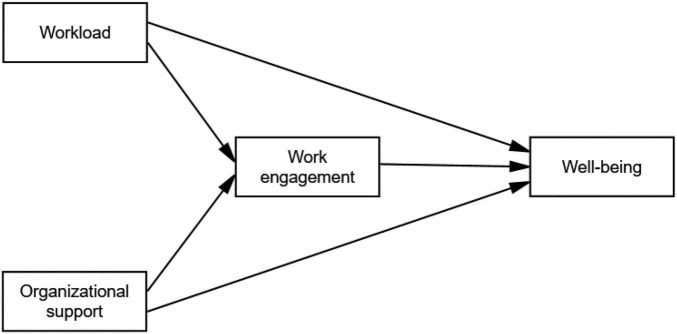
This study used structural equation modeling to examine how workload, perceived organizational support, and work engagement relate to psychological wellbeing in 572 secondary school teachers in China. Workload was negatively associated with wellbeing, while organizational support and work engagement were positively associated; work engagement also mediated the links from workload and organizational support to wellbeing.
Key findings
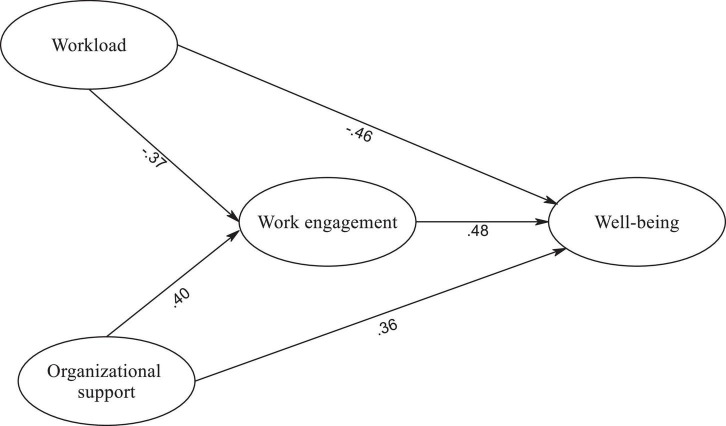
- In the sample of 572 Chinese secondary school teachers, workload was negatively correlated with organizational support (r = −0.24, p < 0.05), work engagement (r = −0.18, p < 0.05), and wellbeing (r = −0.35, p < 0.01).
- Organizational support was positively correlated with work engagement (r = 0.42, p < 0.01) and wellbeing (r = 0.54, p < 0.01), and work engagement was positively correlated with wellbeing (r = 0.48, p < 0.01).
- The SEM showed good fit: χ2 = 660.120, df = 450, CFI = 0.981, TLI = 0.972, RMSEA = 0.025, SRMR = 0.042.
- Direct effects on wellbeing were significant: workload (β = 0.46, p < 0.001), organizational support (β = 0.36, p < 0.001), and work engagement (β = 0.48, p < 0.001); indirect effects via work engagement were also significant for workload (β = 0.17, p < 0.001) and organizational support (β = 0.19, p < 0.001).
Methods
- Cross-sectional survey of 572 secondary school teachers from Southwestern China, collected between January 2023 and June 2023 using purposive sampling and in-person administration.
- Measures included a 6-item workload scale (α = 0.82), a perceived organizational support scale (α = 0.87; 4 items removed from the original 20), the 17-item Utrecht Work Engagement Scale (α = 0.89), and the 25-item Psychological Wellbeing at Work inventory (α = 0.88).
- Analyses used SPSS 28.0 and AMOS 26.0 for descriptive statistics, correlations, confirmatory factor analysis, structural equation modeling, and bootstrapped mediation tests with 5000 resamples.
Limitations
- The paper states that the cross-sectional design prevents definitive causal inference.
- The paper states that self-report measures may introduce common method bias.
- The paper states that generalizability may be limited by contextual and cultural factors in the educational system; this is evident because the sample was limited to 572 secondary school teachers in Southwestern China.
Model-written summary. Check it against the paper before relying on it.
Integrity signals
Registry
Cites
Statistics
Figures
Verification
Claims the paper makes
6 Valid · 2 Not valid · 17 Not checked · 39 Own results and interpretations
At least one cited source doesn’t support this claim or points to a different paper, and none confirmed it — see the verdicts below.
In the paper
“Empirical research across various occupational settings has demonstrated the mediating role of work engagement between job demands and wellbeing (Schaufeli et al., 2009; Koroglu and Ozmen, 2022).”
§ Exploring the impact of workload, organizational support, and work engagement on teachers’ psychological wellbeing: a structural equation modeling approach > Literature review > The present study: hypotheses
What the sources say
- Disputedcites Schaufeli et al., 2009 matched to “How changes in job demands and resources predict burnout, work engagement, and sickness absenteeism.” (2009) sourceExperimental — accuracy not yet measured
Our copy of Schaufeli, Bakker and Van Rhenen (2009) contradicts the attributed point: in the 'Test of hypothesized structural equation model' section the authors explicitly tested an alternative model adding the path from changes in job demands to T2 work engagement and found it non-significant (b = -.10, n.s.), concluding that engagement is predicted by increases in job resources but not by job demands; the 'Practical implications' section repeats that 'in order to increase engagement reducing the exposure to job demands is not the best option'. The mediation-type pathway the paper reports runs demands -> burnout -> absence duration and resources -> engagement -> absence frequency, i.e. engagement mediates the resource path, not a demands-to-wellbeing path (the 'Evidence for the JD-R model' section likewise credits prior evidence for engagement's mediating role between job resources and organizational commitment). Moreover the study is a single two-wave survey of 201 telecom managers, so it does not represent research 'across various occupational settings'. (LLM, conf=0.75)
Checked by a reasoning model — may be wrong.
- Not checked — no full text of the sourcecites Koroglu and Ozmen, 2022 matched to “The mediating effect of work engagement on innovative work behavior and the role of psychological well-being in the job demands–resources (JD-R) model.” (2022) source
boostedstates a cause- Asserted: passes — The authors put it forward as true.
- Checkable: passes — It can be checked against evidence.
- Load-bearing: passes — The paper’s conclusions depend on it.
- Based: passes — The paper gives a reason why it holds.
- Disputed
The cited sources support only part of this claim — read each source’s verdict below.
In the paper
“Work engagement emerges as a vital mediator within the nexus between teacher workload, organizational support, and overall wellbeing (Bakker and Demerouti, 2007; Xanthopoulou et al., 2009).”
§ Exploring the impact of workload, organizational support, and work engagement on teachers’ psychological wellbeing: a structural equation modeling approach > Introduction
What the sources say
- Not checked — no full text of the sourcecites Bakker and Demerouti, 2007 matched to “The Job Demands‐Resources model: state of the art” (2007) source
- Partly supportedcites Xanthopoulou et al., 2009 matched to “Reciprocal relationships between job resources, personal resources, and work engagement.” (2009) sourceExperimental — accuracy not yet measured
Our copy of Xanthopoulou et al. (2009) supports only part of what the citing sentence attributes to it: §1.1/§4.1 (Unique effects) report that job resources — including social support from colleagues and supervisory coaching — predicted work engagement over an 18-month interval, and §2.1 places the study within 'a broader project on employee well-being'. However, the sample is 163 employees of a Dutch electrical engineering/electronics company (§2.1, Procedure and participants), not teachers, and neither job demands nor quantitative workload was measured (§2.2 lists only job and personal resources and UWES engagement). Moreover, §3.2 (Model testing) and §4.3 (Limitations) frame the findings as reciprocal/cyclical cross-lagged paths and explicitly state the design 'does not allow conclusions about causality'; no mediation model (workload → engagement → wellbeing) was tested. Thus the mediator role, the teacher population and the workload element of the claim are not supported by this source. (LLM, conf=0.75)
plainstates a cause- Asserted: passes — The authors put it forward as true.
- Checkable: passes — It can be checked against evidence.
- Load-bearing: passes — The paper’s conclusions depend on it.
- Based: passes — The paper gives a reason why it holds.
The cited sources support only part of this claim — read each source’s verdict below.
In the paper
“Additionally, POS acts as a protective mechanism, decreasing the negative effects of stressors, such as high workload and challenging student behaviors, on teacher psychological wellbeing (Runhaar et al., 2013; Kurtessis et al., 2017).”
§ Exploring the impact of workload, organizational support, and work engagement on teachers’ psychological wellbeing: a structural equation modeling approach > Literature review > Perceived organizational support
What the sources say
- Could not verifycites Runhaar et al., 2013 matched to “Teachers’ organizational citizenship behaviour: considering the roles of their work engagement, autonomy and leader–member exchange.” (2013) sourceExperimental — accuracy not yet measured
Our copy of Runhaar, Konermann & Sanders (2013) holds only the publication-record content — title/metadata page plus the Abstract (n = 211, six Dutch secondary schools) and citation blocks — with no body text. The abstract is about autonomy and leader–member exchange as moderators of the work engagement → organizational citizenship behaviour (OCBI/OCBO) relationships, and never mentions perceived organizational support, workload or other stressors, or teacher psychological wellbeing (searched: 'perceived organizational support', 'buffer/protective effect', 'job demands, burnout, well-being', 'LMX social support workload'). Nothing in our copy therefore supports the buffering claim, and nothing states a contrary point either, since the outcome and predictor variables differ from those in the citing sentence. (LLM, conf=0.72)
- Partly supportedcites Kurtessis et al., 2017 matched to “Perceived organizational support: a meta-analytic evaluation of organizational support theory.” (2017) sourceExperimental — accuracy not yet measured
The Subjective Well-Being section describes POS as a resource for coping with work demands and reports negative associations with job stress and burnout. It does not establish that POS buffers the effects of high workload or challenging student behavior on teachers’ psychological well-being; its findings concern employees more generally. (LLM, conf=0.87)
plainstates a cause- Asserted: passes — The authors put it forward as true.
- Checkable: passes — It can be checked against evidence.
- Load-bearing: passes — The paper’s conclusions depend on it.
- Based: passes — The paper gives a reason why it holds.
- Could not verify
The sources with a verdict support this claim; the rest weren’t checked yet, have no full text we could read, or their verdicts aren’t rated yet.
In the paper
“Extensive research consistently highlights a positive association between work engagement and teacher wellbeing (Lesener et al., 2020; Liu et al., 2023).”
§ Exploring the impact of workload, organizational support, and work engagement on teachers’ psychological wellbeing: a structural equation modeling approach > Literature review > Work engagement
What the sources say
- Not checked — no full text of the sourcecites Lesener et al., 2020 matched to “The drivers of work engagement: a meta-analytic review of longitudinal evidence” (2020) source
- Supportedcites Liu et al., 2023 matched to “A model of teachers’ growth mindset, teaching enjoyment, work engagement, and teacher grit among EFL teachers” (2023) source
The Introduction states that teachers’ work engagement has been documented as positively associated with well-being. This supports the association attributed to Liu et al. (2023); the paper reports it as a finding in the literature, rather than as a result of its own study. (LLM, conf=0.91)
boostedstates an association- Asserted: passes — The authors put it forward as true.
- Checkable: passes — It can be checked against evidence.
- Load-bearing: passes — The paper’s conclusions depend on it.
- Based: passes — The paper gives a reason why it holds.
None of the sources cited for this claim have been checked yet.
In the paper
“Perceived organizational support profoundly influences educators’ work engagement, fostering a constructive work-related state (Eisenberger et al., 2001; Xanthopoulou et al., 2009; Sudibjo and Manihuruk, 2022; Journell, 2023).”
§ Exploring the impact of workload, organizational support, and work engagement on teachers’ psychological wellbeing: a structural equation modeling approach > Discussion
What the sources say
- Not checked — no full text of the sourcecites Eisenberger et al., 2001 matched to “Reciprocation of perceived organizational support.” (2001) source
- Not checked yetcites Xanthopoulou et al., 2009 matched to “Reciprocal relationships between job resources, personal resources, and work engagement.” (2009) source
Checked before — its earlier verdict is held back until a new check runs.
- Could not verifycites Sudibjo and Manihuruk, 2022 matched to “How do happiness at work and perceived organizational support affect teachers’ mental health through job satisfaction during the COVID-19 pandemic?” (2022) sourceExperimental — accuracy not yet measured
The Results > Mediated Effect section links perceived organizational support to teachers’ job satisfaction, not work engagement. A work-engagement study appears in the References, but our copy does not report its finding about engagement. Searches for “work engagement” and the claimed relationship found no passage establishing that support fosters educators’ work engagement. (LLM, conf=0.74)
boostedstates a cause- Asserted: passes — The authors put it forward as true.
- Checkable: passes — It can be checked against evidence.
- Load-bearing: passes — The paper’s conclusions depend on it.
- Based: passes — The paper gives a reason why it holds.
39 more claims
Create a free account to see all 64 claims and to verify the 6 references still open.
- Probably not a substantial claim. 11
- It may state two separate claims as one. 9
- The quote only partly states this claim. 1
Self-check
Percentages, sums and reported differences re-computed from the paper’s own numbers.
Each contradiction between two passages listed here was confirmed by an independent check.
Rated major: it would touch a result — a value a result rests on, reported and recomputed p-values on opposite sides of the significance level, two passages that conflict with no sign which is right, or a cited work retracted before this paper was published.
In the paper
“Disciplinary distribution indicated that 236 educators specialized in language arts (41.3%), 167 in mathematics (29.2%), and 169 in various other subjects such as English, science, and music (29.5%). Additionally, 18 educators did not specify their subject.”
§ Exploring the impact of workload, organizational support, and work engagement on teachers’ psychological wellbeing: a structural equation modeling approach > Materials and methods > Participants
Reported 572 · recomputed 590
Rated major: it would touch a result — a value a result rests on, reported and recomputed p-values on opposite sides of the significance level, two passages that conflict with no sign which is right, or a cited work retracted before this paper was published.
In the paper
§ Exploring the impact of workload, organizational support, and work engagement on teachers’ psychological wellbeing: a structural equation modeling approach > Abstract > Results
“The findings unveiled compelling negative associations between workload and perceived organizational support, workload and work engagement, and workload and psychological wellbeing among the secondary school teachers.”
§ Exploring the impact of workload, organizational support, and work engagement on teachers’ psychological wellbeing: a structural equation modeling approach > Results
“Notably, direct effects of workload, organizational support, and work engagement on wellbeing were statistically significant (workload → wellbeing: β = 0.46, 95% CI [0.41, 0.52], T = 12.60, p < 0.001; organizational support → wellbeing: β = 0.36, 95% CI [0.31, 0.42], T = 9.80, p < 0.001; work engagement → wellbeing: β = 0.48, 95% CI [0.43, 0.54], T = 13.40, p < 0.001).”
Citations
Cites
Evaluating structural equation models with unobservable variables and measurement error
Fornell, C., & Larcker, D. F. (1981) · Journal of Marketing Research · doi:10.1177/002224378101800104 · Cited by 109,190
Hu, L., & Bentler, P. M. (1999) · Structural Equation Modeling A Multidisciplinary Journal · doi:10.1080/10705519909540118 · Cited by 108,788
Conservation of resources: A new attempt at conceptualizing stress
Hobfoll, S. E. (1989) · American Psychologist · doi:10.1037/0003-066x.44.3.513 · Cited by 18,187
Confirmatory factor analysis for applied research
(2007) · Choice Reviews Online · doi:10.5860/choice.44-2769 · Cited by 15,614
The Job Demands‐Resources model: state of the art
Bakker, A. B., & Demerouti, E. (2007) · Journal of Managerial Psychology · doi:10.1108/02683940710733115 · Cited by 12,996
Maslach, C., Schaufeli, W. B., & Leiter, M. P. (2001) · Annual Review of Psychology · doi:10.1146/annurev.psych.52.1.397 · Cited by 12,852
On Happiness and Human Potentials: A Review of Research on Hedonic and Eudaimonic Well-Being
Ryan, R. M., & Deci, E. L. (2001) · Annual Review of Psychology · doi:10.1146/annurev.psych.52.1.141 · Cited by 11,567
The structure of psychological well-being revisited.
Ryff, C. D., & Keyes, C. L. M. (1995) · Journal of Personality and Social Psychology · doi:10.1037//0022-3514.69.4.719 · Cited by 10,285
Perceived organizational support.
Eisenberger, R., Huntington, R., Hutchison, S., & Sowa, D. (1986) · Journal of Applied Psychology · doi:10.1037/0021-9010.71.3.500 · Cited by 10,023 · cited 3×
“It encompasses employees’ perceptions of their organization valuing their contributions and caring about their wellbeing (Eisenberger et al., 1986).”
BackgroundInfluentialThe measurement of engagement and burnout: a two sample confirmatory factor analytic approach.
Schaufeli, W. B., Salanova, M., González-romá, V., & Bakker, A. B. (2002) · Journal of Happiness Studies · doi:10.1023/a:1015630930326 · Cited by 10,014
Research works printed but not linked: 5
- Feni N. K. Y. (2022). The Effect of Perceived Organizational Support and Psychological Capital on the Psychological Well-Being of Teachers. Doctoral dissertation. South Africa: University of the Free State.
- Journell L. (2023). The Relationships Among Organizational Support, Teacher Well-being, and Teacher Resilience in Secondary School Teachers. Doctoral dissertation. Dayton: Wright State University.
- Ling W. Yang H. Fang L. (2006). Perceived organizational support (POS) of the employees. Acta Psychol. Sinica 38 281– 287.
- Magalong A. A. Torreon L. C. (2021). Teaching workload management: its impact on teachers’ well-being and effectiveness. Am. J. Multidiscip. Res. Dev. 3 31– 36.
- Sarath P. Manikandan K. (2014). Work engagement and work related wellbeing of school teachers. SELP J. Soc. Sci. 5 93– 100.
Cited by
Teachers’ workload, turnover intentions, and mental health: perspectives of Australian teachers
Granziera, H., Collie, R. J., Roberts, A., Corkish, B., Tickell, A. M., Deady, M., O’Dea, B., Tye, M., & Werner‐Seidler, A. (2025) · Social Psychology of Education · doi:10.1007/s11218-025-10113-w · Cited by 26
“For teachers, workload comprises numerous responsibilities, including administration, data tracking, planning and delivering lessons, managing student behaviour, adhering to school and departmental policies and procedures, and fulfilling administrative duties (Bellibas et al., 2024; Wang, 2024).”
Karacabey, M. F., Özkul, R., Polatcan, M., & Bellibaş, M. Ş. (2025) · Educational Management Administration & Leadership · doi:10.1177/17411432251346087 · Cited by 28
“This support stems from the Job Demands-Resources (JD-R) theory, which suggests that leaders can enhance positive teacher emotions and outcomes by developing job resources, such as OS, and reducing job demands, such as work overload (Bakker and Demerouti, 2017; Wang, 2024).”
Wang, W., & Shakibaei, G. (2025) · BMC Psychology · doi:10.1186/s40359-025-02857-z · Cited by 34
“Wang [74] points out that TJE is crucial as it directly impacts their ability to create a positive learning environment, manage classroom dynamics, and foster student engagement and achievement.”
Wang, Y. (2025) · Teaching and Teacher Education · doi:10.1016/j.tate.2025.105039 · Cited by 18
Self-citationSanchis-Giménez, L., Tamarit, A., Prado‐Gascó, V., Pujalte, L. S., & Díaz-Rodríguez, L. (2024) · Sustainability · doi:10.3390/su16166814 · Cited by 10
“The consequences that will be addressed in this study are health problems [45,46], burnout [47], and engagement [48,49].”
BackgroundZhang, Q. (2025) · Frontiers in Psychology · doi:10.3389/fpsyg.2025.1572070 · Cited by 14
“The unique pressures and demands faced by these educators, including heavy workloads, high expectations, and potential isolation, may necessitate a tailored approach to understanding and promoting engagement and mental well-being (Wang, 2024).”
Shuai, C., He, Y., & Yu, X. (2025) · Psychological Reports · doi:10.1177/00332941251358217 · Cited by 7
Gou, Y., Zeng, G., Xu, Y., & Xie, X. M. (2025) · Frontiers in Psychology · doi:10.3389/fpsyg.2025.1660484 · Cited by 9
“…psychological resource encompasses positive traits such as hope, optimism, resilience, and self-efficacy, helping individuals maintain a positive state when facing complex tasks or organizational stress (Wang, 2024), thereby influencing the emergence of voice behavior (Cooper et al., 2025).”
InfluentialSu, Q.-L. (2024) · Frontiers in Psychology · doi:10.3389/fpsyg.2024.1465880 · Cited by 5
“For example, Wang (2024) notes that in China, female teachers often face added pressures from traditional gender expectations, which may negatively influence their professional commitment and job involvement.”
BackgroundResultInfluentialKim, A. (2026) · Education and Information Technologies · doi:10.1007/s10639-025-13892-z · Cited by 12
“Given the negative associations between workload and psychological well-being (Wang, 2024 ), while higher ICT literacy and instructional quality aimed at fostering creativity are desirable outcomes, they may increase demands on teachers, underscoring the need for supportive structures such as…”
InfluentialLi, J., Ni, X., Wang, M., Ou, Z., Chen, J., Chen, T., & Yu, C. (2026) · Frontiers in Psychology · doi:10.3389/fpsyg.2025.1723296 · Cited by 4
“…sample of Chinese teachers, perceived organizational support was positively and stably correlated with engagement and mental health, suggesting a systematic connection between workload and support and engagement, in line with the path assumption of the work requirements resource model (Wang, 2024).”
Hussain, A., Xia, X., Jameel, A., Sadiq, S., Kanwel, S., & Saleem, S. (2026) · BMC Psychology · doi:10.1186/s40359-026-04189-y · Cited by 7
“Therefore, OST provides the situational background [33], whereas SET elucidates the relationship and motivational dynamics that will increase engagement [34].”
Negative Implications of Workload among Teachers: A Systematic Literature Review
Abdullah, M. H. S., & Hassan, N. M. (2024) · International Journal of Academic Research in Progressive Education and Development · doi:10.6007/ijarped/v13-i3/22193 · Cited by 10
“Similarly, the research conducted by Wang (2024), Jain et al (2023), and Slamet et al (2023), concurred that administrative responsibilities in schools have led to a rise in workload, hence impeding the professional growth of teachers.”
BackgroundResultInfluentialGuan, W., Cheng, Y., Wu, T., Liu, J., & Xie, Z. (2024) · European Journal of Education · doi:10.1111/ejed.12856 · Cited by 5
Generativity and Psychological Well-Being in Primary and Secondary Teachers: A Systematic Review
Sandoval-Obando, E., Barros-Osorio, C., Castellanos-Alvarenga, L., Páucar, M. A. V., & Vega-Muñoz, A. (2025) · Societies · doi:10.3390/soc15110320 · Cited by 5
“In this context, it is essential to examine not only the material and structural conditions of teachers’ work but also the psychological processes that undergird their professional performance and well-being [4].”
Malik, M. J. N., Ali, M., Malik, A., & Malik, S. (2025) · International Journal of Environmental Research and Public Health · doi:10.3390/ijerph22121856 · Cited by 17
“It encompasses both structural mechanisms such as workload management, training and feedback systems and emotional resources that help employees navigate workplace stress [33].”
Exploring Leadership’s Impact on Teacher Well-being: A Case Study from Dubai
Siyam, N., Yacoub, H. A. M., & Siyam, Y. (2025) · International Journal of Community Well-Being · doi:10.1007/s42413-025-00246-3 · Cited by 4
“Organizational support is another key determinant, with a well-supported environment contributing positively to teacher well-being (Wang, 2024).”
Wei, S., Wang, Q., & Song, S. (2025) · Current Psychology · doi:10.1007/s12144-025-07545-0 · Cited by 4
“…engagement (Mao et al., 2019); the sense of organizational support of middle school teachers positively predicts work engagement (Zou & Yin, 2017; Wang, 2024) and another study of early childhood teachers’ social support can significantly and positively predict work engagement (Cheng & Gao,…”
Impact of workplace commitment and skill discretion on mental health: Insights from path analysis
(2025) · doi:10.1080/2331186x.2025.2593040 · Cited by 2
“Similarly, a study on Chinese faculty found that organizational support and balanced workloads specifically boosted vigor, which in turn contributed to greater psychological well-being (Wang, 2023).”
The influence of work-life balance on teacher performance in Zhengzhou, China
Li, M., & Ahmad, A. (2025) · Frontiers in Psychology · doi:10.3389/fpsyg.2025.1586128 · Cited by 15
“Assistance from school administration offers institutional resources and emotional support, alleviating occupational stress (Wang, 2024).”
Institutional Support and Teaching Efficacy: Evidence From Private University Faculty in China
Feng, H., Singh, S. S. B., & Ming, X. (2026) · SAGE Open · doi:10.1177/21582440251410721 · Cited by 7
“For example, Wang (2024) employed a structural equation modeling approach to show that perceived organizational support significantly enhances teachers’ psychological well-being and instructional confidence across East Asian institutions.”
Zhao, Z., Yang, D., & Tsai, P.-W. (2026) · Frontiers in Psychology · doi:10.3389/fpsyg.2025.1708425 · Cited by 3
“Teaching enjoyment is the pleasant emotional experiences and feeling of happiness when teaching, as well as while interacting with students (Burić and Wang, 2024).”
Su, F., Beh, W. F., & Lee, K. C. S. (2026) · Acta Psychologica · doi:10.1016/j.actpsy.2026.107353 · Cited by 10
Şengüllendi, M. F. (2025) · Journal of Health Organization and Management · doi:10.1108/jhom-08-2024-0352 · Cited by 5
A multivariate analysis of the influencing factors for job satisfaction and well-being of academics
Puiu, S., Udriștioiu, M. T., & Petrişor, I. (2025) · Scientific Reports · doi:10.1038/s41598-025-20594-6 · Cited by 6
“The correlation between management support and performance was not validated—H6, which in other studies was noticed as significant 25–27 , 35 .”
Piele, M. D., Ionașcu, D. D., Pânişoară, I. O., & Lazăr, I. (2026) · BMC Psychology · doi:10.1186/s40359-026-04169-2 · Cited by 8
“Similary, Wang [78] confirmed that teachers who experience their school institutional environment as supportive are likely to report higher levels of motivation, engagement, and psychological well-being, as organizational support is important for sustaining professional adaptability.”
Alonso, A. C., de Carvalho, A. O. M., de Lira, J. O., Paixão, V., Modenes, R. D., Ernandes, R. D. C., da Silva, V. C., Júnior, G. S., Passos, K. G., Lino, M. H. D. S., et al. (2025) · Heliyon · doi:10.1016/j.heliyon.2025.e42256 · Cited by 8
Shahrokhi, M., & Dehaghani, F. J. (2025) · Acta Psychologica · doi:10.1016/j.actpsy.2025.105986 · Cited by 5
Han, B., & Zhang, K. (2025) · Frontiers in Psychology · doi:10.3389/fpsyg.2025.1640996 · Cited by 7
“Evidence from teacher studies indicates that POS influences their job satisfaction, work conditions, and mental health (Wang, 2024).”
Ntumi, S. (2025) · Research Square · doi:10.21203/rs.3.rs-6794493/v1 · Cited by 2
Teacher Subjective Well-being and Work Engagement: The Mediating Role of Professional Resilience
Kalman, M. (2025) · The Asia-Pacific Education Researcher · doi:10.1007/s40299-025-01066-x · Cited by 3
“Further studies indicate that WE mediates relationships between various variables, includ - ing positivity ratio and well-being (Rusu & Colomeis - chi, 2020 ), workload and well-being (Wang, 2024), and personal and job resources and job satisfaction (Wang et al., 2024a, b).”
Mordeno, I. G., Lucero, L., & Bigcas, J. D. (2026) · Frontiers in Education · doi:10.3389/feduc.2026.1850327 · Cited by 2
Li, Z., Liu, L., & Yan, L. (2026) · PLoS ONE · doi:10.1371/journal.pone.0350574 · Cited by 1
“[14].”
Wei, J., (17845137), H. P., (2902363), Y. H., Shuai, C., & (12677534), A. W. (2026) · Frontiers in Psychology · doi:10.3389/fpsyg.2026.1737206 · Cited by 1
“Organizational support theory posits that an organization’s attention to and support for its members are critical factors that encourage individuals to remain with the organization and actively contribute to its success (Yu and Frenkel, 2013; Wang, 2024).”
Sun, H., Chang, H., & Shen, X. (2026) · Frontiers in Psychology · doi:10.3389/fpsyg.2026.1746170 · Cited by 1
“Recent quantitative studies confirm that workload, perceived organizational support, and work engagement jointly predict teachers’ psychological well-being, underscoring the relevance of JD-R perspectives in understanding academic staff experiences (Wang, 2024).”
Çakan, M., Bükün, M. F., Barmanpek, U., Irmak, E., & Özgün, Z. (2024) · Bartın Üniversitesi İktisadi ve İdari Bilimler Fakültesi Dergisi · doi:10.47129/bartiniibf.1450970 · Cited by 1
Harrison, M. G., Mendoza, N. B., Hocson, S. M. G., & King, R. B. (2026) · British Journal of Guidance and Counselling · doi:10.1080/03069885.2025.2610616 · Cited by 3
“Though narrower and more work-focused than wellbeing, engagement is associated with organisational support and higher wellbeing in schools (Sarath & Manikandan, 2014; Schaufeli & Sal-anova, 2007; Wang, 2024).”
Sung, W., & An, H. (2026) · Teaching and Teacher Education · doi:10.1016/j.tate.2025.105375 · Cited by 2
Trajectory of teachers’ work engagement during and after the COVID-19 pandemic
Tsuyuguchi, K., 生田, 淳., & Kawakami, Y. (2026) · Teaching and Teacher Education · doi:10.1016/j.tate.2026.105803
Hameed, T., Ghauri, T. A., & Iqbal, S. M. J. (2025) · iRASD Journal of Management · doi:10.52131/irasd-jom.2025.v7i4.3219
Beyhan, A. (2026) · Journal of Education Human Resources · doi:10.3138/jehr-2025-0034 · Cited by 2
Oliveira, R. F. D., Duarte, H. S. D. C. B., Swara, N. N. A. A. V., Arsha, I. M. R. M., & Suardhika, I. N. (2026) · Springer proceedings in business and economics · doi:10.1007/978-981-95-6415-6_5
Liu, J., Tahri, D., Aziku, M., & Mbowe, A. E. (2026) · European Journal of Teacher Education · doi:10.1080/02619768.2026.2680932
Wan, C. L., Leow, W. F., & Khor, W. M. (2025) · Journal of Information System and Technology Management · doi:10.35631/jistm.1041022
Catamio, J. R. (2026) · Psychology and Education A Multidisciplinary Journal · doi:10.70838/pemj.570410 · Cited by 1
Li, H., & Peng, T. (2025) · International Conference on Artificial Intelligence, Virtual Reality and Interaction Design · doi:10.1145/3777730.3777740
Awan, N. J. (2024) · Bulletin of Business and Economics (BBE) · doi:10.61506/01.00362 · Cited by 1
“Wang (2024) further defines work engagement as a multifaceted construct that includes physical, emotional, and cognitive components.”
BackgroundThe Impact of Perceived Organizational Support on Work Engagement in Schools
ORHAN, M. (2026) · Cumhuriyet International Journal of Education · doi:10.30703/cije.1716195
Sabbahi, D., Meisha, D. E., Abuljadayel, L. W., Samman, M., Alwafi, A. A., Kabbarah, A. J., Ayoub, S., & Almutairi, S. (2026) · BMC Oral Health · doi:10.1186/s12903-026-08080-5 · Cited by 1
“Additionally, in this study, teachers who did not engage in out-of-school work tasks had lower distress levels than those who did, which confirms studies that found that a high workload adversely affected teachers’ psychological well-being [30].”
Emotional and Material Support Needed by Teachers
Velmurugan, R., Sudarvel, J., Bhuvaneswari, R., & Senthilkumar, S. (2026) · IGI Global eBooks · doi:10.4018/979-8-3373-8983-7.ch022
Barriers in Management Research Productivity: A TISM and Fuzzy MICMAC Study
Sharma, D., Kumar, D., & Mahajan, R. (2026) · International Journal of Mathematical Engineering and Management Sciences · doi:10.33889/ijmems.2026.11.2.044
Xiong, L., Liu, Y., & Wei, Z. (2026) · Frontiers in Psychology · doi:10.3389/fpsyg.2026.1830411 · Cited by 1
“Engaged teachers are not only more resilient and innovative but also cultivate more positive classroom environments, directly influencing student success (Christian et al., 2011; Wang, 2024; Zee and Koomen, 2016).”
InfluentialMa, C. (2026) · Frontiers in Psychology · doi:10.3389/fpsyg.2026.1943721
The Impact of Exercise on Teacher Satisfaction and Retention: A Scoping Review
Wilkens, S. A., & Milla, C. (2026) · IGI Global eBooks · doi:10.4018/979-8-3373-6157-4.ch012
Malaga, R. S., & Olenski, D. E. (2026) · International Journal of ADVANCED AND APPLIED SCIENCES · doi:10.21833/ijaas.2026.01.021
Zhang, X., Xu, S., Sun, Y., Zhang, Y., Li, X., & Wang, K. (2026) · Research Square · doi:10.21203/rs.3.rs-10341870/v1
Ulubey, Ö., & Alpaslan, M. M. (2026) · Anales de Psicología · doi:10.6018/analesps.631891
“Previous studies demonstrate that time pressure negatively impacts teacher well-being and job satisfaction and can increase stress (Avanzi et al., 2018; Smith & Bourke, 1992; Wang, 2024).”
PROMOTING THE WELL-BEING OF BEGINNING TEACHERS: AN ASSESSMENT
FRAGATA, J. A. M. (2025) · Cognizance Journal of Multidisciplinary Studies · doi:10.47760/cognizance.2025.v05i05.019
Gamongan, F. G. (2026) · doi:10.69739/jmhp.v1i1.1839 · Cited by 1
Baharun, H., Najiburrahman, Zamroni, Rozi, F., Qodriyah, K., & Hikmah, R. (2025) · International Conference on Artificial Intelligence, Blockchain, Cloud Computing, and Data Analytics (ICoABCD) · doi:10.1109/icoabcd67551.2025.11470802 · Cited by 2
“Mental health challenges among educators have become a global concern, with teachers experiencing high levels of stress due to increasing workload demands, classroom interactions, and administrative responsibilities, which may lead to anxiety, depression, and mental exhaustion [1][2].”
Chen, M., & Zhang, L. (2026) · Frontiers in Psychology · doi:10.3389/fpsyg.2026.1837443
“This scale has been proven to be valid among the Chinese population (Wang, 2024).”
The effects of job autonomy on work engagement and burnout: a meta-analysis across ages and cultures
Firouzjaeiangalougah, M., & Procházka, J. (2026) · Work & Stress · doi:10.1080/02678373.2026.2718052 · Cited by 1
Geng, F., Yu, S., & Yuan, R. (2026) · Teaching and Teacher Education · doi:10.1016/j.tate.2026.105548 · Cited by 2
YURTTAŞ, Y., Çakar, M., & Erat, S. (2026) · Doğuş Üniversitesi Dergisi · doi:10.31671/doujournal.1929974
Chetry, B. (2025) · Advances in analytics for learning and teaching · doi:10.1007/978-3-031-87740-7_11
Connon, E., Park, H. R. P., Turner, R. M., Williams, L. M., & Gatt, J. M. (2026) · Psychological Medicine · doi:10.1017/s0033291726104784
Ainsworth, S., Adamson, C., & Oldfield, J. (2026) · Review of Education · doi:10.1002/rev3.70204
ICT Use at Work as a Double-Edged Sword: A Moderated Mediation Model of Employee Well-Being
Arriagada-Venegas, M., Ariño-Mateo, E., & González‐Romá, V. (2026) · The Spanish Journal of Psychology · doi:10.1017/sjp.2026.10029
“A subsequent study with teachers in China corroborated this finding, demonstrating that a high level of work-load negatively impacts work engagement (Wang, 2024).”
Seçer, E. (2026) · BMC Public Health · doi:10.1186/s12889-026-27902-3
“International empirical studies supporting the JD-R model have shown that when teachers face heavy work-loads and complex tasks, their burnout increases and their psychological well-being decreases [72–74].”
Alignment Between Assessment Processes and Active Methodologies in Primary Education
Conde-Izquierdo, S., Nicolás, D. P., & Ruano, Á. M. (2026) · International Journal of Educational Research · doi:10.1016/j.ijer.2026.103078
Sucacahua, N. M. Y., Almonte, E. E. T., & Farfán, F. R. C. (2026) · Revista Simón Rodríguez · doi:10.62319/simonrodriguez.v.6i12.191
Workplace Stress and Coping Strategies Among Teachers in District II-A, Division of Olongapo City
Furigay, C. D., & Espiritu, R. D. (2026) · Advanced Social Science in Research Journal · doi:10.11594/assrj.01.03.06
“This suggests that excessive tasks, documentation, and time pressure may affect teachers’ well -being and work engagement, consistent with Wang (2024) and Creagh et al. (2025), who reported that workload and work intensification negatively influence teachers’ psychological well-being.”
Sruthi, V., & Jayakumar, K. N. (2026) · Journal of Workplace Behavioral Health · doi:10.1080/15555240.2026.2734891
Palaz, T., Savaş, G., AYDIN, F., Çepni, O., & Kılınç, A. Ç. (2025) · International Journal of Educational Research · doi:10.1016/j.ijer.2025.102918 · Cited by 5
Dapat, S. F. (2025) · International Journal of Research Publications · doi:10.47119/ijrp1001731520257884
Wang, Y., & Mauhay, R. C. A. (2026) · International Journal of Research Studies in Management · doi:10.5861/ijrsm.2026.26118
Self-citationPsychological capital as a predictor of work engagement in a training academy
Harris, C., Jacobs, C., & Stindt, C. (2025) · SA Journal of Human Resource Management · doi:10.4102/sajhrm.v23i0.3207 · Cited by 5
(2026) · doi:10.3389/fpsyg.2026.1784108
“For example, resilience is more strongly associated with career commitment in collectivist educational settings, whereas self-efficacy dominates in individualistic settings, suggesting a cultural moderating effect of sub-dimension salience (Cheng and Zhao, 2023; Wang, 2024).”
Garba, S. A., & Yusuf, B. (2026) · Springer international handbooks of education · doi:10.1007/978-981-95-2423-5_30 · Cited by 2
Caare, J., & Puertos, J. D. (2026) · Psychology and Education A Multidisciplinary Journal · doi:10.70838/pemj.540904
Bişog, L. P., Huțul, T., & Karner‐Huțuleac, A. (2026) · Psychological Reports · doi:10.1177/00332941261450869 · Cited by 1
EXPERT VALIDATION OF TEACHER'S ACADEMIC WORKLOAD ASSESSMENT TOOL FOR SECONDARY SCHOOLS
Ibrahim, W. M. K. W., Osman, A. A., & Hussain, S. (2025) · International Journal of Modern Education · doi:10.35631/ijmoe.728065
Patrimonio, G. P., & Laya, M. (2026) · Psychology and Education A Multidisciplinary Journal · doi:10.70838/pemj.560404 · Cited by 1
Sanchez-Puente, I., Mejía, P. C. I., & Cuadras, D. L. C. (2025) · Dékau Perú · doi:10.55996/dekape.v3i1.352
“At the local level, education sector frequently experiences contextual challenges related to workload distribution, interpersonal dynamics, and organizational culture (Wang, 2024).”
Şahin, A., Dönmez, S. A., & GÖK, R. (2026) · Psicología Educativa · doi:10.5093/psed2026a21
Fu, C., & Niu, X. (2025) · Current Psychology · doi:10.1007/s12144-025-08234-8 · Cited by 1
“Thus, a supportive educational environ-ment—characterized by friendly peers, encouraging leaders, and well-performing students—can help teachers better manage stress (Wang, 2024 ), thereby significantly enhancing the effectiveness of cognitive reappraisal for PSTs. reappraisal are essential.”
Alsulaiman, S. A., & Albrekkan, F. M. (2026) · Frontiers in Psychology · doi:10.3389/fpsyg.2026.1853679
“Other studies have shown how POS can increase work engagement and protect psychological well-being (Wang, 2024).”
The role of organizational and psychological effect on teachers’ occupational stress
Cheng, A., Fauziyah, N., & Junaidi, J. (2026) · Frontiers in Education · doi:10.3389/feduc.2026.1759589
Metadata
- Authors
- Wang, Y.
- Affiliations
- Southwestern University of Finance and Economics (CN)
- Corresponding author
- Wang, Yonggang
- ORCID
- Wang, Yonggang
- Venue
- Frontiers in Psychology
- Publisher
- Frontiers Media SA
- Published
- 2024-01-19
- Volume
- 14
- Pages
- 1345740-1345740
- ISSN
- 1664-1078 (ISSN-L)
- PMC
- PMC10834696
- OpenAlex
- W4391033587
- Cited by
- 104
- References
- 94
- Citations by year
- 2026: 59 · 2025: 37 · 2024: 8
- FWCI
- 51.76
- Type
- journal article
- Language
- en
- Open access
- gold
- doi.org
- Licence
- Locations
- Frontiers in Psychology (publishedVersion, cc-by)
- PubMed Central (publishedVersion, cc-by)
- PubMed (publishedVersion)
- DOAJ (DOAJ: Directory of Open Access Journals) (submittedVersion, cc-by-sa)
- Topics
- Social Sciences › Business, Management and Accounting › Organizational Behavior and Human Resource Management › Job Satisfaction and Organizational Behavior
- Health Sciences › Medicine › Public Health, Environmental and Occupational Health › Occupational Health and Burnout
- Social Sciences › Psychology › Social Psychology › Workaholism, burnout, and well-being
- Keywords
- teacher workload, perceived organizational support, work engagement, psychological well-being, secondary school teachers, mediation, Chinese teachers
About these checks
Registry, retraction, Cites and statistics results are computed, not judged, with one exception: a printed reference that no index lists is read once by a model before it counts as a citation error. Claims are extracted by a model and kept only when their quote appears verbatim in the text; each cited source is then checked, with a model’s help, for whether it says what the claim relies on. Those verdicts can be wrong — read the claim’s quote and the cited source before relying on one.
The claim verdicts this report counts are experimental: their accuracy is not yet measured.
A language model drew the claims from the paper on 2026-10-10, under version 3 of the claim definition (model deepseek-v4.1-flash, prompt extract-v3).
A second model labelled each claim on 2026-10-10 (model jev-1.13-20260917, definition revision gold-guideline-v0.2).
Cited sources are checked with a language model’s help (qwen3.8-omni-flash and gpt-6-sol).
Statistics and arithmetic are recomputed, not judged.
Confidence bands are shown only for fields calibrated on our annotated test set. None is calibrated yet, so no band is shown.
What counts as a claim ›How we measure confidence ›How we check this ›
Are you an author, or do you see a problem with this page? Request a review
Data sources
Bibliographic data: Semantic Scholar, OpenAlex, Crossref.
Contains information from the Semantic Scholar Academic Graph Datasets, made available under the ODC Attribution License (ODC-BY 1.0).
Semantic Scholar’s data is described in: Kinney, R., et al. (2023). The Semantic Scholar Open Data Platform. arXiv:2301.10140.
