

Ethical issues in multi-agent AI systems for healthcare: a narrative review
Open accessThe DOI matches its Crossref record; 59 of the 62 references it cites were found in a registry or an index; 62 of the 108 sources its claims cite were checked for support.
Abstract
Introduction: Multi-agent AI systems are believed to bring significant improvements in digital health, but it also brings new and more serious ethical issues. Such systems distribute the decision-making process among multiple interacting agents, and this decentralized decision-making system has raised ethical concerns in the medical field. On the one hand, it continues the ethical issues of traditional AI tools; on the other hand, the interaction processes within complex systems have also brought about new dilemmas. This narrative review aims to synthesize the ethical issues related to multi-agent AI systems in healthcare presented and explore the corresponding mitigation strategies. Methods: The study outcomes were synthesized using a narrative approach. Relevant records were gathered through Boolean searches in databases such as PubMed, Scopus, and Web of Science. A total of 21 articles related to multi-agent AI, healthcare, and ethical issues are included in this review. Results: Seven key ethical challenges were identified: (1) compound opacity, where interacting AI agents create layers of inscrutable decision-making; (2) error propagation and attribution difficulties, complicating accountability for clinical harm; (3) increased clinician dependence and automation bias, leading to potential deskilling and overreliance; (4) erosion of human oversight, as multi-agent AI systems operate beyond effective human control; (5) privacy and data security risks, stemming from complex data flows among agents; (6) threats to patient autonomy and informed consent, due to opaque or paternalistic AI recommendations; and (7) contextual blindness, reflecting a loss of individualized patient understanding in modular AI workflows. Furthermore, this review also summarized solutions proposed in the existing literature for these ethical issues. Conclusions: Multi-agent AI systems intensify existing ethical concerns in healthcare by distributing decision-making and blurring responsibility. To mitigate these issues, recent research advocates for the development of adaptive governance models, clear accountability frameworks, human–AI collaboration structures that preserve clinician authority, enhanced systems for explainability, and privacy-centered designs. In order to successfully incorporate agentic AI into healthcare, it is essential to maintain transparency, protect patient rights, and ensure that human-centered values continue to guide clinical decision-making in an era dominated by autonomous, interacting AI systems.
Overview
CoChat Summary
TL;DR
This narrative review synthesizes 21 articles from 2022–2025 on ethical issues in multi-agent AI systems for healthcare, identifying seven key challenges including compound opacity, error propagation and attribution difficulty, automation bias, eroded human oversight, privacy risks, threats to patient autonomy/informed consent, and contextual blindness. It summarizes proposed mitigations such as adaptive governance, clear accountability frameworks, human–AI collaboration preserving clinician authority, enhanced explainability, and privacy-centered design.
Key findings
- Seven ethical challenges were identified: (1) compound opacity; (2) error propagation and attribution difficulties; (3) increased clinician dependence and automation bias; (4) erosion of human oversight; (5) privacy and data security risks; (6) threats to patient autonomy and informed consent; and (7) contextual blindness.
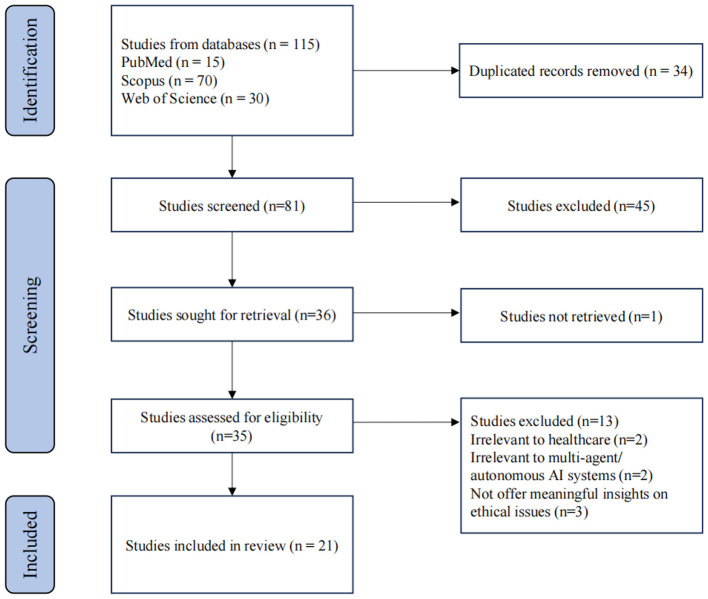
- The search retrieved 115 records; after removing 34 duplicates, 81 articles were screened, 35 were assessed in full text, and 21 met inclusion criteria. Among the 21 included studies, eight were review articles.
- Multi-agent AI systems are argued to intensify existing healthcare AI ethical concerns by distributing decision-making and blurring responsibility, rather than merely adding risks to single-model AI.
- Proposed mitigation strategies from the literature include adaptive governance models, clear accountability frameworks, human–AI collaboration structures that preserve clinician authority, system-level explainability, and privacy-centered designs.
Methods
- Narrative review using SANRA guidelines, with Boolean searches in PubMed, Scopus, and Web of Science for English studies published January 2022–December 2025. Inclusion focused on multi-agent and/or agentic AI in healthcare with ethical, governance, or accountability dimensions; exclusions included non-healthcare AI, purely technical studies, and AI ethics in healthcare without multi-agent or interactive system dynamics.
- Screening proceeded by title/abstract, then full-text assessment: 115 records retrieved, 34 duplicates removed, 81 retained for screening, 35 assessed for full text, and 21 included.
- Data analysis used inductive thematic synthesis; authors reviewed material independently, met to compare findings and reach consensus, then clustered overlapping and frequently cited issues into seven broader themes. The synthesis was qualitative and did not attempt quantitative analysis.
Limitations
- The paper states that the review was restricted to English-language publications from 2022–2025, which may have excluded relevant studies in other languages or outside that time frame, limiting global and temporal scope; it also notes that rapidly evolving AI technologies may mean some relevant studies were overlooked.
- The paper states that as a narrative review it relies on interpretive synthesis, introducing subjectivity; study selection, thematic grouping, and analytical emphasis may have been influenced by the authors’ perspectives, with a higher risk of interpretive bias than quantitative evidence syntheses.
- The paper also notes that included studies varied considerably in aims and scope, so direct comparison of findings across studies was not feasible.
Model-written summary. Check it against the paper before relying on it.
Integrity signals
Registry
Cites
Statistics
Figures
Verification
Claims the paper makes
42 Valid · 5 Not valid · 18 Not checked · 37 Own results and interpretations
The cited sources support only part of this claim — read each source’s verdict below.
In the paper
“As multi-agent systems take on increasingly complex analytical responsibilities—such as imaging interpretation, longitudinal data synthesis, and workflow optimization—the risk of professional skill erosion becomes more pronounced.”
§ Ethical issues in multi-agent AI systems for healthcare: a narrative review > Results > Increased clinical dependence on AI outputs
What the sources say
- Partly supportedcites [36] Sapkota R Roumeliotis KI Karkee M. AI agents vs. agentic AI: a conceptual taxonomy, applications and challenges. Inf Fusion. (2025) 126: 103599. doi: 10.1016/j.inffus.2025.103599 sourceExperimental — accuracy not yet measured
Section 4.0.2 (page unavailable) describes coordinated agents analyzing clinical data, summarizing patient histories, and supporting treatment decisions; Section 3.0.1 describes multi-agent systems pursuing complex objectives. The paper does not connect those responsibilities to erosion of professionals’ skills, and the searched passages on deskilling and loss of expertise did not establish that risk. (LLM, conf=0.84)
- Could not verifycites [26] Holmes SA Faria V Moulton EA. Generative AI in healthcare: challenges to patient agency and ethical implications. Front Dig Health. (2025) 7: 1524553. doi: 10.3389/fdgth.2025.1524553 40607189 PMC12213482 sourceExperimental — accuracy not yet measured
The Future directions section says generative AI models are growing more complex, while Shifting our diagnostic basis discusses the risk of improper diagnoses from AI-generated data. Neither passage addresses professional skill erosion as AI takes on analytical work. Searches for deskilling and the cited analytical tasks found no passage making that connection. (LLM, conf=0.75)
plainstates a possible cause- Asserted: passes — The authors put it forward as true.
- Checkable: passes — It can be checked against evidence.
- Load-bearing: passes — The paper’s conclusions depend on it.
- Based: passes — The paper gives a reason why it holds.
- Partly supported
The cited sources support only part of this claim — read each source’s verdict below.
In the paper
“As these systems become capable of perceiving environments and acting upon them without direct real-time input, the role of the clinician risks transforming from an active decision-maker to a passive supervisor of automated processes (31).”
§ Ethical issues in multi-agent AI systems for healthcare: a narrative review > Results > Erosion of human oversight and control
What the sources say
- Partly supportedcites [31] Bani Issa H. Robotic surgery and the law: defining control and criminal responsibility. J Soft Comput Data Min. (2025) 6: 423– 34. doi: 10.30880/jscdm.2025.06.01.028 sourceExperimental — accuracy not yet measured
The Introduction (p. 424) says surgical robots can react to sensor measurements, act semi-autonomously, and share some decisions with humans. The paper also describes these systems as operating with human supervision, but it does not say clinicians risk becoming passive supervisors or cease providing real-time input. (LLM, conf=0.80)
hedgedstates a possible cause- Asserted: passes — The authors put it forward as true.
- Checkable: passes — It can be checked against evidence.
- Load-bearing: passes — The paper’s conclusions depend on it.
- Based: passes — The paper gives a reason why it holds.
- Partly supported
The cited sources support only part of this claim — read each source’s verdict below.
In the paper
“LLMs may inadvertently memorize and regurgitate personal health information from training or interaction data, especially when not fine-tuned with rigorous privacy-preserving constraints (45).”
§ Ethical issues in multi-agent AI systems for healthcare: a narrative review > Results > Privacy and data security risks
What the sources say
- Partly supportedcites [45] Hu Y Liu J Jiang W. Large language models in nephrology: applications and challenges in chronic kidney disease management. Renal Fail. (2025) 47: 2555686. doi: 10.1080/0886022X.2025.2555686 PMC12418797 40916423 sourceExperimental — accuracy not yet measured
The ‘Privacy and data security’ section (page not provided) warns that entering patient details into an online LLM could inadvertently transmit identifiable health data to a third party, and calls for strict safeguards. It does not say that LLMs memorize and regurgitate health information from training or interaction data, or link that risk to a lack of privacy-preserving fine-tuning. (LLM, conf=0.85)
hedgedstates a possible cause- Asserted: passes — The authors put it forward as true.
- Checkable: passes — It can be checked against evidence.
- Load-bearing: passes — The paper’s conclusions depend on it.
- Based: passes — The paper gives a reason why it holds.
- Partly supported
Every source the paper cites for this claim was checked and supports it.
In the paper
“Failures resulting from algorithmic error or malfunction create “responsibility gaps” in existing legal doctrines that assume human intent or negligence.”
§ Ethical issues in multi-agent AI systems for healthcare: a narrative review > Results > Erosion of human oversight and control
What the sources say
- Supportedcites [31] Bani Issa H. Robotic surgery and the law: defining control and criminal responsibility. J Soft Comput Data Min. (2025) 6: 423– 34. doi: 10.30880/jscdm.2025.06.01.028 source
The Introduction (p. 424) says software bugs and algorithm defects can cause harm in robotic surgery, while medical-malpractice doctrine is ill prepared for diffused responsibility and criminal liability traditionally presupposes a guilty mind. The Abstract (p. 423) likewise identifies accountability problems when machine malfunctions or algorithmic mistakes lead to errors. (LLM, conf=0.93)
plainstates a cause- Asserted: passes — The authors put it forward as true.
- Checkable: passes — It can be checked against evidence.
- Load-bearing: passes — The paper’s conclusions depend on it.
- Based: passes — The paper gives a reason why it holds.
- Supported
The cited sources support only part of this claim — read each source’s verdict below.
In the paper
“By using techniques like federated learning and zero-knowledge proofs, agents can work together without sharing raw patient data (48).”
§ Ethical issues in multi-agent AI systems for healthcare: a narrative review > Discussion > Strategies for ethical mitigation and governance
What the sources say
- Partly supportedcites [48] Cherif AN Youssfi M En-Naimani Z Tadlaoui A Soulami M Bouattane O. Cqrs and blockchain with zero-knowledge proofs for secure multi-agent decision-making. Int J Adv Comput Sci Applic. (2024). doi: 10.14569/IJACSA.2024.0151188 sourceExperimental — accuracy not yet measured
The Zero-Knowledge Proofs section says agents can verify claims without revealing sensitive information, and the Healthcare Data Management section discusses patient privacy. However, our copy does not describe federated learning or say that agents collaborate without sharing raw patient data; searches for those terms found no such passage. (LLM, conf=0.87)
plainstates a cause- Asserted: passes — The authors put it forward as true.
- Checkable: passes — It can be checked against evidence.
- Load-bearing: unclear — It is unclear whether the paper’s conclusions depend on it.
- Based: passes — The paper gives a reason why it holds.
- Partly supported
53 more claims · 27 with their cited sources checked
Create a free account to see all 102 claims and to verify the 4 references still open.
- It may state two separate claims as one. 25
- Probably not a substantial claim. 23
Citations
Cites
Artificial intelligence in healthcare: past, present and future
Jiang, F., Jiang, Y., Zhi, H., Dong, Y., Li, H., Ma, S., Wang, Y., Dong, Q., Shen, H., & Wang, Y. (2017) · Stroke and Vascular Neurology · doi:10.1136/svn-2017-000101 · Cited by 4,837
SANRA—a scale for the quality assessment of narrative review articles
Baethge, C., Goldbeck-Wood, S., & Mertens, S. (2019) · Research Integrity and Peer Review · doi:10.1186/s41073-019-0064-8 · Cited by 3,469 · cited 1×
“Data analysis employed a narrative and thematic synthesis methodology,adhering to the SANRA guidelines for narrative reviews (32).”
Artificial intelligence in healthcare
Yu, K.-H., Beam, A. L., & Kohane, I. S. (2018) · Nature Biomedical Engineering · doi:10.1038/s41551-018-0305-z · Cited by 2,817
Large Language Model based Multi-Agents: A Survey of Progress and Challenges
Guo, T., Chen, X., Wang, Y., Chang, R., Pei, S., Chawla, N. V., Wiest, O., & Zhang, X. (2024) · arXiv · doi:10.48550/arxiv.2402.01680 · Cited by 1,713
The ethics of AI in health care: A mapping review
Morley, J., Machado, C. C. V., Burr, C., Cowls, J., Joshi, I., Taddeo, M., & Floridi, L. (2020) · Social Science & Medicine · doi:10.1016/j.socscimed.2020.113172 · Cited by 1,105
Dorri, A., Kanhere, S. S., & Jurdak, R. (2018) · IEEE Access · doi:10.1109/access.2018.2831228 · Cited by 1,043 · cited 1×
“While distinct, these concepts are increasingly convergent in healthcare applications (7).”
Agentic AI: Autonomous intelligence for complex goals–a comprehensive survey
Acharya, D. B., Kuppan, K., & Divya, B. (2025) · IEEE Access · doi:10.1109/access.2025.3532853 · Cited by 717 · cited 1×
““Agentic AI” refers to the functional capability of a system to exhibit goal-directed autonomy— perceiving its environment, reasoning about objectives, and executing actions without continuous human prompting (5, 6).”
AI Agents vs. Agentic AI: A Conceptual taxonomy, applications and challenges
Sapkota, R., Roumeliotis, K. I., & Karkee, M. (2026) · Information Fusion · doi:10.1016/j.inffus.2025.103599 · Cited by 671
Ethical and Bias Considerations in Artificial Intelligence/Machine Learning
Hanna, M. G., Pantanowitz, L., Jackson, B., Palmer, O., Visweswaran, S., Pantanowitz, J., Deebajah, M., & Rashidi, H. H. (2025) · Modern Pathology · doi:10.1016/j.modpat.2024.100686 · Cited by 535
Ethics and governance of trustworthy medical artificial intelligence
Zhang, J., & Zhang, Z.-M. (2023) · BMC Medical Informatics and Decision Making · doi:10.1186/s12911-023-02103-9 · Cited by 507
Multi-Agent Risks from Advanced AI
Hammond, L., Chan, A., Clifton, J., Hoelscher-Obermaier, J., Khan, A., McLean, E., Smith, C., Barfuss, W., Foerster, J., Gavenčiak, T., et al. (2025) · arXiv · doi:10.48550/arxiv.2502.14143 · Cited by 305 · cited 1×
“Each agent in a chain may be a black-box itself, and their interactions can create layers of inscrutability beyond what a single model would produce (21, 22).”
AI Agents vs. Agentic AI: A Conceptual Taxonomy, Applications and Challenges
Sapkota, R., Roumeliotis, K. I., & Karkee, M. (2025) · arXiv · doi:10.48550/arxiv.2505.10468 · Cited by 295
Čartolovni, A., Tomičić, A., & Lazić Mosler, E. (2022) · International Journal of Medical Informatics · doi:10.1016/j.ijmedinf.2022.104738 · Cited by 267
Cestonaro, C., Delicati, A., Marcante, B., Caenazzo, L., & Tozzo, P. (2023) · Frontiers in Medicine · doi:10.3389/fmed.2023.1305756 · Cited by 231
AI agents and agentic systems: a multi-expert analysis
Hughes, L., Dwivedi, Y. K., Malik, T., Shawosh, M., Albashrawi, M. A., Jeon, I., Dutot, V., Appanderanda, M., Crick, T., De’, R., et al. (2025) · Journal of Computer Information Systems · doi:10.1080/08874417.2025.2483832 · Cited by 168 · cited 10×
“This creates a “many hands” problem where the locus of control becomes diffuse, validating concerns raised by Reiter et al. (43) and Hughes et al. (6) that current frameworks predicated on individual negligence are insufficient.”
InfluentialThe generative era of medical AI
Fahrner, J., Chen, E., Topol, E. J., & Rajpurkar, P. (2025) · Cell · doi:10.1016/j.cell.2025.05.018 · Cited by 145 · cited 1×
“In accordance with this premise, Salehi et al. (15) and Fahrner et al. (57) humans should retain the responsibilities of nuanced judgment and contextual integration.”
Large Language Model Enhanced Multi-Agent Systems for 6G Communications
Jiang, F., Peng, Y., Dong, L., Wang, K., Yang, K., Pan, C., Niyato, D., & Dobre, O. A. (2024) · IEEE Wireless Communications · doi:10.1109/mwc.016.2300600 · Cited by 118
AI Agents in Clinical Medicine: A Systematic ReviewPreprint
Gorenshtein, A., Omar, M., Glicksberg, B. S., Nadkarni, G. N., & Klang, E. (2025) · medRxiv · doi:10.1101/2025.08.22.25334232 · Cited by 97
Brohi, S., Mastoi, Q.-U.-A., Jhanjhi, N. Z., & Pillai, T. R. (2025) · Algorithms · doi:10.3390/a18080499 · Cited by 69 · cited 12×
“Without such safeguards, error propagation in multi-agent healthcare systems risks producing clinically significant harms for which responsibility cannot be clearly assigned, leaving patients, clinicians, and institutions without effective mechanisms for redress or accountability (24).”
InfluentialKe, Y., Yang, R., Lie, S. A., Lim, T. X. Y., Ning, Y., Li, I., Abdullah, H. R., Ting, D. S. W., & Liu, N. (2024) · Journal of Medical Internet Research · doi:10.2196/59439 · Cited by 64 · cited 2×
“As a result, even when harmful outcomes are identified, it remains unclear which agent, developer, deployer, or clinical actor should be audited, sanctioned, or held legally responsible, revealing a structural mismatch between distributed AI agency and liability-based regulatory models (38).”
Raza, S., Sapkota, R., Karkee, M., & Emmanouilidis, C. (2026) · AI Open · doi:10.1016/j.aiopen.2026.02.006 · Cited by 57
Multi-agent systems powered by large language models: applications in swarm intelligence
Jimenez-Romero, C., Yegenoglu, A., & Blum, C. (2025) · Frontiers in Artificial Intelligence · doi:10.3389/frai.2025.1593017 · Cited by 55
(2025) · doi:10.3390/electronics14071294 · Cited by 55
Using Blockchain Ledgers to Record AI Decisions in IoT
Kulothungan, V. (2025) · IoT · doi:10.3390/iot6030037 · Cited by 54
A foundational architecture for AI agents in healthcare
Liu, F., Niu, Y., Zhang, Q., Wang, K., Dong, Z., Wong, I. N., Cheng, L., Li, T., Duan, L., Li, K., et al. (2025) · Cell Reports Medicine · doi:10.1016/j.xcrm.2025.102374 · Cited by 41 · cited 1×
“For example, multi-agent AI systems have been employed in intensive care, perioperative management, radiology, and medical coding, offering improved workflow efficiency, personalized care, and enhanced patient safety (14–17).”
Enhancing Clinical Decision-Making: Integrating Multi-Agent Systems with Ethical AI Governance
Chen, Y.-J., Albarqawi, A., & Chen, C.-S. (2025) · IEEE Conference on Computational Intelligence in Bioinformatics and Computational Biology (CIBCB) · doi:10.1109/cibcb66090.2025.11177136 · Cited by 34
Overcoming regulatory barriers to the implementation of AI agents in healthcare
Freyer, O., Jayabalan, S., Kather, J. N., & Gilbert, S. (2025) · Nature Medicine · doi:10.1038/s41591-025-03841-1 · Cited by 31 · cited 10×
“Tiered autonomy (automating routine tasks while requiring approval for critical ones); enforceable human-in-the-loop structures; real-time alerts; reversibility of AI actions (15, 33).”
InfluentialBiased and biasing: the hidden bias cascade and bias snowball effects
Dror, I. E. (2025) · Behavioral Sciences · doi:10.3390/bs15040490 · Cited by 29
Ethics 4.0: Ethical Dilemmas in Healthcare Mediated by Social Robots
Soares, A., Piçarra, N., Giger, J., Oliveira, R., & Arriaga, P. (2023) · International Journal of Social Robotics · doi:10.1007/s12369-023-00983-5 · Cited by 25
Global health and big data: the WHO's artificial intelligence guidance
Goodman, K. W., Litewka, S., Malpani, R., Pujari, S., & Reis, A. A. (2023) · South African Journal of Science · doi:10.17159/sajs.2023/14725 · Cited by 24
Beyond single systems: how multi-agent ai is reshaping ethics in radiology
Salehi, S., Singh, Y., Habibi, P., & Erickson, B. J. (2025) · Bioengineering · doi:10.3390/bioengineering12101100 · Cited by 21 · cited 17×
“However, these advances also inherit longstanding ethical concerns of earlier AI and in many cases amplify them (15).”
InfluentialMulti-Agent Systems: Technical & Ethical Challenges of Functioning in a Mixed Group
Gal, K., & Grosz, B. J. (2022) · Daedalus · doi:10.1162/daed_a_01904 · Cited by 17 · cited 1×
“Each agent in a chain may be a black-box itself, and their interactions can create layers of inscrutability beyond what a single model would produce (21, 22).”
Designing robots that do no harm: understanding the challenges of Ethics for Robots
Hutler, B., Rieder, T. N., Mathews, D. J. H., Handelman, D. A., & Greenberg, A. M. (2024) · AI and Ethics · doi:10.1007/s43681-023-00283-8 · Cited by 16 · cited 4×
“Hutler et al. (44) argue that embedding non-maleficence (“do no harm”) as an operative design principle demands explicit delineation of an AI’s sphere of responsibility and limits of autonomous action.”
InfluentialHu, Y., Liu, J., & Jiang, W. (2025) · Renal Failure · doi:10.1080/0886022x.2025.2555686 · Cited by 14 · cited 10×
“The risk is compounded by the tendency of LLMs to memorize sensitive training data, which conflicts with privacy standards such as the right to be forgotten (45).”
InfluentialMedCoAct: Confidence-Aware Multi-Agent Collaboration for Complete Clinical Decision
Zheng, H., Shi, Z., & Yi, P. (2025) · IEEE International Conference on Bioinformatics and Biomedicine (BIBM) · doi:10.1109/bibm66473.2025.11356820 · Cited by 12
Multi-agent AI systems in healthcare: a systematic review enhancing clinical decision-making
Nweke, I. P., Ogadah, C. O., Koshechkin, K., & Oluwasegun, P. M. (2025) · Asian Journal of Medical Principles and Clinical Practice · doi:10.9734/ajmpcp/2025/v8i1288 · Cited by 11
Bellahsen-Harrar, Y., Lubrano, M., Lépine, C., Beaufrère, A., Bocciarelli, C., Brunet, A., Decroix, E., El-Sissy, F. N., Fabiani, B., Morini, A., et al. (2025) · PLOS One · doi:10.1371/journal.pone.0323270 · Cited by 11 · cited 2×
“The findings regarding automation bias suggest that the conversational nature of Large Language Model-driven agents creates a veneer of consensus that is psychologically difficult for clinicians to challenge (41).”
The Hard Problem of AI Alignment: Value Forks in Moral Judgment
Kneer, M., & Viehoff, J. (2025) · ACM Conference on Fairness, Accountability, and Transparency (FAccT) · doi:10.1145/3715275.3732174 · Cited by 11
Kim, J., Lui, B., Goldstein, P. A., Rubin, J. E., White, R. S., & Jotwani, R. (2025) · Journal of Personalized Medicine · doi:10.3390/jpm15110540 · Cited by 10
Team dynamics in human-AI collaboration: effects on confidence, satisfaction, and accountability
Yousefi, M., Shahi, A., Sharifi, M., J Jorge Romera, A., Hoermann, S., & Piumsomboon, T. (2025) · Proceedings of the 27th International Conference on Multimodal Interaction · doi:10.1145/3716553.3750776 · Cited by 7
Agentic AI for Clinical Decision Support: Real-Time Diagnosis, Triage, and Treatment Planning
Thamma, S. R. (2025) · International Journal of Scientific Research in Science Engineering and Technology · doi:10.32628/ijsrset251265 · Cited by 7
Creating characteristically auditable agentic AI systems
Phiri, C. C. (2025) · Proceedings of the Intelligent Robotics FAIR 2025 · doi:10.1145/3759355.3759356 · Cited by 7
An agentic framework for compliant, ethical and trustworthy GenAI applications in healthcare
Menezes, V. P., Chowdhury, M. J. M., & Mahmood, A. (2025) · Proceedings of the 2025 Australasian Computer Science Week · doi:10.1145/3727166.3727191 · Cited by 6
Leveraging MDS2 and SBOM data for LLM-assisted vulnerability analysis of medical devices
Stein, S., Pilgermann, M., Weber, S., & Sedlmayr, M. (2025) · Computational and Structural Biotechnology Journal · doi:10.1016/j.csbj.2025.07.012 · Cited by 6 · cited 6×
“Multi-agent frameworks amplify data exposure pathways by introducing multiple autonomous components—each potentially accessing and transmitting personal health data across decentralized networks (46).”
InfluentialEvaluating the role of ChatGPT in rehabilitation medicine: a narrative review
Luo, M., Duan, Z., Gao, J., Sun, Y., Chen, L., & Feng, X. (2025) · Frontiers in Digital Health · doi:10.3389/fdgth.2025.1618510 · Cited by 5 · cited 6×
“Such frameworks might encompass shared liability models, wherein vendors are responsible for technical precision within specified confidence intervals, while clinicians maintain ultimate authority over clinical judgments (37).”
InfluentialSelf-Sovereign Patient as a Cornerstone of Healthcare 4.0
Chaffer, T., Joe Littlejohn, M., Arun Nadarasa, M., & Claudia Lamschtein, M. (2025) · Blockchain in Healthcare Today · doi:10.30953/bhty.v8.414 · Cited by 5
JustAct: Actions Universally Justified by Partial Dynamic Policies
Esterhuyse, C. A., Müller, T., & van Binsbergen, L. T. (2024) · Lecture notes in computer science · doi:10.1007/978-3-031-62645-6_4 · Cited by 5
Ke, Y. H., Yang, R., Lie, S. A., Lim, T. X. Y., Abdullah, H. R., Ting, D. S. W., & Liu, N. (2024) · arXiv · doi:10.48550/arxiv.2401.14589 · Cited by 5
Generative AI in healthcare: challenges to patient agency and ethical implications
Holmes, S. A., Faria, V., & Moulton, E. A. (2025) · Frontiers in Digital Health · doi:10.3389/fdgth.2025.1524553 · Cited by 4 · cited 7×
“This supports the concern that the “human-in-the-loop” is transitioning from an active decision-maker to a passive ratification mechanism, potentially leading to the deskilling of medical professionals (26).”
InfluentialOde, O. P., Kalu, N. C., Abbas, S., Arshad, A., Inalegwu, A. I., & Koshechkin, K. A. (2025) · International Journal of Latest Technology in Engineering Management & Applied Science · doi:10.51583/ijltemas.2025.140500080 · Cited by 4
Mapping ethical guidelines for AI in healthcare: a global perspective
Korukoglu, F. B., Rishan, R. M., Elhamer, Z., Lakamana, S., Zhang, J., & Bozkurt, S. (2025) · Studies in Health Technology and Informatics · doi:10.3233/shti250624 · Cited by 3
Governance of direct-to-user digital mental health tools: emphasizing transparency over paternalism
Panda, O. D., & Binkley, C. E. (2025) · Hastings Center Report · doi:10.1002/hast.5009 · Cited by 3 · cited 4×
“Users of AI-powered therapeutic agents often form attachment-like relationships with the system, cultivating a dependency that circumvents professional supervision and potentially exploits user vulnerability under the pretense of empathetic care (42).”
InfluentialTowards Role definition in agile ai-based system development: perspectives and reflections
Souza, F. C. M., Souza, A. C. C., Amorim, B. F., & Cordeiro, T. D. (2024) · Proceedings of the XXIII Brazilian Symposium on Software Quality · doi:10.1145/3701625.3701661 · Cited by 3
Adaptive accountability in networked multi-agent systems
Alqithami, S. (2025) · Proceedings of the AAAI/ACM Conference on AI, Ethics, and Society · doi:10.1609/aies.v8i1.36536 · Cited by 3
Artificial moral agents: should machines take ethical responsibility?
Reiter, P., Norman, U., Weinberger, N., & Bruno, B. (2025) · 2025 IEEE International Conference on Advanced Robotics and its Social Impacts (ARSO) · doi:10.1109/arso64737.2025.11124921 · Cited by 2
Robotic surgery and the law: defining control and criminal responsibility
Issa, H. B. (2025) · Journal of Soft Computing and Data Mining · doi:10.30880/jscdm.2025.06.01.028 · Cited by 2
Cqrs and blockchain with zero-knowledge proofs for secure multi-agent decision-making
CHERIF, A. N., YOUSSFI, M., EN-NAIMANI, Z., TADLAOUI, A., SOULAMI, M., & BOUATTANE, O. (2024) · International Journal of Advanced Computer Science and Applications · doi:10.14569/ijacsa.2024.0151188 · Cited by 1 · cited 7×
“Inter-agent communication requires frequent sharing of sensitive patient data across distributed components, increasing attack surfaces and audit complexity (24, 45, 46, 48).”
InfluentialAI-Powered Medical Coding: A Multi-Agent GenAI System for Clean Claims
Nalla, S. M. R. (2025) · Journal of Information Systems Engineering & Management · doi:10.52783/jisem.v10i57s.12544 · Cited by 1
Human-machine interaction in the age of generative AI
Niraula, D., Shotande, M. O., & El Naqa, I. (2025) · The Cancer Journal · doi:10.1097/ppo.0000000000000797 · Cited by 1 · cited 2×
“This ambiguity underscores the growing importance of establishing an effective responsibility attribution framework that clearly delineates and coordinates obligations among developers, deployers, and end users of agentic systems, particularly in high-risk clinical environments (39).”
The Hard Problem of AI Alignment: Value Forks in Moral JudgementPreprint
Kneer, M., & Viehoff, J. (2025) · SSRN Electronic Journal · doi:10.2139/ssrn.5272172 · Cited by 1
Tiered Agentic Oversight: A Hierarchical Multi-Agent System for Healthcare Safety
Kim, Y., Jeong, H., Park, C., Park, E., Zhang, H., Liu, X., Lee, H., McDuff, D., Ghassemi, M., Breazeal, C., et al. (2025) · arXiv · doi:10.48550/arxiv.2506.12482 · Cited by 1 · cited 2×
“One practical way to operationalize tiered autonomy in healthcare AI is to assign task authority according to clinical risk and reversibility, rather than treating autonomy as uniform across the system (58).”
Research works printed but not linked: 4
- Chen YJ Albarqawi A Chen CS. Reinforcing Clinical Decision Support through Multi-Agent Systems and Ethical AI Governance. ArXiv:2504.03699. (2025). · arXiv
- European Union. Regulation Laying Down Harmonised Rules on Artificial Intelligence (Artificial Intelligence Act). Official Journal of the European Union (2024).
- American Medical Association. AMA Adopts Policy to Advance AI Literacy in Medical Education (2025). Available online at: https://www.ama-assn.org/press-center/ama-press-releases/ama-adopts-policy-advance-ai-literacy-medical-education (Accessed March 24, 2026).
- American Medical Association. To Implement Health AI, First Decide Who's Accountable (2025). Available online at: https://www.ama-assn.org/practice-management/digital-health/implement-health-ai-first-decide-who-s-accountable (Accessed March 24, 2026).
Cited by
Overseeing Agentic AI in Medicine From First Principles
Sharfstein, J. M. (2026) · JAMA Health Forum · doi:10.1001/jamahealthforum.2026.4455
Tun, H. M., & Rahman, H. A. (2026) · Research Square · doi:10.21203/rs.3.rs-11137330/v1
Digital Twins and Agentic AI: Applications, Risks, and Governance Frameworks
Alnoman, A. A., Khwaja, A. S., Anpalagan, A., & Woungang, I. (2026) · Future Internet · doi:10.3390/fi18100501
Oyetunji, I. O., Stansberry, T. T., & Bull, S. S. (2026) · doi:10.2196/preprints.110087
Ethical and Secure AI Systems in Healthcare
Kolhar, A., & Gundoor, T. K. (2026) · Advances in computational intelligence and robotics book series · doi:10.4018/979-8-2600-3070-7.ch001
Metadata
- Authors
- Xie, Z., Wang, H., Dai, L., Wang, Z., Song, H., & Qian, J.
- Affiliations
- Shanghai Jiao Tong University (CN)
- Chinese University of Hong Kong (HK)
- University of Southern California (US)
- Shanghai Artificial Intelligence Research Institute
- Corresponding author
- Wang, Zikai
- Song, Haitao
- Qian, Jingzhe
- Venue
- Frontiers in Public Health
- Publisher
- Frontiers Media SA
- Published
- 2026-04-28
- Volume
- 14
- Pages
- 1792627-1792627
- ISSN
- 2296-2565 (ISSN-L)
- PMC
- PMC13160892
- OpenAlex
- W7157117263
- Semantic Scholar
- fcbe13294b18848309c504d6697d64a10abfe50b
- Cited by
- 11
- References
- 52
- Citations by year
- 2026: 11
- FWCI
- 5.10
- Type
- journal article
- Language
- en
- Open access
- gold
- doi.org
- Licence
- Locations
- Frontiers in Public Health (publishedVersion, cc-by)
- PubMed (publishedVersion)
- PubMed Central (publishedVersion, cc-by)
- DOAJ (DOAJ: Directory of Open Access Journals) (submittedVersion, cc-by-sa)
- Topics
- Health Sciences › Medicine › Health Informatics › Artificial Intelligence in Healthcare and Education
- Physical Sciences › Computer Science › Artificial Intelligence › Ethics and Social Impacts of AI
- Physical Sciences › Computer Science › Artificial Intelligence › Explainable Artificial Intelligence (XAI)
- Keywords
- multi-agent AI, health care ethics, decentralized decision-making, algorithmic opacity, automation bias, human oversight, privacy and data security, patient autonomy, informed consent, explainability, adaptive governance, human-AI collaboration, digital health
- MeSH terms
- Digital Health, Artificial Intelligence, Delivery of Health Care, Humans
About these checks
Registry, retraction, Cites and statistics results are computed, not judged, with one exception: a printed reference that no index lists is read once by a model before it counts as a citation error. Claims are extracted by a model and kept only when their quote appears verbatim in the text; each cited source is then checked, with a model’s help, for whether it says what the claim relies on. Those verdicts can be wrong — read the claim’s quote and the cited source before relying on one.
The claim verdicts this report counts are experimental: their accuracy is not yet measured.
A language model drew the claims from the paper on 2026-10-10, under version 3 of the claim definition (model deepseek-v4.1-flash, prompt extract-v3).
A second model labelled each claim on 2026-10-10 (model jev-1.13-20260917, definition revision gold-guideline-v0.2).
Cited sources are checked with a language model’s help (gpt-6-sol).
Statistics and arithmetic are recomputed, not judged.
Confidence bands are shown only for fields calibrated on our annotated test set. None is calibrated yet, so no band is shown.
What counts as a claim ›How we measure confidence ›How we check this ›
Are you an author, or do you see a problem with this page? Request a review
Data sources
Bibliographic data: Semantic Scholar, OpenAlex, Crossref.
Contains information from the Semantic Scholar Academic Graph Datasets, made available under the ODC Attribution License (ODC-BY 1.0).
Semantic Scholar’s data is described in: Kinney, R., et al. (2023). The Semantic Scholar Open Data Platform. arXiv:2301.10140.
