

The DOI matches its Crossref record; 7 of the 7 references it cites were found in a registry or an index.
Assessing the utility of epigenetic clocks for health prediction in South Korean
Abstract
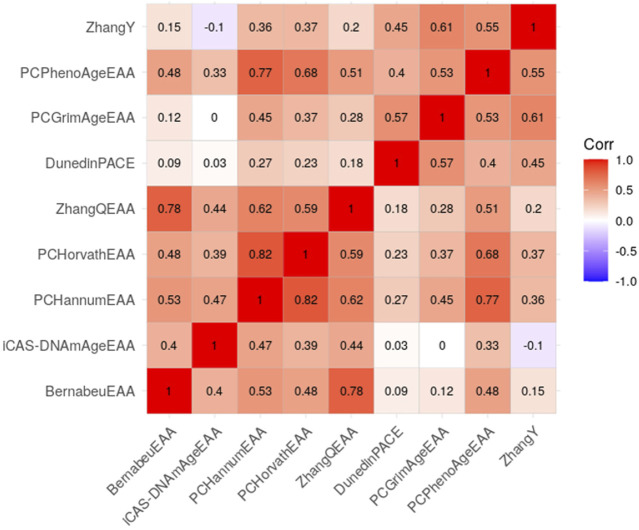
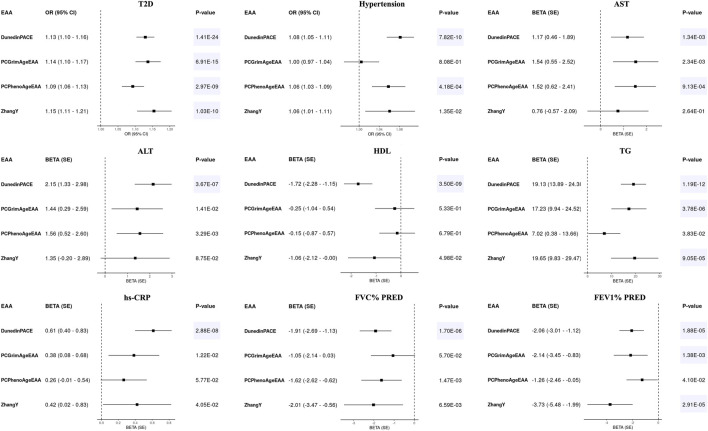
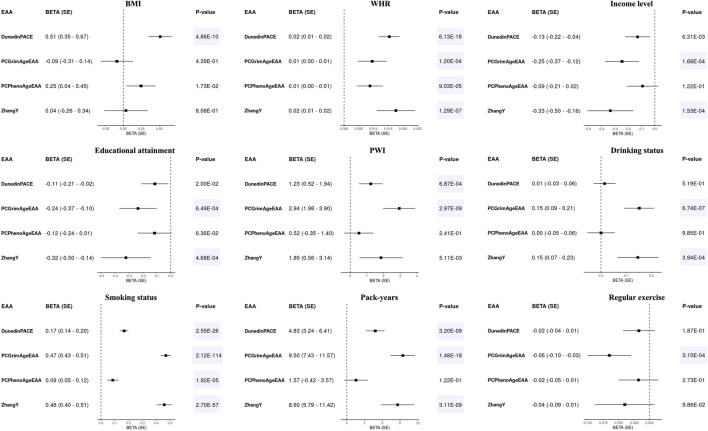
Epigenetic clocks have been developed to track both chronological age and biological age, which is defined by physiological biomarkers and the risk of adverse health outcomes. Epigenetic age acceleration (EAA) has been found to predict various diseases, aging-related factors, and mortality. However, epigenetic clocks have predominantly been developed with individuals of European or Hispanic ancestry, and their association with health outcomes and environmental factors has not been sufficiently assessed in East Asian populations. Here, we investigated nine epigenetic clocks: five trained on chronological age (first-generation) and four on biological age (second-generation), using DNA methylation data from blood samples of South Koreans. EAAs of second-generation epigenetic clocks reflected the risk of chronic diseases (type 2 diabetes and hypertension), levels of health-related blood markers (alanine aminotransferase, aspartate aminotransferase, high density lipoprotein, triglyceride, and high sensitivity C-reactive protein), and lung functions (percentage of predicted FEV1 and percentage of predicted FVC), while EAAs of first generation clocks did not. Using follow-up data, we also found that EAAs of second-generation clocks were associated with the time to onset risks of chronic diseases. Health behavior factors (drinking, smoking, exercise, body mass index, and waist-hip ratio), socioeconomic status (income level and educational attainment), and psychosocial status were associated with EAAs of second-generation clocks, while only smoking status was associated with EAAs of first-generation clocks. We conducted validation analyses in an independent South Korean cohort and replicated the association of EAAs with health outcomes and environmental factors. Age acceleration of epigenetic clocks is influenced by various environmental factors and can serve as an effective predictor of health in South Korea.
Overview
The claims and statistics of this paper haven’t been checked yet.
Run the check — free, no account needed. It reads the open-access text and checks the sources it cites.
Integrity signals
Registry
Cites
Statistics
Figures
Verification
Claims the paper makes
The claims and statistics of this paper haven’t been checked yet.
Run the check — free, no account needed. It reads the open-access text and checks the sources it cites.
Claims other papers make about this one
Each is checked against this paper’s own text: does it say what the citing paper says it does?
The check wasn’t confident either way, so it gives no verdict — never disputed.
In the citing paper
“We observed that the health status of the study population influenced biomarker responsiveness34.”
From Responsiveness of epigenetic aging biomarkers to longevity interventions in humans (2026) · cites this paper as [34]
Experimental — accuracy not yet measured
Self-check
Percentages, sums and reported differences re-computed from the paper’s own numbers.
The self-check needs the paper’s full text.
Citations
Cites
Hallmarks of aging: An expanding universe
López-Otín, C., Blasco, M. A., Partridge, L., Serrano, M., & Kroemer, G. (2023) · Cell · doi:10.1016/j.cell.2022.11.001 · Cited by 6,549
DNA methylation aging clocks: challenges and recommendations
Bell, C. G., Lowe, R., Adams, P. D., Baccarelli, A. A., Beck, S., Bell, J. T., Christensen, B. C., Gladyshev, V. N., Heijmans, B. T., Horvath, S., et al. (2019) · Genome Biology · doi:10.1186/s13059-019-1824-y · Cited by 1,025
Horvath, S., Oshima, J., Martin, G. M., Lu, A. T., Quach, A., Cohen, H., Felton, S., Matsuyama, M., Lowe, D., Kabacik, S., et al. (2018) · Aging · doi:10.18632/aging.101508 · Cited by 815
Epigenetic clock analysis of diet, exercise, education, and lifestyle factors
Quach, A., Levine, M. E., Tanaka, T., Lu, A. T., Chen, B. H., Ferrucci, L., Ritz, B., Bandinelli, S., Neuhouser, M. L., Beasley, J. M., et al. (2017) · Aging · doi:10.18632/aging.101168 · Cited by 801
Zhang, Q., Vallerga, C. L., Walker, R. M., Lin, T., Henders, A. K., Montgomery, G. W., He, J., Fan, D., Fowdar, J., Kennedy, M., et al. (2019) · Genome Medicine · doi:10.1186/s13073-019-0667-1 · Cited by 487
DNA methylation signatures in peripheral blood strongly predict all-cause mortality
Zhang, Y., Wilson, R., Heiss, J., Breitling, L. P., Saum, K.-U., Schöttker, B., Holleczek, B., Waldenberger, M., Peters, A., & Brenner, H. (2017) · Nature Communications · doi:10.1038/ncomms14617 · Cited by 382
Fitzgerald, K. N., Hodges, R., Hanes, D., Stack, E., Cheishvili, D., Szyf, M., Henkel, J., Twedt, M. W., Giannopoulou, D., Herdell, J., et al. (2021) · Aging · doi:10.18632/aging.202913 · Cited by 361
Research works printed but not linked: 37
- Aryee, 2014, Minfi: a flexible and comprehensive Bioconductor package for the analysis of Infinium DNA methylation microarrays, Bioinformatics, 30, 1363, 10.1093/bioinformatics/btu049 · DOI
- Aune, 2021, Hypertension and the risk of all-cause and cause-specific mortality: an outcome-wide association study of 67 causes of death in the national health interview survey, Biomed. Res. Int., 2021, 9376134, 10.1155/2021/9376134 · DOI
- Belsky, 2022, DunedinPACE, a DNA methylation biomarker of the pace of aging, Elife, 11, e73420, 10.7554/eLife.73420 · DOI · Paper page
- Bernabeu, 2023, Refining epigenetic prediction of chronological and biological age, Genome Med., 15, 12, 10.1186/s13073-023-01161-y · DOI
- Chen, 2022, Elevated AST/ALT ratio is associated with all-cause mortality and cancer incident, J. Clin. Lab. Anal., 36, e24356, 10.1002/jcla.24356 · DOI
- Crimmins, 2021, Associations of age, sex, race/ethnicity, and education with 13 epigenetic clocks in a nationally representative U.S. Sample: the health and retirement study, J. Gerontol. A Biol. Sci. Med. Sci., 76, 1117, 10.1093/gerona/glab016 · DOI · Paper page
- Faul, 2023, Epigenetic-based age acceleration in a representative sample of older Americans: associations with aging-related morbidity and mortality, Proc. Natl. Acad. Sci. U. S. A., 120, e2215840120, 10.1073/pnas.2215840120 · DOI · Paper page
- Hannum, 2013, Genome-wide methylation profiles reveal quantitative views of human aging rates, Mol. Cell., 49, 359, 10.1016/j.molcel.2012.10.016 · DOI · Paper page
- 2015, The Health Examinees (HEXA) study: rationale, study design and baseline characteristics, Asian Pac J. Cancer Prev., 16, 1591, 10.7314/apjcp.2015.16.4.1591 · DOI
- Higgins-Chen, 2022, A computational solution for bolstering reliability of epigenetic clocks: implications for clinical trials and longitudinal tracking, Nat. Aging, 2, 644, 10.1038/s43587-022-00248-2 · DOI · Paper page
- Horvath, 2013, DNA methylation age of human tissues and cell types, Genome Biol., 14, R115, 10.1186/gb-2013-14-10-r115 · DOI · Paper page
- Horvath, 2016, An epigenetic clock analysis of race/ethnicity, sex, and coronary heart disease, Genome Biol., 17, 171, 10.1186/s13059-016-1030-0 · DOI
- Horvath, 2018, DNA methylation-based biomarkers and the epigenetic clock theory of ageing, Nat. Rev. Genet., 19, 371, 10.1038/s41576-018-0004-3 · DOI · Paper page
- Jain, 2022, Analysis of epigenetic age acceleration and healthy longevity among older US women, JAMA Netw. Open, 5, e2223285, 10.1001/jamanetworkopen.2022.23285 · DOI
- Kim, 2017, Cohort profile: the Korean Genome and Epidemiology study (KoGES) consortium, Int. J. Epidemiol., 46, 1350, 10.1093/ije/dyx105 · DOI
- Leek, 2012, The sva package for removing batch effects and other unwanted variation in high-throughput experiments, Bioinformatics, 28, 882, 10.1093/bioinformatics/bts034 · DOI · Paper page
- Levine, 2018, An epigenetic biomarker of aging for lifespan and healthspan, Aging (Albany NY), 10, 573, 10.18632/aging.101414 · DOI · Paper page
- Li, 2017, Hs-CRP and all-cause, cardiovascular, and cancer mortality risk: a meta-analysis, Atherosclerosis, 259, 75, 10.1016/j.atherosclerosis.2017.02.003 · DOI
- Lin, 2021, Associations of five obesity metrics with epigenetic age acceleration: evidence from 2,474 Taiwan Biobank participants, Obes. (Silver Spring), 29, 1731, 10.1002/oby.23255 · DOI
- Liu, 2013, Effects of blood triglycerides on cardiovascular and all-cause mortality: a systematic review and meta-analysis of 61 prospective studies, Lipids Health Dis., 12, 159, 10.1186/1476-511X-12-159 · DOI
- Lu, 2019, DNA methylation GrimAge strongly predicts lifespan and healthspan, Aging (Albany NY), 11, 303, 10.18632/aging.101684 · DOI · Paper page
- Maddock, 2020, DNA methylation age and physical and cognitive aging, J. Gerontol. A Biol. Sci. Med. Sci., 75, 504, 10.1093/gerona/glz246 · DOI
- Magnussen, 2017, FEV1 and FVC predict all-cause mortality independent of cardiac function - results from the population-based Gutenberg Health Study, Int. J. Cardiol., 234, 64, 10.1016/j.ijcard.2017.02.012 · DOI
- McCrory, 2021, GrimAge outperforms other epigenetic clocks in the prediction of age-related clinical phenotypes and all-cause mortality, J. Gerontol. A Biol. Sci. Med. Sci., 76, 741, 10.1093/gerona/glaa286 · DOI · Paper page
- Palma-Gudiel, 2020, Psychosocial stress and epigenetic aging, Int. Rev. Neurobiol., 150, 107, 10.1016/bs.irn.2019.10.020 · DOI
- Petrie, 2018, Diabetes, hypertension, and cardiovascular disease: clinical insights and vascular mechanisms, Can. J. Cardiol., 34, 575, 10.1016/j.cjca.2017.12.005 · DOI · Paper page
- Rockl, 2017, All-cause mortality in adults with and without type 2 diabetes: findings from the national health monitoring in Germany, BMJ Open Diabetes Res. Care, 5, e000451, 10.1136/bmjdrc-2017-000451 · DOI
- Ryan, 2020, A systematic review and meta-analysis of environmental, lifestyle, and health factors associated with DNA methylation age, J. Gerontol. A Biol. Sci. Med. Sci., 75, 481, 10.1093/gerona/glz099 · DOI
- Schmitz, 2022, The socioeconomic gradient in epigenetic ageing clocks: evidence from the multi-ethnic study of atherosclerosis and the health and retirement study, Epigenetics, 17, 589, 10.1080/15592294.2021.1939479 · DOI
- Tomo, 2024, Transfer elastic Net for developing epigenetic clocks for the Japanese population, Mathematics, 12, 2716, 10.3390/math12172716 · DOI
- Wang, 2024, Insights into ageing rates comparison across tissues from recalibrating cerebellum DNA methylation clock, Geroscience, 46, 39, 10.1007/s11357-023-00871-w · DOI
- Wu, 2019, Effect of tobacco smoking on the epigenetic age of human respiratory organs, Clin. Epigenetics, 11, 183, 10.1186/s13148-019-0777-z · DOI
- Yaskolka, 2021, Lifestyle weight-loss intervention may attenuate methylation aging: the CENTRAL MRI randomized controlled trial, Clin. Epigenetics, 13, 48, 10.1186/s13148-021-01038-0 · DOI
- Yousefi, 2022, DNA methylation-based predictors of health: applications and statistical considerations, Nat. Rev. Genet., 23, 369, 10.1038/s41576-022-00465-w · DOI
- Zhang, 2023, New insights into the genetics and epigenetics of aging plasticity, Genes (Basel), 14, 329, 10.3390/genes14020329 · DOI
- Zheng, 2024, DNA methylation clocks for estimating biological age in Chinese cohorts, Protein Cell, 15, 575, 10.1093/procel/pwae011 · DOI
- Zhong, 2020, HDL-C is associated with mortality from all causes, cardiovascular disease and cancer in a J-shaped dose-response fashion: a pooled analysis of 37 prospective cohort studies, Eur. J. Prev. Cardiol., 27, 1187, 10.1177/2047487320914756 · DOI
Cited by
Sorted by citations
Responsiveness of epigenetic aging biomarkers to longevity interventions in humans
Sehgal, R., Borrus, D., Armstrong, J. F., Gonzalez, J., Kasamoto, J., Markov, Y., Priyanka, A., Smith, R., Carreras-Gallo, N., Lasky-Su, J., et al. (2026) · Nature Medicine · doi:10.1038/s41591-026-04562-9 · Cited by 31
Metadata
- Authors
- Kim, D. J., Kang, J. H., Kim, J.-W., Kim, S. B., Lee, Y. K., Cheon, M. J., & Lee, B.-C.
- Venue
- Frontiers in Aging
- Publisher
- Frontiers Media SA
- Published
- 2024-12-02
- Volume
- 5
- ISSN
- 2673-6217
- PMC
- PMC11646986
- Cited by
- 10
- References
- 7
About these checks
Registry, retraction, Cites and statistics results are computed, not judged, with one exception: a printed reference that no index lists is read once by a model before it counts as a citation error. Claims are extracted by a model and kept only when their quote appears verbatim in the text; each cited source is then checked, with a model’s help, for whether it says what the claim relies on. Those verdicts can be wrong — read the claim’s quote and the cited source before relying on one.
Statistics and arithmetic are recomputed, not judged.
Confidence bands are shown only for fields calibrated on our annotated test set. None is calibrated yet, so no band is shown.
What counts as a claim ›How we measure confidence ›How we check this ›
Are you an author, or do you see a problem with this page? Request a review
