

ChatGPT in medicine: an overview of its applications, advantages, limitations, future prospects, and ethical considerations
Open accessThe DOI matches its Crossref record; 17 of the 17 references it cites were found in a registry or an index; 3 of the 39 sources its claims cite were checked for support.
Abstract
This paper presents an analysis of the advantages, limitations, ethical considerations, future prospects, and practical applications of ChatGPT and artificial intelligence (AI) in the healthcare and medical domains. ChatGPT is an advanced language model that uses deep learning techniques to produce human-like responses to natural language inputs. It is part of the family of generative pre-training transformer (GPT) models developed by OpenAI and is currently one of the largest publicly available language models. ChatGPT is capable of capturing the nuances and intricacies of human language, allowing it to generate appropriate and contextually relevant responses across a broad spectrum of prompts. The potential applications of ChatGPT in the medical field range from identifying potential research topics to assisting professionals in clinical and laboratory diagnosis. Additionally, it can be used to help medical students, doctors, nurses, and all members of the healthcare fraternity to know about updates and new developments in their respective fields. The development of virtual assistants to aid patients in managing their health is another important application of ChatGPT in medicine. Despite its potential applications, the use of ChatGPT and other AI tools in medical writing also poses ethical and legal concerns. These include possible infringement of copyright laws, medico-legal complications, and the need for transparency in AI-generated content. In conclusion, ChatGPT has several potential applications in the medical and healthcare fields. However, these applications come with several limitations and ethical considerations which are presented in detail along with future prospects in medicine and healthcare.
Overview
CoChat Summary
TL;DR
This narrative overview examines ChatGPT’s applications, advantages, limitations, ethical issues, and future prospects in medicine and healthcare. It concludes that ChatGPT has promising uses in research, diagnosis, patient monitoring, and education, but requires human oversight because of accuracy, bias, plagiarism, copyright, and accountability concerns.
Key findings
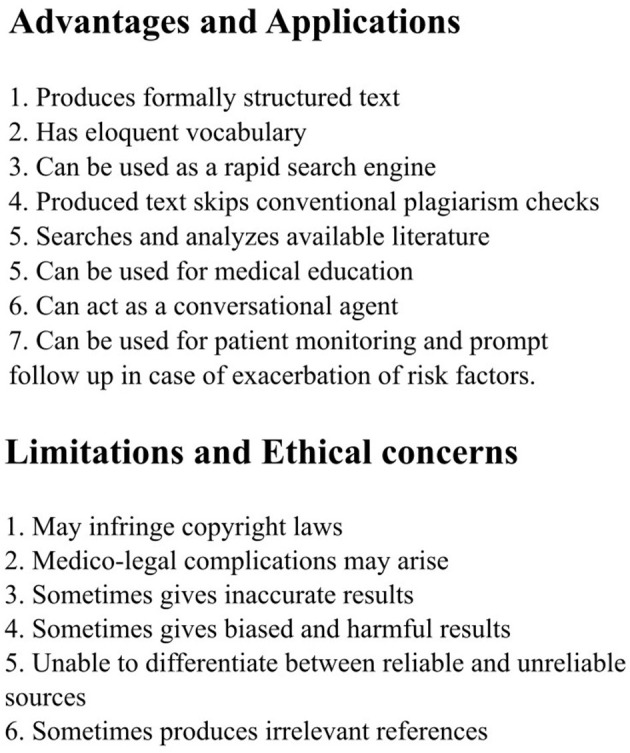
- ChatGPT can assist with identifying research topics, analyzing literature, clinical and laboratory diagnosis, clinical decision support, patient monitoring, medical education, health literacy, virtual patient assistants, medication reminders, and clinical trial recruitment.
- In one cited study, ChatGPT was asked to produce 50 medical research abstracts; the median originality score was 100% on plagiarism detection software, while an AI-output checker identified only 66% of the generated abstracts.
- The paper reports that ChatGPT’s data fed into it is only up to 2021, and that its output can be inaccurate, biased, dependent on training data quality, overly sensitive to question phrasing, and unable to clarify ambiguous prompts.
- Ethical and legal concerns include possible copyright infringement, plagiarism, medico-legal complications, lack of transparency, authorship and accountability dilemmas, and potential misuse or widening disparities.
Methods
- Narrative overview/review of ChatGPT and AI in healthcare and medicine, covering advantages, applications, limitations, ethical considerations, and future prospects.
- The authors state they performed a literature search and literature review/data collection; no systematic review protocol, database list, inclusion criteria, or quantitative synthesis is reported.
- The paper synthesizes prior articles, editorials, and web sources rather than presenting original empirical data or a formal study sample.
Limitations
- The paper states that ChatGPT’s accuracy depends heavily on training data quality, that outputs can be incorrect and lead to legal issues, and that it cannot fully replace human writers because it lacks comparable comprehension and specialized medical knowledge.
- The paper states that ChatGPT-generated text is not totally free of plagiarism and requires human editing, and that identifying its output currently requires meticulous inspection by editors.
- Evident from the text: this is a non-systematic narrative overview with no stated search strategy, no empirical evaluation, and reliance on cited sources and web pages, which limits reproducibility and strength of conclusions.
Model-written summary. Check it against the paper before relying on it.
Integrity signals
Registry
Cites
Statistics
Figures
Verification
Claims the paper makes
2 Valid · 2 Not valid · 35 Not checked · 14 Own results and interpretations
The cited sources support only part of this claim — read each source’s verdict below.
In the paper
“According to a recent article on the benefits of artificial intelligence for the self-management of sickle cell disease, ChatGPT can serve as a reliable conversational agent to collect information from patients with a diverse range of diseases (Issom et al., 2021).”
§ ChatGPT in medicine: an overview of its applications, advantages, limitations, future prospects, and ethical considerations > 2. Advantages and applications
What the sources say
- Partly supportedcites Issom et al., 2021 matched to “Toward a conversational agent to support the self-management of adults and young adults with sickle cell disease: usability and usefulness study” (2021) sourceExperimental — accuracy not yet measured
The Conclusion (Table 1; page unavailable) shows that patients used the paper’s chatbot, TREVOR, to provide demographic and health information. But the study concerns sickle cell disease, not ChatGPT or a diverse range of diseases; the Conclusion also says longer controlled studies are needed to assess clinical utility and safety, so it does not establish reliability. (LLM, conf=0.90)
plainstates a cause- Asserted: passes — The authors put it forward as true.
- Checkable: passes — It can be checked against evidence.
- Load-bearing: unclear — It is unclear whether the paper’s conclusions depend on it.
- Based: passes — The paper gives a reason why it holds.
- Partly supported
The cited sources support only part of this claim — read each source’s verdict below.
In the paper
“and can also be used as a tool of assessment to assess clinical skills (Han et al., 2022)”
§ ChatGPT in medicine: an overview of its applications, advantages, limitations, future prospects, and ethical considerations > 2. Advantages and applications
What the sources say
- Partly supportedcites Han et al., 2022 matched to “Analysis of the effect of an artificial intelligence chatbot educational program on non-face-to-face classes: a quasi-experimental study” (2022) sourceExperimental — accuracy not yet measured
Our copy of Han et al. (2022) describes a rule-based AI chatbot built on LandBot.io, not ChatGPT; the tool-of-assessment element it does contain is formative only — the Methods > Study stages section says 'Various methods such as O/X quiz, multiple choice, and open-ended questions are used to check the understanding of preceding learning,' with feedback per answer. The clinical-skills part is not supported: the Discussion (p. n/a) reports 'no significant differences in clinical reasoning competency and confidence in fetal health assessment using EFM between the two groups' and notes 'lack of studies measuring clinical reasoning competency and fetal health assessment in nursing college students using chatbot'; those outcomes were measured with separate instruments (an EFM knowledge test and the Liou et al. clinical reasoning scale, Methods > Study instruments), not by the chatbot. So the source supports a chatbot quizzing/checking student understanding in a nursing education program, while 'ChatGPT' and 'assess clinical skills' are attributed to it without backing. (LLM, conf=0.70)
plainstates a possible cause- Asserted: passes — The authors put it forward as true.
- Checkable: passes — It can be checked against evidence.
- Load-bearing: unclear — It is unclear whether the paper’s conclusions depend on it.
- Based: passes — The paper gives a reason why it holds.
- Partly supported
The cited sources that could be checked couldn’t confirm or dispute this claim.
In the paper
“It can also be used to help medical students, doctors, nurses, and all members of the healthcare fraternity alike to know about updates and new developments in their respective fields”
§ ChatGPT in medicine: an overview of its applications, advantages, limitations, future prospects, and ethical considerations > 2. Advantages and applications
What the sources say
- Could not verifycites Han et al., 2022 matched to “Analysis of the effect of an artificial intelligence chatbot educational program on non-face-to-face classes: a quasi-experimental study” (2022) sourceExperimental — accuracy not yet measured
Our copy of Han et al. (2022) evaluates a purpose-built rule-based chatbot (built on LandBot.io, Methods > Study stages) for electronic fetal monitoring skills in third-year nursing students at one Korean university; it never mentions ChatGPT, and no passage attributes to any chatbot the function of informing medical students, doctors or nurses about updates and new developments in their fields. The nearest content — Background, 'evidence for clinical application is fast-changing, the importance of educational programs utilizing AI... for nursing college students has been emphasized [1]' — is a rationale for AI-based learning programs in nursing students, credited to Buchanan et al.'s scoping review (ref. 1), not a claim about ChatGPT or about practising clinicians keeping current. Searches: 'ChatGPT updates and new developments... medical students, doctors, nurses' and 'chatbot helps healthcare professionals stay current with rapidly changing clinical evidence' returned only the Background/Introduction/Discussion/Conclusions passages on the EFM chatbot program. Nothing in our copy contradicts the claim, so this is unaddressed rather than disputed. (LLM, conf=0.72)
plainstates a possible cause- Asserted: passes — The authors put it forward as true.
- Checkable: passes — It can be checked against evidence.
- Load-bearing: unclear — It is unclear whether the paper’s conclusions depend on it.
- Based: passes — The paper gives a reason why it holds.
- Could not verify
In the paper
“Chatbots like ChatGPT can be used as powerful tools to increase health literacy, especially among students and young adults (Mokmin and Ibrahim, 2021).”
§ ChatGPT in medicine: an overview of its applications, advantages, limitations, future prospects, and ethical considerations > 2. Advantages and applications
What the sources say
- Not checked yetcites Mokmin and Ibrahim, 2021
plainstates a possible cause- Asserted: passes — The authors put it forward as true.
- Checkable: passes — It can be checked against evidence.
- Load-bearing: unclear — It is unclear whether the paper’s conclusions depend on it.
- Based: passes — The paper gives a reason why it holds.
In the paper
“while the AI-output checker identified only 66% of the generated abstracts (Else, 2023).”
§ ChatGPT in medicine: an overview of its applications, advantages, limitations, future prospects, and ethical considerations > 2. Advantages and applications
What the sources say
- Not checked yetcites Else, 2023 matched to “Abstracts written by ChatGPT fool scientists” (2023) source
plain- Asserted: passes — The authors put it forward as true.
- Checkable: passes — It can be checked against evidence.
- Load-bearing: unclear — It is unclear whether the paper’s conclusions depend on it.
- Based: passes — The paper gives a reason why it holds.
14 more claims
Create a free account to see all 53 claims and to verify the 36 references still open.
- Probably not a substantial claim. 22
- It may state two separate claims as one. 21
Claims other papers make about this one
Each is checked against this paper’s own text: does it say what the citing paper says it does?
The source backs part of the claim, not all of it — or backs it for a different population, condition or comparison.
In the citing paper
“Generative AI aims to address various medical conditions, from chronic diseases like diabetes to acute conditions like stroke [6, 38, 60].”
From Generative AI in healthcare: an implementation science informed translational path on application, integration and governance (2024) · cites this paper as [60]
Experimental — accuracy not yet measuredThe source backs part of the claim, not all of it — or backs it for a different population, condition or comparison.
In the citing paper
“15 publications focused explicitly on this topic [7, 38, 84, 97, 186, 190–199].”
From Artificial intelligence in undergraduate medical education: an updated scoping review (2025) · cites this paper as [194]
Experimental — accuracy not yet measuredThe source backs part of the claim, not all of it — or backs it for a different population, condition or comparison.
In the citing paper
“AI-enabled educational technologies including, but not limited to, virtual patient simulations, tutoring systems, assessment tools, and adaptive learning systems have demonstrated the potential to optimize learning efficiency, personalize educational experiences, and facilitate learner engagement [8, 9].”
From Ethical and responsible use of artificial intelligence in medical education (2026) · cites this paper as [9]
Experimental — accuracy not yet measuredThe cited source says what the claim attributes to it.
In the citing paper
“The heightened interest in telehealth and AI education at t1 could be attributed to the rise of telemedicine during the COVID-19 pandemic [39] and the increasing prominence of generative AI tools such as ChatGPT [40].”
From Evolving Medical Students’ Digital Health Perceptions and Intentions: Insights From a Prepandemic and Postpandemic Survey Study (2025) · cites this paper as [40]
The cited source says what the claim attributes to it.
In the citing paper
“The integration of ChatGPT into medical practices and healthcare settings presents challenges and ethical considerations.”
4 more claims about this paper
Create a free account to see every claim other papers make about this one.
Citations
Cites
ChatGPT: five priorities for research
van Dis, E. A. M., Bollen, J., Zuidema, W., van Rooij, R., & Bockting, C. L. (2023) · Nature · doi:10.1038/d41586-023-00288-7 · Cited by 1,842
ChatGPT and other large language models are double-edged swords
Shen, Y., Heacock, L., Elias, J., Hentel, K. D., Reig, B., Shih, G., & Moy, L. (2023) · Radiology · doi:10.1148/radiol.230163 · Cited by 1,008 · cited 2×
“Additionally, the data fed into it is only up to 2021 (Kitamura, 2023; Shen et al., 2023).”
BackgroundChatGPT listed as author on research papers: many scientists disapprove
Stokel-Walker, C. (2023) · Nature · doi:10.1038/d41586-023-00107-z · Cited by 868 · cited 2×
“ChatGPT, according to publishers and preprint servers contacted by Nature’s news team, does not meet the criteria for a study author since it cannot bear responsibility for the content and authenticity of scientific studies (Stokel-Walker, 2023).”
BackgroundAbstracts written by ChatGPT fool scientists
Else, H. (2023) · Nature · doi:10.1038/d41586-023-00056-7 · Cited by 611
Tools such as ChatGPT threaten transparent science; here are our ground rules for their use
(2023) · Nature · doi:10.1038/d41586-023-00191-1 · Cited by 605 · cited 2×
“However, ongoing research aims to address these issues and propose effective solutions (Editorials, 2023).”
BackgroundA Conversation on Artificial Intelligence, Chatbots, and Plagiarism in Higher Education
King, M. R., & chatGPT (2023) · Cellular and Molecular Bioengineering · doi:10.1007/s12195-022-00754-8 · Cited by 602
Generating scholarly content with ChatGPT: Ethical challenges for medical publishing
Liebrenz, M., Schleifer, R., Buadze, A., Bhugra, D., & Smith, A. (2023) · The Lancet Digital Health · doi:10.1016/s2589-7500(23)00019-5 · Cited by 594 · cited 1×
“Strict guidelines should be implemented by the journals regarding AI use in scholarly papers to minimize its misuse (Liebrenz et al., 2023).”
BackgroundChatGPT and the future of medical writing
Biswas, S. (2023) · Radiology · doi:10.1148/radiol.223312 · Cited by 571 · cited 4×
“, 2023), plagiarism (Biswas, 2023; King and ChatGPT, 2023), and more which are presented in more detail later in this paper.”
BackgroundInfluentialChatGPT: Evolution or revolution?
Gordijn, B., & Have, H. T. (2023) · Medicine, Health Care and Philosophy · doi:10.1007/s11019-023-10136-0 · Cited by 317 · cited 2×
“Several articles have reported on the use of ChatGPT for writing scientific literature, with one study demonstrating that ChatGPT can produce formal research articles (Gordijn and Have, 2023).”
BackgroundChatGPT is shaping the future of medical writing but still requires human judgment
Kitamura, F. C. (2023) · Radiology · doi:10.1148/radiol.230171 · Cited by 317 · cited 2×
“Additionally, the data fed into it is only up to 2021 (Kitamura, 2023; Shen et al., 2023).”
BackgroundMethod
Research works printed but not linked: 1
- Radford A. Narasimhan K. Salimans T. Sutskever I. (2018). Improving language understanding by generative pre-training.
Cited by
Items 401–500 of 1,006
Assessment of ChatGPT-3.5's Knowledge in Oncology: Comparative Study with ASCO-SEP Benchmarks
Odabashian, R., Bastin, D., Jones, G., Manzoor, M., Tangestaniapour, S., Assad, M., Lakhani, S., Odabashian, M., & McGee, S. (2024) · JMIR AI · doi:10.2196/50442 · Cited by 18
Can ChatGPT diagnose my collapsing dog?
Abani, S., Decker, S. D., Tipold, A., Nessler, J. N., & Volk, H. A. (2023) · Frontiers in Veterinary Science · doi:10.3389/fvets.2023.1245168 · Cited by 18
Threats and opportunities of using ChatGPT in scientific writing—The risk of getting spine less
Ambrosio, L., Schol, J., Pietra, V. A. L., Russo, F., Vadalà, G., & Sakai, D. (2023) · JOR Spine · doi:10.1002/jsp2.1296 · Cited by 18
ChatGPT Review: A Sophisticated Chatbot Models in Medical & Health-related Teaching and Learning
Razak, N. I. A., Yusoff, M. F. M., & Rahmat, R. W. O. K. (2023) · Malaysian Journal of Medicine and Health Sciences · doi:10.47836/mjmhs.19.s12.12 · Cited by 18
Roy, A. D., Das, D., & Mondal, H. (2024) · Journal of Education and Health Promotion · doi:10.4103/jehp.jehp_625_23 · Cited by 18
Large language models through the lens of ubuntu for health research in sub-Saharan Africa
Obasa, A. E. (2024) · South African Journal of Science · doi:10.17159/sajs.2024/16814 · Cited by 18
Artificial intelligence and pediatric surgery: where are we?
Miyake, Y., Retrosi, G., & Keijzer, R. (2024) · Pediatric Surgery International · doi:10.1007/s00383-024-05921-8 · Cited by 18
He, Y. J., Liu, P. L., Wei, T., Liu, T., Li, Y. F., Yang, J., & Fan, W. (2025) · Renal Failure · doi:10.1080/0886022x.2025.2458754 · Cited by 18
AI in Medical Questionnaires: Scoping Review
Luo, X., Li, Y. L., Xu, J., Zheng, Z., Ying, F., & Huang, G. (2025) · Journal of Medical Internet Research · doi:10.2196/72398 · Cited by 18
Expert assessment of ChatGPT’s ability to generate illness scripts: an evaluative study
Yanagita, Y., Yokokawa, D., Fukuzawa, F., Uchida, S., Uehara, T., & Ikusaka, M. (2024) · BMC Medical Education · doi:10.1186/s12909-024-05534-8 · Cited by 17
Comparative analysis of ChatGPT 3.5 and ChatGPT 4 obstetric and gynecological knowledge
Ługowski, F., Babińska, J., Ludwin, A., & Stanirowski, P. J. (2025) · Scientific Reports · doi:10.1038/s41598-025-08424-1 · Cited by 17
Towards a transparent and reproducible AI-assisted research paper writing
Park, J. (2025) · Genomics & Informatics · doi:10.1186/s44342-025-00057-0 · Cited by 17
Zhang, P., Wang, J., Hu, X., Wang, X., Fan, X., Chi, W., & Yang, W. (2026) · Frontiers in Cell and Developmental Biology · doi:10.3389/fcell.2026.1744389 · Cited by 17
Piazza, D., Martorana, F., Curaba, A., Sambataro, D., Valerio, M. R., Firenze, A., Pecorino, B., Scollo, P., Chiàntera, V., Scibilia, G., et al. (2024) · Current Oncology · doi:10.3390/curroncol31050212 · Cited by 17
AI-Generated Content in Cancer Symptom Management: A Comparative Analysis Between ChatGPT and NCCN
Lazris, D., Schenker, Y., & Thomas, T. H. (2024) · Journal of Pain and Symptom Management · doi:10.1016/j.jpainsymman.2024.06.019 · Cited by 18
Akyön, Ş. H., Akyön, F. Ç., Camyar, A. S., Hızlı, F., Sari, T., & Hızlı, Ş. (2024) · JMIR Medical Informatics · doi:10.2196/59258 · Cited by 17
Ahmed, H. S., & Thrishulamurthy, C. J. (2024) · European Journal of Ophthalmology · doi:10.1177/11206721241272251 · Cited by 18
Vindigni, G. (2024) · European Journal of Contemporary Education and E-Learning · doi:10.59324/ejceel.2024.2(4).10 · Cited by 17
Ali, A., Kumar, R. P., Polavarapu, H., Lavadi, R. S., Mahavadi, A. K., Legarreta, A. P., Hudson, J. S., Shah, M. U., Paul, D. A., Mooney, J. H., et al. (2024) · World Neurosurgery · doi:10.1016/j.wneu.2024.08.062 · Cited by 17
Bias Perpetuates Bias: ChatGPT Learns Gender Inequities in Academic Surgery Promotions
Desai, P. T., Wang, H., Davis, L., Ullmann, T. M., & DiBrito, S. R. (2024) · Journal of surgical education · doi:10.1016/j.jsurg.2024.07.023 · Cited by 17
Hammour, A. M. A., Hammour, K. A., Alhamad, H., Nassar, R. I., El‐Dahiyat, F., Sawaqed, M., Allan, A., Manaseer, Q., Hammour, M. A., Halboup, A. M., et al. (2024) · Journal of Pharmaceutical Policy and Practice · doi:10.1080/20523211.2024.2429000 · Cited by 17
Tseng, L., Lu, Y.-C., Tseng, L.-C., Chen, Y., & Chen, H. (2025) · JMIR Medical Education · doi:10.2196/58897 · Cited by 17
Abanmy, N. O., Al-Ghreimil, N., Alsabhan, J. F., Al-Baity, H. H., & Aljadeed, R. (2025) · Frontiers in Artificial Intelligence · doi:10.3389/frai.2025.1550591 · Cited by 17
Ullah, E., Baig, M. M., Waqas, A., Rasool, G., Singh, R. P., Shandilya, A., GholamHossieni, H., & Parwani, A. V. (2025) · Advances in Anatomic Pathology · doi:10.1097/pap.0000000000000498 · Cited by 17
Transforming education: tackling the two sigma problem with AI in journal clubs – a proof of concept
Umer, F., Naved, N., Naseem, A., Mansoor, A., & Kazmi, S. M. R. (2025) · BDJ Open · doi:10.1038/s41405-025-00338-4 · Cited by 17
Freire, Y., Santamaría-Laorden, A., Pérez, J. O., Ortiz-Collado, I., Sánchez, M. G., Vasallo, I. J. T., García, V. D., & Suárez, A. (2025) · PLoS ONE · doi:10.1371/journal.pone.0323086 · Cited by 17
Use of large language models for evidence-based cardiovascular medicine
Skalidis, I., Cagnina, A., & Fournier, S. (2023) · European Heart Journal - Digital Health · doi:10.1093/ehjdh/ztad041 · Cited by 17
Rare and complex diseases in focus: ChatGPT's role in improving diagnosis and treatment
Zheng, Y., Sun, X., Feng, B., Kang, K., Yang, Y., Zhao, A., & Wu, Y. (2024) · Frontiers in Artificial Intelligence · doi:10.3389/frai.2024.1338433 · Cited by 18
Reis, F., & Lenz, C. (2024) · Cureus · doi:10.7759/cureus.53899 · Cited by 17
Shafqat, F., & Amjad, A. I. (2024) · Pakistan Social Sciences Review · doi:10.35484/pssr.2024(8-ii)36 · Cited by 17
Local Large Language Models for Complex Structured Medical TasksPreprint
Bumgardner, C., Mullen, A., Armstrong, S. E., Hickey, C. D., & Talbert, J. (2023) · arXiv (Cornell University) · doi:10.48550/arxiv.2308.01727 · Cited by 17
Exploring the Comprehension of ChatGPT in Traditional Chinese Medicine KnowledgePreprint
Yizhen, L., Shaohan, H., Qi, J., Lei, Q., Dongran, H., & Luan, Z. (2024) · arXiv (Cornell University) · doi:10.48550/arxiv.2403.09164 · Cited by 17
Traceable Texts and Their Effects: A Study of Summary-Source Links in AI-Generated Summaries
Kambhamettu, H., Flores, J., & Head, A. (2025) · CHI Conference Extended Abstracts on Human Factors in Computing Systems (CHI EA) · doi:10.1145/3706599.3719830 · Cited by 16
Rinderknecht, E., Haas, M., Schnabel, M. J., Kravchuk, A. P., Schäfer, C., Siepmann, S., Mayr, R., von Winning, D., Grassinger, J., Goßler, C., et al. (2025) · European Urology Oncology · doi:10.1016/j.euo.2025.11.016 · Cited by 16
Schneider, K., Tomchuk, D., Snyder, B., Bisch, T., & Koch, G. (2024) · Athletic Training Education Journal · doi:10.4085/1062-6050-028.23 · Cited by 16
Pedro, T., Sousa, J. M., Fonseca, L., Gama, M. G., Moreira, G., Pintalhão, M., Castro‐Chaves, P., Aires, A., Alves, G., Augusto, L., et al. (2024) · Journal of NeuroInterventional Surgery · doi:10.1136/jnis-2024-021556 · Cited by 16
Liu, X., Lai, R., Wu, C., Yan, C., Gan, Z., Yang, Y., Zeng, X., Liu, J., Liao, L., Lin, Y., et al. (2024) · Frontiers in Public Health · doi:10.3389/fpubh.2024.1391906 · Cited by 16
Yao, Y., Hasan, W. Z. W., Jiao, W., Dong, X., Ramli, H. R., Norsahperi, N. M. H., & Dong, W. (2024) · Frontiers in Human Neuroscience · doi:10.3389/fnhum.2024.1426055 · Cited by 16
Educational Utility of Clinical Vignettes Generated in Japanese by ChatGPT-4: Mixed Methods Study
Takahashi, H., Shikino, K., Kondo, T., Komori, A., Yamada, Y., Saita, M., & Naito, T. (2024) · JMIR Medical Education · doi:10.2196/59133 · Cited by 16
Ho, R., Shaari, A. L., Cowan, P. T., & Yan, K. K.-L. (2024) · OTO Open · doi:10.1002/oto2.163 · Cited by 16
Artificial intelligence and forensic mental health in Africa: a narrative review
Ogunwale, A., Smith, A. J., Fakorede, O. O., & Ogunlesi, A. O. (2024) · International Review of Psychiatry · doi:10.1080/09540261.2024.2405174 · Cited by 16
Ghanta, S. N., Alaref, S. J., Lala, A., Nadkarni, G. N., Ganatra, S., Dani, S. S., & Mehta, J. L. (2024) · Diagnostics · doi:10.3390/diagnostics14212393 · Cited by 17
Does ChatGPT have a typical or atypical theory of mind?
Attanasio, M., Mazza, M., Donne, I. L., Masedu, F., Greco, M. P., & Valenti, M. (2024) · Frontiers in Psychology · doi:10.3389/fpsyg.2024.1488172 · Cited by 17
Liao, C.-Y., Chu, C.-N., Lien, M.-Y., Wu, Y., & Wang, T. (2024) · Current Oncology · doi:10.3390/curroncol32010007 · Cited by 16
Evaluating a large language model’s ability to answer clinicians’ requests for evidence summaries
Blasingame, M. N., Koonce, T. Y., Williams, A. M., Giuse, D. A., Su, J., Krump, P. A., & Giuse, N. B. (2025) · Journal of the Medical Library Association JMLA · doi:10.5195/jmla.2025.1985 · Cited by 16
Jenkins, S. M., Palmquist, R. N., Shayota, B. J., Solorzano, C. M., Bonkowsky, J. L., Estabrooks, P. A., & Tristani‐Firouzi, M. (2025) · Pediatric Research · doi:10.1038/s41390-025-03859-8 · Cited by 16
Koh, M. C. Y., Ngiam, J. N., Oon, J. E. L., Lum, L. H.-W., Smitasin, N., & Archuleta, S. (2025) · BMC Health Services Research · doi:10.1186/s12913-025-12373-w · Cited by 16
Liu, J., Gu, J., Tong, M., Yue, Y., Qiu, Y., Zeng, L., Yu, Y., Yang, F., & Zhao, S. (2025) · BMC Psychiatry · doi:10.1186/s12888-025-06798-0 · Cited by 16
Exploring the integration of AI in library services: Perspectives and considerations
Patra, N. K., Gaitanou, P., Oladokun, B. D., & Sahu, S. C. (2025) · Business Information Review · doi:10.1177/02663821251343742 · Cited by 16
Hao, J., Yao, Z., & Siu, K. (2025) · Musculoskeletal Care · doi:10.1002/msc.70177 · Cited by 16
Pinto, V. B. P., de Azevedo, M. F., Wroclawski, M. L., Gentile, G., Jesus, V. L. M., de Bessa, J., Nahas, W. C., Sacomani, C. A. R., Sandhu, J. S., & Gomes, C. M. (2024) · Neurourology and Urodynamics · doi:10.1002/nau.25442 · Cited by 16
The potential of ChatGPT in oral medicine: a new era of patient care?
de Souza, L. L., Lopes, M. A., Santos‐Silva, A. R., & Vargas, P. A. (2023) · Oral Surgery Oral Medicine Oral Pathology and Oral Radiology · doi:10.1016/j.oooo.2023.09.010 · Cited by 16
van Nuland, M., Snoep, J. D., Egberts, T., Erdogan, A., Wassink, R., & van der Linden, P. D. (2024) · European Journal of Clinical Pharmacology · doi:10.1007/s00228-024-03687-5 · Cited by 15
Sallam, M., Khalil, R., & Sallam, M. (2024) · Mesopotamian Journal of Artificial Intelligence in Healthcare · doi:10.58496/mjaih/2024/010 · Cited by 15
“Most of all, the reliability of genAI models’ performance in healthcare must be demonstrated in real-world [1, 33].”
BackgroundBakhaya, S., Lehnbom, E. C., Filho, C., Ma, K., & Svensberg, K. (2025) · Currents in Pharmacy Teaching and Learning · doi:10.1016/j.cptl.2025.102503 · Cited by 16
Haylaz, E., Gümüşsoy, İ., Kalabalık, F., Say, S., Eren, M. C., & Geduk, G. (2026) · BMC Oral Health · doi:10.1186/s12903-026-07790-0 · Cited by 15
Measuring the Effectiveness of AI Tools in Clinical Research and Writing: A Case Study in Healthcare
Salisu, S., Alyasiri, O. M., Younis, H. A., Sahib, T. M., Ali, A. H., Noor, A. A., & Hayder, I. M. (2024) · Mesopotamian Journal of Artificial Intelligence in Healthcare · doi:10.58496/mjaih/2024/002 · Cited by 15
Chiarelli, G., Stephens, A., Finati, M., Cirulli, G. O., Beatrici, E., Filipas, D. K., Arora, S., Tinsley, S., Bhandari, M., Carrieri, G., et al. (2024) · International Urology and Nephrology · doi:10.1007/s11255-024-04009-5 · Cited by 15
Local Large Language Models for Complex Structured Tasks.
Bumgardner, C., Mullen, A., Armstrong, S. E., Hickey, C. D., Marek, V. W., & Talbert, J. (2024) · PubMed Central · Cited by 15
Sharun, K., Banu, S. A., Mamachan, M., Abualigah, L., PAWDE, A. M., & Dhama, K. (2024) · Journal of Experimental Biology and Agricultural Sciences · doi:10.18006/2024.12(3).297.317 · Cited by 15
Warn, M. J., Meller, L. L. T., Chan, D., Torabi, S. J., Bitner, B. F., Tajudeen, B. A., & Kuan, E. C. (2024) · American Journal of Rhinology and Allergy · doi:10.1177/19458924241273055 · Cited by 16
The impact of artificial intelligence on medical article writing: A boon or a bane?
Karuppal, R. (2024) · Journal of Orthopaedics · doi:10.1016/j.jor.2024.10.045 · Cited by 15
Wu, D., Huang, X., Chen, L., Hou, P., Liu, L., & Yang, G. (2024) · Experimental Biology and Medicine · doi:10.3389/ebm.2024.10320 · Cited by 16
Performance of GPT-3.5 and GPT-4 on the Korean Pharmacist Licensing Examination: Comparison Study
Jin, H. K., & Kim, E. Y. (2024) · JMIR Medical Education · doi:10.2196/57451 · Cited by 15
Li, J., Gao, X., Dou, T., Gao, Y., Xu, L., & Zhu, W. (2024) · BMJ Open · doi:10.1136/bmjopen-2023-082344 · Cited by 15
Othman, Z. K., Ahmed, M. M., Okesanya, O. J., Ibrahim, A. M., Musa, S. S., Hassan, B. A., Saeed, L. I., & Lucero‐Prisno, D. E. (2025) · Intelligence-Based Medicine · doi:10.1016/j.ibmed.2025.100233 · Cited by 15
Comparing orthodontic pre-treatment information provided by large language models
Chen, J., Ge, X., Yuan, C., Chen, Y., Li, X., Zhang, X., Chen, S., Zheng, W., & Miao, C. (2025) · BMC Oral Health · doi:10.1186/s12903-025-06246-1 · Cited by 15
Callanan, T. C., Marquez, J., Pisani, C., Schmitt, P. R., Pietro, J., Chen, M., Milner, J., Daher, M., Katz, L., Liu, J., et al. (2025) · Journal of Bone and Joint Surgery · doi:10.2106/jbjs.24.01462 · Cited by 15
Philosophy of medicine meets AI hallucination and AI drift: moving toward a more gentle medicine
Namazi, H., & Radfar, M. H. (2025) · Journal of Medical Ethics and History of Medicine · doi:10.18502/jmehm.v18i2.18812 · Cited by 17
Miranda, J., Pereira-Silva, R., Guichard, J., Meneses, J., Carreira, A. N., & Seixas, D. (2025) · Bioengineering · doi:10.3390/bioengineering12060653 · Cited by 15
Su, A. Y., Knebel, A., Xu, A. Y., Kaper, M., Schmitt, P. R., Nassar, J. E., Singh, M., Farias, M. J., Kim, J.-H., Diebo, B. G., et al. (2025) · European Spine Journal · doi:10.1007/s00586-025-08994-8 · Cited by 15
Sousa, S. A., Bukhari, S. S. U. H., Steagall, P. V. M., Bęczkowski, P. M., Giuliano, A., & Flay, K. J. (2025) · Frontiers in Veterinary Science · doi:10.3389/fvets.2025.1616566 · Cited by 15
Relational Ethics and Structural Epistemic Injustice of AI in Medicine
Herzog, C., & Branford, J. (2025) · Philosophy & Technology · doi:10.1007/s13347-025-00987-1 · Cited by 15
Sanchez, F. B., & Durand, C. R. C. (2025) · Revista InveCom · doi:10.5281/zenodo.14934488 · Cited by 15
Decoding Applications of Artificial Intelligence in Rheumatology
Chinnadurai, S., Mahadevan, S., Navaneethakrishnan, B., & Mamadapur, M. (2023) · Cureus · doi:10.7759/cureus.46164 · Cited by 15
Irfan, B., & Yaqoob, A. (2023) · Cureus · doi:10.7759/cureus.47754 · Cited by 15
Melissano, G., Tinelli, G., & Söderlund, T. T. (2023) · European Journal of Vascular and Endovascular Surgery · doi:10.1016/j.ejvs.2023.10.042 · Cited by 15
Transforming Abdominal Wall Surgery With Generative Artificial Intelligence
Mayol, J. M. (2023) · Journal of Abdominal Wall Surgery · doi:10.3389/jaws.2023.12419 · Cited by 15
A User-Centered Framework to Empower People with Parkinson's Disease
Rahman, W., Abdelkader, A., Lee, S., Yang, P., Islam, M. S., Adnan, T., Hasan, M., Wagner, E. S., Park, S., Dorsey, E. R., et al. (2023) · Proceedings of the ACM on Interactive Mobile Wearable and Ubiquitous Technologies · doi:10.1145/3631430 · Cited by 15
Li, A., Shrestha, R., Jegatheeswaran, T., Chan, H. O., Hong, C., & Joshi, R. (2024) · medRxiv · doi:10.1101/2024.09.27.24314506 · Cited by 15
Hu, Y., Liu, J., & Jiang, W. (2025) · Renal Failure · doi:10.1080/0886022x.2025.2555686 · Cited by 14
“…are recognized as promising applications of ChatGPt in medicine, assisting patients in managing their health through conversational interactions [10]. they can provide medication reminders, dosage instructions, and warnings about potential side effects or drug interactions, which is…”
Chen, J., Liu, L., Ruan, S., Li, M., & Yin, C. (2023) · Journal of Multidisciplinary Healthcare · doi:10.2147/jmdh.s441790 · Cited by 14
Sebo, P. (2024) · JMIR AI · doi:10.2196/53656 · Cited by 14
Yang, S., & Chang, M. C. (2024) · Medicine · doi:10.1097/md.0000000000038445 · Cited by 14
Exploring large language models for microstructure evolution in materials
Satpute, P., Tiwari, S., Gupta, M., & Ghosh, S. (2024) · Materials Today Communications · doi:10.1016/j.mtcomm.2024.109583 · Cited by 14
Using ChatGPT to Provide Patient-Specific Answers to Parental Questions in the PICU
Hunter, R. B., Thammasitboon, S., Rahman, S. S., Fainberg, N. A., Renuart, A. J., Kumar, S., Jain, P., Rissmiller, B., Sur, M., & Mehta, S. D. (2024) · PEDIATRICS · doi:10.1542/peds.2024-066615 · Cited by 15
Faisal, S., Kamran, T. E., Khalid, R., Haider, Z., Siddiqui, Y., Saeed, N., Imran, S., Faisal, R., & Jabeen, M. (2024) · Digital Health · doi:10.1177/20552076241289730 · Cited by 14
Chung, D., Sidhom, K., Dhillon, H., Bal, D. S., Fidel, M., Jawanda, G., & Patel, P. (2024) · World Journal of Urology · doi:10.1007/s00345-024-05385-4 · Cited by 14
Healthcare professionals and the public sentiment analysis of ChatGPT in clinical practice
Lu, L., Zhu, Y., Yang, J., Yang, Y., Ye, J., Ai, S., & Zhou, Q. (2025) · Scientific Reports · doi:10.1038/s41598-024-84512-y · Cited by 15
Khan, A. A., KHAN, A. R., Munshi, S., Dandapani, H. G., Jimale, M., Bogni, F. M., & Khawaja, H. R. (2025) · Journal of Medical Ethics · doi:10.1136/jme-2024-110240 · Cited by 14
Enhancing perinatal health patient information through ChatGPT – An accuracy study
de Vries, P. L. M., Baud, D., Baggio, S., Ceulemans, M., Favre, G., Gerbier, E., Legardeur, H., Maisonneuve, É., Pena-Reyes, C., Pomar, L., et al. (2025) · PEC Innovation · doi:10.1016/j.pecinn.2025.100381 · Cited by 16
Roy, R., Gupta, S., Das, D., & Chowdhury, P. (2025) · Journal of Postgraduate Medicine · doi:10.4103/jpgm.jpgm_775_24 · Cited by 14
Šuto, J., Marušić, A., & Buljan, I. (2025) · JMIR Cancer · doi:10.2196/63347 · Cited by 14
Performance of ChatGPT in dentistry: a cross-sectional, multi-specialty and multi-centric study
Shrivastava, P. K., Rai, A., Injety, R. J., Singh, S., Jain, A. R., Mahuli, A. V., Parushetti, A. D., Sharma, A., Sivakumar, A., Narang, B., et al. (2025) · Brazilian journal of oral sciences/Brazilian Journal of Oral Sciences · doi:10.20396/bjos.v24i00.8674954 · Cited by 14
Self-citationFaçade Psychology Is Hardwired: AI Selects Windows Supporting Health
Salingaros, N. A. (2025) · Buildings · doi:10.3390/buildings15101645 · Cited by 14
Isaradech, N., Riedel, A., Sirikul, W., Kreuzthaler, M., & Schulz, S. (2025) · Artificial Intelligence in Medicine · doi:10.1016/j.artmed.2025.103165 · Cited by 14
Liu, J., Wang, L., He, X., Xia, Y., Gong, X., Wu, R., Li, S., & Wu, L. (2025) · Clinical Simulation in Nursing · doi:10.1016/j.ecns.2025.101770 · Cited by 14
Ali, A. (2025) · Babylonian Journal of Artificial Intelligence · doi:10.58496/bjai/2025/010 · Cited by 14
Sharma, H., & Ruikar, M. (2023) · Perspectives in Clinical Research · doi:10.4103/picr.picr_196_23 · Cited by 16
Covington, E. W., Alexander, C. S. W., Sewell, J., Hutchison, A. M., Kay, J., Tocco, L., & Hyte, M. (2024) · Journal of the American Pharmacists Association · doi:10.1016/j.japh.2024.102119 · Cited by 14
Metadata
- Authors
- Dave, T., Athaluri, S. A., & Singh, S.
- Affiliations
- Bukovinian State Medical University (UA)
- Rangaraya Medical College (IN)
- Ganesh Shankar Vidyarthi Memorial Medical College (IN)
- Corresponding author
- Dave, Tirth
- Venue
- Frontiers in Artificial Intelligence
- Publisher
- Frontiers Media SA
- Published
- 2023-05-04
- Volume
- 6
- Pages
- 1169595-1169595
- ISSN
- 2624-8212 (ISSN-L)
- PMC
- PMC10192861
- OpenAlex
- W4368367885
- Cited by
- 1,204
- References
- 17
- Citations by year
- 2026: 162 · 2025: 347 · 2024: 531 · 2023: 162
- FWCI
- 47.86
- Type
- journal article
- Language
- en
- Open access
- gold
- doi.org
- Licence
- Locations
- Frontiers in Artificial Intelligence (publishedVersion, cc-by)
- PubMed Central (publishedVersion, cc-by)
- PubMed (publishedVersion)
- DOAJ (DOAJ: Directory of Open Access Journals) (submittedVersion, cc-by-sa)
- Topics
- Health Sciences › Medicine › Health Informatics › Artificial Intelligence in Healthcare and Education
- Physical Sciences › Computer Science › Artificial Intelligence › Artificial Intelligence Applications
- Health Sciences › Health Professions › Health Information Management › Artificial Intelligence in Healthcare
- Keywords
- ChatGPT, large language models, artificial intelligence in healthcare, diagnosis, virtual health assistants, medical education, medical writing, copyright infringement, medicolegal issues, ethical considerations
About these checks
Registry, retraction, Cites and statistics results are computed, not judged, with one exception: a printed reference that no index lists is read once by a model before it counts as a citation error. Claims are extracted by a model and kept only when their quote appears verbatim in the text; each cited source is then checked, with a model’s help, for whether it says what the claim relies on. Those verdicts can be wrong — read the claim’s quote and the cited source before relying on one.
The claim verdicts this report counts are experimental: their accuracy is not yet measured.
A language model drew the claims from the paper on 2026-10-04, under version 3 of the claim definition (model deepseek-v4.1-flash, prompt extract-v3).
A second model labelled each claim on 2026-10-04 (model jev-1.13-20260917, definition revision gold-guideline-v0.2).
Cited sources are checked with a language model’s help (gpt-6-sol and qwen3.8-omni-flash).
Statistics and arithmetic are recomputed, not judged.
Confidence bands are shown only for fields calibrated on our annotated test set. None is calibrated yet, so no band is shown.
What counts as a claim ›How we measure confidence ›How we check this ›
Are you an author, or do you see a problem with this page? Request a review
Data sources
Bibliographic data: Semantic Scholar, OpenAlex, Crossref.
Contains information from the Semantic Scholar Academic Graph Datasets, made available under the ODC Attribution License (ODC-BY 1.0).
Semantic Scholar’s data is described in: Kinney, R., et al. (2023). The Semantic Scholar Open Data Platform. arXiv:2301.10140.
