

ChatGPT in medicine: an overview of its applications, advantages, limitations, future prospects, and ethical considerations
Open accessThe DOI matches its Crossref record; 17 of the 17 references it cites were found in a registry or an index; 3 of the 39 sources its claims cite were checked for support.
Abstract
This paper presents an analysis of the advantages, limitations, ethical considerations, future prospects, and practical applications of ChatGPT and artificial intelligence (AI) in the healthcare and medical domains. ChatGPT is an advanced language model that uses deep learning techniques to produce human-like responses to natural language inputs. It is part of the family of generative pre-training transformer (GPT) models developed by OpenAI and is currently one of the largest publicly available language models. ChatGPT is capable of capturing the nuances and intricacies of human language, allowing it to generate appropriate and contextually relevant responses across a broad spectrum of prompts. The potential applications of ChatGPT in the medical field range from identifying potential research topics to assisting professionals in clinical and laboratory diagnosis. Additionally, it can be used to help medical students, doctors, nurses, and all members of the healthcare fraternity to know about updates and new developments in their respective fields. The development of virtual assistants to aid patients in managing their health is another important application of ChatGPT in medicine. Despite its potential applications, the use of ChatGPT and other AI tools in medical writing also poses ethical and legal concerns. These include possible infringement of copyright laws, medico-legal complications, and the need for transparency in AI-generated content. In conclusion, ChatGPT has several potential applications in the medical and healthcare fields. However, these applications come with several limitations and ethical considerations which are presented in detail along with future prospects in medicine and healthcare.
Overview
CoChat Summary
TL;DR
This narrative overview examines ChatGPT’s applications, advantages, limitations, ethical issues, and future prospects in medicine and healthcare. It concludes that ChatGPT has promising uses in research, diagnosis, patient monitoring, and education, but requires human oversight because of accuracy, bias, plagiarism, copyright, and accountability concerns.
Key findings
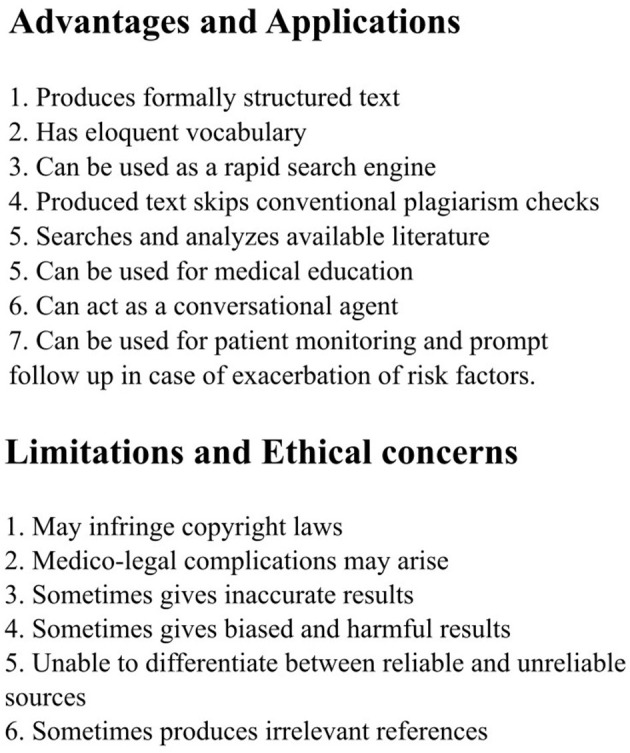
- ChatGPT can assist with identifying research topics, analyzing literature, clinical and laboratory diagnosis, clinical decision support, patient monitoring, medical education, health literacy, virtual patient assistants, medication reminders, and clinical trial recruitment.
- In one cited study, ChatGPT was asked to produce 50 medical research abstracts; the median originality score was 100% on plagiarism detection software, while an AI-output checker identified only 66% of the generated abstracts.
- The paper reports that ChatGPT’s data fed into it is only up to 2021, and that its output can be inaccurate, biased, dependent on training data quality, overly sensitive to question phrasing, and unable to clarify ambiguous prompts.
- Ethical and legal concerns include possible copyright infringement, plagiarism, medico-legal complications, lack of transparency, authorship and accountability dilemmas, and potential misuse or widening disparities.
Methods
- Narrative overview/review of ChatGPT and AI in healthcare and medicine, covering advantages, applications, limitations, ethical considerations, and future prospects.
- The authors state they performed a literature search and literature review/data collection; no systematic review protocol, database list, inclusion criteria, or quantitative synthesis is reported.
- The paper synthesizes prior articles, editorials, and web sources rather than presenting original empirical data or a formal study sample.
Limitations
- The paper states that ChatGPT’s accuracy depends heavily on training data quality, that outputs can be incorrect and lead to legal issues, and that it cannot fully replace human writers because it lacks comparable comprehension and specialized medical knowledge.
- The paper states that ChatGPT-generated text is not totally free of plagiarism and requires human editing, and that identifying its output currently requires meticulous inspection by editors.
- Evident from the text: this is a non-systematic narrative overview with no stated search strategy, no empirical evaluation, and reliance on cited sources and web pages, which limits reproducibility and strength of conclusions.
Model-written summary. Check it against the paper before relying on it.
Integrity signals
Registry
Cites
Statistics
Figures
Verification
Claims the paper makes
2 Valid · 2 Not valid · 35 Not checked · 14 Own results and interpretations
The cited sources support only part of this claim — read each source’s verdict below.
In the paper
“According to a recent article on the benefits of artificial intelligence for the self-management of sickle cell disease, ChatGPT can serve as a reliable conversational agent to collect information from patients with a diverse range of diseases (Issom et al., 2021).”
§ ChatGPT in medicine: an overview of its applications, advantages, limitations, future prospects, and ethical considerations > 2. Advantages and applications
What the sources say
- Partly supportedcites Issom et al., 2021 matched to “Toward a conversational agent to support the self-management of adults and young adults with sickle cell disease: usability and usefulness study” (2021) sourceExperimental — accuracy not yet measured
The Conclusion (Table 1; page unavailable) shows that patients used the paper’s chatbot, TREVOR, to provide demographic and health information. But the study concerns sickle cell disease, not ChatGPT or a diverse range of diseases; the Conclusion also says longer controlled studies are needed to assess clinical utility and safety, so it does not establish reliability. (LLM, conf=0.90)
plainstates a cause- Asserted: passes — The authors put it forward as true.
- Checkable: passes — It can be checked against evidence.
- Load-bearing: unclear — It is unclear whether the paper’s conclusions depend on it.
- Based: passes — The paper gives a reason why it holds.
- Partly supported
The cited sources support only part of this claim — read each source’s verdict below.
In the paper
“and can also be used as a tool of assessment to assess clinical skills (Han et al., 2022)”
§ ChatGPT in medicine: an overview of its applications, advantages, limitations, future prospects, and ethical considerations > 2. Advantages and applications
What the sources say
- Partly supportedcites Han et al., 2022 matched to “Analysis of the effect of an artificial intelligence chatbot educational program on non-face-to-face classes: a quasi-experimental study” (2022) sourceExperimental — accuracy not yet measured
Our copy of Han et al. (2022) describes a rule-based AI chatbot built on LandBot.io, not ChatGPT; the tool-of-assessment element it does contain is formative only — the Methods > Study stages section says 'Various methods such as O/X quiz, multiple choice, and open-ended questions are used to check the understanding of preceding learning,' with feedback per answer. The clinical-skills part is not supported: the Discussion (p. n/a) reports 'no significant differences in clinical reasoning competency and confidence in fetal health assessment using EFM between the two groups' and notes 'lack of studies measuring clinical reasoning competency and fetal health assessment in nursing college students using chatbot'; those outcomes were measured with separate instruments (an EFM knowledge test and the Liou et al. clinical reasoning scale, Methods > Study instruments), not by the chatbot. So the source supports a chatbot quizzing/checking student understanding in a nursing education program, while 'ChatGPT' and 'assess clinical skills' are attributed to it without backing. (LLM, conf=0.70)
plainstates a possible cause- Asserted: passes — The authors put it forward as true.
- Checkable: passes — It can be checked against evidence.
- Load-bearing: unclear — It is unclear whether the paper’s conclusions depend on it.
- Based: passes — The paper gives a reason why it holds.
- Partly supported
The cited sources that could be checked couldn’t confirm or dispute this claim.
In the paper
“It can also be used to help medical students, doctors, nurses, and all members of the healthcare fraternity alike to know about updates and new developments in their respective fields”
§ ChatGPT in medicine: an overview of its applications, advantages, limitations, future prospects, and ethical considerations > 2. Advantages and applications
What the sources say
- Could not verifycites Han et al., 2022 matched to “Analysis of the effect of an artificial intelligence chatbot educational program on non-face-to-face classes: a quasi-experimental study” (2022) sourceExperimental — accuracy not yet measured
Our copy of Han et al. (2022) evaluates a purpose-built rule-based chatbot (built on LandBot.io, Methods > Study stages) for electronic fetal monitoring skills in third-year nursing students at one Korean university; it never mentions ChatGPT, and no passage attributes to any chatbot the function of informing medical students, doctors or nurses about updates and new developments in their fields. The nearest content — Background, 'evidence for clinical application is fast-changing, the importance of educational programs utilizing AI... for nursing college students has been emphasized [1]' — is a rationale for AI-based learning programs in nursing students, credited to Buchanan et al.'s scoping review (ref. 1), not a claim about ChatGPT or about practising clinicians keeping current. Searches: 'ChatGPT updates and new developments... medical students, doctors, nurses' and 'chatbot helps healthcare professionals stay current with rapidly changing clinical evidence' returned only the Background/Introduction/Discussion/Conclusions passages on the EFM chatbot program. Nothing in our copy contradicts the claim, so this is unaddressed rather than disputed. (LLM, conf=0.72)
plainstates a possible cause- Asserted: passes — The authors put it forward as true.
- Checkable: passes — It can be checked against evidence.
- Load-bearing: unclear — It is unclear whether the paper’s conclusions depend on it.
- Based: passes — The paper gives a reason why it holds.
- Could not verify
In the paper
“Chatbots like ChatGPT can be used as powerful tools to increase health literacy, especially among students and young adults (Mokmin and Ibrahim, 2021).”
§ ChatGPT in medicine: an overview of its applications, advantages, limitations, future prospects, and ethical considerations > 2. Advantages and applications
What the sources say
- Not checked yetcites Mokmin and Ibrahim, 2021
plainstates a possible cause- Asserted: passes — The authors put it forward as true.
- Checkable: passes — It can be checked against evidence.
- Load-bearing: unclear — It is unclear whether the paper’s conclusions depend on it.
- Based: passes — The paper gives a reason why it holds.
In the paper
“while the AI-output checker identified only 66% of the generated abstracts (Else, 2023).”
§ ChatGPT in medicine: an overview of its applications, advantages, limitations, future prospects, and ethical considerations > 2. Advantages and applications
What the sources say
- Not checked yetcites Else, 2023 matched to “Abstracts written by ChatGPT fool scientists” (2023) source
plain- Asserted: passes — The authors put it forward as true.
- Checkable: passes — It can be checked against evidence.
- Load-bearing: unclear — It is unclear whether the paper’s conclusions depend on it.
- Based: passes — The paper gives a reason why it holds.
14 more claims
Create a free account to see all 53 claims and to verify the 36 references still open.
- Probably not a substantial claim. 22
- It may state two separate claims as one. 21
Claims other papers make about this one
Each is checked against this paper’s own text: does it say what the citing paper says it does?
The source backs part of the claim, not all of it — or backs it for a different population, condition or comparison.
In the citing paper
“Generative AI aims to address various medical conditions, from chronic diseases like diabetes to acute conditions like stroke [6, 38, 60].”
From Generative AI in healthcare: an implementation science informed translational path on application, integration and governance (2024) · cites this paper as [60]
Experimental — accuracy not yet measuredThe source backs part of the claim, not all of it — or backs it for a different population, condition or comparison.
In the citing paper
“15 publications focused explicitly on this topic [7, 38, 84, 97, 186, 190–199].”
From Artificial intelligence in undergraduate medical education: an updated scoping review (2025) · cites this paper as [194]
Experimental — accuracy not yet measuredThe source backs part of the claim, not all of it — or backs it for a different population, condition or comparison.
In the citing paper
“AI-enabled educational technologies including, but not limited to, virtual patient simulations, tutoring systems, assessment tools, and adaptive learning systems have demonstrated the potential to optimize learning efficiency, personalize educational experiences, and facilitate learner engagement [8, 9].”
From Ethical and responsible use of artificial intelligence in medical education (2026) · cites this paper as [9]
Experimental — accuracy not yet measuredThe cited source says what the claim attributes to it.
In the citing paper
“The heightened interest in telehealth and AI education at t1 could be attributed to the rise of telemedicine during the COVID-19 pandemic [39] and the increasing prominence of generative AI tools such as ChatGPT [40].”
From Evolving Medical Students’ Digital Health Perceptions and Intentions: Insights From a Prepandemic and Postpandemic Survey Study (2025) · cites this paper as [40]
The cited source says what the claim attributes to it.
In the citing paper
“The integration of ChatGPT into medical practices and healthcare settings presents challenges and ethical considerations.”
4 more claims about this paper
Create a free account to see every claim other papers make about this one.
Citations
Cites
ChatGPT: five priorities for research
van Dis, E. A. M., Bollen, J., Zuidema, W., van Rooij, R., & Bockting, C. L. (2023) · Nature · doi:10.1038/d41586-023-00288-7 · Cited by 1,842
ChatGPT and other large language models are double-edged swords
Shen, Y., Heacock, L., Elias, J., Hentel, K. D., Reig, B., Shih, G., & Moy, L. (2023) · Radiology · doi:10.1148/radiol.230163 · Cited by 1,008 · cited 2×
“Additionally, the data fed into it is only up to 2021 (Kitamura, 2023; Shen et al., 2023).”
BackgroundChatGPT listed as author on research papers: many scientists disapprove
Stokel-Walker, C. (2023) · Nature · doi:10.1038/d41586-023-00107-z · Cited by 868 · cited 2×
“ChatGPT, according to publishers and preprint servers contacted by Nature’s news team, does not meet the criteria for a study author since it cannot bear responsibility for the content and authenticity of scientific studies (Stokel-Walker, 2023).”
BackgroundAbstracts written by ChatGPT fool scientists
Else, H. (2023) · Nature · doi:10.1038/d41586-023-00056-7 · Cited by 611
Tools such as ChatGPT threaten transparent science; here are our ground rules for their use
(2023) · Nature · doi:10.1038/d41586-023-00191-1 · Cited by 605 · cited 2×
“However, ongoing research aims to address these issues and propose effective solutions (Editorials, 2023).”
BackgroundA Conversation on Artificial Intelligence, Chatbots, and Plagiarism in Higher Education
King, M. R., & chatGPT (2023) · Cellular and Molecular Bioengineering · doi:10.1007/s12195-022-00754-8 · Cited by 602
Generating scholarly content with ChatGPT: Ethical challenges for medical publishing
Liebrenz, M., Schleifer, R., Buadze, A., Bhugra, D., & Smith, A. (2023) · The Lancet Digital Health · doi:10.1016/s2589-7500(23)00019-5 · Cited by 594 · cited 1×
“Strict guidelines should be implemented by the journals regarding AI use in scholarly papers to minimize its misuse (Liebrenz et al., 2023).”
BackgroundChatGPT and the future of medical writing
Biswas, S. (2023) · Radiology · doi:10.1148/radiol.223312 · Cited by 571 · cited 4×
“, 2023), plagiarism (Biswas, 2023; King and ChatGPT, 2023), and more which are presented in more detail later in this paper.”
BackgroundInfluentialChatGPT: Evolution or revolution?
Gordijn, B., & Have, H. T. (2023) · Medicine, Health Care and Philosophy · doi:10.1007/s11019-023-10136-0 · Cited by 317 · cited 2×
“Several articles have reported on the use of ChatGPT for writing scientific literature, with one study demonstrating that ChatGPT can produce formal research articles (Gordijn and Have, 2023).”
BackgroundChatGPT is shaping the future of medical writing but still requires human judgment
Kitamura, F. C. (2023) · Radiology · doi:10.1148/radiol.230171 · Cited by 317 · cited 2×
“Additionally, the data fed into it is only up to 2021 (Kitamura, 2023; Shen et al., 2023).”
BackgroundMethod
Research works printed but not linked: 1
- Radford A. Narasimhan K. Salimans T. Sutskever I. (2018). Improving language understanding by generative pre-training.
Cited by
Items 301–400 of 1,006
Anaya, F., Prasad, R., Bashour, M. F., Yaghmour, R., Alameh, A., & Balakumaran, K. (2024) · Current Problems in Cardiology · doi:10.1016/j.cpcardiol.2024.102797 · Cited by 26
Mind + Machine: ChatGPT as a Basic Clinical Decisions Support Tool
Ayoub, M., Ballout, A. A., Zayek, R. A., & Ayoub, N. F. (2023) · Cureus · doi:10.7759/cureus.43690 · Cited by 25
“The medico-legal ramifications of using these models also need further evaluation [8].”
BackgroundYuan, Y., Fu, J., Leng, L., Wen, Z., Wei, X., Han, D., Hu, X., Liang, Y., Luo, Q., Zhang, X., et al. (2025) · Frontiers in Public Health · doi:10.3389/fpubh.2025.1672140 · Cited by 25
“Although some quantitative studies have explored nursing students’ acceptance and usage of AI, in-depth insights into their subjective experiences, specific perceptions, and the educational impact of Gen AI remain limited (20–24).”
Eisinger, F., Holderried, F., Mahling, M., Stegemann–Philipps, C., Herrmann‐Werner, A., Nazarenus, E., Sonanini, A., Guthoff, M., Eickhoff, C., & Holderried, M. (2025) · Journal of Medical Internet Research · doi:10.2196/67143 · Cited by 25
Omar, M., Nassar, S., Sharif, Κ., Glicksberg, B. S., Nadkarni, G. N., & Klang, E. (2025) · Frontiers in Medicine · doi:10.3389/fmed.2024.1512824 · Cited by 26
Park, C., An, M. H., Hwang, G., Park, R. W., & An, J. (2025) · JMIR Medical Informatics · doi:10.2196/68409 · Cited by 26
Herwald, S. E., Shah, P., Johnston, A., Olsen, C., Delbrouck, J.-B., & Langlotz, C. P. (2025) · Journal of the American College of Radiology · doi:10.1016/j.jacr.2025.06.013 · Cited by 25
Belaldavar, C., & Angadi, P. V. (2024) · Annals of dental specialty · doi:10.51847/e49ika828d · Cited by 25
Çil, G., & Doğan, K. (2024) · World Journal of Urology · doi:10.1007/s00345-024-04847-z · Cited by 25
Vij, O., Calver, H., Myall, N., Dey, M., & Kouranloo, K. (2024) · PLoS ONE · doi:10.1371/journal.pone.0307372 · Cited by 25
ChatGPT-4o′s performance on pediatric Vesicoureteral reflux
Önder, E. N. A., Ensari, E., & Ertan, P. (2024) · Journal of Pediatric Urology · doi:10.1016/j.jpurol.2024.12.002 · Cited by 25
Ghozali, M. T. (2025) · Journal of Asthma · doi:10.1080/02770903.2025.2450482 · Cited by 25
Large language models in physical therapy: time to adapt and adept
Naqvi, W. M., Shaikh, S. Z., & Mishra, G. V. (2024) · Frontiers in Public Health · doi:10.3389/fpubh.2024.1364660 · Cited by 24
Solaiman, B. (2024) · International Journal of Law and Psychiatry · doi:10.1016/j.ijlp.2024.102028 · Cited by 24
Exploring the role of ChatGPT in oncology: providing information and support for cancer patients
Cè, M., Chiarpenello, V., Bubba, A., Felisaz, P. F., Oliva, G., Irmici, G., & Cellina, M. (2024) · BioMedInformatics · doi:10.3390/biomedinformatics4020049 · Cited by 24
“In conclusion, AI in healthcare must be strictly regulated and overseen to reduce these risks [6,30].”
BackgroundInfluentialCan ChatGPT answer patient questions regarding reverse shoulder arthroplasty?
Lack, B. T., Mouhawasse, E., Childers, J. T., Jackson, G. R., Daji, A. V., Hansen, P. Y., Familiari, F., Knapik, D. M., & Sabesan, V. J. (2024) · Journal of ISAKOS Joint Disorders & Orthopaedic Sports Medicine · doi:10.1016/j.jisako.2024.100323 · Cited by 25
Future of Electronic Healthcare Management: Blockchain and Artificial Intelligence Integration
Verma, P., Rao, C. M., Chapalamadugu, P. K., Tiwari, R., & Upadhyay, S. (2024) · Blockchain technologies · doi:10.1007/978-981-97-1249-6_9 · Cited by 24
Mohammadi, S. S., Khatri, A., Jain, T., Thng, Z. X., Yoo, W.-S., Yavari, N., Bazojoo, V., Mobasserian, A., Akhavanrezayat, A., Than, N. T. T., et al. (2024) · Ophthalmology Science · doi:10.1016/j.xops.2024.100594 · Cited by 24
Huo, B., Marfo, N. Y. A., Sylla, P. A., Calabrese, E., Kumar, S. S., Slater, B. J., Walsh, D. S., & Vosburg, R. W. (2024) · Surgical Endoscopy · doi:10.1007/s00464-024-11155-5 · Cited by 24
Jung, Y. S., Chae, Y. K., Kim, M. S., Lee, H., Choi, S. C., & Nam, O. H. (2024) · THE JOURNAL OF THE KOREAN ACADEMY OF PEDTATRIC DENTISTRY · doi:10.5933/jkapd.2024.51.3.299 · Cited by 24
Practical Applications of Large Language Models for Health Care Professionals and Scientists
Reis, F., Lenz, C., Gossen, M., Volk, H., & Drzeniek, N. M. (2024) · JMIR Medical Informatics · doi:10.2196/58478 · Cited by 24
The Diagnostic Ability of GPT-3.5 and GPT-4.0 in Surgery: Comparative Analysis
Liu, J., Liang, X., Fang, D., Zheng, J., Yin, C., Xie, H., Li, Y., Sun, X., Tong, Y., Che, H., et al. (2024) · Journal of Medical Internet Research · doi:10.2196/54985 · Cited by 24
Evaluating AI performance in nephrology triage and subspecialty referrals
Koirala, P., Thongprayoon, C., Miao, J., Valencia, O. A. G., Sheikh, M. S., Suppadungsuk, S., Mao, M. A., Pham, J. H., Craici, I. M., & Cheungpasitporn, W. (2025) · Scientific Reports · doi:10.1038/s41598-025-88074-5 · Cited by 24
Marinelli, S., Paola, L. D., Stark, M. M., & Vergallo, G. M. (2025) · PubMed · doi:10.7417/ct.2025.5192 · Cited by 25
Guo, X. (2025) · Interactive Learning Environments · doi:10.1080/10494820.2024.2445177 · Cited by 23
Leitão, C. A., Salvador, G. L. D. O., Rabelo, L. M., & Escuissato, D. L. (2024) · Radiologia Brasileira · doi:10.1590/0100-3984.2023.0083 · Cited by 23
Sawamura, S., Bito, T., Ando, T., Masuda, K., Kameyama, S., & Ishida, H. (2024) · Journal of Physical Therapy Science · doi:10.1589/jpts.36.234 · Cited by 25
Albalawi, F., Khanagar, S. B., Iyer, K., Alhazmi, N., Alayyash, A., Alhazmi, A. S., Awawdeh, M. A., & Singh, O. G. (2025) · Applied Sciences · doi:10.3390/app15020893 · Cited by 23
Taşyürek, M., Adıgüzel, Ö., Gündoğar, M., Goncharuk-Khomyn, M., & Ortaç, H. (2025) · International Dental Research · doi:10.5577/intdentres.662 · Cited by 23
ChatGPT as an aid for pathological diagnosis of cancer
Malik, S., & Zaheer, S. (2023) · Pathology - Research and Practice · doi:10.1016/j.prp.2023.154989 · Cited by 25
Chatting with artificial intelligence to combat antibiotic resistance: Opportunities and challenges
Abavisani, M., Khoshrou, A., Foroushan, S. K., & Sahebkar, A. (2024) · Current Research in Biotechnology · doi:10.1016/j.crbiot.2024.100197 · Cited by 23
Berry, C. E., Fazilat, A. Z., Lavin, C. V., Lintel, H. A., Cole, N. A., Stingl, C. S., Valencia, C., Morgan, A. G., Momeni, A., & Wan, D. C. (2024) · Journal of Reconstructive Microsurgery · doi:10.1055/a-2273-4163 · Cited by 23
Should Artificial Intelligence Be Used for Physician Documentation to Reduce Burnout?
Miao, J., Thongprayoon, C., & Cheungpasitporn, W. (2024) · Kidney360 · doi:10.34067/kid.0000000000000430 · Cited by 23
Revolutionizing Education of Art and Design Through ChatGPT
Lazkani, O. (2024) · Studies in big data · doi:10.1007/978-3-031-52280-2_4 · Cited by 23
Awal, M. R., & Asaduzzaman (2024) · Higher Education Skills and Work-based Learning · doi:10.1108/heswbl-09-2023-0249 · Cited by 23
Levin, G., Pareja, R., Viveros-Carreño, D. A., Díaz, E. S., Yates, E. M., Zand, B., & Ramirez, P. T. (2024) · International Journal of Gynecological Cancer · doi:10.1136/ijgc-2023-005162 · Cited by 23
Computational Legal Studies Comes of Age
Chau, B. K., & Livermore, M. A. (2024) · European journal of empirical legal studies · doi:10.62355/ejels.19684 · Cited by 23
Can AI-Generated Clinical Vignettes in Japanese Be Used Medically and Linguistically?
Yanagita, Y., Yokokawa, D., Uchida, S., Li, Y., Uehara, T., & Ikusaka, M. (2024) · Journal of General Internal Medicine · doi:10.1007/s11606-024-09031-y · Cited by 23
Dinçer, H. A., & Doğu, D. (2025) · ANZ Journal of Surgery · doi:10.1111/ans.70198 · Cited by 23
Practical Use of ChatGPT in Psychiatry for Treatment Plan and PsychoeducationPreprint
Vahedifard, F., Sadeghniiat-Haghighi, A., Dave, T., Tolouei, M., & Zare, F. H. (2023) · arXiv (Cornell University) · doi:10.48550/arxiv.2311.09131 · Cited by 23
Self-citationLevit, N. S., & Saban, M. (2025) · npj Digital Medicine · doi:10.1038/s41746-025-01747-3 · Cited by 23
Zhang, C., Yang, H., Liu, X., Wu, R., Zong, H., Wu, E., Zhou, Y. K., Li, J., & Shen, B. (2025) · Journal of Medical Internet Research · doi:10.2196/67201 · Cited by 22
ChatGPT and OpenAI: A Comprehensive Bibliometric Review
Önden, A., & Alnour, M. (2023) · Journal of Soft Computing and Decision Analytics · doi:10.31181/jscda11202324 · Cited by 22
Makiev, K. G., Asimakidou, M., Vasios, I. S., Keskinis, A., Petkidis, G., Tilkeridis, K. E., Ververidis, A. N., & Iliopoulos, E. (2023) · Cureus · doi:10.7759/cureus.49166 · Cited by 22
Artificial Intelligence in Scoliosis Classification: An Investigation of Language-Based Models
Fabijan, A., Polis, B., Fabijan, R., Zakrzewski, K., Nowosławska, E., & Zawadzka-Fabijan, A. (2023) · Journal of Personalized Medicine · doi:10.3390/jpm13121695 · Cited by 21
Gritti, M. N., AlTurki, H., Farid, P., & Morgan, C. T. (2024) · Pediatric Cardiology · doi:10.1007/s00246-023-03385-6 · Cited by 22
Munir, M. M., Endo, Y., Ejaz, A. M., Dillhoff, M. E., Cloyd, J. M., & Pawlik, T. M. (2024) · Journal of Gastrointestinal Surgery · doi:10.1016/j.gassur.2023.11.019 · Cited by 22
Pereyra, L., Schlottmann, F., Steinberg, L., & Lasa, J. (2024) · Journal of Clinical Gastroenterology · doi:10.1097/mcg.0000000000001979 · Cited by 22
The Future of ChatGPT in Medicinal Chemistry: Harnessing AI for Accelerated Drug Discovery
Pradhan, T., Gupta, O., & Chawla, G. (2024) · ChemistrySelect · doi:10.1002/slct.202304359 · Cited by 23
Bhatia, A. M., Titus, R. S., Porto, J. G., Katz, J. E., Lopategui, D. M., Marcovich, R., Parekh, D. J., & Shah, H. N. (2024) · Journal of Endourology · doi:10.1089/end.2023.0690 · Cited by 22
Application of artificial intelligence in the diagnosis and treatment of cardiac arrhythmia
Guo, R., Tian, X., Bazoukis, G., Tse, G., Hong, S., Chen, K., & Liu, T. (2024) · Pacing and Clinical Electrophysiology · doi:10.1111/pace.14995 · Cited by 22
Chung, S. M., & Chang, M. C. (2024) · BMJ Health & Care Informatics · doi:10.1136/bmjhci-2023-101006 · Cited by 22
Khalpey, Z. I., Kumar, U. A., King, N. C., Abraham, A., & Khalpey, A. (2024) · Cureus · doi:10.7759/cureus.65083 · Cited by 22
Goldstein, M., Donos, N., Teughels, W., Gkranias, N., Temmerman, A., Derks, J., Kuru, B. E., Carra, M. C., Castro, A. B. S., Dereka, X. E., et al. (2024) · Journal Of Clinical Periodontology · doi:10.1111/jcpe.14033 · Cited by 22
Large language model triaging of simulated nephrology patient inbox messages
Pham, J. H., Thongprayoon, C., Miao, J., Suppadungsuk, S., Koirala, P., Craici, I. M., & Cheungpasitporn, W. (2024) · Frontiers in Artificial Intelligence · doi:10.3389/frai.2024.1452469 · Cited by 23
Bianco, G. L., Cascella, M., Li, S., Day, M. R., Kapural, L., Robinson, C. L., & Sinagra, E. (2025) · Journal of Clinical Medicine · doi:10.3390/jcm14051453 · Cited by 22
Grinberg, N., Whitefield, S., Kleinman, S., Ianculovici, C., Wasserman, G., & Peleg, O. (2025) · Clinical Oral Investigations · doi:10.1007/s00784-025-06268-7 · Cited by 22
ALGAN: Time Series Anomaly Detection with Adjusted-LSTM GAN
Bashar, M. A., & Nayak, R. (2023) · doi:10.21203/rs.3.rs-3609809/v1 · Cited by 22
Widen the debate: What is the academic community’s perception on ChatGPT?
Jiang, Y., Xie, L., Lin, G., & Mo, F. (2024) · Education and Information Technologies · doi:10.1007/s10639-024-12677-0 · Cited by 21
“Additionally, there’s debate on its role in automating tasks traditionally performed by educators and call for ethical guidelines in its implementation (Dave et al., 2023; Liebrenz et al., 2023; Livberber & Ayvaz, 2023; Zhuo et al., 2023).”
Incorporation of artificial intelligence into nursing research: A scoping review
Yasin, Y. M., Al‐Hamad, A., Metersky, K., & Kehyayan, V. (2025) · International Nursing Review · doi:10.1111/inr.13013 · Cited by 21
Google Gemini’s Performance in Endodontics: A Study on Answer Precision and Reliability
García, V. D., Freire, Y., Tortosa, M., Tejedor, B., Estévez, R., & Suárez, A. (2024) · Applied Sciences · doi:10.3390/app14156390 · Cited by 21
Asfuroğlu, Z. M., Yağar, H., & Gümüşoğlu, E. (2024) · BMC Musculoskeletal Disorders · doi:10.1186/s12891-024-07983-0 · Cited by 21
Chandra, K., Ghilzai, U. M., Lawand, J. J., Ghali, A. N., Fiedler, B., & Ahmed, A. S. (2025) · Journal of Shoulder and Elbow Surgery · doi:10.1016/j.jse.2025.02.025 · Cited by 21
Large language models and the future of rheumatology: assessing impact and emerging opportunities
Mannstadt, I., & Mehta, B. Y. (2023) · Current Opinion in Rheumatology · doi:10.1097/bor.0000000000000981 · Cited by 21
Boyd, C. J., Hemal, K., Sorenson, T. J., Patel, P. A., Bekisz, J. M., Choi, M., & Karp, N. S. (2024) · Plastic & Reconstructive Surgery Global Open · doi:10.1097/gox.0000000000005580 · Cited by 21
ChatGPT and Medicine: Together We Embrace the AI Renaissance
Hacking, S. M. (2024) · JMIR Bioinformatics and Biotechnology · doi:10.2196/52700 · Cited by 21
Impact of high-quality, mixed-domain data on the performance of medical language models
Griot, M., Hemptinne, C., Vanderdonckt, J. M., & Yüksel, D. (2024) · Journal of the American Medical Informatics Association · doi:10.1093/jamia/ocae120 · Cited by 21
Exploring ChatGPT for Face Presentation Attack Detection in Zero and Few-Shot in-Context Learning
Komaty, A., Shahreza, H. O., George, A., & Marcel, S. (2025) · IEEE/CVF Winter Conference on Applications of Computer Vision Workshops (WACVW) · doi:10.1109/wacvw65960.2025.00093 · Cited by 21
Sallam, M., Al‐Farajat, A., & Egger, J. (2024) · Jordan Medical Journal · doi:10.35516/jmj.v58i1.2285 · Cited by 21
MedAide: Leveraging Large Language Models for On-Premise Medical Assistance on Edge DevicesPreprint
Basit, A., Hussain, K., Hanif, M. A., & Shafique, M. (2024) · arXiv (Cornell University) · doi:10.48550/arxiv.2403.00830 · Cited by 21
Bridges, J. M. (2024) · Diagnosis · doi:10.1515/dx-2024-0033 · Cited by 20
From Prompt to Drug: Toward Pharmaceutical Superintelligence
Zhavoronkov, A. A., Gennert, D. G., & Shi, J. (2026) · ACS Central Science · doi:10.1021/acscentsci.5c01473 · Cited by 20
Evaluation of ChatGPT for Patient Counseling in Kidney Stone Clinic: A Prospective Study
Javid, M., Bhandari, M., Parameshwari, P., Reddiboina, M., & Prasad, S. (2024) · Journal of Endourology · doi:10.1089/end.2023.0571 · Cited by 20
Alessi, M. R., Gomes, H. A., de Castro, M. L., & Okamoto, C. T. (2024) · Cureus · doi:10.7759/cureus.64924 · Cited by 20
Finch, L. A., Broach, V. A., Feinberg, J., Al‐Niaimi, A., Abu‐Rustum, N. R., Zhou, Q. C., Iasonos, A. E., & Dennis, S. (2024) · Gynecologic Oncology · doi:10.1016/j.ygyno.2024.07.007 · Cited by 20
Evaluation of four chatbots in autoimmune liver disease: A comparative analysis
Daza, J., Bezerra, L. S., Santamaría, L., Rueda‐Esteban, R. J., Bantel, H., Girala, M., Ebert, M. P., van Bömmel, F., Geier, A., Gómez-Aldana, A., et al. (2024) · Annals of Hepatology · doi:10.1016/j.aohep.2024.101537 · Cited by 20
Based on Medicine, The Now and Future of Large Language Models
Su, Z., Tang, G., Huang, R., Yang, Q. W., Zhang, Z., & Dai, X. (2024) · Cellular and Molecular Bioengineering · doi:10.1007/s12195-024-00820-3 · Cited by 20
Freitas, M. D., López‐Pintor, R. M., Santos‐Silva, A. R., Warnakulasuriya, S., & Dios, P. D. (2024) · Exploration of Digital Health Technologies · doi:10.37349/edht.2024.00032 · Cited by 20
Hiredesai, A. N., Martínez, C., Anderson, M. L., Howlett, C. P., Unadkat, K. D., & Noland, S. S. (2024) · Hand · doi:10.1177/15589447241298982 · Cited by 20
Strategies for integrating ChatGPT and generative AI into clinical studies
Lee, J. (2024) · Blood Research · doi:10.1007/s44313-024-00045-3 · Cited by 20
HERNÁNDEZ-FLORES, L. A., López‐Martínez, J. B., la Rosa, J. J. R.-D., Aillaud‐De‐Uriarte, D., Contreras‐Garduño, S., & Cortés‐González, R. (2025) · Journal of Surgical Oncology · doi:10.1002/jso.28121 · Cited by 20
Dehkordi, M. K. H., Perl, Y., Deek, F. P., He, Z., Keloth, V. K., Liu, H., Elhanan, G., & Einstein, A. J. (2025) · JMIR Medical Informatics · doi:10.2196/66476 · Cited by 20
Dufey-Portilla, N., Frisman, A. B., Robles, M. G., Peña‐Bengoa, F., Ávila, C. C., Nagendrababu, V., Dummer, P. M. H., García‐Font, M., & Sans, F. A. (2025) · Journal of Applied Oral Science · doi:10.1590/1678-7757-2025-0321 · Cited by 20
Khan, M. S. (2023) · AI and Ethics · doi:10.1007/s43681-023-00360-y · Cited by 20
Scott, I. A., Reddy, S., Kelly, T., Miller, T., & van der Vegt, A. H. (2025) · The Medical Journal of Australia · doi:10.5694/mja2.70057 · Cited by 20
ChatGPT: What Every Pediatric Surgeon Should Know About Its Potential Uses and Pitfalls
González, R., Poenaru, D., Woo, R. K., Trappey, A. F., Carter, S., Darcy, D., Encisco, E. M., Gulack, B. C., Miniati, D., Tombash, E., et al. (2024) · Journal of Pediatric Surgery · doi:10.1016/j.jpedsurg.2024.01.007 · Cited by 19
Abid, A., & Baxter, S. L. (2024) · Journal of Glaucoma · doi:10.1097/ijg.0000000000002382 · Cited by 19
Croen, B. J., Abdullah, M. S., Berns, E. M., Rapaport, S. F., Hahn, A. K., Barrett, C. C., & Sobel, A. D. (2024) · Hand · doi:10.1177/15589447241247332 · Cited by 19
DiDonna, N., Shetty, P. N., Khan, K., & Damitz, L. (2024) · Plastic & Reconstructive Surgery Global Open · doi:10.1097/gox.0000000000005929 · Cited by 20
Cheng, S., Xiao, Y., Liu, L., & Sun, X. (2024) · Postgraduate Medical Journal · doi:10.1093/postmj/qgae083 · Cited by 19
Bibliometric top ten healthcare-related ChatGPT publications in the first ChatGPT anniversary
Sallam, M. (2024) · Narra J · doi:10.52225/narra.v4i2.917 · Cited by 19
Krumsvik, R. J. (2024) · Nordic Journal of Digital Literacy · doi:10.18261/njdl.19.3.5 · Cited by 19
Can ChatGPT reliably answer the most common patient questions regarding total shoulder arthroplasty?
White, C. A., Masturov, Y. A., Haunschild, E. D., Michaelson, E. M., Shukla, D. R., & Cagle, P. J. (2024) · Journal of Shoulder and Elbow Surgery · doi:10.1016/j.jse.2024.08.025 · Cited by 19
Kaçmaz, H. Y., Kahraman, H., Akutay, S., & Dağdelen, D. (2024) · Journal of Advanced Nursing · doi:10.1111/jan.16542 · Cited by 19
Chasing sleep physicians: ChatGPT-4o on the interpretation of polysomnographic results
Seifen, C., Huppertz, T., Gouveris, H. T., Bahr‐Hamm, K., Pordzik, J., Eckrich, J., Smith, H., Kelsey, T., Blaikie, A. J., Matthias, C., et al. (2024) · European Archives of Oto-Rhino-Laryngology · doi:10.1007/s00405-024-08985-3 · Cited by 19
Montagna, M., Chiabrando, F., LORENZO, R. D., & Rovere, P. Q. (2025) · JMIR Medical Education · doi:10.2196/55709 · Cited by 19
Herzog, C., & Blank, S. (2024) · Journal of Responsible Innovation · doi:10.1080/23299460.2024.2431350 · Cited by 19
Aggarwal, K., Ravi, R., & Yerraguntla, K. (2025) · Intelligence-Based Medicine · doi:10.1016/j.ibmed.2025.100214 · Cited by 20
Yapay Zeka Sohbet Robotları ve ChatGPT’nin Hemşirelik Eğitiminde Kullanılması
İlaslan, E. (2023) · Akdeniz Hemşirelik Dergisi · doi:10.59398/ahd.1330341 · Cited by 19
Cherif, H., Moussa, C., Missaoui, A. M., Salouage, I., Mokaddem, S., & Dhahri, B. (2024) · JMIR Medical Education · doi:10.2196/52818 · Cited by 18
“However, these benefits come with significant challenges and uncertainties that need to be carefully addressed and navigated [10,11].”
Background
Metadata
- Authors
- Dave, T., Athaluri, S. A., & Singh, S.
- Affiliations
- Bukovinian State Medical University (UA)
- Rangaraya Medical College (IN)
- Ganesh Shankar Vidyarthi Memorial Medical College (IN)
- Corresponding author
- Dave, Tirth
- Venue
- Frontiers in Artificial Intelligence
- Publisher
- Frontiers Media SA
- Published
- 2023-05-04
- Volume
- 6
- Pages
- 1169595-1169595
- ISSN
- 2624-8212 (ISSN-L)
- PMC
- PMC10192861
- OpenAlex
- W4368367885
- Cited by
- 1,204
- References
- 17
- Citations by year
- 2026: 162 · 2025: 347 · 2024: 531 · 2023: 162
- FWCI
- 47.86
- Type
- journal article
- Language
- en
- Open access
- gold
- doi.org
- Licence
- Locations
- Frontiers in Artificial Intelligence (publishedVersion, cc-by)
- PubMed Central (publishedVersion, cc-by)
- PubMed (publishedVersion)
- DOAJ (DOAJ: Directory of Open Access Journals) (submittedVersion, cc-by-sa)
- Topics
- Health Sciences › Medicine › Health Informatics › Artificial Intelligence in Healthcare and Education
- Physical Sciences › Computer Science › Artificial Intelligence › Artificial Intelligence Applications
- Health Sciences › Health Professions › Health Information Management › Artificial Intelligence in Healthcare
- Keywords
- ChatGPT, large language models, artificial intelligence in healthcare, diagnosis, virtual health assistants, medical education, medical writing, copyright infringement, medicolegal issues, ethical considerations
About these checks
Registry, retraction, Cites and statistics results are computed, not judged, with one exception: a printed reference that no index lists is read once by a model before it counts as a citation error. Claims are extracted by a model and kept only when their quote appears verbatim in the text; each cited source is then checked, with a model’s help, for whether it says what the claim relies on. Those verdicts can be wrong — read the claim’s quote and the cited source before relying on one.
The claim verdicts this report counts are experimental: their accuracy is not yet measured.
A language model drew the claims from the paper on 2026-10-04, under version 3 of the claim definition (model deepseek-v4.1-flash, prompt extract-v3).
A second model labelled each claim on 2026-10-04 (model jev-1.13-20260917, definition revision gold-guideline-v0.2).
Cited sources are checked with a language model’s help (gpt-6-sol and qwen3.8-omni-flash).
Statistics and arithmetic are recomputed, not judged.
Confidence bands are shown only for fields calibrated on our annotated test set. None is calibrated yet, so no band is shown.
What counts as a claim ›How we measure confidence ›How we check this ›
Are you an author, or do you see a problem with this page? Request a review
Data sources
Bibliographic data: Semantic Scholar, OpenAlex, Crossref.
Contains information from the Semantic Scholar Academic Graph Datasets, made available under the ODC Attribution License (ODC-BY 1.0).
Semantic Scholar’s data is described in: Kinney, R., et al. (2023). The Semantic Scholar Open Data Platform. arXiv:2301.10140.
