

ChatGPT in medicine: an overview of its applications, advantages, limitations, future prospects, and ethical considerations
Open accessThe DOI matches its Crossref record; 17 of the 17 references it cites were found in a registry or an index; 3 of the 39 sources its claims cite were checked for support.
Abstract
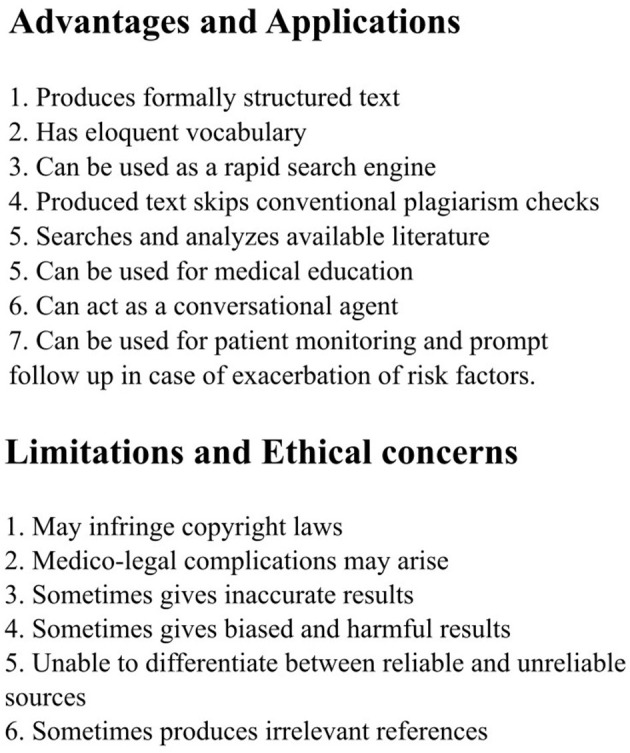
This paper presents an analysis of the advantages, limitations, ethical considerations, future prospects, and practical applications of ChatGPT and artificial intelligence (AI) in the healthcare and medical domains. ChatGPT is an advanced language model that uses deep learning techniques to produce human-like responses to natural language inputs. It is part of the family of generative pre-training transformer (GPT) models developed by OpenAI and is currently one of the largest publicly available language models. ChatGPT is capable of capturing the nuances and intricacies of human language, allowing it to generate appropriate and contextually relevant responses across a broad spectrum of prompts. The potential applications of ChatGPT in the medical field range from identifying potential research topics to assisting professionals in clinical and laboratory diagnosis. Additionally, it can be used to help medical students, doctors, nurses, and all members of the healthcare fraternity to know about updates and new developments in their respective fields. The development of virtual assistants to aid patients in managing their health is another important application of ChatGPT in medicine. Despite its potential applications, the use of ChatGPT and other AI tools in medical writing also poses ethical and legal concerns. These include possible infringement of copyright laws, medico-legal complications, and the need for transparency in AI-generated content. In conclusion, ChatGPT has several potential applications in the medical and healthcare fields. However, these applications come with several limitations and ethical considerations which are presented in detail along with future prospects in medicine and healthcare.
Overview
CoChat Summary
TL;DR
This narrative overview examines ChatGPT’s applications, advantages, limitations, ethical issues, and future prospects in medicine and healthcare. It concludes that ChatGPT has promising uses in research, diagnosis, patient monitoring, and education, but requires human oversight because of accuracy, bias, plagiarism, copyright, and accountability concerns.
Key findings
- ChatGPT can assist with identifying research topics, analyzing literature, clinical and laboratory diagnosis, clinical decision support, patient monitoring, medical education, health literacy, virtual patient assistants, medication reminders, and clinical trial recruitment.
- In one cited study, ChatGPT was asked to produce 50 medical research abstracts; the median originality score was 100% on plagiarism detection software, while an AI-output checker identified only 66% of the generated abstracts.
- The paper reports that ChatGPT’s data fed into it is only up to 2021, and that its output can be inaccurate, biased, dependent on training data quality, overly sensitive to question phrasing, and unable to clarify ambiguous prompts.
- Ethical and legal concerns include possible copyright infringement, plagiarism, medico-legal complications, lack of transparency, authorship and accountability dilemmas, and potential misuse or widening disparities.
Methods
- Narrative overview/review of ChatGPT and AI in healthcare and medicine, covering advantages, applications, limitations, ethical considerations, and future prospects.
- The authors state they performed a literature search and literature review/data collection; no systematic review protocol, database list, inclusion criteria, or quantitative synthesis is reported.
- The paper synthesizes prior articles, editorials, and web sources rather than presenting original empirical data or a formal study sample.
Limitations
- The paper states that ChatGPT’s accuracy depends heavily on training data quality, that outputs can be incorrect and lead to legal issues, and that it cannot fully replace human writers because it lacks comparable comprehension and specialized medical knowledge.
- The paper states that ChatGPT-generated text is not totally free of plagiarism and requires human editing, and that identifying its output currently requires meticulous inspection by editors.
- Evident from the text: this is a non-systematic narrative overview with no stated search strategy, no empirical evaluation, and reliance on cited sources and web pages, which limits reproducibility and strength of conclusions.
Model-written summary. Check it against the paper before relying on it.
Integrity signals
Registry
Cites
Statistics
Figures
Verification
Claims the paper makes
2 Valid · 2 Not valid · 35 Not checked · 14 Own results and interpretations
The cited sources support only part of this claim — read each source’s verdict below.
In the paper
“According to a recent article on the benefits of artificial intelligence for the self-management of sickle cell disease, ChatGPT can serve as a reliable conversational agent to collect information from patients with a diverse range of diseases (Issom et al., 2021).”
§ ChatGPT in medicine: an overview of its applications, advantages, limitations, future prospects, and ethical considerations > 2. Advantages and applications
What the sources say
- Partly supportedcites Issom et al., 2021 matched to “Toward a conversational agent to support the self-management of adults and young adults with sickle cell disease: usability and usefulness study” (2021) sourceExperimental — accuracy not yet measured
The Conclusion (Table 1; page unavailable) shows that patients used the paper’s chatbot, TREVOR, to provide demographic and health information. But the study concerns sickle cell disease, not ChatGPT or a diverse range of diseases; the Conclusion also says longer controlled studies are needed to assess clinical utility and safety, so it does not establish reliability. (LLM, conf=0.90)
plainstates a cause- Asserted: passes — The authors put it forward as true.
- Checkable: passes — It can be checked against evidence.
- Load-bearing: unclear — It is unclear whether the paper’s conclusions depend on it.
- Based: passes — The paper gives a reason why it holds.
- Partly supported
The cited sources support only part of this claim — read each source’s verdict below.
In the paper
“and can also be used as a tool of assessment to assess clinical skills (Han et al., 2022)”
§ ChatGPT in medicine: an overview of its applications, advantages, limitations, future prospects, and ethical considerations > 2. Advantages and applications
What the sources say
- Partly supportedcites Han et al., 2022 matched to “Analysis of the effect of an artificial intelligence chatbot educational program on non-face-to-face classes: a quasi-experimental study” (2022) sourceExperimental — accuracy not yet measured
Our copy of Han et al. (2022) describes a rule-based AI chatbot built on LandBot.io, not ChatGPT; the tool-of-assessment element it does contain is formative only — the Methods > Study stages section says 'Various methods such as O/X quiz, multiple choice, and open-ended questions are used to check the understanding of preceding learning,' with feedback per answer. The clinical-skills part is not supported: the Discussion (p. n/a) reports 'no significant differences in clinical reasoning competency and confidence in fetal health assessment using EFM between the two groups' and notes 'lack of studies measuring clinical reasoning competency and fetal health assessment in nursing college students using chatbot'; those outcomes were measured with separate instruments (an EFM knowledge test and the Liou et al. clinical reasoning scale, Methods > Study instruments), not by the chatbot. So the source supports a chatbot quizzing/checking student understanding in a nursing education program, while 'ChatGPT' and 'assess clinical skills' are attributed to it without backing. (LLM, conf=0.70)
plainstates a possible cause- Asserted: passes — The authors put it forward as true.
- Checkable: passes — It can be checked against evidence.
- Load-bearing: unclear — It is unclear whether the paper’s conclusions depend on it.
- Based: passes — The paper gives a reason why it holds.
- Partly supported
The cited sources that could be checked couldn’t confirm or dispute this claim.
In the paper
“It can also be used to help medical students, doctors, nurses, and all members of the healthcare fraternity alike to know about updates and new developments in their respective fields”
§ ChatGPT in medicine: an overview of its applications, advantages, limitations, future prospects, and ethical considerations > 2. Advantages and applications
What the sources say
- Could not verifycites Han et al., 2022 matched to “Analysis of the effect of an artificial intelligence chatbot educational program on non-face-to-face classes: a quasi-experimental study” (2022) sourceExperimental — accuracy not yet measured
Our copy of Han et al. (2022) evaluates a purpose-built rule-based chatbot (built on LandBot.io, Methods > Study stages) for electronic fetal monitoring skills in third-year nursing students at one Korean university; it never mentions ChatGPT, and no passage attributes to any chatbot the function of informing medical students, doctors or nurses about updates and new developments in their fields. The nearest content — Background, 'evidence for clinical application is fast-changing, the importance of educational programs utilizing AI... for nursing college students has been emphasized [1]' — is a rationale for AI-based learning programs in nursing students, credited to Buchanan et al.'s scoping review (ref. 1), not a claim about ChatGPT or about practising clinicians keeping current. Searches: 'ChatGPT updates and new developments... medical students, doctors, nurses' and 'chatbot helps healthcare professionals stay current with rapidly changing clinical evidence' returned only the Background/Introduction/Discussion/Conclusions passages on the EFM chatbot program. Nothing in our copy contradicts the claim, so this is unaddressed rather than disputed. (LLM, conf=0.72)
plainstates a possible cause- Asserted: passes — The authors put it forward as true.
- Checkable: passes — It can be checked against evidence.
- Load-bearing: unclear — It is unclear whether the paper’s conclusions depend on it.
- Based: passes — The paper gives a reason why it holds.
- Could not verify
In the paper
“Chatbots like ChatGPT can be used as powerful tools to increase health literacy, especially among students and young adults (Mokmin and Ibrahim, 2021).”
§ ChatGPT in medicine: an overview of its applications, advantages, limitations, future prospects, and ethical considerations > 2. Advantages and applications
What the sources say
- Not checked yetcites Mokmin and Ibrahim, 2021
plainstates a possible cause- Asserted: passes — The authors put it forward as true.
- Checkable: passes — It can be checked against evidence.
- Load-bearing: unclear — It is unclear whether the paper’s conclusions depend on it.
- Based: passes — The paper gives a reason why it holds.
In the paper
“while the AI-output checker identified only 66% of the generated abstracts (Else, 2023).”
§ ChatGPT in medicine: an overview of its applications, advantages, limitations, future prospects, and ethical considerations > 2. Advantages and applications
What the sources say
- Not checked yetcites Else, 2023 matched to “Abstracts written by ChatGPT fool scientists” (2023) source
plain- Asserted: passes — The authors put it forward as true.
- Checkable: passes — It can be checked against evidence.
- Load-bearing: unclear — It is unclear whether the paper’s conclusions depend on it.
- Based: passes — The paper gives a reason why it holds.
14 more claims
Create a free account to see all 53 claims and to verify the 36 references still open.
- Probably not a substantial claim. 22
- It may state two separate claims as one. 21
Claims other papers make about this one
Each is checked against this paper’s own text: does it say what the citing paper says it does?
The source backs part of the claim, not all of it — or backs it for a different population, condition or comparison.
In the citing paper
“Generative AI aims to address various medical conditions, from chronic diseases like diabetes to acute conditions like stroke [6, 38, 60].”
From Generative AI in healthcare: an implementation science informed translational path on application, integration and governance (2024) · cites this paper as [60]
Experimental — accuracy not yet measuredThe source backs part of the claim, not all of it — or backs it for a different population, condition or comparison.
In the citing paper
“15 publications focused explicitly on this topic [7, 38, 84, 97, 186, 190–199].”
From Artificial intelligence in undergraduate medical education: an updated scoping review (2025) · cites this paper as [194]
Experimental — accuracy not yet measuredThe source backs part of the claim, not all of it — or backs it for a different population, condition or comparison.
In the citing paper
“AI-enabled educational technologies including, but not limited to, virtual patient simulations, tutoring systems, assessment tools, and adaptive learning systems have demonstrated the potential to optimize learning efficiency, personalize educational experiences, and facilitate learner engagement [8, 9].”
From Ethical and responsible use of artificial intelligence in medical education (2026) · cites this paper as [9]
Experimental — accuracy not yet measuredThe cited source says what the claim attributes to it.
In the citing paper
“The heightened interest in telehealth and AI education at t1 could be attributed to the rise of telemedicine during the COVID-19 pandemic [39] and the increasing prominence of generative AI tools such as ChatGPT [40].”
From Evolving Medical Students’ Digital Health Perceptions and Intentions: Insights From a Prepandemic and Postpandemic Survey Study (2025) · cites this paper as [40]
The cited source says what the claim attributes to it.
In the citing paper
“The integration of ChatGPT into medical practices and healthcare settings presents challenges and ethical considerations.”
4 more claims about this paper
Create a free account to see every claim other papers make about this one.
Citations
Cites
ChatGPT: five priorities for research
van Dis, E. A. M., Bollen, J., Zuidema, W., van Rooij, R., & Bockting, C. L. (2023) · Nature · doi:10.1038/d41586-023-00288-7 · Cited by 1,842
ChatGPT and other large language models are double-edged swords
Shen, Y., Heacock, L., Elias, J., Hentel, K. D., Reig, B., Shih, G., & Moy, L. (2023) · Radiology · doi:10.1148/radiol.230163 · Cited by 1,008 · cited 2×
“Additionally, the data fed into it is only up to 2021 (Kitamura, 2023; Shen et al., 2023).”
BackgroundChatGPT listed as author on research papers: many scientists disapprove
Stokel-Walker, C. (2023) · Nature · doi:10.1038/d41586-023-00107-z · Cited by 868 · cited 2×
“ChatGPT, according to publishers and preprint servers contacted by Nature’s news team, does not meet the criteria for a study author since it cannot bear responsibility for the content and authenticity of scientific studies (Stokel-Walker, 2023).”
BackgroundAbstracts written by ChatGPT fool scientists
Else, H. (2023) · Nature · doi:10.1038/d41586-023-00056-7 · Cited by 611
Tools such as ChatGPT threaten transparent science; here are our ground rules for their use
(2023) · Nature · doi:10.1038/d41586-023-00191-1 · Cited by 605 · cited 2×
“However, ongoing research aims to address these issues and propose effective solutions (Editorials, 2023).”
BackgroundA Conversation on Artificial Intelligence, Chatbots, and Plagiarism in Higher Education
King, M. R., & chatGPT (2023) · Cellular and Molecular Bioengineering · doi:10.1007/s12195-022-00754-8 · Cited by 602
Generating scholarly content with ChatGPT: Ethical challenges for medical publishing
Liebrenz, M., Schleifer, R., Buadze, A., Bhugra, D., & Smith, A. (2023) · The Lancet Digital Health · doi:10.1016/s2589-7500(23)00019-5 · Cited by 594 · cited 1×
“Strict guidelines should be implemented by the journals regarding AI use in scholarly papers to minimize its misuse (Liebrenz et al., 2023).”
BackgroundChatGPT and the future of medical writing
Biswas, S. (2023) · Radiology · doi:10.1148/radiol.223312 · Cited by 571 · cited 4×
“, 2023), plagiarism (Biswas, 2023; King and ChatGPT, 2023), and more which are presented in more detail later in this paper.”
BackgroundInfluentialChatGPT: Evolution or revolution?
Gordijn, B., & Have, H. T. (2023) · Medicine, Health Care and Philosophy · doi:10.1007/s11019-023-10136-0 · Cited by 317 · cited 2×
“Several articles have reported on the use of ChatGPT for writing scientific literature, with one study demonstrating that ChatGPT can produce formal research articles (Gordijn and Have, 2023).”
BackgroundChatGPT is shaping the future of medical writing but still requires human judgment
Kitamura, F. C. (2023) · Radiology · doi:10.1148/radiol.230171 · Cited by 317 · cited 2×
“Additionally, the data fed into it is only up to 2021 (Kitamura, 2023; Shen et al., 2023).”
BackgroundMethod
Research works printed but not linked: 1
- Radford A. Narasimhan K. Salimans T. Sutskever I. (2018). Improving language understanding by generative pre-training.
Cited by
Items 801–900 of 1,006
Enhancing disease clustering through symptom-based analysis and large language model interpretations
Onojete, E., Ibeke, E., Ezenkwu, C. P., Iwendi, C., & Dhaou, I. B. (2025) · Scientific Reports · doi:10.1038/s41598-025-20382-2 · Cited by 4
Artificial intelligence in thoracic surgery: Perspectives and challenges
Liao, W., Peng, B., Ding, G., Li, Z., & Wang, G. (2025) · Surgery in Practice and Science · doi:10.1016/j.sipas.2025.100317 · Cited by 4
Thiru, S. S., Aksu, N. E., Chiang, M., Gallagher, D. O., Furlong, M., Prevou, E. R., & Khanna, A. J. (2026) · JMIR Medical Education · doi:10.2196/82885 · Cited by 4
Li, Y., Huang, S., Qi, J., Lü, Y., Quan, L., Han, D., Li, B., Liu, X., & Luan, Z. (2026) · Journal of Evidence-Based Medicine · doi:10.1111/jebm.70118 · Cited by 4
Mukhtar, A., Arzu, G. E., Toor, W. T., & Ali, U. (2026) · Parkinsonism & Related Disorders · doi:10.1016/j.parkreldis.2026.108292 · Cited by 4
Generative Artificial Intelligence (AI) and Medical Ethics: A Symbiotic Dance for the Future
Ray, P. P. (2023) · Journal of Oral and Maxillofacial Surgery · doi:10.1016/j.joms.2023.09.015 · Cited by 4
Empowering Healthcare Professionals and Patients with ChatGPT: Applications and Challenges
Mosaiyebzadeh, F., Pouriyeh, S., Parizi, R. M., Han, M., Dehbozorgi, N., Dorodchi, M., & Batista, D. M. (2023) · Congress in Computer Science, Computer Engineering, and Applied Computing (CSCE) · doi:10.1109/csce60160.2023.00233 · Cited by 4
Chang, J. T.-C., Lee, K.-J., Wang, T., & Chen, C. (2024) · Journal of Clinical Medicine · doi:10.3390/jcm13144042 · Cited by 4
Behroozinia, M., & Khosrawi, S. (2024) · Archives of Rehabilitation Research and Clinical Translation · doi:10.1016/j.arrct.2024.100419 · Cited by 4
Tlachac, M., Reisch, M., Shrestha, A., Flores, R., Toto, E., & Rundensteiner, E. A. (2025) · ACM Transactions on Computing for Healthcare · doi:10.1145/3716315 · Cited by 4
Parashar, B., Sridhar, S. B., Kalpana, K., Malviya, R., Prajapati, B. G., & Uniyal, P. (2025) · Current Pharmaceutical Design · doi:10.2174/0113816128353371250119121315 · Cited by 4
Milner, J., Quinn, M. S., Schmitt, P. R., Knebel, A., Henstenburg, J. M., Nasreddine, A. Y., Boulos, A. R., Schiller, J. R., Eberson, C. P., & Cruz, A. I. (2025) · Journal of the Pediatric Orthopaedic Society of North America · doi:10.1016/j.jposna.2025.100164 · Cited by 5
Why Would University Students Use ChatGPT for Health Discourses? A Moderated Mediation Analysis
Vu, C. B., & Park, D. Y. (2025) · Journal of Consumer Health on the Internet · doi:10.1080/15398285.2025.2491042 · Cited by 4
Riedel, M., Meyer, B., Kfuri‐Rubens, R., Riedel, C., Amann, N., Kiechle, M. B., & Riedel, F. (2025) · Acta Obstetricia Et Gynecologica Scandinavica · doi:10.1111/aogs.15123 · Cited by 4
Olivier, T. J., Ma, Z., Patel, A. A., Shi, W., Murtuza, M., Hatchard, N., Pan, X. N., & Annaswamy, T. M. (2025) · Interventional Pain Medicine · doi:10.1016/j.inpm.2025.100592 · Cited by 4
Bies, J. J., Reddy, S., Botros, M., Stuart, A. C., Dwivedi, A. K., Edwards, B. P., Hechanova, L. A., Mukherjee, D., & Deoker, A. (2025) · Cureus · doi:10.7759/cureus.85401 · Cited by 4
Li, H., Zeng, C., Miao, L., Wang, Y., Xia, J., & He, D. (2025) · Annals of Medicine and Surgery · doi:10.1097/ms9.0000000000003519 · Cited by 4
Reasoning with AI: Six Essential Factors for Augmenting Human Expertise in the Workplace
Koon, S. (2025) · Progress in IS · doi:10.1007/978-3-031-83512-4_6 · Cited by 4
Shamith, S., Kothari, N. K., Kothari, S. K., & Giordano, C. (2025) · Journal of Orthopaedic Experience & Innovation · doi:10.60118/001c.128540 · Cited by 4
Zhan, L., Dang, X., Xie, Z., Zeng, C., Wu, W., Zhang, X., Zhang, L., & Cai, X. (2025) · Digital Health · doi:10.1177/20552076251355797 · Cited by 4
Artificial Intelligence in Pharmaceutical Drug Development: Transforming Formulation and Innovation
Dushyant, Narwal, S., Saini, V., Dhingra, A. K., Singh, J., Jasmeen, Devi, R., & Shabnam, S. (2025) · Current Drug Discovery Technologies · doi:10.2174/0115701638388052250724070324 · Cited by 4
Nassar, J. E., Farias, M. J., Singh, M., Dinh, P. V., Sahhar, M., Daher, M., Fallon, R. T., Marcaccio, S. E., Daniels, A. H., & Owens, B. D. (2025) · Orthopaedic Journal of Sports Medicine · doi:10.1177/23259671251371234 · Cited by 4
Kayaalp, M. E., GÜLTEKİN, O., Akçaalan, S., Kahraman, H. Ç., Topçu, H. N., & Kayaalp, G. K. (2025) · TURKISH JOURNAL OF BIOLOGY · doi:10.55730/1300-0152.2765 · Cited by 4
Alexander, A. C., Raghupathy, S. S., & Surapaneni, K. M. (2024) · Advances in Ophthalmology Practice and Research · doi:10.1016/j.aopr.2024.01.005 · Cited by 4
Miller Fisher’s Rules and Digital Health: The Best of Both Worlds
de Andrade, J. B. C., Mendes, G. N. N., & Silva, G. S. (2024) · Cerebrovascular Diseases · doi:10.1159/000539323 · Cited by 4
The Role of Chatbots in Data Analytics: An Evaluation of Functional Abilities
Patel, P., & Shooshtarian, S. (2024) · Lecture notes in networks and systems · doi:10.1007/978-3-031-62277-9_10 · Cited by 4
Venosa, M., Calvisi, V., Iademarco, G., Romanini, E., Ciminello, E., Cerciello, S., & Logroscino, G. (2024) · Prosthesis · doi:10.3390/prosthesis6040066 · Cited by 4
Evaluation of the efficacy of ChatGPT versus medical students in clinical case resolution
Bustillos, A., Marizande, F., Teneda, A. C. C., Bustillos-Ortiz, D. I., Arteaga, C., & Cabezas, F. A. V. D. L. B. (2024) · Data & Metadata · doi:10.56294/dm2024.433 · Cited by 4
Harnessing ChatGPT in Financial Services: Opportunities and Challenges
Kanjolia, A., Tiwari, A., Kumar, B., & Mehra, P. S. (2024) · International Conference on Advanced Computing and Emerging Technologies (ACET) · doi:10.1109/acet61898.2024.10730216 · Cited by 4
Kepez, M. S., & Ugur, F. (2024) · Cureus · doi:10.7759/cureus.73989 · Cited by 4
Development a decision support system for selection healthcare chatbot
Phooriyaphan, S., & Rachsiriwatcharabul, N. (2024) · Bulletin of Electrical Engineering and Informatics · doi:10.11591/eei.v14i1.8484 · Cited by 4
Qiu, X., Luo, C., Zhang, Q., Chung, K. Y., Chen, W., & Chen, H. (2025) · Translational Vision Science & Technology · doi:10.1167/tvst.14.8.19 · Cited by 4
Clinical Sentiment Analysis by Large Language Models Enhances Prediction of Hepatorenal Syndrome
Lai, M., Fenton, C. L., Rubin, J., Huang, C., Pletcher, M. J., Lai, J. C., Cullaro, G., & Ge, J. (2025) · Gastro Hep Advances · doi:10.1016/j.gastha.2025.100797 · Cited by 5
Rahmanian, M., Fakhrahmad, S. M., & Mousavi, S. Z. (2025) · Healthcare Informatics Research · doi:10.4258/hir.2025.31.4.367 · Cited by 4
Technological advances in the search for a CURE for asthma
Quon, S., Johanson, T. M., Wadhwa, R., Faiz, A., Flynn, A. W. P., Anderson, G. P., Cox, A. J., West, N. P., Menden, M. P., & Allan, R. S. (2025) · The Medical Journal of Australia · doi:10.5694/mja2.70084 · Cited by 4
Driving Medical Diagnostics Forward: The Role of AI in Innovation and Implementation
Ranojit Palit, A. G., Gupta, A., Gupta, A., Mendiratta, D., & Agarwal, Y. (2025) · Cuestiones de Fisioterapia · Cited by 4
Kizito, S. (2023) · Medical Education Online · doi:10.1080/10872981.2023.2246781 · Cited by 4
Artificial intelligence, parasites and parasitic diseases
Dantas‐Torres, F. (2023) · Parasites & Vectors · doi:10.1186/s13071-023-05972-1 · Cited by 4
Rane, N. L., Choudhary, S., & Rane, J. (2024) · SSRN Electronic Journal · doi:10.2139/ssrn.4681735 · Cited by 4
Towards Training A Chinese Large Language Model for AnesthesiologyPreprint
Wang, Z., Jiang, J., Zhan, Y., Zhou, B., Li, Y., Zhang, C., Ding, L., Jin, H., Peng, J. L., Xu, L., et al. (2024) · arXiv (Cornell University) · doi:10.48550/arxiv.2403.02742 · Cited by 4
Kunze, K. N. (2024) · Arthroscopy The Journal of Arthroscopic and Related Surgery · doi:10.1016/j.arthro.2024.09.013 · Cited by 4
Numviyumukiza, E., Niyonsenga, J., Niyibizi, J. B., & Jansen, S. (2024) · Research Square · doi:10.21203/rs.3.rs-5150455/v1 · Cited by 4
Discipline-Sensitive Generative AI in Higher Education
López-López, E. M., Bru-Cordero, O., & Correa-Álvarez, C. D. (2026) · Encyclopedia · doi:10.3390/encyclopedia6060119 · Cited by 4
Wang, M., Shen, Y., Zhao, B., Zhou, X., Sun, L., & Liu, X. (2025) · Health Information Science and Systems · doi:10.1007/s13755-025-00379-x · Cited by 3
“LLMs have the potential for continuous patient monitoring as well, alerting providers to early warning signs [27, 29, 37, 41], although concerns about inaccurate referencing persist [42–45].”
Piras, A., Mastroleo, F., Colciago, R. R., Morelli, I., D’Aviero, A., Longo, S., Grassi, R., Iorio, G. C., Felice, F. D., Boldrini, L., et al. (2024) · La radiologia medica · doi:10.1007/s11547-024-01945-1 · Cited by 4
Luo, Z., Kam, S. C., Kim, J. Y., Hu, W., Lin, C., Park, H. J., & Shin, Y. S. (2025) · The World Journal of Men s Health · doi:10.5534/wjmh.240331 · Cited by 3
Artificial intelligence in breast oncology
Mundinger, A. (2025) · Holistic Integrative Oncology · doi:10.1007/s44178-025-00174-4 · Cited by 3
Xu, M., Lotke, P. S., Figueroa, M., Doty, N., & Baum, J. D. (2025) · Culture Health & Sexuality · doi:10.1080/13691058.2025.2517289 · Cited by 3
ChatGPT – die aufgeklärte Patientin auf Augenhöhe in der Gynäkologie und Geburtshilfe
Recker, F., Neubauer, R., Wittek, A., & Scholten, N. (2025) · Die Gynäkologie · doi:10.1007/s00129-025-05386-3 · Cited by 3
Assessing the Success of Chatgpt-4o in Oral Radiology Education and Practice: A Pioneering Research
Akkoca, F., Özdede, M., İlhan, G., Koyuncu, E., & Ellıdokuz, H. (2025) · Cumhuriyet Dental Journal · doi:10.7126/cumudj.1623854 · Cited by 3
Akefe, I. O., Adegoke, V. A., Akefe, E., Schweitzer, D. R., & Bolaji, S. (2025) · Trends in Higher Education · doi:10.3390/higheredu4030036 · Cited by 3
Liao, L., Lai, I., & Chang, L. (2025) · Journal of Human Nutrition and Dietetics · doi:10.1111/jhn.70108 · Cited by 3
Understanding Teachers' Experiences in Using Artificial Intelligence
Mazo, J., Castro, L. D., Buhain, V. I., Tabunda, D., Cainglet, R. G., Asuncion, J., & Rosario, L. Z. D. (2025) · Psychology and Education A Multidisciplinary Journal · doi:10.70838/pemj.450904 · Cited by 3
Meng, H., Tang, Y., Qi, Y., Zhou, Q., He, L., & Chen, S. (2025) · Frontiers in Artificial Intelligence · doi:10.3389/frai.2025.1638904 · Cited by 3
Hatipoğlu, Ş., Özkan, E. Ç., Taşova, F. A. K., & Zincir, Ö. Ö. (2025) · American Journal of Orthodontics and Dentofacial Orthopedics · doi:10.1016/j.ajodo.2025.08.015 · Cited by 3
The AI-powered pathologist: A global survey mapping initial trends in AI adoption and outlook
Herman, M. K., Qazi, S., Farrell, E., Song, J., Cecchini, M. J., Mirza, K., Bui, M. M., & Hacking, S. M. (2025) · Journal of Pathology Informatics · doi:10.1016/j.jpi.2025.100526 · Cited by 3
Effectiveness of ChatGPT to provide esophageal cancer information: A SERVQUAL-based analysis
Cheng, W., Liu, Y., Zhou, C., & Xie, C. (2025) · Digital Health · doi:10.1177/20552076251393291 · Cited by 3
Balcı, M. F., Akdemir, C., & Yıldırım, F. (2025) · Cukurova Anestezi ve Cerrahi Bilimler Dergisi · doi:10.36516/jocass.1753846 · Cited by 3
Jiang, L., Yao, J., Yang, Z., Tang, F., Zheng, X., Zhang, X., Xie, X., Xu, M. T., & Huang, T. (2025) · JMIR Medical Informatics · doi:10.2196/71178 · Cited by 3
Ayyash, M. K., Aviram, A., Krenitsky, N. M., Wen, T., & Berghella, V. (2026) · American Journal of Obstetrics & Gynecology MFM · doi:10.1016/j.ajogmf.2025.101885 · Cited by 3
rasoli, R., Ebrahimisadrabadi, F., Khedri, Z., & Sohrabei, S. (2026) · Oxford Open Digital Health · doi:10.1093/oodh/oqag001 · Cited by 3
Elkersh, N. M., Saif, N., Samir, W., Hussein, G. B. A., & Mohamed, H. (2026) · European Journal Of Dental Education · doi:10.1111/eje.70104 · Cited by 3
Informing patients with otologic balance disorders: A performance review of ChatGPT-4
Güngör, V., & Yaslikaya, S. (2026) · Medicine · doi:10.1097/md.0000000000047127 · Cited by 3
Huan, O., & Wang, Z. (2026) · Archives of Gynecology and Obstetrics · doi:10.1007/s00404-026-08358-7 · Cited by 3
Faneli, A. C., Oliveira, R. D. C., Nakayama, L. F., Torres, R. A., Muccioli, C., & Regatieri, C. V. (2026) · Arquivos Brasileiros de Oftalmologia · doi:10.5935/0004-2749.2025-0113 · Cited by 3
Sears, L. M., Köseoğlu, M., Antonopoulou, S., Lee, S. K. Y., Kase, M. T., Colebeck, A. C., Lin, Y. (., Huber, H. M., Krzesinski, M., Wee, A. G., et al. (2026) · Journal of Prosthodontics · doi:10.1111/jopr.70136 · Cited by 3
Alhowaish, T. S., Alshafi, N. I., Aldekhyyel, R. N., Mesallam, T. A., Farahat, M., Temsah, M.-H. A., & Malki, K. H. (2026) · International Journal of Medical Informatics · doi:10.1016/j.ijmedinf.2026.106458 · Cited by 3
Suwaidan, H. I. A., Althumairi, A., Al-Rayes, S., & Alkhurayji, K. S. (2026) · JMIR Formative Research · doi:10.2196/79276 · Cited by 3
A large comprehensive comparison of large language models on ophthalmology board exams
Galindo, A. M., Saadi, R., Kerman, T., Schwartzman, D., Pasternak, D., Kinori, M., & Loewenstein, A. (2026) · Graefe s Archive for Clinical and Experimental Ophthalmology · doi:10.1007/s00417-026-07264-7 · Cited by 3
Chen, J., & Wang, F. (2026) · Journal of Dentistry · doi:10.1016/j.jdent.2026.106750 · Cited by 3
How Does Generative AI Reshape Chinese Patients’ Perceptions of Medical Authority?
Yuan, X., Jin, Q., Tang, Y., & Xu, J. (2026) · Media and Communication · doi:10.17645/mac.11485 · Cited by 3
Ourang, S. A., Kahler, B., Ha, W. N., Jafari, B., Zahedrozegar, S., & Nosrat, A. (2026) · Journal of Endodontics · doi:10.1016/j.joen.2026.05.010 · Cited by 3
Athukorala, D., Ahmed, K. E. U., & Nowrozy, R. (2026) · Healthcare · doi:10.3390/healthcare14131975 · Cited by 3
From Reactive to Proactive – The Future Life Design to Promote Health and Extend the Human Lifespan
Yao, L., Yang, C., Graff, J. C., Wang, G., Wang, G., & Gu, W. (2024) · Advanced Biology · doi:10.1002/adbi.202400148 · Cited by 3
Lotfi, N., & Madani, M. (2024) · Springer eBooks · doi:10.1007/978-3-031-65691-0_6 · Cited by 3
Barua, M. (2024) · Cureus · doi:10.7759/cureus.72293 · Cited by 3
Leonardo, C. J., Melcer, K., Liu, S. H., Komatsu, D. E., & Barsi, J. M. (2024) · Cureus · doi:10.7759/cureus.74574 · Cited by 3
Ding, Z., Wei, R., Xia, J., Mu, Y., Wang, J., & Lin, Y. (2024) · Briefings in Bioinformatics · doi:10.1093/bib/bbae641 · Cited by 3
Pharmacogenomics education in China and the United States: advancing personalized medicine
Wang, Q., Sun, S., Zhang, W., Cao, D., & Jin, Y. (2024) · Personalized Medicine · doi:10.1080/17410541.2024.2441651 · Cited by 3
ChatGPT e tomada de decisão em medicina, onde estamos: revisão integrativa
Souza, C. D. O., Capistrano, C. N. A., Ázara, M. E. S., Scofield, L. M. D., Prata, B. F., Guedes, V. D. A., Borges, M. P., & Barbosa, D. (2024) · Brazilian Journal of Health Review · doi:10.34119/bjhrv7n9-414 · Cited by 3
Pasin, T., Karatekin, B. D., & Pasin, Ö. (2025) · Bangladesh Journal of Medical Science · doi:10.3329/bjms.v24i1.78716 · Cited by 3
O USO DO ChatGPT POR PROFISSIONAIS E ESTUDANTES DA ÁREA DA SAÚDE: UMA REVISÃO SISTEMÁTICA
Mansour, K. M. K., Félix, N. Q., Pohl, H. H., & Krug, S. B. F. (2025) · Revista Interfaces Saúde Humanas e Tecnologia · doi:10.16891/2317-434x.v13.e5.a2025.id2350 · Cited by 3
ChatGPT performance in answering medical residency questions in nephrology: a pilot study in Brazil
Filho, H. N. F., Furtado, J. F. C. U., Eulálio, E. C., Ribeiro, P. V. C., Paiva, L. M. A., Correia, M. M. G. B., & da Silva, G. B. (2025) · Brazilian Journal of Nephrology · doi:10.1590/2175-8239-jbn-2024-0254en · Cited by 3
Psilopatis, I., Lotz, L., Sipulina, N., Heindl, F., Levidou, G., & Emons, J. (2025) · International Journal of Gynecology & Obstetrics · doi:10.1002/ijgo.70407 · Cited by 3
Er, A. G., Gülten, E., Temoçin, F., & Demir, N. A. (2026) · Klimik Dergisi/Klimik Journal · doi:10.36519/kd.2026.5400 · Cited by 5
AI in the repurposing of potential herbs for filariasis therapy
Wiwanitkit, S., & Wiwanitkit, V. (2024) · Journal of Vector Borne Diseases · doi:10.4103/jvbd.jvbd_153_23 · Cited by 3
Sanya-Isijola, F., & Leung, F. (2024) · Canadian Medical Education Journal · doi:10.36834/cmej.78643 · Cited by 3
Report of two cases of acute appendicitis prior to exams in medical students using OpenAI’s ChatGPT
Moya‐Salazar, J., Salazar, C. R., & Goicochea‐Palomino, E. A. (2024) · Electronic Journal of General Medicine · doi:10.29333/ejgm/14571 · Cited by 3
Bešlić, J., Bešlić, A., Haverić, A., & Gajević, M. (2024) · SN Computer Science · doi:10.1007/s42979-024-03119-2 · Cited by 3
Pham, J. H., Thongprayoon, C., Suppadungsuk, S., Miao, J., Craici, I. M., & Cheungpasitporn, W. (2024) · Digital Health · doi:10.1177/20552076241277458 · Cited by 3
Inteligencia artificial en la gestión de la medicina: avances y desafíos
López, M. J. C., Casados, J. C., & Casados, L. N. C. (2024) · Revista Venezolana de Gerencia · doi:10.52080/rvgluz.29.108.21 · Cited by 3
An Innovative Approach for Treating Chronic Vaginitis Based on AI-Driven Drug Repurposing
Daungsupawong, H., & Wiwanitkit, V. (2024) · Khazanah Informatika Jurnal Ilmu Komputer dan Informatika · doi:10.23917/khif.v10i1.3201 · Cited by 3
Advantages and ethics of artificial intelligence in plastic and reconstructive surgery
Treger, D., Harris, G., & Thaller, S. R. (2025) · Artificial Intelligence Surgery · doi:10.20517/ais.2024.66 · Cited by 3
Histoire et perspectives de l’intelligence artificielle
Benani, A. (2024) · Springer Link (Chiba Institute of Technology) · doi:10.1051/medsci/2024022/pdf · Cited by 3
Quid Pro Quo Doctor, I tell you things, you tell me things: ChatGPT’s thoughts on a killer
Menshawey, R., & Menshawey, E. (2023) · Forensic Science Medicine and Pathology · doi:10.1007/s12024-023-00696-1 · Cited by 3
Exploring angina: A fascinating chat with ChatGPT
Mehta, S. M. (2024) · Current Problems in Cardiology · doi:10.1016/j.cpcardiol.2024.102393 · Cited by 3
Evaluating ChatGPT's effectiveness and tendencies in Japanese internal medicine
Kaneda, Y., Tayuinosho, A., Tomoyose, R., Takita, M., Hamaki, T., Tanimoto, T. E., & Ozaki, A. (2024) · Journal of Evaluation in Clinical Practice · doi:10.1111/jep.14011 · Cited by 3
Moothedan, E., Jhumkhawala, V., Burgoa, S., Martinez, L. C., & Sacca, L. (2024) · Sexually Transmitted Diseases · doi:10.1097/olq.0000000000002088 · Cited by 3
Gupta, N. K., Doyle, D. M., & D’Amico, R. S. (2023) · Journal of Neuro-Oncology · doi:10.1007/s11060-023-04396-2 · Cited by 3
Metadata
- Authors
- Dave, T., Athaluri, S. A., & Singh, S.
- Affiliations
- Bukovinian State Medical University (UA)
- Rangaraya Medical College (IN)
- Ganesh Shankar Vidyarthi Memorial Medical College (IN)
- Corresponding author
- Dave, Tirth
- Venue
- Frontiers in Artificial Intelligence
- Publisher
- Frontiers Media SA
- Published
- 2023-05-04
- Volume
- 6
- Pages
- 1169595-1169595
- ISSN
- 2624-8212 (ISSN-L)
- PMC
- PMC10192861
- OpenAlex
- W4368367885
- Cited by
- 1,204
- References
- 17
- Citations by year
- 2026: 162 · 2025: 347 · 2024: 531 · 2023: 162
- FWCI
- 47.86
- Type
- journal article
- Language
- en
- Open access
- gold
- doi.org
- Licence
- Locations
- Frontiers in Artificial Intelligence (publishedVersion, cc-by)
- PubMed Central (publishedVersion, cc-by)
- PubMed (publishedVersion)
- DOAJ (DOAJ: Directory of Open Access Journals) (submittedVersion, cc-by-sa)
- Topics
- Health Sciences › Medicine › Health Informatics › Artificial Intelligence in Healthcare and Education
- Physical Sciences › Computer Science › Artificial Intelligence › Artificial Intelligence Applications
- Health Sciences › Health Professions › Health Information Management › Artificial Intelligence in Healthcare
- Keywords
- ChatGPT, large language models, artificial intelligence in healthcare, diagnosis, virtual health assistants, medical education, medical writing, copyright infringement, medicolegal issues, ethical considerations
About these checks
Registry, retraction, Cites and statistics results are computed, not judged, with one exception: a printed reference that no index lists is read once by a model before it counts as a citation error. Claims are extracted by a model and kept only when their quote appears verbatim in the text; each cited source is then checked, with a model’s help, for whether it says what the claim relies on. Those verdicts can be wrong — read the claim’s quote and the cited source before relying on one.
The claim verdicts this report counts are experimental: their accuracy is not yet measured.
A language model drew the claims from the paper on 2026-10-04, under version 3 of the claim definition (model deepseek-v4.1-flash, prompt extract-v3).
A second model labelled each claim on 2026-10-04 (model jev-1.13-20260917, definition revision gold-guideline-v0.2).
Cited sources are checked with a language model’s help (gpt-6-sol and qwen3.8-omni-flash).
Statistics and arithmetic are recomputed, not judged.
Confidence bands are shown only for fields calibrated on our annotated test set. None is calibrated yet, so no band is shown.
What counts as a claim ›How we measure confidence ›How we check this ›
Are you an author, or do you see a problem with this page? Request a review
Data sources
Bibliographic data: Semantic Scholar, OpenAlex, Crossref.
Contains information from the Semantic Scholar Academic Graph Datasets, made available under the ODC Attribution License (ODC-BY 1.0).
Semantic Scholar’s data is described in: Kinney, R., et al. (2023). The Semantic Scholar Open Data Platform. arXiv:2301.10140.
