

Bioactive Compounds and Antioxidant Potential of Truffles: A Comprehensive Review
Open accessThe DOI matches its Crossref record; 136 of the 136 references it cites were found in a registry or an index; none of the 259 sources its claims cite is checked for support yet.
Abstract
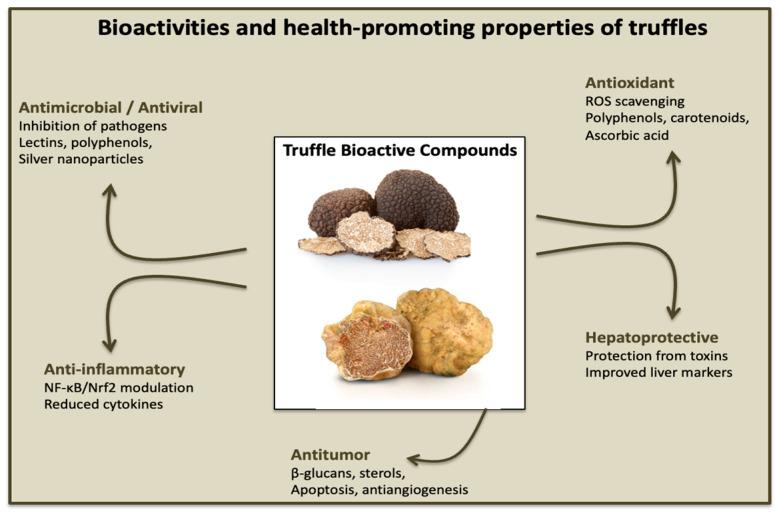
Truffles are edible symbiotic hypogeal fungi and highly prized worldwide for their unique aroma and rich nutritional profile. Belonging to the order Pezizales and family Tuberaceae, with the genus Tuber being the most notable, truffles contain a diverse array of bioactive compounds including phenols, terpenoids, polysaccharides, anandamide, fatty acids, and ergosterols. These compounds contribute to a wide range of biological activities such as antioxidant, antibacterial, anti-inflammatory, hepatoprotective, and anticancer effects. This review comprehensively summarizes current scientific evidence on the biochemical composition, nutritional and aromatic properties, and biological activities of truffles, with special emphasis on their antioxidant and anti-tumor potential. Additionally, factors influencing truffle productivity and quality as well as advanced extraction and storage techniques to preserve bioactivity are discussed, highlighting their potential as valuable functional foods and sources of natural antioxidants.
Overview
CoChat Summary
TL;DR
This review summarizes the biochemical composition, bioactive compounds, antioxidant/antitumor potential, and extraction/preservation strategies for truffles. It concludes that truffles are promising functional-food and nutraceutical sources, but most evidence remains in vitro or preclinical, with scarce clinical validation.
Key findings
- Truffles contain diverse bioactive compounds—phenols, terpenoids, polysaccharides, anandamide, fatty acids, and ergosterols—linked to antioxidant, antibacterial, anti-inflammatory, hepatoprotective, and anticancer activities. On a dry-weight basis, carbohydrates range from 37% to 80%, proteins from 11% to 35%, fats from 2% to 7%, and fibers from 4% to 13%.
- Antioxidant and antitumor data include *Terfezia boudieri* DPPH scavenging with IC50 = 0.031 mg/mL; *Tirmania nivea* from Iran showing highest DPPH scavenging (30.6 ± 13%), NO radical EC50 = 102 mg/mL, and 91% inhibition of deoxyribose degradation; and truffle polysaccharides showing cytotoxicity against HepG2, A549, HCT-116, SK-BR-3, and HL-60 cell lines.
- Advanced extraction methods such as ultrasound-assisted extraction, pressurized liquid extraction, supercritical CO2, and microwave-assisted extraction improve yields and preserve bioactivity; PLE with water/ethanol yielded 64%/22.5% extract containing 9.1% β-glucan and 4.5% ergosterol, while NADES + UAE increased polysaccharide yield up to 11.5 times versus conventional solvents.
- Preservation strategies include lyophilisation, modified atmosphere packaging, encapsulation with β- or γ-cyclodextrin, edible coatings, gamma irradiation up to 2.5 kGy, and high-pressure processing, though processing can reduce antioxidant capacity and alter aroma.
Methods
- Design: comprehensive narrative review of current scientific evidence on truffle biochemical composition, nutritional/aromatic properties, biological activities, and extraction/preservation techniques.
- Literature search: PubMed search combining keywords such as “truffle,” “bioactive compounds,” “antioxidant activity,” “anticancer and antioxidant activities,” “nutritional values,” and “extraction technique,” covering January 2000 to July 2024; only peer-reviewed English articles were considered.
- Inclusion/exclusion: studies on *Tuber*, *Terfezia*, *Tirmania*, and *Picoa* were included; conference abstracts without full text, non-peer-reviewed materials, studies not directly investigating truffle biochemical composition or biological activity, and duplicates were excluded. Main analysis is qualitative synthesis, with comparative tables.
Limitations
- Stated: most studies are limited to in vitro assays or preclinical models, while clinical trials and in-depth in vivo studies remain scarce; truffle bioactivity varies by species, geographic origin, ripeness, and extraction method, requiring standardization of analytical and extraction procedures.
- Stated: stability of bioactive compounds during processing and storage must be optimized to preserve functional properties.
- Evident from the text: although the review describes a PubMed search strategy, it does not report a systematic review protocol, risk-of-bias assessment, or quantitative meta-analysis, so findings are synthesized narratively and may be subject to selection or reporting bias.
Model-written summary. Check it against the paper before relying on it.
Integrity signals
Registry
Cites
Statistics
Figures
Verification
Claims the paper makes
0 Valid · 9 Not valid · 209 Not checked · 26 Own results and interpretations
In the paper
“Furthermore, more recent studies have begun to highlight the anticancer and immunomodulatory potential of specific extracts or polysaccharide fractions [3].”
§ Bioactive Compounds and Antioxidant Potential of Truffles: A Comprehensive Review > 1. Introduction
What the sources say
- Not checked yetcites [3] Lee H. Nam K. Zahra Z. Farooqi M.Q.U. Potentials of Truffles in Nutritional and Medicinal Applications: A Review Fungal Biol. Biotechnol. 2020 7 9 10.1186/s40694-020-00097-x 32566240 PMC7301458 source
plainstates an association- Asserted: passes — The authors put it forward as true.
- Checkable: passes — It can be checked against evidence.
- Load-bearing: unclear — It is unclear whether the paper’s conclusions depend on it.
- Based: passes — The paper gives a reason why it holds.
The paper states this without a source or data behind it here, so there is nothing to check it against. The quote shows it is in the paper.
In the paper
“Numerous experimental studies have demonstrated that these molecules possess antioxidant, anti-inflammatory, antimicrobial, antiviral, and hepatoprotective properties.”
§ Bioactive Compounds and Antioxidant Potential of Truffles: A Comprehensive Review > 1. Introduction
boostedstates a cause- Asserted: passes — The authors put it forward as true.
- Checkable: passes — It can be checked against evidence.
- Load-bearing: passes — The paper’s conclusions depend on it.
- Based: unclear — It is unclear why the paper says it holds.
The paper states this without a source or data behind it here, so there is nothing to check it against. The quote shows it is in the paper.
In the paper
“Truffles are edible symbiotic hypogeal fungi and highly prized worldwide for their unique aroma and rich nutritional profile. Belonging to the order Pezizales and family Tuberaceae, with the genus Tuber being the most notable, truffles contain a diverse array of bioactive compounds including phenols, terpenoids, polysaccharides, anandamide, fatty acids, and ergosterols.”
§ Bioactive Compounds and Antioxidant Potential of Truffles: A Comprehensive Review > Abstract
plain- Asserted: passes — The authors put it forward as true.
- Checkable: passes — It can be checked against evidence.
- Load-bearing: passes — The paper’s conclusions depend on it.
- Based: unclear — It is unclear why the paper says it holds.
In the paper
“At the same time, technological research has developed innovative extraction and preservation methods (such as ultrasound-assisted extraction, supercritical fluids, and encapsulation) aimed at preserving the stability of bioactive compounds and expanding their potential industrial applications [4].”
§ Bioactive Compounds and Antioxidant Potential of Truffles: A Comprehensive Review > 1. Introduction
What the sources say
- Not checked yetcites [4] Phong W.N. Gibberd M.R. Payne A.D. Dykes G.A. Coorey R. Methods Used for Extraction of Plant Volatiles Have Potential to Preserve Truffle Aroma: A Review Comp. Rev. Food Sci. Food Safe 2022 21 1677 1701 10.1111/1541-4337.12927 35179824 source
plainstates a cause- Asserted: passes — The authors put it forward as true.
- Checkable: passes — It can be checked against evidence.
- Load-bearing: passes — The paper’s conclusions depend on it.
- Based: passes — The paper gives a reason why it holds.
In the paper
“The total fat content of truffles varies between species and geographic origin, typically ranging from 1.8% to 7.4% on dry weight basis [5].”
§ Bioactive Compounds and Antioxidant Potential of Truffles: A Comprehensive Review > 2. Chemical Composition of Truffles > 2.2. Lipids: Fatty Acids and Ergosterols
What the sources say
- Not checked yetcites [5] Sawaya W.N. Al-Shalhat A. Al-Sogair A. Al-Mohammad M. Chemical Composition and Nutritive Value of Truffles of Saudi Arabia J. Food Sci. 1985 50 450 453 10.1111/j.1365-2621.1985.tb13425.x source
plainstates an association- Asserted: passes — The authors put it forward as true.
- Checkable: passes — It can be checked against evidence.
- Load-bearing: unclear — It is unclear whether the paper’s conclusions depend on it.
- Based: passes — The paper gives a reason why it holds.
103 more claims
Create a free account to see all 244 claims and to verify the 259 references still open.
- Probably not a substantial claim. 20
- It may state two separate claims as one. 122
Self-check
Percentages, sums and reported differences re-computed from the paper’s own numbers.
Each contradiction between two passages listed here was confirmed by an independent check.
Rated minor: it would not touch a result — a value no result rests on, a p-value that stays on the same side of the significance level, or a conflict that is clerical, resolved elsewhere in the paper, or outside its own findings.
In the paper
§ Bioactive Compounds and Antioxidant Potential of Truffles: A Comprehensive Review > 4. Biological Properties of Truffles > 4.1. Antiviral, Antibacterial and Antimicrobial Effects
“Casarica et al. demonstrated that the aqueous extract of Terfezia claveryi was active against Escherichia coli, Staphylococcus epidermidis, and Staphylococcus aureus, suggesting its potential therapeutic use in ocular infections [56].”
§ Bioactive Compounds and Antioxidant Potential of Truffles: A Comprehensive Review > References
“56. Nadhim Owaid M. Biosynthesis of Silver Nanoparticles from Truffles and Mushrooms and Their Applications as Nanodrugs Curr. Appl. Sci. Technol. 2021 22 10-55003 10.55003/cast.2022.05.22.009”
Rated minor: it would not touch a result — a value no result rests on, a p-value that stays on the same side of the significance level, or a conflict that is clerical, resolved elsewhere in the paper, or outside its own findings.
In the paper
§ Bioactive Compounds and Antioxidant Potential of Truffles: A Comprehensive Review > 1. Introduction > Literature Search Strategy
“The search covered publications from January 2000 to July 2024.”
§ Bioactive Compounds and Antioxidant Potential of Truffles: A Comprehensive Review > References
“43. Fan M. Li M. Ma Y. Wang T. Cai S. Du M. Sun D. Devahastin S. Yi J. Identification of Novel Umami Peptides from Truffle and Their Effects on Umami Perception When Used in Combination with MSG or IMP Curr. Res. Food Sci. 2025 11 101177 10.1016/j.crfs.2025.101177 40969200 PMC12441717”
Rated minor: it would not touch a result — a value no result rests on, a p-value that stays on the same side of the significance level, or a conflict that is clerical, resolved elsewhere in the paper, or outside its own findings.
In the paper
§ Bioactive Compounds and Antioxidant Potential of Truffles: A Comprehensive Review > 4. Biological Properties of Truffles > 4.1. Antiviral, Antibacterial and Antimicrobial Effects
“Tuber pinoyi has also shown significant activity: DibBellahouel and Fortas attributed the antimicrobial effect of its ethyl acetate extract to the presence of pyrazines and derivatives [58], while Stojković et al. documented that aqueous and methanolic extracts were able to limit the proliferation of Staphylococcus aureus in chicken broth stored both at room temperature and refrigerated [59] (Table 2).”
§ Bioactive Compounds and Antioxidant Potential of Truffles: A Comprehensive Review > References
“58. Dib Bellahouel S. Fortas Z. Antibacterial Activity of Various Fractions of Ethyl Acetate Extract from the Desert Truffle, Tirmania Pinoyi, Preliminarily Analyzed by Gas Chromatography-Mass Spectrometry (GC-MS) Afr. J. Biotechnol. 2011 10 9694 9699 10.5897/AJB10.2687”
Rated minor: it would not touch a result — a value no result rests on, a p-value that stays on the same side of the significance level, or a conflict that is clerical, resolved elsewhere in the paper, or outside its own findings.
In the paper
§ Bioactive Compounds and Antioxidant Potential of Truffles: A Comprehensive Review > 4. Biological Properties of Truffles > 4.1. Antiviral, Antibacterial and Antimicrobial Effects
“In addition, Tuber nivea, widespread in the arid regions of Tunisia, showed a broad antimicrobial spectrum, active against three Gram-positive and four Gram-negative bacteria, including Salmonella typhimurium, Escherichia coli, Pseudomonas aeruginosa, Enterococcus faecalis, Staphylococcus aureus, Staphylococcus epidermidis, and Bacillus subtilis [57].”
§ Bioactive Compounds and Antioxidant Potential of Truffles: A Comprehensive Review > References
“57. Hamza A. Jdir H. Nutritional, Antioxidant and Antibacterial Properties of Tirmania Nivea, A Wild Edible Desert Truffle from Tunisia Arid Zone Med. Aromat. Plants 2016 5 2167-0412 10.4172/2167-0412.1000258”
Rated minor: it would not touch a result — a value no result rests on, a p-value that stays on the same side of the significance level, or a conflict that is clerical, resolved elsewhere in the paper, or outside its own findings.
In the paper
§ Bioactive Compounds and Antioxidant Potential of Truffles: A Comprehensive Review > 1. Introduction > Literature Search Strategy
“The search covered publications from January 2000 to July 2024.”
§ Bioactive Compounds and Antioxidant Potential of Truffles: A Comprehensive Review > References
“5. Sawaya W.N. Al-Shalhat A. Al-Sogair A. Al-Mohammad M. Chemical Composition and Nutritive Value of Truffles of Saudi Arabia J. Food Sci. 1985 50 450 453 10.1111/j.1365-2621.1985.tb13425.x”
Citations
Cites
Bioactive compounds in foods: their role in the prevention of cardiovascular disease and cancer
Kris-Etherton, P. M., Hecker, K. D., Bonanome, A., Coval, S. M., Binkoski, A. E., Hilpert, K. F., Griel, A. E., & Etherton, T. D. (2002) · The American Journal of Medicine · doi:10.1016/s0002-9343(01)00995-0 · Cited by 2,546
Extraction of phenolic compounds: A review
Alara, O. R., Abdurahman, N. H., & Ukaegbu, C. I. (2021) · Current Research in Food Science · doi:10.1016/j.crfs.2021.03.011 · Cited by 1,209
Frey-Klett, P., Burlinson, P., Deveau, A., Barret, M., Tarkka, M., & Sarniguet, A. (2011) · Microbiology and Molecular Biology Reviews · doi:10.1128/mmbr.00020-11 · Cited by 913
Barros, L., Ferreira, M.-J., Queirós, B., Ferreira, I. C. F. R., & Baptista, P. (2007) · Food Chemistry · doi:10.1016/j.foodchem.2006.07.038 · Cited by 586
Diabetes and the Brain: Oxidative Stress, Inflammation, and Autophagy
Muriach, M., Flores-Bellver, M., Romero, F. J., & Barcia, J. M. (2014) · Oxidative Medicine and Cellular Longevity · doi:10.1155/2014/102158 · Cited by 482
Advances in Lipid Extraction Methods—A Review
Saini, R. K., Prasad, P., Shang, X., & Keum, Y.-S. (2021) · International Journal of Molecular Sciences · doi:10.3390/ijms222413643 · Cited by 479
Recent developments in mushrooms as anti-cancer therapeutics: a review
Patel, S., & Goyal, A. (2012) · 3 Biotech · doi:10.1007/s13205-011-0036-2 · Cited by 462
Antitumor activity of mushroom polysaccharides: a review
Ren, L., Perera, C., & Hemar, Y. (2012) · Food & Function · doi:10.1039/c2fo10279j · Cited by 429
Encapsulation of Bioactive Compounds for Food and Agricultural Applications
Zabot, G. L., Schaefer Rodrigues, F., Polano Ody, L., Vinícius Tres, M., Herrera, E., Palacin, H., Córdova-Ramos, J. S., Best, I., & Olivera-Montenegro, L. (2022) · Polymers · doi:10.3390/polym14194194 · Cited by 397
DUBOST, N., OU, B., & BEELMAN, R. (2007) · Food Chemistry · doi:10.1016/j.foodchem.2007.01.030 · Cited by 365
Research works printed but not linked: 2
- Casarica A. Moscovici M. Daas M. Nicu I. Panteli M. Rasit I. A Purified Extract from Brown Truffles of The Species Terfezia claveryi Chatin And Its Antimicrobial Activity Farmacia 2016 64 298 301
- Althobaiti N.A. Alhasani N.H. BinMowyna M.N. Albalawi A.E. Alsharif I. Terfezia Claveryi Chatin: Anti-Tumor Effects against Ehrlich Solid Tumor in Mice Pharmacogn. Mag. 2022 18 651 658
Cited by
Phenolic-Rich Wild Edible Macrofungi: Antimicrobial Activity and Antioxidant Potential
Ildız, E., & Canpolat, E. Y. (2026) · Molecules · doi:10.3390/molecules31060978 · Cited by 5
Diamantis, I., Vasilakis, G., Papanikolaou, S., Stoforos, N. G., & Diamantopoulou, P. A. (2026) · Clean Technologies · doi:10.3390/cleantechnol8020033 · Cited by 2
Alotaibi, M., Al‐Quraishy, S., Almohawis, N., Santourlidis, S., Al‐Shaebi, E. M., & Abdel‐Gaber, R. (2026) · Frontiers in Cellular and Infection Microbiology · doi:10.3389/fcimb.2026.1774323 · Cited by 1
Carinci, E., Castelli, S., Vitiello, L., Pennesi, A., Amicucci, A., Zambonelli, A., Ciriolo, M. R., Stocchi, V., & Baldelli, S. (2025) · Metabolites · doi:10.3390/metabo15120796 · Cited by 1
Self-citationGhanney, N., Yahia, L. B., Hlel, H., Lachiheb, B., Bouhamda, T., Fakhfakh, N., & Nagaz, K. (2026) · Frontiers in Pharmacology · doi:10.3389/fphar.2026.1816928 · Cited by 1
Metadata
- Authors
- Baldelli, S., Aiello, G., De Bruno, A., Castelli, S., Lombardo, M., Stocchi, V., & Tripodi, G.
- Affiliations
- San Raffaele University of Rome (IT)
- Department for the Promotion of Human Science and Quality of Life, San Raffaele Open University, Via di Val Cannuta, 247, 00166 Rome, Italy
- Corresponding author
- Baldelli, Sara
- Aiello, Gilda
- ORCID
- Venue
- Antioxidants
- Publisher
- MDPI AG
- Published
- 2025-11-07
- Volume
- 14
- Issue
- 11
- Pages
- 1341
- ISSN
- 2076-3921 (ISSN-L)
- PMC
- PMC12649337
- OpenAlex
- W4415988577
- Cited by
- 15
- References
- 134
- Citations by year
- 2026: 14 · 2025: 1
- FWCI
- 1.29
- Type
- journal article
- Language
- en
- Open access
- gold
- doi.org
- Licence
- Locations
- Antioxidants (publishedVersion, cc-by)
- PubMed Central (publishedVersion, cc-by)
- PubMed (publishedVersion)
- DOAJ (DOAJ: Directory of Open Access Journals) (submittedVersion)
- Funders
- Prin 2022 (2022K272X8)
- Topics
- Health Sciences › Medicine › Pharmacology (medical) › Fungal Biology and Applications
- Life Sciences › Agricultural and Biological Sciences › Plant Science › Garlic and Onion Studies
- Life Sciences › Agricultural and Biological Sciences › Plant Science › Mycorrhizal Fungi and Plant Interactions
- Keywords
- truffles, tubers, bioactive compounds, antioxidant activity, phenolic compounds, terpenoids, polysaccharides, anandamide, ergosterol, antibacterial activity, anti-inflammatory activity, hepatoprotection, anticancer activity, functional foods, natural antioxidants, truffle aroma
About these checks
Registry, retraction, Cites and statistics results are computed, not judged, with one exception: a printed reference that no index lists is read once by a model before it counts as a citation error. Claims are extracted by a model and kept only when their quote appears verbatim in the text; each cited source is then checked, with a model’s help, for whether it says what the claim relies on. Those verdicts can be wrong — read the claim’s quote and the cited source before relying on one.
A language model drew the claims from the paper on 2026-11-24, under version 3 of the claim definition (model deepseek-v4.1-flash, prompt extract-v3).
A second model labelled each claim on 2026-11-24 (model jev-1.13-20260917, definition revision gold-guideline-v0.2).
Statistics and arithmetic are recomputed, not judged.
Confidence bands are shown only for fields calibrated on our annotated test set. None is calibrated yet, so no band is shown.
What counts as a claim ›How we measure confidence ›How we check this ›
Are you an author, or do you see a problem with this page? Request a review
Data sources
Bibliographic data: Semantic Scholar, OpenAlex, Crossref.
Contains information from the Semantic Scholar Academic Graph Datasets, made available under the ODC Attribution License (ODC-BY 1.0).
Semantic Scholar’s data is described in: Kinney, R., et al. (2023). The Semantic Scholar Open Data Platform. arXiv:2301.10140.
