

The DOI matches its Crossref record; 45 of the 45 references it cites were found in a registry or an index; 2 of the 16 sources its claims cite were checked for support.
Low-Cost Biochar Adsorbents for Water Purification Including Microplastics Removal
Open accessAbstract
The applicability of steam activated pine and spruce bark biochar for storm water and wastewater purification has been investigated. Biochar samples produced from the bark of scots pine (Pinus sylvestrus) and spruce (Picea spp.) by conventional slow pyrolysis at 475 °C were steam activated at 800 °C. Steam activation was selected as a relatively inexpensive method for creating porous biochar adsorbents from the bark-containing sidestreams of the wood refining industry. A suite of standard analytical procedures were carried out to quantify the performance of the activated biochar in removing both cations and residual organics from aqueous media. Phenol and microplastics retention and cation exchange capacity were employed as key test parameters. Despite relatively low surface areas (200–600 m2/g), the steam-activated biochars were highly suitable adsorbents for the chemical species tested as well as for microplastics removal. The results indicate that ultra-high porosities are not necessary for satisfactory water purification, supporting the economic feasibility of bio-based adsorbent production.
Overview
AI snapshot
Written from the paper’s full text.
TL;DR
Steam-activated biochars from pine and spruce bark, despite modest surface areas (200–600 m²/g), removed phenol, cations, and larger microplastics effectively, showing ultrahigh porosity is not necessary. Pine bark AC performed best for phenol and CEC, while spruce bark AC with broader pores retained more 10-µm microbeads.
Key findings
- Steam-activated biochars had surface areas of 187–603 m²/g; pine bark AC activated with 30% steam and high gas flow had 603 m²/g and the maximum phenol adsorption capacity of 169 mg/g, comparable to much higher-surface-area activated carbons.
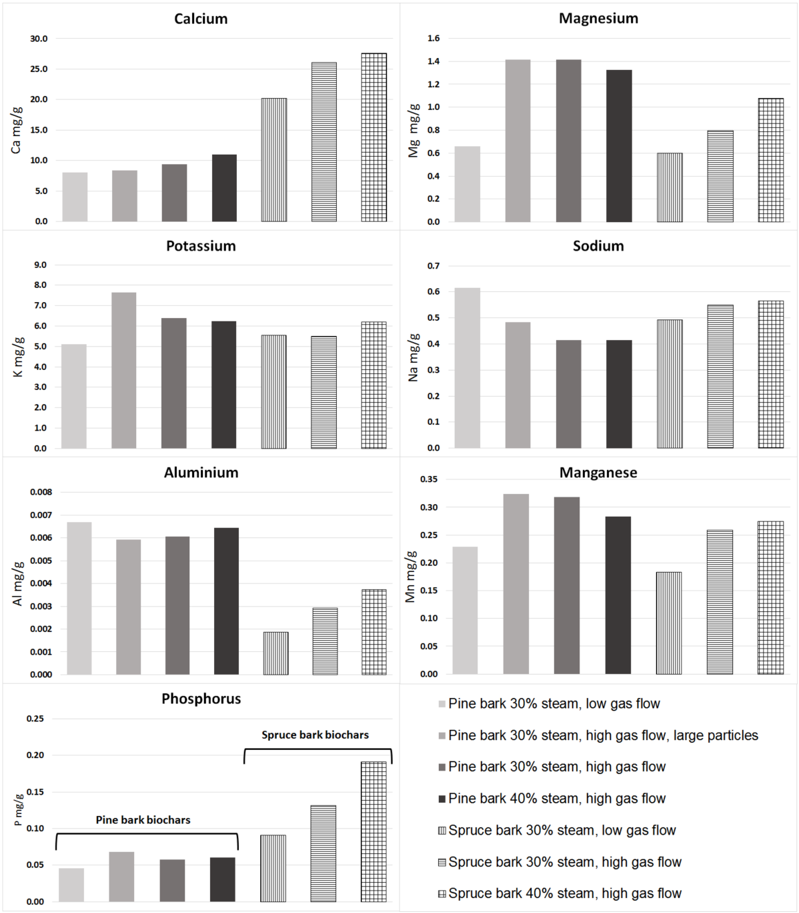
- CEC was greater for pine bark ACs (16–24 mmol/kg) than spruce bark ACs (9–11 mmol/kg); spruce ACs had higher ash (12–15 wt-% vs. 5–6 wt-% for pine AC) and more exchangeable Ca.
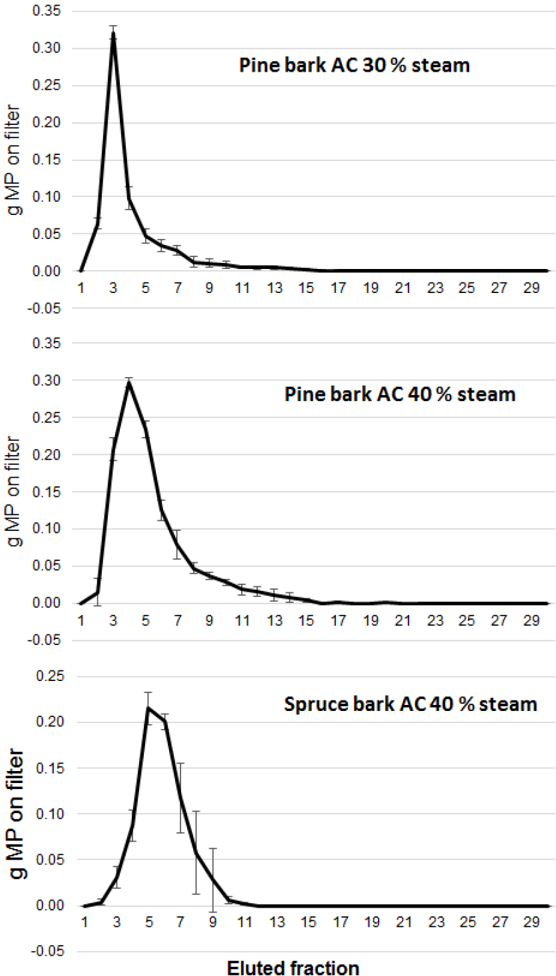
- Microplastics retention was 100% for larger PE particles and nearly 100% for fleece fibers (only 1–4 fibers detected after elution), with no differences among tested ACs; 10-µm spherical microbead retention was weaker, and retained MP material ranged from 0.130 ± 0.040 g to 0.293 ± 0.046 g depending on AC.
- Surface areas of 400–600 m²/g were adequate for efficient removal of tested contaminants from storm and wastewater, supporting economic feasibility of steam-activated biochar.
Methods
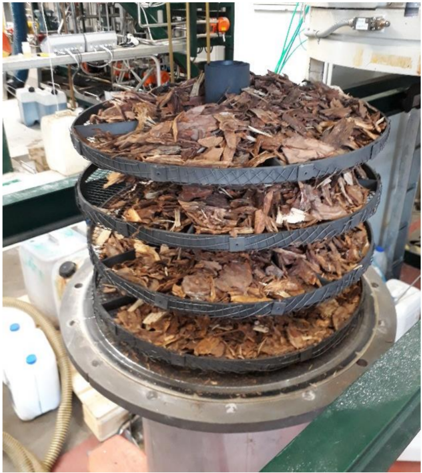
- Pine and spruce bark biochars were produced by slow pyrolysis at 475 °C for 3 h, then steam activated at 800 °C for 3.5 h using 30% or 40% steam and low or high N₂ gas flow; particle size fractions were also compared.
- Characterization included elemental analysis, ash content, BET surface area and DFT pore size distribution; batch phenol adsorption used 0.1 g sorbent in 15 mL phenol solution (100–2000 mg/L) for 24 h with spectrophotometric analysis at 271 nm; CEC and exchangeable cations were measured by NH₄OAc/KCl extraction.
- Microplastics column tests used 20 g activated biochar, washed with 5 L tap water, then eluted with 30 fractions of 50 mL tap water; MP types were 2 g spherical PE microbeads (10 µm), 2 g cylindrical PE pieces (2–3 mm), and 2 g fleece shirt fibers, each in triplicate.
Limitations
- The paper states that raw materials were inhomogeneous (contained some stem wood), spruce bark’s high ash may have caused pore blockage, the microplastics sorption mechanism remains unknown, and further research is needed on recovery of micrometer-scale MP and on economic feasibility of different sidestreams.
- Evident from the text: phenol tests for biochars were single determinations (ACs were duplicated), CEC was determined only for selected activated biochars, and MP tests used tap water and specific synthetic particles, limiting generalization.
Model-written summary. Check it against the paper before relying on it.
Integrity signals
Registry
Cites
Statistics
Figures
Verification
Claims the paper makes
25 Own result · 22 Own interpretation · 16 No basis given · 11 No full text of the sources · 3 Own method · 2 Partly supported · 1 Not checked yet · accuracy not yet measured
The cited sources support only part of this claim — read each source’s verdict below.
In the paper
“The sharp rise of the pine bark curves (Figure4) indicates a lesser quantity of competing ions for the adsorption sites[30]”
§ Low-Cost Biochar Adsorbents for Water Purification Including Microplastics Removal > 5. Conclusions
What the sources say
- Partly supportedcites [30] 2017, Single and competitive adsorption of Cd(II) and Pb(II) ions from aqueous solutions onto industrial chili seeds (Capsicum annuum) waste, Sustain. Environ. Res. sourceExperimental — accuracy not yet measured
Section 3.6 reports that Cd(II) and Pb(II) compete for the same adsorption sites on chili seeds. It does not examine pine bark curves or establish that a sharp rise indicates fewer competing ions, so the specific interpretation attributed to it is unsupported. (LLM, conf=0.78)
hedgeddirect- Asserted: passes — The authors put it forward as true.
- Checkable: passes — It can be checked against evidence.
- Load-bearing: unclear — It is unclear whether the paper’s conclusions depend on it.
- Based: passes — The paper gives a reason why it holds.
- Partly supported
The paper states this without a source or data behind it here, so there is nothing to check it against. The quote shows it is in the paper.
In the paper
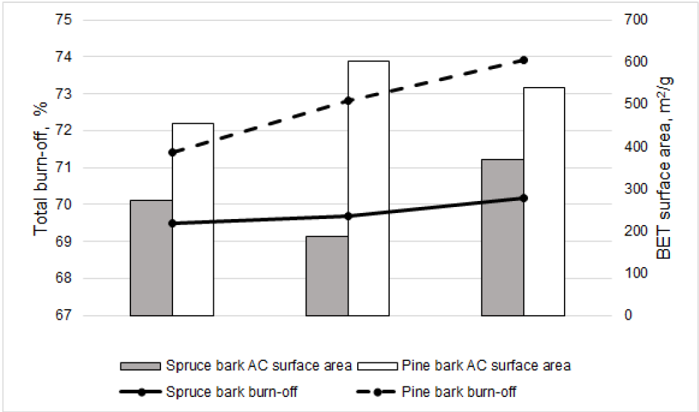
“The surface areas of the spruce bark ACs were considerably lesser than those of pine bark ACs.”
§ Low-Cost Biochar Adsorbents for Water Purification Including Microplastics Removal > 3.1. Yields, Surface Areas, and Porosities
plain- Asserted: passes — The authors put it forward as true.
- Checkable: passes — It can be checked against evidence.
- Load-bearing: unclear — It is unclear whether the paper’s conclusions depend on it.
- Based: passes — The paper gives a reason why it holds.
The paper states this without a source or data behind it here, so there is nothing to check it against. The quote shows it is in the paper.
In the paper
“The biochar particle size before activation did not significantly affect the surface area and porosity.”
§ Low-Cost Biochar Adsorbents for Water Purification Including Microplastics Removal > 4.1. Raw Material Selection and Particle Size
plain- Asserted: passes — The authors put it forward as true.
- Checkable: passes — It can be checked against evidence.
- Load-bearing: passes — The paper’s conclusions depend on it.
- Based: passes — The paper gives a reason why it holds.
A result the paper reports from its own data — it cites no other source for it, so there is none to check. The quote shows it is in the paper.
In the paper
“The ash content of spruce biochars and ACs were much greater than ash contents of pine bark carbons.”
§ Low-Cost Biochar Adsorbents for Water Purification Including Microplastics Removal > 3.2. Elemental Composition and Ash
plaincorrelational- Asserted: passes — The authors put it forward as true.
- Checkable: passes — It can be checked against evidence.
- Load-bearing: unclear — It is unclear whether the paper’s conclusions depend on it.
- Based: passes — The paper gives a reason why it holds.
A result the paper reports from its own data — it cites no other source for it, so there is none to check. The quote shows it is in the paper.
In the paper
“The 30 and 40% steam-activated pine biochars exhibited weaker retention of spherical microbead MPs compared to the spruce bark AC and the majority of the spherical microbead MPs eluted rapidly within the first 2-14 fractions.”
§ Low-Cost Biochar Adsorbents for Water Purification Including Microplastics Removal > 3.3.3. Microplastics Retention
plaincorrelational- Asserted: passes — The authors put it forward as true.
- Checkable: passes — It can be checked against evidence.
- Load-bearing: passes — The paper’s conclusions depend on it.
- Based: passes — The paper gives a reason why it holds.
A result the paper reports from its own data — it cites no other source for it, so there is none to check. The quote shows it is in the paper.
In the paper
“The obtained maximum adsorption capacity for pine bark AC (169 mg/g, Table 5) is comparable to capacities found in the literature for much higher surface area ACs (Table 7).”
§ Low-Cost Biochar Adsorbents for Water Purification Including Microplastics Removal > 4.2. Adsorption Capacities of Chemical Compounds
plain- Asserted: passes — The authors put it forward as true.
- Checkable: passes — It can be checked against evidence.
- Load-bearing: passes — The paper’s conclusions depend on it.
- Based: passes — The paper gives a reason why it holds.
A result the paper reports from its own data — it cites no other source for it, so there is none to check. The quote shows it is in the paper.
In the paper
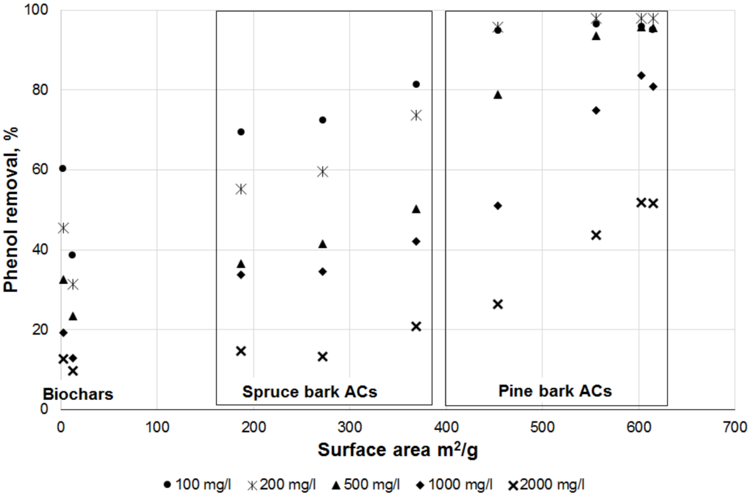
“The adsorption capacity increased with both raw materials as a function of surface area (Figure 3).”
§ Low-Cost Biochar Adsorbents for Water Purification Including Microplastics Removal > 3.3.1. Removal of Organic Contaminants
plaindirect- Asserted: passes — The authors put it forward as true.
- Checkable: passes — It can be checked against evidence.
- Load-bearing: unclear — It is unclear whether the paper’s conclusions depend on it.
- Based: passes — The paper gives a reason why it holds.
- Rests on an assumption: Phenol adsorption is an indicator of organic contaminant removal.
A result the paper reports from its own data — it cites no other source for it, so there is none to check. The quote shows it is in the paper.
In the paper
“All tested ACs had excellent retention performance for the larger MPs tested.”
§ Low-Cost Biochar Adsorbents for Water Purification Including Microplastics Removal > 3.3.3. Microplastics Retention
plain- Asserted: passes — The authors put it forward as true.
- Checkable: passes — It can be checked against evidence.
- Load-bearing: passes — The paper’s conclusions depend on it.
- Based: passes — The paper gives a reason why it holds.
A result the paper reports from its own data — it cites no other source for it, so there is none to check. The quote shows it is in the paper.
In the paper
“Raising the steam proportion to 40% did not induce higher surface area for pine bark biochar despite the larger activation burn-off.”
§ Low-Cost Biochar Adsorbents for Water Purification Including Microplastics Removal > 3.1. Yields, Surface Areas, and Porosities
plain- Asserted: passes — The authors put it forward as true.
- Checkable: passes — It can be checked against evidence.
- Load-bearing: unclear — It is unclear whether the paper’s conclusions depend on it.
- Based: passes — The paper gives a reason why it holds.
A result the paper reports from its own data — it cites no other source for it, so there is none to check. The quote shows it is in the paper.
In the paper
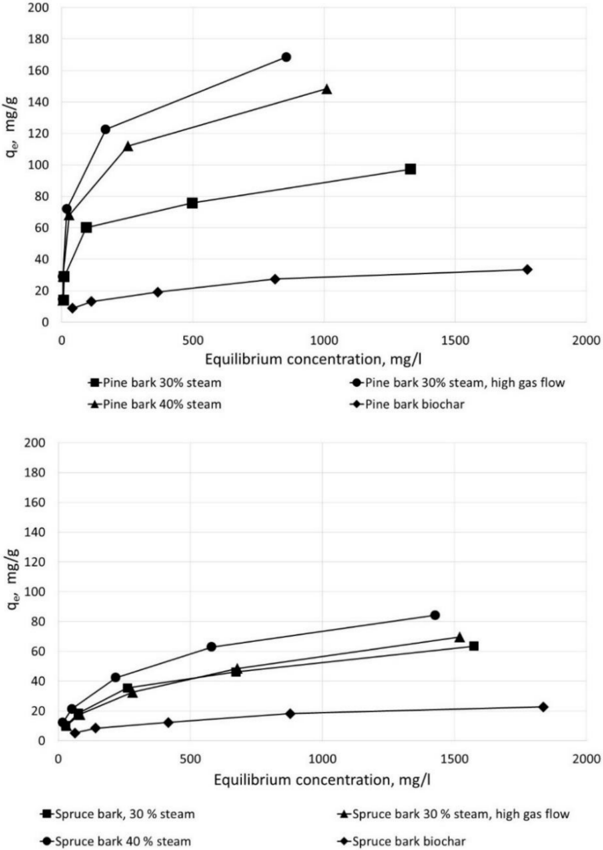
“The quantity of adsorbed phenol increased with solution concentration for both bark ACs”
§ Low-Cost Biochar Adsorbents for Water Purification Including Microplastics Removal > 5. Conclusions
plaindirect- Asserted: passes — The authors put it forward as true.
- Checkable: passes — It can be checked against evidence.
- Load-bearing: passes — The paper’s conclusions depend on it.
- Based: passes — The paper gives a reason why it holds.
- It may state two separate claims as one. 26
- Probably not a substantial claim. 11
- The quote only partly states this claim. 1
The cited sources support only part of this claim — read each source’s verdict below.
In the paper
“Lower pH is, therefore, more favorable for phenol adsorption and respectively, in some cases removal of ash using an acid wash may be necessary [18,39].”
§ Low-Cost Biochar Adsorbents for Water Purification Including Microplastics Removal > 4.2. Adsorption Capacities of Chemical Compounds
What the sources say
- Partly supportedcites [18] Smets, K., De Jong, M., Lupul, I., Gryglewicz, G., Schreurs, S., Carleer, R., and Yperman, J. (2016). Rapeseed and raspberry seed cakes as inexpensive raw materials in the production of activated carbon by physical activation: Effect of activation conditions on textural and phenol adsorption characteristics. Materials (Basel), 9. sourceExperimental — accuracy not yet measured
Section 3.3.1 finds that phenol removal decreases above about pH 9, but is largely unchanged at lower pH; it does not support a general claim that progressively lower pH is more favorable. Sections 2.2 and 3.1 support acid washing in some cases: the authors washed high-ash rapeseed-derived carbon with HCl and found better phenol adsorption than in untreated samples. (LLM, conf=0.88)
- Not checked — no full text of the sourcecites [39] Beker, 2010, Adsorption of phenol by activated carbon: Influence of activation methods and solution pH, Energy Convers. Manag. source
hedgedconditional- Asserted: passes — The authors put it forward as true.
- Checkable: passes — It can be checked against evidence.
- Load-bearing: passes — The paper’s conclusions depend on it.
- Based: passes — The paper gives a reason why it holds.
It may state two separate claims as one.
- Partly supported
A result the paper reports from its own data — it cites no other source for it, so there is none to check. The quote shows it is in the paper.
In the paper
“The surface areas of the activated biochars increased as a function of the burn-off, however the results were also influenced by pore formation.”
§ Low-Cost Biochar Adsorbents for Water Purification Including Microplastics Removal > 3.1. Yields, Surface Areas, and Porosities
plaindirect- Asserted: passes — The authors put it forward as true.
- Checkable: passes — It can be checked against evidence.
- Load-bearing: unclear — It is unclear whether the paper’s conclusions depend on it.
- Based: passes — The paper gives a reason why it holds.
It may state two separate claims as one.
The paper states this without a source or data behind it here, so there is nothing to check it against. The quote shows it is in the paper.
In the paper
“The CECs, corresponding to the relative quantities of charged surface sites, are greater for pine bark ACs (16-24 mmol/kg for pine, 9-11 mmol/kg for spruce) as these ACs had a relatively larger surface area compared with spruce ACs and, therefore, more surface groups for cations adsorption.”
§ Low-Cost Biochar Adsorbents for Water Purification Including Microplastics Removal > 3.3.2. Cation Exchange Capacity (CEC)
plaindirect- Asserted: passes — The authors put it forward as true.
- Checkable: passes — It can be checked against evidence.
- Load-bearing: passes — The paper’s conclusions depend on it.
- Based: passes — The paper gives a reason why it holds.
It may state two separate claims as one.
- Rests on an assumption: Cation exchange capacity determination estimates inorganic contaminant removal capacity.
A result the paper reports from its own data — it cites no other source for it, so there is none to check. The quote shows it is in the paper.
In the paper
“Both bark materials produced microporous ACs, but differences were found in the larger pore sizes.”
§ Low-Cost Biochar Adsorbents for Water Purification Including Microplastics Removal > 4.1. Raw Material Selection and Particle Size
plaincorrelational- Asserted: passes — The authors put it forward as true.
- Checkable: passes — It can be checked against evidence.
- Load-bearing: unclear — It is unclear whether the paper’s conclusions depend on it.
- Based: passes — The paper gives a reason why it holds.
It may state two separate claims as one.
A result the paper reports from its own data — it cites no other source for it, so there is none to check. The quote shows it is in the paper.
In the paper
“The maximum phenol adsorption capacity obtained at the highest initial solution concentration was observed for pine bark activated with 30% steam and high gas flow, which also had the greatest surface area of the tested carbons (Figure 4, Table 5).”
§ Low-Cost Biochar Adsorbents for Water Purification Including Microplastics Removal > 3.3.1. Removal of Organic Contaminants
plaincorrelational- Asserted: passes — The authors put it forward as true.
- Checkable: passes — It can be checked against evidence.
- Load-bearing: unclear — It is unclear whether the paper’s conclusions depend on it.
- Based: passes — The paper gives a reason why it holds.
It may state two separate claims as one.
- Rests on an assumption: Phenol adsorption is an indicator of organic contaminant removal.
A result the paper reports from its own data — it cites no other source for it, so there is none to check. The quote shows it is in the paper.
In the paper
“The retention was 100% for the PE particles and nearly 100% for the fleece fibers, with only 1-4 fibers detected after elution.”
§ Low-Cost Biochar Adsorbents for Water Purification Including Microplastics Removal > 3.3.3. Microplastics Retention
plain- Asserted: passes — The authors put it forward as true.
- Checkable: passes — It can be checked against evidence.
- Load-bearing: passes — The paper’s conclusions depend on it.
- Based: passes — The paper gives a reason why it holds.
It may state two separate claims as one.
A result the paper reports from its own data — it cites no other source for it, so there is none to check. The quote shows it is in the paper.
In the paper
“Pine bark AC, 30% steam activation 0.165 ± 0.096 g Pine bark AC, 40% steam activation 0.130 ± 0.040 g Spruce bark AC, 40% steam activation 0.293 ± 0.046 g”
§ Low-Cost Biochar Adsorbents for Water Purification Including Microplastics Removal > Sample Retention
plain- Asserted: passes — The authors put it forward as true.
- Checkable: passes — It can be checked against evidence.
- Load-bearing: unclear — It is unclear whether the paper’s conclusions depend on it.
- Based: passes — The paper gives a reason why it holds.
It may state two separate claims as one.
A result the paper reports from its own data — it cites no other source for it, so there is none to check. The quote shows it is in the paper.
In the paper
“The 10-µm spherical microbead retention was not as efficient as for the larger particles, and some differences between the ACs could be detected (Figure 6).”
§ Low-Cost Biochar Adsorbents for Water Purification Including Microplastics Removal > 3.3.3. Microplastics Retention
hedged- Asserted: passes — The authors put it forward as true.
- Checkable: passes — It can be checked against evidence.
- Load-bearing: unclear — It is unclear whether the paper’s conclusions depend on it.
- Based: passes — The paper gives a reason why it holds.
It may state two separate claims as one.
A result the paper reports from its own data — it cites no other source for it, so there is none to check. The quote shows it is in the paper.
In the paper
“The surface area of pine bark biochar was most affected by increasing the gas flow rate, whereas greater amounts of steam yielded improved surface area results for spruce biochar.”
§ Low-Cost Biochar Adsorbents for Water Purification Including Microplastics Removal > 3.1. Yields, Surface Areas, and Porosities
plaindirect- Asserted: passes — The authors put it forward as true.
- Checkable: passes — It can be checked against evidence.
- Load-bearing: unclear — It is unclear whether the paper’s conclusions depend on it.
- Based: passes — The paper gives a reason why it holds.
It may state two separate claims as one.
A result the paper reports from its own data — it cites no other source for it, so there is none to check. The quote shows it is in the paper.
In the paper
“Spruce bark biochar had a higher amount of mesopores before activation, and the pores were enlarged during the activation into macropores.”
§ Low-Cost Biochar Adsorbents for Water Purification Including Microplastics Removal > 4.1. Raw Material Selection and Particle Size
plaindirect- Asserted: passes — The authors put it forward as true.
- Checkable: passes — It can be checked against evidence.
- Load-bearing: unclear — It is unclear whether the paper’s conclusions depend on it.
- Based: passes — The paper gives a reason why it holds.
It may state two separate claims as one.
The paper states this without a source or data behind it here, so there is nothing to check it against. The quote shows it is in the paper.
In the paper
“The spruce bark biomass was more fresh and moist compared to the pine bark, which had been stored in dry conditions for a longer time period.”
§ Low-Cost Biochar Adsorbents for Water Purification Including Microplastics Removal > 4.1. Raw Material Selection and Particle Size
plain- Asserted: passes — The authors put it forward as true.
- Checkable: passes — It can be checked against evidence.
- Load-bearing: fails — The paper’s conclusions may not depend on it.
- Based: fails — The paper may give no reason why it holds.
Probably not a substantial claim. The paper’s conclusions may not depend on it. The paper may give no reason why it holds. It may state two separate claims as one.
The paper states this without a source or data behind it here, so there is nothing to check it against. The quote shows it is in the paper.
In the paper
“Pine bark biochar did not increase in macropore volume due to activation, but mesoporosity increased by ten-fold.”
§ Low-Cost Biochar Adsorbents for Water Purification Including Microplastics Removal > 4.1. Raw Material Selection and Particle Size
plaindirect- Asserted: passes — The authors put it forward as true.
- Checkable: passes — It can be checked against evidence.
- Load-bearing: unclear — It is unclear whether the paper’s conclusions depend on it.
- Based: passes — The paper gives a reason why it holds.
It may state two separate claims as one.
The paper states this without a source or data behind it here, so there is nothing to check it against. The quote shows it is in the paper.
In the paper
“Pine bark activated using 30% steam and the higher rate of gas flow performed best in the phenol adsorption tests and had relatively greater CEC due to its larger surface area.”
§ Low-Cost Biochar Adsorbents for Water Purification Including Microplastics Removal > 5. Conclusions
plaindirect- Asserted: passes — The authors put it forward as true.
- Checkable: passes — It can be checked against evidence.
- Load-bearing: passes — The paper’s conclusions depend on it.
- Based: passes — The paper gives a reason why it holds.
It may state two separate claims as one.
The paper states this without a source or data behind it here, so there is nothing to check it against. The quote shows it is in the paper.
In the paper
“Both bark ACs had acceptable CECs for application in water treatment, with pine bark ACs performing slightly better because of their higher surface area.”
§ Low-Cost Biochar Adsorbents for Water Purification Including Microplastics Removal > 4.2. Adsorption Capacities of Chemical Compounds
plaindirect- Asserted: passes — The authors put it forward as true.
- Checkable: passes — It can be checked against evidence.
- Load-bearing: unclear — It is unclear whether the paper’s conclusions depend on it.
- Based: passes — The paper gives a reason why it holds.
It may state two separate claims as one.
A result the paper reports from its own data — it cites no other source for it, so there is none to check. The quote shows it is in the paper.
In the paper
“The maximum phenol adsorption capacity obtained at the highest initial solution concentration was observed for pine bark activated with 30% steam and high gas flow, which also had the greatest surface area of the tested carbons (Figure4, Table5).”
§ Low-Cost Biochar Adsorbents for Water Purification Including Microplastics Removal > 5. Conclusions
plaincorrelational- Asserted: passes — The authors put it forward as true.
- Checkable: passes — It can be checked against evidence.
- Load-bearing: passes — The paper’s conclusions depend on it.
- Based: passes — The paper gives a reason why it holds.
It may state two separate claims as one.
A result the paper reports from its own data — it cites no other source for it, so there is none to check. The quote shows it is in the paper.
In the paper
“The large particles were retained completely, but the micrometer-scale MP particles did not absorb as efficiently.”
§ Low-Cost Biochar Adsorbents for Water Purification Including Microplastics Removal > 4.3. Microplastics
plain- Asserted: passes — The authors put it forward as true.
- Checkable: passes — It can be checked against evidence.
- Load-bearing: passes — The paper’s conclusions depend on it.
- Based: passes — The paper gives a reason why it holds.
It may state two separate claims as one.
A result the paper reports from its own data — it cites no other source for it, so there is none to check. The quote shows it is in the paper.
In the paper
“The most efficient spruce bark AC removed about 20% of the phenol at the highest concentration tested (2000 mg/L) and 80% at the lowest concentration tested (100 mg/L).”
§ Low-Cost Biochar Adsorbents for Water Purification Including Microplastics Removal > 5. Conclusions
plaincorrelational- Asserted: passes — The authors put it forward as true.
- Checkable: passes — It can be checked against evidence.
- Load-bearing: passes — The paper’s conclusions depend on it.
- Based: passes — The paper gives a reason why it holds.
It may state two separate claims as one.
In the paper
“Surface area as high as 1361 m 2 /g has been achieved for crushed walnut shells (particle size 1-2 mm), for example, using steam activation at 850 • C and 60 min [35].”
§ Low-Cost Biochar Adsorbents for Water Purification Including Microplastics Removal > 4.1. Raw Material Selection and Particle Size
What the sources say
- Not checked — no full text of the sourcecites [35] Nabais, 2009, Porosity Development in Activated Carbons Prepared from Walnut Shells by Carbon Dioxide or Steam Activation, Ind. Eng. Chem. Res. source
plaindirect- Asserted: passes — The authors put it forward as true.
- Checkable: passes — It can be checked against evidence.
- Load-bearing: fails — The paper’s conclusions may not depend on it.
- Based: passes — The paper gives a reason why it holds.
Probably not a substantial claim. The paper’s conclusions may not depend on it.
What the paper did — it cites no source for this, so there is none to check. The quote shows it is in the paper.
In the paper
“Each experiment was performed in triplicate.”
§ Low-Cost Biochar Adsorbents for Water Purification Including Microplastics Removal > 2.4. Adsorption Tests
plain- Asserted: passes — The authors put it forward as true.
- Checkable: passes — It can be checked against evidence.
- Load-bearing: fails — The paper’s conclusions may not depend on it.
- Based: passes — The paper gives a reason why it holds.
Probably not a substantial claim. The paper’s conclusions may not depend on it. The quote only partly states this claim.
What the paper did — it cites no source for this, so there is none to check. The quote shows it is in the paper.
In the paper
“The standard deviations of the CEC measurements ranged from 0.3 to 1.1 mmol/kg.”
§ Low-Cost Biochar Adsorbents for Water Purification Including Microplastics Removal > 2.4. Adsorption Tests
plain- Asserted: passes — The authors put it forward as true.
- Checkable: passes — It can be checked against evidence.
- Load-bearing: fails — The paper’s conclusions may not depend on it.
- Based: passes — The paper gives a reason why it holds.
Probably not a substantial claim. The paper’s conclusions may not depend on it.
A conclusion the paper draws from its own results — it cites no other source for it, so there is none to check. The quote shows it is in the paper.
In the paper
“Bark materials are therefore suitable for AC production as they possess mesoporosity and the required microporosity can be generated by activation.”
§ Low-Cost Biochar Adsorbents for Water Purification Including Microplastics Removal > 4.1. Raw Material Selection and Particle Size
plaindirect- Asserted: passes — The authors put it forward as true.
- Checkable: passes — It can be checked against evidence.
- Load-bearing: passes — The paper’s conclusions depend on it.
- Based: passes — The paper gives a reason why it holds.
It may state two separate claims as one.
In the paper
“Steam reacts more readily with the carbon pore walls and begins to expand the existing pores, whereas CO 2 creates microporosity by reacting primarily with the active sites at the pore centers [35].”
§ Low-Cost Biochar Adsorbents for Water Purification Including Microplastics Removal > 4.1. Raw Material Selection and Particle Size
What the sources say
- Not checked — no full text of the sourcecites [35] Nabais, 2009, Porosity Development in Activated Carbons Prepared from Walnut Shells by Carbon Dioxide or Steam Activation, Ind. Eng. Chem. Res. source
plaindirect- Asserted: passes — The authors put it forward as true.
- Checkable: passes — It can be checked against evidence.
- Load-bearing: unclear — It is unclear whether the paper’s conclusions depend on it.
- Based: passes — The paper gives a reason why it holds.
It may state two separate claims as one.
In the paper
“Mineral impurities could have caused the high ash content of spruce, but the freshness and storage method of the material also affect the ash content [33].”
§ Low-Cost Biochar Adsorbents for Water Purification Including Microplastics Removal > 4.1. Raw Material Selection and Particle Size
What the sources say
- Not checked — no full text of the sourcecites [33] Lehtikangas, 2001, Quality properties of pelletised sawdust, logging residues and bark, Biomass Bioenergy source
hedgedconditional- Asserted: passes — The authors put it forward as true.
- Checkable: passes — It can be checked against evidence.
- Load-bearing: fails — The paper’s conclusions may not depend on it.
- Based: passes — The paper gives a reason why it holds.
Probably not a substantial claim. The paper’s conclusions may not depend on it. It may state two separate claims as one.
The paper states this without a source or data behind it here, so there is nothing to check it against. The quote shows it is in the paper.
In the paper
“Despite the large volumes generated by the forest products industry, tree bark has not been extensively tested for production of steam activated carbons.”
§ Low-Cost Biochar Adsorbents for Water Purification Including Microplastics Removal > 1. Introduction
plain- Asserted: passes — The authors put it forward as true.
- Checkable: passes — It can be checked against evidence.
- Load-bearing: passes — The paper’s conclusions depend on it.
- Based: passes — The paper gives a reason why it holds.
Probably not a substantial claim.
What the paper did — it cites no source for this, so there is none to check. The quote shows it is in the paper.
In the paper
“The ACs were tested using two replicate samples and the calculated relative standard deviations (SD/mean*100, RSD) ranged from 0.1 to 18.1%.”
§ Low-Cost Biochar Adsorbents for Water Purification Including Microplastics Removal > 2.4. Adsorption Tests
plainn = 2- Asserted: passes — The authors put it forward as true.
- Checkable: passes — It can be checked against evidence.
- Load-bearing: fails — The paper’s conclusions may not depend on it.
- Based: passes — The paper gives a reason why it holds.
Probably not a substantial claim. The paper’s conclusions may not depend on it. It may state two separate claims as one.
A conclusion the paper draws from its own results — it cites no other source for it, so there is none to check. The quote shows it is in the paper.
In the paper
“These experiments were performed using the activated carbons, but the results indicate that non-activated biochar may as well be suitable for removal of larger MP particles.”
§ Low-Cost Biochar Adsorbents for Water Purification Including Microplastics Removal > 4.3. Microplastics
hedgedconditional- Asserted: passes — The authors put it forward as true.
- Checkable: passes — It can be checked against evidence.
- Load-bearing: passes — The paper’s conclusions depend on it.
- Based: passes — The paper gives a reason why it holds.
It may state two separate claims as one.
A conclusion the paper draws from its own results — it cites no other source for it, so there is none to check. The quote shows it is in the paper.
In the paper
“Both spruce and pine bark were suitable for biochar and activated biochar production for water treatment purposes, but some differences were observed between the two materials.”
§ Low-Cost Biochar Adsorbents for Water Purification Including Microplastics Removal > 5. Conclusions
plaincorrelational- Asserted: passes — The authors put it forward as true.
- Checkable: passes — It can be checked against evidence.
- Load-bearing: passes — The paper’s conclusions depend on it.
- Based: passes — The paper gives a reason why it holds.
It may state two separate claims as one.
In the paper
“It has also been found that ion exchange is the dominating mode by which biochars from fast pyrolysis adsorb metal ions [43].”
§ Low-Cost Biochar Adsorbents for Water Purification Including Microplastics Removal > 4.2. Adsorption Capacities of Chemical Compounds
What the sources say
- Not checked — no full text of the sourcecites [43] Mohan, 2007, Sorption of arsenic, cadmium, and lead by chars produced from fast pyrolysis of wood and bark during bio-oil production, J. Colloid Interface Sci. source
plaindirect- Asserted: passes — The authors put it forward as true.
- Checkable: passes — It can be checked against evidence.
- Load-bearing: fails — The paper’s conclusions may not depend on it.
- Based: passes — The paper gives a reason why it holds.
Probably not a substantial claim. The paper’s conclusions may not depend on it.
The paper states this without a source or data behind it here, so there is nothing to check it against. The quote shows it is in the paper.
In the paper
“At pH less than the pK a value of phenol (9.89 at 298 K), phenol occurs in its non-dissociated form, which is the most active adsorbing form.”
§ Low-Cost Biochar Adsorbents for Water Purification Including Microplastics Removal > 4.2. Adsorption Capacities of Chemical Compounds
plaindirect- Asserted: passes — The authors put it forward as true.
- Checkable: passes — It can be checked against evidence.
- Load-bearing: passes — The paper’s conclusions depend on it.
- Based: passes — The paper gives a reason why it holds.
It may state two separate claims as one.
A conclusion the paper draws from its own results — it cites no other source for it, so there is none to check. The quote shows it is in the paper.
In the paper
“The lower carbon content of spruce bark also indicated that longer activation time or greater steam proportion may have yielded a higher degree of carbonization and greater porosity development.”
§ Low-Cost Biochar Adsorbents for Water Purification Including Microplastics Removal > 5. Conclusions
hedgedconditional- Asserted: passes — The authors put it forward as true.
- Checkable: passes — It can be checked against evidence.
- Load-bearing: fails — The paper’s conclusions may not depend on it.
- Based: passes — The paper gives a reason why it holds.
Probably not a substantial claim. The paper’s conclusions may not depend on it. It may state two separate claims as one.
A conclusion the paper draws from its own results — it cites no other source for it, so there is none to check. The quote shows it is in the paper.
In the paper
“Carbonization provides an added value use for the ligno-cellulosic forest residues with environmentally benign applications.”
§ Low-Cost Biochar Adsorbents for Water Purification Including Microplastics Removal > 5. Conclusions
plaindirect- Asserted: passes — The authors put it forward as true.
- Checkable: passes — It can be checked against evidence.
- Load-bearing: passes — The paper’s conclusions depend on it.
- Based: passes — The paper gives a reason why it holds.
Probably not a substantial claim.
In the paper
“Higher CEC estimates for biochars can be found in literature (e.g., [44]) compared to current work.”
§ Low-Cost Biochar Adsorbents for Water Purification Including Microplastics Removal > 4.2. Adsorption Capacities of Chemical Compounds
What the sources say
- Not checked — no full text of the sourcecites [44] Yuan, 2011, The forms of alkalis in the biochar produced from crop residues at different temperatures, Bioresour. Technol. source
plain- Asserted: passes — The authors put it forward as true.
- Checkable: passes — It can be checked against evidence.
- Load-bearing: fails — The paper’s conclusions may not depend on it.
- Based: passes — The paper gives a reason why it holds.
Probably not a substantial claim. The paper’s conclusions may not depend on it.
The paper states this without a source or data behind it here, so there is nothing to check it against. The quote shows it is in the paper.
In the paper
“Above pH 9, phenol dissociates into the phenolate anion and has to compete with other negatively charged ions (e.g., hydroxyl ions) for adsorption sites.”
§ Low-Cost Biochar Adsorbents for Water Purification Including Microplastics Removal > 4.2. Adsorption Capacities of Chemical Compounds
plaindirect- Asserted: passes — The authors put it forward as true.
- Checkable: passes — It can be checked against evidence.
- Load-bearing: passes — The paper’s conclusions depend on it.
- Based: passes — The paper gives a reason why it holds.
It may state two separate claims as one.
The paper relies on this without support.
Phenol adsorption is an indicator of organic contaminant removal.
“including phenol adsorption as an indicator of organic contaminant removal”
The paper relies on this without support.
Cation exchange capacity determination estimates inorganic contaminant removal capacity.
“cation exchange capacity (CEC) determination to estimate inorganic contaminate removal capacity”
The paper relies on this without support.
Steam activation is a relatively inexpensive method for creating porous biochar adsorbents.
“Steam activation was selected as a relatively inexpensive method for creating porous biochar adsorbents from the bark-containing sidestreams of the wood refining industry.”
The paper relies on this without support.
Phenol adsorption occurs mainly in the micropores, but sufficient mesoporosity is needed to create channels into the micropores.
“Phenol adsorption occurs in the micropores, but sufficient mesoporosity is also needed to create channels into the micropores.”
The paper relies on this without support.
Adsorption occurs mainly in the micropores, but larger pores work as channels into the micropores.
“The adsorption occurs mainly in the micropores, but larger pores work as channels into the micropores.”
The paper relies on this without support.
The effect of entrained stem wood on the results was minimal.
“The effect of the stem wood was, however, likely minimal as the quantities of entrained stem wood were small.”
The paper relies on this without support.
Steam-activated biochar is economically feasible for water purification.
“The results support the economic feasibility of steam-activated biochar for such water purification purposes.”
The paper relies on this without support.
Biochars present an inexpensive means of removing MPs from waters.
“Biochars present an inexpensive means of removing MPs from waters with the added benefit of the simultaneous removal of other contaminants.”
The paper relies on this without support.
Small particle size generally favors porosity development because of the larger reactive surface area for the activation reagent.
“Although small particle size generally favors porosity development because of the larger reactive surface area for the activation reagent, crushing is an extra step in the manufacturing process.”
Self-check
Percentages, sums and reported differences re-computed from the paper’s own numbers.
Each contradiction between two passages listed here was confirmed by an independent check.
Rated minor: it would not touch a result — a value no result rests on, a p-value that stays on the same side of the significance level, or a conflict that is clerical, resolved elsewhere in the paper, or outside its own findings.
In the paper
§ Low-Cost Biochar Adsorbents for Water Purification Including Microplastics Removal > 2.2. Slow Pyrolysis and Activation Treatments
“The 30% steam activations were performed using low and high gas rates while in the 40% steam treatment only high N 2 flow was used.”
§ Low-Cost Biochar Adsorbents for Water Purification Including Microplastics Removal > 5. Conclusions
“| 40% steam, low gas flow | 1.97 | 300 | 800 | 3.5 |”
Rated minor: it would not touch a result — a value no result rests on, a p-value that stays on the same side of the significance level, or a conflict that is clerical, resolved elsewhere in the paper, or outside its own findings.
In the paper
§ Low-Cost Biochar Adsorbents for Water Purification Including Microplastics Removal > 1. Introduction
“The steam activation method has been used to produce ACs from various biomasses, such as white spruce sawdust, canola, and wheat straw [14], switchgrass, hard and soft wood [15], oil palm stones [16]”
§ Low-Cost Biochar Adsorbents for Water Purification Including Microplastics Removal > References
“16. Lua, A.C.; Guo, J. Activated carbon prepared from oil palm stone by one-step CO2 activation for gaseous pollutant removal.”
Citations
Cites
Adsorption of Gases in Multimolecular Layers
Brunauer, S., Emmett, P. H., & Teller, E. (1938) · Journal of the American Chemical Society · doi:10.1021/ja01269a023 · Cited by 28,156
Microplastics in the marine environment
Andrady, A. L. (2011) · Marine Pollution Bulletin · doi:10.1016/j.marpolbul.2011.05.030 · Cited by 8,105
Li, J., Liu, H., & Chen, J. P. (2017) · Water Research · doi:10.1016/j.watres.2017.12.056 · Cited by 2,432
Mohan, D., Sarswat, A., Ok, Y. S., & Pittman, C. U. (2014) · Bioresource Technology · doi:10.1016/j.biortech.2014.01.120 · Cited by 2,313
The forms of alkalis in the biochar produced from crop residues at different temperatures
Yuan, J.-H., Xu, R.-K., & Zhang, H. (2011) · Bioresource Technology · doi:10.1016/j.biortech.2010.11.018 · Cited by 2,029
Cation Exchange Capacity and Exchange Coefficients
Sumner, M. E., & Miller, W. P. (1996) · Soil Science Society of America book series · doi:10.2136/sssabookser5.3.c40 · Cited by 1,677
The present and future of microplastic pollution in the marine environment
do Sul, J. A. I., & da Costa, M. F. (2013) · Environmental Pollution · doi:10.1016/j.envpol.2013.10.036 · Cited by 1,663
Lares, M., Ncibi, M. C., Sillanpää, M., & Sillanpää, M. E. T. (2018) · Water Research · doi:10.1016/j.watres.2018.01.049 · Cited by 1,337
Mohan, D., Pittman, C. U., Bricka, M., Smith, F., Yancey, B., Mohammad, J., Steele, P. H., Alexandre-Franco, M. F., Gómez-Serrano, V., & Gong, H. (2007) · Journal of Colloid and Interface Science · doi:10.1016/j.jcis.2007.01.020 · Cited by 973
Waste materials for activated carbon preparation and its use in aqueous-phase treatment: A review
Dias, J. M., Alvim-Ferraz, M. C. M., Almeida, M. F., Rivera-Utrilla, J., & Sánchez-Polo, M. (2007) · Journal of Environmental Management · doi:10.1016/j.jenvman.2007.07.031 · Cited by 862
Cited by
Sorted by citations
Innovative Adsorbents for Pollutant Removal: Exploring the Latest Research and Applications
Akhtar, M. S., Ali, S., & Zaman, W. (2024) · Molecules · doi:10.3390/molecules29184317 · Cited by 468
Roy, P., Mohanty, A. K., Dick, P., & Misra, M. (2023) · ACS Environmental Au · doi:10.1021/acsenvironau.2c00050 · Cited by 421
Microplastics in the environment: Occurrence, perils, and eradication
Sharma, S., Basu, S., Shetti, N. P., Nadagouda, M. N., & Aminabhavi, T. M. (2020) · Chemical Engineering Journal · doi:10.1016/j.cej.2020.127317 · Cited by 337
Thacharodi, A., Meenatchi, R., Hassan, S., Hussain, N., Bhat, M. A., Arockiaraj, J., Ngo, H. H., Le, Q. H., & Pugazhendhi, A. (2023) · Journal of Environmental Management · doi:10.1016/j.jenvman.2023.119433 · Cited by 323
Naghdi, S., Shahrestani, M. M., Zendehbad, M., Djahaniani, H., Kazemian, H., & Eder, D. (2022) · Journal of Hazardous Materials · doi:10.1016/j.jhazmat.2022.130127 · Cited by 317
Microplastic stress in plants: effects on plant growth and their remediations
Li, J., Liu, L., Zhang, Y., Fu, W., Liu, X., Wang, Q., Tanveer, M., & Huang, L. (2023) · Frontiers in Plant Science · doi:10.3389/fpls.2023.1226484 · Cited by 283
Microplastic particles in the aquatic environment: A systematic review
Ahmed, M. B., Rahman, M. S., Alom, J., Hasan, M. S., Johir, M. A. H., Mondal, M. I. H., Lee, D.-Y., Park, J.-I., Zhou, J. L., & Yoon, M. (2021) · The Science of The Total Environment · doi:10.1016/j.scitotenv.2021.145793 · Cited by 279
Zango, Z. U., Jumbri, K., Sambudi, N. S., Ramli, A., Bakar, N. H. H. A., Saad, B., Rozaini, M. N. H., Isiyaka, H. A., Jagaba, A. H., Aldaghri, O. A., et al. (2020) · Polymers · doi:10.3390/polym12112648 · Cited by 219
Micro (nano) plastic pollution: The ecological influence on soil-plant system and human health
Allouzi, M. M. A., Tang, D. Y. Y., Chew, K. W., Rinklebe, J., Bolan, N. S., Allouzi, S. M. A., & Show, P. L. (2021) · The Science of The Total Environment · doi:10.1016/j.scitotenv.2021.147815 · Cited by 218
Waste-to-energy nexus: A sustainable development
Sharma, S., Basu, S., Shetti, N. P., Kamali, M., Walvekar, P., & Aminabhavi, T. M. (2020) · Environmental Pollution · doi:10.1016/j.envpol.2020.115501 · Cited by 210
Removal of microplastics in water: Technology progress and green strategies
Gao, W., Zhang, Y., Mo, A., Jiang, J., Liang, Y., Cao, X., & He, D. (2022) · Green Analytical Chemistry · doi:10.1016/j.greeac.2022.100042 · Cited by 207
Ahmaruzzaman, M., Mishra, S. R., Gadore, V., Yadav, G., Roy, S., Bhattacharjee, B., Bhuyan, A., Hazarika, B., Darabdhara, J., & Kumari, K. (2024) · Journal of environmental chemical engineering · doi:10.1016/j.jece.2024.112964 · Cited by 206
Microplastics and nanoplastics: Source, behavior, remediation, and multi-level environmental impact
Arif, Y., Mir, A. R., Zieliński, P., Hayat, S., & Bajguz, A. (2024) · Journal of Environmental Management · doi:10.1016/j.jenvman.2024.120618 · Cited by 199
Tursi, A., Baratta, M., Easton, T., Chatzisymeon, E., Chidichimo, F., Biase, M. D., & Filpo, G. D. (2022) · RSC Advances · doi:10.1039/d2ra04713f · Cited by 185
Micro- and nano-plastic pollution: Behavior, microbial ecology, and remediation technologies
Rai, P. K., Lee, J., Brown, R. J. C., & Kim, K. (2020) · Journal of Cleaner Production · doi:10.1016/j.jclepro.2020.125240 · Cited by 171
Kumar, R., Verma, A., Rakib, M. R. J., Gupta, P. K., Sharma, P., Garg, A., Girard, P., & Aminabhavi, T. M. (2022) · The Science of The Total Environment · doi:10.1016/j.scitotenv.2022.159097 · Cited by 169
Sustainable adsorbents for the removal of pharmaceuticals from wastewater: A review
Vinayagam, V., Murugan, S., Kumaresan, R., Narayanan, M., Sillanpää, M. E. T., Vo, D. N., Kushwaha, O. S., Jenis, P., Potdar, P., & Gadiya, S. (2022) · Chemosphere · doi:10.1016/j.chemosphere.2022.134597 · Cited by 163
Biochar for the Removal of Emerging Pollutants from Aquatic Systems: A Review
Dong, M., He, L., Jiang, M., Zhu, Y. S., Wang, J., Gustave, W., Wang, S., Deng, Y., Zhang, X., & Wang, Z. (2023) · International Journal of Environmental Research and Public Health · doi:10.3390/ijerph20031679 · Cited by 151
Understanding microplastic pollution of marine ecosystem: a review
Sharma, S., Bhardwaj, A., Thakur, M., & Saini, A. (2023) · Environmental Science and Pollution Research · doi:10.1007/s11356-023-28314-1 · Cited by 149
Zango, Z. U., Sambudi, N. S., Jumbri, K., Ramli, A., Bakar, N. H. H. A., Saad, B., Rozaini, M. N. H., Isiyaka, H. A., Osman, A. M., & Sulieman, A. (2020) · Water · doi:10.3390/w12102921 · Cited by 144
Sajid, M., Ihsanullah, I., Khan, M. T., & Baig, N. (2022) · Separation and Purification Technology · doi:10.1016/j.seppur.2022.122453 · Cited by 140
Hanif, M. A., Ibrahim, N., Dahalan, F. A., Ali, U. F. M., Hasan, M., & Jalil, A. A. (2021) · The Science of The Total Environment · doi:10.1016/j.scitotenv.2021.152115 · Cited by 136
Abuwatfa, W. H., Al-Muqbel, D., Al–Othman, A., Halalsheh, N., & Tawalbeh, M. (2021) · Case Studies in Chemical and Environmental Engineering · doi:10.1016/j.cscee.2021.100151 · Cited by 130
Biochar as adsorbents for environmental microplastics and nanoplastics removal
Ji, G., Xing, Y., & You, T. (2024) · Journal of environmental chemical engineering · doi:10.1016/j.jece.2024.113377 · Cited by 130
Nguyen, M., Hadi, M., Lin, C., Nguyen, H., Thai, V.-B., Hoang, H.-G., Vo, D. N., & Tran, .-T. (2022) · Chemosphere · doi:10.1016/j.chemosphere.2022.136455 · Cited by 124
Coagulation removal of microplastics from wastewater by magnetic magnesium hydroxide and PAM
Zhang, Y., Zhao, J., Liu, Z., Tian, S., Lu, J., Mu, R., & Yuan, H. (2021) · Journal of Water Process Engineering · doi:10.1016/j.jwpe.2021.102250 · Cited by 120
Pandey, B., Pathak, J., Singh, P. C., Kumar, R., Kumar, A., Kaushik, S., & Thakur, T. K. (2022) · Water · doi:10.3390/w15010051 · Cited by 110
Miino, M. C., Galafassi, S., Zullo, R., Torretta, V., & Rada, E. C. (2024) · The Science of The Total Environment · doi:10.1016/j.scitotenv.2024.172675 · Cited by 108
Chen, Z., Fang, J., Wei, W., Ngo, H. H., Guo, W., & Ni, B. (2022) · Journal of Cleaner Production · doi:10.1016/j.jclepro.2022.133676 · Cited by 105
Technologies to eliminate microplastic from water: Current approaches and future prospects
Puteri, M. N., Gew, L. T., Ong, H. C., & Ming, L. C. (2025) · Environment International · doi:10.1016/j.envint.2025.109397 · Cited by 100
Fseha, Y. H., Shaheen, J. F., & Sızırıcı, B. (2023) · Emerging contaminants · doi:10.1016/j.emcon.2022.100202 · Cited by 98
Verma, A., Sharma, G., Kumar, A., Dhiman, P., Mola, G. T., Shan, A., & Si, C. (2024) · Chemosphere · doi:10.1016/j.chemosphere.2024.141365 · Cited by 98
Current status of microplastics and nanoplastics removal methods: Summary, comparison and prospect
Liu, Q., Chen, Y., Chen, Z., Yang, F., Xie, Y., & Yao, W. (2022) · The Science of The Total Environment · doi:10.1016/j.scitotenv.2022.157991 · Cited by 94
Effect of pyrolysis temperature on the physical and chemical characteristics of pine wood biochar
Handiso, B., Pääkkönen, T., & Wilson, B. P. (2024) · Waste Management Bulletin · doi:10.1016/j.wmb.2024.11.008 · Cited by 91
Akeremale, O. K., Ore, O. T., Bayode, A. A., Badamasi, H., Olusola, J. A., & Durodola, S. S. (2023) · Results in Chemistry · doi:10.1016/j.rechem.2023.100866 · Cited by 87
Microplastics removal strategies: A step toward finding the solution
Badola, N., Bahuguna, A., Sasson, Y., & Chauhan, J. S. (2021) · Frontiers of Environmental Science & Engineering · doi:10.1007/s11783-021-1441-3 · Cited by 85
Ahmad, M., Lubis, N. M. A., Usama, M., Ahmad, J., Al-Wabel, M. I., Al-Swadi, H. A., Rafique, M. I., & Al-Farraj, A. S. F. (2023) · Environmental Pollution · doi:10.1016/j.envpol.2023.122319 · Cited by 83
Marghade, D. T., Shelare, S. D., Prakash, C., Soudagar, M. E. M., Khan, T. M. Y., & Kalam, M. A. (2024) · Environmental Research · doi:10.1016/j.envres.2024.119404 · Cited by 83
Removal of emerging contaminants (ECs) from aqueous solutions by modified biochar: A review
Zhang, J., Chen, Z., Liu, Y., Wei, W., & Ni, B. (2023) · Chemical Engineering Journal · doi:10.1016/j.cej.2023.147615 · Cited by 82
Key adsorbents and influencing factors in the adsorption of micro- and nanoplastics: A review
García-Rollán, M., Sanz-Santos, E., Belver, C., & Bedia, J. (2025) · Journal of Environmental Management · doi:10.1016/j.jenvman.2025.125394 · Cited by 81
Recent advancement in microplastic removal process from wastewater - A critical review
Dayal, L., Yadav, K. K., Dey, U., Das, K., Kumari, P., Raj, D., & Mandal, R. R. (2024) · Journal of Hazardous Materials Advances · doi:10.1016/j.hazadv.2024.100460 · Cited by 77
Nanomaterials and biochar mediated remediation of emerging contaminants
Rajput, P., Kumar, P., Priya, A. K., Kumari, S., Shiade, S. R. G., Rajput, V. D., Fathi, A., Pradhan, A., Sarfraz, R., Sushkova, S., et al. (2024) · The Science of The Total Environment · doi:10.1016/j.scitotenv.2024.170064 · Cited by 76
Tan, Y., Dai, J., Wu, X., Wu, S., & Zhang, J. (2022) · Journal of Cleaner Production · doi:10.1016/j.jclepro.2022.130766 · Cited by 75
Mohan, B., Singh, K., Gupta, R. K., Kumar, A., Pombeiro, A. J. L., & Ren, P. (2024) · Separation and Purification Technology · doi:10.1016/j.seppur.2024.126987 · Cited by 75
Blanchard, R., & Mekonnen, T. H. (2024) · RSC Applied Polymers · doi:10.1039/d4lp00016a · Cited by 75
Unravelling the emerging threats of microplastics to agroecosystems
Yadav, S., Gupta, E., Patel, A., Srivastava, S., Mishra, V. K., Singh, P. C., Srivastava, P. K., & Barik, S. K. (2022) · Reviews in Environmental Science and Bio/Technology · doi:10.1007/s11157-022-09621-4 · Cited by 74
dos Reis, G. S., Larsson, S. H., Mathieu, M., Thyrel, M., & Pham, T. N. (2021) · Biomass Conversion and Biorefinery · doi:10.1007/s13399-021-01917-9 · Cited by 72
A critical review on remediation of microplastics using microalgae from aqueous system
Das, P., Halder, G., & Bal, M. (2023) · The Science of The Total Environment · doi:10.1016/j.scitotenv.2023.166425 · Cited by 72
dos Reis, G. S., Larsson, S. H., Thyrel, M., Pham, T. N., Lima, E. C., de Oliveira, H. P., & Dotto, G. L. (2021) · Coatings · doi:10.3390/coatings11070772 · Cited by 71
Surana, D., Vinay, V., Patel, P., Ghosh, P., Sharma, S., Kumar, V., & Kumar, S. (2024) · Journal of environmental chemical engineering · doi:10.1016/j.jece.2024.112333 · Cited by 71
Mahmud, A., Wasif, M. M., Roy, H., Mehnaz, F., Ahmed, T., Pervez, M. N., Naddeo, V., & Islam, M. S. (2022) · Water · doi:10.3390/w14233968 · Cited by 69
Mehmood, T., Mustafa, B., Mackenzie, K., Ali, W., Sabir, R. I., Anum, W., Gaurav, G. K., Riaz, U., Liu, X., & Peng, L. (2022) · Chemosphere · doi:10.1016/j.chemosphere.2022.137704 · Cited by 69
Carbon-based adsorbents for micro/nano-plastics removal: current advances and perspectives
Zheng, H., Chen, Q., & Chen, Z. (2024) · Water Emerging Contaminants & Nanoplastics · doi:10.20517/wecn.2023.74 · Cited by 68
He, J., Zhang, Y., Fan, N., Tian, D., Zhang, Y., Long, L., He, Y., Chen, C., & Zou, J. (2022) · The Science of The Total Environment · doi:10.1016/j.scitotenv.2022.154826 · Cited by 67
Fungi and biochar applications in bioremediation of organic micropollutants from aquatic media
Madadi, R., & Bester, K. (2021) · Marine Pollution Bulletin · doi:10.1016/j.marpolbul.2021.112247 · Cited by 67
Removal of polystyrene microplastics using biochar-based continuous flow fixed-bed column
Subair, A., Lakshmi, P. K., Chellappan, S., & Chinglenthoiba, C. (2024) · Environmental Science and Pollution Research · doi:10.1007/s11356-024-32088-5 · Cited by 65
Rai, P. K. (2022) · Cleaner Materials · doi:10.1016/j.clema.2022.100054 · Cited by 62
Velusamy, K., Isabel, J. B., Periyasamy, S., Thiruvenkadam, A., Ravikumar, H., Gupta, S. K., & López‐Maldonado, E. A. (2024) · Journal of the Taiwan Institute of Chemical Engineers · doi:10.1016/j.jtice.2024.105732 · Cited by 60
Biochar as an Environment-Friendly Alternative for Multiple Applications
Yadav, R., & Ramakrishna, W. (2023) · Sustainability · doi:10.3390/su151813421 · Cited by 58
Wastewater treatment using Metal-Organic Frameworks (MOFs)
Manzoor, M. H., Naz, N., Naqvi, S. M. G., Ashraf, S., Ashiq, M. Z., & Verpoort, F. (2024) · Applied Materials Today · doi:10.1016/j.apmt.2024.102358 · Cited by 58
Adeleye, A. T., Bahar, M. M., Megharaj, M., & Rahman, M. M. (2023) · Journal of Water Process Engineering · doi:10.1016/j.jwpe.2023.103777 · Cited by 57
Fakhri, V., Hamzehlouy, A., Dehchani, A. J., Moradi, E., Dare, M. T., Jafari, A., & Khonakdar, H. A. (2024) · Journal of Water Process Engineering · doi:10.1016/j.jwpe.2024.105854 · Cited by 57
Biochar Affects Heavy Metal Uptake in Plants through Interactions in the Rhizosphere
Medyńska-Juraszek, A., Rivier, P.-A., Rasse, D., & Joner, E. J. (2020) · Applied Sciences · doi:10.3390/app10155105 · Cited by 56
Removal of microplastics from agricultural runoff using biochar: a column feasibility study
Olubusoye, B. S., Cizdziel, J. V., Wontor, K., Heinen, E., Grandberry, T., Bennett, E. R., & Moore, M. T. (2024) · Frontiers in Environmental Science · doi:10.3389/fenvs.2024.1388606 · Cited by 56
Alwan, B. A. M. A., Ismail, B., Jery, A. E., & Badawi, A. K. (2024) · Journal of Water Process Engineering · doi:10.1016/j.jwpe.2024.105336 · Cited by 55
Sustainable Management and Advanced Nutrient Recovery from Biogas Energy Sector Effluents
Zielińska, M., & Bułkowska, K. (2024) · Energies · doi:10.3390/en17153705 · Cited by 48
Emerging contaminants in polluted waters: Harnessing Biochar's potential for effective treatment
Tripathi, A., Ekanayake, A., Tyagi, V. K., Vithanage, M. S., Singh, R. R., & Rao, Y. R. S. (2024) · Journal of Environmental Management · doi:10.1016/j.jenvman.2024.123778 · Cited by 47
Enhancing microplastics removal from soils using wheat straw and cow dung-derived biochars
Chai, B., Xiao, T., Xiao, E., Du, S., Yang, S., Yin, H., Dang, Z., & Pan, K. (2024) · Journal of Cleaner Production · doi:10.1016/j.jclepro.2024.143288 · Cited by 46
Elbasiouny, H., Mostafa, A. A., Zedan, A. M., Elbltagy, H. M., Dawoud, S., Elbanna, B. A., El-Shazly, S. A., El-Sadawy, A. A., Sharaf-Eldin, A. M., Darweesh, M., et al. (2023) · Agronomy · doi:10.3390/agronomy13010149 · Cited by 46
Nidheesh, P. V., Kumar, M., Venkateshwaran, G., Ambika, S., Bhaskar, S., Vinay, V., & Ghosh, P. (2024) · Chemosphere · doi:10.1016/j.chemosphere.2024.141566 · Cited by 45
Napi, N. N. A. M., Ibrahim, N., Hanif, M. A., Hasan, M., Dahalan, F. A., Syafiuddin, A., & Boopathy, R. (2023) · Bioengineered · doi:10.1080/21655979.2023.2276391 · Cited by 44
Volatilisations of ammonia from the soils amended with modified and nitrogen-enriched biochars
Egyir, M., Luyima, D., Park, S., Lee, K.-S., & Oh, T. (2022) · The Science of The Total Environment · doi:10.1016/j.scitotenv.2022.155453 · Cited by 43
Zhu, G., Wang, J., Wang, X., Liu, Y., Wu, W., Xiao, H., Huang, L., Dai, H., Zhou, X., & Bian, H. (2023) · ACS Sustainable Chemistry & Engineering · doi:10.1021/acssuschemeng.3c02582 · Cited by 43
Das, K. P., Chauhan, P., Staudinger, U., & Satapathy, B. K. (2024) · Environmental Science Advances · doi:10.1039/d4va00039k · Cited by 43
Microplastics in water: types, detection, and removal strategies
Muthulakshmi, L., Mohan, S., & Татарчук, Т. (2023) · Environmental Science and Pollution Research · doi:10.1007/s11356-023-28460-6 · Cited by 43
Effective Removal of Microplastic Particles from Wastewater Using Hydrophobic Bio-Substrates
Romero‐Zerón, L. B., Bhagwat, K. P., & Rodrigue, D. (2024) · Pollutants · doi:10.3390/pollutants4020015 · Cited by 42
Dhiman, S., Sharma, C., Kumar, A., Pathak, P., & Purohit, S. D. (2023) · Sustainability · doi:10.3390/su151914184 · Cited by 41
Albaseer, S. S., Al-Hazmi, H. E., Kurniawan, T. A., Xu, X., Abdulrahman, S. A. M., Ezzati, P., Habibzadeh, S., Hollert, H., Rabiee, N., Lima, E. C., et al. (2024) · The Science of The Total Environment · doi:10.1016/j.scitotenv.2024.173963 · Cited by 41
Elimination of microplastics from the aquatic milieu: A dream to achieve
Mukherjee, A. G., Wanjari, U. R., Bradu, P., Patil, M., Biswas, A., Murali, R., Renu, K., Dey, A., Vellingiri, B., Ganesan, R., et al. (2022) · Chemosphere · doi:10.1016/j.chemosphere.2022.135232 · Cited by 40
Verma, M., Singh, P., & Dhanorkar, M. N. (2023) · Journal of Chemical Technology & Biotechnology · doi:10.1002/jctb.7548 · Cited by 40
Kumari, P., & Raj, D. (2024) · Chemistry and Ecology · doi:10.1080/02757540.2023.2297714 · Cited by 39
Cao, J., Cao, S., Ji, Y., Ding, Y., Zhang, B., Liu, L., & Zhu, H. (2024) · Process Safety and Environmental Protection · doi:10.1016/j.psep.2024.03.102 · Cited by 39
Lotfy, H. R., & Roubík, H. (2021) · Biomass Conversion and Biorefinery · doi:10.1007/s13399-021-01618-3 · Cited by 38
Singh, P., Sharma, S., & Dhanorkar, M. N. (2022) · International Journal of Environmental Science and Technology · doi:10.1007/s13762-022-04601-1 · Cited by 37
Tripathi, M., Singh, P., Pathak, S., Manimekalai, R., Garg, D., & Dashora, K. (2025) · Journal of Xenobiotics · doi:10.3390/jox15010030 · Cited by 37
Bhuyan, M. A. H., Busquets, R., Campos, L. C., & Luukkοnen, T. (2024) · Separation and Purification Technology · doi:10.1016/j.seppur.2024.126709 · Cited by 36
The power of green: Harnessing phytoremediation to combat micro/nanoplastics
Yuan, W., Xu, E. G., Shabaka, S. H., Chen, P., & Yang, Y. (2024) · Eco-Environment & Health · doi:10.1016/j.eehl.2024.04.001 · Cited by 36
Nordic perspectives on the emerging biochar business
Salo, E., Weber, K., Hagner, M., & Näyhä, A. (2024) · Journal of Cleaner Production · doi:10.1016/j.jclepro.2024.143660 · Cited by 35
Li, W., Xing, Y., Guo, Y., Zhang, D., Tang, Y., Chen, J., Zhang, H., & Jiang, B. (2024) · Sustainability · doi:10.3390/su16229749 · Cited by 36
Cansado, I. P. D. P., Mourão, P. A. M., Nabais, J. M. V., Tita, B., Batista, T., Rocha, T., Borges, C., & Matos, G. (2021) · Water and Environment Journal · doi:10.1111/wej.12762 · Cited by 35
Removal of microplastics in unit processes used in water and wastewater treatment: a review
Bodzek, M., & Pohl, A. (2022) · Archives of Environmental Protection · doi:10.24425/aep.2022.143713 · Cited by 34
Magnetic polymeric composites: potential for separating and degrading micro/nano plastics
López‐Maldonado, E. A., Khan, N. A., Singh, S., Ramamurthy, P. C., Kabak, B., Vega‐Baudrit, J. R., Alkahtani, M. Q., Álvarez-Torrellas, S., Varshney, R., Serra-Pérez, E., et al. (2024) · Desalination and Water Treatment · doi:10.1016/j.dwt.2024.100198 · Cited by 33
Microplastics in ecosystems: ecotoxicological threats and strategies for mitigation and governance
Das, B. K., Das, S., Kumar, V., Roy, S., Mitra, A., & Mandal, B. (2025) · Frontiers in Marine Science · doi:10.3389/fmars.2025.1672484 · Cited by 33
Plastic or plastic-free life: From formation to removal
Li, M., Pan, Y., Hou, Z., Wu, Z., Zeng, Z., & Wang, B. (2023) · The Science of The Total Environment · doi:10.1016/j.scitotenv.2023.164359 · Cited by 33
Li, Y., Ding, B. H., & Geng, X. (2024) · The Science of The Total Environment · doi:10.1016/j.scitotenv.2024.173194 · Cited by 32
Microplastics in agroecosystems: Soil-plant dynamics and effective remediation approaches
Tayyab, M. H., Kazmi, S. S. U. H., Pastorino, P., Saqib, H. S. A., Yaseen, Z. M., Hanif, M. S., & Islam, W. (2024) · Chemosphere · doi:10.1016/j.chemosphere.2024.142641 · Cited by 32
Hanif, M. A., Ibrahim, N., Hayazi, N. A., Dahalan, F. A., Ali, U. F. M., Jalil, A. A., & Syafiuddin, A. (2024) · Separation and Purification Technology · doi:10.1016/j.seppur.2024.130596 · Cited by 32
A review of prospects and current scenarios of biomass co-pyrolysis for water treatment
Zuhara, S., Mackey, H. R., Al‐Ansari, T. A., & McKay, G. (2022) · Biomass Conversion and Biorefinery · doi:10.1007/s13399-022-03011-0 · Cited by 32
Rostami, S., Talaie, M. R., Talaiekhozani, A., & Sillanpää, M. E. T. (2021) · Environmental Science and Pollution Research · doi:10.1007/s11356-021-12888-9 · Cited by 31
Hanif, M. A., Ibrahim, N., Dahalan, F. A., Ali, U. F. M., Hasan, M., Azhari, A. W., & Jalil, A. A. (2023) · Environmental Science and Pollution Research · doi:10.1007/s11356-023-26741-8 · Cited by 31
Metadata
- Authors
- Siipola, V., Pflugmacher, S., Romar, H., Wendling, L., & Koukkari, P.
- Affiliations
- VTT Technical Research Centre of Finland (FI)
- University of Helsinki (FI)
- University of Oulu (FI)
- Corresponding author
- Siipola, Virpi
- Venue
- Applied Sciences
- Publisher
- MDPI AG
- Published
- 2020-01-22
- Volume
- 10
- Issue
- 3
- Pages
- 788
- ISSN
- 2076-3417 (ISSN-L)
- OpenAlex
- W3001312199
- Cited by
- 287
- References
- 44
- Citations by year
- 2026: 51 · 2025: 66 · 2024: 74 · 2023: 39 · 2022: 33 · 2021: 18 · 2020: 6
- FWCI
- 7.47
- Type
- journal article
- Language
- en
- Open access
- gold
- dx.doi.org
- Licence
- Locations
- Applied Sciences (publishedVersion, cc-by)
- DOAJ (DOAJ: Directory of Open Access Journals) (submittedVersion)
- Työväentutkimus Vuosikirja (submittedVersion)
- Funders
- Maa- ja MetsätalousministeriÖ (754/03.02.06.00/2018)
- Topics
- Physical Sciences › Environmental Science › Water Science and Technology › Adsorption and biosorption for pollutant removal
- Physical Sciences › Energy › Fuel Technology › Thermochemical Biomass Conversion Processes
- Physical Sciences › Environmental Science › Environmental Engineering › Environmental remediation with nanomaterials
- Keywords
- biochar adsorbent, steam activation, pine bark, spruce bark, Pinus sylvestris, wastewater treatment, microplastic removal, phenol removal, cation exchange capacity, residual organic matter, low-cost adsorbent, porous biochar
About these checks
Registry, retraction, Cites and statistics results are computed, not judged, with one exception: a printed reference that no index lists is read once by a model before it counts as a citation error. Claims are extracted by a model and kept only when their quote appears verbatim in the text; each cited source is then checked, with a model’s help, for whether it says what the claim relies on. Those verdicts can be wrong — read the claim’s quote and the cited source before relying on one.
A language model drew the claims from the paper on 2026-11-08, under version 3 of the claim definition (model deepseek-v4.1-flash, prompt extract-v3).
A second model labelled each claim on 2026-11-08 (model jev-1.13-20260917, definition revision gold-guideline-v0.2).
Cited sources are checked with a language model’s help (gpt-6-sol).
Statistics and arithmetic are recomputed, not judged.
Confidence bands are shown only for fields calibrated on our annotated test set. None is calibrated yet, so no band is shown.
What counts as a claim ›How we measure confidence ›How we check this ›
Are you an author, or do you see a problem with this page? Request a review
