

The DOI matches its Crossref record; 95 of the 95 references it cites were found in a registry or an index.
FAK Structure and Regulation by Membrane Interactions and Force in Focal Adhesions
Open accessAbstract
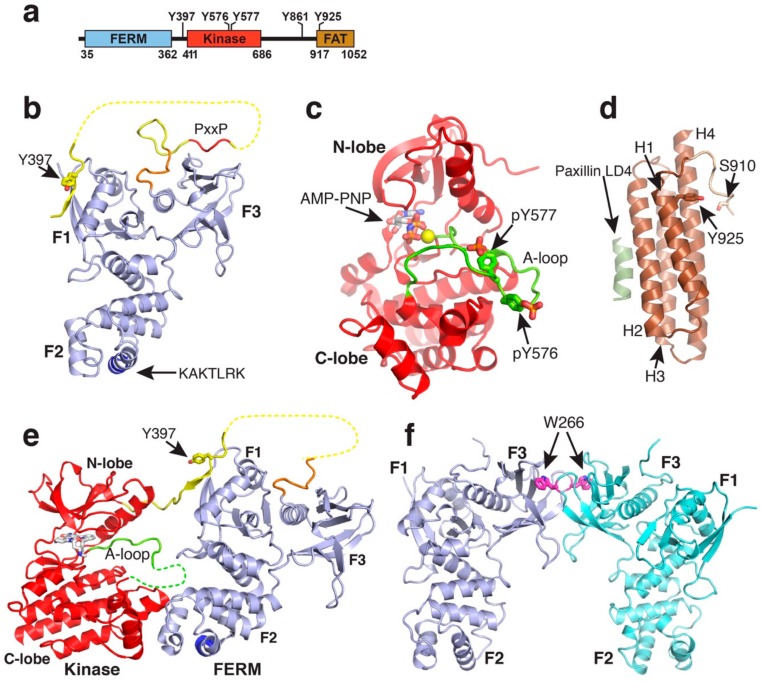
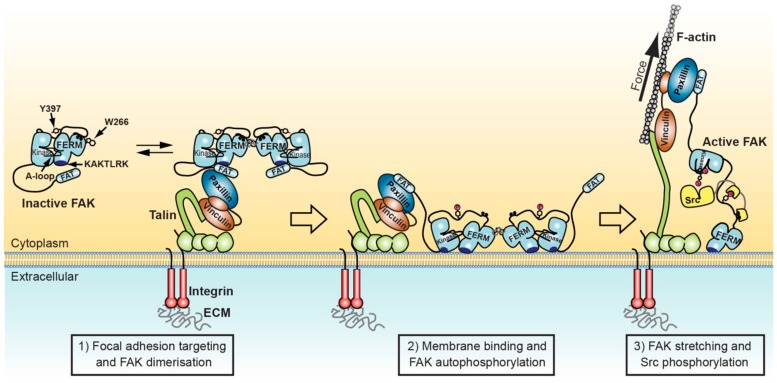
Focal adhesion kinase (FAK) is a non-receptor tyrosine kinase with key roles in the regulation of cell adhesion migration, proliferation and survival. In cancer FAK is a major driver of invasion and metastasis and its upregulation is associated with poor patient prognosis. FAK is autoinhibited in the cytosol, but activated upon localisation into a protein complex, known as focal adhesion complex. This complex forms upon cell adhesion to the extracellular matrix (ECM) at the cytoplasmic side of the plasma membrane at sites of ECM attachment. FAK is anchored to the complex via multiple sites, including direct interactions with specific membrane lipids and connector proteins that attach focal adhesions to the actin cytoskeleton. In migrating cells, the contraction of actomyosin stress fibres attached to the focal adhesion complex apply a force to the complex, which is likely transmitted to the FAK protein, causing stretching of the FAK molecule. In this review we discuss the current knowledge of the FAK structure and how specific structural features are involved in the regulation of FAK signalling. We focus on two major regulatory mechanisms known to contribute to FAK activation, namely interactions with membrane lipids and stretching forces applied to FAK, and discuss how they might induce structural changes that facilitate FAK activation.
Overview
The claims and statistics of this paper haven’t been checked yet.
Run the check — free, no account needed. It reads the open-access text and checks the sources it cites.
Integrity signals
Registry
Cites
Statistics
Figures
Verification
Claims the paper makes
The claims and statistics of this paper haven’t been checked yet.
Run the check — free, no account needed. It reads the open-access text and checks the sources it cites.
Claims other papers make about this one
Each is checked against this paper’s own text: does it say what the citing paper says it does?
The source backs part of the claim, not all of it — or backs it for a different population, condition or comparison.
In the citing paper
“The osteoclast cytoskeleton is made of filamentous structures that belong to one of four categories: polarized actin filaments; polarized microtubules; non-polarized intermediate filaments; or non-polarized septin filaments. The cytoskeleton fulfills essential functions including cell adhesion, migration, contractility, division, vesicular transport, and bone resorption [2,3,4,5,6].”
From Osteoclasts and Microgravity (2020) · cites this paper as [5]
Experimental — accuracy not yet measured
Self-check
Percentages, sums and reported differences re-computed from the paper’s own numbers.
The self-check needs the paper’s full text.
Citations
Cites
Molecular Mechanisms of Stress-Responsive Changes in Collagen and Elastin Networks in Skin
Aziz, J., Shezali, H., Radzi, Z., Yahya, N. A., Abu Kassim, N. H., Czernuszka, J., & Rahman, M. T. (2016) · Skin Pharmacology and Physiology · doi:10.1159/000447017 · Cited by 7,323
Matrix Crosslinking Forces Tumor Progression by Enhancing Integrin Signaling
Levental, K. R., Yu, H., Kass, L., Lakins, J. N., Egeblad, M., Erler, J. T., Fong, S. F. T., Csiszar, K., Giaccia, A., Weninger, W., et al. (2009) · Cell · doi:10.1016/j.cell.2009.10.027 · Cited by 4,101 · cited 1×
“Levental and colleagues [85] used a breast cancer mouse model to show that stiffening of the tumour stroma, induced by increased ECM crosslinking, results in activation of FAK which in turn causes a highly aggressive and invasive behaviour of tumour cells.”
BackgroundReduced cell motility and enhanced focal adhesion contact formation in cells from FAK-deficient mice
llić, D., Furuta, Y., Kanazawa, S., Takeda, N., Sobue, K., Nakatsuji, N., Nomura, S., Fujimoto, J., Okada, M., Yamamoto, T. S., et al. (1995) · Nature · doi:10.1038/377539a0 · Cited by 1,853
Integrin-mediated signal transduction linked to Ras pathway by GRB2 binding to focal adhesion kinase
Schlaepfer, D. D., Hanks, S. K., Hunter, T., & Geer, P. V. D. (1994) · Nature · doi:10.1038/372786a0 · Cited by 1,595 · cited 2×
“In this scenario, force could be a trigger to release the N-terminal FAT helix resulting in exposure of Y925 for phosphorylation by Src. Phosphorylated Y925 is a docking site for the adaptor protein Grb2 [90], which on the one hand links FAK signalling to the Ras/MAPK signalling pathway but was also suggested to recru…”
BackgroundNanoscale architecture of integrin-based cell adhesions
Kanchanawong, P., Shtengel, G. E., Pasapera, A. M., Ramko, E. B., Davidson, M. W., Hess, H. F., & Waterman, C. M. (2010) · Nature · doi:10.1038/nature09621 · Cited by 1,572 · cited 3×
“Super-resolution optical microscopy has defined a layered focal adhesion architecture with a signalling layer closest to the plasma membrane, a central force transduction layer and an actin regulatory layer, the site of actin attachment to the focal adhesion complex [24].”
BackgroundInfluentialMeasuring mechanical tension across vinculin reveals regulation of focal adhesion dynamics
Grashoff, C., Hoffman, B. D., Brenner, M. D., Zhou, R., Parsons, M., Yang, M. T., McLean, M. A., Sligar, S. G., Chen, C. S., Ha, T., et al. (2010) · Nature · doi:10.1038/nature09198 · Cited by 1,549
Stretching Single Talin Rod Molecules Activates Vinculin Binding
Hernández, A. E. D. R., Pérez‐Jiménez, R., Liu, R., Roca‐Cusachs, P., Fernández, J. M., & Sheetz, M. P. (2009) · Science · doi:10.1126/science.1162912 · Cited by 1,492
pp125FAK a structurally distinctive protein-tyrosine kinase associated with focal adhesions.
Schaller, M. D., Borgman, C. A., Cobb, B. S., Vines, R. R., Reynolds, A. B., & Parsons, J. T. (1992) · Proceedings of the National Academy of Sciences · doi:10.1073/pnas.89.11.5192 · Cited by 1,447
FAK in cancer: mechanistic findings and clinical applications
Sulzmaier, F. J., Jean, C., & Schlaepfer, D. D. (2014) · Nature Reviews Cancer · doi:10.1038/nrc3792 · Cited by 1,381 · cited 2×
“The importance of FAK in cell motility is also reflected in disease where FAK plays major roles in tumour invasion and metastasis [11].”
BackgroundFAK integrates growth-factor and integrin signals to promote cell migration
Sieg, D. J., Hauck, C. R., Ilić, D., Klingbeil, C. K., SCHAEFER, E. M., Damsky, C. H., & Schlaepfer, D. D. (2000) · Nature Cell Biology · doi:10.1038/35010517 · Cited by 1,240
Cited by
Sorted by citations
Targeting PI3K/AKT signaling for treatment of idiopathic pulmonary fibrosis
Wang, J., Hu, K., Cai, X., Yang, B., He, Q., Wang, J., & Weng, Q. (2021) · Acta Pharmaceutica Sinica B · doi:10.1016/j.apsb.2021.07.023 · Cited by 476
Dual Role of Reactive Oxygen Species and their Application in Cancer Therapy
Huang, R., Chen, H., Liang, J., Li, Y., Yang, J., Luo, C., Tang, Y., Ding, Y., Liu, X., Yuan, Q., et al. (2021) · Journal of Cancer · doi:10.7150/jca.54699 · Cited by 228
“On the one hand, FAK can lead to focal adhesion, and actin stress fibers located on the inside of the cell membrane adhere to the focal adhesion spot [82].”
BackgroundRoles of focal adhesion proteins in skeleton and diseases
Chen, S., He, T., Zhong, Y., Chen, M., Yao, Q., Chen, D., Shao, Z., & Xiao, G. (2022) · Acta Pharmaceutica Sinica B · doi:10.1016/j.apsb.2022.09.020 · Cited by 157
PROTAC’ing oncoproteins: targeted protein degradation for cancer therapy
Kelm, J. M., Pandey, D. S., Malin, E., Kansou, H. W., Arora, S., Kumar, R., & Gavande, N. S. (2023) · Molecular Cancer · doi:10.1186/s12943-022-01707-5 · Cited by 122
Progress in the Development of Small Molecular Inhibitors of Focal Adhesion Kinase (FAK)
Lu, Y., & Sun, H. (2020) · Journal of Medicinal Chemistry · doi:10.1021/acs.jmedchem.0c01248 · Cited by 104
Effects of Mechanical Stress Stimulation on Function and Expression Mechanism of Osteoblasts
Liu, P., Tu, J., Wang, W., Li, Z., Li, Y., Yu, X., & Zhang, Z. (2022) · Frontiers in Bioengineering and Biotechnology · doi:10.3389/fbioe.2022.830722 · Cited by 109
Integrin and Its Associated Proteins as a Mediator for Mechano-Signal Transduction
Katoh, K. (2025) · Biomolecules · doi:10.3390/biom15020166 · Cited by 114
“AT PPR 1, the tyrosine 397 residue is present, which is very crucial for the activation of FAK [104].”
Mechanochemistry: Fundamental Principles and Applications
Dong, L., Li, L., Chen, H., Cao, Y., & Lei, H. (2024) · Advanced Science · doi:10.1002/advs.202403949 · Cited by 109
Yang, J., Wang, P., Zhang, Y., Zhang, M., Sun, Q., Chen, H., Dong, L., Chu, Z., Xue, B., Hoff, W. D., et al. (2024) · Cell stem cell · doi:10.1016/j.stem.2024.09.016 · Cited by 95
Roles and inhibitors of FAK in cancer: current advances and future directions
Hu, H.-H., Wang, S., Shang, H.-L., Lv, H., Chen, B., Gao, S., & Chen, X. (2024) · Frontiers in Pharmacology · doi:10.3389/fphar.2024.1274209 · Cited by 100
New insights into FAK structure and function in focal adhesions
Coq, J. L., Acebrón, I., Martín, B. R., Navajas, P. L., & Lietha, D. (2022) · Journal of Cell Science · doi:10.1242/jcs.259089 · Cited by 86
Self-citationMechanical homeostasis imbalance in hepatic stellate cells activation and hepatic fibrosis
Zhao, Y.-Q., Deng, X.-W., Xu, G.-Q., Lin, J., Lu, H.-Z., & Chen, J. (2023) · Frontiers in Molecular Biosciences · doi:10.3389/fmolb.2023.1183808 · Cited by 71
Extracellular Matrix Signaling Cues: Biological Functions, Diseases, and Therapeutic Targets
Zhao, T., Huang, Y., Zhu, J., Qin, Y., Wu, H., Yu, J., Zhai, Q., Li, S., Qin, X., Wang, D., et al. (2025) · MedComm · doi:10.1002/mco2.70281 · Cited by 82
Wang, S., Englund, E., Kjellman, P., Li, Z., Ahnlide, J. K., Rodriguez-Cupello, C., Saggioro, M., Kanzaki, R., Pietras, K., Lindgren, D., et al. (2021) · Nature Cell Biology · doi:10.1038/s41556-021-00702-0 · Cited by 64
RetractedResponse of mesenchymal stem cells to surface topography of scaffolds and the underlying mechanisms
Xiao, L., Sun, Y., Liao, L., & Su, X. (2023) · Journal of Materials Chemistry B · doi:10.1039/d2tb01875f · Cited by 68
A Hierarchical Mechanotransduction System: From Macro to Micro
Cao, R. Y., Tian, H., Tian, Y., & Fu, X. (2023) · Advanced Science · doi:10.1002/advs.202302327 · Cited by 67
Analytical methods in studying cell force sensing: principles, current technologies and perspectives
Liu, X., Yu, L., Xiao, A., Sun, W., Wang, H., Wang, X., Zhou, Y., Li, C., Li, J., Wang, Y., et al. (2025) · Regenerative Biomaterials · doi:10.1093/rb/rbaf007 · Cited by 55
Schmidt, A., Liebelt, G., Nießner, F., von Woedtke, T., & Bekeschus, S. (2020) · Redox Biology · doi:10.1016/j.redox.2020.101809 · Cited by 53
Smith, J. K. (2020) · Life · doi:10.3390/life10090207 · Cited by 52
Pancreatic endocrine and exocrine signaling and crosstalk in physiological and pathological status
Hu, C., Chen, Y., Yin, X., Xu, R., Yin, C., Wang, C., & Zhao, Y. (2025) · Signal Transduction and Targeted Therapy · doi:10.1038/s41392-024-02098-3 · Cited by 69
Focal Adhesion Kinase Fine Tunes Multifaced Signals toward Breast Cancer Progression
Rigiracciolo, D. C., Cirillo, F., Talia, M., Muglia, L., Gutkind, J. S., Maggiolini, M., & Lappano, R. (2021) · Cancers · doi:10.3390/cancers13040645 · Cited by 55
“It consists of an activation loop located at the 564–592 gene sequence and the conformation depends on the difference between the active and the inactive form of FAK [35,47].”
BackgroundInfluentialExtracellular Matrix Stiffness in Lung Health and Disease
Guo, T., He, C., Venado, A. E., & Zhou, Y. (2022) · Comprehensive physiology · doi:10.1002/cphy.c210032 · Cited by 104
“The role of FAK in sensing mechanical force among other cues has been well characterized and reviewed elsewhere (377, 398).”
Focal adhesion kinase (FAK): its structure, characteristics, and signaling in skeletal system
Huang, Y., Liao, J., Vlashi, R., & Chen, G. (2023) · Cellular Signalling · doi:10.1016/j.cellsig.2023.110852 · Cited by 50
Focal adhesion kinase: Insight into its roles and therapeutic potential in oesophageal cancer
Zhang, Y., Liu, S., Zhou, S. F., Yu, D., Gu, J., Qin, Q., Cheng, Y., & Sun, X. (2020) · Cancer Letters · doi:10.1016/j.canlet.2020.10.005 · Cited by 50
Liu, Y., Sun, L. J., Li, Y., & Holmes, C. A. (2024) · Journal of Extracellular Vesicles · doi:10.1002/jev2.12472 · Cited by 50
“Meanwhile, PTK2, also known as focal adhesion kinase (FAK), which is critical in cell attachment to the extracellular matrix (Tapial Martínez et al., 2020), was identified as the central node of passage-related protein differences in BMSC-EVs, with a 100-fold increase at P2 compared to P8, implying…”
BackgroundCytoskeletal crosstalk: A focus on intermediate filaments
Pradeau-Phélut, L., & Etienne‐Manneville, S. (2024) · Current Opinion in Cell Biology · doi:10.1016/j.ceb.2024.102325 · Cited by 47
New Insights on the Nuclear Functions and Targeting of FAK in Cancer
Pomella, S., Cassandri, M., Braghini, M. R., Marampon, F., Alisi, A., & Rota, R. (2022) · International Journal of Molecular Sciences · doi:10.3390/ijms23041998 · Cited by 49
“FAK’s structure includes three main domains: an N-terminal FERM (four-point—1, ezrin, radixin and moesin—domain, a central kinase domain followed and a C-terminal FAT (focal adhesion targeting) domain (reviewed in [13]) that are separated by three proline-rich regions (PR1-3) working as binding sites for the Src homol…”
BackgroundMousson, A., Legrand, M., Steffan, T., Vauchelles, R., Carl, P., Gies, J., Lehmann, M., Zuber, G., Mey, J. D., Dujardin, D., et al. (2021) · Cancers · doi:10.3390/cancers13081871 · Cited by 36
“Structurally, FAK is a 125 kDa protein that contains an N-terminal FERM domain, a central kinase domain, and a Cterminal domain which contains the focal adhesion targeting (FAT) site [9].”
BackgroundValdivia, A., Avalos, A. M., & Leyton, L. (2023) · Frontiers in Cell and Developmental Biology · doi:10.3389/fcell.2023.1221306 · Cited by 40
Wang, Y., Shen, N., Yang, Y., Xia, Y., Zhang, W., Yu, L., Wang, Z., Yang, Z., & Wang, Z. (2024) · Cell Communication and Signaling · doi:10.1186/s12964-023-01366-z · Cited by 42
“Integrin clustering causes FAK to be recruited to newly generated focal adhesion sites, and various downstream effectors are phosphorylated after FAK activation, resulting in angiogenesis, cell migration, and cell proliferation [16–19].”
BackgroundMillward, D. J. (2021) · Nutrients · doi:10.3390/nu13030729 · Cited by 44
Lin, C., He, Y., Feng, Q., Xu, K., Chen, Z., Tao, B., Li, X., Xia, Z., Jiang, H., & Cai, K. (2021) · Biomaterials · doi:10.1016/j.biomaterials.2021.121235 · Cited by 36
Focal adhesion kinase inhibitors, a heavy punch to cancer
Wu, Y., Li, N., Ye, C., Jiang, X., Luo, H., Zhang, B., Zhang, Y., & Zhang, Q. (2021) · Discover Oncology · doi:10.1007/s12672-021-00449-y · Cited by 38
“phosphorylated and binds to the junction protein Grb2 to make FAK aggregate with integrins, while Tyr397 and Tyr 861 both could recruit other SH2 proteins [10].”
BackgroundLi, L., Li, Z., Lu, C., Li, J., Zhang, K., Lin, C., Tang, X., Liu, Z., Zhang, Y., Han, R., et al. (2022) · Communications Biology · doi:10.1038/s42003-022-03111-7 · Cited by 34
Role of αVβ3 in Prostate Cancer: Metastasis Initiator and Important Therapeutic Target
Tang, L., Xu, M. Q., Zhang, L., Qu, L., & Liu, X. (2020) · OncoTargets and Therapy · doi:10.2147/ott.s258252 · Cited by 31
Luo, Q.-Y., Zhou, S.-N., Pan, W., Sun, J., Yang, L., Zhang, L., Qiu, M., & Yang, D. (2020) · Biochemical Pharmacology · doi:10.1016/j.bcp.2020.114318 · Cited by 32
Luo, N., Cheng, W., Zhou, Y., Gu, B., Zhao, Z., & Zhao, Y. (2021) · Animals · doi:10.3390/ani11072132 · Cited by 31
Roles of Integrins in Gastrointestinal Cancer Metastasis
Hou, S., Wang, J., Li, W., Hao, X., & Hang, Q. (2021) · Frontiers in Molecular Biosciences · doi:10.3389/fmolb.2021.708779 · Cited by 34
How cells sense and integrate information from different sources
Ullo, M. F., & Case, L. B. (2023) · WIREs Mechanisms of Disease · doi:10.1002/wsbm.1604 · Cited by 30
Eshaq, A. M., Flanagan, T. W., Hassan, S.-Y., Asheikh, S. A. A., Al-Amoudi, W. A., Santourlidis, S., Hassan, S.-L., Alamodi, M. O., Bendhack, M. L., Alamodi, M. O., et al. (2024) · Cancers · doi:10.3390/cancers16152754 · Cited by 31
“The C-terminal region of the Fak family possesses a region that is implicated in focal adhesion targeting (FAT) [124–126].”
BackgroundMedvedev, A. E., Kopylov, A. T., Бунеева, О. А., et al. (2020) · International Journal of Molecular Sciences · doi:10.3390/ijms21114187 · Cited by 29
Orthodontic Force–Induced BMAL1 in PDLCs Is a Vital Osteoclastic Activator
Xie, Y., Tang, Q., Yu, S., et al. (2021) · Journal of Dental Research · doi:10.1177/00220345211019949 · Cited by 28
“1F; Tapial Martínez et al. 2020). qRT-PCR and Western blotting were performed to detect the mRNA and protein levels of BMAL1 and its downstream molecules period 2 (PER2) and cryptochrome 1 (CRY1).”
MethodYao, Y., Zaw, A. M., Anderson, D. E. J., Jeong, Y., Kunihiro, J., Hinds, M. T., & Yim, E. K. F. (2022) · Bioactive Materials · doi:10.1016/j.bioactmat.2022.10.011 · Cited by 33
Wang, C., Zhao, Q., Zheng, X., Li, S., Chen, J., Zhao, H., Chen, F., Cui, L., & Li, W. (2022) · Acta Biomaterialia · doi:10.1016/j.actbio.2022.12.044 · Cited by 30
Gao, L., Wang, A., Chen, Y., Cai, X., Li, Y., Zhao, J., Zhang, Y., Zhang, W., Zhu, J., Zeng, Y., et al. (2023) · Cell Communication and Signaling · doi:10.1186/s12964-023-01343-6 · Cited by 27
Wang, X., Li, N., Liu, Y., Wu, J., Liu, Q.-G., Niu, J.-B., Xu, Y., Huang, C., Zhang, S., & Song, J. (2024) · European Journal of Medicinal Chemistry · doi:10.1016/j.ejmech.2024.116678 · Cited by 34
He, J., You, D., Li, Q., Wang, J., Ding, S., He, X., Zheng, H., Ji, Z., Wang, X., Ye, X., et al. (2022) · Advanced Science · doi:10.1002/advs.202200053 · Cited by 24
Dual roles of FAK in tumor angiogenesis: A review focused on pericyte FAK
Zhang, J., Li, W., Wang, W., Chen, Q., Xu, Z., Deng, M., Zhou, L., & He, G. (2023) · European Journal of Pharmacology · doi:10.1016/j.ejphar.2023.175694 · Cited by 28
Phosphorylated paxillin and phosphorylated FAK constitute subregions within focal adhesions
Bachmann, M., Skripka, A., Weißenbruch, K., Wehrle‐Haller, B., & Bastmeyer, M. (2022) · Journal of Cell Science · doi:10.1242/jcs.258764 · Cited by 24
A prognostic model for oral squamous cell carcinoma using 7 genes related to tumor mutational burden
Wu, F., Du, Y., Hou, X., & Cheng, W. (2022) · BMC Oral Health · doi:10.1186/s12903-022-02193-3 · Cited by 23
“Focal adhesion kinase (FAK) is a non-receptor tyrosine kinase which is associated with poor prognosis and can promotes breast cancer cell migration and metastasis [43, 44].”
BackgroundActin dynamics in protein homeostasis
Williams, T. D., & Rousseau, A. (2022) · Bioscience Reports · doi:10.1042/bsr20210848 · Cited by 27
LKB1 Regulates Goat Intramuscular Adipogenesis Through Focal Adhesion Pathway
Xiong, Y., Wang, Y., Xu, Q., Li, A., Yue, Y., Ma, Y., & Lin, Y. (2021) · Frontiers in Physiology · doi:10.3389/fphys.2021.755598 · Cited by 23
“Our RNA-seq data showed that the DEGs were enriched in the focal adhesion pathway, and FAK is one of the main components of the focal adhesion complex to activate this pathway (Tapial Martinez et al., 2020).”
BackgroundWei, W., Feng, Z., Liu, Z., Li, X., He, H., Ran, K., Shi, Y., Zhu, Y., Ye, T., Gao, C., et al. (2021) · European Journal of Medicinal Chemistry · doi:10.1016/j.ejmech.2021.113978 · Cited by 27
Huang, T., Li, Y.-Q.-X., Zhou, M., Hu, R.-H., Zou, G.-L., Li, J.-C., Feng, S. Y., Liu, Y., Xin, C.-Q., & Zhao, X. (2021) · World Journal of Gastroenterology · doi:10.3748/wjg.v28.i1.123 · Cited by 23
The Role of non-muscle actin paralogs in cell cycle progression and proliferation
Jeruzalska, E., & Mazur, A. J. (2023) · European Journal of Cell Biology · doi:10.1016/j.ejcb.2023.151315 · Cited by 25
Ren, J. X., Chen, L., Guo, W., Feng, K., Cai, Y., & Huang, T. (2023) · Combinatorial Chemistry & High Throughput Screening · doi:10.2174/0113862073266300231026103844 · Cited by 23
Yang, Q., Guo, J., Zhang, S., et al. (2022) · Colloids and Surfaces A Physicochemical and Engineering Aspects · doi:10.1016/j.colsurfa.2022.130638 · Cited by 22
LAMC1 attenuates neuronal apoptosis via FAK/PI3K/AKT signaling pathway after subarachnoid hemorrhage
Wu, Q., Yuan, K., Yao, Y., Yao, J., Shao, J., Meng, Y., Wu, P., & Shi, H. (2024) · Experimental Neurology · doi:10.1016/j.expneurol.2024.114776 · Cited by 21
Roles of CCN2 as a mechano-sensing regulator of chondrocyte differentiation
Nishida, T., & Kubota, S. (2020) · Japanese Dental Science Review · doi:10.1016/j.jdsr.2020.07.001 · Cited by 20
da Cruz, A. T., Hunger, A., de Melo, F. H. M., et al. (2021) · Neoplasia · doi:10.1016/j.neo.2021.05.015 · Cited by 20
Solı́s, C., & Russell, B. (2021) · Biophysical Reviews · doi:10.1007/s12551-021-00835-4 · Cited by 20
“An excellent review of how force affects FAK structure and mechanotransduction provides more details (Tapial Martínez et al. 2020).”
BackgroundZearalenone damages the male reproductive system of rats by destroying testicular focal adhesion
Cai, P., Feng, N., Zou, H., et al. (2022) · Environmental Toxicology · doi:10.1002/tox.23694 · Cited by 19
Chen, Y.-C., Gu, Y., Hu, H., Liu, H., Li, W., Huang, C., Chen, J., Liang, L., & Liu, Y. (2023) · Journal of Inorganic Biochemistry · doi:10.1016/j.jinorgbio.2023.112134 · Cited by 19
Biomechanical Modulation of Dental Pulp Stem Cell (DPSC) Properties for Soft Tissue Engineering
Groß, T., Dieterle, M. P., Vach, K., et al. (2023) · Bioengineering · doi:10.3390/bioengineering10030323 · Cited by 19
Wei, X., Pan, S.-S., Wang, Z., Chen, J., Lü, L., Cao, Q., Song, S., Zhang, H., Liu, X., Qu, X., et al. (2023) · Cell Death and Disease · doi:10.1038/s41419-023-06199-9 · Cited by 19
Focal adhesion kinase (FAK): emerging target for drug-resistant malignant tumors
Aakriti, J., Vithalkar, M. P., Maity, S., Baby, K., Nagareddy, P. R., & Nayak, Y. (2025) · Molecular Biology Reports · doi:10.1007/s11033-025-10296-7 · Cited by 20
Zhang, X., Li, P., Zhou, J., Zhang, Z., Wu, H., Shu, X., Li, W., Wu, Y. C., Lü, S., Lü, D., et al. (2024) · Biomaterials · doi:10.1016/j.biomaterials.2023.122462 · Cited by 22
Liu, Y., Kong, L.-J., Li, N., Liu, Y., Jia, M.-Q., Liu, Q.-G., Zhang, S., & Song, J. H. (2023) · Bioorganic Chemistry · doi:10.1016/j.bioorg.2023.106895 · Cited by 20
Wińska, P., Karatsai, O., Staniszewska, M., Koronkiewicz, M., Chojnacki, K., & Rędowicz, M. J. (2020) · International Journal of Molecular Sciences · doi:10.3390/ijms21176234 · Cited by 17
“It plays an important role in the control of several biological processes, including cell spreading, migration, and survival [37].”
BackgroundAzaadamantanes, a New Promising Scaffold for Medical Chemistry
Суслов, Е. В., Ponomarev, K. Y., Volcho, K. P., et al. (2021) · Russian Journal of Bioorganic Chemistry · doi:10.1134/s1068162021060236 · Cited by 17
Rab40c regulates focal adhesions and PP6 activity by controlling ANKRD28 ubiquitylation
Han, K.-J., Mikalayeva, V., Gerber, S. A., Kettenbach, A. N., Skeberdis, V. A., & Prekeris, R. (2022) · Life Science Alliance · doi:10.26508/lsa.202101346 · Cited by 17
Modaresifar, K., Ganjian, M., Díaz‐Payno, P. J., et al. (2022) · Materials Today Bio · doi:10.1016/j.mtbio.2022.100448 · Cited by 16
Influence of DNA Methylation on Vascular Smooth Muscle Cell Phenotypic Switching
Yorn, C., Kim, H., & Jeong, K. (2024) · International Journal of Molecular Sciences · doi:10.3390/ijms25063136 · Cited by 15
The Hippo Pathway in Breast Cancer: The Extracellular Matrix and Hypoxia
Yang, H., Yang, J., Zheng, X., Chen, T., Zhang, R., Chen, R., Cao, T., Zeng, F., & Liu, Q. (2024) · International Journal of Molecular Sciences · doi:10.3390/ijms252312868 · Cited by 17
Nalawansha, D. A., Mazis, G., Husemoen, G., Ashton, K. S., Deng, W., Wurz, R. P., Tran, A. T., Lanman, B. A., Xie, J., Guenette, R. G., et al. (2025) · Nature Communications · doi:10.1038/s41467-025-63128-4 · Cited by 15
“Strikingly, fi ve out of six kinases that were downregulated by LYMTAC-1 were exclusively integral membrane proteins (EPHA2, INSR, EPHB4, ACVR1, TGFBR2) 33,34 .”
García‐Padilla, C., Muñoz-Gallardo, M. D. M., Lozano-Velasco, E., Castillo-Casas, J. M., Caño-Carrillo, S., García‐López, V., Aránega, A. E., Franco, D., García‐Martínez, V., & López‐Sánchez, C. (2022) · Non-Coding RNA · doi:10.3390/ncrna8020028 · Cited by 14
Kuroda, J., Itabashi, T., Iwane, A. H., Aramaki, T., & Kondo, S. (2020) · Frontiers in Cell and Developmental Biology · doi:10.3389/fcell.2020.580520 · Cited by 12
Human Adenovirus Species D Interactions with Corneal Stromal Cells
Rajaiya, J., Saha, A., Zhou, X., et al. (2021) · Viruses · doi:10.3390/v13122505 · Cited by 13
Lv, W., Yu, X., Xu, Z., Jiang, H., Tong, Q., & Wang, Z. (2022) · mBio · doi:10.1128/mbio.02218-22 · Cited by 11
Chen, Z., Zou, Y., & Lv, Y. (2023) · Biomaterials Science · doi:10.1039/d2bm01928k · Cited by 13
Wang, X., Liao, J., Shi, H., et al. (2024) · Advanced Science · doi:10.1002/advs.202403640 · Cited by 13
FAK Signaling in Rhabdomyosarcoma
Perrone, C., Pomella, S., Cassandri, M., Braghini, M. R., Pezzella, M., Locatelli, F., & Rota, R. (2020) · International Journal of Molecular Sciences · doi:10.3390/ijms21228422 · Cited by 11
Resistin Induces Migration and Invasion in PC3 Prostate Cancer Cells: Role of Extracellular Vesicles
Oregel-Cortez, M. I., Frayde-Gómez, H., Quintana-González, G., García‐González, V., Vázquez-Jiménez, J. G., & Galindo‐Hernández, O. (2023) · Life · doi:10.3390/life13122321 · Cited by 15
“Therefore, they promote cell survival and migration and promote the activation/phosphorylation of FAK at the Y397 residue, which is associated with the metastasis process [16].”
BackgroundKlotho functionalization on vascular graft for improved patency and endothelialization
Pan, Z., Fang, Q., Dongsheng, G., et al. (2022) · Biomaterials Advances · doi:10.1016/j.msec.2021.112630 · Cited by 12
Pan, Q., Wang, Q., Zhao, T., Zhao, X., Liang, Y., Shi, M., Chen, C., & Lin, F. (2023) · Medical Oncology · doi:10.1007/s12032-023-02092-9 · Cited by 12
Biomaterials Mimicking Mechanobiology: A Specific Design for a Specific Biological Application
Donati, L., Valicenti, M. L., Giannoni, S., Morena, F., & Martino, S. (2024) · International Journal of Molecular Sciences · doi:10.3390/ijms251910386 · Cited by 14
Microgravity, Bone Homeostasis, and Insulin-Like Growth Factor-1
Smith, J. K. (2020) · Applied Sciences · doi:10.3390/app10134433 · Cited by 10
Fidgetin-like 2 depletion enhances cell migration by regulating GEF-H1, RhoA, and FAK
Smart, K., Kramer, A. H., Smart, S., Hodgson, L., & Sharp, D. J. (2022) · Biophysical Journal · doi:10.1016/j.bpj.2022.12.018 · Cited by 12
“FAK, which is activated by phosphorylation(p-FAK) (14,15),isoneofthedeterminantsofFA break-down (3,13,15,42).”
Gao, J., Cheng, J., Xie, W., Zhang, P., Liu, X., Wang, Z., & Zhang, B. (2024) · Expert Opinion on Investigational Drugs · doi:10.1080/13543784.2024.2348068 · Cited by 14
Lee, S. Y., Fujioka, T., Osuga, M., Nishimura, T., & Suetsugu, S. (2022) · Elsevier eBooks · doi:10.1016/b978-0-323-89911-6.00019-4 · Cited by 10
Effect of Extracellular Matrix Stiffness on Candesartan Efficacy in Anti-Fibrosis and Antioxidation
Zhu, T., Song, J., Gao, B., Zhang, J., Li, Y., Ye, Z., Zhao, Y., Guo, X., Xu, F., & Li, F. (2023) · Antioxidants · doi:10.3390/antiox12030679 · Cited by 10
Wang, Z., Xie, M., Jia, Z., Tao, Z., Zhao, P., & Ying, M. (2024) · Scientific Reports · doi:10.1038/s41598-024-72578-7 · Cited by 10
“Two main regulatory mechanisms that known to contribute to FAK activation are the interactions with membrane lipids and stretching forces applied to FAK 24 .”
Geijerman, E., Terrana, F., Peters, G. J., Deng, D., Diana, P., Giovannetti, E., & Xu, G. (2024) · Expert Opinion on Investigational Drugs · doi:10.1080/13543784.2024.2417762 · Cited by 12
Focal adhesion kinase inhibitors in fibrotic diseases therapy: Development and therapeutic potential
Gan, C., Wei, W., Xue, T., Xie, Y., Yue, L., Su, X., Yan, Y., Liu, Z., & Ye, T. (2025) · European Journal of Medicinal Chemistry · doi:10.1016/j.ejmech.2025.117882 · Cited by 12
Oncel, S., & Basson, M. D. (2022) · Cell and Tissue Research · doi:10.1007/s00441-022-03674-1 · Cited by 10
Su, S. H., Begum, S., & Ezratty, E. J. (2020) · Molecular Biology of the Cell · doi:10.1091/mbc.e20-04-0232 · Cited by 10
“…data suggest that Ift20 plays an extraciliary role during polarized migration of 1°MKs. Polarized cell migration requires activation of integrinmediated cell adhesion, which is translated to changes in the phosphorylation status of mechanically sensitive proteins (Tapial Martinez et al., 2020).”
BackgroundWang, N., Xu, X., Guan, F., Zheng, Y., Shou, Y., Xu, T., Shen, G., Chen, H., Lin, Y., Cong, W., et al. (2024) · The FASEB Journal · doi:10.1096/fj.202302251r · Cited by 9
“19 It possesses tyrosine protein kinase activity and plays a significant role in regulating various biological signal transductions in cells, thereby performing a wide range of biological functions.”
BackgroundSun, Y., Yu, Y., Ma, S., Liao, C., Yang, J., Lyu, Y., Zhang, X., Zhang, J., Tian, W., & Liao, L. (2024) · Journal of Materials Chemistry B · doi:10.1039/d3tb02828c · Cited by 9
Targeting Focal Adhesion Kinase in Lung Diseases: Current Progress and Future Directions
Wan, Z., Zhu, Z., Wang, P., Xu, X., Ma, T., Li, H., Li, L., Qian, F., & Gu, W. (2025) · Biomolecules · doi:10.3390/biom15091233 · Cited by 11
Liu, J., Long, X., Li, H., et al. (2023) · Clinical and Translational Medicine · doi:10.1002/ctm2.1261 · Cited by 9
Metadata
- Authors
- Tapial Martínez, P., López Navajas, P., & Lietha, D.
- Affiliations
- Centro de Investigaciones Biológicas (CIB), Spanish National Research Council (CSIC), Cell Signalling and Adhesion Group, 28040 Madrid, Spain
- Consejo Superior de Investigaciones Científicas (ES)
- Corresponding author
- Lietha, Daniel
- ORCID
- Lietha, Daniel
- Venue
- Biomolecules
- Publisher
- MDPI AG
- Published
- 2020-01-24
- Volume
- 10
- Issue
- 2
- Pages
- 179
- ISSN
- 2218-273X (ISSN-L)
- PMC
- PMC7072507
- OpenAlex
- W3002011373
- Semantic Scholar
- 3830912f29816d1795a68aeaa4e040c80c112f67
- Cited by
- 206
- References
- 95
- Citations by year
- 2026: 16 · 2025: 21 · 2024: 45 · 2023: 44 · 2022: 41 · 2021: 24 · 2020: 15
- FWCI
- 4.32
- Type
- journal article
- Language
- en
- Open access
- gold
- dx.doi.org
- Licence
- Locations
- Biomolecules (publishedVersion, cc-by)
- PubMed Central (publishedVersion, cc-by)
- PubMed (publishedVersion)
- DIGITAL.CSIC (Spanish National Research Council (CSIC)) (submittedVersion, cc-by)
- DOAJ (DOAJ: Directory of Open Access Journals) (submittedVersion, cc-by-sa)
- Funders
- Ministerio de Ciencia, Innovación y Universidades (RTI2018-099318-B-I00, RTI2018)
- Ministerio de Asuntos Económicos y Transformación Digital, Gobierno de España (BFU2016-77665-R)
- European Regional Development Fund (BFU2016, RTI2018, BFU2016-77665-R)
- Agencia Estatal de Investigación
- Topics
- Health Sciences › Medicine › Immunology and Allergy › Cell Adhesion Molecules Research
- Life Sciences › Biochemistry, Genetics and Molecular Biology › Cell Biology › Cellular Mechanics and Interactions
- Life Sciences › Biochemistry, Genetics and Molecular Biology › Molecular Biology › Protein Kinase Regulation and GTPase Signaling
- Keywords
- focal adhesion kinase, focal adhesions, membrane lipid interactions, mechanical forces, FAK activation, non-receptor tyrosine kinase, cell adhesion, extracellular matrix, metastasis, actin cytoskeleton
- MeSH terms
- Cell Adhesion, Cell Movement, Humans, Membranes, Actin Cytoskeleton, Phosphorylation, Signal Transduction, Focal Adhesions, Mechanotransduction, Cellular, Focal Adhesion Kinase 1
About these checks
Registry, retraction, Cites and statistics results are computed, not judged, with one exception: a printed reference that no index lists is read once by a model before it counts as a citation error. Claims are extracted by a model and kept only when their quote appears verbatim in the text; each cited source is then checked, with a model’s help, for whether it says what the claim relies on. Those verdicts can be wrong — read the claim’s quote and the cited source before relying on one.
Statistics and arithmetic are recomputed, not judged.
Confidence bands are shown only for fields calibrated on our annotated test set. None is calibrated yet, so no band is shown.
What counts as a claim ›How we measure confidence ›How we check this ›
Are you an author, or do you see a problem with this page? Request a review
