

The DOI matches its Crossref record; 95 of the 95 references it cites were found in a registry or an index.
FAK Structure and Regulation by Membrane Interactions and Force in Focal Adhesions
Open accessAbstract
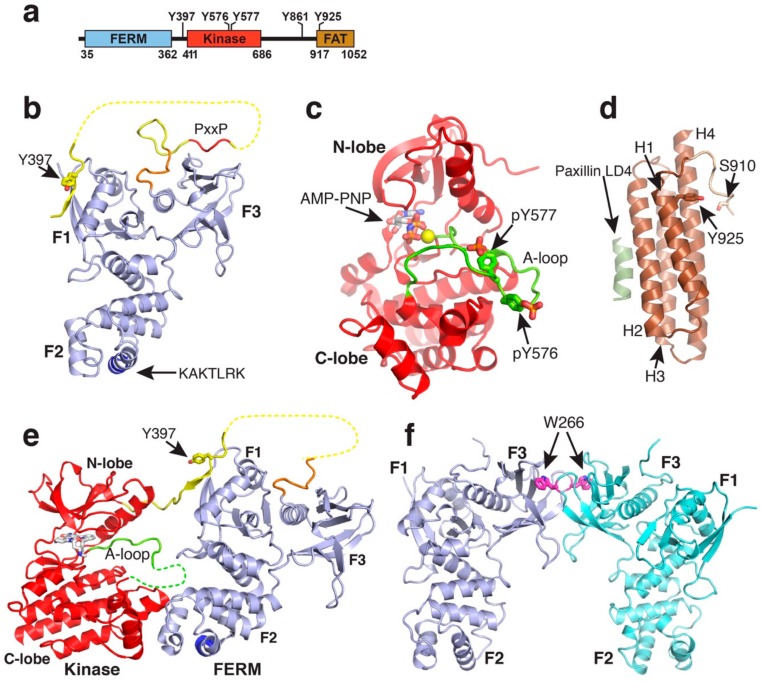
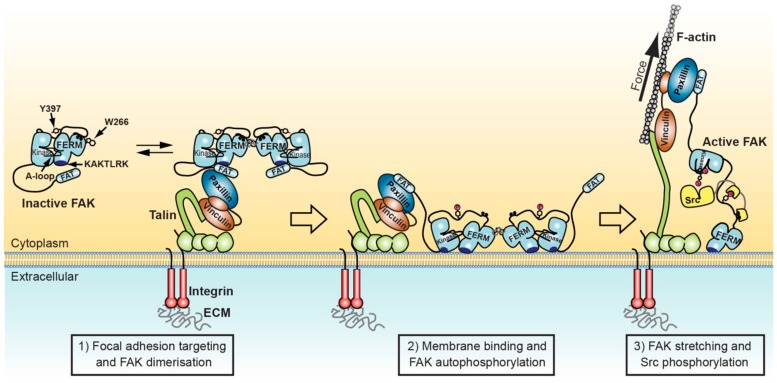
Focal adhesion kinase (FAK) is a non-receptor tyrosine kinase with key roles in the regulation of cell adhesion migration, proliferation and survival. In cancer FAK is a major driver of invasion and metastasis and its upregulation is associated with poor patient prognosis. FAK is autoinhibited in the cytosol, but activated upon localisation into a protein complex, known as focal adhesion complex. This complex forms upon cell adhesion to the extracellular matrix (ECM) at the cytoplasmic side of the plasma membrane at sites of ECM attachment. FAK is anchored to the complex via multiple sites, including direct interactions with specific membrane lipids and connector proteins that attach focal adhesions to the actin cytoskeleton. In migrating cells, the contraction of actomyosin stress fibres attached to the focal adhesion complex apply a force to the complex, which is likely transmitted to the FAK protein, causing stretching of the FAK molecule. In this review we discuss the current knowledge of the FAK structure and how specific structural features are involved in the regulation of FAK signalling. We focus on two major regulatory mechanisms known to contribute to FAK activation, namely interactions with membrane lipids and stretching forces applied to FAK, and discuss how they might induce structural changes that facilitate FAK activation.
Overview
The claims and statistics of this paper haven’t been checked yet.
Run the check — free, no account needed. It reads the open-access text and checks the sources it cites.
Integrity signals
Registry
Cites
Statistics
Figures
Verification
Claims the paper makes
The claims and statistics of this paper haven’t been checked yet.
Run the check — free, no account needed. It reads the open-access text and checks the sources it cites.
Claims other papers make about this one
Each is checked against this paper’s own text: does it say what the citing paper says it does?
The source backs part of the claim, not all of it — or backs it for a different population, condition or comparison.
In the citing paper
“The osteoclast cytoskeleton is made of filamentous structures that belong to one of four categories: polarized actin filaments; polarized microtubules; non-polarized intermediate filaments; or non-polarized septin filaments. The cytoskeleton fulfills essential functions including cell adhesion, migration, contractility, division, vesicular transport, and bone resorption [2,3,4,5,6].”
From Osteoclasts and Microgravity (2020) · cites this paper as [5]
Experimental — accuracy not yet measured
Self-check
Percentages, sums and reported differences re-computed from the paper’s own numbers.
The self-check needs the paper’s full text.
Citations
Cites
Molecular Mechanisms of Stress-Responsive Changes in Collagen and Elastin Networks in Skin
Aziz, J., Shezali, H., Radzi, Z., Yahya, N. A., Abu Kassim, N. H., Czernuszka, J., & Rahman, M. T. (2016) · Skin Pharmacology and Physiology · doi:10.1159/000447017 · Cited by 7,323
Matrix Crosslinking Forces Tumor Progression by Enhancing Integrin Signaling
Levental, K. R., Yu, H., Kass, L., Lakins, J. N., Egeblad, M., Erler, J. T., Fong, S. F. T., Csiszar, K., Giaccia, A., Weninger, W., et al. (2009) · Cell · doi:10.1016/j.cell.2009.10.027 · Cited by 4,101 · cited 1×
“Levental and colleagues [85] used a breast cancer mouse model to show that stiffening of the tumour stroma, induced by increased ECM crosslinking, results in activation of FAK which in turn causes a highly aggressive and invasive behaviour of tumour cells.”
BackgroundReduced cell motility and enhanced focal adhesion contact formation in cells from FAK-deficient mice
llić, D., Furuta, Y., Kanazawa, S., Takeda, N., Sobue, K., Nakatsuji, N., Nomura, S., Fujimoto, J., Okada, M., Yamamoto, T. S., et al. (1995) · Nature · doi:10.1038/377539a0 · Cited by 1,853
Integrin-mediated signal transduction linked to Ras pathway by GRB2 binding to focal adhesion kinase
Schlaepfer, D. D., Hanks, S. K., Hunter, T., & Geer, P. V. D. (1994) · Nature · doi:10.1038/372786a0 · Cited by 1,595 · cited 2×
“In this scenario, force could be a trigger to release the N-terminal FAT helix resulting in exposure of Y925 for phosphorylation by Src. Phosphorylated Y925 is a docking site for the adaptor protein Grb2 [90], which on the one hand links FAK signalling to the Ras/MAPK signalling pathway but was also suggested to recru…”
BackgroundNanoscale architecture of integrin-based cell adhesions
Kanchanawong, P., Shtengel, G. E., Pasapera, A. M., Ramko, E. B., Davidson, M. W., Hess, H. F., & Waterman, C. M. (2010) · Nature · doi:10.1038/nature09621 · Cited by 1,572 · cited 3×
“Super-resolution optical microscopy has defined a layered focal adhesion architecture with a signalling layer closest to the plasma membrane, a central force transduction layer and an actin regulatory layer, the site of actin attachment to the focal adhesion complex [24].”
BackgroundInfluentialMeasuring mechanical tension across vinculin reveals regulation of focal adhesion dynamics
Grashoff, C., Hoffman, B. D., Brenner, M. D., Zhou, R., Parsons, M., Yang, M. T., McLean, M. A., Sligar, S. G., Chen, C. S., Ha, T., et al. (2010) · Nature · doi:10.1038/nature09198 · Cited by 1,549
Stretching Single Talin Rod Molecules Activates Vinculin Binding
Hernández, A. E. D. R., Pérez‐Jiménez, R., Liu, R., Roca‐Cusachs, P., Fernández, J. M., & Sheetz, M. P. (2009) · Science · doi:10.1126/science.1162912 · Cited by 1,492
pp125FAK a structurally distinctive protein-tyrosine kinase associated with focal adhesions.
Schaller, M. D., Borgman, C. A., Cobb, B. S., Vines, R. R., Reynolds, A. B., & Parsons, J. T. (1992) · Proceedings of the National Academy of Sciences · doi:10.1073/pnas.89.11.5192 · Cited by 1,447
FAK in cancer: mechanistic findings and clinical applications
Sulzmaier, F. J., Jean, C., & Schlaepfer, D. D. (2014) · Nature Reviews Cancer · doi:10.1038/nrc3792 · Cited by 1,381 · cited 2×
“The importance of FAK in cell motility is also reflected in disease where FAK plays major roles in tumour invasion and metastasis [11].”
BackgroundFAK integrates growth-factor and integrin signals to promote cell migration
Sieg, D. J., Hauck, C. R., Ilić, D., Klingbeil, C. K., SCHAEFER, E. M., Damsky, C. H., & Schlaepfer, D. D. (2000) · Nature Cell Biology · doi:10.1038/35010517 · Cited by 1,240
Cited by
Sorted by citations
Items 101–200 of 206
Smith, S. F., Brewer, D. S., Hurst, R., & Cooper, C. S. (2024) · Cancers · doi:10.3390/cancers16091717 · Cited by 9
“Phosphorylated FAK is associated with metastasis, and the metalloproteinases MMP-2 and MMP-9 have roles in degrading the extracellular matrix [77].”
BackgroundMyocardial Cytoskeletal Adaptations in Advanced Kidney Disease
Halim, A., Narayanan, G., Hato, T., Ho, L., Wan, D., Siedlecki, A. M., Rhee, E. P., Allegretti, A. S., Nigwekar, S. U., Zehnder, D., et al. (2022) · Journal of the American Heart Association · doi:10.1161/jaha.121.022991 · Cited by 9
“50,51 RNA-seq showed significant downregulation A , Expression of FAK mRNA is significantly upregulated in left ventricular tissues from patients undergoing hemodialysis, ex vivo.”
Brown, N. D., & Vomhof‐DeKrey, E. E. (2024) · Cells · doi:10.3390/cells13141178 · Cited by 8
“The focal adhesion targeting (FAT) domain acts as a scaffolding protein, which allows the protein to localize and stabilize within the cell due to its interactions with paxillin [1,21] (Figure 2B).”
BackgroundZhang, Z., Isaji, T., Oyama, Y., Liu, J., Xu, Z., Sun, Y., Fukuda, T., Lu, H., & Gu, J. (2024) · Biomolecules · doi:10.3390/biom14121577 · Cited by 10
“[57–59].”
Zhang, X., Zhang, Q., Yu, M., Zhang, Y., He, T., Qiu, Z., Qiu, Y., & Wang, W. (2023) · Journal of Ethnopharmacology · doi:10.1016/j.jep.2023.117349 · Cited by 8
Yang, F., Yang, M., Liu, Y., et al. (2024) · Thyroid · doi:10.1089/thy.2023.0497 · Cited by 8
“17 As a key executor of FAs signaling events, the activation and stabilization of FAK was finely tuned for driving cell migration.”
He, Y., Gang, B., Zhang, M., et al. (2024) · International Immunopharmacology · doi:10.1016/j.intimp.2024.111535 · Cited by 8
Scianò, F., Terrana, F., Pecoraro, C., Parrino, B., Cascioferro, S., Diana, P., Giovannetti, E., & Carbone, D. (2024) · Future Medicinal Chemistry · doi:10.4155/fmc-2023-0234 · Cited by 9
Wang, X., Li, X., Niu, L., Lv, F., Guo, T., Gao, Y., Ran, Y., Huang, W., & Wang, B. (2024) · Oncogene · doi:10.1038/s41388-024-03027-y · Cited by 9
“The major molecular functions of FAK are executed by the phosphorylated form of FAK, which is induced by rapid autophosphorylation at tyrosine 397, and this initial phosphorylation subsequently activates phosphorylation at other sites [10 – 12].”
Li, L., Jiang, M., Wang, W., Cao, X., Ma, Q., Han, J., Liu, Z., Huang, Y., & Chen, Y. (2024) · Ecotoxicology and Environmental Safety · doi:10.1016/j.ecoenv.2024.116579 · Cited by 8
Lei, X., Liu, Q., Li, S., et al. (2021) · Bioengineered · doi:10.1080/21655979.2021.1962686 · Cited by 8
“FAK was correlated to FAs turnover, regulating the recombination of cytoskeleton and lamellipodia [14].”
BackgroundInfluentialLiao, Y., Liu, L., Yang, J., et al. (2022) · In Vitro Cellular & Developmental Biology - Animal · doi:10.1007/s11626-022-00660-3 · Cited by 8
“…integrins and growth factor signals stimulated phosphorylation at tyrosine 397 (Y397) in FAK that is particularly responsible for FAK efficient activation and providing high affinity binding site for FAK-interacting proteins, being referred to as scaffolding function (Tapial Martínez et al. 2020).”
BackgroundFeng, Z., Wei, W., Wang, S., Li, X., Zhao, L., Wan, G., Hu, R., & Yu, L. (2024) · Biochemical Pharmacology · doi:10.1016/j.bcp.2024.116461 · Cited by 7
Yan, J., Yang, A., & Tu, S. (2024) · Frontiers in Oncology · doi:10.3389/fonc.2024.1445978 · Cited by 7
“FA is a linking complex consists of various proteins, including integrin, PKC, plectin, RACK1, and c-Src (109).”
BackgroundXu, E., Huang, Z. Y., Zhu, K., Hu, J., Ma, X., Wang, Y., Zhu, J., & Zhang, C. (2024) · Cellular Signalling · doi:10.1016/j.cellsig.2024.111501 · Cited by 7
Fucoxanthin Targets β1 Integrin to Disrupt Adhesion and Migration in Human Glioma Cells
Huang, H. F., Zhang, W., Wu, Q., Zhang, L., Wu, Y., Tong, H., & Su, M. (2025) · Journal of Agricultural and Food Chemistry · doi:10.1021/acs.jafc.4c10108 · Cited by 7
Mechanisms and therapeutic potential of epithelial-immune crosstalk in airway inflammation
Chen, Y., Yang, Y., Liu, H., Hao, Y., Xu, X., Zhang, Y., Zhao, H., Zuo, T., Yu, H., Yin, J., et al. (2025) · Expert Review of Clinical Immunology · doi:10.1080/1744666x.2025.2514604 · Cited by 8
Wen, C., Wang, C., Hu, C., Qi, T., Jing, R., Wang, Y., Zhang, M., Shao, Y., & Pei, C. (2022) · Cellular Signalling · doi:10.1016/j.cellsig.2022.110378 · Cited by 7
Huang, J., Jooss, N. J., Fernández, D. I., et al. (2022) · International Journal of Molecular Sciences · doi:10.3390/ijms23158688 · Cited by 7
“In various cell types, including platelets, PTK2 is known to accumulate in focal adhesion sites formed upon stretching forces [19,20].”
BackgroundChen, F., Zhong, Z., Zhang, C., Lu, Y., Chan, Y.-T., Wang, N., Zhao, D., & Feng, Y. (2022) · International Journal of Molecular Sciences · doi:10.3390/ijms232113334 · Cited by 8
“reorganized signals in cancer cells, thereby inducing malignant growth and metastasis [2,3].”
BackgroundInfluentialHe, W.-G., Deng, Y., Ke, K.-X., Cao, X.-L., Liu, S., Yang, Y., Luo, H., Yao, X., Gao, X. Y., Du, Y., et al. (2023) · Stem Cells International · doi:10.1155/2023/5915988 · Cited by 7
Pocasap, P., Prawan, A., Kongpetch, S., et al. (2024) · Heliyon · doi:10.1016/j.heliyon.2024.e32352 · Cited by 6
“Phosphorylation also enables FAK in the active conformation to be available for sequential phosphorylation at the C-terminal region (Tyr925) [26].”
Xiao, H., Zhang, W., Liu, J., Ma, Y., Liu, D., Li, M., Xin, R., He, L., & Liu, S. (2026) · Advanced Healthcare Materials · doi:10.1002/adhm.202503560 · Cited by 6
Protein tyrosine phosphatase 1B targets focal adhesion kinase and paxillin in cell–matrix adhesions
Wusener, A. E. G., González, Á., Collado, M. E. P., et al. (2021) · Journal of Cell Science · doi:10.1242/jcs.258769 · Cited by 6
Kang, D., Kim, T., Choi, G.-E., Park, A., Yoon, J. H., Yu, J., & Suh, N. (2024) · Cell Communication and Signaling · doi:10.1186/s12964-024-01737-0 · Cited by 6
“Building on our findings regarding actomyosin contractility, we focused on the role of miR-29a-3p in regulating FAs and the actin cytoskeleton, both of which are also critical for cellular migration [32].”
BackgroundCarvalho, B. P. D., Chern, Y., He, J., & Chan, C. (2020) · FEBS Letters · doi:10.1002/1873-3468.13999 · Cited by 6
Zhu, X., Wu, X., Yang, H., et al. (2023) · Biology Direct · doi:10.1186/s13062-023-00386-6 · Cited by 6
Castillo-Sánchez, R., García-Hernández, A. P., Torres‐Alamilla, P., et al. (2024) · Molecular Carcinogenesis · doi:10.1002/mc.23726 · Cited by 5
“42,43 We studied whether B[a]P induced an increase in the number of focal adhesions, which were analyzed by staining of cells with anti ‐ p ‐ FAK Ab.”
Backgroundc-Src-induced vascular malformations require localised matrix degradation at focal adhesions
Essebier, P., Schimmel, L., Yordanov, T. E., Keyser, M. S., Yu, A., Noordstra, I., Hill, B., Yap, A. S., Stehbens, S. J., Lagendijk, A. K., et al. (2024) · Journal of Cell Science · doi:10.1242/jcs.262101 · Cited by 5
Gao, Y., Hossain, M. N., Zhao, L., de Avila, J. M., Law, N. C., Zhu, M.-J., Murdoch, G. K., & Du, . (2024) · International Journal of Molecular Sciences · doi:10.3390/ijms25179488 · Cited by 5
“…migration requires the anterior portion of cells to protrude and attach onto the substrate surface, which is mediated by proteins that form focal adhesions, including integrin [37], focal adhesion kinase (FAK, also known as PTK2) [38], paxillin (PXN) [39], talin (TLN) [40], and vinculin (VCL) [41].”
BackgroundMechanotransduction in fibrosis: Mechanisms and treatment targets
Yeh, C., Chou, C. E. N., & Yang, K. (2021) · Current topics in membranes · doi:10.1016/bs.ctm.2021.07.004 · Cited by 4
CK2β Is a Gatekeeper of Focal Adhesions Regulating Cell Spreading
Filhol, O., Hesse, A.-M., Bouin, A., Albigès‐Rizo, C., Jeanneret, F., Battail, C., Pflieger, D., & Cochet, C. (2022) · Frontiers in Molecular Biosciences · doi:10.3389/fmolb.2022.900947 · Cited by 5
Chen, J., Yin, Z., Song, W., He, B., & Zhang, W. (2022) · Journal of Immunology Research · doi:10.1155/2022/2931214 · Cited by 4
Tsujioka, M., Miyazawa, K., Ohmuraya, M., Nibe, Y., Shirokawa, T., Hayasaka, H., Mizushima, T., Fukuma, T., & Shimizu, S. (2023) · Cell Death and Disease · doi:10.1038/s41419-023-05774-4 · Cited by 4
Fu, Y., Sui, Y., Zhao, Y., Jiang, J., Wang, X., Cui, J., Fu, X., Xing, S., & Zhao, Z. J. (2023) · Aging · doi:10.18632/aging.204771 · Cited by 4
Apollonio, M., Bellazzo, A., Franco, N., Lombardi, S., Senigagliesi, B., Casalis, L., Parisse, P., Thalhammer, A., Baj, G., Fania, R. D. F., et al. (2023) · Cancers · doi:10.3390/cancers15133379 · Cited by 4
“Finally, the increase in cell density was paralleled by a gradual accumulation of E-cadherin (Figure 1E) [27,28].”
BackgroundTu, Y., Pan, B., Wu, X., Hu, X., Li, Q., Zhang, Z., Sheng, P., & Chen, W. (2025) · International Immunopharmacology · doi:10.1016/j.intimp.2025.115246 · Cited by 4
Eickenscheidt, A., Lavaux, V., Paschke, S., et al. (2022) · Macromolecular Bioscience · doi:10.1002/mabi.202200225 · Cited by 4
Substrate stiffness promotes dentinogenesis via LAMB1 – FAK – MEK1 /2 signaling axis
Bai, M., Chen, H., Zhang, Z., et al. (2022) · Oral Diseases · doi:10.1111/odi.14469 · Cited by 4
Yan, M., Zheng, H., Yan, R., et al. (2023) · Journal of Proteome Research · doi:10.1021/acs.jproteome.3c00277 · Cited by 4
Two Transient Receptor Potential Channels at Focal Adhesions
Mitsou, I., Carlson, C. R., Multhaupt, H. A. B., et al. (2023) · Journal of Histochemistry & Cytochemistry · doi:10.1369/00221554231194119 · Cited by 4
He, X., Wang, Y., Zhang, Y., Sahu, A., Almhanna, K., & Liu, Y. (2024) · Translational Cancer Research · doi:10.21037/tcr-24-2049 · Cited by 3
Lasocka, I., Jastrzębska, E., Żuchowska, A., et al. (2022) · Nanotoxicology · doi:10.1080/17435390.2022.2127128 · Cited by 3
Legerstee, K., Sueters, J., Abraham, T. E., et al. (2022) · Biology Open · doi:10.1242/bio.059417 · Cited by 3
A Triazaspirane Derivative Inhibits Migration and Invasion in PC3 Prostate Cancer Cells
Vasconcelos-Ulloa, J. D. J., García-González, V., Valdez-Salas, B., Vazquez-Jimenez, J. G., Rivero-Espejel, I., Díaz-Molina, R., & Galindo-Hernández, O. (2023) · Molecules · doi:10.3390/molecules28114524 · Cited by 2
CAMK2G Promotes Neuronal Differentiation and Inhibits Migration in Neuroblastoma
Ma, Y., He, C., Lin, W., Wang, J., Xu, C., Pan, D., Wang, Z., Yao, W., Dong, R., Jia, D., et al. (2024) · Journal of Pediatric Surgery · doi:10.1016/j.jpedsurg.2024.08.019 · Cited by 3
He, W., Liu, W., Liu, X., et al. (2024) · CytoJournal · doi:10.25259/cytojournal_50_2024 · Cited by 3
Rezk, R., Basar, F., Mediavillo, J., Donaldson, R., Watts, C., Franze, K., & Kabla, A. (2025) · Clinical and Experimental Medicine · doi:10.1007/s10238-025-01736-6 · Cited by 2
Dysregulated ITGA3/FAK/YAP axis mediates impaired alveolar type II epithelial cells function in COPD
Liu, L., Zhong, S., Zhou, T., Wu, Y., Hu, W., Wang, X., Ren, Y., Wang, K., Lin, X., & Zhang, J. (2025) · Journal of Advanced Research · doi:10.1016/j.jare.2025.11.033 · Cited by 2
H19 lncRNA in programming prenatal development and DOHaD due to maternal obesity
Islam, S., & Du, . (2026) · Life Sciences · doi:10.1016/j.lfs.2026.124360 · Cited by 2
“Effective migration requires the formation of focal adhesions through proteins such as integrins [83], focal adhesion kinase (FAK) [84], paxillin (PXN), and talin (TLN) [25], which link the extracellular matrix (ECM) to the actin cytoskeleton and allow cells to move directionally.”
Moolsup, F., Tanasawet, S., Woonnoi, W., Daodee, S., Parhira, S., Chonpathompikunlert, P., Muneerungsee, N., Wongtawatchai, T., & Sukketsiri, W. (2023) · Journal of Herbal Medicine · doi:10.1016/j.hermed.2023.100699 · Cited by 4
Chang, H., Chen, C., Yu, T., et al. (2023) · Journal of Orthopaedic Research® · doi:10.1002/jor.25762 · Cited by 2
“26,27 When FAK is autophosphorylated at tyrosine 397, it recruits the SRC family to form a complex and phosphorylates FAK at tyrosines 576 and 577.”
BackgroundRodríguez-Rojas, K., Cortés‐Reynosa, P., Torres‐Alamilla, P., et al. (2024) · Breast Cancer Research and Treatment · doi:10.1007/s10549-024-07397-5 · Cited by 2
Modified Lipid Particle Recognition: A Link Between Atherosclerosis and Cancer?
Hall, A. E., Jade, D., Shaik, F., Homer‐Vanniasinkam, S., Muench, S. P., Harrison, M. A., & Ponnambalam, S. (2025) · Biology · doi:10.3390/biology14060675 · Cited by 2
Wu, H.-Y., Han, L., Ran, T., Sun, Y., Zhang, Q. C., Huang, T., Zou, G.-L., Zhang, Y., Zhou, Y.-M., Lin, G.-Y., et al. (2025) · World Journal of Gastroenterology · doi:10.3748/wjg.v31.i28.107361 · Cited by 2
Zhang, L., Zeng, L., Zhang, J., He, Z., & Liu, X. (2025) · Discover Oncology · doi:10.1007/s12672-025-03373-7 · Cited by 2
“Currently, high expression of FAK has been found in a variety of malignant tumor tissues, such as breast cancer, lung cancer, prostate cancer, liver cancer, pancreatic cancer, and colorectal cancer [22].”
Li, Z. (2024) · American Journal of Cancer Research · doi:10.62347/mypg4066 · Cited by 2
Cheng, X., Wang, M., Li, W., et al. (2025) · Oncogene · doi:10.1038/s41388-025-03568-w · Cited by 1
“Focal adhesion kinase (FAK), a nonreceptor tyrosine kinase, is a critical regulator of cell migration, invasion, adhesion, proliferation, and survival, with autophosphorylation at tyrosine 397 (pY397) being a hallmark of its activation [23, 24].”
Topography as a cue for driving osteochondral unit regeneration
Ramos-Díez, S., & Camarero‐Espinosa, S. (2025) · Biofabrication · doi:10.1088/1758-5090/ae24b0 · Cited by 1
“Downstream, Rho/Rac mitogen-activated protein kinase or the phosphatydilinosytol-3-kinase (PI3K) signaling routes are activated, regulating chondrocyte contractility, adhesion and migration [155, 156].”
Cui, K.-L., Guo, L.-L., Lei, X., et al. (2026) · Poultry Science · doi:10.1016/j.psj.2026.106922 · Cited by 1
Papaioannou, G., Sato, T., Houghton, C., Yan, C., Kotsalidis, P. E., Strauss, K., Dean, T., Mazur, C. M., Nelson, A. J., Stokes, M. P., et al. (2026) · iScience · doi:10.1016/j.isci.2026.116049 · Cited by 1
“…PGE 2 , prostaglandin E2; PTH, parathyroid hormone. consists of amino acids 393–698, bearing part of the linker be-tween the FERM and kinase domain, the kinase domain, and major autophosphorylation site (Y397) 79,80 as well as additional tyrosine phosphorylation sites including Y576 and Y577.”
Musat, A.-M.-R., Nechita, R., Oprea, N.-D., et al. (2024) · Materials Letters · doi:10.1016/j.matlet.2024.136439 · Cited by 1
Ma, R., Bi, H., Wang, Y., Wang, J., Zhang, J., Yu, X., Chen, Z., Wang, J., Lu, C., Zheng, J., et al. (2024) · Cell Communication and Signaling · doi:10.1186/s12964-024-01679-7 · Cited by 1
Han, K.-J., & Prekeris, R. (2021) · bioRxiv (Cold Spring Harbor Laboratory) · doi:10.1101/2021.12.06.471409
“One of the well-established key regulators of FA dynamics is focal adhesion kinase (FAK) (Katoh, 2020, Tapial Martinez et al., 2020).”
BackgroundYang, G. Y., Wu, Y., Zheng, Y. R., et al. (2022) · Research Square · doi:10.21203/rs.3.rs-1338495/v1
Tsujioka, M., Miyazawa, K., Ohmuraya, M., Nibe, Y., Shirokawa, T., Hayasaka, H., Mizushima, T., Fukuma, T., & Shimizu, S. (2022) · Research Square · doi:10.21203/rs.3.rs-1690904/v1
microRNA-mRNA regulatory network analysis reveals a possible metastatic mechanism of uveal melanomaPreprint
zhang, R., Wen, Y., Hao, J., et al. (2022) · Research Square · doi:10.21203/rs.3.rs-2009996/v1
ANXA5 promotes glioma progression through the FAk/PI3K/AKT pathwayPreprint
Zhang, X., Zhou, H., Han, W., et al. (2022) · Research Square · doi:10.21203/rs.3.rs-2280906/v1
Rezk, R., Basar, F., Mediavillo, J., et al. (2022) · bioRxiv (Cold Spring Harbor Laboratory) · doi:10.1101/2022.12.19.520994
Expression and Association of p53, PTEN and MMR in Endometrial Carcinoma
刘, 铭. (2023) · Advances in Clinical Medicine · doi:10.12677/acm.2023.1361453
Liang, W., Yang, G., Zhang, H., et al. (2023) · doi:10.22541/au.169963121.12479597/v1
Zhu, X., Wu, X., Yang, H., et al. (2023) · Figshare · doi:10.6084/m9.figshare.23292015
Zhu, X., Wu, X., Yang, H., et al. (2023) · Figshare · doi:10.6084/m9.figshare.23292018
Zhu, X., Wu, X., Yang, H., et al. (2023) · Figshare · doi:10.6084/m9.figshare.23292030
Li, A., Ju, Z., Luo, T., et al. (2024) · SSRN Electronic Journal · doi:10.2139/ssrn.4859761
Li, A., Zhang, X., Ju, Z., et al. (2025) · Journal of Chromatography B · doi:10.1016/j.jchromb.2025.124522
Zhao, X., Yu, C., Adamson, A. D., Zhao, A., Zhou, H., Sharma, P., & Wang, T. (2025) · bioRxiv (Cold Spring Harbor Laboratory) · doi:10.1101/2025.05.30.656914
Baltes, C. A., Nolle, F., Kaiser, K. M., Gjana, E., Sander, K., Jacobs, K., Hawkins, R. J., & Lautenschläger, F. (2025) · PLoS ONE · doi:10.1371/journal.pone.0330071
Wang, Y., Shen, N., Yang, Y., Xia, Y., Zhang, W., Lu, Y., Wang, Z., Yang, Z., & Wang, Z. (2024) · Figshare · doi:10.6084/m9.figshare.25017871
Zhu, X., Wu, X., Yang, H., et al. (2023) · Figshare · doi:10.6084/m9.figshare.23292024
Wang, Y., Shen, N., Yang, Y., Xia, Y., Zhang, W., Lu, Y., Wang, Z., Yang, Z., & Wang, Z. (2024) · Figshare · doi:10.6084/m9.figshare.25017963
Zhu, X., Wu, X., Yang, H., et al. (2023) · Figshare · doi:10.6084/m9.figshare.23292021
Zhu, X., Wu, X., Yang, H., et al. (2023) · Figshare · doi:10.6084/m9.figshare.23292033
A novel mechanistic insight: BYHWD glycosides promote vascular endothelial repair via EPCs
Yan, F.-C., Sun, Z.-J., Tan, W., et al. (2026) · European journal of medical research · doi:10.1186/s40001-026-03925-9
FAK signaling pathways are modulated by HSPB8 and BAG3 in breast cancer
Piccolella, M., Tedesco, B., Ferrari, V., et al. (2026) · Cell Communication and Signaling · doi:10.1186/s12964-026-02698-2
Mendes, J., Sias, F., de Araujo, J. R., et al. (2026) · In vitro models · doi:10.1007/s44164-026-00109-x
Régulation des tyrosine kinases FAK et Pyk2 par les ß-arrestines
Lot, I. (2021) · theses.fr (ABES) · doi:10.70675/44901d9bz7728z47efz816dze698ae966bbd
Analyse du rôle des protéines FAK et CD47 dans l'invasion tumorale du mélanome
Mousson, A. (2020) · theses.fr (ABES) · doi:10.70675/fe000e00ze698z4536za6b1z7b9986716e1f
Ciblage de régulateurs du cytosquelette d'actine pour le traitement de la fibrose pulmonaire
Mergault, C. (2022) · theses.fr (ABES) · doi:10.70675/8c5fc5c2zab24z4a0dzac04z416d07499048
Zhang, Y., Gultekin, O., Kupčík, R., Budagaga, Y., Vagiannis, D., Sabet, Z., Lehti, K., & Hofman, J. (2026) · Cell Communication and Signaling · doi:10.1186/s12964-026-02927-8
“Evidence suggests that FAK and YAP1 signaling actively regulate ECM dynamics and, consequently, the tumor microenvironment [43, 44].”
Metadata
- Authors
- Tapial Martínez, P., López Navajas, P., & Lietha, D.
- Affiliations
- Centro de Investigaciones Biológicas (CIB), Spanish National Research Council (CSIC), Cell Signalling and Adhesion Group, 28040 Madrid, Spain
- Consejo Superior de Investigaciones Científicas (ES)
- Corresponding author
- Lietha, Daniel
- ORCID
- Lietha, Daniel
- Venue
- Biomolecules
- Publisher
- MDPI AG
- Published
- 2020-01-24
- Volume
- 10
- Issue
- 2
- Pages
- 179
- ISSN
- 2218-273X (ISSN-L)
- PMC
- PMC7072507
- OpenAlex
- W3002011373
- Semantic Scholar
- 3830912f29816d1795a68aeaa4e040c80c112f67
- Cited by
- 206
- References
- 95
- Citations by year
- 2026: 16 · 2025: 21 · 2024: 45 · 2023: 44 · 2022: 41 · 2021: 24 · 2020: 15
- FWCI
- 4.32
- Type
- journal article
- Language
- en
- Open access
- gold
- dx.doi.org
- Licence
- Locations
- Biomolecules (publishedVersion, cc-by)
- PubMed Central (publishedVersion, cc-by)
- PubMed (publishedVersion)
- DIGITAL.CSIC (Spanish National Research Council (CSIC)) (submittedVersion, cc-by)
- DOAJ (DOAJ: Directory of Open Access Journals) (submittedVersion, cc-by-sa)
- Funders
- Ministerio de Ciencia, Innovación y Universidades (RTI2018-099318-B-I00, RTI2018)
- Ministerio de Asuntos Económicos y Transformación Digital, Gobierno de España (BFU2016-77665-R)
- European Regional Development Fund (BFU2016, RTI2018, BFU2016-77665-R)
- Agencia Estatal de Investigación
- Topics
- Health Sciences › Medicine › Immunology and Allergy › Cell Adhesion Molecules Research
- Life Sciences › Biochemistry, Genetics and Molecular Biology › Cell Biology › Cellular Mechanics and Interactions
- Life Sciences › Biochemistry, Genetics and Molecular Biology › Molecular Biology › Protein Kinase Regulation and GTPase Signaling
- Keywords
- focal adhesion kinase, focal adhesions, membrane lipid interactions, mechanical forces, FAK activation, non-receptor tyrosine kinase, cell adhesion, extracellular matrix, metastasis, actin cytoskeleton
- MeSH terms
- Cell Adhesion, Cell Movement, Humans, Membranes, Actin Cytoskeleton, Phosphorylation, Signal Transduction, Focal Adhesions, Mechanotransduction, Cellular, Focal Adhesion Kinase 1
About these checks
Registry, retraction, Cites and statistics results are computed, not judged, with one exception: a printed reference that no index lists is read once by a model before it counts as a citation error. Claims are extracted by a model and kept only when their quote appears verbatim in the text; each cited source is then checked, with a model’s help, for whether it says what the claim relies on. Those verdicts can be wrong — read the claim’s quote and the cited source before relying on one.
Statistics and arithmetic are recomputed, not judged.
Confidence bands are shown only for fields calibrated on our annotated test set. None is calibrated yet, so no band is shown.
What counts as a claim ›How we measure confidence ›How we check this ›
Are you an author, or do you see a problem with this page? Request a review
