

Anti-Inflammatory and Barrier-Stabilising Effects of Myrrh, Coffee Charcoal and Chamomile Flower Extract in a Co-Culture Cell Model of the Intestinal Mucosa
Open accessThe DOI matches its Crossref record; 30 of the 30 references it cites were found in a registry or an index.
Abstract
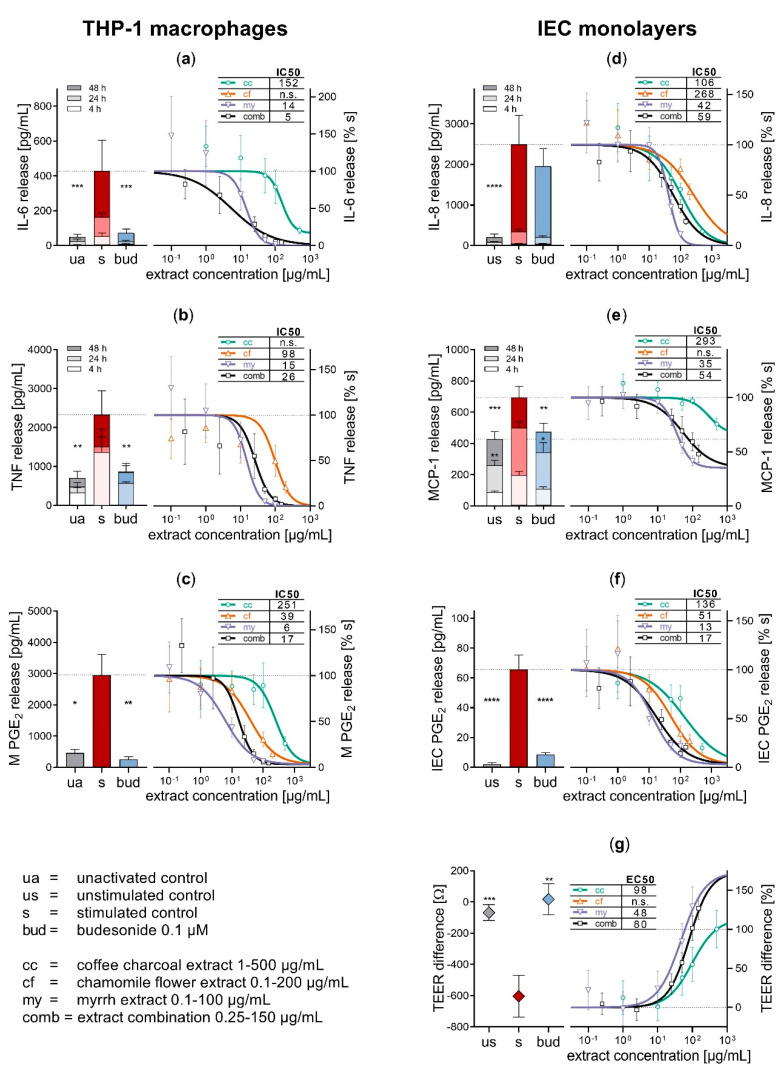
Recent clinical evidence suggests the efficacy of a traditional herbal medicinal product containing myrrh (Commiphora molmol Engl.), coffee charcoal (Coffea arabica L.) and chamomile flower dry extract (Matricaria chamomilla L.) in the therapy of inflammatory bowel diseases (IBD). However, the mechanisms of action in this context have not been entirely elucidated. The present study aimed to evaluate the effects of myrrh, coffee charcoal and chamomile flower extract on the inflammatory cross talk between immune and intestinal epithelial cells together with the resulting intestinal barrier disorders. A complex co-culture cell model consisting of intestinal epithelial cell (IEC) monolayers (Caco-2, HT29-MTX-E12) and macrophages (THP-1) was established for the simultaneous investigation of these two IBD characteristics. The lipopolysaccharide (LPS) activation of the macrophages led to a pro-inflammatory mediator release and thereby an inflammatory stimulation of IECs with chemokine release and reduced barrier function. The effects of the individual plant extracts and a ternary combination on inflammatory mediator release (IL-6, TNF, IL-8, MCP-1, PGE2) was quantified by ELISA. The transepithelial electrical resistance (TEER) of IEC monolayers was measured to evaluate the effects on the barrier function. Budesonide served as a positive control. All three plant extracts exhibited anti-inflammatory properties via the inhibition of the inflammatory mediator release to a varying extent. An intestinal barrier stabilising effect was observed for myrrh and coffee charcoal. Myrrh exerted the most distinct pharmacological activity. Dose reducing and synergistic interactions emerged within the threefold combination. Thus, our results provide a mechanistic basis for the use of the herbal combination of myrrh, coffee charcoal and chamomile flower extract in IBD treatment and underline the potential benefits of the phytotherapeutic multi-component/multi-target approach in this complex pathogenesis.
Overview
The claims and statistics of this paper haven’t been checked yet.
Free: it reads the open-access text and checks the first 5 claims that cite a source we can check. Create a free account to check every claim.
Integrity signals
Registry
Cites
Statistics
Figures
Verification
Claims the paper makes
The claims and statistics of this paper haven’t been checked yet.
Free: it reads the open-access text and checks the first 5 claims that cite a source we can check. Create a free account to check every claim.
Claims other papers make about this one
Each is checked against this paper’s own text: does it say what the citing paper says it does?
The source backs part of the claim, not all of it — or backs it for a different population, condition or comparison.
In the citing paper
“In this case, the intestinal cells increased their barrier function, and inflammatory mediators such as interleukin (IL) IL-6, IL-8, tumor necrosis factor (TNF), methyl-accepting chemotaxis protein-1 (MCP-1), and prostaglandin (PG) E2 were inhibited [76].”
From Effects of Coffee and Its Components on the Gastrointestinal Tract and the Brain–Gut Axis (2020) · cites this paper as [76]
Experimental — accuracy not yet measured
Self-check
Percentages, sums and reported differences re-computed from the paper’s own numbers.
The self-check needs the paper’s full text.
Citations
Cites
Chou, T.-C. (2006) · Pharmacological Reviews · doi:10.1124/pr.58.3.10 · Cited by 5,163 · cited 5×
“Based on the categorisation of Chou [16], an CI between 0.9 and 1.10 (0) indicates nearly additive effects.”
MethodInfluentialUnravelling the pathogenesis of inflammatory bowel disease
Xavier, R. J., & Podolsky, D. K. (2007) · Nature · doi:10.1038/nature06005 · Cited by 4,364
Gomollón, F., Dignass, A., Annese, V., Tilg, H., Van Assche, G., Lindsay, J. O., Peyrin-Biroulet, L., Cullen, G. J., Daperno, M., Kucharzik, T., et al. (2017) · Journal of Crohn's and Colitis · doi:10.1093/ecco-jcc/jjw168 · Cited by 2,057 · cited 2×
“in the treatment of inflammatory diseases like mildly to moderately active Crohn’s disease and asthma [24,25].”
BackgroundInflammatory bowel disease: Pathogenesis
Zhang, Y.-Z. (2014) · World Journal of Gastroenterology · doi:10.3748/wjg.v20.i1.91 · Cited by 1,507
Leaky gut: mechanisms, measurement and clinical implications in humans
Camilleri, M. (2019) · Gut · doi:10.1136/gutjnl-2019-318427 · Cited by 1,081
Martini, E., Krug, S. M., Siegmund, B., Neurath, M. F., & Becker, C. (2017) · Cellular and Molecular Gastroenterology and Hepatology · doi:10.1016/j.jcmgh.2017.03.007 · Cited by 668 · cited 1×
“However, inflammatory crosstalk between immune cells and intestinal epithelial cells (IECs) as well as inflammation-driven mucosal barrier dysfunction are pivotal to the complex IBD pathogenesis [13,14].”
BackgroundImportance of disrupted intestinal barrier in inflammatory bowel diseases
Salim, S. Y., & Söderholm, J. D. (2011) · Inflammatory Bowel Diseases · doi:10.1002/ibd.21403 · Cited by 602 · cited 1×
“However, inflammatory crosstalk between immune cells and intestinal epithelial cells (IECs) as well as inflammation-driven mucosal barrier dysfunction are pivotal to the complex IBD pathogenesis [13,14].”
BackgroundAn Update on Inflammatory Bowel Disease
Sairenji, T., Collins, K. L., & Evans, D. V. (2017) · Primary Care: Clinics in Office Practice · doi:10.1016/j.pop.2017.07.010 · Cited by 499 · cited 1×
“Therapeutic approaches aim to control the symptoms, increase the quality of life and prevent disease progression and complications [2].”
BackgroundWindsor, J. W., & Kaplan, G. G. (2019) · Current Gastroenterology Reports · doi:10.1007/s11894-019-0705-6 · Cited by 320
Lozoya-Agullo, I., Araújo, F., González-Álvarez, I., Merino-Sanjuán, M., González-Álvarez, M., Bermejo, M., & Sarmento, B. (2017) · Molecular Pharmaceutics · doi:10.1021/acs.molpharmaceut.6b01165 · Cited by 214 · cited 1×
“This co-culture model unites features of Caco-2/HT29-MTX-mucosa models that focus on intestinal epithelial cell function [27] with an experimental approach for inflammatory stimulation by involving THP-1 macrophages [28].”
Background
Cited by
A Comprehensive Study of Therapeutic Applications of Chamomile
Sah, A., Naseef, P. P., Kuruniyan, M. S., Jain, G. K., Zakir, F., & Aggarwal, G. (2022) · Pharmaceuticals · doi:10.3390/ph15101284 · Cited by 132
“The results suggest that chamomile flower extracts can be used for the alleviation of inflammation associated with IBS.”
BackgroundInfluentialEffects of Coffee and Its Components on the Gastrointestinal Tract and the Brain–Gut Axis
Iriondo-DeHond, A., Uranga, J. A., del Castillo, M. D., & Abalo, R. (2020) · Nutrients · doi:10.3390/nu13010088 · Cited by 126
“In this case, the intestinal cells increased their barrier function, and inflammatory mediators such as interleukin (IL) IL-6, IL-8, tumor necrosis factor (TNF), methyl-accepting chemotaxis protein-1 (MCP-1), and prostaglandin (PG) E2 were inhibited [76].”
BackgroundIn vitro models and ex vivo systems used in inflammatory bowel disease
Joshi, A., Soni, A., & Acharya, S. R. (2022) · In vitro models · doi:10.1007/s44164-022-00017-w · Cited by 87
Joumaa, M. M. E., & Borjac, J. (2022) · Phytochemistry Reviews · doi:10.1007/s11101-022-09817-0 · Cited by 90
“In addition, Weber et al. (2020) investigated the anti-inflammatory effect of ethanolic chamomile extract (0.1–200 lg/mL) against inflammatory bowel diseases (IBD), particularly on the inflammatory cross talk between immune and intestinal epithelial cells that leads to intestinal barrier disorders.”
BackgroundInfluentialJang, J. Y., Im, E., & Kim, N. D. (2023) · International Journal of Molecular Sciences · doi:10.3390/ijms24031954 · Cited by 67
Metadata
- Authors
- Weber, L., Kuck, K., Jürgenliemk, G., Heilmann, J., Lipowicz, B., & Vissiennon, C.
- Affiliations
- Repha (Germany) (DE)
- University of Regensburg (DE)
- Corresponding author
- Weber, Laura
- Vissiennon, Cica
- Venue
- Biomolecules
- Publisher
- MDPI AG
- Published
- 2020-07-11
- Volume
- 10
- Issue
- 7
- Pages
- 1033
- ISSN
- 2218-273X (ISSN-L)
- PMC
- PMC7407830
- OpenAlex
- W3041837931
- Cited by
- 51
- References
- 30
- Citations by year
- 2026: 5 · 2025: 8 · 2024: 5 · 2023: 12 · 2022: 10 · 2021: 6 · 2020: 5
- FWCI
- 4.84
- Type
- journal article
- Language
- en
- Open access
- gold
- dx.doi.org
- Licence
- Locations
- Biomolecules (publishedVersion, cc-by)
- PubMed Central (publishedVersion, cc-by)
- PubMed (publishedVersion)
- DOAJ (DOAJ: Directory of Open Access Journals) (submittedVersion, cc-by-sa)
- University of Regensburg Publication Server (University of Regensburg) (submittedVersion)
- Funders
- Repha GmbH Biologische Arzneimittel (not applicable)
- Topics
- Health Sciences › Medicine › Gastroenterology › Inflammatory Bowel Disease
- Life Sciences › Agricultural and Biological Sciences › Plant Science › Phytochemistry and biological activity of medicinal plants
- Health Sciences › Medicine › Pharmacology (medical) › Pharmacological Effects of Medicinal Plants
- Keywords
- myrrh, inflammatory bowel disease, intestinal barrier function, intestinal epithelial cells, macrophages, lipopolysaccharide, anti-inflammatory activity, herbal medicine, herbal combination, synergistic interaction, transepithelial electrical resistance, chemokine secretion, inflammatory cytokines
- MeSH terms
- THP-1 Cells, Anti-Inflammatory Agents, Cell Line, Humans, Intestinal Mucosa, Lipopolysaccharides, Models, Biological, Plant Extracts, Coculture Techniques, Chemokines, Caco-2 Cells, HT29 Cells, Chamomile, Commiphora, Flowers, Coffea
About these checks
Registry, retraction, Cites and statistics results are computed, not judged, with one exception: a printed reference that no index lists is read once by a model before it counts as a citation error. Claims are extracted by a model and kept only when their quote appears verbatim in the text; each cited source is then checked, with a model’s help, for whether it says what the claim relies on. Those verdicts can be wrong — read the claim’s quote and the cited source before relying on one.
Statistics and arithmetic are recomputed, not judged.
Confidence bands are shown only for fields calibrated on our annotated test set. None is calibrated yet, so no band is shown.
What counts as a claim ›How we measure confidence ›How we check this ›
Are you an author, or do you see a problem with this page? Request a review
How to cite
Cite CoChat for the checks on this page, and the paper for its own findings.
- This page
- CoChat. (2026). Citation check: Anti-Inflammatory and Barrier-Stabilising Effects of Myrrh, Coffee Charcoal and Chamomile Flower Extract in a Co-Culture Cell Model of the Intestinal Mucosa. https://app.cochat.ai/papers/10.3390/biom10071033
- The paper
- Weber, L., Kuck, K., Jürgenliemk, G., Heilmann, J., Lipowicz, B., & Vissiennon, C. (2020). Anti-Inflammatory and Barrier-Stabilising Effects of Myrrh, Coffee Charcoal and Chamomile Flower Extract in a Co-Culture Cell Model of the Intestinal Mucosa. Biomolecules. https://doi.org/10.3390/biom10071033
Data sources
Bibliographic data: Semantic Scholar, OpenAlex, Crossref.
Contains information from the Semantic Scholar Academic Graph Datasets, made available under the ODC Attribution License (ODC-BY 1.0).
Semantic Scholar’s data is described in: Kinney, R., et al. (2023). The Semantic Scholar Open Data Platform. arXiv:2301.10140.
