

Estrogens in Adipose Tissue Physiology and Obesity-Related Dysfunction
Open accessThe DOI matches its Crossref record; 174 of the 175 references it cites were found in a registry or an index.
Abstract
Menopause-related decline in estrogen levels is accompanied by a change in adipose tissue distribution from a gynoid to an android and an increased prevalence of obesity in women. These unfavorable phenomena can be partially restored by hormone replacement therapy, suggesting a significant role for estrogen in the regulation of adipocytes’ function. Indeed, preclinical studies proved the involvement of these hormones in adipose tissue development, metabolism, and inflammatory activity. However, the relationship between estrogen and obesity is bidirectional. On the one hand-their deficiency leads to excessive fat accumulation and impairs adipocyte function, on the other-adipose tissue of obese individuals is characterized by altered expression of estrogen receptors and key enzymes involved in their synthesis. This narrative review aims to summarize the role of estrogen in adipose tissue development, physiology, and in obesity-related dysfunction. Firstly, the estrogen classification, synthesis, and modes of action are presented. Next, their role in regulating adipogenesis and adipose tissue activity in health and the course of obesity is described. Finally, the potential therapeutic applications of estrogen and its derivates in obesity treatment are discussed.
Overview
The claims and statistics of this paper haven’t been checked yet.
Free: it reads the open-access text and checks the first 5 claims that cite a source we can check. Create a free account to check every claim.
Integrity signals
Registry
Cites
Statistics
Figures
Verification
Claims the paper makes
The claims and statistics of this paper haven’t been checked yet.
Free: it reads the open-access text and checks the first 5 claims that cite a source we can check. Create a free account to check every claim.
Claims other papers make about this one
Each is checked against this paper’s own text: does it say what the citing paper says it does?
The source backs part of the claim, not all of it — or backs it for a different population, condition or comparison.
In the citing paper
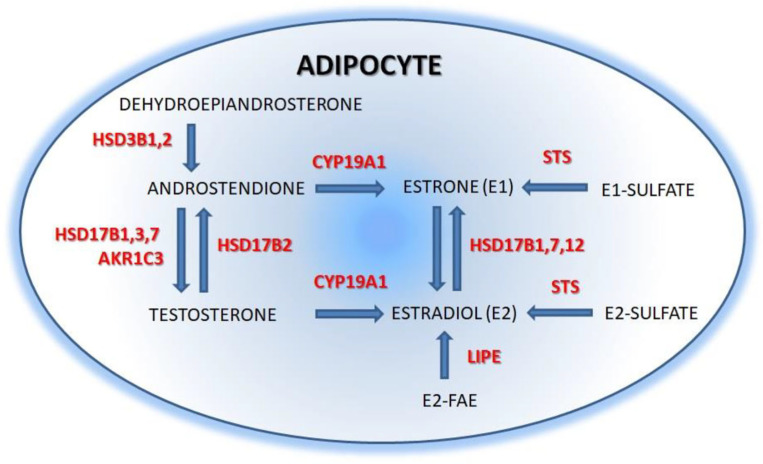
“E1 and E2 can interconvert due to the activity of several hydroxysteroid dehydrogenase (HSD) enzymes, HSD17β subtypes 1, 7, and 12 (62).”
From Metabolic impact of endogenously produced estrogens by adipose tissue in females and males across the lifespan (2025) · cites this paper as [62]
Experimental — accuracy not yet measuredThe source backs part of the claim, not all of it — or backs it for a different population, condition or comparison.
In the citing paper
“Briefly, as shown in Figure 1 , gonadal sex steroids are synthesized from cholesterol by the enzymatic action of steroidogenic acute regulatory protein (StAR) and CYP11A1.”
From Metabolic impact of endogenously produced estrogens by adipose tissue in females and males across the lifespan (2025) · cites this paper as [62]
Experimental — accuracy not yet measuredThe source backs part of the claim, not all of it — or backs it for a different population, condition or comparison.
In the citing paper
“E1 is primarily synthesized in adipose tissue through the aromatization of androgens via aromatase (CYP19A1) (62, 177).”
From Metabolic impact of endogenously produced estrogens by adipose tissue in females and males across the lifespan (2025) · cites this paper as [62]
Experimental — accuracy not yet measuredThe source backs part of the claim, not all of it — or backs it for a different population, condition or comparison.
In the citing paper
“the major substrates for aromatase-mediated estrogenesis in WAT are DHEA and androstenedione, and may be driven by inflammatory cytokines (62, 98).”
From Metabolic impact of endogenously produced estrogens by adipose tissue in females and males across the lifespan (2025) · cites this paper as [62]
Experimental — accuracy not yet measuredThe source backs part of the claim, not all of it — or backs it for a different population, condition or comparison.
In the citing paper
“WAT converts androgens to E1 via CYP19A1 (62, 141), an enzyme that appears to increase with adiposity in males due to the decline in available testosterone (187).”
From Metabolic impact of endogenously produced estrogens by adipose tissue in females and males across the lifespan (2025) · cites this paper as [62]
Experimental — accuracy not yet measured
3 more claims about this paper
Create a free account to see every claim other papers make about this one.
Self-check
Percentages, sums and reported differences re-computed from the paper’s own numbers.
The self-check needs the paper’s full text.
Citations
Cites
The metabolic phenotype in obesity: Fat mass, body fat distribution, and adipose tissue function
Goossens, G. H. (2017) · Obesity Facts · doi:10.1159/000471488 · Cited by 8,481
Identification and Importance of Brown Adipose Tissue in Adult Humans
Cypess, A. M., Lehman, S., Williams, G., Tal, I., Rodman, D., Goldfine, A. B., Kuo, F. C., Palmer, E. L., Tseng, Y.-H., Doria, A., et al. (2009) · New England Journal of Medicine · doi:10.1056/nejmoa0810780 · Cited by 4,399
Estrogen Resistance Caused by a Mutation in the Estrogen-Receptor Gene in a Man
Smith, E. P., Boyd, J., Frank, G. R., Takahashi, H., Cohen, R. M., Specker, B., Williams, T. C., Lubahn, D. B., & Korach, K. S. (1994) · New England Journal of Medicine · doi:10.1056/nejm199410203311604 · Cited by 2,471
Adipocytes as regulators of energy balance and glucose homeostasis
Rosen, E. D., & Spiegelman, B. M. (2006) · Nature · doi:10.1038/nature05483 · Cited by 2,170
Overview of steroidogenic enzymes in the pathway from cholesterol to active steroid hormones
Payne, A. H., & Hales, D. B. (2004) · Endocrine Reviews · doi:10.1210/er.2003-0030 · Cited by 1,766 · cited 1×
“Classical steroidogenic tissues, including gonads, adrenals, and placenta, can synthesize steroid hormones de novo from cholesterol, while steroid synthesis in other tissues mainly relies on the conversion of various precursors obtained from circulation [21].”
BackgroundChait, A., & den Hartigh, L. J. (2020) · Frontiers in Cardiovascular Medicine · doi:10.3389/fcvm.2020.00022 · Cited by 1,529 · cited 1×
“Therefore, the health risk of an obese individual is determined not only by the total amount of adipose tissue but also by its distribution and metabolic activity [4].”
BackgroundIncreased adipose tissue in male and female estrogen receptor-α knockout mice
Heine, P. A., Taylor, J. A., Iwamoto, G. A., Lubahn, D. B., & Cooke, P. S. (2000) · Proceedings of the National Academy of Sciences · doi:10.1073/pnas.97.23.12729 · Cited by 1,282 · cited 1×
“Mice with a global ERα-knockout (αERKO), regardless of sex, are characterized by a significant (50–180%) increase in adipocyte number that is accompanied by insulin resistance, glucose intolerance, and liver steatosis [52].”
BackgroundEstrogen receptor signaling mechanisms
(2019) · Advances in Protein Chemistry and Structural Biology · doi:10.1016/bs.apcsb.2019.01.001 · Cited by 988 · cited 1×
“Upon ligand binding, ERs undergo conformational changes that allow for the formation of heterodimers and interaction with estrogen response elements (ERE) in the promoter of a target gene [37].”
BackgroundThe sexual dimorphism of obesity
Palmer, B. F., & Clegg, D. J. (2015) · Molecular and Cellular Endocrinology · doi:10.1016/j.mce.2014.11.029 · Cited by 919 · cited 1×
“This finding points to the role of estrogen in regulating adipose tissue distribution [6,7].”
BackgroundAndrogens Decrease Plasma Adiponectin, an Insulin-Sensitizing Adipocyte-Derived Protein
Nishizawa, H., Shimomura, I., Kishida, K., Maeda, N., Kuriyama, H., Nagaretani, H., Matsuda, M., Kondo, H., Furuyama, N., Kihara, S., et al. (2002) · Diabetes · doi:10.2337/diabetes.51.9.2734 · Cited by 837
Research works printed but not linked: 1
- 28. Gardner, D.G.; Shoback, D. Greenspan's Basic & Clinical Endocrinology , 7th ed.; McGraw-Hill Medical: New York, NY, USA, 2011.
Cited by
Items 201–221 of 221
The Intricate Relationship between Obesity and Type 2 Diabetes
Poznyak, A. V., Pleshko, E. M., Utkina, A. S., Maltseva, O. N., Asoyan, A., & Orekhov, A. N. (2026) · OnLine Journal of Biological Sciences · doi:10.3844/ojbsci.2026.26.01.010
Acute Effects of Aromatase Inhibitor Therapy for Breast Cancer on Glycemic Control
Lee, O. R. (2026) · TSpace (University of Toronto)
Gdańska, A., Jurys, T., Sadowska‐Krępa, E., & Grajek, M. K. (2026) · Menopause Review/Przegląd Menopauzalny · doi:10.5114/pm.2026.163868
“Additionally, alterations in lipid and glucose metabolism, as well as impaired vitamin D metabolism, may contribute to bone demineralization and an increased risk of osteoporosis [6].”
Bahtiar, A., Angie, A. N., Wahyuni, T., & Siriamornpun, S. (2026) · Nutrients · doi:10.3390/nu18172874
“Consequently, estrogen deficiency often leads to increased adiposity and metabolic dysfunction [40].”
Heimer, J., Spielhofer, N., Schwyzer, M., Becker, A. S., Reinisch, I., Krämer, S. D., Hamilton, B. S., Panova‐Noeva, M., Neubauer, H., Wolfrum, C., et al. (2026) · EANM Innovation · doi:10.1016/j.eanmi.2026.100304
Biotics in Menopausal Health: A Two-Decade Bibliometric Analysis and Narrative Review
Olawale, F., Alake, S. E., Chandrashekar, R., Kim, Y., Chowanadisai, W., (6622952), E. A. M., Smith, B. J., & Lucas, E. A. (2026) · Current Nutrition Reports · doi:10.1007/s13668-026-00798-6
Chmurzyńska, A., Muzsik, A., Skoczek-Rubińska, A., Stanisławska, W., & Bajerska, J. (2026) · Maturitas · doi:10.1016/j.maturitas.2026.109120
NUTRIÇÃO NO CLIMATÉRIO: ESTRATÉGIAS PARA A SAÚDE ÓSSEA, METABÓLICA E CARDIOVASCULAR DA MULHER
da Silva, A. C., Murta, L. T., Estanislau, N. T., Alves, A. J. M., Valgoi, E. F., Pereira, J. F., Nascimento, J. L. M. D. C., Miranda, E. M. F., Brito, T. K. D. C., Machado, G. C., et al. (2026) · Editora Pasteur eBooks · doi:10.59290/8990242221
Medeiros, R. D. O., Abrão, F., Abrão, L., Pozenato, C. G. D. A., Buzeto, C. A. C., de Brito, M. L., de Freitas, I. C. Z., do Santo, V. A., Ponciano, G. H. D. P. R., Marques, B., et al. (2026) · Biomedicines · doi:10.3390/biomedicines14092039
“This hormonal imbalance is compounded by increased aromatase activity in expanded adipose tissue, which promotes peripheral conversion of androgens to estrogens and further destabilizes the reproductive axis [3,13].”
Bilal, K., Nazeem, S., Farman, W., Kamran, M., & Sami, M. U. (2026) · Research Square · doi:10.21203/rs.3.rs-10563595/v1
Sanyoto, D. D., Triawanti, T., Limantara, S., Juhairina, J., Setiawan, B., Qomariah, N., Dafif, M. W., Habibah, A. U., Zeta, M., Airlangga, D. I., et al. (2025) · SELAPARANG Jurnal Pengabdian Masyarakat Berkemajuan · doi:10.31764/jpmb.v9i6.34667
Xie, C., 庄, 明., Huang, J., & Guo, Y. (2026) · Metabolites · doi:10.3390/metabo16100725
“Adipose tissue expansion may enhance aromatase activity, thereby promoting the conversion of androgens into estrogens [11].”
Lee, C., Park, S., Lee, C., Lee, D., Ha, H., Shin, H., Kim, T., Cho, C., Byun, K., & Lee, S. (2026) · Physical Activity and Nutrition · doi:10.20463/pan.2026.0050
“Adipose tissue is not only an energy storage organ but also an endocrine organ, and physiological changes in adipose tissue after menopause may be closely related to the estrogen milieu and metabolic homeostasis 8 .”
Ahmadi, M., Pourjafari, F., Sheikhbahaei, F., Mansoori, M., Asadi, A., Haghpanah, T., & Eftekhar‐Vaghefi, S. H. (2026) · Journal of Molecular Histology · doi:10.1007/s10735-026-10988-9
“By signaling through estrogen receptor α (Kuryłowicz 2023), estrogens suppress lipoprotein lipase in visceral depots and favor subcutaneous fat accumulation, reducing free fatty acid flux to the liver and muscle and thereby limiting ectopic lipid-induced impairment of insulin signaling and glucose…”
Aldayel, T. S., Mahmoud, H. S., Abdelrazek, H. M. A., Elsayed, D. H., Higo, M. A., Eltamany, E. E., & El-Hak, H. N. G. (2026) · Frontiers in Pharmacology · doi:10.3389/fphar.2026.1841164
“Despite this decline, low levels of circulating estrogens persist in postmenopausal women, largely due to extragonadal aromatization of androgens primarily in adipose tissue, where ovarian and adrenal precursors are converted into estrogen (Kuryłowicz, 2023).”
Nateghi, M. R., Naderi, M. S., & Mohammadian, H. (2025) · Sarem Journal of Medical Research · doi:10.66224/sjrm.10.2.3
Wright, N. C., Hossain, R., Bouxsein, M., Keaveny, T. M., Lee, D. C., Hellemann, G. S., Carr, J. J., Terry, J. G., Warriner, A. H., & Lewis, C. E. (2026) · Journal of the Endocrine Society · doi:10.1210/jendso/bvag193
“Adipose tissue and estrogen have a complex relationship, with both positive and negative effects on bone (84), so a deeper exploration into these pathways could further elucidate information on the relationship between CMD and vertebral strength properties in women.”
Despot, A., Sabol, I., Hrgović, Z., Despot, A.-M., Vlatkovic, I., Tešanović, M., Fureš, D., Malojčić, S. M., Ćosić, V., Sinković, N., et al. (2026) · Cells · doi:10.3390/cells15211956
Endometrial Hyperplasia as an Actionable Precursor to Endometrial Cancer: Narrative Review
Krynytska, І., Орел, Ю. М., Hladii, O. I., Mykolenko, A. Z., & Golovata, T. (2026) · Україна Здоров’я нації · doi:10.32782/2077-6594/2026.3/05
“Lastly, higher concentrations of estradiol can be found in obese patients as plasma levels of estradiol-binding sex hormone-binding globulin (SHBG) are typically depressed in this patient population [35; 36].”
Hegazy, M., Mattar, A., Shawky, M., Soliman, D. S., Mowafy, M., NourEldin, Y. M., Noweir, A. M., Aboulghate, M. K., Elshazli, M., Hassaballa, M. A., et al. (2026) · Diabetes Metabolic Syndrome and Obesity · doi:10.2147/dmso.s629991
The Emerging Role of CYP17A1 in Diabetes and Related Metabolic Disorders
Alhalwachi, Z., Zainalabedin, M., Alhayki, D., Alsultan, A. B., Abdullahi, S., Alnahwi, K. A., Butler, A. E., & Hasan, A. S. H. (2026) · International Journal of Molecular Sciences · doi:10.3390/ijms27219826
Metadata
- Authors
- Kuryłowicz, A.
- Affiliations
- Mossakowski Medical Research Institute, Polish Academy of Sciences (PL)
- Corresponding author
- Kuryłowicz, Alina
- ORCID
- Kuryłowicz, Alina
- Venue
- Biomedicines
- Publisher
- MDPI AG
- Published
- 2023-02-24
- Volume
- 11
- Issue
- 3
- Pages
- 690
- ISSN
- 2227-9059 (ISSN-L)
- PMC
- PMC10045924
- OpenAlex
- W4321786273
- Semantic Scholar
- 1e70d4f2c94aa332018deb017aac0942bbcefa03
- Cited by
- 178
- References
- 175
- Citations by year
- 2026: 67 · 2025: 74 · 2024: 26 · 2023: 11
- FWCI
- 6.86
- Type
- journal article
- Language
- en
- Open access
- gold
- doi.org
- Licence
- Locations
- Biomedicines (publishedVersion, cc-by)
- PubMed Central (publishedVersion, cc-by)
- PubMed (publishedVersion)
- DOAJ (DOAJ: Directory of Open Access Journals) (submittedVersion, cc-by-sa)
- Funders
- National Science Centre Poland (2018/31/B/NZ5/01556)
- Topics
- Life Sciences › Biochemistry, Genetics and Molecular Biology › Endocrinology › Estrogen and related hormone effects
- Health Sciences › Medicine › Endocrinology, Diabetes and Metabolism › Adipokines, Inflammation, and Metabolic Diseases
- Health Sciences › Medicine › Physiology (medical) › Adipose Tissue and Metabolism
- Keywords
- estrogen, adipose tissue, obesity, menopause, hormone replacement therapy, estrogen receptor, adipogenesis, adipocyte function, estrogen synthesis, obesity-associated inflammation, estrogen derivatives, obesity treatment
About these checks
Registry, retraction, Cites and statistics results are computed, not judged, with one exception: a printed reference that no index lists is read once by a model before it counts as a citation error. Claims are extracted by a model and kept only when their quote appears verbatim in the text; each cited source is then checked, with a model’s help, for whether it says what the claim relies on. Those verdicts can be wrong — read the claim’s quote and the cited source before relying on one.
Statistics and arithmetic are recomputed, not judged.
Confidence bands are shown only for fields calibrated on our annotated test set. None is calibrated yet, so no band is shown.
What counts as a claim ›How we measure confidence ›How we check this ›
Are you an author, or do you see a problem with this page? Request a review
Data sources
Bibliographic data: Semantic Scholar, OpenAlex, Crossref.
Contains information from the Semantic Scholar Academic Graph Datasets, made available under the ODC Attribution License (ODC-BY 1.0).
Semantic Scholar’s data is described in: Kinney, R., et al. (2023). The Semantic Scholar Open Data Platform. arXiv:2301.10140.
