

Functional Evaluation and Nephrotoxicity Assessment of Human Renal Proximal Tubule Cells on a Chip
Open accessThe DOI matches its Crossref record; 39 of the 40 references it cites were found in a registry or an index, and 1 are not checked yet.
Abstract
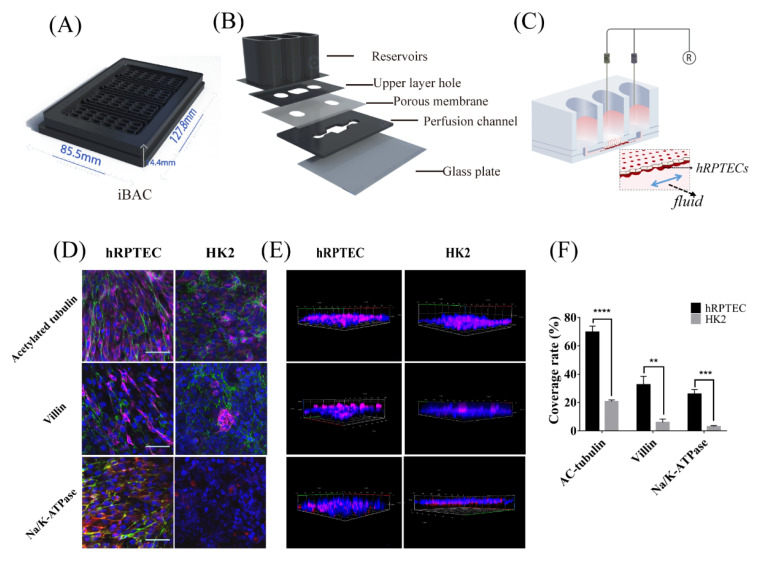
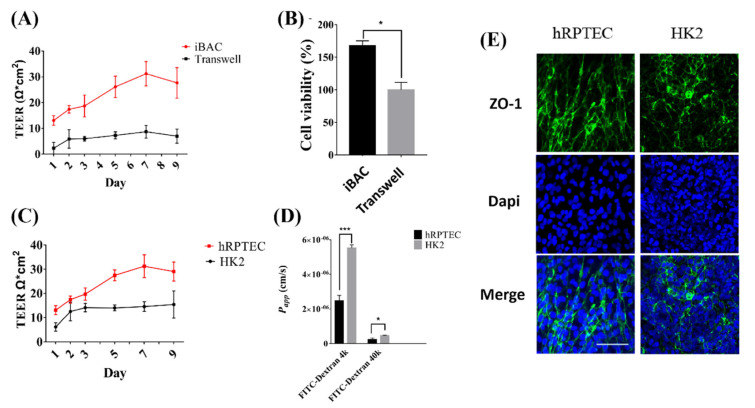
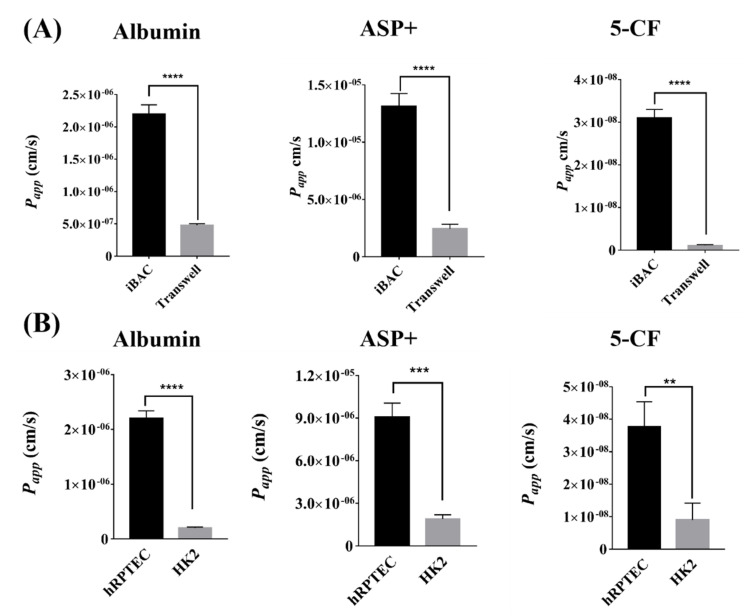
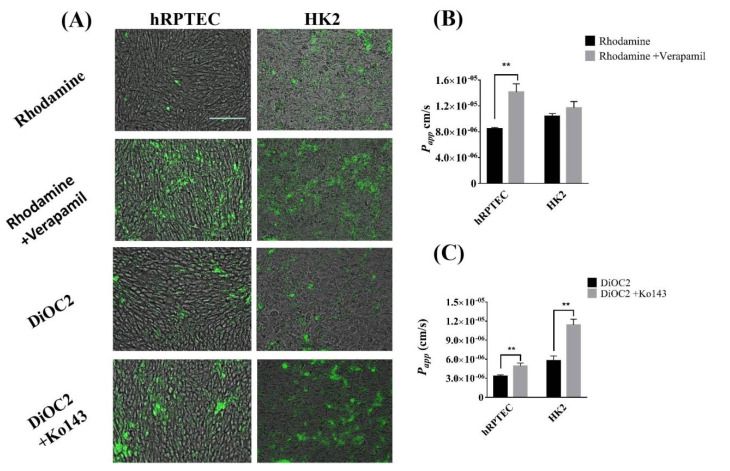
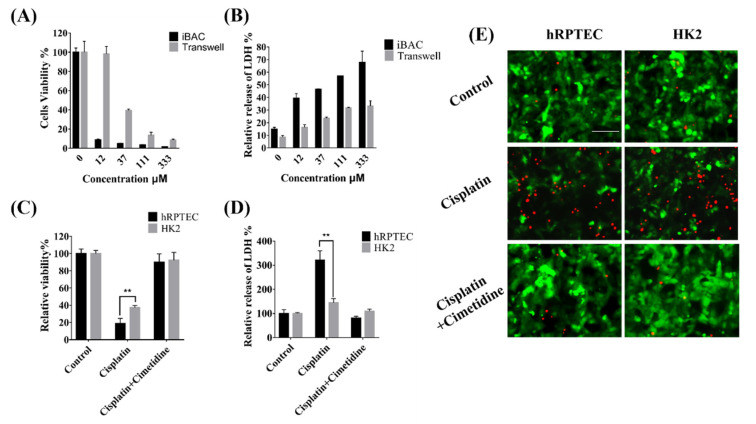
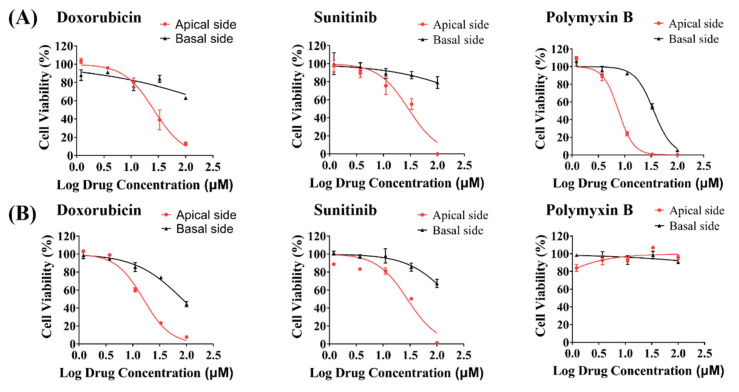
An in vitro human renal proximal tubule model that represents the proper transporter expression and pronounced epithelial polarization is necessary for the accurate prediction of nephrotoxicity. Here, we constructed a high-throughput human renal proximal tubule model based on an integrated biomimetic array chip (iBAC). Primary human renal proximal tubule epithelial cells (hRPTECs) cultured on this microfluidic platform were able to form a tighter barrier, better transporter function and more sensitive nephrotoxicity prediction than those on the static Transwell. Compared with the human immortalized HK2 model, the hRPTECs model on the chip gained improved apical-basolateral polarization, barrier function and transporter expression. Polymyxin B could induce nephrotoxicity not only from the apical of the hRPTECs, but also from the basolateral side on the iBAC. However, other chemotherapeutic agents, such as doxorubicin and sunitinib, only induced nephrotoxicity from the apical surface of the hRPTECs on the iBAC. In summary, our renal proximal tubule model on the chip exhibits improved epithelial polarization and membrane transporter activity, and can be implemented as an effective nephrotoxicity-screening toolkit.
Overview
The claims and statistics of this paper haven’t been checked yet.
Free: it reads the open-access text and checks the first 5 claims that cite a source we can check. Create a free account to check every claim.
Integrity signals
Registry
Cites
Statistics
Figures
Verification
Claims the paper makes
The claims and statistics of this paper haven’t been checked yet.
Free: it reads the open-access text and checks the first 5 claims that cite a source we can check. Create a free account to check every claim.
Claims other papers make about this one
Each is checked against this paper’s own text: does it say what the citing paper says it does?
The source backs part of the claim, not all of it — or backs it for a different population, condition or comparison.
In the citing paper
“Jing et al. (2022)reported that primary human renal proximal tubule epithelial cells cultured in a kidneyon-a-chip model showed improved epithelial polarization, barrier integrity, transporter function, and nephrotoxicity prediction compared with static Transwell culture.”
From Primary cell cultures versus immortalized cell lines: critical comparative insights into biological fidelity and translational applications (2026) · cites this paper as Jing et al. 2022
Experimental — accuracy not yet measuredThe source backs part of the claim, not all of it — or backs it for a different population, condition or comparison.
In the citing paper
“Furthermore, it is well-suited for experiments involving inserts or MPS and is widely used in our laboratory for studies that model the kidney (Nihei et al., 2025).”
From Material-dependent oxygen transport governs ischemia-reperfusion injury and drug response in a kidney microphysiological system (2026) · cites this paper as Nihei et al., 2025
Experimental — accuracy not yet measuredThe cited source says what the claim attributes to it.
In the citing paper
“As a result, primary cells cultured in MPS platforms can retain and display organspecific functions more effectively than those maintained in conventional static two-dimensional cultures”
From Primary cell cultures versus immortalized cell lines: critical comparative insights into biological fidelity and translational applications (2026) · cites this paper as Jing et al. 2022
Self-check
Percentages, sums and reported differences re-computed from the paper’s own numbers.
The self-check needs the paper’s full text.
Citations
Cites
Organs-on-chips: into the next decade
Low, L. A., Mummery, C., Berridge, B. R., Austin, C. P., & Tagle, D. A. (2021) · Nature Reviews Drug Discovery · doi:10.1038/s41573-020-0079-3 · Cited by 1,029 · cited 1×
“Therefore, the establishment of an in vitro model mimicking human renal physiology for nephrotoxicity evaluation can retain more promising lead compounds and reduce the failure rate of clinical trials [7].”
BackgroundHK-2: An immortalized proximal tubule epithelial cell line from normal adult human kidney
Ryan, M. J., Johnson, G., Kirk, J., Fuerstenberg, S. M., Zager, R. A., & Torok-Storb, B. (1994) · Kidney International · doi:10.1038/ki.1994.6 · Cited by 891 · cited 1×
“The commonly used renal cell-based models are HK2 or MDCK cells cultured in multi-well plates, which cannot recreate the crucial physiological functions of the renal proximal tubule, and only allow restricted access to its basolateral surface for proper toxicity evaluation [24,25].”
MethodHuman kidney proximal tubule-on-a-chip for drug transport and nephrotoxicity assessment
Jang, K.-J., Mehr, A. P., Hamilton, G. A., McPartlin, L. A., Chung, S., Suh, K.-Y., & Ingber, D. E. (2013) · Integrative Biology · doi:10.1039/c3ib40049b · Cited by 849 · cited 2×
“discovered exposure of the epithelial monolayer to an apical fluid shear stress enhanced epithelial cell polarization and primary cilia formation compared to traditional Transwell culture systems [20].”
BackgroundResultToxicity of polymyxins: a systematic review of the evidence from old and recent studies
Falagas, M. E., & Kasiakou, S. K. (2006) · Critical Care · doi:10.1186/cc3995 · Cited by 828
Zuk, A., & Bonventre, J. V. (2016) · Annual Review of Medicine · doi:10.1146/annurev-med-050214-013407 · Cited by 739 · cited 1×
“Drug-induced kidney injury (DIKI), one of the common adverse drug effects, is frequently discovered during later phases of pharmaceutical development and in clinical practices [1].”
BackgroundHerland, A., Maoz, B. M., Das, D., Somayaji, M. R., Prantil-Baun, R., Novak, R., Cronce, M., Huffstater, T., Jeanty, S. S. F., Ingram, M., et al. (2020) · Nature Biomedical Engineering · doi:10.1038/s41551-019-0498-9 · Cited by 500
Kidney-on-a-Chip technology for drug-induced nephrotoxicity screening
Wilmer, M. J., Ng, C. P., Lanz, H. L., Vulto, P., Suter-Dick, L., & Masereeuw, R. (2016) · Trends in Biotechnology · doi:10.1016/j.tibtech.2015.11.001 · Cited by 354 · cited 1×
“FSS was shown to play a critical role in improving the functionality and polarization of renal proximal tubule in vitro [17,18].”
BackgroundRenal Transporters in Drug Development
Morrissey, K. M., Stocker, S. L., Wittwer, M. B., Xu, L., & Giacomini, K. M. (2013) · Annual Review of Pharmacology and Toxicology · doi:10.1146/annurev-pharmtox-011112-140317 · Cited by 324 · cited 1×
“This transportation system selectively reabsorbs crucial nutrients, ions and water from glomerulus ultrafiltrate, and actively excretes endogenous and exogenous wastes, toxins and drugs, from blood [3].”
BackgroundPabla, N., Murphy, R. F., Liu, K., & Dong, Z. (2009) · American Journal of Physiology-Renal Physiology · doi:10.1152/ajprenal.90545.2008 · Cited by 283 · cited 1×
“Cisplatin, a classic nephrotoxic chemotherapeutic agent, is absorbed into RPTEC via the basolateral OCT2, copper transporter 1 (CTR1) and the less explored volumeregulated anion channel (VRAC) transporters [33].”
BackgroundIngber, D. E. (2020) · Advanced Science · doi:10.1002/advs.202002030 · Cited by 277 · cited 1×
“The in vitro PTOC is a promising platform for toxicology study, since it overcomes certain limitations of the animal model, such as high cost, low throughput and inconsistent prediction of human outcomes [27,28].”
Background
Cited by
Seal, S., Mahale, M., García-Ortegón, M., Joshi, C. K., Hosseini-Gerami, L., Beatson, A., Greenig, M., Shekhar, M., Patra, A., Weis, C., et al. (2025) · Chemical Research in Toxicology · doi:10.1021/acs.chemrestox.5c00033 · Cited by 187
Revolutionizing nephrology research: expanding horizons with kidney-on-a-chip and beyond
Huang, W., Chen, Y., He, F.-F., & Zhang, C. (2024) · Frontiers in Bioengineering and Biotechnology · doi:10.3389/fbioe.2024.1373386 · Cited by 36
Application of microfluidic chips in the simulation of the urinary system microenvironment
Hou, C., Gu, Y., Yuan, W., Zhang, W., Xiu, X., Lin, J., Gao, Y., Liu, P., Chen, X., & Song, L. (2023) · Materials Today Bio · doi:10.1016/j.mtbio.2023.100553 · Cited by 31
Microfluidics and Organ-on-a-Chip for Disease Modeling and Drug Screening
Nasiri, R., Zhu, Y., & de Barros, N. R. (2024) · Biosensors · doi:10.3390/bios14020086 · Cited by 21
Novel emerging cell and organoid systems for the study of drug metabolism and toxicity in humans
Gracey, E. G., & Lampe, J. N. (2025) · Drug Metabolism and Disposition · doi:10.1016/j.dmd.2025.100188 · Cited by 11
“66,67 RPTECs are the most correlated with DIKI due to their high transporter expression, including OCT2 and OATP1, and have been shown to predict DIKI in a similar fashion to animal models.”
Metadata
- Authors
- Jing, B., Yan, L., Li, J., Luo, P., Ai, X., & Tu, P.
- Affiliations
- Peking University (CN)
- R&D Department Beijing Daxiang Biotech, No. 80 Xingshikou Road, Beijing 100195, China
- Corresponding author
- Ai, Xiaoni
- Tu, Pengfei
- Venue
- Biosensors
- Publisher
- MDPI AG
- Published
- 2022-09-03
- Volume
- 12
- Issue
- 9
- Pages
- 718
- ISSN
- 2079-6374 (ISSN-L)
- PMC
- PMC9496563
- OpenAlex
- W4294989783
- Cited by
- 21
- References
- 39
- Citations by year
- 2026: 8 · 2025: 6 · 2024: 4 · 2023: 3
- FWCI
- 0.94
- Type
- journal article
- Language
- en
- Open access
- gold
- doi.org
- Licence
- Locations
- Biosensors (publishedVersion, cc-by)
- PubMed Central (publishedVersion, cc-by)
- PubMed (publishedVersion)
- DOAJ (DOAJ: Directory of Open Access Journals) (submittedVersion, cc-by-sa)
- Funders
- the National Natural Science Foundation of China (82174086, 82030114, 7222273, 2020-QNRC2-08, BMU2021MX009)
- Beijing Natural Science Foundation (82174086, 82030114, 7222273, 2020-QNRC2-08, BMU2021MX009)
- the Youth Talents Promotion Project of China Association of Chinese Medicine (82174086, 82030114, 7222273, 2020-QNRC2-08, BMU2021MX009)
- Peking University Medicine Seed Fund for Interdisciplinary Research (82174086, 82030114, 7222273, 2020-QNRC2-08, BMU2021MX009)
- Topics
- Physical Sciences › Engineering › Biomedical Engineering › 3D Printing in Biomedical Research
- Health Sciences › Medicine › Nephrology › Acute Kidney Injury Research
- Physical Sciences › Engineering › Biomedical Engineering › Microfluidic and Capillary Electrophoresis Applications
- Keywords
- nephrotoxicity, proximal tubule, microfluidics, epithelial polarization, barrier function, membrane transporters, polymyxin B, doxorubicin, sunitinib, in vitro toxicity screening, HK-2 cells
- MeSH terms
- Sunitinib, Doxorubicin, Epithelial Cells, Humans, Polymyxin B, Membrane Transport Proteins, Lab-On-A-Chip Devices, Drug-Related Side Effects and Adverse Reactions
About these checks
Registry, retraction, Cites and statistics results are computed, not judged, with one exception: a printed reference that no index lists is read once by a model before it counts as a citation error. Claims are extracted by a model and kept only when their quote appears verbatim in the text; each cited source is then checked, with a model’s help, for whether it says what the claim relies on. Those verdicts can be wrong — read the claim’s quote and the cited source before relying on one.
Statistics and arithmetic are recomputed, not judged.
Confidence bands are shown only for fields calibrated on our annotated test set. None is calibrated yet, so no band is shown.
What counts as a claim ›How we measure confidence ›How we check this ›
Are you an author, or do you see a problem with this page? Request a review
Data sources
Bibliographic data: Semantic Scholar, OpenAlex, Crossref.
Contains information from the Semantic Scholar Academic Graph Datasets, made available under the ODC Attribution License (ODC-BY 1.0).
Semantic Scholar’s data is described in: Kinney, R., et al. (2023). The Semantic Scholar Open Data Platform. arXiv:2301.10140.
