

Prolonged Intrinsic Neural Timescales Dissociate from Phase Coherence in Schizophrenia
Open accessThe DOI matches its Crossref record; 40 of the 40 references it cites were found in a registry or an index.
Abstract
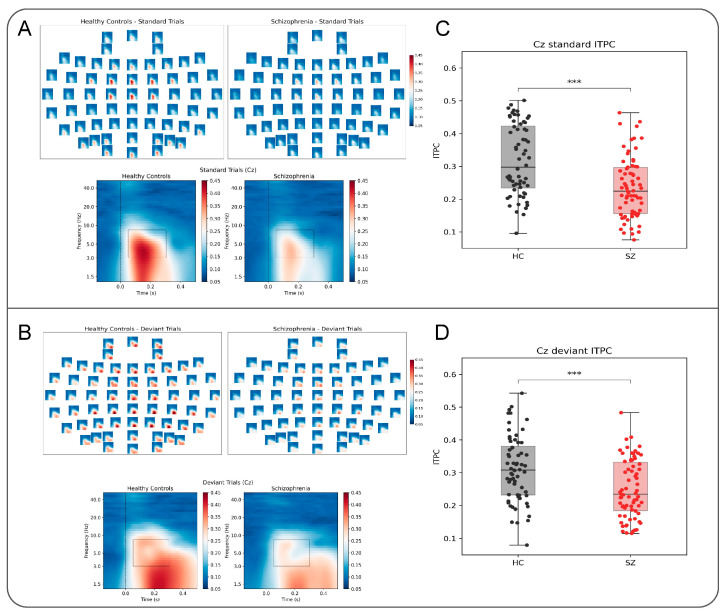
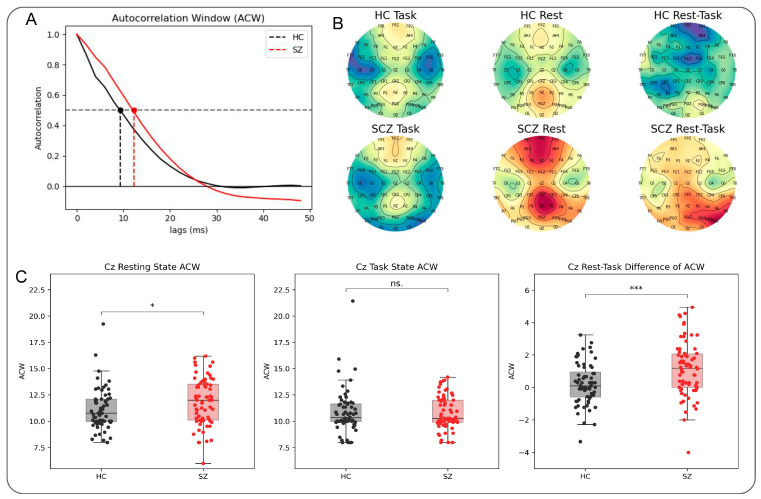
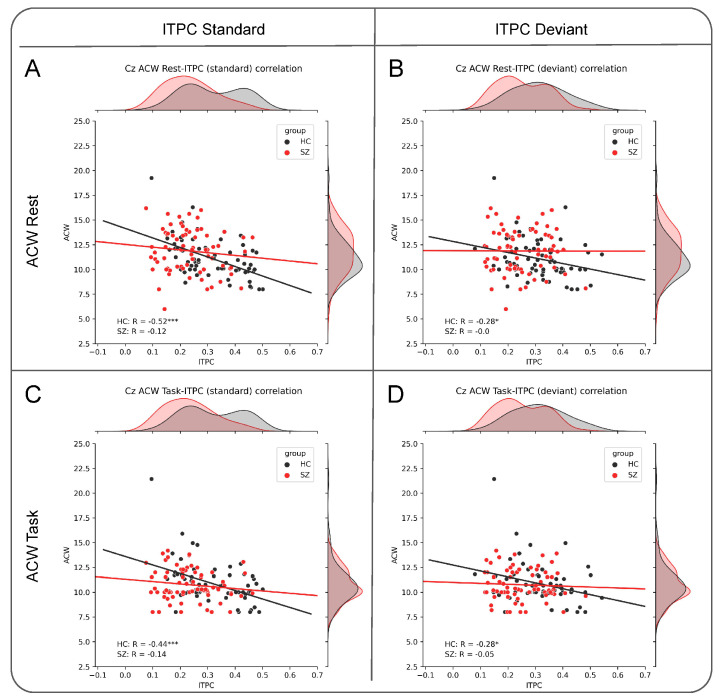
Input processing in the brain is mediated by phase synchronization and intrinsic neural timescales, both of which have been implicated in schizophrenia. Their relationship remains unclear, though. Recruiting a schizophrenia EEG sample from the B-SNIP consortium dataset (n = 134, 70 schizophrenia patients, 64 controls), we investigate phase synchronization, as measured by intertrial phase coherence (ITPC), and intrinsic neural timescales, as measured by the autocorrelation window (ACW) during both the rest and oddball-task states. The main goal of our paper was to investigate whether reported shifts from shorter to longer timescales are related to decreased ITPC. Our findings show (i) decreases in both theta and alpha ITPC in response to both standard and deviant tones; and (iii) a negative correlation of ITPC and ACW in healthy subjects while such correlation is no longer present in SCZ participants. Together, we demonstrate evidence of abnormally long intrinsic neural timescales (ACW) in resting-state EEG of schizophrenia as well as their dissociation from phase synchronization (ITPC). Our data suggest that, during input processing, the resting state’s abnormally long intrinsic neural timescales tilt the balance of temporal segregation and integration towards the latter. That results in temporal imprecision with decreased phase synchronization in response to inputs. Our findings provide further evidence for a basic temporal disturbance in schizophrenia on the different timescales (longer ACW and shorter ITPC), which, in the future, might be able to explain common symptoms related to the temporal experience in schizophrenia, for example temporal fragmentation.
Overview
The claims and statistics of this paper haven’t been checked yet.
Free: it reads the open-access text and checks the first 5 claims that cite a source we can check. Create a free account to check every claim.
Integrity signals
Registry
Cites
Statistics
Figures
Verification
Claims the paper makes
The claims and statistics of this paper haven’t been checked yet.
Free: it reads the open-access text and checks the first 5 claims that cite a source we can check. Create a free account to check every claim.
Claims other papers make about this one
Each is checked against this paper’s own text: does it say what the citing paper says it does?
The cited source says what the claim attributes to it.
In the citing paper
“Our findings complement evidence from psychiatric populations,35,89,90 suggesting that dysfunctional allostatic-interoception may be a transdiagnostic feature.11”
From Altered spatiotemporal brain dynamics of interoception in behavioural-variant frontotemporal dementia (2025) · cites this paper as [35]
In the citing paper
“Additionally, in the current work we focused on the time-domain of INT,15 in line with previous works.35,70”
From Altered spatiotemporal brain dynamics of interoception in behavioural-variant frontotemporal dementia (2025) · cites this paper as [35]
In the citing paper
“Altered intrinsic neural timescales measured by the ACW are observed in psychiatric conditions during resting state and self-referential processing.35,89,90”
From Altered spatiotemporal brain dynamics of interoception in behavioural-variant frontotemporal dementia (2025) · cites this paper as [35]
Self-check
Percentages, sums and reported differences re-computed from the paper’s own numbers.
The self-check needs the paper’s full text.
Citations
Cites
Delorme, A., & Makeig, S. (2004) · Journal of Neuroscience Methods · doi:10.1016/j.jneumeth.2003.10.009 · Cited by 24,371 · cited 1×
“Raw data were down-sampled to 500 Hz and then preprocessed using the Harvard Automated Preprocessing Pipeline for EEG (HAPPE) [28] in EEGLAB v2018b [29], following the procedure in Northoff et al.”
MethodStatsmodels: Econometric and Statistical Modeling with Python
Seabold, S., & Perktold, J. (2010) · Proceedings of the Python in Science Conference · doi:10.25080/majora-92bf1922-011 · Cited by 6,465 · cited 1×
“The autocorrelation function was obtained for each subject and channel using the fast Fourier transform algorithm as implemented in statsmodels library for python [32].”
MethodMNE software for processing MEG and EEG data
Gramfort, A., Luessi, M., Larson, E., Engemann, D. A., Strohmeier, D., Brodbeck, C., Parkkonen, L., & Hämäläinen, M. S. (2014) · NeuroImage · doi:10.1016/j.neuroimage.2013.10.027 · Cited by 1,951 · cited 1×
“tfr_morlet function, with the number of cycles set to half of each frequency [31].”
BackgroundMining event-related brain dynamics
Makeig, S., Debener, S., Onton, J., & Delorme, A. (2004) · Trends in Cognitive Sciences · doi:10.1016/j.tics.2004.03.008 · Cited by 1,493 · cited 2×
“ITPC is based on the ongoing randomly distributed phase angles which are reset by the incoming external stimulus—this results in the clustering of phase angles at the hundreds-of-millisecond range after stimulus onset when averaged over trials [12].”
BackgroundFASTER: Fully Automated Statistical Thresholding for EEG artifact Rejection
Nolan, H., Whelan, R., & Reilly, R. B. (2010) · Journal of Neuroscience Methods · doi:10.1016/j.jneumeth.2010.07.015 · Cited by 1,077 · cited 2×
“A final limitation of this study is the use of the FASTER method which interpolates the signal and hence does not result in a genuinely continuous signal [30].”
MethodA hierarchy of intrinsic timescales across primate cortex
Murray, J. D., Bernacchia, A., Freedman, D. J., Romo, R., Wallis, J. D., Cai, X., Padoa-Schioppa, C., Pasternak, T., Seo, H., Lee, D., et al. (2014) · Nature Neuroscience · doi:10.1038/nn.3862 · Cited by 990
Hierarchical process memory: memory as an integral component of information processing
Hasson, U., Chen, J., & Honey, C. J. (2015) · Trends in Cognitive Sciences · doi:10.1016/j.tics.2015.04.006 · Cited by 749
Shared memories reveal shared structure in neural activity across individuals
Chen, J., Leong, Y. C., Honey, C. J., Yong, C. H., Norman, K. A., & Hasson, U. (2017) · Nature Neuroscience · doi:10.1038/nn.4450 · Cited by 645
Gabard-Durnam, L. J., Mendez Leal, A. S., Wilkinson, C. L., & Levin, A. R. (2018) · Frontiers in Neuroscience · doi:10.3389/fnins.2018.00097 · Cited by 535 · cited 4×
“Raw data were down-sampled to 500 Hz and then preprocessed using the Harvard Automated Preprocessing Pipeline for EEG (HAPPE) [28] in EEGLAB v2018b [29], following the procedure in Northoff et al. 2021 [24] with minor alterations.”
MethodInfluentialSlow cortical dynamics and the accumulation of information over long timescales
Honey, C. J., Thesen, T., Donner, T. H., Silbert, L. J., Carlson, C. E., Devinsky, O., Doyle, W. K., Rubin, N., Heeger, D. J., & Hasson, U. (2012) · Neuron · doi:10.1016/j.neuron.2012.08.011 · Cited by 532 · cited 3×
“Here, we want to investigate whether the EEG findings of prolonged INTs, as measured by the autocorrelation window (ACW), can be extended to the resting state [14,15,18,20,24,26].”
BackgroundA New Unifying Account of the Roles of Neuronal Entrainment
Lakatos, P., Gross, J., & Thut, G. (2019) · Current Biology · doi:10.1016/j.cub.2019.07.075 · Cited by 508
Cortical entrainment to continuous speech: functional roles and interpretations
Ding, N., & Simon, J. Z. (2014) · Frontiers in Human Neuroscience · doi:10.3389/fnhum.2014.00311 · Cited by 443
Sensory Processing Dysfunction in the Personal Experience and Neuronal Machinery of Schizophrenia
Javitt, D. C., & Freedman, R. (2015) · American Journal of Psychiatry · doi:10.1176/appi.ajp.2014.13121691 · Cited by 403 · cited 1×
“Schizophrenia patients show deficits with input processing [1,2].”
BackgroundAuditory dysfunction in schizophrenia: integrating clinical and basic features
Javitt, D. C., & Sweet, R. A. (2015) · Nature Reviews Neuroscience · doi:10.1038/nrn4002 · Cited by 367 · cited 1×
“Schizophrenia patients show deficits with input processing [1,2].”
BackgroundTamminga, C. A., Ivleva, E. I., Keshavan, M. S., Pearlson, G. D., Clementz, B. A., Witte, B., Morris, D. W., Bishop, J., Thaker, G. K., & Sweeney, J. A. (2013) · American Journal of Psychiatry · doi:10.1176/appi.ajp.2013.12101339 · Cited by 364
Entrainment of neural oscillations as a modifiable substrate of attention
Calderone, D. J., Lakatos, P., Butler, P. D., & Castellanos, F. X. (2014) · Trends in Cognitive Sciences · doi:10.1016/j.tics.2014.02.005 · Cited by 281
Intrinsic neural timescales: temporal integration and segregation
Wolff, A., Berberian, N., Golesorkhi, M., Gomez-Pilar, J., Zilio, F., & Northoff, G. (2022) · Trends in Cognitive Sciences · doi:10.1016/j.tics.2021.11.007 · Cited by 235 · cited 1×
“Here, we want to investigate whether the EEG findings of prolonged INTs, as measured by the autocorrelation window (ACW), can be extended to the resting state [14,15,18,20,24,26].”
BackgroundSelf-citationThe brain and its time: intrinsic neural timescales are key for input processing
Golesorkhi, M., Gomez-Pilar, J., Zilio, F., Berberian, N., Wolff, A., Yagoub, M. C. E., & Northoff, G. (2021) · Communications Biology · doi:10.1038/s42003-021-02483-6 · Cited by 198 · cited 1×
“Here, we want to investigate whether the EEG findings of prolonged INTs, as measured by the autocorrelation window (ACW), can be extended to the resting state [14,15,18,20,24,26].”
BackgroundSelf-citationThe auditory steady-state response (ASSR)
O'Donnell, B. F., Vohs, J. L., Krishnan, G. P., Rass, O., Hetrick, W. P., & Morzorati, S. L. (2013) · Supplements to Clinical Neurophysiology · doi:10.1016/b978-0-7020-5307-8.00006-5 · Cited by 176 · cited 8×
“The main goal of our paper therefore is to investigate how the changes in INTs in SCZ are related to temporal imprecision as indexed by ITPC?”
BackgroundInfluentialPsychopathology of Lived Time: Abnormal Time Experience in Persons With Schizophrenia
Stanghellini, G., Ballerini, M., Presenza, S., Mancini, M., Raballo, A., Blasi, S., & Cutting, J. (2015) · Schizophrenia Bulletin · doi:10.1093/schbul/sbv052 · Cited by 151 · cited 1×
“Often patients will report that their perception of the flow of time is more akin to snapshots rather than a continuum [39,40].”
BackgroundAtypical intrinsic neural timescale in autism
Watanabe, T., Rees, G., & Masuda, N. (2019) · eLife · doi:10.7554/elife.42256 · Cited by 150 · cited 1×
“A similar reduction in INTs of resting-state fMRI of primary sensory areas was found in high-functioning autism patients [37].”
BackgroundSynchronisation of Neural Oscillations and Cross-modal Influences
Bauer, A. R., Debener, S., & Nobre, A. C. (2020) · Trends in Cognitive Sciences · doi:10.1016/j.tics.2020.03.003 · Cited by 149
Temporal hierarchy of intrinsic neural timescales converges with spatial core-periphery organization
Golesorkhi, M., Gomez-Pilar, J., Tumati, S., Fraser, M., & Northoff, G. (2021) · Communications Biology · doi:10.1038/s42003-021-01785-z · Cited by 134 · cited 4×
“Here, we want to investigate whether the EEG findings of prolonged INTs, as measured by the autocorrelation window (ACW), can be extended to the resting state [14,15,18,20,24,26].”
BackgroundInfluentialSelf-citationPredictive Suppression of Cortical Excitability and Its Deficit in Schizophrenia
Lakatos, P., Schroeder, C. E., Leitman, D. I., & Javitt, D. C. (2013) · Journal of Neuroscience · doi:10.1523/jneurosci.0010-13.2013 · Cited by 115
Zilio, F., Gomez-Pilar, J., Cao, S., Zhang, J., Zang, D., Qi, Z., Tan, J., Hiromi, T., Wu, X., Fogel, S., et al. (2021) · NeuroImage · doi:10.1016/j.neuroimage.2020.117579 · Cited by 114 · cited 2×
“Here, we want to investigate whether the EEG findings of prolonged INTs, as measured by the autocorrelation window (ACW), can be extended to the resting state [14,15,18,20,24,26].”
BackgroundSelf-citationWengler, K., Goldberg, A. T., Chahine, G., & Horga, G. (2020) · eLife · doi:10.7554/elife.56151 · Cited by 96 · cited 5×
“The reduction in INTs in auditory areas was further correlated with severity of hallucinations and delusions [23].”
BackgroundInfluentialKo, D., Kwon, S., Lee, G.-T., Im, C. H., Kim, K. H., & Jung, K.-Y. (2012) · Journal of Clinical Neurology · doi:10.3988/jcn.2012.8.1.35 · Cited by 93
The self and its prolonged intrinsic neural timescale in schizophrenia
Northoff, G., Sandsten, K. E., Nordgaard, J., Kjaer, T. W., & Parnas, J. (2021) · Schizophrenia Bulletin · doi:10.1093/schbul/sbaa083 · Cited by 91 · cited 6×
“Moreover, it is not clear how the observation of prolonged INTs in EEG [24] can be reconciled with the observation of shortened INTs in fMRI of schizophrenia [23].”
BackgroundMethodResultInfluentialSelf-citationPrinciples of Temporal Processing Across the Cortical Hierarchy
Himberger, K. D., Chien, H.-Y., & Honey, C. J. (2018) · Neuroscience · doi:10.1016/j.neuroscience.2018.04.030 · Cited by 88
Koh, Y., Shin, K. S., Kim, J. S., Choi, J., Kang, D., Jang, J. H., Cho, K., O’Donnell, B. F., Chung, C. K., & Kwon, J. S. (2010) · Schizophrenia Research · doi:10.1016/j.schres.2010.10.001 · Cited by 81 · cited 2×
“This extends previous findings [4,5,7,8] by showing reduced phase synchronization during both deviant and standard tones.”
BackgroundResultAuditory steady-state EEG response across the schizo-bipolar spectrum
Parker, D., Hamm, J. P., McDowell, J. E., Keedy, S., Gershon, E. S., Ivleva, E. I., Pearlson, G. D., Keshavan, M. S., Tamminga, C. A., Sweeney, J. A., et al. (2019) · Schizophrenia Research · doi:10.1016/j.schres.2019.04.014 · Cited by 64 · cited 2×
“Decreased phase clustering in response to stimuli have been reported across the psychotic disorders, albeit to a lesser extent [10,11].”
BackgroundOvercoming Rest–Task Divide—Abnormal Temporospatial Dynamics and Its Cognition in Schizophrenia
Northoff, G., & Gomez-Pilar, J. (2021) · Schizophrenia Bulletin · doi:10.1093/schbul/sbaa178 · Cited by 61
Self-citationIt’s in the timing: reduced temporal precision in neural activity of schizophrenia
Wolff, A., Gómez‐Pilar, J., Zhang, J., Choueiry, J., de la Salle, S., Knott, V., & Northoff, G. (2021) · Cerebral Cortex · doi:10.1093/cercor/bhab425 · Cited by 48 · cited 5×
“Based on previous findings [4], we hypothesized decreased ITPC in particular in theta and alpha bands to be present in basically all EGG channels (to a lesser or stronger degree).”
BackgroundMethodResultInfluentialSelf-citationThe 40-Hz auditory steady-state response in bipolar disorder: A meta-analysis
Jefsen, O. H., Юрьевич, Ш. Ю., Larsen, K. M., & Dietz, M. J. (2022) · Clinical Neurophysiology · doi:10.1016/j.clinph.2022.06.014 · Cited by 44 · cited 2×
“Decreased phase clustering in response to stimuli have been reported across the psychotic disorders, albeit to a lesser extent [10,11].”
BackgroundReduced intrinsic neural timescales in schizophrenia along posterior parietal and occipital areas
Uscătescu, L. C., Said‐Yürekli, S., Kronbichler, L., Stelzig-Schöler, R., Pearce, B.-G., Reich, L. A., Weber, S., Aichhorn, W., & Kronbichler, M. (2021) · Schizophrenia · doi:10.1038/s41537-021-00184-x · Cited by 37 · cited 2×
“Research at lower frequencies using fMRI has found that different gradients of INTs are present in different sensory processing hierarchies in schizophrenia [22,23].”
BackgroundArantes-Gonçalves, F., Wolman, A., de Bastos-Leite, A. J., & Northoff, G. (2021) · Psychopathology · doi:10.1159/000519500 · Cited by 34 · cited 3×
“Future studies that use the STEP scale and allow for a comparison of resting-state INTs and task-state ITPC are needed to investigate the relevance and potential of the neuronal measures for bridging the gap between brain and experience [40].”
BackgroundMethodSelf-citationShin, K. S., Kim, J. S., Kim, S. N., Hong, K. S., O’Donnell, B. F., Chung, C. K., & Kwon, J. S. (2015) · Schizophrenia · doi:10.1038/npjschz.2015.31 · Cited by 19
Does temporal irregularity drive prediction failure in schizophrenia? temporal modelling of ERPs
Karanikolaou, M., Limanowski, J., & Northoff, G. (2022) · Schizophrenia · doi:10.1038/s41537-022-00239-7 · Cited by 16 · cited 2×
“to problems with the temporal segregation of incoming information [3,4].”
BackgroundMethodSelf-citationRamsay, I. S., Pokorny, V., Lynn, P. A., Klein, S. D., & Sponheim, S. R. (2023) · Biological Psychiatry Cognitive Neuroscience and Neuroimaging · doi:10.1016/j.bpsc.2023.02.001 · Cited by 15 · cited 1×
“Various EEG studies show that schizophrenia subjects are not able to precisely synchronize their phases to the time point of the onset of the external stimuli; this is measured by reduced intertrial phase coherence (ITPC) in particularly in theta [4–6], alpha [5,7], delta [4,8] and beta [9] frequencies.”
BackgroundThe self in art therapy – Brain-based assessment of the drawing process
Lin, Y. S., Hartwich, P., Wolff, A., Golesorkhi, M., & Northoff, G. (2020) · Medical Hypotheses · doi:10.1016/j.mehy.2020.109596 · Cited by 12
Self-citation
Cited by
A Novel CNN-Based Framework for Alzheimer’s Disease Detection Using EEG Spectrogram Representations
Stefanou, K., Tzimourta, K. D., Bellos, C. V., Stergios, G. S., Markoglou, K., Gionanidis, E., Tsipouras, M. G., Γιαννακέας, Ν., Tzallas, A. T., & Μιλτιάδους, Α. (2025) · Journal of Personalized Medicine · doi:10.3390/jpm15010027 · Cited by 77
“In cases where brain connectivity patterns are central to understanding the underlying pathology, such as in schizophrenia [24] or major depressive disorder (MDD) [25], methodologies that analyze interactions between different brain regions are crucial.”
Wolff, A., & Northoff, G. (2024) · Molecular Psychiatry · doi:10.1038/s41380-023-02337-z · Cited by 49
Self-citationTemporal imprecision and phase instability in schizophrenia resting state EEG
Lechner, S., & Northoff, G. (2023) · Asian Journal of Psychiatry · doi:10.1016/j.ajp.2023.103654 · Cited by 36
Self-citationIntrinsic neural timescales exhibit different lengths in distinct meditation techniques
Ventura, B., Çatal, Y., Wolman, A., Buccellato, A., Cooper, A. C., & Northoff, G. (2024) · NeuroImage · doi:10.1016/j.neuroimage.2024.120745 · Cited by 26
Self-citationFlexibility of intrinsic neural timescales during distinct behavioral states
Çatal, Y., Keskin, K., Wolman, A., Klar, P., Smith, D., & Northoff, G. (2024) · Communications Biology · doi:10.1038/s42003-024-07349-1 · Cited by 31
Self-citation
Metadata
- Authors
- Lechner, S., & Northoff, G.
- Affiliations
- University of Vienna (AT)
- University of Ottawa (CA)
- Corresponding author
- Lechner, Stephan
- Venue
- Brain Sciences
- Publisher
- MDPI AG
- Published
- 2023-04-21
- Volume
- 13
- Issue
- 4
- Pages
- 695
- ISSN
- 2076-3425 (ISSN-L)
- PMC
- PMC10137081
- OpenAlex
- W4366773391
- Cited by
- 27
- References
- 40
- Citations by year
- 2026: 4 · 2025: 11 · 2024: 10 · 2023: 2
- FWCI
- 4.04
- Type
- journal article
- Language
- en
- Open access
- gold
- doi.org
- Licence
- Locations
- Brain Sciences (publishedVersion, cc-by)
- PubMed Central (publishedVersion, cc-by)
- PubMed (publishedVersion)
- DOAJ (DOAJ: Directory of Open Access Journals) (submittedVersion, cc-by-sa)
- Funders
- European Union’s Horizon 2020 Framework Program for Research and Innovation (785907, ES/T01279X/1)
- UMRF (785907, ES/T01279X/1)
- uOBMRI (785907, ES/T01279X/1)
- PSI (785907, ES/T01279X/1)
- CIHR (785907, ES/T01279X/1)
- Topics
- Life Sciences › Neuroscience › Cognitive Neuroscience › Neural dynamics and brain function
- Health Sciences › Medicine › Psychiatry and Mental health › Schizophrenia research and treatment
- Social Sciences › Arts and Humanities › Philosophy › Mental Health and Psychiatry
- Keywords
- schizophrenia, intrinsic neural timescales, inter-trial phase coherence, phase synchronization, resting-state EEG, oddball paradigm, theta oscillations, alpha oscillations, temporal integration, temporal segregation, temporal fragmentation, temporal processing
About these checks
Registry, retraction, Cites and statistics results are computed, not judged, with one exception: a printed reference that no index lists is read once by a model before it counts as a citation error. Claims are extracted by a model and kept only when their quote appears verbatim in the text; each cited source is then checked, with a model’s help, for whether it says what the claim relies on. Those verdicts can be wrong — read the claim’s quote and the cited source before relying on one.
Statistics and arithmetic are recomputed, not judged.
Confidence bands are shown only for fields calibrated on our annotated test set. None is calibrated yet, so no band is shown.
What counts as a claim ›How we measure confidence ›How we check this ›
Are you an author, or do you see a problem with this page? Request a review
Data sources
Bibliographic data: Semantic Scholar, OpenAlex, Crossref.
Contains information from the Semantic Scholar Academic Graph Datasets, made available under the ODC Attribution License (ODC-BY 1.0).
Semantic Scholar’s data is described in: Kinney, R., et al. (2023). The Semantic Scholar Open Data Platform. arXiv:2301.10140.
