

The DOI matches its Crossref record; 14 of the 14 references it cites were found in a registry or an index.
Unpacking the Dynamics of AI-Based Language Learning: Flow, Grit, and Resilience in Chinese EFL Contexts
Abstract
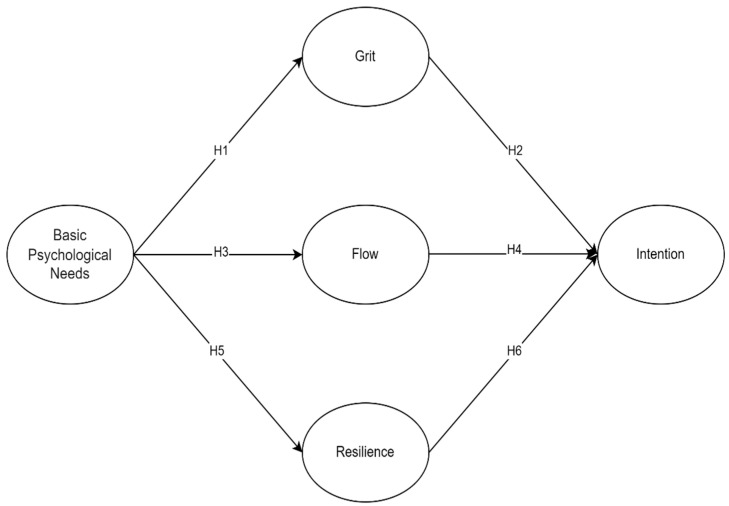
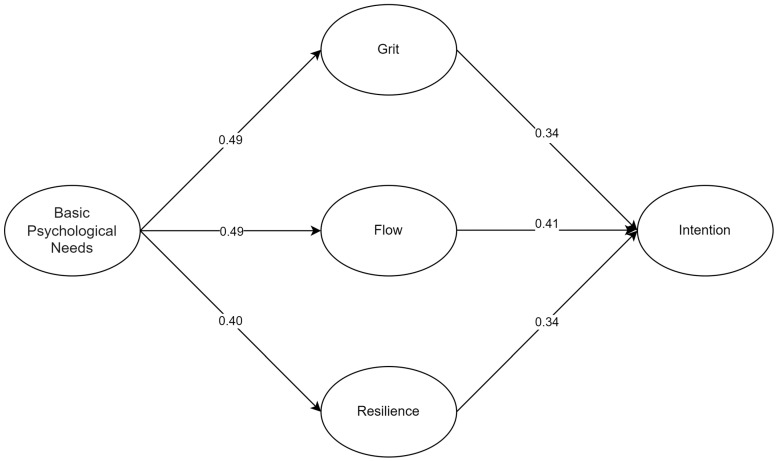
Artificial intelligence and positive psychology play crucial roles in education, yet there is limited research on how these psychological factors influence learners’ use of AI, particularly in language education. Grounded in self-determination theory, this study investigates the factors influencing Chinese English learners’ intention to use AI for language learning. Utilizing structural equation modeling, this research examines the mediating roles of grit, flow, and resilience in the relationship between basic psychological needs and the intention to use AI. Data were analyzed using AMOS 26 and SPSS 26. The findings reveal that flow, grit, and resilience mediate the relationship between basic psychological needs and the intention to adopt AI tools for language learning. This study provides valuable insights into how educational environments can be designed to fulfill psychological needs, thereby fostering greater engagement and acceptance of AI in language education.
Overview
The claims and statistics of this paper haven’t been checked yet.
Run the check — free, no account needed. It reads the open-access text and checks the sources it cites.
Integrity signals
Registry
Cites
Statistics
Figures
Verification
Claims the paper makes
The claims and statistics of this paper haven’t been checked yet.
Run the check — free, no account needed. It reads the open-access text and checks the sources it cites.
Claims other papers make about this one
Each is checked against this paper’s own text: does it say what the citing paper says it does?
In the citing paper
“While previous studies examining human-to-human relationships have established that love serves as a predictor of attachment, this research extends these findings by demonstrating a similar effect within the context of human-AI companion relationships (Mamun et al., 2023;Song et al., 2022;Zhai et al., 2024).”
From I love you, my AI companion! Do you? Perspectives from the Triangular Theory of Love and Attachment Theory (2026) · cites this paper as Zhai et al., 2024
Self-check
Percentages, sums and reported differences re-computed from the paper’s own numbers.
The self-check needs the paper’s full text.
Citations
Cites
Intrinsic and Extrinsic Motivations: Classic Definitions and New Directions
Ryan, R. M., & Deci, E. L. (2000) · Contemporary Educational Psychology · doi:10.1006/ceps.1999.1020 · Cited by 18,666 · cited 1×
“In this research, we assessed fundamental psychological needs utilizing a modified version of the questionnaire initially created by Ryan and Deci [71,72] and later modified by Wang and Reynolds [28].”
MethodZawacki-Richter, O., Marín, V. I., Bond, M., & Gouverneur, F. (2019) · International Journal of Educational Technology in Higher Education · doi:10.1186/s41239-019-0171-0 · Cited by 7,242
Grit: perseverance and passion for long-term goals
Duckworth, A. L., Peterson, C., Matthews, M. D., & Kelly, D. R. (2007) · Journal of Personality and Social Psychology · doi:10.1037/0022-3514.92.6.1087 · Cited by 6,911
The brief resilience scale: Assessing the ability to bounce back
Smith, B. W., Dalen, J., Wiggins, K., Tooley, E., Christopher, P., & Bernard, J. (2008) · International Journal of Behavioral Medicine · doi:10.1080/10705500802222972 · Cited by 6,439 · cited 1×
“In this study, we assessed flow utilizing a modified version of the questionnaire created by Smith et al. [74], which was tailored to align with the specific objectives of our research.”
MethodDevelopment and validation of the short grit scale (grit-s)
Duckworth, A. L., & Quinn, P. D. (2009) · Journal of Personality Assessment · doi:10.1080/00223890802634290 · Cited by 3,376
A Review of Artificial Intelligence (AI) in Education from 2010 to 2020
Zhai, X., Chu, X., Chai, C. S., Jong, M. S. Y., Istenic, A., Spector, M., Liu, J.-B., Yuan, J., & Li, Y. (2021) · Complexity · doi:10.1155/2021/8812542 · Cited by 1,364 · cited 2×
“Previous research [23–25] has utilized artificial intelligence (AI) to investigate the use of technology in language learning.”
BackgroundSelf-citationSong, C., & Song, Y. (2023) · Frontiers in Psychology · doi:10.3389/fpsyg.2023.1260843 · Cited by 717
Bhutoria, A. (2022) · Computers and Education: Artificial Intelligence · doi:10.1016/j.caeai.2022.100068 · Cited by 677
Huang, A. Y. Q., Lu, O. H. T., & Yang, S. J. H. (2023) · Computers & Education · doi:10.1016/j.compedu.2022.104684 · Cited by 605
Artificial intelligence and education in China
Knox, J. (2020) · Learning, Media and Technology · doi:10.1080/17439884.2020.1754236 · Cited by 489
Research works printed but not linked: 68
- Hong, 2017, Intrinsic Motivation of Chinese Learning in Predicting Online Learning Self-Efficacy and Flow Experience Relevant to Students’ Learning Progress, Comput. Assist. Lang. Learn., 30, 552, 10.1080/09588221.2017.1329215 · DOI
- Xiuwen, 2021, An Overview of the Utilization of Tiktok to Improve Oral English Communication Competence among Efl Undergraduate Students, Univ. J. Educ. Res., 9, 1439
- Ahmad, S.F., Rahmat, M.K., Mubarik, M.S., Alam, M.M., and Hyder, S.I. (2021). Artificial Intelligence and Its Role in Education. Sustainability, 13. · DOI
- Ebadi, 2024, Examining the Roles of Social Presence and Human-Likeness on Iranian Efl Learners’ Motivation Using Artificial Intelligence Technology: A Case of Csiec Chatbot, Interact. Learn. Environ., 32, 655, 10.1080/10494820.2022.2096638 · DOI
- Gao, 2024, Exploring Male English Major’s Motivation Trajectory through Complex Dynamic Systems Theory, Curr. Psychol., 43, 9089, 10.1007/s12144-023-05062-6 · DOI
- Wang, Q., Sun, F., Wang, X., and Gao, Y. (2023). Exploring Undergraduate Students’ Digital Multitasking in Class: An Empirical Study in China. Sustainability, 15. · DOI
- Mayer, 2022, Instructional Media and Instructional Methods in Digital Language Learning: Are We Asking the Right Questions?, Biling. Lang. Cogn., 25, 396, 10.1017/S1366728921000559 · DOI
- Naidu, S. (2003). Learning & Teaching with Technology: Principles and Practices, Psychology Press.
- Songsiengchai, 2023, Leveraging Artificial Intelligence (Ai): Chat Gpt for Effective English Language Learning among Thai Students, Eng. Lang. Teach., 16, 68, 10.5539/elt.v16n11p68 · DOI
- Zhai, 2021, Utilization of Online Fan-Fiction to Improve English Literacy Skills among Efl Undergraduate Students, Int. J. Acad. Res. Progress. Educ. Dev., 10, 139
- Qiu, 2023, Trends in Vr/Ar Technology-Supporting Language Learning from 2008 to 2019: A Research Perspective, Interact. Learn. Environ., 31, 2090, 10.1080/10494820.2021.1874999 · DOI
- Shadiev, R., and Yang, M. (2020). Review of Studies on Technology-Enhanced Language Learning and Teaching. Sustainability, 12. · DOI
- Yang, 2007, Technology-Enhanced Language Learning: A Case Study, Comput. Hum. Behav., 23, 860, 10.1016/j.chb.2006.02.015 · DOI
- Warschauer, 1995, Comparing Face-to-Face and Electronic Discussion in the Second Language Classroom, Calico J., 13, 7, 10.1558/cj.v13i2-3.7-26 · DOI
- Allen, 2024, Chatgpt over My Friends: Japanese English-as-a-Foreign-Language Learners’ Preferences for Editing and Proofreading Strategies, Relc J., 17, 00336882241262533, 10.1177/00336882241262533 · DOI
- Nami, 2020, Educational Smartphone Apps for Language Learning in Higher Education: Students’ Choices and Perceptions, Australas. J. Educ. Tec., 36, 82
- Wei, L. (2023). Artificial Intelligence in Language Instruction: Impact on English Learning Achievement, L2 Motivation, and Self-Regulated Learning. Front. Psychol., 14. · DOI · Paper page
- Deci, 2012, Self-Determination Theory, Handb. Theor. Soc. Psychol., 1, 416
- Deci, E.L., and Ryan, R.M. (2013). Intrinsic Motivation and Self-Determination in Human Behavior, Springer Science & Business Media.
- Wang, X., and Reynolds, B.L. (2024). Beyond the Books: Exploring Factors Shaping Chinese English Learners’ Engagement with Large Language Models for Vocabulary Learning. Educ. Sci., 14. · DOI
- Wang, 2024, Exploring Chinese Efl Learners’ Engagement with Large Language Models: A Self-Determination Theory Perspective, Learn. Motiv., 87, 102014, 10.1016/j.lmot.2024.102014 · DOI
- Sudina, 2021, Academic Perseverance in Foreign Language Learning: An Investigation of Language-Specific Grit and Its Conceptual Correlates, Mod. Lang. J., 105, 829, 10.1111/modl.12738 · DOI
- 2018, What Shall We Do About Grit? A Critical Review of What We Know and What We Don’t Know, Educ. Res., 47, 606, 10.3102/0013189X18801322 · DOI
- Chen, 2021, Grit and Motivation for Learning English among Japanese University Students, System, 96, 102411, 10.1016/j.system.2020.102411 · DOI
- Feng, 2020, Persistence in Language Learning: The Role of Grit and Future Self-Guides, Learn. Individ. Differ., 81, 101904, 10.1016/j.lindif.2020.101904 · DOI
- Khajavy, 2021, A Closer Look at Grit and Language Mindset as Predictors of Foreign Language Achievement, Stud. Second Lang. Acq., 43, 379, 10.1017/S0272263120000480 · DOI
- Zarrinabadi, 2022, L2 Grit and Language Mindsets as Predictors of Efl Learners’ Attitudes toward Effectiveness and Value of Call, Comput. Assist. Lang. L., 43, 1
- Csikszentmihalyi, 1990, Literacy and Intrinsic Motivation, Daedalus, 119, 115
- Egbert, 2004, A Study of Flow Theory in the Foreign Language Classroom, Can. Mod. Lang. Rev., 60, 549, 10.3138/cmlr.60.5.549 · DOI
- Liu, Y., and Huang, X. (2021). Effects of Basic Psychological Needs on Resilience: A Human Agency Model. Front. Psychol., 12. · DOI
- Cho, 2018, Task Complexity and Modality: Exploring Learners’ Experience from the Perspective of Flow, Mod. Lang. J., 102, 162, 10.1111/modl.12460 · DOI
- Csikszentmihalyi, 1997, Flow and the Psychology of Discovery and Invention, HarperPerennial, 39, 1
- 2013, How Basic Need Satisfaction and Dispositional Motives Interact in Predicting Flow Experience in Sport, J. Appl. Soc. Psychol., 43, 687, 10.1111/j.1559-1816.2013.01045.x · DOI
- Mitchell, 2001, Weighing the Ways of the Flow: Twentieth Century Language Instruction, Mod. Lang. J., 85, 26, 10.1111/0026-7902.00095 · DOI
- Dewaele, J.-M., Albakistani, A., and Kamal Ahmed, I. (2022). Is Flow Possible in the Emergency Remote Teaching Foreign Language Classroom?. Educ. Sci., 12. · DOI
- Ibrahim, Z. (2020). Sustained Flow: Affective Obsession in Second Language Learning. Front. Psychol., 10. · DOI
- Masten, 1990, Resilience and Development: Contributions from the Study of Children Who Overcome Adversity, Dev. Psychopathol., 2, 425, 10.1017/S0954579400005812 · DOI
- Wagnild, 1993, Development and Psychometric, J. Nurs. Meas., 1, 165
- Kim, 2019, Role of Resilience in (De) Motivation and Second Language Proficiency: Cases of Korean Elementary School Students, J. Psycholinguist. Res., 48, 371, 10.1007/s10936-018-9609-0 · DOI
- Aldosari, M.S., and Alsager, H.N. (2023). A Step toward Autonomy in Education: Probing into the Effects of Practicing Self-Assessment, Resilience, and Creativity in Task Supported Language Learning. Bmc Psychol., 11. · DOI
- Nguyen, 2015, Resilience in Language Learners and the Relationship to Storytelling, Cogent Educ., 2, 991160, 10.1080/2331186X.2014.991160 · DOI
- Zarrinabadi, 2022, Resilience in Language Classrooms: Exploring Individual Antecedents and Consequences, System, 109, 102892, 10.1016/j.system.2022.102892 · DOI
- Kim, 2017, The Impact of Resilience on L2 Learners’ Motivated Behaviour and Proficiency in L2 Learning, Educ. Stud., 43, 1, 10.1080/03055698.2016.1237866 · DOI
- Guay, 2022, Applying Self-Determination Theory to Education: Regulations Types, Psychological Needs, and Autonomy Supporting Behaviors, Can. J. Sch. Psychol., 37, 75, 10.1177/08295735211055355 · DOI · Paper page
- McEown, 2019, Self-Determination for All Language Learners: New Applications for Formal Language Education, System, 86, 102124, 10.1016/j.system.2019.102124 · DOI
- Noels, 2003, Why Are You Learning a Second Language? Motivational Orientations and Self-Determination Theory, Lang. L., 53, 33, 10.1111/1467-9922.53223 · DOI
- Al-Hoorie, A.H., Oga-Baldwin, W.L.Q., Hiver, P., and Vitta, J.P. (2022). Self-Determination Mini-Theories in Second Language Learning: A Systematic Review of Three Decades of Research. Lang. Teach. Res., 13621688221102686. · DOI
- Huescar Hernandez, E., Moreno-Murcia, J.A., Cid, L., Monteiro, D., and Rodrigues, F. (2020). Passion or Perseverance? The Effect of Perceived Autonomy Support and Grit on Academic Performance in College Students. Int. J. Env. Res. Pub. He., 17. · DOI
- Shirvan, 2022, Modeling the Interplay of Efl Learners’ Basic Psychological Needs, Grit and L2 Achievement, J. Multiling. Multicul., 45, 2831, 10.1080/01434632.2022.2075002 · DOI
- 2022, Predicting Students’ Basic Psychological Need Profiles through Motivational Appeals: Relations with Grit and Well-Being, Learn. Individ. Differ., 97, 102162, 10.1016/j.lindif.2022.102162 · DOI
- Gao, 2023, Grit and Learning: Understanding the Sequential Learning Behaviours in Snap!, J. Comput. Assist. Lear., 39, 603, 10.1111/jcal.12766 · DOI
- Lee, 2023, Digital Storytelling Outcomes, Emotions, Grit, and Perceptions among Efl Middle School Learners: Robot-Assisted Versus Powerpoint-Assisted Presentations, Comput. Assist. Lang. Learn., 36, 1088, 10.1080/09588221.2021.1969410 · DOI
- Sampedro, 2013, The Role of Basic Psychological Needs in Predicting Dispositional Flow of Basketball Players in Training. Differences by Sex, Rev. De Psicol. Del Depor., 22, 187
- Hu, L., Hei, D., Wang, H., and Dai, X. (2023). Chinese College Students Collaborative Mobile-Assisted Language Learning Experience and Flow as a Key Factor for Further Adoption. Front. Psychol., 14. · DOI
- Tai, 2024, Practicing Drum on Vr to Promote Rhythm Performance: Exploring the Learning Progress Related to Incremental Belief of Rhythm, Gameplay Anxiety, Flow Experience, and Perceived Learning Value, Entertain. Comput., 48, 100607, 10.1016/j.entcom.2023.100607 · DOI
- Neufeld, A., and Malin, G. (2019). Exploring the Relationship between Medical Student Basic Psychological Need Satisfaction, Resilience, and Well-Being: A Quantitative Study. Bmc Med. Educ., 19. · DOI
- Lee, 2023, Developing Digital Resilience: An Educational Intervention Improves Elementary Students’ Response to Digital Challenges, Comput. Educ. Open, 5, 100144, 10.1016/j.caeo.2023.100144 · DOI
- Versteeg, M., Kappe, R.F., and Knuiman, C. (2022). Predicting Student Engagement: The Role of Academic Belonging, Social Integration, and Resilience During Covid-19 Emergency Remote Teaching. Front. Public Health, 10. · DOI
- Zheng, 2024, Identifying Key Features of Resilient Students in Digital Reading: Insights from a Machine Learning Approach, Educ. Inf. Technol., 29, 2277, 10.1007/s10639-023-11908-0 · DOI
- Ryan, R.M., and Deci, E.L. (2017). Self-Determination Theory: Basic Psychological Needs in Motivation, Development, and Wellness, Guilford Press. · DOI · Paper page
- Collier, J.E. (2020). Applied Structural Equation Modeling Using Amos: Basic to Advanced Techniques, Routledge. · DOI
- Wheaton, 1977, Assessing Reliability and Stability in Panel Models, Sociol. Methodol., 8, 84, 10.2307/270754 · DOI
- Tabachnick, B.G., Fidell, L.S., and Ullman, J.B. (2013). Using Multivariate Statistics, Pearson.
- Yang, 2022, Towards Understanding Teacher Mentoring, Learner Wcf Beliefs, and Learner Revision Practices through Peer Review Feedback: A Sociocultural Perspective, J. Lang. Educ., 8, 58, 10.17323/jle.2022.15962 · DOI
- Wang, 2024, Unveiling the Tapestry of Teacher Belief Research: Tracing the Present and Forging the Future through Bibliometric Analysis, Curr. Psychol., 43, 15659, 10.1007/s12144-023-05546-5 · DOI
- Wang, X., Gao, Y., Wang, Q., and Zhang, P. (2024). Relationships between Self-Efficacy and Teachers’ Well-Being in Middle School English Teachers: The Mediating Role of Teaching Satisfaction and Resilience. Behav. Sci., 14. · DOI
- Gao, 2024, How Do Praxis-Oriented Themes Inform the Unity of Language Teachers’ Beliefs, Practices, and Identities? A Narrative Inquiry, Chin. J. Appl. Ling., 47, 83, 10.1515/CJAL-2024-0106 · DOI
- Wang, X., Sun, F., Wang, Q., and Li, X. (2022). Motivation and Affordance: A Study of Graduate Students Majoring in Translation in China. Front. Educ., 7. · DOI
Cited by
Sorted by citations
Ng, P. M. L., Wan, C., Lee, D., Garnelo-Gomez, I., & Lau, M. M. (2026) · Internet Research · doi:10.1108/intr-11-2024-1783 · Cited by 27
Metadata
- Authors
- Zhai, X., Zhao, R., Jiang, Y., & Wu, H.
- Affiliations
- School of Foreign Language Studies, Guangxi University, Nanning 530004, China
- School of Foreign Studies, Xi’an Jiaotong University, Xi’an 710049, China
- Institute for Advanced Studies in Humanities and Social Science, Beihang University, Beijing 100191, China
- School of Foreign Studies, Hunan Normal University, Changsha 410000, China
- Venue
- Behavioral Sciences
- Publisher
- MDPI AG
- Published
- 2024-09-19
- Volume
- 14
- Issue
- 9
- Pages
- 838
- ISSN
- 2076-328X
- PMC
- PMC11428701
- Cited by
- 50
- References
- 14
- Language
- en
- Funders
- Research and Practice on Digital Teaching of the ‘Introduction to Linguistics’ Course Based on ‘Knowledge Graph + Large Language Models (LLMs)’ (2024JGA112, XWK202429, CWZD202404)
- Exploration and Practice of Training Reserve Talents as ‘Strategic Social Scientists’ for ASEAN Countries and Regions (2024JGA112, XWK202429, CWZD202404)
- Research on ASEAN Strategies of Major Extraterritorial Countries: Major Project of the 2024 Open Topics of the China-ASEAN Regional Development Collaborative Innovation Center (2024JGA112, XWK202429, CWZD202404)
About these checks
Registry, retraction, Cites and statistics results are computed, not judged, with one exception: a printed reference that no index lists is read once by a model before it counts as a citation error. Claims are extracted by a model and kept only when their quote appears verbatim in the text; each cited source is then checked, with a model’s help, for whether it says what the claim relies on. Those verdicts can be wrong — read the claim’s quote and the cited source before relying on one.
Statistics and arithmetic are recomputed, not judged.
Confidence bands are shown only for fields calibrated on our annotated test set. None is calibrated yet, so no band is shown.
What counts as a claim ›How we measure confidence ›How we check this ›
Are you an author, or do you see a problem with this page? Request a review
How to cite
Cite CoChat for the checks on this page, and the paper for its own findings.
- This page
- CoChat. (2026). Citation check: Unpacking the Dynamics of AI-Based Language Learning: Flow, Grit, and Resilience in Chinese EFL Contexts. https://app.cochat.ai/papers/10.3390/bs14090838
- The paper
- Zhai, X., Zhao, R., Jiang, Y., & Wu, H. (2024). Unpacking the Dynamics of AI-Based Language Learning: Flow, Grit, and Resilience in Chinese EFL Contexts. Behavioral Sciences. https://doi.org/10.3390/bs14090838
